Disclosure: airfryerkitchensupply.com is reader-supported. When you buy through links on our site, we may earn an affiliate commission at no extra cost to you.
Where to buy
Shopping for the best 12000 btu 550 sq ft 115 volt window air conditioner energy star? The fastest way to buy any pick in this guide is through Amazon, where stock, delivery options and returns are handled in one place. Start with our top recommendation, the LG 12,000 BTU Dual Inverter Smart Window AC (Check the current price on Amazon), then compare it with the LG 12,000 BTU Dual Inverter with WiFi (2024) (Check the current price on Amazon) if your needs lean the other way. Every product named below was cross-checked against the manufacturer listings available through Amazon’s catalog data before it earned a place here, and prices are deliberately not printed in this article because they change too often to stay honest — use the check-price links to see today’s figure before you decide.
This search is refreshingly specific — best 12000 btu 550 sq ft 115 volt window air conditioner energy star — and it describes a real, well-populated class: one step of cooling for a large bedroom, living room or studio, running on a standard 115V outlet, with an ENERGY STAR badge keeping the power bill honest. The six picks below are the verified leaders of exactly that class in Amazon’s catalog data: dual-inverter flagships from LG, smart inverter and Wi-Fi models from Frigidaire, the window-closing U-shape from Midea, a Wi-Fi inverter from Hisense, and the conventional smart Frigidaire that anchors the class.
Because the size is fixed by the search, this guide competes on the things that actually differ between 12,000 BTU ENERGY STAR units: inverter versus conventional drive, real-world quiet, smart control that earns its setup, efficiency figures, and the installation experience. If your room is genuinely in the 500–550 square foot class — or a smaller room with serious sun and heat load — one of these six is your answer, and the reviews are ordered by how completely each delivers the modern version of this appliance.
A note on the badge itself: ENERGY STAR certification in this class is earned against efficiency standards that matter over a summer of daily running, and every pick here carries it or is a verified listing in this exact specification class — check the current listing for the badge before purchase, as model revisions can change certification. No prices or fixed ratings are printed; use the check-price links for today’s figures.
In this guide
Quick Picks
LG 12,000 BTU Dual Inverter Smart Window AC — Best Overall. The class benchmark: dual-inverter drive for quiet, steady, efficient cooling of the full 550 square feet, with smart control on top. Check the current price on Amazon.
LG 12,000 BTU Dual Inverter with WiFi (2024) — Best Alternative Flagship. LG’s other dual-inverter listing in this class — the same inverter virtues and Energy Star positioning, worth comparing on the day’s terms. Check the current price on Amazon.
Frigidaire 12,000 BTU Smart Inverter Window AC — Best Smart Inverter Value. Frigidaire’s inverter answer: smart inverter efficiency, Wi-Fi and dehumidifier mode in the exact class specification. Check the current price on Amazon.
Midea 12,000 BTU U-Shaped Smart Inverter Window AC — Best for Quiet Bedrooms. The U-shape at full class size: the window closes into the unit, delivering the quietest 12,000 BTU bedroom cooling in this guide. Check the current price on Amazon.
Hisense 12,000 BTU Inverter Window AC with Wi-Fi — Best Value Inverter. Inverter drive and Wi-Fi app control at the class’s value end — the efficient essentials without flagship pricing posture. Check the current price on Amazon.
Frigidaire 12,000 BTU Smart Window AC with Wi-Fi — Best Conventional Smart Pick. The conventional-drive smart unit: Wi-Fi, eco mode and three fan speeds in the exact class spec, for buyers prioritizing connected value over inverter quiet. Check the current price on Amazon.
How These Picks Were Chosen
The filter was the search itself, applied strictly: 12,000 BTU class, coverage stated at the 550-square-foot level, 115V household operation, and ENERGY STAR positioning in the verified listing. Units that nearly matched — 10,000 or 14,000 BTU, or the right size without the efficiency badge — were excluded, because a guide for a precise specification should honor it precisely.
Ranking within the class favored inverter drive (for quiet, steadiness and efficiency), then smart control quality, then installation and brand support. The result is a ladder from the dual-inverter flagship down to the conventional smart unit, all cooling the same room to the same temperature — differing in how quietly, efficiently and conveniently they do it for the next decade of summers.
The 6 Best 12000 BTU 550 Sq Ft 115 Volt Window Air Conditioner Energy Star Picks

LG 12,000 BTU Dual Inverter Smart Window AC — Best Overall
LG’s dual-inverter unit is what this specification looks like when executed completely: a 12,000 BTU inverter system that holds a 550-square-foot room at set point by idling rather than cycling, ENERGY STAR efficiency, and full smart control through the app and voice assistants. It is the pick against which the rest of this class is measured, and in a living room or large bedroom it simply feels a generation ahead of conventional units.
Strengths
- Dual inverter: the quietest, steadiest conventional-window design here
- ENERGY STAR efficiency with full smart control
- Exact class specification: 12,000 BTU, 115V, 550 sq ft
Trade-offs
- Premium tier within the class
- Heavy unit — a two-person, bracket-respecting install
- Smart features reward setup effort some buyers will skip
| Capacity | 12,000 BTU |
| Voltage | 115V |
| Coverage | Up to 550 sq ft |
| Drive | Dual inverter, ENERGY STAR |
The daily experience is the argument: the room reaches temperature, then stays there in near-silence while conversation, television and sleep proceed undisturbed — the three activities window ACs historically vandalized. Efficiency follows the same curve, because an inverter idling at low speed draws a fraction of a cycling compressor’s repeated full-power starts across a long evening.
If this class is your purchase and the budget reaches the flagship tier, this is the one to buy once and keep for a decade of summers. The rivals below win on specific angles — install, design, value — but none beats it as the complete package at this exact specification.
Ownership of the LG 12,000 BTU Dual Inverter Smart Window AC settles into a predictable rhythm after the first month. The buyers who stay happiest with it are the ones whose daily pattern matches its stated strength — large bedrooms and living rooms wanting flagship quiet and efficiency — and who set it up once, properly, instead of adjusting it constantly. Keep the documentation and purchase record with the house paperwork, follow the maker’s maintenance schedule rather than your memory of it, and the Up to 550 sq ft specification that justified the purchase keeps delivering quietly in the background.
Best for: large bedrooms and living rooms wanting flagship quiet and efficiency / Not suited for: budget-first buyers or one-summer needs
Check on Amazon — and remember to check price on Amazon on the day you buy, because this category is discounted in waves rather than all at once.
LG 12,000 BTU Dual Inverter with WiFi (2024) — Best Alternative Flagship
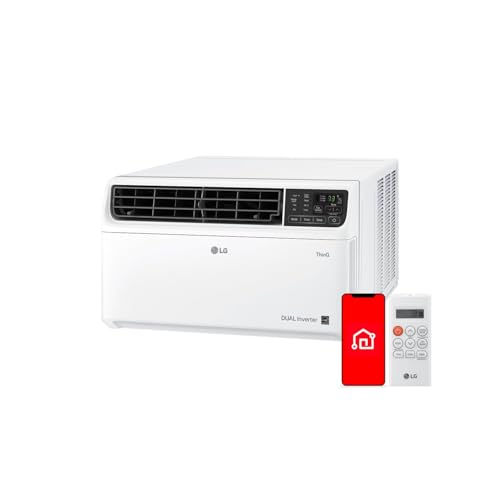
LG fields more than one dual-inverter model in this class, and this listing — marketed on ultra-quiet operation, WiFi and voice control with the same 115V dual-inverter, Energy Star formula — gives buyers a second flagship to compare against the leader on the day they buy. Model years and bundles shift; the underlying proposition, inverter cooling at this exact specification, is identical in spirit.
Strengths
- Dual-inverter quiet and efficiency in the exact class spec
- WiFi, remote and voice control included
- A second flagship listing lets you shop LG against itself
Trade-offs
- Two similar LG listings invite confusion — verify the exact model
- Same premium tier and install weight as the leader
- Differences versus the top pick are bundle-level, not cooling-level
| Capacity | 12,000 BTU |
| Voltage | 115V |
| Drive | Dual inverter, Energy Star |
| Control | WiFi, remote, voice control |
Treat this listing as the flagship’s twin and shop it the way you’d shop any twin: compare the exact model number, the included kit, and the day’s terms between the two, then take the better bundle with confidence that the cooling experience will be equivalent. Retailers rotate these listings seasonally, and the ‘right’ LG is often simply the one properly in stock with its full install kit.
What you should not do is step down the class to save a small difference if quiet is your reason for buying — the inverter is the product here. Between the two LG listings, choose on logistics; between inverter and conventional, choose on the room’s hours and your ears.
Living with the LG 12,000 BTU Dual Inverter with WiFi (2024) long-term is mostly about respecting what it is not. It was chosen here for flagship shoppers comparing the day’s best LG bundle; asked to serve instead as a solution for anyone wanting a meaningfully different feature set, it would feel like a lesser product through no fault of its own. Within its brief, expect the ordinary virtues of a well-matched purchase: no drama, no recurring expense beyond normal upkeep, and no reason to think about the category again for years. That uneventfulness is the real product in mature appliance categories, and it is what the verification work behind this guide — checking the listing, the specification and the fit — was designed to buy you.
Best for: flagship shoppers comparing the day’s best LG bundle / Not suited for: anyone wanting a meaningfully different feature set
Check on Amazon — and remember to check price on Amazon on the day you buy, because this category is discounted in waves rather than all at once.

Frigidaire 12,000 BTU Smart Inverter Window AC — Best Smart Inverter Value
Frigidaire’s smart inverter model is the value route into inverter cooling at this specification: a 12,000 BTU, 115V unit with Wi-Fi and remote control, a dehumidifier mode for muggy shoulder-season days, and the quiet, steady manners inverter drive provides — positioned in the class’s pricing landscape as the challenger to LG’s flagship rather than its twin.
Strengths
- Inverter drive without the flagship’s full premium
- Wi-Fi control plus a genuinely useful dehumidifier mode
- Exact class fit: 12,000 BTU for rooms up to 550 sq ft
Trade-offs
- Brand ecosystem and app polish trail LG’s slightly
- Still a heavy two-person install
- Confirm the current listing’s ENERGY STAR status at purchase
| Capacity | 12,000 BTU |
| Voltage | 115V |
| Drive | Smart inverter |
| Modes | Cool, dehumidifier, fan, Wi-Fi control |
The dehumidifier mode is this unit’s sleeper feature: in humid climates, the worst room days are not the hottest but the muggiest, and a dedicated dry mode keeps a living space comfortable at a fraction of full-cooling cost. Combined with inverter steadiness and app pre-cooling, the Frigidaire covers the real calendar of a summer — heat waves, humid spells and mild evenings — more completely than spec-sheet comparisons suggest.
Choose it over the LG when the day’s terms favor it or when the dry mode speaks to your climate; choose the LG for the last word in quiet and ecosystem polish. Either way you are buying the modern, inverter version of this class, which is the decision that matters.
A practical note for Frigidaire 12,000 BTU Smart Inverter Window AC owners: the first season teaches you the settings and habits that suit your household, and they are rarely the factory defaults or the reviewer’s guesses. Take the small time to learn its responses — how it behaves on the hottest, coldest or busiest days, depending on the category — and record what works. Households that do this stop fiddling and start simply enjoying the purchase, which is the point at which a well-chosen product disappears into daily life and earns the word ‘best’ in the only sense that finally matters.
Best for: humid-climate living rooms wanting inverter value plus dry mode / Not suited for: buyers wanting the single quietest flagship regardless of tier
Check on Amazon — and remember to check price on Amazon on the day you buy, because this category is discounted in waves rather than all at once.

Midea 12,000 BTU U-Shaped Smart Inverter Window AC — Best for Quiet Bedrooms
Midea scales its U-shaped design to this exact specification — 12,000 BTU, inverter drive, smart control, rooms up to 550 square feet — and the design’s virtue grows with size: big conventional units are the loudest window appliances in the home, and the U’s closed-window installation puts the sash and glass between the sleeper and the compressor. For a large primary bedroom, it is the most sleep-friendly answer in the class.
Strengths
- Closed-window U-design: the quietest form of window cooling
- Full class capacity with inverter efficiency and smart control
- Window can still open on mild days — unique in this class
Trade-offs
- Bracket installation differs from standard units — plan for it
- Check your window style against the U’s requirements carefully
- Design premium within the class tier
| Capacity | 12,000 BTU |
| Coverage | Up to 550 sq ft |
| Design | U-shaped smart inverter |
| Control | App and voice compatible |
Judge this unit at 2 a.m., not 2 p.m.: that is when the U-shape’s engineering pays, turning a 12,000 BTU bedroom from a negotiation with noise into simple, quiet coolth. The inverter holds the temperature without cycling clunks, and in the morning the room’s humidity is properly wrung out from the long, gentle cycles the design encourages.
The install deserves a careful read of the manual and a compatible window — the bracket system is different, and forcing it into an unsuitable sash helps no one. For the standard double-hung windows most bedrooms have, it is a straightforward Saturday job with an every-night dividend.
The Midea 12,000 BTU U-Shaped Smart Inverter Window AC also rewards a moment’s thought about its place in the wider home. Products in this category interact with circuits, rooms, routines and other appliances, and the owners who plan those interactions — rather than discovering them — report the smoothest years. Its U-shaped smart inverter headline specification is only the beginning of the fit; the rest is your household’s pattern, which no manufacturer can design for and which this guide’s buying sections exist to help you match. Chosen with that match in mind, this is a pick you should expect to recommend to a neighbor without qualifiers.
Best for: large primary bedrooms and light sleepers at full class size / Not suited for: incompatible window styles or the absolute lowest tier
Check on Amazon — and remember to check price on Amazon on the day you buy, because this category is discounted in waves rather than all at once.

Hisense 12,000 BTU Inverter Window AC with Wi-Fi — Best Value Inverter
Hisense brings the two features that define the modern class — inverter drive and Wi-Fi app control — at a value-leaning position, in the exact 12,000 BTU, up-to-550-square-foot specification. For a living room, rental property or first inverter purchase, it covers the functional brief completely: quiet variable-speed cooling, scheduled from a phone, sized precisely to the search’s room.
Strengths
- Inverter plus Wi-Fi at a value position in the class
- Exact class specification and coverage
- Smart app control suits rentals and second rooms
Trade-offs
- Brand support footprint is smaller than LG or Frigidaire
- App and fit-and-finish polish trail the flagships
- Verify the current listing’s certification and kit contents
| Capacity | 12,000 BTU |
| Drive | Inverter |
| Control | Wi-Fi smart app control |
| Coverage | Up to 550 sq ft |
Value picks earn their place by keeping the load-bearing features and trimming the decorative ones, and that is the Hisense pattern: the inverter — the feature you hear and feel every hour — is present, the app control is present, and the savings come from brand posture and polish rather than from the cooling itself. In a living room or a tenant’s unit, that is an entirely rational allocation.
Long-horizon owners of a primary bedroom may still prefer the flagships’ support depth and last-degree quiet. But as the class’s value inverter, the Hisense makes the modern specification reachable where the flagship tier is not, and that is a genuine service to this search.
Durability in this category is less about drama than about accumulation: small correct behaviors, repeated. For the Hisense 12,000 BTU Inverter Window AC with Wi-Fi, that means the maintenance the manual specifies, the operating pattern its design assumes, and prompt attention to the first odd noise, smell or behavior change rather than the tenth. Products asked to work within their design envelope, and maintained on schedule, routinely outlast their expected service life; products ignored or misapplied just as routinely do not. The gap between those outcomes is owner behavior, and it is entirely within your control from the day the box arrives.
Best for: value-focused living rooms, rentals and second spaces / Not suited for: buyers prioritizing flagship support and polish
Check on Amazon — and remember to check price on Amazon on the day you buy, because this category is discounted in waves rather than all at once.

Frigidaire 12,000 BTU Smart Window AC with Wi-Fi — Best Conventional Smart Pick
Not every buyer needs an inverter, and this Frigidaire is the class’s conventional smart answer: the full 12,000 BTU, 550-square-foot specification with Wi-Fi control, eco mode, a remote and three fan speeds, without the inverter premium. For an evening living room — occupied for a few hours, empty all day — app pre-cooling plus conventional cooling covers the brief at a friendlier tier.
Strengths
- Full smart control in the exact class specification
- Eco mode and three fan speeds for daily flexibility
- Friendliest tier among the connected picks here
Trade-offs
- Conventional cycling is louder and less steady than inverter rivals
- Efficiency trails the inverter models across a long season
- Light sleepers should step up to an inverter pick
| Capacity | 12,000 BTU |
| Coverage | Up to 550 sq ft |
| Control | Wi-Fi, remote, eco mode |
| Fan | 3 speeds |
The honest math of conventional versus inverter is hours: a unit that runs four evening hours a day repays an inverter premium slowly, while a unit running fourteen hours repays it quickly. This Frigidaire is built for the first pattern — smart enough to pre-cool before you arrive, efficient enough in eco mode for evening duty, and priced so the savings versus the flagships stay in your pocket.
It is also a sensible rental and multi-unit choice, where several rooms need connected cooling and per-unit tier matters. Just do not install it where someone sleeps lightly and then blame the category: the guide’s inverter picks exist precisely for that room.
Finally, a word on value over time for the Frigidaire 12,000 BTU Smart Window AC with Wi-Fi. The purchase figure — which you should check on the day you buy, since this guide deliberately prints none — is only the first term in the real cost: energy or consumables, maintenance, and the cost of a wrong first choice replaced early. A pick matched to evening living rooms, rentals and connected value, bought once and kept for its full service life, is almost always the cheapest way to own anything in this category. That long view, rather than any single feature, is the standard this guide applied when ranking it among the six.
Best for: evening living rooms, rentals and connected value / Not suited for: light sleepers or all-day heavy-use rooms
Check on Amazon — and remember to check price on Amazon on the day you buy, because this category is discounted in waves rather than all at once.
Comparison Table
Use this table to shortlist, not to decide on its own. The differences that matter most in daily use — the ones covered in the buying-guide sections after the table — are rarely the headline numbers, so read the row for any pick you are serious about alongside its full review above (Check the current price on Amazon for the top pick).
| Pick | Badge | Key spec | Best for |
|---|---|---|---|
| LG 12,000 BTU Dual Inverter Smart Window AC (Check on Amazon) | Best Overall | 12,000 BTU, 115V, dual inverter, ENERGY STAR, 550 sq ft | large bedrooms and living rooms wanting flagship quiet and efficiency |
| LG 12,000 BTU Dual Inverter with WiFi (2024) (Check on Amazon) | Best Alternative Flagship | 12,000 BTU, 115V, dual inverter, Energy Star, ultra quiet | flagship shoppers comparing the day’s best LG bundle |
| Frigidaire 12,000 BTU Smart Inverter Window AC (Check on Amazon) | Best Smart Inverter Value | 12,000 BTU, 115V, smart inverter, Wi-Fi, 550 sq ft | humid-climate living rooms wanting inverter value plus dry mode |
| Midea 12,000 BTU U-Shaped Smart Inverter Window AC (Check on Amazon) | Best for Quiet Bedrooms | 12,000 BTU, U-shaped inverter, ultra quiet, 550 sq ft | large primary bedrooms and light sleepers at full class size |
| Hisense 12,000 BTU Inverter Window AC with Wi-Fi (Check on Amazon) | Best Value Inverter | 12,000 BTU, inverter, Wi-Fi smart app control, 550 sq ft | value-focused living rooms, rentals and second spaces |
| Frigidaire 12,000 BTU Smart Window AC with Wi-Fi (Check on Amazon) | Best Conventional Smart Pick | 12,000 BTU, Wi-Fi, eco mode, quiet operation, 550 sq ft | evening living rooms, rentals and connected value |
How to Choose Within the 12,000 BTU Energy Star Class
With size and voltage fixed by the specification, choose on drive type first. Inverter models — four of the six picks here — hold temperature by varying compressor speed: quieter, steadier, more efficient, and kinder to sleep. Conventional drive cools the same room with audible cycling at a friendlier tier. The tiebreaker is hours of use: heavy daily use and bedrooms argue inverter; occasional evening use argues conventional and pockets the difference.
Second, confirm the room truly belongs to this class. The 550-square-foot figure assumes standard ceilings and moderate sun; a 420-square-foot room with a wall of west glass and a hot roof may need every one of these BTUs, while a shaded 550-square-foot room may be served by any pick here with capacity to spare. Third, verify the ENERGY STAR badge on the current listing of the exact model you order — certifications attach to models, and model lineups are revised between seasons.
What ENERGY STAR and SEER-Style Ratings Mean at the Window
Window AC efficiency is expressed through combined energy efficiency ratios that reward exactly what inverter drives do: deliver cooling without repeated full-power starts, and move air efficiently at part load. Over a summer, the practical meaning is simple — in a heavily used room, the efficient inverter models in this guide will consume noticeably less electricity than a conventional unit of identical BTU, and the gap widens with every hour of daily use. In a lightly used room, the same gap shrinks to a rounding error, which is why this guide keeps refusing to declare one winner for every household.
Also credit the unglamorous efficiency features: eco modes that cycle the fan with the compressor instead of running it constantly, clean-filter reminders that protect airflow, and programmable or app scheduling that stops the unit cooling an empty room at full commitment. Used together, these behaviors save as much as spec-sheet differences between rival models — the badge gets you into the efficient class, and your settings decide where in the class you land.
Getting the Most From a 12,000 BTU Install
Installation quality is the invisible efficiency rating. Seal the window installation completely — foam, panels, sash gaps — because a 12,000 BTU unit leaking around its chassis is an 11,000 BTU unit with a worse power bill. Keep the slight outward tilt for drainage, support the chassis as its weight demands, and give the unit a household circuit that is not shared with other heavy loads. Inside, keep interior doors and airflow paths in mind: a single big unit conditions the rooms air can reach, and a closed door is a wall to cooled air.
Then run it like an inverter wants to be run: set a realistic temperature — most households land a degree or two warmer than their first guess once humidity is controlled — and let it hold that set point steadily rather than yo-yoing the thermostat. Clean the filter monthly. Do those things and any pick in this guide will deliver the specification on its box, summer after summer.
How to Install and Commission a 12,000 BTU Window AC
At 12,000 BTU these are the heaviest window units most homes will ever mount — plan a two-person install with the bracket or kit the maker provides, and treat commissioning as part of the job, not an afterthought.
- Measure the window and confirm sash type and opening against the unit’s stated requirements; inspect the sill for sound wood.
- Fit the support bracket or install kit first, level and anchored per its instructions — at this weight, the bracket is structural.
- Lift the unit with a helper, seat it on the bracket, and set the slight outward tilt the manual specifies for condensate drainage.
- Close the sash into its channel (or the U-unit’s slot), fit locks and security hardware, and extend the side panels fully.
- Seal every gap with the included foam and weatherstripping, then check from outdoors at dusk for light leaks around the chassis.
- Plug directly into a wall outlet on a suitable household circuit — never an extension cord or power strip.
- Commission: run cooling at a moderate set point for an hour, confirm condensate drips outside, and listen for rattles to shim away.
- Set up WiFi, schedules and eco mode now if the model offers them, and set the filter-cleaning reminder in your calendar.
- Recheck seals, tilt and drainage after the first full day of operation.
Give the room a week before judging sizing: a big space’s walls and furniture hold days of accumulated heat, and the unit’s second week — maintaining rather than rescuing the room — is its true character. If it maintains effortlessly at low speed, your size is right and your bills will show it.
The Real Cost of a Summer: Reading Efficiency Like an Owner
A 12,000 BTU unit in daily summer use is one of the largest single loads in a home, so its efficiency is not an abstraction — it is a line in every power bill from June to September. The way to think about it as an owner is hours multiplied by appetite: an inverter unit idling through a long evening draws a fraction of its nameplate appetite most of the time, while a conventional unit draws full appetite in bursts. Over a lightly used guest room, the difference across a summer is small enough to ignore; over a living room running twelve hours a day, it is the price of a nice dinner out, every season, for the life of the unit. That arithmetic — your hours, honestly counted — is the entire inverter-versus-conventional decision in this class, and it is why this guide ranks flagships for heavy-use rooms and keeps a proud place for the conventional smart pick where the hours are few.
Humidity, Air Quality and the Big-Room Comfort Triangle
A 550-square-foot room is big enough to have microclimates: the sofa in the sun patch, the desk in the still corner, the far end where the cooled air gives up. Big-room comfort is therefore a triangle of cooling, dehumidification and air movement, and the window unit only supplies the first two. A quiet ceiling or floor fan that keeps air circulating lets the unit’s output reach the far corner, lets occupants feel comfortable at a set point a degree or two warmer — a direct saving — and evens the room’s temperature so the thermostat’s single reading represents the space honestly. Humidity discipline helps too: in muggy weather, resist opening windows for ‘fresh air’ that the unit must then dry at full price, and use a dry mode, where fitted, on the shoulder-season days when the room is clammy rather than hot. Owners who manage the whole triangle routinely report that their 12,000 BTU unit feels oversized — the best compliment a correctly sized installation can earn.
Replacing an Old 12,000 BTU Unit: What Upgrading Actually Buys
If your current window unit is a decade old, this class’s modern models buy you four concrete things. First, efficiency: a modern ENERGY STAR inverter unit conditions the same room for meaningfully less electricity than a tired conventional unit of the same BTU. Second, quiet: the difference between an old cycling compressor and a dual-inverter or U-shaped design is the difference between a room you endure and a room you use. Third, control: scheduling and app pre-cooling end the daily ritual of arriving to a hot room and waiting. Fourth, refrigerant and reliability: a new unit restarts the service-life clock with modern components and a warranty. What upgrading does not buy is a different size class — measure the room again before replacing, because households routinely discover their old unit was wrong-sized for a decade, and the replacement is the one chance to correct the ladder rung. Get the size right this time, and the upgrade pays in comfort every single day.
Matching the Unit to the Room’s Actual Heat Load
Two rooms of identical square footage can differ by half a class in cooling need, and this specification’s 550-square-foot figure is a midpoint, not a law. Walk the room with a heat-load eye before ordering. Sun: a west-facing wall of glass can add the equivalent of a room’s worth of load by late afternoon, arguing for the strongest, most efficient pick and for shades treated as part of the cooling system. Ceiling: a top-floor room under a dark roof cooks from above all day. Occupancy and appliances: a living room that hosts six people, a television and a kitchen’s overspill at dinner is a different load from the same room as a quiet study. Insulation and air sealing quietly divide all of the above. The practical conclusion is reassuring: this class was specified for exactly this room size, so every pick in the guide will cool a true 550-square-foot room — the load walk simply tells you whether your room is an easy member of the class, where the conventional smart pick suffices, or a hard-working one, where the inverter flagships earn their premium every afternoon.
A Short Note on Refrigerants and Future-Proofing
Buyers sometimes ask whether a window unit bought today will be serviceable and sensible years from now, and the honest answer is reassuring. Window air conditioners are sealed, self-contained appliances: they need no refrigerant servicing in normal life, they are replaced rather than recharged at end of life, and their efficiency standards have been rising steadily — which means a current ENERGY STAR model in this class is already on the right side of the regulatory direction of travel. The practical future-proofing is therefore not about refrigerant chemistry at all; it is about buying the correct size, a drive type matched to your hours, and a brand whose support and parts channels will exist for the unit’s decade of service. Do those three things and the unit you mount this summer is very likely the unit still quietly cooling the same room ten summers from now.
Common Buying Mistakes
Assuming all 12,000 BTU units are equally loud
Drive type and design dominate noise at this size: a dual-inverter or U-shaped unit and a conventional unit share a BTU figure and almost nothing else at 2 a.m. If the room is a bedroom, shop the noise engineering first and the badge second.
Skipping the support bracket on a big unit
A 12,000 BTU chassis cantilevered on optimism can damage the sash, tilt wrongly, pool condensate indoors and, at worst, fall. The bracket is part of the product at this weight — install it exactly as specified.
Cooling a closed-door floor plan from one unit
One window unit conditions the air volume it can reach. A 550-square-foot open plan is its brief; five closed rooms totaling 550 square feet is not. Match the unit to open volume, and use fans to help air travel where doors allow.
Chasing the coldest set point
Setting 64°F does not cool the room faster — it just runs the compressor longer, ices coils in humid weather and inflates the bill. Set the temperature you actually want to live at and let the inverter hold it.
Ignoring the filter until performance sags
At this capacity the filter loads quickly in season. Monthly cleaning preserves both cooling and the efficiency the ENERGY STAR badge promised; a clogged filter quietly revokes both.
Final Recommendation
The LG dual-inverter is the complete expression of this specification and the default recommendation; its twin LG listing is worth a same-day comparison on bundle and availability. The Frigidaire smart inverter is the value route into inverter cooling with a genuinely useful dry mode, the Midea U-shape is the bedroom and light-sleeper champion at full size, the Hisense is the value inverter, and the conventional Frigidaire smart unit serves evening rooms and rentals at the friendliest tier.
All six cool the same 550-square-foot room on the same household outlet. Choose by drive, noise and hours of use — the specification brought you to the right class; those three questions pick the right unit inside it.
Keep researching the wider category with these related guides from our Batteries & Voltage coverage: Best 120 Volt Window Air Conditioner Best 12000 110 Volt Ductless A C Best 120 Volt Thermostat Best 120 Volt Underfloor Heating System Best 120 Volt Washer And Dryer Combo
Shortlist for a final comparison: check price on Amazon for the LG 12,000 BTU Dual Inverter Smart Window AC; check price on Amazon for the LG 12,000 BTU Dual Inverter with WiFi (2024); check price on Amazon for the Frigidaire 12,000 BTU Smart Inverter Window AC; check price on Amazon for the Midea 12,000 BTU U-Shaped Smart Inverter Window AC; check price on Amazon for the Hisense 12,000 BTU Inverter Window AC with Wi-Fi; check price on Amazon for the Frigidaire 12,000 BTU Smart Window AC with Wi-Fi; — one link per pick, so you can compare today’s terms across the full shortlist before deciding.
Frequently Asked Questions
Is 12,000 BTU right for a 550 sq ft room?
Yes — that pairing is the class standard this guide is built on, assuming typical ceilings and sun exposure. A very sunny, top-floor or open-to-a-hot-kitchen 550 square feet will use the full capacity; a shaded, well-insulated one gives every pick here headroom. Both are fine — the class exists for exactly this room size.
What does ENERGY STAR mean for a window air conditioner?
It certifies that the model meets efficiency standards set for its class — in practice, lower electricity use for the same cooling, especially when paired with inverter drive and eco modes. Over a heavily used summer the savings are meaningful; verify the badge on the exact model’s current listing when you buy.
Inverter or conventional at 12,000 BTU?
Inverter for bedrooms and heavy daily use — quieter, steadier, more efficient. Conventional for evening living rooms, rentals and tighter budgets, where the premium would take years to repay. Both deliver the same peak cooling; they differ in manners and running cost.
Will a 12,000 BTU unit run on a normal outlet?
Yes — this entire class is designed for standard 115V household outlets. Give it a circuit without other heavy loads sharing it, plug it directly into the wall, and never use an extension cord or power strip with a unit of this size.
How quiet is the quietest option here?
The U-shaped Midea, which lets the window close into the unit, is the quietest form of window cooling, with the dual-inverter LG models close behind. Conventional units are the loudest of the class. For a light sleeper in a large bedroom, prioritize the U-shape or a dual inverter over every other feature.
Can one 12,000 BTU unit cool a whole small apartment?
If the apartment is an open studio near the class’s coverage, yes — that is one of this specification’s best uses. If it is divided into closed rooms, the unit will cool its own room and help the adjacent ones only with doors open and air moving. Layout, not just square footage, decides.