Disclosure: As an Amazon Associate, airfryerkitchensupply.com earns from qualifying purchases. Links on this page are affiliate links; they cost you nothing extra. Prices and availability change often, so check the current Amazon listing before you buy.
Meat thermometer pros and cons lists are easy to find and usually too tidy: six neat advantages, three polite disadvantages, and a recommendation nobody could disagree with. This meat thermometer pros and cons guide tries to be more useful. The advantages of cooking by temperature are real and, for safety, decisive — but ownership also asks things of you: a washing habit, a storage habit, a small learning curve, and, for the monitored designs, cables or apps to manage. Both sides are argued properly below, followed by what the trade-offs mean for different cooks, and the alternatives people actually compare against.
Meat Thermometer Pros and Cons: Quick Verdict and Key Takeaways
Who it suits: anyone who cooks meat weekly, cooks for people whose health makes safety non-negotiable, or is tired of the dry-chicken lottery. Who it does not suit: households that rarely cook meat, and cooks who know a wash-after-use tool will be abandoned. Key takeaways: temperature is the only reliable doneness check, and that single fact outweighs most of the cons; the cons that remain are mostly habits and handling, not flaws in the idea; design choice — instant-read, leave-in, wireless — moves several items between the pro and con columns, so read this alongside the meat thermometer buying guide.
One principle sits underneath everything in this article, and it is worth stating plainly: temperature is the only reliable check of doneness. Colour is not. A chicken breast can look white and opaque at the edges while its centre is still underdone, a burger can brown beautifully on the outside long before the middle is safe, and pork can keep a blush of pink at a temperature that standard public food-safety guidance considers fully cooked. Judging by colour, by how clear the juices run, or by how long a recipe says a cut usually takes are all ways of guessing at the one number that actually decides both safety and quality. A thermometer replaces the guess with the number.
Standard public food-safety guidance — the figures published by government food-safety agencies and printed on countless packaging inserts — puts poultry at the top of the scale, ground meats in the middle, and whole cuts of beef, pork, lamb and fish lower, with a short rest for whole cuts before serving. You do not need to memorise a chart to cook well, but you do need to look your target up for the cut in front of you and then measure the coldest spot, because the coldest spot is the one that decides. That habit — target first, probe second, judgement third — is the entire skill this article is about.
In this guide
The Pros
Top pick
1. It Is the Only Reliable Doneness Check
Every other method is an inference. Colour infers from the surface, time infers from an average recipe, touch infers from firmness that varies with cut, age and marinade. A thermometer measures the actual variable that decides safety and texture — the temperature at the centre — and it does so on this piece, in this oven, today. That is not a marginal improvement on guessing; it is a different category of knowledge, and it is the pro from which most others follow.
2. It Makes Food Safer in the Specific Place Risk Lives
Undercooking risk lives at the coldest spot: the centre of the thickest part, beside the bone in a thigh, the middle of a stuffed breast. A thermometer is the only common kitchen tool that inspects exactly that spot. Used with the hygiene habit — wash the probe between raw and cooked checks, so the tool never becomes the contamination it is meant to prevent — it closes the gap that colour and timing leave open, which matters most when cooking for children, older relatives or anyone with a weaker immune system.
3. It Ends Overcooking, Which Is the Commoner Failure
Most home meat is not undercooked; it is overcooked ‘to be safe’. The cost is paid in dry chicken, chalky pork and steaks marched past their prime by a cook who could not see the number and so added five cautious minutes. A thermometer returns those minutes. Pulling at the target — and judging after the rest, when carryover has done its work — is the single easiest quality upgrade available to a home cook, and it repeats at every meal.
4. It Makes Results Repeatable
Once you know the number that produced the perfect roast, you can produce it again: same target, same rest, same result, in a different oven and a different season. Recipes become starting points instead of spells. This is also how the tool teaches — a few cooks with a probe will calibrate your instincts about your own oven’s drift and your grill’s hot spots better than a year of unaided repetition.
5. Monitoring Designs Give Your Time Back
A leave-in or wireless probe with an alarm converts supervision into notification. The smoker stops needing patrols; the roast announces itself while you make the sides; a four-probe system watches a mixed grill that no human could spot-check fairly. For long cooks this is not convenience garnish — it is the difference between cooking and guarding. The monitored category is compared in depth in wireless meat thermometers.
6. It Works Far Beyond Meat
Bread crumb, custard, reheated leftovers, poaching water, jam and fudge stages, the temperature of oil recovering between batches of fries — the probe earns drawer space on days when no meat is cooked at all. Few single-purpose-looking tools turn out to be this general.
The Cons
Top pick
1. It Asks for a Hygiene Habit, Every Time
The probe goes into raw food and then, minutes later, into food you are about to serve. Skip the wash between those moments and the tool spreads exactly what it was bought to control. The habit takes seconds — hot soapy water or a thorough wipe, a bowl kept by the grill — but it is non-negotiable, and cooks who resent it will quietly stop temping instead. This is the most honest con on the list: the tool’s safety story includes the user’s discipline.
2. One Design Rarely Covers Everything
The instant-read cannot monitor; the leave-in cannot spot-check a thin fillet; the wireless probe needs meat with depth and a charged battery. Covering all of home cooking can mean two purchases, two things to store, two things to wash. Households should budget and plan for the design that covers most of their cooking, and accept the gap, rather than buying a compromise that does everything adequately and nothing well.
3. Probes Are Sharp, Fragile at the Tip, and Easy to Store Badly
The sensing tip is the business end and the vulnerable end. Stored loose in a utensil drawer it endangers fingers — children’s fingers especially — and gets bent and dulled by cutlery. Cables kink, bodies dislike immersion, dial needles drift. None of this is exotic, but all of it means the tool rewards a sheath, a home and gentle handling, and punishes neglect faster than a knife or a pan does.
4. Readings Can Be Wrong in the User’s Hands
A thermometer measures where its tip is, and a tip resting on bone, in a fat seam or short of the centre reports that place faithfully — which can mean a falsely reassuring number on undercooked meat. The tool does not remove the need for technique: thickest part, centred, clear of bone and fat, two spots on irregular pieces, lowest reading trusted. A cook who temps carelessly owns a random-number generator with a display. The technique itself is short and learnable — see how to use a meat thermometer.
5. Connected Models Add Digital Friction
Apps want accounts, updates and permissions; radios have range; batteries die at the worst moment — usually mid-turkey. The more a thermometer behaves like a phone accessory, the more its lifespan is tied to software rather than to its sturdy probe. This is a genuine argument for the simpler designs in many kitchens, and it is why the app-free radio category continues to thrive alongside the connected one.
6. It Can Become a Crutch That Flattens Learning
A milder con, but real: cooks who only ever chase the number may stop smelling, listening and looking — the senses that catch the things a probe cannot, like a marinade burning or a pan sauce breaking. The healthiest relationship with the tool is as an arbiter, not an oracle: instincts propose, temperature disposes.
How you handle the probe matters as much as where you put it. A probe that has just been inside raw chicken is, for hygiene purposes, raw chicken: wash it with hot soapy water, or wipe it thoroughly, before it goes into cooked food, into a second piece of meat you are about to serve, or back into its storage sleeve. The same rule applies between checks during one cook — probe the raw side of a half-cooked roast, wash, then probe again — because cross-contamination is how a careful cook undoes careful cooking. Keep a small bowl of hot soapy water or a clean damp cloth by the grill for exactly this job and it becomes a two-second habit rather than a chore.
Placement is the other half of accuracy. Always probe the thickest part of the meat, pushing the tip into the centre of that thickest mass, and keep the tip away from bone, fat seams and gristle. Bone conducts heat differently from muscle and can read hot while the meat beside it lags; a pocket of fat reads its own temperature, not the muscle’s; gristle and cartilage do the same. If a reading looks suspiciously fast or high, it usually means the tip is touching bone or sitting in fat — pull back slightly, angle into fresh muscle, and check again. On irregular pieces, take two readings in two spots and trust the lower one.
What the Trade-Offs Mean for You
For the safety-first household, the ledger is not close: the pros address the one variable that decides safety, and the cons are habits costing seconds. For the quality-obsessed griller, the same verdict arrives by a different road — the end of overcooking alone justifies ownership. For the minimalist or the rare-meat household, the cons weigh more: a tool used twice a year still demands its sheath, its washes and its battery checks, and an entry-tier dial — or even a borrowed one at holidays — may be the proportionate answer. For the smoker, the question is not whether but which monitoring design, a decision the meat thermometer reviews roundup can settle model by model.
Context: Thermometer vs the Alternatives
| Method | What it tells you | Where it fails |
|---|---|---|
| Thermometer | The actual centre temperature | Needs correct placement and a clean probe |
| Colour and juices | Surface state and myoglobin behaviour | Pink-but-safe and white-but-underdone both occur |
| Recipe time | An average for an average piece | Your piece, oven and starting temperature differ |
| Touch and firmness | A rough doneness band for steaks | Useless for poultry safety; varies by cut and hand |
| Cutting it open | A look at the centre | Juices lost, presentation ruined, still judged by colour |
The alternatives are not worthless — experienced cooks layer them as supporting instincts. But note that every row except the first judges doneness by a proxy, and the proxies fail in both directions at once.
How to Buy Smart, Given the Cons
Let the cons write your checklist. worried about the second-purchase problem? Start with the design covering most of your cooks and defer the other. Worried about storage and sharpness? Choose a model with a proper sheath or case and decide its home before it arrives. Worried about app friction? Shortlist the radio and plain digital designs. Worried about drift? Prefer models that can be checked and adjusted, and put the iced-water check in your calendar. The detailed picks live in the meat thermometer review.
ThermoWorks ThermoPop — Best Mid-Tier Instant-Read
The ThermoPop takes the same design philosophy as its bigger sibling and trims it to the essentials: a short folding-style probe on a compact body, a display that rotates so you can read it from whichever hand and angle you approach the meat, and simple one-button operation. The rotating display sounds like a small thing until you are checking a chicken thigh from the left side of a crowded oven shelf and realise you no longer have to read numbers upside down. It is light, pocketable, and easy to wipe clean.
Best for: Home cooks who want a trustworthy everyday checker without paying flagship prices. Not suited for: Cooks who want a single tool that also monitors long cooks; pair it with a leave-in instead.
Tier: mid — check price on Amazon.
ThermoWorks Smoke — Best Leave-In for Smoking and Roasting
The Smoke is a leave-in system built around a simple idea: one probe watches the meat, a second watches the air inside your smoker, grill or oven, and a wireless receiver you carry with you reports both, with alarms you set for a target temperature and for a cooking-chamber range. There is no app to pair and no account to create; the base unit and receiver talk to each other over a direct radio link, which is exactly what you want at six in the morning when the brisket goes on and your phone is still on the nightstand.
Best for: Smokers and roast cooks who want alarms without apps, accounts or pairing rituals. Not suited for: Cooks who need to monitor from away from home; a Wi-Fi model is the better fit.
Tier: premium — check price on Amazon.

Inkbird IBBQ-4T — Best Multi-Probe Wi-Fi Value
The Inkbird IBBQ-4T is the multi-probe workhorse of the group: four colour-coded probes on one base unit, Wi-Fi as well as local wireless, and an app that graphs the cook and fires alarms at your targets. Four probes change how you cook a mixed grill — two cuts of different thickness, a chicken and a rack of ribs, meat plus chamber — because each piece gets its own number instead of sharing one hopeful check. The colour coding sounds trivial until you are tracing which cable belongs to which reading in the dark.
Best for: Cooks running several meats at once, and anyone who wants to check a long cook from another room or further. Not suited for: Minimalists who cook one small cut at a time; a simple instant-read is less to manage.
Tier: mid — check price on Amazon.
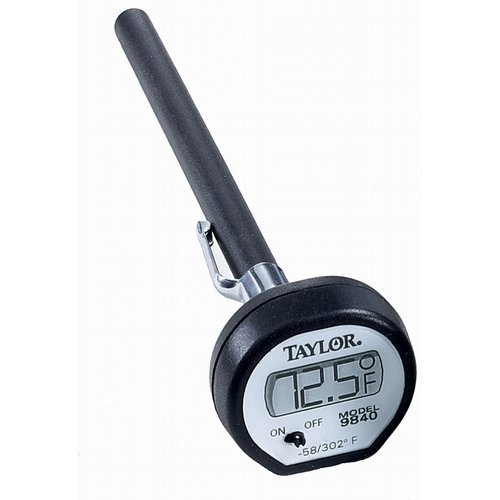
Taylor Classic Instant Read Thermometer — Best Entry-Tier Backup
The Taylor Classic is the old-school answer: an analogue dial thermometer with a stainless stem, a pocket sleeve with a clip, and no battery to die at the wrong moment. You push the stem into the meat, wait for the needle to settle, and read the dial. It has survived in kitchen drawers for decades because it is simple, tough and cheap enough — firmly entry tier — to own as a spare without thinking about it.
Best for: Beginners building the temping habit, and as a no-battery backup for any kitchen. Not suited for: Thin cuts, fast grill work, or anyone who wants an unambiguous digital number.
Tier: entry — check price on Amazon.
Setup and Care That Reduce the Cons
Resting is part of measuring, not an afterthought. When meat comes off the heat, its temperature does not freeze: the hot outer layers keep pushing heat inward for a while, a carryover effect that is strongest on large roasts and whole birds, and juices that are still moving will flood out of a cut made too early. As a principle, judge a roast by the temperature it will reach after its rest, not only by the number at the moment you lift it out, and let the rest happen tented and undisturbed. Small cuts rest briefly; big joints rest longer. The thermometer’s job is not finished at the oven door — a final check after resting, in the thickest part, is the reading that counts.
Finally, check the checker. Thermometers drift, get dropped and age, so build the habit of verifying yours periodically at principle level: a glass of iced water, well stirred, should read at freezing point, and boiling water at a rolling boil should read at boiling point for your altitude. If a digital model reads a degree or two off in both tests, cook with that offset in mind or follow the maker’s recalibration steps; if a dial model is off, its adjustment nut exists for exactly this. Two minutes, twice a year, keeps every other reading in this article honest. And because probes are sharp, store them capped or sheathed — sleeve, magnetic case or a cork on the tip — in a drawer where children cannot grab a bare spike, and never loose in a washing-up bowl where a hand goes in blind.
Care is short and unglamorous. Wash the probe shaft after every use — hot soapy water, a thorough wipe, dry before storing — and never immerse a digital body or base unit unless the maker explicitly says it is waterproof; most are splash-resistant at best, and the electronics live in the handle, not the probe. Keep cables away from direct flame, do not let them dangle onto a hot grate, and coil them loosely rather than wrapping them tightly around the base, which fatigues the wire inside. Store probes capped or sheathed, tips protected and out of children’s reach, and keep spare batteries with the thermometer rather than discovering a dead display with a turkey in the oven.
Calibration checks, as described earlier, belong on the same calendar as changing a smoke-alarm battery: iced water and boiling water, twice a year, two minutes. If a probe reads consistently off and cannot be adjusted, retire it from safety-critical duty — a thermometer you cannot trust is worse than none, because it replaces honest uncertainty with false confidence. Treat the tool well and a good digital model will outlast several grills.
Bottom Line
Weighed fairly, meat thermometer pros and cons do not balance — the pros win, because the central pro (knowing the one number that decides safety and quality) is structural, while the cons are operational: habits to build, a sheath to use, a design to choose well. Operational problems have operational solutions, all of them in this article. If you want the ownership question argued from the money-and-space side instead, is a meat thermometer worth it takes that angle next.
Pros and Cons by Design
The balance above is for the category as a whole, but each design moves the ledger around, and buyers feel the design-level version, not the average.
Instant-Read: Pros and Cons
Pros: the fastest route from question to answer in all of cooking; works on every food including the thin and delicate; nothing to set up, pair or charge on the basic models; doubles as a general kitchen probe for bread, custards and reheats. Cons: it only visits the cook, so long cooks still need your attendance; each check costs a lid-lift and a little heat; and its very convenience can hide the fact that five checks without a wash between them is a hygiene failure wearing a digital display. On balance it is the design with the fewest cons per meal cooked, which is why every other design is usually bought second.
Leave-In Wired: Pros and Cons
Pros: continuous knowledge and alarms transform long cooks from supervision into cooking; a chamber probe audits your oven or smoker as a free side effect; multiple channels cover mixed loads fairly; no dependence on a phone on the radio models. Cons: cables demand routing discipline — clear of flame, clear of the door’s pinch — and they tangle in storage and complicate washing; the probe occupies one spot, so placement errors persist for hours instead of seconds; and the base unit is one more thing living on the counter during a cook. For smokers the pros are decisive; for weeknight cooks the cons are.
Truly Wireless: Pros and Cons
Pros: total freedom of movement — rotisseries turn, pans stay sealed, air fryer baskets slide — with monitoring and alarms delivered to an app that can also estimate the finish; the neatest storage footprint of any monitoring design. Cons: one probe watches one piece; the probe needs depth, ruling out thin cuts; charge and connection join the list of things that can fail mid-cook; the ambient reading is taken at the meat’s surface, not the chamber’s heart; and the whole system’s lifespan is entangled with an app. It is the most specialised design here — unbeatable inside its niche, the wrong only-thermometer outside it.
Dial: Pros and Cons
Pros: no battery, no electronics, nothing to pair and nothing to update; entry tier; tolerant of neglect in a way no digital survives; adjustable on many models, so drift can be corrected rather than merely mourned. Cons: slow to settle, which taxes every check; senses along the stem, demanding depth thin food cannot give; a small dial is the hardest display in the category to read at a glance over smoke and steam. Its honest modern role is backup and teacher — the thermometer that proves the concept before the household invests in speed.
The Con That Decides More Purchases Than Any Other
Ask retailers why thermometers come back, or owners why theirs live in drawers, and one answer recurs: not inaccuracy, not price — friction. The tool was in another room. The battery was dead. The probe needed washing and the cook was mid-service with wet hands and a pan at the smoking point. Every design decision in this article can be re-read as friction management: the sheath by the stove, the battery kept with the tool, the soapy bowl placed before the meat goes on, the alarm that removes the need to remember. The pros of a meat thermometer are only collected by cooks whose setup makes using it the easiest action available at the moment of doubt. Set the friction to zero and the cons column of this entire article shrinks to handwriting.
The Environmental and Waste Ledger
One more honest column belongs in a pros and cons account: waste. On the pro side, a thermometer is a food-waste instrument. Meat is among the most resource-intensive foods a household buys, and every joint saved from the bin, every chicken cooked right the first time instead of replaced, is a small environmental win repeated weekly. Confident cooks also buy better and waste less of it, because exact cooking makes cheaper, less fashionable cuts perform — and using the whole animal well starts with not ruining the parts of it you bought. On the con side, the tool itself is a small electronic object with a battery, and the connected models join the cycle of devices whose software ages faster than their hardware. The proportionate response is the one this article has recommended throughout: buy the simplest design that covers your cooking, buy it once at a tier that lasts, maintain it with the ice-and-boiling-water checks, and let a decade of saved dinners carry the ledger.
Pros and Cons for Specific Households
Households With Young Children
The pros sharpen: safety stakes are highest, the foods of childhood — chicken, burgers, sausages — are exactly where colour misleads, and a number ends the parental guesswork at the moment everyone is hungry and distracted. The cons sharpen too, in one specific place: storage. A sharp probe must live capped, sheathed and genuinely out of reach, not merely in a high drawer a determined climber can open. Households that solve the storage con in advance collect the pros at full value.
Households That Entertain
For hosts, the pro is composure: the roast announces itself, the bird is verified rather than debated at the table, and the cook is present for the evening instead of performing surgery on the centrepiece in front of an audience. The con is performance pressure of a new kind — a number can be argued with by a confident guest in a way that ‘the chef has checked’ cannot — and the mature host learns to temp in the kitchen, rest in peace, and carve without commentary.
Households Cooking for One or Two
Small households cook small pieces, which move through their ideal window quickly and punish distraction — a pro for the fast instant-read and a con for elaborate monitoring systems that take longer to set up than the chop takes to cook. The balanced purchase here is the simplest one in the article: one good digital instant-read, sheathed by the stove, and the pros and cons settle into the most lopsided ledger of any profile — nearly all pro.
Frequently Voiced Objections, Answered Fairly
‘My Grandmother Never Used One’
True, and her generation also cooked with different meat, different ovens and a different tolerance for both risk and dryness. Chickens are bred larger now, which changes their thermal behaviour; guidance has been rewritten on better evidence; and grandmother, it is worth remembering, also cut into the joint to look — she was checking, with the tools she had. The thermometer is the same instinct with better instruments, not a repudiation of hers.
‘Real Cooks Judge by Touch’
Real cooks judge by every signal available, and the best of them temp their meat — walk into a serious kitchen and count the probes. Touch is a genuine skill for steaks in practiced hands, and it says nothing reliable about a chicken thigh, a stuffed breast or the centre of a meatloaf. The objection survives mostly as a point of pride, and pride is a poor seasoning.
‘It Takes the Joy Out of Cooking’
Only if certainty is joyless. For most owners the opposite happens: the anxious part of cooking meat — the part that was never joyful — is retired, and what remains is the fire, the seasoning, the timing of the sides, the table. A tool that removes dread and adds repeatability does not mechanise cooking; it returns the cook’s attention to the parts of cooking that are actually expressive.
‘One More Thing to Wash’
A fair con, and the smallest one in this article: a probe washes in seconds, faster than the knife it often replaces at checking time, since the exploratory slice it prevents also dirtied a board. The honest summary of the objection is that it prices the hygiene habit at more than it costs — usually by cooks imagining a dishwasher cycle where a soapy wipe is the reality.
The Verdict Restated, With Its Conditions
So the ledger closes where it opened, but with its conditions made explicit. The pros of a meat thermometer are structural: it measures the variable that decides safety and quality, it prevents the commonest failure in home meat cookery, it teaches while it works, and its monitored forms return time itself. The cons are operational: a washing habit, a sheathed home, correct placement, occasional verification, and design compromises that must be chosen rather than solved. Structural advantages against operational costs is, in product terms, about as favourable a balance as exists — provided the household actually cooks meat, chooses the design that matches its cooks, and sets the friction of use to zero by keeping the tool clean, charged and within reach. Households meeting those conditions will find the pros column of this article describing their kitchen within a month. Households that do not meet them have been given, in the cons, an honest map of exactly where their purchase would fail — which is all a pros and cons guide owes anyone.
Pros and Cons Across a Year of Seasons
A final angle the tidy lists miss: the ledger breathes with the calendar. In barbecue season the monitoring pros swell — long cooks multiply, guests gather, and the alarm-equipped cook is visibly the calmest person at the party — while the cable-management cons are felt at their fullest, because the tools are in daily use and every tangle is a daily tangle. In the roasting months the leave-in earns its keep on joints and birds, and the instant-read’s post-rest confirmation becomes the household ritual that decides carving. In the thin, busy weeks of the year — the weeknight grind of chops, breasts and burgers — the ledger simplifies to its essence: one pro, certainty, collected in five-second instalments, against one con, a washed probe, paid in the same currency. And at the holidays, when the year’s most expensive bird meets the year’s least practiced cook, every pro in this article reports for duty at once. A household deciding whether the balance favours ownership should therefore not ask the question in the abstract, or in a single season: it should picture its own year — the smokes, the roasts, the Tuesdays, the feast — and count how many of those cooks would have been safer, juicier or calmer with a number at the centre. For most meat-cooking households, that count is the whole argument, and it is not close.
What the Pros and Cons Look Like at Each Tier
The balance also shifts as money moves, and a complete pros and cons account should say how. At entry tier, the ledger is dominated by one enormous pro — a real measurement where there was none — against cons of speed and delicacy: the dial is slow, wants depth, and asks patience at the exact moment the grill is busiest. Households feel those cons as friction, not failure, and the tier’s honest role is proving the concept cheaply. At mid tier, the cons of the category mostly evaporate from daily experience: the digital instant-read is quick and clear, the multi-probe system monitors like equipment from a far richer kitchen, and what remains on the debit side is the permanent, tier-independent list — hygiene discipline, sheathed storage, placement technique, periodic verification. At premium tier, the pros become refinements rather than revelations: settling speed you feel on a crowded grate, build that shrugs off the years, alarms and receivers engineered like instruments, and the quiet confidence of tools that professional kitchens standardise on. The premium cons are equally specific: more money sunk into an object that can still be dropped, and, on connected flagships, a lifespan partly governed by software. Read across the tiers and a pattern emerges that no single-tier review can show: the cons of a meat thermometer are front-loaded, shrinking as tier and habit rise, while the pros are permanent, collected at full value from the very first cook. That asymmetry — temporary debits, permanent credits — is the deepest reason the balance of this article lands where it does.
Pros and Cons in the Professional Mirror
It clarifies the home ledger to glance at the professional one, because professionals run the same calculation with money attached. In commercial kitchens the thermometer is not a preference but a discipline: food-safety practice is built around measured temperatures, records are kept, probes are calibrated on schedule, and the cost of a single failure — a kitchen’s reputation, or worse — dwarfs any line in this article. The professionals’ cons are identical to yours, merely scaled: probes washed between every use as a matter of routine, tips protected, spares kept because a dead probe at service is a small emergency. What the professional mirror shows the home cook is not that they should cook like a restaurant, but that the tool’s pros survived the harshest possible audit — daily use, legal scrutiny, thin margins — while its cons were solved not by better products but by better routines. The routines in this article are the home-sized versions of those solutions: the bowl of soapy water, the sheath, the calendar check. Adopt them, and the professional verdict becomes available in a domestic kitchen: the pros are simply what the tool does, and the cons are what the routine handles.
The Shortest Honest Summary
Compress this entire article into the advice you would give a friend at the shop, and it runs like this. The case for a meat thermometer is the case for knowing: it replaces the four traditional guesses — colour, time, touch and the exploratory slice — with the single measurement that actually decides whether meat is safe and whether it is at its best, and it does so at every cook, on every cut, in every oven, including the cuts where the guesses fail worst. The case against it is a list of small disciplines: wash the probe between raw and cooked, aim it at the thickest part and away from bone, keep it sheathed and out of children’s reach, check it against ice and boiling water now and then, and choose the design your cooking actually needs rather than the one with the longest feature list. Put the two cases side by side and the shape of the answer is unmistakable — a permanent, structural advantage on one side, and a handful of ten-second habits on the other. Households that cook meat should buy the thermometer and adopt the habits. Households that do not, should not, and now know exactly why not. That is the whole of it, and everything above this paragraph is the evidence.
One Reader’s Ledger, Filled In
Abstractions settle arguments poorly, so borrow a concrete household for the final entry: four people, meat five nights a week, a smoker used monthly, a holiday bird yearly. Their pros, collected in a typical month, run to dozens of verified chickens and burgers, four roasts pulled on evidence, one long smoke supervised by an alarm instead of a chair, and zero exploratory slices. Their cons, in the same month, run to a few minutes of probe washing in total, one battery changed, and a sheath doing its silent job in a drawer a child cannot reach. No honest reading of those two columns produces a close call — and the household in question is not exotic. It is, give or take a smoker, most of the households this article was written for.
The Trade-Offs in Daily Life: Where a Meat Thermometer Earns Its Place and Where It Does Not
Buying a meat thermometer takes an afternoon; living with it happens at the grill, oven or stovetop, wherever food is cooking, while checking doneness at the thickest part without cutting the food open, and that daily reality is what this section judges. So work backwards from daily life: fix the routine, the space and the people in your mind first, and only then weigh the features that looked persuasive on a product page. Start with that the probe reaches the centre of the thickest piece without touching bone or pan. If that check fails, stop there, since the remaining virtues of any meat thermometer are built on a foundation your home has already rejected. If you cannot name those things yet, you are not ready to choose, and an hour spent clarifying the routine will save more disappointment than an hour spent comparing near-identical listings.
Every household has an unusual week, and for yours it may be that thin cuts and small pieces, where probe placement matters more than the device itself; buy for that week as well as the ordinary one. Decide whether the placement is permanent or provisional, and buy accordingly, because a meat thermometer chosen for a fixed home and one chosen to move, fold or travel are different designs wearing similar names. Ask the least enthusiastic person in the home what would annoy them about it. Their answer usually identifies the storage, cleaning or noise issue that the buyer was too optimistic to see. Think about handing the task over: if someone else had to use, clean or reset the meat thermometer from your brief description alone, the design and your setup would pass or fail together.
- Re-read the verdict imagining your busiest week, not your calmest.
- Mark each disadvantage with whether a simple habit can manage it.
- Decide which trade-off your household tolerates most easily.
- Score every advantage by how often your household will feel it.
- Give daily annoyances more weight than twice-a-year inconveniences.
Apply this thinking to real candidates, such as the ThermoWorks ThermoPop or the ThermoWorks Smoke: open the current listing, confirm the dimensions, parts and care details, and only then judge the photographs. The easiest items to own are the ones that ask for nothing between uses. If a meat thermometer asks for something, make sure the routine gives it automatically rather than relying on memory. Long-term performance usually comes down to whether you keep up with one routine: washing the probe after every use, drying it and storing it where the tip is protected. Decide honestly whether your household will do it before you rely on it. Add up the minutes honestly: the washing, wiping, descaling, emptying, airing or reassembly a meat thermometer demands each week is part of its real specification.
Anything heavy, hot, sharp, load-bearing or electrically powered deserves a respectful pause in the decision, and the maker’s own guidance, read before purchase, is part of the specification. A pro you meet twice a year and a con you meet every morning are not balanced, whatever the symmetry of the list they appear in. Check for duplicated function in your own home first, because the item you already own that does part of this job changes what the new meat thermometer actually needs to be. Ask which part of the meat thermometer will look tired first and whether that tiredness is cosmetic, cleanable, repairable or terminal, because the answer sets the realistic lifespan.
Routines change across the year, so ask whether the meat thermometer still makes sense in the opposite season, during holidays, or when the household grows, shrinks or rearranges the room it lives in. Plan the end at the beginning: a meat thermometer should be repairable, passable on, recyclable or at least easy to dispose of responsibly when its service ends, and designs differ widely on this. Most disappointment with a meat thermometer traces back to readings taken in the wrong spot, giving confidence the food has not earned. It is a slow, predictable process, which is good news, because predictable problems can be designed out before you buy. For items that suffer from constant use without rest, a planned spare is not extravagance; it is how the routine survives the day the main one is wet, dirty, broken or missing.
Keep the paperwork, digital or printed, in one known place: instructions, guarantee details and the measurements you took. Future you, troubleshooting at an inconvenient hour, will be grateful. Separate the fatal flaws from the manageable ones: a con answered by a simple routine belongs in a different column from a con built into the design. Consider what the meat thermometer gives off while it works and what it leaves behind afterwards, because living with the by-products is part of living with the product. If a guest can use the meat thermometer correctly without instruction, the design is intuitive; if they cannot, expect the same friction, softened only by habit, in your own routine.
Frequently Asked Questions
What is the biggest advantage of a meat thermometer?
Certainty about the one thing that matters: the temperature at the centre of the thickest part. That number decides whether food is safe and whether it is juicy or dried out, and no other kitchen method measures it directly. Colour, cooking time and touch all estimate it from proxies that fail in both directions — meat can look done before it is safe, and can stay pink after it is fully cooked.
What is the biggest disadvantage?
The discipline it requires. The probe must be washed between raw and cooked checks or it becomes a cross-contamination risk itself; it must be placed correctly — thickest part, clear of bone and fat — or its number misleads; and it must be stored sheathed and checked for accuracy now and then. None of this is hard, but a cook unwilling to do it gets less from the tool than its price promises.
Can a meat thermometer give a wrong reading?
Yes, in predictable ways: tip touching bone or sitting in a fat seam, probe not reaching the centre of a thick cut, a dial that has drifted, or a leave-in probe placed where a thin section cooks faster than the rest. The fixes are technique and maintenance — centre the tip in muscle, take two readings on irregular pieces and trust the lower, and verify the tool against iced water and boiling water periodically.
Is a cheap dial thermometer better than nothing?
Clearly yes. A dial model is slower to settle and needs deeper insertion, so it struggles with thin cuts, but on roasts, whole birds and thick chops it replaces pure guessing with a real measurement, and it never needs a battery. Many cooks start there, build the habit, and later upgrade to a digital instant-read for speed — keeping the dial as a drawer backup.
Do I need two thermometers?
Only if your cooking spans both jobs. An instant-read covers spot-checking, which is most home cooking; a leave-in or wireless system adds monitoring for smoking and big roasts. Households that do both regularly often own both, bought in that order. Households that do one kind of cooking should buy the one design and skip the other without guilt — an unused second thermometer is a con, not a pro.
Does using a thermometer slow cooking down?
By seconds, and it usually gives time back. A fast instant-read check takes moments; a monitoring probe removes repeated door-opening and guesswork checks entirely. Against that, weigh the time cost of the failures it prevents: a roast carved too early and returned to the oven, a chicken served dry, or a brisket pulled an hour wrong. Measured across a month of dinners, the thermometer is a time-saver.
Related Guides
Keep exploring: meat thermometer buying guide; how to use a meat thermometer; electric smokers for beginners; Bluetooth meat thermometers for smoking.


