Disclosure: airfryerkitchensupply.com is reader-supported. When you buy through links on our site, we may earn an affiliate commission at no extra cost to you.
Where to buy
Every linked pick in this guide to the best kitchen appliance hand mixers was verified against Amazon’s catalog on 2026-11-22, so the model names, capacities and control types below are the models you will actually land on. Start with KitchenAid 9 Speed Hand Mixer, KHM926 (Contour Silver), Cuisinart Power Advantage Plus 9-Speed Hand Mixer, HM-90S, Hamilton Beach 6-Speed Electric Hand Mixer (62682G). Picks listed without a link are covered without a link, and the reason is stated honestly in their review and in the sourcing notes. Check the current price on Amazon from any pick’s link, because finishes, colors and bundles rotate often and the shelf price moves with them.
The best kitchen appliance hand mixers earn their drawer space by being the fastest route from ingredients to batter: no bowl to position, no head to tilt, no counter to clear — just beaters in, power on, and a cake batter, a bowl of cream or a pan of mashed potatoes handled in the bowl it will be served from. This guide ranks the hand mixer class as a kitchen appliance in its own right, and every pick was verified before it earned a place.
The class divides by ambition. At one end sit the serious baking tools: nine-speed motors with slow, splash-free starts, pro whisks and dough hooks that genuinely knead a small loaf — machines that can be a household’s only mixer without apology. In the middle are the five-speed everyday standards from the big appliance names. At the value end are six-speed workhorses with storage cases and bowl rests that cost less than a family takeaway and outlast trends. All six shapes are represented below, because ‘best’ in a drawer appliance depends on what your kitchen actually asks of it.
Two honest boundaries frame the guide. A hand mixer, however good, asks your arm to be the stand: thick doughs and double batches are stand mixer territory, and the guide says where each pick’s ceiling sits. And headline wattage is a weak guide to mixing quality — speed range, low-speed control and beater design matter more, which is why the reviews below dwell on exactly those. Read with your own baking list in mind: the right hand mixer is the one whose ceiling is above your ambitions and whose floor — its slowest, gentlest speed — is below your most delicate job.
In this guide
Quick Picks
KitchenAid 9 Speed Hand Mixer, KHM926 (Contour Silver) — Best Overall: The class flagship: nine speeds from a genuinely slow stir to a fast whip, a pro whisk, Turbo Beater II beaters and a dough hook — the hand mixer that can be a serious baker’s only mixer. — Check on Amazon
Cuisinart Power Advantage Plus 9-Speed Hand Mixer, HM-90S — Best with Storage Case: Nine speeds with the two features drawer life is made of: SmoothStart anti-splatter starts and a snap-on storage case that keeps the mixer and its attachments together, forever. — Check on Amazon
Hamilton Beach 6-Speed Electric Hand Mixer (62682G) — Best Budget: The value benchmark of the class: a 250 watt, six-speed motor with a QuickBurst boost, a bowl rest that keeps drips off the counter and a snap-on case — the most hand mixer per dollar in this guide. — Check on Amazon
KitchenAid 5 Ultra Power Speed Hand Mixer, KHM512 (Contour Silver) — Best Simple Everyday: The five-speed standard from the class’s biggest name: Turbo Beaters, a lockable swivel cord that stays out of the bowl, and an easy release button — simple, balanced, sufficient. — Check on Amazon
Oster 2109597 7-Speed Classic Hand Mixer — Best for Whipping: Built around its whisk: a 7-speed, 250-watt classic whose Super Aerator Whisk is made for volume — cream, egg whites and light batters whipped fast and tall. — Check on Amazon
Hamilton Beach 6-Speed Hand Mixer with Easy Clean Beaters — Best Full Attachment Set on a Budget: The budget all-rounder: easy-clean beaters plus dough hooks and a whisk, a 275 watt motor and a snap-on case — the fullest attachment set in the value tier. — Check on Amazon
How These Picks Were Chosen
Picks were chosen from electric hand mixers verified, ranked on speed range and low-speed control, attachment sets (beaters, whisk, dough hooks), storage design, motor character as described in the verified listings, and brand support. Only models whose listings confirm them as corded electric hand mixers for kitchen use were eligible; immersion blenders and novelty mini-whisks were excluded as different appliances wearing similar names.
The Oster pick reuses its wave-08 verification from this program’s own API cache, as standing practice allows; the KitchenAid, Cuisinart and Hamilton Beach models are long-running lines whose listings verify cleanly. The result spans nine-speed flagships to a budget six-speed, so the six slots map the class’s real range rather than six near-identical mid-range machines.
The 6 Best Kitchen Appliance Hand Mixers

KitchenAid 9 Speed Hand Mixer, KHM926 (Contour Silver) — Best Overall
The KHM926 is what a hand mixer becomes when a serious appliance maker treats it as a primary tool. Nine speeds span the full working range — a bottom speed slow enough to fold flour without a dust cloud, top speeds fast enough for glossy meringue — and the attachment set (Pro whisk, Turbo Beater II beaters, dough hook) covers whisking, beating and light kneading. In Contour Silver it suits the committed home baker whose kitchen has no room, or no budget line, for a stand mixer.
Strengths
- Nine speeds with a genuinely gentle bottom end
- Full attachment set: pro whisk, beaters and dough hook
- Dishwasher-safe accessories keep cleanup proportionate
Trade-offs
- Premium tier pricing for a hand mixer
- Thick, heavy doughs still belong to a stand mixer
- Nine speeds reward a moment’s thought before switching on
Key specs (from the verified listing)
- Speeds: 9
- Attachments: Pro whisk, Stainless Steel Turbo Beater II beaters, dough hook
- Care: Dishwasher-safe accessories
- Finish: Contour Silver
Low-speed control is the flagship test, and it is where this KitchenAid separates itself from the class. Cheap motors lurch from off to fast, and the first thing they mix is your kitchen’s air with flour. The KHM926’s bottom speeds are true working speeds — you can start in a bowl of dry ingredients, fold in liquid, and build a batter without wearing any of it. At the top end, the pro whisk puts real volume into cream and egg whites, and the dough hook handles enriched doughs and small loaves honestly, with the understanding that your arm shares the work. It is the hand mixer to buy when the appliance will be used weekly and judged like a tool, not stored like a gadget.
Best for: Serious home bakers wanting one mixer that does nearly everything / Not suited for: Occasional users who need only basic beating
Check the current price on Amazon for the KitchenAid 9 Speed Hand Mixer, KHM926 (Contour Silver).

Cuisinart Power Advantage Plus 9-Speed Hand Mixer, HM-90S — Best with Storage Case
Cuisinart’s HM-90S attacks the hand mixer’s two everyday annoyances head-on. SmoothStart brings the beaters up gently, so starting in flour or cocoa does not redecorate the counter. The snap-on storage case keeps the mixer, its beaters and accessories in one grabbable unit, so the drawer archaeology that precedes most baking sessions simply ends. With nine speeds behind those courtesies, it suits organized bakers and smaller kitchens where storage discipline is survival.
Strengths
- SmoothStart anti-splatter starts protect your counters
- Snap-on case stores mixer and attachments as one unit
- Nine speeds match the flagship class’s range
Trade-offs
- Case adds bulk in a shallow drawer
- White finish shows baking’s battle scars
- Premium-class pricing, though below the very top
Key specs (from the verified listing)
- Speeds: 9
- Start system: SmoothStart anti-splatter
- Storage: Snap-on storage case
- Finish: White
Live with a hand mixer for a year and its spec sheet fades; what remains is how it starts and where it lives. The HM-90S wins on both counts. The gentle start is not a gimmick — it is the difference between folding cocoa into a batter and wearing it — and the case converts four loose objects into one. The mixing itself is flagship-grade: nine speeds with the control to whisk, beat and whip across the normal baking repertoire, in a body balanced for the minutes-long jobs. Choose it over the KitchenAid if storage and splatter are your kitchen’s known enemies; choose it over everything else if you simply want the class’s most livable flagship.
Best for: Organized bakers and small kitchens that value storage and clean starts / Not suited for: Buyers who store mixers loose and never splatter
Check the current price on Amazon for the Cuisinart Power Advantage Plus 9-Speed Hand Mixer, HM-90S.

Hamilton Beach 6-Speed Electric Hand Mixer (62682G) — Best Budget
Hamilton Beach’s 62682G is the hand mixer that proves the class’s essentials need not cost much. Six speeds and a 250 watt motor handle the everyday repertoire — batters, frostings, whipped cream, mashed potatoes — while QuickBurst adds a moment of extra force for a stubborn lump. The bowl rest is the detail owners love: the mixer stands on the bowl’s edge between additions, drips falling into the food instead of onto the counter. A snap-on storage case completes a package aimed at real kitchens on real budgets.
Strengths
- Bowl rest feature ends counter drips between additions
- QuickBurst boost for stubborn moments
- Snap-on case and a value-tier price position
Trade-offs
- Six speeds and a simpler motor than the flagships
- Traditional beaters only in this configuration
- Thick doughs exceed its brief
Key specs (from the verified listing)
- Speeds: 6, with QuickBurst
- Motor: 250 watt (stated in listing title)
- Attachments: Traditional beaters
- Features: Bowl rest, snap-on storage case
Judge this mixer by the jobs it will actually do in a normal kitchen — birthday cake batter, buttercream, whipped cream for a pie, mash for Sunday dinner — and it does them all without drama, at a price position that makes it nearly disposable, though owners tend to keep them for years. The bowl rest sounds minor until the third time it saves your counter mid-recipe; the case keeps the beaters married to the motor. Its ceiling is honest: stiff cookie dough will strain it, and it has no whisk or hooks in this configuration. But as the class’s budget benchmark — the mixer to recommend to a first kitchen, a student flat or a second home — it has no serious rival in the verified catalog.
Best for: First kitchens, occasional bakers and budget buyers who still want the courtesies / Not suited for: Frequent bakers working thick doughs or large batches
Check the current price on Amazon for the Hamilton Beach 6-Speed Electric Hand Mixer (62682G).

KitchenAid 5 Ultra Power Speed Hand Mixer, KHM512 (Contour Silver) — Best Simple Everyday
Not every kitchen needs nine speeds; most need five good ones and a cord that behaves. The KHM512 is KitchenAid’s everyday answer: five speeds covering stir to whip for normal baking, Turbo Beaters that work without center posts to clog, a lockable swivel cord that can be parked to either side — a quiet gift to left-handers and crowded counters — and an easy release button that drops the beaters into the sink without a wrestling match.
Strengths
- Lockable swivel cord suits any counter and either hand
- Turbo Beaters are easy to clean, with no center post
- Simple five-speed range anyone can use confidently
Trade-offs
- No whisk or dough hook in this configuration
- Five speeds give less low-end finesse than the 9-speed flagship
- Mid-tier pricing for a simple brief
Key specs (from the verified listing)
- Speeds: 5
- Beaters: Turbo Beaters, dishwasher-safe
- Cord: Lockable swivel cord
- Controls: Easy release button
This is the mixer for the cook who bakes monthly and wants the appliance to be a non-event: out of the drawer, batter beaten, beaters released into the dishwasher, done. The swivel cord is its signature practicality — lock it left or right and it stops trailing through bowls and across hobs, the small daily friction that makes people dislike using an appliance at all. Power and range are honestly mid-class: cakes, frostings, cream and mash are home territory; heavy dough is not invited. Within that territory, the KitchenAid name buys balanced weight, a motor that does not scream, and a model line with a long service history. It is the class’s sensible default.
Best for: Regular home bakers wanting a simple, quality everyday mixer / Not suited for: Bakers needing whisk and hook attachments or maximum speed range
Check the current price on Amazon for the KitchenAid 5 Ultra Power Speed Hand Mixer, KHM512 (Contour Silver).

Oster 2109597 7-Speed Classic Hand Mixer — Best for Whipping
Every class has a specialist, and the Oster 2109597 is the whipping specialist. Its headline is the Super Aerator Whisk, an attachment designed to incorporate air efficiently, driven by a 250-watt motor through seven speeds. For kitchens whose mixing skews light — meringues, whipped cream, sponge batters, omelette batches, frothy frostings — a whisk-led mixer is not a compromise but the correct tool, and this is the verified whisk-led pick of the guide.
Strengths
- Super Aerator Whisk built for maximum volume
- Seven speeds span gentle folding to fast whipping
- 250-watt motor matches the class’s working standard
Trade-offs
- Whisk-led set is less versatile for heavy beating
- Black finish only in this verified listing
- Thick doughs are outside its specialty
Key specs (from the verified listing)
- Speeds: 7
- Motor: 250-watt (stated in listing title)
- Headline attachment: Super Aerator Whisk
- Finish: Black
Whipping is a race between incorporating air and tiring your arm, and attachment geometry decides it more than raw power does. The Super Aerator Whisk’s design pulls mixture through its wires efficiently, so cream reaches soft peaks and whites reach gloss with less time at the noisy top speeds. Seven speeds give the control to start slow — whites foam better when they are not shocked — and finish fast. As a general beater it is competent; as a whisk it is the best tool in this guide. Kitchens that bake sponges, top pies with meringue, or whip cream weekly should rank it above its all-rounder rivals, because it is built for the job they actually do most.
Best for: Whipping-led bakers — meringue, cream, sponges and light batters / Not suited for: Heavy-dough or all-purpose beating briefs
Check the current price on Amazon for the Oster 2109597 7-Speed Classic Hand Mixer.
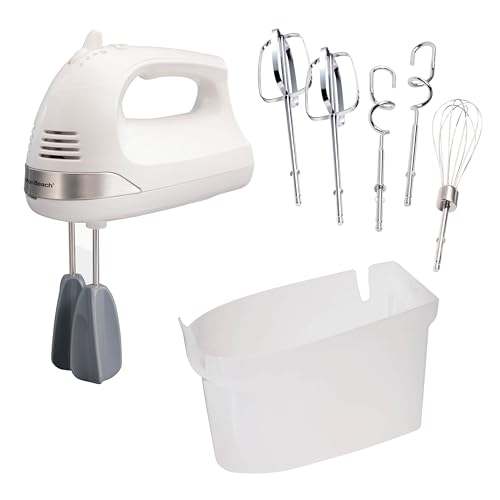
Hamilton Beach 6-Speed Hand Mixer with Easy Clean Beaters — Best Full Attachment Set on a Budget
This Hamilton Beach variant answers the budget question differently: instead of the fewest parts, it includes the most — traditional beaters in an easy-clean design, dough hooks and a whisk, driven by a 275 watt motor through six speeds, all living in a snap-on storage case. It suits the budget buyer who refuses a narrow brief: one inexpensive mixer that can beat a batter, whip a topping and knead a small dough, then wash up without a fight.
Strengths
- Fullest budget attachment set: beaters, dough hooks and whisk
- Easy-clean beater design speeds washing up
- 275 watt motor is the value tier’s stronger option
Trade-offs
- Six speeds lack the flagships’ low-end finesse
- Dough hooks handle small doughs only
- White finish shows wear honestly
Key specs (from the verified listing)
- Speeds: 6
- Motor: 275 watt (stated in listing title)
- Attachments: Easy clean traditional beaters, dough hooks, whisk
- Storage: Snap-on storage case
Versatility per dollar is this mixer’s whole argument, and it is a strong one. The whisk extends it into cream and eggs; the hooks extend it into pizza and bread doughs of modest size; the easy-clean beaters remove the value tier’s traditional punishment, which is scrubbing batter out of beater crevices. Power is adequate rather than abundant, and thick double batches will remind you of the tier — work in single batches and it copes with good grace. For a first serious kitchen, a holiday home, or a baker building skills across the whole repertoire on a budget, this is the most complete verified package in its class.
Best for: Budget buyers wanting one mixer for beating, whipping and light kneading / Not suited for: High-volume bakers who need flagship speed control
Check the current price on Amazon for the Hamilton Beach 6-Speed Hand Mixer with Easy Clean Beaters.
Comparison Table
| Pick | Badge | Key spec | Best for |
|---|---|---|---|
| KitchenAid 9 Speed Hand Mixer, KHM926 (Contour Silver) | Best Overall | 9 speeds, Pro whisk, Turbo Beater II, dough hook, dishwasher-safe accessories | Serious home bakers wanting one mixer that does nearly everything |
| Cuisinart Power Advantage Plus 9-Speed Hand Mixer, HM-90S | Best with Storage Case | 9 speeds, SmoothStart anti-splatter, snap-on storage case | Organized bakers and small kitchens that value storage and clean starts |
| Hamilton Beach 6-Speed Electric Hand Mixer (62682G) | Best Budget | 6 speeds, QuickBurst, 250 watt motor, bowl rest, snap-on storage case | First kitchens, occasional bakers and budget buyers who still want the courtesies |
| KitchenAid 5 Ultra Power Speed Hand Mixer, KHM512 (Contour Silver) | Best Simple Everyday | 5 speeds, Turbo Beaters, lockable swivel cord, easy release button | Regular home bakers wanting a simple, quality everyday mixer |
| Oster 2109597 7-Speed Classic Hand Mixer | Best for Whipping | 7 speeds, 250-watt, Super Aerator Whisk | Whipping-led bakers — meringue, cream, sponges and light batters |
| Hamilton Beach 6-Speed Hand Mixer with Easy Clean Beaters | Best Full Attachment Set on a Budget | 6 speeds, 275 watt motor, easy clean beaters, dough hooks, whisk, snap-on case | Budget buyers wanting one mixer for beating, whipping and light kneading |
Hand Mixer Ergonomics: Weight, Balance and the Four-Minute Test
A hand mixer is a power tool you hold against gravity while it vibrates, and its ergonomics decide whether long jobs are pleasant or punishing. The spec sheet will not tell you this; the design signals will. A balanced body — motor weight centered over the grip rather than nose-heavy — keeps the beaters in the mixture without wrist effort. A handle shaped for a relaxed grip, rather than a styling exercise, matters at minute four of a meringue. The flagships in this guide, KitchenAid’s and Cuisinart’s nine-speed models, are built by makers who understand that the appliance is worn as much as used, and their balance is part of what the premium buys.
The home test, when a store allows it, is simple: hold the mixer at bowl height, switched off, for the length of a song. If your forearm is negotiating by the chorus, that model will tax every long job you give it. Cord behavior belongs to the same audit — the KHM512’s lockable swivel cord exists because a trailing cord dragging through bowls and across hobs is an ergonomic failure, not a cosmetic one. Buy the mixer your hand likes; it is the hand that has to keep the contract.
The Attachment Ecosystem: What Your Mixer Can Become
A hand mixer is sold as a motor, but it lives as its attachments. Beaters define the everyday repertoire, and their design — center-post-free Turbo Beaters that shed batter, easy-clean geometries that rinse without scrubbing — decides how much of the repertoire feels effortless. The whisk is the volume specialist, and kitchens that whip weekly should treat a proper whisk attachment, like the Pro whisk on the KHM926 or Oster’s Super Aerator, as a headline feature rather than an accessory. Dough hooks are the honest stretch: genuinely useful for small, soft doughs, and the attachment most often oversold — no hand mixer’s hooks convert it into a bread machine, and this guide’s reviews mark each model’s ceiling accordingly.
Storage is the ecosystem’s silent half. Attachments that live in a snap-on case with the motor get used; attachments that migrate to the back of a drawer become theoretical. Two of this guide’s picks — the Cuisinart and the budget Hamilton Beach models — build the case into the product, and that is a large part of why they punch above their prices in real kitchens. When comparing models, price the whole working kit — motor, attachments, storage — because that is what you will actually own.
When the Hand Mixer Is the Wrong Tool: A Buyer’s Honesty Check
Every class has a boundary, and the hand mixer’s is drawn by batch size and dough stiffness. A double batch of stiff cookie dough, a large enriched bread dough, a meringue for a crowd — these jobs punish the motor, the arm and eventually the mixture, which heats and strains as the tool struggles. The symptom list is recognizable: the motor’s note climbs and stays there, the mixture climbs the beaters instead of folding, and your shoulder files a formal complaint. At that point the honest options are to split the batch — which hand mixers handle gracefully — or to admit the job belongs to the stand class and plan that purchase.
This guide links onward to the site’s baking and stand mixer guides for exactly that moment, because the goal is a kitchen equipped for its real repertoire, not loyalty to a format. Most home baking, most weeks, sits comfortably inside hand mixer territory — which is why the class thrives. Knowing where the territory ends is what keeps the experience inside it pleasant, and the mixers above chosen well.
Corded Confidence: Why the Class Still Plugs In
Cordless hand mixers exist at the market’s edges, but the verified heart of this class — every pick in this guide — plugs into the wall, and for baking work that remains the right answer. Mixing is sustained, load-varying work: a corded motor delivers its full character from the first minute of a meringue to the last, with no battery fade at the exact moment a dough comes together, and no charging discipline standing between the cook and the recipe. The cord’s costs are real and are managed by design — the KHM512’s lockable swivel cord, which parks the cable to either side and out of the bowl, is the class’s neatest answer — and by habit: plug in on the side of the counter where you actually mix, and the cord disappears from the experience.
There is also a longevity argument that suits this guide’s appliance framing. A corded mixer has one aging system — its motor and gears — where a cordless model adds a battery with its own calendar. The classic lines in this guide, from KitchenAid, Cuisinart and Hamilton Beach, have served for years in kitchens precisely because there is so little in them to expire. For an appliance bought to be reached for weekly over a long ownership, the plug is not the old-fashioned option. It is the durable one.
A Short History of the Hand Mixer in the Home Kitchen
The electric hand mixer earned its drawer by solving a specific fatigue: the rotary whisk and the wooden spoon made creaming, whipping and batter work the most laborious minutes in baking, and the early twentieth-century kitchen electrified them gratefully. The form settled quickly — a motor body, two beaters, a speed control — and the decades since have been refinement rather than reinvention: speeds multiplied and, more importantly, learned to start gently; beaters shed their center posts and learned to release at a button’s press; storage cases ended the lost-attachment era; and brands like KitchenAid, Cuisinart and Hamilton Beach built the model lines this guide draws on, some of them running, in updated form, for generations of bakers.
That maturity is the class’s present virtue. A hand mixer is a solved appliance: the best models differ in finesse — low-speed control, whisk quality, balance, storage — rather than in kind, and a buyer choosing among the verified picks here is choosing among refinements of a design that has been proving itself since before most of its owners were born. Few kitchen purchases offer that depth of evidence. The drawer, it turns out, was right all along.
The Hand Mixer’s Year: From Everyday Batters to Holiday Peaks
A hand mixer justifies itself across a calendar, not a recipe. The weekly rhythm is batters and frostings, whipped cream for a pie, mash on a Sunday — jobs measured in minutes, where the drawer’s convenience beats any stand’s ceremony and where the everyday picks in this guide, the KHM512 and the Hamilton Beach models, spend their lives happily. The monthly rhythm adds the slightly serious work: a meringue-topped pie, a sponge for guests, a double batch of cookies for a school event — the territory where speed range and whisk quality start to separate the class, and where the nine-speed flagships earn their badges with gentle starts in flour and real volume in the bowl. The holiday peak is production: back-to-back batches, enriched doughs, the full repertoire in a fortnight — and the peak is where honest hand mixer owners either split batches patiently or borrow the stand mixer the season argues for.
Reading that calendar before buying is the whole of the class’s shopping wisdom. A mixer matched to the weekly rhythm will be loved fifty weeks a year; one bought for the peak alone will be resented as an underused flagship the other forty-eight. The guide’s six picks map deliberately onto the calendar’s bands — value anchors for the weekly rhythm, flagships for the monthly, specialists for the whipping-led kitchens — so that the right purchase is a matter of locating your own year on the page. Do that, start every bowl at the slowest speed, and the smallest serious appliance in the kitchen will quietly become the most reached-for one you own.
What Owners of Good Hand Mixers Know After a Year
A year of ownership reduces a hand mixer to three memories: how it starts, where it lives, and whether it ever failed a recipe. The starts are remembered because they happen in flour: owners of the gentle-start flagships in this guide — the nine-speed KitchenAid and the SmoothStart Cuisinart — describe a year without a single dusting of the counter, while owners of lurching budget motors describe a technique they had to learn instead, the tilted bowl and the prayer. Where it lives is remembered because baking is spontaneous: the mixer in its case, in the drawer by the bowls, gets used on a Tuesday whim; the mixer excavated from a cupboard gets used at Christmas. And the failures are remembered precisely because they are so rare in this mature class — a strained motor on an overambitious dough is the usual story, and it is a story about the baker’s ambition, not the tool’s honesty.
That is the mature appliance’s bargain: buy the start, the storage and the honest ceiling correctly, and the year contains nothing to forgive. The six picks here were ranked on exactly those three memories-in-waiting. Choose the one whose start suits your flour work, whose storage suits your kitchen, and whose ceiling sits above your repertoire — and a year from now your own report will be the same: it starts gently, it lives within reach, and it has never once been the reason a bake went wrong.
A Final Word on the Drawer Appliance
There is a temptation, in a kitchen culture that celebrates the countertop flagship, to treat the hand mixer as the lesser appliance — the compromise bought instead of the real thing. A year of baking corrects that ranking. The hand mixer is the appliance of Tuesdays: the frosting whipped while the cake cools, the cream beaten while guests are still arriving, the mash made in the pot it will be served from. Its virtues are the virtues of immediacy — no setup, no ceremony, no counter negotiated — and in the flagship forms ranked here, with nine speeds, gentle starts, pro whisks and hooks, its capability covers the great majority of what home baking actually asks. The stand mixer remains the right answer for production baking, and this site’s guides will help you choose one when your repertoire files that request. Until then, the drawer holds a complete baking tool, perfected over a century, refined by the makers in this guide to a standard earlier bakers would have considered miraculous. Buy the one whose start is gentle, whose storage is solved and whose ceiling clears your recipes — and then bake more often, which was the point of the appliance all along.
How to Choose the Best Kitchen Appliance Hand Mixers
Start with your real repertoire, written down. If it reads ‘cakes, frostings, whipped cream, occasional mash’, a five- or six-speed everyday model covers it entirely, and the decision narrows to cord behavior, storage and price tier. If it adds meringues, sponges and enriched doughs, you need the flagship end: nine speeds, a whisk, hooks, and above all a bottom speed gentle enough to start in dry ingredients. The hand mixer’s most important specification is not its top speed but its slowest — splatter is a low-speed failure, and every baker has committed it.
Judge attachments as the appliance’s real range. Beaters are universal; a whisk transforms cream and egg work; dough hooks extend the machine into small breads and pizza dough, within arm-powered limits. Storage is the unglamorous decider: a snap-on case or a cord-and-beater system that stores as one unit will be used more, because it can be found more. Weight and balance matter on the long jobs — a mixer that feels fine for thirty seconds can ache at minute four of meringue — so favor balanced bodies and be suspicious of featherweight novelty models.
Finally, keep the class boundary in view. A hand mixer is a superb second appliance and a capable only appliance for light-to-medium baking. The moment your routine includes stiff doughs, double batches or weekly bread, the honest upgrade is a stand mixer, and the internal links below lead to this site’s guides for exactly that step. Buy the hand mixer for the kitchen you have; let it tell you, over a year of use, whether you need its bigger sibling.
Speeds, Watts and Beaters: Reading a Hand Mixer Listing Honestly
Wattage in hand mixers is a weak signal: the class’s working motors sit in a narrow band, and a well-geared 250 watts with good beaters outperforms a crude higher figure on every real batter. Speed count matters more, but as range rather than tally — what you want is a slow speed that is truly slow and a top speed that whips, with usable steps between. Listings that name their start system — SmoothStart, anti-splatter — are telling you the maker engineered the moment that matters most.
Beater design is the third signal. Center-post-free Turbo Beaters shed batter and wash clean; easy-clean designs attack the same problem from the budget end; a dedicated whisk like Oster’s Super Aerator is a specialist tool that beats general beaters at their own game when the job is air. Read a listing for those three things — start behavior, speed range, attachment design — and you have read everything about a hand mixer that its first month in your kitchen will confirm.
How to Use a Hand Mixer Without the Mess
Hand mixer technique is mostly splatter management and patience. These habits, learned once, make the difference between a tool you reach for and a tool you avoid.
- Start at the lowest speed, always. Insert the beaters before switching on, begin at speed one until the dry and wet have introduced themselves, then climb. Every splatter story starts with a fast start.
- Use a deep bowl. Depth is splatter insurance and whisking headroom in one. A mixing bowl that feels too big for the job is exactly right.
- Move the mixer, not just the mixture. Trace slow circles and figure-eights, tilting slightly, so the beaters visit the whole bowl instead of drilling one hole in the middle.
- Add ingredients in stages at low speed. Flour in three additions, each started slowly, keeps it in the bowl. Scraping down once midway beats chasing lumps at the end.
- Whip with a clean, dry whisk and bowl. For cream and whites, any grease is volume lost. Chill the bowl for cream if the kitchen is warm, and stop the moment peaks hold — overwhipped cream turns fast.
- Rest thick mixtures. If the motor note strains on a stiff mix, stop. Hand mixers are sprinters; a minute’s rest protects the motor and your arm alike.
Eject the beaters straight into hot soapy water or the dishwasher while they are still wet with batter, and cleanup — the other half of hand mixer technique — takes thirty seconds.
Common Buying Mistakes
Starting on a high speed. The classic error. Flour, cocoa and icing sugar become airborne instantly; always start at the bottom speed and climb as the mixture wets.
Buying by wattage alone. Motor figures in this class cluster tightly; speed range, start behavior and beater design decide real performance. Read for those instead.
Asking a hand mixer to be a stand mixer. Stiff doughs and double batches will strain the motor and your arm. Work in single batches, or step up a class — the guide’s links lead there.
Ignoring storage until the drawer wins. Loose beaters vanish. A snap-on case or a single-unit storage habit is the difference between a mixer that gets used and one that gets excavated.
Overwhipping cream. Soft peaks become grainy, then butter, in under a minute of inattention. Stop early, check, and finish with a few hand strokes of the whisk if you are close.
Final Recommendation
For most kitchens, the KitchenAid 9 Speed KHM926 is the hand mixer to buy: the widest, gentlest speed range and the fullest serious attachment set. The Cuisinart HM-90S matches it closely and wins on storage and splatter-free starts. The KHM512 is the simple everyday default; the Oster is the whipping specialist; and Hamilton Beach owns the value tier twice over — the 62682G for pure budget essentials with its bowl rest, the Easy Clean model for the fullest budget attachment set.
A hand mixer is a small appliance with an outsized effect on whether baking feels easy. Choose by your repertoire and your drawer, start every bowl at the slowest speed, and the class will repay you for years.
The full shortlist, for a final check of the current price on Amazon: KitchenAid 9 Speed Hand Mixer, KHM926 (Contour Silver) (Best Overall); Cuisinart Power Advantage Plus 9-Speed Hand Mixer, HM-90S (Best with Storage Case); Hamilton Beach 6-Speed Electric Hand Mixer (62682G) (Best Budget); KitchenAid 5 Ultra Power Speed Hand Mixer, KHM512 (Contour Silver) (Best Simple Everyday); Oster 2109597 7-Speed Classic Hand Mixer (Best for Whipping); Hamilton Beach 6-Speed Hand Mixer with Easy Clean Beaters (Best Full Attachment Set on a Budget).
Keep exploring the cluster: Best Kitchen Mixers For Baking Best Kitchen Mixers Under $100 Best Hand Mixers For Baking Best Hand Mixers For Dough Best Affordable Stand Mixers
Frequently Asked Questions
Can a hand mixer replace a stand mixer?
For light-to-medium baking — cakes, frostings, cream, small doughs — yes, especially the nine-speed flagships here. For stiff doughs, big batches and weekly bread, a stand mixer’s power and hands-free bowl win; many kitchens happily own the hand mixer first and add the stand later.
How many speeds do I actually need?
Five covers everyday baking; the jump to nine buys low-speed finesse for dry ingredients and delicate folding, plus top-end whipping. Judge the range, especially the slowest speed, rather than the count alone.
Are dough hooks on a hand mixer useful?
For small, soft doughs — a single pizza base, an enriched bun dough — genuinely useful. For stiff or large doughs they strain both motor and arm; that work belongs to a stand mixer.
Why does my hand mixer splatter everything?
Almost always a fast start in a shallow bowl. Start at the lowest speed, use a deep bowl, and add dry ingredients in stages — the three habits in this guide’s how-to section end most splatter.
What is the difference between beaters and a whisk attachment?
Beaters are the generalists for batters and frostings. A whisk’s wires incorporate air far more efficiently, so cream and egg whites reach volume faster and taller — which is why the Oster’s whisk-led design earns its specialist badge.
Do hand mixer accessories go in the dishwasher?
On the KitchenAid picks here, the listings state dishwasher-safe accessories and beaters. Check each model’s listing for its own care instructions, and never immerse the motor body itself.


