Disclosure: airfryerkitchensupply.com is reader-supported. When you buy through links on our site, we may earn an affiliate commission at no extra cost to you.
Where to buy
All six picks in this guide to the best hand mixers for dough are available on Amazon, and the listings matter here more than usual: dough work depends on whether dough hooks are actually in the box, and bundles vary. Use the links below to reach the exact verified configurations reviewed, and read the introduction’s honest limits before ordering — dough is the job where hand mixer expectations most often outrun physics. Check the current price on Amazon on the listing, and confirm the attachment list matches the review before you buy.
- Hamilton Beach 6-Speed Electric Hand Mixer with Easy Clean Beaters (62636J, White) — Best Overall for Dough: Check the current price on Amazon
- KitchenAid 9-Speed Hand Mixer (KHM926, Contour Silver) — Best Premium for Dough: Check the current price on Amazon
- Hamilton Beach Classic Stand and Hand Mixer (Black/Stainless) — Best for Hands-Free Dough Work: Check the current price on Amazon
- Hamilton Beach 6-Speed Electric Hand Mixer (62682G, White) — Best Budget for Starting Doughs: Check the current price on Amazon
- Breville Handy Mixer (BHM800SIL, Silver) — Best Control for Delicate Doughs: Check the current price on Amazon
- Cuisinart Power Advantage Plus 9-Speed Hand Mixer (HM-90S) — Best Gentle Starter for Soft Doughs: Check the current price on Amazon
Introduction
The best hand mixers for dough come with a truth that has to be stated before any ranking: a hand mixer is a limited dough tool. It can pull together soft, enriched doughs — brioche-style mixtures, soft roll dough, sweet bread bases, a small pizza dough started wet — and it can develop them modestly with dough hooks in short, patient bursts. It cannot knead a stiff, lean bread dough the way a stand mixer or a pair of hands can, and forcing it to try will overheat the motor, walk the mixer across the counter and shorten the tool’s life. This guide is written for the dough work hand mixers honestly do, and it says so in every review.
Within that honest scope, dough makes specific demands. Torque matters more than top speed: the motor must hold a slow, steady pace while the hooks work a resistant mass, without surging or fading. Dough hooks themselves matter — spiral or hook attachments that pull and fold dough rather than beaters that slice through it and clog. Bowl behaviour matters: dough climbs, and a mixer that lets you work in short controlled bursts, resting between them, produces better dough and survives longer. Weight matters too, because dough sessions involve guiding a working tool, not just holding it.
The six picks below were verified connection and are ranked for dough within those limits: two hook-equipped models with the strongest dough credentials lead, followed by the hybrid that can work dough in stand mode, then the strongest and most controlled general mixers whose beaters can start a soft dough before hands take over. Each review states plainly what doughs that pick can handle and which doughs it must refuse.
If your baking life is lean sourdoughs, baguettes and large stiff batches, the honest recommendation is a stand mixer or hand kneading, and the guide sections below explain the dividing line in detail. If your dough life is soft, enriched, small-batch and occasional — the dough life most home bakers actually live — a good hand mixer with hooks is a genuinely useful tool, and this is its guide.
In this guide
Quick Picks
Ranked for soft-dough work: hooks in the box and torque first, then stand-mode stamina, then the strongest beaters for starting doughs.
- Hamilton Beach 62636J — Best Overall for Dough: Dough hooks in the box and the strongest verified motor at 275 watts — the most capable soft-dough hand mixer here. Check price on Amazon
- KitchenAid KHM926 — Best Premium for Dough: A dough hook in a complete nine-speed kit — gentle low gears suit delicate enriched doughs that tear under rough handling. Check price on Amazon
- Hamilton Beach Classic 2-in-1 — Best for Hands-Free Dough Work: Stand mode with a 4-quart bowl and 290 watts peak power takes your arm out of longer dough sessions; detaches for hand use. Check price on Amazon
- Hamilton Beach 62682G — Best Budget for Starting Doughs: A 250-watt motor that brings soft doughs together reliably before a hand finish — honest starter strength at a budget tier. Check price on Amazon
- Breville Handy Mixer — Best Control for Delicate Doughs: Nine settings plus boost give precise low-speed control for fragile enriched doughs in small, careful batches. Check price on Amazon
- Cuisinart HM-90S — Best Gentle Starter for Soft Doughs: SmoothStart begins doughs without flinging flour, and nine speeds manage the shaggy stage calmly before a hand finish. Check price on Amazon
How These Picks Were Chosen
Verification came first, confirming which models actually list dough hooks among their attachments — several otherwise excellent mixers were ranked lower in this guide, openly, because their boxes contain beaters only. Dough criteria then took over: hook inclusion, motor strength and steadiness at low speed under resistance, and the practical ability to work in bursts without the tool becoming a handful.
The ranking deliberately mixes categories. Two hook-equipped hand mixers lead because hooks are the correct tool. The stand-and-hand hybrid follows because its stand mode removes the baker’s arm from a long, resistant job. The remaining picks are strong general mixers included for the common pattern where a soft dough is started with beaters and finished by hand — included, but labelled as exactly that, not dressed up as kneading machines.
Excluded: mini cordless whisks, which stall in batter let alone dough; any model whose motor is too light to hold a pace in a resistant mixture; and every temptation to describe hand mixer dough capacity in stand mixer language. Where a pick’s dough role is limited, the review says so in its first paragraph rather than its last.
The 6 Best Hand Mixers for Dough — With Honest Limits
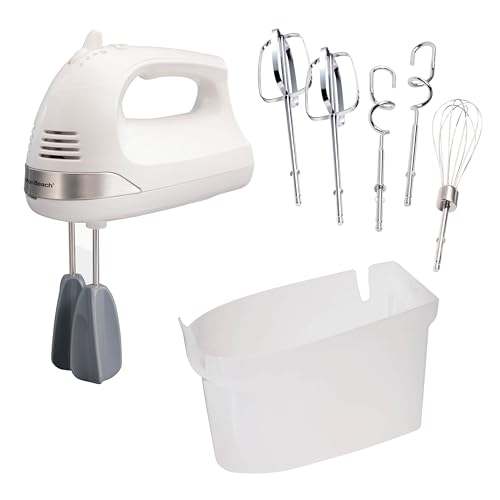
Hamilton Beach 6-Speed Electric Hand Mixer with Easy Clean Beaters (62636J, White) — Best Overall for Dough
The Hamilton Beach 62636J is the dough pick because it is the only model in this guide that combines the two things dough actually needs: dough hooks in the box and the strongest verified motor to drive them. At 275 watts it holds a steadier slow pace in a resistant dough than lighter mixers, which is the entire mechanical game — hooks pulling and folding a soft dough at a pace the motor can sustain, in bursts, without the surge-and-stall rhythm that tears dough instead of developing it.
Its honest working range: enriched doughs like brioche-style and sweet roll mixtures, soft white and milk bread doughs in small batches, and pizza dough that starts wet and shaggy. Work in one-to-two-minute bursts at low speed, rest the dough — and the motor — between bursts, and finish with a brief hand knead on the counter for the smoothest result. The Easy Clean beaters and whisk cover the rest of the baking session, and the snap-on case keeps the hooks with the mixer where dough bakers need them.
The refusal list matters as much: stiff lean doughs, large batches and anything that makes the motor’s note strain are stand mixer work. Used inside its range, this is as capable as hand mixer dough work gets — a real tool for soft doughs, honestly bounded.
The 62636J’s hooks deserve a maintenance note that decides their lifespan: dough residue left to dry on hooks hardens into a cement that stresses both the attachment and the eject mechanism at the next use. A soak in warm water immediately after the bake — while the dough proofs, ideally — keeps the kit effortless. Dough bakers who build that single habit find this budget-friendly workhorse outlasting premium tools owned carelessly.
Strengths
- Dough hooks included — the correct attachment for the job
- 275-watt motor holds a steady pace in resistant dough
- Whisk and Easy Clean beaters cover the full baking session
Trade-offs
- Soft doughs only — stiff lean doughs exceed its design
- Burst-and-rest technique is required, not optional
- Small batches only; dough quantity is limited by hand mixer physics
Key specs (verified):
- Speeds: 6
- Motor: 275 watts
- Attachments: Traditional beaters, dough hooks, whisk
- Storage: Snap-on storage case
Best for: soft and enriched dough bakers in small batches / Not suited for: lean bread bakers and large-batch dough makers — buy a stand mixer

KitchenAid 9-Speed Hand Mixer (KHM926, Contour Silver) — Best Premium for Dough
The KitchenAid KHM926 includes a dough hook in its kit, and its nine-speed range gives dough work something the stronger Hamilton Beach cannot: finesse. Enriched doughs — the butter- and egg-heavy mixtures behind brioche, panettone-style bakes and soft sweet breads — are delicate as well as resistant, and the KHM926’s gentle, closely spaced low speeds let you work them at exactly the pace they tolerate, folding fat in without tearing the developing structure.
In practice it suits the baker whose dough work is occasional but refined: a small enriched batch for a weekend bake, a soft dough pulled together in the bowl before a short hand finish. The Turbo Beater II beaters and Pro whisk mean the same session’s batters, creams and whites are covered by the same tool, which is the real premium proposition — one complete kit, dough included, rather than a dough specialist that does nothing else.
Its motor is tuned for control rather than maximum dough torque, so batch sizes should stay modest and stiff doughs stay refused. Rank it first if your doughs are enriched and your baking is broad; rank the Hamilton Beach first if raw soft-dough strength is the whole brief.
The KHM926’s dough hook has a second, quieter role: pasta-adjacent and dumpling doughs in small quantities, which are soft, enriched-leaning mixtures well inside its range. A household that makes fresh dumpling wrappers or a small batch of noodles gains a use for the hook beyond bread, and tools with two jobs survive kitchen clear-outs that claim single-purpose rivals.
Strengths
- Dough hook included in a complete kit
- Nine speeds give delicate low gears for enriched doughs
- Pro whisk and Turbo Beaters cover the whole bake
Trade-offs
- Control-tuned motor — modest batch sizes only
- Premium positioning
- Stiff doughs remain out of scope
Key specs (verified):
- Speeds: 9
- Attachments: Stainless Steel Turbo Beater II beaters, Pro whisk, dough hook
- Accessories: Dishwasher-safe attachments
Best for: enriched-dough bakers who want one premium complete kit / Not suited for: bakers needing maximum dough torque on a budget
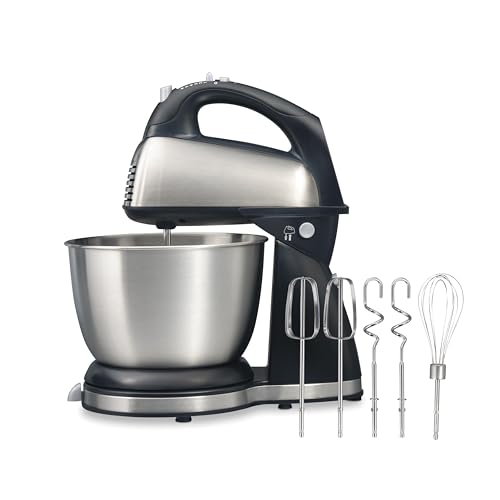
Hamilton Beach Classic Stand and Hand Mixer (Black/Stainless) — Best for Hands-Free Dough Work
Dough’s hidden cost with a hand mixer is the baker: guiding a working mixer through a resistant dough for burst after burst tires the wrist and arm, and tired bakers rush. The Hamilton Beach Classic answers by giving the mixer a stand. In stand mode with its 4-quart bowl, the unit works a soft dough hands-free at a steady pace while you watch, scrape and judge — a materially better way to run the longer, slower stages of dough development.
The 290 watts of peak power and QuickBurst help the dough come together in the early, shaggy stage, and detaching the mixer returns a capable hand tool for finishing, for other bowls and for the rest of the bake. For bakers who make soft doughs weekly — rolls for the family, a regular pizza night — the stand mode changes dough from a chore into a background task.
Keep the physics in view: peak power is a ceiling, not a cruise, and stand mode does not add kneading mechanics a hand mixer lacks. Soft doughs in the bowl’s comfortable capacity, worked patiently, are its range; stiff doughs and oversized batches remain refused. Within that range, it is the most comfortable dough platform in this guide.
Stand mode on the Classic changes one dough variable nobody mentions: temperature. A hand-held mixer worked through dough warms the baker’s grip and tempts shorter sessions; the stand removes the human thermostat from the equation, letting the dough itself dictate session length. For enriched doughs in warm kitchens, where butter temperature is a real variable, that detachment is a genuine technical advantage.
Strengths
- Stand mode removes arm fatigue from longer dough work
- 4-quart bowl gives dough room to work
- Detaches into a full hand mixer for the rest of the bake
Trade-offs
- Peak power is not continuous kneading power
- Soft doughs and moderate batches only
- Larger footprint than a pure hand mixer
Key specs (verified):
- Speeds: 6 with QuickBurst
- Motor: 290 watts peak power
- Bowl: 4-quart bowl in stand mode
- Modes: Stand mixer and detachable hand mixer
Best for: weekly soft-dough bakers who value hands-free running / Not suited for: stiff-dough bakers, and kitchens with no storage room

Hamilton Beach 6-Speed Electric Hand Mixer (62682G, White) — Best Budget for Starting Doughs
The Hamilton Beach 62682G is included in a dough guide under an honest job description: it starts doughs. Its 250-watt motor and traditional beaters can bring a soft dough together — hydrating the flour, forming the shaggy mass, working it to the point where it leaves the bowl cleanly — after which a few minutes of hand kneading on the counter finishes the job better than any hand mixer can. That division of labour is how most experienced home bakers actually use a mixer without hooks, and there is no shame in it.
The QuickBurst button helps in the early stage, giving a short blast to pull in the last dry flour from the bowl’s edge, and the Bowl Rest lets you park the mixer on the rim while you scrape or add ingredients — small mercies during a messy process. The snap-on case keeps everything together for the rest of its baking life, which for most owners will be batters and frostings anyway.
What it must not be asked to do is knead: without hooks, prolonged powered work in dough slices and clogs rather than folds, and strains the motor. Buy it as a strong budget mixer that starts soft doughs well, and it will never disappoint you; buy it as a kneading machine and it will, through no fault of its design.
The 62682G’s dough-starting role pairs with a technique upgrade: the overnight fridge start. A soft dough brought together with this mixer in five minutes at night, then rested cold until morning, develops flavour and structure that same-day hand finishing rarely matches — and the mixer does the only messy part. Budget tool, advanced result, because the method respects what each stage of the process is for.
Strengths
- 250-watt motor brings soft doughs together reliably
- QuickBurst pulls in the last dry flour at the bowl edge
- Excellent budget all-rounder for the rest of baking
Trade-offs
- No dough hooks — it starts doughs, it does not knead them
- Prolonged powered dough work strains the motor
- Hand finishing is part of the method, not a shortcut around it
Key specs (verified):
- Speeds: 6 plus QuickBurst
- Motor: 250 watts
- Attachments: Traditional beaters
- Storage: Snap-on storage case
- Rest: Bowl Rest feature
Best for: bakers happy to hand-finish soft doughs / Not suited for: bakers who need powered kneading — choose a hook-equipped pick

Breville Handy Mixer (BHM800SIL, Silver) — Best Control for Delicate Doughs
The Breville Handy Mixer’s dough role is narrow and genuine: precise control for delicate doughs in small batches. Enriched mixtures with high butter and egg content tear and overheat easily, and the Breville’s fine speed steps let a careful baker work at the lowest effective pace, in short bursts, judging the dough’s state continuously. For the baker making a small panettone-style or brioche batch as a craft project, that control is the product.
It is ranked fifth, deliberately, because this guide grades dough tools on dough equipment and torque before finesse, and the Breville’s proposition is control across baking generally rather than dough strength specifically. Its dough work should be small, soft and patient, with hand finishing welcomed rather than avoided.
If your dough ambitions are larger or more frequent, the hook-equipped picks above are the honest route. If your baking is broad, precise and small-batch — with dough as one delicate chapter among many — the Breville serves the whole book, dough included, at a premium standard.
The Breville’s dough precision finds its best expression in a specific bake: the small, rich celebration loaf — a panettone-style or festive enriched dough made once or twice a year, where the batch is small, the ingredients are expensive and the baker’s attention is total. That is the dough this pick was ranked for, and for the household whose dough life looks like that, its fifth-place ranking in a strength-first guide understates its fit.
Strengths
- Finest speed control in the guide for delicate doughs
- Low gears suit fragile enriched mixtures
- Premium all-round baking performance beyond dough
Trade-offs
- Dough role is small-batch and delicate only
- Ranked on control, not dough torque
- Premium positioning for a narrow dough brief
Key specs (verified):
- Speeds: 9 plus boost
- Control: Speed settings with boost for precise control
Best for: precision bakers making small enriched batches / Not suited for: anyone whose dough work is frequent, large or stiff

Cuisinart Power Advantage Plus 9-Speed Hand Mixer (HM-90S) — Best Gentle Starter for Soft Doughs
The Cuisinart HM-90S closes the guide with a specific dough virtue: the calmest start. Dough making begins with dry flour meeting liquid, and a mixer that lunges at switch-on coats the kitchen before the dough even forms. The HM-90S’s SmoothStart ramp prevents that splatter, and its nine speeds then manage the shaggy, coming-together stage at a controlled pace — after which, like the Hamilton Beach 62682G, it hands over to hands for the actual kneading finish.
That makes it a sensible dough-adjacent pick for bakers whose dough work is occasional and soft: a pizza base on Friday, soft rolls for a family meal, an enriched dough at a holiday. The rest of the week it is a strong general baking mixer with tidy snap-on storage, so the dough role is a bonus on a tool already earning its place.
The boundary is the same as every beater-only pick here: no hooks means no powered kneading, and pretending otherwise would strain both the dough and the motor. As a gentle starter of soft doughs inside an excellent all-round mixer, it earns its place in this guide honestly.
The HM-90S’s gentle start matters most in dough’s first minute, when flour is dry and the bowl is effectively a dust hazard. Dough bakers who have coated a kitchen at the hydration stage — most of us, once — will recognise the SmoothStart’s value instantly. It is the only pick here whose signature feature fires at dough’s messiest moment, and for bakers who start doughs weekly amid general baking, that is a defensible reason to choose it.
Strengths
- SmoothStart prevents flour scatter at the dough’s first stage
- Nine speeds manage the shaggy stage with control
- Strong all-round baking mixer with tidy storage
Trade-offs
- No dough hooks listed — starts doughs rather than kneading
- Soft doughs and modest batches only
- Ramp-up start feels slow on quick jobs
Key specs (verified):
- Speeds: 9
- Start: SmoothStart anti-splatter start
- Storage: Snap-on storage case
Best for: occasional soft-dough bakers who want a calm start / Not suited for: regular dough bakers who need hooks — choose the top picks
Comparison Table
| Pick | Badge | Key spec | Best for |
|---|---|---|---|
| Hamilton Beach 62636J | Best Overall for Dough | 6 speeds, 275W, beaters + dough hooks + whisk | Soft, enriched doughs in small batches |
| KitchenAid KHM926 | Best Premium for Dough | 9 speeds, beaters + Pro whisk + dough hook | Enriched and delicate doughs, premium all-round baking |
| Hamilton Beach Classic 2-in-1 | Best for Hands-Free Dough Work | 6 speeds + QuickBurst, 290W peak, 4-qt bowl, stand + hand modes | Longer soft-dough sessions without the arm fatigue |
| Hamilton Beach 62682G | Best Budget for Starting Doughs | 6 speeds + QuickBurst, 250W, storage case | Starting soft doughs for a hand-kneaded finish |
| Breville Handy Mixer | Best Control for Delicate Doughs | 9 speed settings plus boost | Small, delicate enriched dough batches |
| Cuisinart HM-90S | Best Gentle Starter for Soft Doughs | 9 speeds, SmoothStart, snap-on storage case | Calmly starting soft doughs and general baking |
How to Choose a Hand Mixer for Dough
Begin with the attachment list, because it decides the category: a hand mixer with dough hooks can genuinely work soft dough; a hand mixer with beaters only can start soft dough for a hand finish. Both are legitimate purchases, but they are different purchases, and this guide labels them differently for exactly that reason. If powered dough work is a real part of your baking, hooks are non-negotiable — they are the first two picks here.
Next, judge the motor by steadiness, not speed. Dough work happens at low speeds under high resistance, so a motor that holds an even slow pace matters more than any top-speed figure. Strength helps — the 275-watt leader here earns its place — but technique multiplies it: small batches, soft hydration, burst-and-rest working and a hand finish will let a modest mixer succeed where a strong mixer abused on a stiff batch will fail and overheat.
- Dough hooks in the box if you want powered dough work — beaters only start doughs
- Motor steadiness at low speed under load, above any top-speed claim
- Batch honesty: hand mixers work small, soft batches — plan recipes accordingly
- A stand-mode option if dough sessions are long and your arm tires
- Easy-clean attachments, because dough residue dries like cement
Which Doughs a Hand Mixer Can and Cannot Handle
Can, with hooks and patience: brioche and enriched doughs, sweet roll and bun doughs, milk bread, soft white doughs in small batches, and wet pizza doughs brought together and lightly developed. Can, as a starter with a hand finish: most soft doughs of moderate hydration. Cannot, honestly: stiff lean doughs, bagel and pretzel doughs, large sourdough batches, and anything whose recipe expects ten minutes of continuous kneading. Those belong to a stand mixer’s planetary action and stronger gearing, or to hands, which remain undefeated dough technology. Knowing which list your favourite recipe sits on is the whole buying decision.
Dough Technique With a Hand Mixer: Bursts, Rest and the Hand Finish
Work in bursts of one to two minutes at the lowest effective speed, then rest the dough for several minutes — resting relaxes gluten, lets flour fully hydrate, and lets the motor cool, so the next burst works better than continuous running would. Keep the hooks in the dough mass rather than racing around the bowl, add flour in stages to avoid a dry, resistant lump forming early, and finish with a brief hand knead: two or three minutes on a floured counter transforms a mixer-worked soft dough’s surface and feel. Bakers who adopt the burst-rest-finish rhythm get stand-mixer-adjacent results from honest hand mixer work; bakers who run any hand mixer continuously in dough get a hot motor and a torn dough.
The Science in Brief: What Kneading Actually Does, and Why Tools Differ
Kneading develops gluten: the flour’s proteins link into an elastic network that traps the gas yeast produces, and that network is the difference between bread and a baked brick. The network forms through a combination of mechanical work and time — which is why resting dough develops it too, and why the burst-and-rest method this guide teaches is not a compromise but a legitimate technique that bakers have used for centuries under the name of stretch-and-fold and autolyse. A stand mixer applies continuous mechanical work with a fixed hook and a rotating bowl relationship; hands apply work with constant feedback, adjusting pressure to the dough’s state moment by moment.
A hand mixer with dough hooks sits between those poles, closer to hands than to the stand mixer: the baker supplies the feedback and the movement around the bowl, the hooks supply the repetitive pulling and folding. That is why it succeeds with soft doughs, whose gluten develops readily and whose resistance is low, and fails with stiff doughs, whose resistance exceeds both the hooks’ grip and the motor’s gearing. Understanding this removes the mystery from the category: the hand mixer is not a weak stand mixer, it is a powered extension of the hand-kneading method, with that method’s strengths — feedback, gentleness — and its limits — scale and stiffness.
The practical translation is a recipe test you can apply to any dough you love. If the dough is soft enough to be sticky in its early stages, hydrates generously and enriches with butter, eggs or milk, a hook-equipped pick from this guide will work it well in a small batch. If the dough is firm, lean and springs back aggressively, it belongs to hands or a stand mixer, and no purchase in this guide changes that verdict.
Dough Troubleshooting With a Hand Mixer
Most hand mixer dough problems announce themselves clearly once you know the signs. Dough climbing the hooks means the batch is slightly too large or the dough too developed for the bowl — stop, pull the dough down, and work in shorter bursts, or finish by hand. A motor whose note rises and strains is reporting resistance beyond its comfort: rest the dough, which genuinely reduces the next burst’s resistance as hydration completes, rather than pushing through. Dough tearing instead of stretching smoothly usually means it needs rest more than work — gluten tightens under continuous effort and relaxes when left alone, and five minutes of patience outperforms two minutes of force.
Shaggy dough that will not come together is almost always a hydration or staging issue: flour added all at once forms a dry core the hooks circle around. Add flour in two stages and let the first fully absorb before the second arrives. Dough that feels right in the bowl but bakes dense usually suffered at the proofing stage rather than the mixing stage — a useful reminder that the mixer owns only the first ten minutes of a loaf’s life, and this guide’s honest limits cut both ways: it will not knead a stiff dough, and it is rarely the reason a soft one fails.
- Climbing hooks: smaller bursts, pull the dough down, or finish by hand
- Straining motor note: rest the dough — hydration lowers resistance
- Tearing dough: rest beats force; gluten relaxes when left alone
- Dry shaggy core: stage the flour additions
- Dense result from a good mix: look to proofing, not the mixer
Hand Kneading vs Hand Mixer: An Honest Partnership
This guide has treated hands as the senior partner in hand mixer dough work, and it is worth explaining why that framing produces better dough rather than reading as an apology for the tool. Hands sense what no motor reports: the exact moment a dough turns from sticky to tacky, the tightening that says gluten is developed, the warmth that says friction is building. A baker guiding dough hooks is reading the dough continuously through the tool — the mixer supplies tireless repetition, the baker supplies judgment, and the combination is genuinely competitive with far more expensive equipment for the soft doughs in scope.
The partnership has a natural division that experienced bakers settle into. The mixer excels at the messy beginning — hydrating flour without floury hands and counters, incorporating butter into an enriched dough without melting it with warm palms, bringing a shaggy mass to the point where it can be handled. Hands excel at the end — the final smoothing, the tensioning of a shaped loaf, the feel-based decisions. Recipes written for stand mixers translate to this partnership by moving their continuous kneading time into the burst-and-rest cycles this guide teaches, and most home bakers find the translation costs them nothing in the finished loaf.
There is a learning dividend, too. Bakers who work dough partly by hand learn dough itself — its hydration, its stages, its moods — in a way that fully automated kneading never teaches. When those bakers later buy a stand mixer, they use it better; when a bake fails, they can diagnose it. The hand mixer, honestly used, is not a lesser route to dough. For the soft repertoire, it is the route that teaches the craft while it does the work.
None of which rescues the category errors this guide has policed throughout: stiff doughs, huge batches and continuous running remain refusals, not challenges. A partnership works because each partner stays inside its competence. Keep the hand mixer inside its soft, small, bursty competence, and it will repay you in doughs that feel handmade — because, in the way that matters, they are.
From Soft Dough to the Table: Where the Mixer’s Work Ends
A soft dough’s journey clarifies what this guide’s picks actually contribute. The mixer’s chapter is the first fifteen minutes: hydration, incorporation, the burst-and-rest development that turns separate ingredients into a smooth, elastic dough. Everything after — the proof, the shaping, the final proof, the bake — belongs to yeast, hands and oven, and no mixer at any price changes their terms. Bakers who understand that division judge a dough mixer fairly: not by the loaf alone, but by whether its fifteen minutes were efficient, controlled and kind to both the dough and the tool.
That framing also sets the upgrade path honestly. If your fifteen minutes are the bottleneck — batches growing, doughs stiffening, sessions multiplying — the answer is a stand mixer, bought knowingly. If your fifteen minutes are pleasant and your loaves are good, the picks in this guide are not a compromise awaiting replacement; they are the finished solution for the dough life you actually live, and the money not spent on a stand mixer buys a great deal of flour.
A Note on Flour: The Variable the Mixer Cannot Control
One variable in every dough sits entirely outside the mixer’s influence, and naming it protects bakers from blaming the tool: flour itself. Protein content varies by brand and batch, and a soft dough formula written for one flour can arrive noticeably stiffer with another — stiff enough to move a batch from the hand mixer’s honest range toward its edge. The defence is the baker’s oldest habit: hold back a small portion of the flour, bring the dough together, and add the remainder only as the dough’s feel asks for it. Worked that way, the hook-equipped picks in this guide succeed across the realistic flour spectrum, and the dough — not the dial — has the final say, which is exactly how dough has always worked.
How to Work a Soft Dough With a Hand Mixer
This method suits an enriched or soft white dough in a small batch, using a hook-equipped pick from this guide.
- Combine flour, liquid, yeast and enrichments in a deep bowl and mix at the lowest speed just until a shaggy mass forms with no dry flour left
- Rest the dough in the bowl for ten minutes — this autolyse-style pause hydrates the flour and makes the dough dramatically easier to work
- Work the dough with the hooks at low speed for one to two minutes, keeping the hooks buried in the mass
- Rest again for five minutes, letting gluten relax and the motor cool
- Repeat the work-and-rest cycle two or three times until the dough is smooth, elastic and pulling from the bowl sides
- Tip the dough onto a lightly floured counter and hand-knead for two minutes to finish the surface
- Cover and proof as the recipe directs — the mixer’s job is done, the yeast’s job has begun
Judge doneness by the dough, not the clock: it should stretch thin without tearing immediately and feel smooth rather than sticky-shaggy. If at any point the motor sounds strained or the dough climbs and stresses the tool, stop, rest, and finish by hand — that judgment is what keeps both the dough and the mixer in good condition.
Common Buying Mistakes
- Asking a hand mixer to knead stiff lean dough — the fastest route to a burnt-out motor
- Running the mixer continuously in dough instead of burst-and-rest cycles
- Starting with all the flour at once, forming a dry lump the hooks cannot work
- Using beaters for prolonged dough work, which slices and clogs instead of folding
- Making batches sized for a stand mixer in a tool built for small soft batches
- Skipping the hand finish, then blaming the mixer for a rough dough surface
Every dough failure with a hand mixer traces to scope: the wrong dough, the wrong batch size or the wrong duty cycle. Keep all three inside the honest limits in this guide and a hand mixer is a genuinely useful dough tool.
Final Recommendation
For powered soft-dough work, buy the Hamilton Beach 62636J — hooks and the strongest motor — or the KitchenAid KHM926 if your doughs are enriched and your baking broad. Weekly dough makers who tire of holding a working mixer should choose the Hamilton Beach Classic and its stand mode. The remaining picks — the Hamilton Beach 62682G, Breville Handy Mixer and Cuisinart HM-90S — serve bakers who start soft doughs with a mixer and finish by hand, and they are recommended in exactly those terms. And if your dough life is lean, stiff and large, the honest final recommendation is a stand mixer; this guide would rather lose the sale than your motor.
Sibling guides: Best Hand Mixers For Baking, Best Hand Mixers For Cakes, Best Hand Mixers Baking Low Speed, Best Hand Mixers For Potatoes And Cake Mixes, and Best Hand Mixers Kitchen Appliances.
Check the current price on Amazon — Hamilton Beach 62636J (Best Overall for Dough)
Check the current price on Amazon — KitchenAid KHM926 (Best Premium for Dough)
Check the current price on Amazon — Hamilton Beach Classic 2-in-1 (Best for Hands-Free Dough Work)
Frequently Asked Questions
Can a hand mixer really knead dough?
It can work soft, enriched doughs in small batches using dough hooks, in short bursts with rests — genuinely useful kneading within limits. It cannot knead stiff lean doughs or large batches; those need a stand mixer or hands. Beater-only hand mixers can start a soft dough but should hand over to hand kneading.
Which hand mixer is best for dough?
The Hamilton Beach 62636J in this guide: dough hooks included and the strongest verified motor at 275 watts. The KitchenAid KHM926, also hook-equipped, is the premium alternative for enriched doughs and broader baking.
Why does my hand mixer overheat when I make dough?
Dough is the highest-resistance work a hand mixer does. Continuous running, stiff dough or oversized batches overheat motors. Work in one-to-two-minute bursts, rest between them, keep batches small and soft, and finish by hand — or move stiff doughs to a stand mixer.
Are dough hooks worth it on a hand mixer?
If you make soft doughs regularly, yes — hooks fold and pull dough in a way beaters cannot, and they make powered dough work legitimate rather than improvised. If dough is a twice-a-year event, a beater-only mixer plus hand kneading is a perfectly good system.
How much dough can a hand mixer handle?
Small batches — a single small loaf’s worth of soft dough is the comfortable working scale for the strongest picks here. When a recipe doubles or stiffens, split the batch or change tools. The reviews state each pick’s honest range.
Can I use a hand mixer for pizza dough?
For a wet, soft pizza dough in a small batch, yes — hooks bring it together and develop it lightly, especially with burst-and-rest working. Drier, stiffer pizza doughs should be finished by hand, which most pizza makers prefer anyway for judging the dough’s feel.


