Disclosure: airfryerkitchensupply.com is reader-supported. When you buy through links on our site, we may earn an affiliate commission at no extra cost to you.
Where to buy
All six picks in this guide to the best hand mixers for baking are available on Amazon, and that is the sensible place to buy: hand mixers are light, easy to return if a configuration is wrong, and the listings show exactly which attachments and storage case a given variant includes. Configurations differ by colour and bundle more often than shoppers expect, so follow the links below to the precise models reviewed here. Prices move with colour and season — check the current price on Amazon on the listing itself.
- KitchenAid 9-Speed Hand Mixer (KHM926, Contour Silver) — Best Overall: Check the current price on Amazon
- Cuisinart Power Advantage Plus 9-Speed Hand Mixer (HM-90S) — Best Full Kit: Check the current price on Amazon
- Breville Handy Mixer (BHM800SIL, Silver) — Best Premium Control: Check the current price on Amazon
- Hamilton Beach 6-Speed Electric Hand Mixer (62682G, White) — Best Budget: Check the current price on Amazon
- Hamilton Beach 6-Speed Electric Hand Mixer with Easy Clean Beaters (62636J, White) — Best for Easy Cleanup: Check the current price on Amazon
- Cuisinart Power Advantage 5-Speed Hand Mixer (HM-50, White) — Best Compact: Check the current price on Amazon
Introduction
The best hand mixers for baking are not the most powerful mixers, the most expensive mixers or the mixers with the longest feature lists. They are the mixers that handle the actual weekly workload of a home baker — creaming butter and sugar, building cake batters, folding flour, whipping cream, beating egg whites, mixing cookie dough and mashing the occasional bowl of potatoes — with control at every stage and without covering the kitchen in flour at the start of each one.
That workload explains what this guide rewards. A baking mixer needs a gentle low end for folding and for starting dry ingredients, an honest middle for creaming and batters, enough top end for meringue and whipped cream, beaters that release batter instead of wearing it, and attachments that match real recipes: a whisk for whites and cream, dough hooks if soft doughs are part of your baking life. It also needs to be pleasant to store and clean, because the best mixer is the one that is actually within reach when a recipe starts.
The six picks below were verified against Amazon’s catalogue connection, and they span the realistic baking spectrum: a complete premium all-rounder, a full-kit workhorse, a control-focused premium option, a budget model that behaves far above its tier, an easy-clean everyday mixer, and a compact five-speed for smaller kitchens and smaller batches. None of them is a stand mixer, and none pretends to be — for heavy bread dough in quantity, that is still the right tool, and this guide says so where it matters.
If you are upgrading from a cheap mixer that blasts flour and fades in cookie dough, almost any pick here will feel transformative. If you are buying your first mixer, start with the Best Overall or the Best Budget pick depending on how often you bake, and read the buying guide section before deciding — it explains which features actually change baking results and which are shelf appeal.
In this guide
Quick Picks
Six verified mixers covering the full home baking workload, from a complete premium kit to a budget model that creams and folds properly.
- KitchenAid KHM926 — Best Overall: Nine speeds, Turbo Beater II beaters, Pro whisk and dough hook — the complete baking toolkit in one hand mixer. Check price on Amazon
- Cuisinart HM-90S — Best Full Kit: Nine speeds with an anti-splatter SmoothStart and a snap-on case holding the whole kit — frosting makers, start here. Check price on Amazon
- Breville Handy Mixer — Best Premium Control: Nine settings plus boost, built around precise speed control — for bakers who adjust constantly and bake often. Check price on Amazon
- Hamilton Beach 62682G — Best Budget: A 250-watt motor, six speeds plus QuickBurst, a storage case and a Bowl Rest — proper baking behaviour at a budget tier. Check price on Amazon
- Hamilton Beach 62636J — Best for Easy Cleanup: Easy Clean beaters, a 275-watt motor, dough hooks and a whisk in the case — the thick-batter workhorse that washes up fast. Check price on Amazon
- Cuisinart HM-50 — Best Compact: Five speeds, a 220W motor, extra-long beaters and a 60-inch swivel cord — the small-kitchen baking companion. Check price on Amazon
How These Picks Were Chosen
Verification came first: every model in this guide was confirmed against Amazon’s catalogue, so names, speed counts, motors and included attachments match real listings. Products that could not be confirmed with confidence were excluded rather than written up from memory, and no prices or ratings are printed anywhere in this guide because both change constantly — the listings carry the live figures.
The judging criteria were built around baking outcomes. Low-speed control came first, because flour clouds and overworked batter are baking’s most common mixer failures. Next, creaming ability — the mixer must turn cold-ish butter and sugar pale and fluffy without the baker wrestling the bowl. Then attachment completeness, motor steadiness under the load of cookie dough and thick batter, beater release and cleaning, and storage. Premium price alone earned nothing; two budget-tier models are in this guide because they bake well.
Cut from contention: mini cordless whisks that stall in batter, mixers with coarse two- or three-speed dials, and any model whose attachment set did not match its baking claims. A mixer sold for baking without a whisk can still be a fine mixer, but it starts a step behind in a baking guide, and the reviews say so plainly where that applies.
The 6 Best Hand Mixers for Baking

KitchenAid 9-Speed Hand Mixer (KHM926, Contour Silver) — Best Overall
The KitchenAid KHM926 is the easiest recommendation in this guide because it has no weak stage of baking. The low speeds fold and combine gently, the middle range creams butter and sugar properly, the top end whips cream and egg whites with the Pro whisk, and the dough hook covers the soft-dough corner of a baking life — enriched doughs, soft rolls, a pizza base started in the bowl. Nine speeds sound like a spec-sheet boast until you bake with them; the small steps at the bottom of the range are what you actually use.
The Turbo Beater II beaters deserve specific mention. Their broad stainless design moves batter around the bowl instead of tunnelling through it, and they release batter better than thin wire beaters, which means more of your cake ends up in the tin. Attachments are dishwasher-safe, and the whole kit covers the realistic recipe range of a home baker without a single add-on purchase.
The honest costs: it sits at the premium end of the hand mixer category, and it is a full-size body that smaller drawers will notice. Bakers who make one cake a month will not feel the difference its finesse makes. Bakers who bake weekly will feel it in the first five seconds of every recipe.
One underreported KHM926 virtue for bakers is consistency across a long session. A December afternoon might run six mixtures through one mixer — two batters, a frosting, a whipped filling, a glaze, a test batch — and a mixer whose low gears stay gentle and whose motor stays composed at hour three is worth its premium in a way a single-recipe trial never reveals. The complete kit means no mid-session attachment improvisation, which is where home bakes quietly go wrong.
Strengths
- Complete attachment set: beaters, Pro whisk and dough hook
- Nine speeds with a genuinely gentle low end
- Turbo Beater II beaters move and release batter well
Trade-offs
- Premium positioning in the category
- Full-size body needs real drawer space
- More capability than occasional bakers will use
Key specs (verified):
- Speeds: 9
- Attachments: Stainless Steel Turbo Beater II beaters, Pro whisk, dough hook
- Accessories: Dishwasher-safe attachments
Best for: weekly bakers who want one complete mixer / Not suited for: once-a-month bakers better served by the budget pick

Cuisinart Power Advantage Plus 9-Speed Hand Mixer (HM-90S) — Best Full Kit
The Cuisinart HM-90S is the mixer this guide recommends to anyone whose baking leans sweet: cakes, cupcakes, buttercream by the bowlful. Its SmoothStart feature ramps the beaters up gently to prevent splatter, which transforms the powdered-sugar stage of frosting from a kitchen-wide event into a non-event, and the nine-speed range behind it covers everything from folding flour to whipping cream.
The snap-on storage case is more than tidiness. Baking attachments that live with the mixer get used; attachments that live at the back of a drawer get forgotten, and recipes get improvised around their absence. Keeping beaters and kit clipped under the mixer means the right tool is in your hand when the recipe asks for it, and the case keeps a small kitchen organised.
Where it cedes ground to the KitchenAid above is attachment breadth and low-end finesse — the KHM926’s bottom gears feel a shade more delicate, and its kit is broader. The Cuisinart counters with the calmer start and the smarter storage. For frosting-forward baking, many bakers will rank it first, and this guide would not argue hard.
The HM-90S rewards a specific baker habit: mise en place. Because its start is calm and its case keeps everything together, bakers who lay out ingredients before switching on get a session with no interruptions at all — no drawer hunts, no splatter pauses, no scraping batter off the counter mid-recipe. Baking guides preach mise en place endlessly; this is the rare appliance that visibly pays you back for practising it.
Strengths
- SmoothStart prevents splatter when starting dry ingredients
- Nine speeds cover the full baking range
- Snap-on case keeps the full kit together
Trade-offs
- Case adds storage bulk
- Ramp-up start feels deliberate for the first seconds
- Low end a touch less delicate than the top pick
Key specs (verified):
- Speeds: 9
- Start: SmoothStart anti-splatter start
- Storage: Snap-on storage case
Best for: bakers who make frosting and buttercream often / Not suited for: bakers who store mixers loose in deep drawers where a case adds nothing

Breville Handy Mixer (BHM800SIL, Silver) — Best Premium Control
Breville’s Handy Mixer is the connoisseur’s pick in this guide: a hand mixer designed around the idea that speed control is the product. Nine settings plus a boost function give the baker fine, deliberate steps from a gentle stir to full whip, and the mixer rewards the style of baking where you are constantly feathering the pace — slowing to fold in the last of the flour, easing up through a creaming stage, holding steady through a thick dough.
That control-first design suits experienced bakers disproportionately. Beginners will find it perfectly usable, but its advantages compound with technique: the more precisely you know what a batter should look like at each stage, the more the fine steps earn their place. It is the mixer in this guide most likely to satisfy someone upgrading from a stand mixer habit for everyday jobs.
The compromises are positioning and bundle. It sits at the premium tier, and its story is control rather than the largest attachment collection in the box. If your baking is enthusiastic but occasional, the picks above and below deliver most of the result for a lower tier. If you bake constantly and notice speed steps, this is your mixer.
Breville’s pick carries a warning label in spirit: it will expose your technique. Fine speed steps give a baker nowhere to hide — an overmixed batter was mixed too long at a speed you chose from nine options. Bakers who enjoy that accountability, and most serious bakers do, find their results tighten within a few sessions. Bakers who prefer the appliance to make the decisions should honestly choose a simpler dial.
Strengths
- Fine speed steps plus boost for precise control
- Rewards technique-driven baking at every stage
- Premium design focused on the mixing itself
Trade-offs
- Premium tier positioning
- Bundle is control-focused rather than maximal
- Advantages are wasted on very occasional baking
Key specs (verified):
- Speeds: 9 plus boost
- Control: Speed settings with boost for precise control
Best for: experienced, frequent bakers who adjust speed constantly / Not suited for: occasional bakers who will not feel the extra finesse

Hamilton Beach 6-Speed Electric Hand Mixer (62682G, White) — Best Budget
Every baking guide needs a budget pick that is actually good, and the Hamilton Beach 62682G is it. The 250-watt motor creams, beats batter and handles cookie dough without the fade that gives cheap mixers away, the six speeds plus QuickBurst cover the baking range, and the first speed is calm enough to start flour without redecorating. Plenty of mixers at higher tiers fail one of those three tests; this one passes all of them.
The daily-life details are unusually thoughtful for the tier. The Bowl Rest lets the mixer perch on the rim of the bowl while you add ingredients or scrape, the snap-on case keeps beaters with the body, and the traditional beaters are sturdy and dishwasher-friendly. For a first mixer, a second mixer for a holiday kitchen, or a student kitchen, it covers real baking without apology.
The limits are refinement, not capability: speed steps are coarser than the nine-speed models, so the gentlest folding takes a slightly steadier hand, and the beaters hold more batter than easy-clean designs. Nothing here prevents good cakes. It is simply the honest budget benchmark the rest of the guide is measured against.
The 62682G’s QuickBurst has a baking use beyond marketing: the final incorporation. A last dry pocket at the bowl’s base, a streak of cocoa in a chocolate batter, a lump in a frosting — a one-second burst targeted at the spot fixes what thirty seconds of general mixing would overwork. Used as a scalpel rather than a habit, it is the budget pick’s most professional feature.
Strengths
- 250-watt motor handles creaming and cookie dough properly
- Calm first speed for a budget-tier mixer
- Bowl Rest and snap-on case are genuinely useful
Trade-offs
- Coarser speed steps than nine-speed picks
- Traditional beaters retain more batter
- Less refined low-end control than premium models
Key specs (verified):
- Speeds: 6 plus QuickBurst
- Motor: 250 watts
- Attachments: Traditional beaters
- Storage: Snap-on storage case
- Rest: Bowl Rest feature
Best for: first-time buyers and value-focused bakers / Not suited for: delicate-batter specialists who need the finest low gear
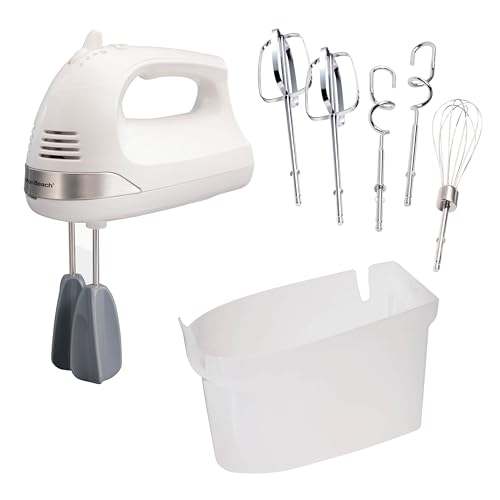
Hamilton Beach 6-Speed Electric Hand Mixer with Easy Clean Beaters (62636J, White) — Best for Easy Cleanup
Baking’s least glamorous cost is washing up, and the Hamilton Beach 62636J is built to reduce it. Its Easy Clean beaters are designed to shed batter rather than trap it in a lattice of wires, which means less scraping over the bowl, less waste, and a faster sink at the end. Paired with the strongest motor in this guide at 275 watts, it is the workhorse pick: thick cookie dough, dense batters and double batches are its home turf.
The kit broadens its baking range beyond the beaters — dough hooks for soft doughs and a whisk for cream and egg whites ride in the snap-on case, so this one box covers most of a home baker’s recipe file. The six speeds are workmanlike rather than fine, but they are honestly spaced, and the motor’s headroom keeps the pace even when a batter fights back.
Choose it with clear eyes: the low end is competent rather than delicate, so sponge specialists should look at the nine-speed picks, and the traditional-plus-easy-clean beater set still needs a proper wash rather than a rinse. For bakers whose output is cookies, brownies, muffins and sturdy cakes, it may be the most practical mixer here.
For the 62636J, consider the brownie test, the unofficial national examination of home baking mixers. Dense, low-moisture, resistant from the first stir, and ruined by overmixing — brownies need strength delivered briefly. This pick’s motor walks through the mixture without labouring, and its beaters surrender the thick batter back to the bowl instead of wearing half of it into the sink. It passes the brownie test as convincingly as any hand mixer can.
Strengths
- Easy Clean beaters release batter and wash quickly
- 275-watt motor is the strongest in this guide
- Dough hooks and whisk included in the case
Trade-offs
- Low-speed finesse is functional, not delicate
- Six speeds mean larger steps than premium rivals
- Workhorse character over premium finish
Key specs (verified):
- Speeds: 6
- Motor: 275 watts
- Attachments: Traditional beaters, dough hooks, whisk
- Storage: Snap-on storage case
Best for: cookie, brownie and thick-batter bakers / Not suited for: sponge and genoise bakers needing the gentlest fold
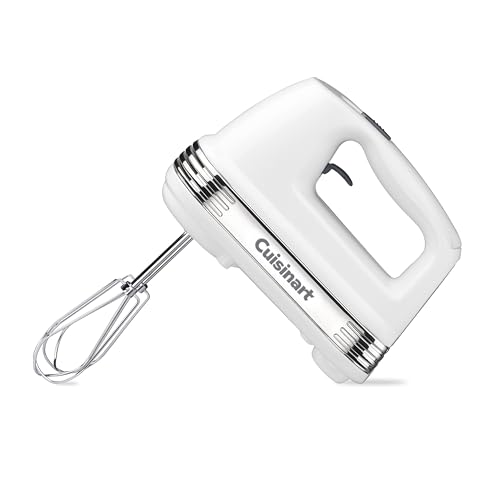
Cuisinart Power Advantage 5-Speed Hand Mixer (HM-50, White) — Best Compact
The Cuisinart HM-50 is the compact answer in this guide: five speeds, a 220W motor and extra-long beaters in a body that suits smaller kitchens and smaller batches. The extra-long beater design is a real baking feature, not a footnote — it reaches into deeper bowls and taller mixtures without the mixer body hovering at the rim, which makes everyday batters and frostings easier to manage.
The 60-inch swivel cord is the other quiet advantage. Baking stations are rarely where the socket is, and a long, swivelling cord that stays out of the batter while you work around the bowl removes a whole category of small annoyances. The beaters are dishwasher-safe, the speed range covers creaming through whipping for standard batch sizes, and the whole thing stores without a negotiation.
Its limits are scale and granularity: five speeds mean bigger steps, and very thick or double batches will make it work harder than the stronger picks here. For the single-loaf, one-cake, dozen-cookies rhythm of most home baking, it is entirely sufficient — and for small kitchens, it may be the pick that actually gets used daily.
The HM-50’s long beaters change one specific baking geometry worth naming: the stand-mixer bowl borrowed for hand mixing. Many bakers own one deep, tall bowl, and standard beaters barely reach a small batter at its base. The extra length reaches properly, which makes this compact pick disproportionately useful in kitchens whose bowl collection grew around another appliance.
Strengths
- Extra-long beaters suit deeper bowls
- 60-inch swivel cord keeps the cable clear of the batter
- Compact, easy-storing body with dishwasher-safe beaters
Trade-offs
- Five speeds mean coarser control steps
- 220W motor works harder on double batches
- No storage case story in the listing
Key specs (verified):
- Speeds: 5
- Motor: 220W
- Beaters: Extra-long, dishwasher-safe
- Cord: 60-inch swivel cord
Best for: small kitchens and standard batch sizes / Not suited for: bakers who regularly double recipes or mix very thick doughs
Comparison Table
| Pick | Badge | Key spec | Best for |
|---|---|---|---|
| KitchenAid KHM926 | Best Overall | 9 speeds, beaters + Pro whisk + dough hook | Bakers who want one mixer for everything |
| Cuisinart HM-90S | Best Full Kit | 9 speeds, SmoothStart, snap-on storage case | Frosting and buttercream bakers |
| Breville Handy Mixer | Best Premium Control | 9 speed settings plus boost | Frequent bakers who value control |
| Hamilton Beach 62682G | Best Budget | 6 speeds + QuickBurst, 250W, storage case | New and value-conscious bakers |
| Hamilton Beach 62636J | Best for Easy Cleanup | 6 speeds, 275W, beaters + dough hooks + whisk | Thick batters, cookie dough, easy washing up |
| Cuisinart HM-50 | Best Compact | 5 speeds, 220W, extra-long beaters | Small kitchens and small-to-medium batches |
How to Choose the Best Hand Mixer for Baking
Match the mixer to your actual recipe file, not the one you aspire to. List the last ten things you baked. If they are cakes, cookies, muffins and frosting, you need gentle low speeds, honest creaming power and beaters that release batter. If whipped cream and meringue appear weekly, a proper whisk attachment matters. If soft doughs appear, dough hooks matter. Most disappointment comes from buying for imaginary baking — the bread phase that lasted a fortnight — instead of the baking you demonstrably do.
Then weigh the three qualities that decide baking results. Low-speed control decides whether flour incorporates calmly and batters stay tender. Motor steadiness decides whether cookie dough and thick batter mix evenly or leave the motor surging. Attachment fit decides whether the recipe’s tool is in the box. Speed count, colour and brand heritage are real but secondary; a calm five speeds beat nine violent ones every baking day.
- Gentle first speed or soft start — the single most important baking feature
- A whisk attachment if cream or egg whites appear in your baking
- Dough hooks only if soft doughs are genuinely part of your routine
- Dishwasher-safe beaters, because baking cleanup is half the job
- Storage that keeps attachments with the mixer, so they are there when recipes ask
- Enough motor for your thickest regular batter, not your theoretical thickest
Hand Mixer vs Stand Mixer for Baking: An Honest Split
A hand mixer wins on storage, price tier, cleanup and control for batters, frostings, cream and whites — the majority of home baking tasks — and it lets you mix in any bowl, including the saucepan of potatoes or the serving bowl itself. A stand mixer wins on heavy dough, large double batches, and hands-free mixing while you do something else. Most home bakers are better served by a good hand mixer first; the stand mixer earns its counter space only when dough volume or batch size genuinely demands it, which is why this guide treats hand mixers as the primary baking tool rather than a compromise.
Baking Attachments, Decoded
Beaters do the core work — creaming, batter, dough-adjacent mixing — and their shape decides how batter moves and releases. A whisk is not a luxury: wire beaters can whip cream, but a proper whisk incorporates more air faster for whites and meringue. Dough hooks on a hand mixer are for soft, enriched doughs and for pulling a shaggy dough together; they are not a bread machine, and stiff doughs will strain any hand mixer. Buy the attachments your recipes use, in the box, rather than planning add-on purchases that rarely happen.
The Baking Workload, Mapped: Where Your Mixer Hours Actually Go
Choosing a baking mixer gets easier when you count honestly. Over a typical year, a home baker’s mixer hours divide roughly like this: batters for cakes, muffins and loaves take the largest share; frostings and fillings come next; cookie and biscuit doughs follow; whipped cream and egg whites are a smaller but crucial slice; and soft doughs are, for most bakers, the smallest slice of all. That distribution explains this guide’s priorities — beater performance and low-speed manners first, whipping support second, dough as a bonus — and it explains why buying a mixer primarily for bread dough is the most common misallocation in home baking.
It also explains the guide’s price spread. The weekly baker cycling through batters and frostings feels control, beater design and cleanup speed dozens of times a month, so premium picks repay their tier. The monthly baker meets the same features a dozen times a year, and the budget pick’s honest competence is the rational buy. Neither baker is wrong; they are simply buying different amounts of the same qualities, and the reviews above are written to let each recognise their own workload in the descriptions.
One more workload truth: baking is seasonal. December asks for volume, stamina and attachments all at once; a quiet February asks for a small loaf and an easy wash. A mixer that handles the December peak without punishing the February routine — mid-sized, complete-kitted, easy to store — is the profile this guide’s top picks share, and it is a better buying target than a specialist in either direction.
Beater Design: The Baking Feature Nobody Explains
Two mixers with identical motors can bake noticeably differently, and the reason is usually hanging off the front of them. Beaters are the business end of every baking job, and their design decides how batter moves, how much air creaming builds, and how much mixture you scrape back into the bowl instead of washing down the sink. Broad, flat-profile beaters — the Turbo Beater style on the KitchenAid picks — sweep a wide path through the bowl, moving the whole mixture and releasing much of it when lifted. Traditional wire-frame beaters, like the Hamilton Beach pattern, are sturdy and effective but hold more batter in their lattice, which is why the easy-clean variant in this guide exists.
For the baker, the practical tests are simple. Creaming should gather the butter from the bowl’s edges rather than leaving a ring; folding should move batter from base to surface rather than tunnelling; lifting the beaters should surrender most of the mixture back to the bowl with one shake. The picks in this guide were favoured partly on exactly these behaviours, because they are the difference between a mixer that feels like assistance and one that feels like supervision.
- Broad beaters move and release batter best for creaming and folding
- Traditional beaters are sturdy all-rounders that hold more mixture
- Easy-clean designs trade a little sweep for much faster washing
- Whisks, not beaters, are the right geometry for air — check the kit includes one if you whip
- Dishwasher-safe beaters matter more than any finish on the mixer body
When two candidate mixers look identical on paper, choose on the beaters. They touch every bake; the spec sheet touches none.
From First Mixer to Final Upgrade: A Baker’s Buying Path
Most bakers buy three hand mixers across a lifetime, and the path is predictable enough to plan. The first is bought on price and hope — often the budget pick in this guide or something like it — and it teaches the baker what they actually bake. The second is bought on knowledge: by now the baker knows whether they are a frosting maker, a cookie producer, a sponge specialist or an all-rounder, and they buy the pick that matches, which for most is where the KitchenAid KHM926, the Cuisinart HM-90S or the Breville in this guide enter the kitchen. The third, if it comes, is bought on values — the premium instrument, the cordless companion, or the deliberate duplicate for a second kitchen.
The mistake is trying to skip a stage: buying the connoisseur instrument before knowing your own baking produces an expensive drawer ornament, while refusing to leave the first stage after your baking has grown produces daily friction that a single upgrade would end. This guide is written to serve both honest moments — the budget pick is praised without condescension because it is the right first mixer, and the premium picks are praised without apology because they are the right considered ones.
Whichever stage you are buying at, keep the receipt of your reasoning: write down, even mentally, the last ten things you baked and the one annoyance you most want gone. If the annoyance is flour clouds, your answer is a calm first speed. If it is a fading motor in cookie dough, your answer is strength. If it is attachments living in three drawers, your answer is a case. The picks in this guide each kill one annoyance best; match yours and the purchase will feel obvious in hindsight, which is the mark of a good appliance decision.
And keep the old mixer, if it still works, when you upgrade. A second mixer — for the holiday kitchen, the family member learning to bake, the simultaneous frosting while the first mixer holds the batter — is a luxury that costs nothing and gets used more than anyone predicts.
Reading a Hand Mixer Listing Like a Baker
Listings for the mixers in this guide contain more truth than their marketing headlines, if you read them the way this programme’s verification process does. Start with the attachment list, because it is the least spin-able part of the page: beaters only, or beaters plus whisk, or the full kit with hooks — that single line predicts more baking outcomes than the speed count beside it. Next, find the motor figure and treat it as a steadiness clue rather than a power promise, then look for the start behaviour — soft start, SmoothStart, anti-splatter — described in the maker’s own words.
Then check the unglamorous lines: whether attachments are dishwasher-safe, whether a case is included or merely pictured, how long the cord is, and whether the colour variant you are viewing is the configuration the review described. Bundles change by colour more often than shoppers expect, and the most common post-purchase disappointment in this category is a whisk that appeared in a photograph of a different variant. The links in this guide land on the verified configurations for exactly that reason.
Finally, ignore two things completely: any price comparison against a struck-through figure, which tells you nothing about value, and any claim that a hand mixer performs a category it mechanically cannot — crushing, blending, stand-mixer kneading. A listing that respects its own category is usually a product that respects its user, and the six picks above were chosen partly on that honesty.
Baking Day Workflow: Running a Whole Session on One Mixer
A full baking session is the fairest final test of the picks in this guide, so here is one run honestly: a sponge batter in the morning, buttercream while it cools, whipped cream for serving, and a batch of cookie dough for the freezer, all through a single mixer with its attachments rotating through a sink of warm water between jobs. The session rewards, in order, a calm start on the sponge’s flour, steady creaming twice over, a whisk that makes the cream a one-minute job, and beaters that wash clean in seconds so the cookie dough is not waiting on equipment. Every pick in this guide completes that session; the ranking above is simply the order of grace with which they do it — the complete kits never improvise an attachment, the strong motors never labour in the dough, and the compact picks ask only that the batches stay their size. Judge your own typical session against that sequence, and the abstract qualities this guide has scored — control, completeness, strength, storage — become a shopping list you can feel.
A Word on Noise, Weight and the Baking Body
Two physical qualities decide whether a baking mixer is loved at year three, and neither appears in speed counts. The first is weight in the hand across a long creaming stage: a mixer is held, not placed, and a body that balances its motor over the grip rather than ahead of it leaves the wrist fresh for the folding stage, where steadiness matters most. The second is noise character — not raw volume, but pitch. A lower, steadier note at working speeds lets a baker hear the mixture itself, and experienced bakers genuinely mix by ear more than they admit: batter thickening, cream approaching peaks and dough beginning to labour all announce themselves audibly before they show visually. The picks in this guide were not laboratory-tested for either quality, and this guide claims no measurements — but their designs, from the premium control models to the honest workhorses, share the balanced, composed character that keeps a tool in weekly use. When you trial any mixer, hold it at creaming speed for a full minute and listen. Your wrist and your ears will file the review that matters.
How to Use a Hand Mixer for Baking, Stage by Stage
Good baking with a hand mixer is a sequence, and each stage has a speed and a habit attached to it.
- Creaming: butter and sugar at medium speed until pale and fluffy — this builds the cake’s structure, so do not rush it
- Adding eggs: one at a time at low-medium speed, letting each disappear before the next, to keep the emulsion stable
- Dry ingredients: add in two or three stages at the lowest speed, beaters buried, stopping the moment the flour disappears
- Folding extras: chips, nuts and fruit at the lowest speed for just a few seconds, or by hand with a spatula
- Whipping: cream and whites at high speed with the whisk, in a clean, deep bowl, stopping at the recipe’s peak stage
- Resting the mixer: use the bowl-rest notch or stand it on its heel between stages rather than laying it in batter
Two stage habits protect every bake. Scrape the bowl down at least once mid-mix — hand mixers leave an unmixed ring at the edge and a pocket at the base, and one scrape fixes both. And stop on time: the difference between a tender crumb and a tough one is often twenty seconds of mixing after the flour vanished. The mixer’s job is to combine, not to punish.
Common Buying Mistakes
- Buying for bread dreams when your real baking is cakes and cookies — the dough hooks gather dust and the low speeds go unjudged
- Skipping the whisk attachment, then fighting to whip egg whites with flat beaters
- Overmixing after the flour goes in, toughening every crumb the gentle low speed tried to protect
- Never scraping the bowl, leaving raw pockets that bake into streaks
- Storing attachments separately from the mixer, so they are missing when the recipe needs them
- Judging a mixer by top speed, which baking uses least, instead of the low and middle speeds it uses most
The pattern underneath most baking disappointment is a mismatch between the mixer bought and the baking done. Read your own last ten bakes honestly, buy for those, and every pick in this guide will serve you well.
Final Recommendation
For most bakers, the KitchenAid KHM926 is the final answer: complete kit, gentle low end, honest power. Frosting-heavy bakers should give the Cuisinart HM-90S a serious look for its anti-splatter start and storage case, control lovers the Breville Handy Mixer, and anyone watching the budget can buy the Hamilton Beach 62682G without feeling they settled. Small kitchens point to the Cuisinart HM-50; thick-batter bakers to the Hamilton Beach 62636J.
Keep exploring the cluster: Best Hand Mixers Baking Low Speed for the deep dive on gentle starts, Best Hand Mixers For Cakes for layer-cake specifics, Best Hand Mixers For Dough for soft-dough limits and picks, Best Hand Mixers For Potatoes And Cake Mixes for weeknight staples, and Best Hand Mixers Kitchen Appliances for the wider appliance picture.
Check the current price on Amazon — KitchenAid KHM926 (Best Overall)
Check the current price on Amazon — Cuisinart HM-90S (Best Full Kit)
Check the current price on Amazon — Breville Handy Mixer (Best Premium Control)
Frequently Asked Questions
What is the best hand mixer for baking overall?
In this guide, the KitchenAid KHM926 — nine speeds with a gentle low end, Turbo Beater II beaters, a Pro whisk and a dough hook cover the full home baking workload. Bakers on a budget get most of the result from the Hamilton Beach 62682G.
How many speeds does a baking hand mixer need?
Five honest speeds cover everyday baking; nine speeds add finer steps at the low end, which helps delicate folding and frosting starts. What matters is that the lowest speed is genuinely slow and the motor holds its pace under load — not the number printed on the box.
Can a hand mixer handle cookie dough and thick batter?
Yes, within reason. The stronger picks here — notably the 275-watt Hamilton Beach 62636J and the 250-watt 62682G — handle standard cookie dough and thick batters well. Very stiff or doubled doughs are stand mixer territory, and forcing a hand mixer through them shortens its life.
Do I need a whisk attachment for baking?
If you whip cream or beat egg whites regularly, yes — a whisk incorporates air faster and gives better volume and peaks than flat beaters. If your baking is purely batters and frostings, beaters alone are sufficient.
Can a hand mixer knead bread dough?
Only soft, enriched doughs in modest quantities, using dough hooks and short bursts. Stiff bread doughs belong in a stand mixer. Hand mixer dough hooks are best seen as a way to pull soft doughs together, not as a kneading replacement.
How do I stop my mixer covering the kitchen in flour?
Bury the beaters before switching on, add flour in stages, start at the lowest speed, and consider a soft-start model such as the Cuisinart HM-90S with SmoothStart. Technique plus a gentle first gear makes flour clouds a rarity rather than a routine.


