Disclosure: airfryerkitchensupply.com is reader-supported. When you buy through links on our site, we may earn an affiliate commission at no extra cost to you.
Where to buy
Every linked pick in this guide to the best kitchen mixers for baking was verified against Amazon’s catalog on 2026-11-22, so the model names, capacities and control types below are the models you will actually land on. Start with KitchenAid Artisan 5-Qt Tilt-Head Stand Mixer, KSM150PS (Contour Silver), Cuisinart Precision Pro SMD-50BC 5.5-Quart Digital Stand Mixer, KitchenAid Classic Series 4.5-Qt Tilt-Head Stand Mixer, K45SS (Onyx Black). Picks listed without a link are covered without a link, and the reason is stated honestly in their review and in the sourcing notes. Check the current price on Amazon from any pick’s link, because finishes, colors and bundles rotate often and the shelf price moves with them.
The best kitchen mixers for baking are judged by a stricter standard than mixers in general, because baking is where a mixer stops being a convenience and becomes part of the recipe. Creaming butter and sugar to the right lightness decides a cake’s crumb. A dough hook’s patience decides a loaf’s structure. A whisk’s geometry decides whether meringue stands or weeps. This guide ranks the verified mixer market — stand and hand — purely on baking performance, and every pick earned its place.
The list is deliberately mixed. Serious bakers who knead weekly need a stand mixer’s bowl, motor and hands-free stamina, and the flagship tilt-head and value large-capacity picks cover that ground. Bakers whose repertoire is cakes, cookies and frostings in single batches are often better served by a flagship hand mixer that lives in a drawer and answers in seconds. Both philosophies are represented, with the reviews stating plainly where each machine’s baking ceiling sits — batch sizes, dough stiffness, and the jobs to hand to a different tool.
What baking asks of a mixer, in order, is: low-speed control for incorporating flour without toughness or dust; torque that does not fade when a dough comes together; a whisk that builds volume efficiently; a bowl that suits creaming — the foundation technique of the whole craft; and attachments and speeds that cover the distance from sponge to sourdough. Read the picks against your own baking list. The right mixer is the one whose strengths are your weekly recipes and whose trade-offs are jobs you never do.
In this guide
Quick Picks
KitchenAid Artisan 5-Qt Tilt-Head Stand Mixer, KSM150PS (Contour Silver) — Best Overall for Baking: The baking benchmark: a 5-quart tilt-head with ten speeds and a pouring shield, sized and powered for the full home repertoire from sponge cake to weekly bread. — Check on Amazon
Cuisinart Precision Pro SMD-50BC 5.5-Quart Digital Stand Mixer — Best Digital Stand for Baking: The precision instrument: 5.5 quarts, twelve speeds and three preprogrammed food prep settings, with whisk, paddle and dough hook — baking by numbers, repeatably. — Check on Amazon
KitchenAid Classic Series 4.5-Qt Tilt-Head Stand Mixer, K45SS (Onyx Black) — Best Classic Entry Stand: The heritage entry point: durable metal construction, ten speeds and a beater engineered for 59 touchpoints around the bowl — the classic stand mixer, sized for standard home batches. — Check on Amazon
Aucma 6.5-QT Tilt-Head Stand Mixer (Black) — Best Large-Capacity Value: The capacity-per-dollar champion: a 6.5-quart bowl and 660W motor with hook, whip and beater included — the biggest baking batches in this guide at a value-tier position. — Check on Amazon
Hamilton Beach 4-Qt Electric Stand Mixer (7 Speeds) — Best Budget Stand for Baking: Stand baking on a budget: planetary mixing for full bowl coverage, seven speeds, all three attachments and a splash guard in a 4-quart machine at the value end of the class. — Check on Amazon
KitchenAid 9 Speed Hand Mixer, KHM926 (Contour Silver) — Best Hand Mixer for Baking: The drawer-sized baking flagship: nine speeds with a true gentle start, a pro whisk for volume work and a dough hook for small loaves — for bakers whose batches are single and whose counters are full. — Check on Amazon
How These Picks Were Chosen
Picks were chosen from mixers verified, ranked on baking-specific criteria: speed range with genuine low-speed control, dough handling (hook design, bowl capacity, motor stamina as described in the verified listings), whisk quality for aeration work, creaming suitability, and attachment completeness. Both stand and hand formats were eligible; format was treated as a baking-style decision, not a quality ranking.
Excluded were audio and DJ mixers that pollute this search’s search space — this is a kitchen brief — and any model whose listing could not confirm it as a kitchen mixer with the attachments its review discusses. The six survivors span the premium tilt-head flagship, a digital mid-range stand, the classic entry stand, a large-capacity value stand, a budget family stand and the flagship hand mixer, so every realistic baking budget and batch size maps to a pick.
The 6 Best Kitchen Mixers for Baking

KitchenAid Artisan 5-Qt Tilt-Head Stand Mixer, KSM150PS (Contour Silver) — Best Overall for Baking
The Artisan is the stand mixer against which home baking is measured, and the reasons are baking-specific: a 5-quart bowl that creams a double batch of butter and sugar without climbing the sides, ten speeds whose bottom end incorporates flour gently, a tilt head that makes adding ingredients and swapping attachments a one-hand operation, and a pouring shield for the flour additions that otherwise dust the kitchen. It suits the committed home baker whose repertoire spans cakes, cookies, breads and meringues in family batches.
Strengths
- 5-qt capacity handles double batches and family doughs
- Ten speeds with a gentle bottom end for flour work
- Pouring shield included for mess-free additions
Trade-offs
- Premium tier pricing
- Tilt-head needs cabinet clearance to open fully
- Heavy to move — it earns a permanent counter spot
Key specs (from the verified listing)
- Bowl: 5-qt, tilt-head design
- Speeds: 10
- Included: Pouring shield (per listing)
- Finish: Contour Silver
Creaming is the Artisan’s home ground: the beater’s sweep and the bowl’s shape bring butter and sugar to pale, aerated lightness evenly, and that foundation shows in every cake that follows. For dough, the hook kneads a family loaf with the stamina hands-free mixing promises — you are free to proof, shape and tidy while the machine works, which quietly changes how often bread gets baked at all. The whisk end of the range builds meringue volume efficiently, and the ten-speed span means one machine honestly covers sponge to sourdough. Its costs are the class’s costs — price, weight, a permanent home on the counter — but for the baker who will use it weekly for a decade, the Artisan is the purchase the rest of the kitchen gets planned around.
Best for: Committed home bakers covering cakes, cookies, bread and meringue weekly / Not suited for: Occasional bakers or kitchens with no counter to spare
Check the current price on Amazon for the KitchenAid Artisan 5-Qt Tilt-Head Stand Mixer, KSM150PS (Contour Silver).
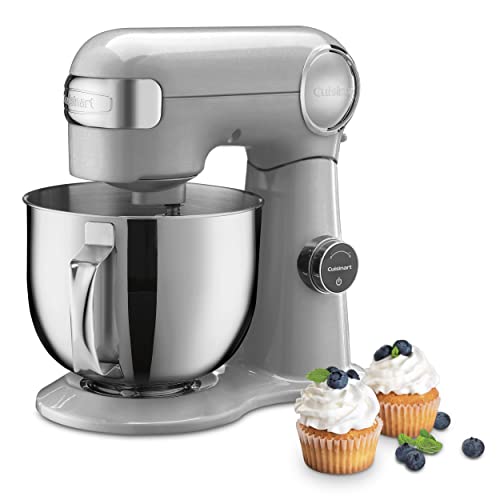
Cuisinart Precision Pro SMD-50BC 5.5-Quart Digital Stand Mixer — Best Digital Stand for Baking
Cuisinart’s Precision Pro is for the baker who recipes by repeatability. Twelve speeds give finer gradations than the class standard, three preprogrammed settings encode common prep sequences, and the full attachment trio — whisk, flat paddle, dough hook — arrives in the box with a 5.5-quart bowl, the largest among this guide’s premium domestic picks. It suits methodical bakers, recipe developers and anyone who wants the machine to remember what their hands used to judge.
Strengths
- Twelve speeds — the finest gradation in this guide
- Preprogrammed settings for repeatable results
- Full attachment trio and a 5.5-qt bowl included
Trade-offs
- Digital controls are a learning curve for dial traditionalists
- Large footprint for the capacity
- Premium-mid pricing tier
Key specs (from the verified listing)
- Bowl: 5.5-quart
- Speeds: 12, with 3 preprogrammed food prep settings
- Attachments: Whisk, flat mixing paddle, dough hook
- Controls: Digital
Baking rewards consistency, and consistency is what a digital mixer sells. The preprogrammed settings take the guesswork out of the sequences bakers repeat — the gradual speed build for a batter, the patient knead — and twelve speeds mean the exact pace a recipe assumes is usually available rather than approximated. Capacity is generous: 5.5 quarts creams and kneads at family scale with headroom for foam. The trade is tactile: bakers raised on a lever and a dial may find the digital panel less romantic, though none less effective. For the measurable, repeatable end of the craft — the baker testing a recipe for the third time and wanting the machine to hold its side of the bargain — this is the guide’s most precise tool.
Best for: Methodical bakers and recipe developers who value repeatability / Not suited for: Traditionalists who want a lever, a dial and no screen
Check the current price on Amazon for the Cuisinart Precision Pro SMD-50BC 5.5-Quart Digital Stand Mixer.

KitchenAid Classic Series 4.5-Qt Tilt-Head Stand Mixer, K45SS (Onyx Black) — Best Classic Entry Stand
The K45SS is the stand mixer as durable goods: metal construction, a 4.5-quart tilt-head bowl, ten speeds, and a flat beater designed to strike 59 points around the bowl so creaming and mixing leave no unworked pockets. It suits the baker stepping up from a hand mixer into stand ownership — cakes, cookies and single loaves in standard batches — who wants the classic machine’s build and ecosystem without the flagship’s capacity or price tier.
Strengths
- Durable metal construction — built as a long-term appliance
- 59-touchpoint beater coverage for thorough creaming
- Ten speeds across the home baking range
Trade-offs
- 4.5-qt bowl limits double batches and big doughs
- Entry tier of the classic line — fewer included extras
- Same counter commitment as its bigger siblings
Key specs (from the verified listing)
- Bowl: 4.5-quart, tilt-head
- Speeds: 10
- Construction: Durable metal (per listing)
- Beater: 59 touchpoints for thorough mixing
What the Classic sells is the essential stand-mixer experience with the quality cues intact. The metal build is not nostalgia; it is the difference between a machine that feels identical in year ten and one that loosens. The touchpoint specification is the baking-relevant engineering: creaming and batter work fail at the bowl’s edges and base, and a beater mapped to 59 contact points is designed precisely against that failure. Capacity is the honest ceiling — a single loaf, a standard cake, a family batch of cookies — and bakers who routinely double should look at the 5-quart Artisan instead. As the first stand mixer in a baking life, this remains the class’s most proven doorway.
Best for: Bakers stepping up to stand ownership for standard batches / Not suited for: High-volume bakers who double recipes as a habit
Check the current price on Amazon for the KitchenAid Classic Series 4.5-Qt Tilt-Head Stand Mixer, K45SS (Onyx Black).

Aucma 6.5-QT Tilt-Head Stand Mixer (Black) — Best Large-Capacity Value
Aucma’s proposition is scale at a value price: the largest bowl in this guide at 6.5 quarts, a 660W motor, and the full attachment trio — dough hook, wire whip, beater — in the box. It suits batch bakers: the holiday cookie producer, the big-family bread maker, the meal-prep baker whose recipes start at ‘double’. Where the flagships sell refinement, this sells room — and for bakers whose binding constraint is bowl volume, room is the specification that matters.
Strengths
- 6.5-qt bowl — the largest capacity in this guide
- Full attachment trio included
- 660W motor specced for the capacity
Trade-offs
- Value-tier fit and finish versus the flagship brands
- Large footprint and a big bowl to wash for small jobs
- Speed finesse at the gentle end is not its specialty
Key specs (from the verified listing)
- Bowl: 6.5-qt, tilt-head
- Motor: 660W (stated in listing title)
- Attachments: Dough hook, wire whip, beater
- Finish: Black
Batch baking exposes small mixers cruelly: flour over the rim at the first addition, dough climbing, a motor laboring at capacity. A 6.5-quart bowl answers all three with headroom, and the included trio means the big bowl is usable for the whole repertoire — whip for volume work, beater for creaming at scale, hook for the doughs that justify the size. The honest trade is refinement: speed gradations are workmanlike rather than silken, and the finish is functional. For the baker whose year peaks at holiday production and family loaves, those trades are correctly ordered — capacity first. Buy it as a production tool and it is the guide’s most enabling value pick.
Best for: Batch bakers and big families whose constraint is bowl volume / Not suited for: Small-batch bakers or buyers prioritizing flagship refinement
Check the current price on Amazon for the Aucma 6.5-QT Tilt-Head Stand Mixer (Black).

Hamilton Beach 4-Qt Electric Stand Mixer (7 Speeds) — Best Budget Stand for Baking
Hamilton Beach brings the stand format down to a budget brief without gutting it: planetary mixing action that carries the beater around the bowl for full coverage, seven speeds, a splash guard, and the complete trio — whisk, flat beater, dough hook — over a 4-quart bowl. It suits new bakers, small households and second kitchens that want hands-free mixing for cakes, cookies and single doughs without entering the flagship price tiers.
Strengths
- Planetary mixing for full bowl coverage at a budget tier
- Complete attachment trio plus splash guard included
- Seven speeds cover the standard baking range
Trade-offs
- 300-watt motor is the guide’s most modest — stiff doughs strain it
- 4-qt bowl suits single batches
- Value-tier build versus the metal flagships
Key specs (from the verified listing)
- Bowl: 4-quart
- Speeds: 7, planetary mixing action
- Motor: 300 watts (stated in listing title)
- Attachments: Whisk, flat beater, dough hook, splash guard
Planetary action is the feature that makes this budget stand a baker’s tool rather than a motorized bowl: the beater orbits while it spins, visiting the whole bowl, so creaming is even and batters need less scraping. Seven speeds cover the honest baking range, and having all three attachments at this tier means the machine can grow with its owner from first cakes to first loaves. The ceiling is power: 300 watts handles standard batters and soft doughs well and asks for patience — and single batches — beyond that. As the entry ticket to stand baking, it is complete, capable and correctly priced by its tier; bakers who outgrow it will know exactly which flagship virtue they are upgrading for.
Best for: New bakers and small households wanting hands-free mixing on a budget / Not suited for: Stiff-dough specialists or double-batch bakers
Check the current price on Amazon for the Hamilton Beach 4-Qt Electric Stand Mixer (7 Speeds).

KitchenAid 9 Speed Hand Mixer, KHM926 (Contour Silver) — Best Hand Mixer for Baking
Not every baking kitchen can house a stand mixer, and the KHM926 is the strongest argument that it may not need to. Nine speeds span folding to whipping; the Pro whisk builds meringue and cream volume properly; the Turbo Beater II beaters cream and mix in any bowl you own; and the dough hook kneads small, soft doughs. It suits small-batch bakers, apartment kitchens, and stand-mixer owners who want a fast second tool for frostings and small jobs.
Strengths
- Nine speeds with genuine low-speed control for flour work
- Pro whisk delivers real aeration performance
- Lives in a drawer — zero counter commitment
Trade-offs
- Your arm is the stand on longer jobs
- Dough capacity is small loaves only
- Premium hand-mixer pricing
Key specs (from the verified listing)
- Speeds: 9
- Attachments: Pro whisk, Stainless Steel Turbo Beater II beaters, dough hook
- Care: Dishwasher-safe accessories
- Format: Hand mixer
Baking with a hand mixer is a different craft rhythm: you feel the batter’s resistance change as it comes together, you move the bowl rather than the machine, and small batches — a single sponge, a half-recipe of frosting, a quick soda bread — become five-minute jobs instead of appliance productions. The KHM926’s low speeds make that craft clean, starting in flour without the dust cloud that teaches bakers to dread hand mixers. Its ceiling is stamina and scale: a stiff double dough belongs to the stands above. But for the large middle of home baking — cakes, cookies, creams, frostings, small doughs — this flagship hand mixer is not the compromise option. It is, for many kitchens, the correct one.
Best for: Small-batch and apartment bakers, and as a fast second mixer / Not suited for: Weekly bread bakers or double-batch households
Check the current price on Amazon for the KitchenAid 9 Speed Hand Mixer, KHM926 (Contour Silver).
Comparison Table
| Pick | Badge | Key spec | Best for |
|---|---|---|---|
| KitchenAid Artisan 5-Qt Tilt-Head Stand Mixer, KSM150PS (Contour Silver) | Best Overall for Baking | 5-qt tilt-head, 10 speeds, pouring shield included | Committed home bakers covering cakes, cookies, bread and meringue weekly |
| Cuisinart Precision Pro SMD-50BC 5.5-Quart Digital Stand Mixer | Best Digital Stand for Baking | 5.5-quart, 12 speeds, 3 preprogrammed settings, whisk, paddle, dough hook | Methodical bakers and recipe developers who value repeatability |
| KitchenAid Classic Series 4.5-Qt Tilt-Head Stand Mixer, K45SS (Onyx Black) | Best Classic Entry Stand | 4.5-quart tilt-head, 10 speeds, metal construction, 59 touchpoints | Bakers stepping up to stand ownership for standard batches |
| Aucma 6.5-QT Tilt-Head Stand Mixer (Black) | Best Large-Capacity Value | 6.5-qt bowl, 660W, dough hook, wire whip and beater included | Batch bakers and big families whose constraint is bowl volume |
| Hamilton Beach 4-Qt Electric Stand Mixer (7 Speeds) | Best Budget Stand for Baking | 4-quart, 7 speeds, planetary mixing, whisk, flat beater, dough hook, splash guard | New bakers and small households wanting hands-free mixing on a budget |
| KitchenAid 9 Speed Hand Mixer, KHM926 (Contour Silver) | Best Hand Mixer for Baking | 9 speeds, Pro whisk, Turbo Beater II, dough hook | Small-batch and apartment bakers, and as a fast second mixer |
Bowl Science: Size, Shape and Material for Baking Work
The bowl is the mixer’s silent partner, and baking makes specific demands of it. For creaming, the bowl’s base must let the beater reach the butter where it pools — the engineering behind the touchpoint counts and planetary sweeps in this guide’s listings — because uncreamed pockets at the base become streaks in the crumb. For whipping, depth is volume’s friend: foam needs headroom to build without climbing out, and a bowl that seems oversized for the whites is correctly sized. For dough, the bowl must contain the knead’s enthusiasm, which is why batch bakers prize the Aucma’s 6.5 quarts and why every review here states its bowl’s honest batch ceiling.
Material is the third variable. Stainless steel — the class standard — is light, unbreakable and chillable for cream work. Glass and ceramic bowls exist in the wider market and bring visibility and heft at the price of weight and fragility. For the home baker, the practical hierarchy is simple: a stainless bowl sized to the median batch, deep enough for foam, with a handle if your pouring arm votes for one. The mixers in this guide were chosen partly on this science — their bowls are baking bowls, not mixing afterthoughts.
The Baker’s Calendar: Matching the Mixer to the Year
Baking has seasons, and a mixer earns its place across all of them. The weekly rhythm — a loaf, a batch of cookies, a frosting — rewards the machine that is fastest to deploy and easiest to clean, which is the flagship hand mixer’s quiet argument and the reason it sits in this guide beside the stands. The project weekends — laminated doughs, celebration cakes, recipe testing — reward capacity and stamina, the stands’ home ground. The holiday peak — production baking for gifts and gatherings — rewards the biggest bowl and the strongest motor you own, and it is the fortnight that justifies the Aucma’s scale and the Artisan’s reputation in thousands of kitchens.
Read your own calendar before you buy. A mixer matched to the weekly rhythm will be loved fifty weeks a year; a mixer matched only to the peak will be resented as clutter for forty-eight of them. The households that end happiest usually own the machine for their rhythm and borrow, batch-split or hand-finish their way through the peak — or, in the mature baking kitchen, keep the hand flagship for the rhythm and the stand for the projects, which is the two-machine settlement this guide’s list is quietly built to allow.
Mixer Maintenance for Bakers: Keeping the Tool True
Baking is sticky work, and a mixer’s enemies are dried batter, flour dust in the vents and dough forced where dough should never go. The routine that defeats them is short. Wash attachments immediately — batter rinses in seconds wet and soaks for an hour dry — and dry them fully before storage, especially in cases. Wipe the body after flour work, and keep the motor’s vents clear; a mixer that cannot breathe runs hot, and heat is the slow enemy of every motor in this guide. Never let the head or hand unit sit in liquid, and never force a mixture the machine is audibly straining against — split the batch instead, and let the motor live to bake again.
Once a season, run the audit: cords uncut and flexible, attachments unbent, the bowl’s fit still true, speeds still distinct from one another. A mixer that passes that audit annually will hold its performance for the long term these machines are bought for. Baking rewards consistency in its tools as much as in its recipes — maintenance is simply consistency, applied to the machine.
Flour, Fat and Air: The Three Materials Every Baking Mixer Must Master
Baking mixtures reduce to three materials, and a mixer’s quality is the sum of its manners with each. Fat — butter above all — must be creamed: beaten with sugar until the mixture traps air and pales, a job of minutes at medium speed where beater coverage decides whether the whole bowl participates or a base layer hides. The listings in this guide speak to it directly — 59 touchpoints, planetary sweeps — because creaming is where cakes are decided. Flour must be incorporated, not worked: the moment liquid meets flour, gluten begins, and the mixer’s lowest speed and the baker’s restraint decide whether the crumb is tender or tough. Every pick here was judged partly on that bottom gear, the speed most listings boast about least and bakers need most.
Air is the third material, and the whisk is its tool: egg whites and cream become structure only when a whisk’s geometry moves enough mixture through enough wires to build foam faster than it collapses. Bowl depth protects the build, speed range shapes it — medium to build, high to finish — and cleanliness guards it, because a trace of fat is foam’s assassin. A mixer that creams thoroughly, incorporates gently and whips efficiently has mastered the whole craft in mechanical form. That is the standard this guide’s six were chosen against, and it is a more demanding standard than any wattage figure ever printed.
Setting Up a Baking Station Around Your Mixer
A mixer’s results improve when the kitchen around it is arranged for baking’s rhythm. The station needs three zones within a step: the mixer zone itself, with counter room for the bowl’s companions — scale, ingredient bowls, the recipe at eye level; the staging zone, where butter softens, eggs come to room temperature and flour waits measured, because a mixer idle while you hunt for baking powder is a rhythm broken; and the landing zone, where tins are greased and racks wait before the batter exists, since a finished batter should never queue for its tin. Stand mixer owners should give the machine its permanent home inside that triangle — a mixer that must be fetched is a mixer that gets skipped — and hand mixer owners should keep the drawer, the bowls and the attachments in one reach of the same triangle.
The payoff is not tidiness for its own sake. Baking is a sequence of timed states — creamed, incorporated, peaked, proofed — and a station that removes friction between those states produces better bakes from the same machine and the same recipe. Set the station once, and every pick in this guide performs closer to its review. The machine provides the motion; the station provides the conditions; the baker, as ever, provides the judgment.
Troubleshooting the Classics: What Your Mixer Is Telling You
Baking’s classic disappointments usually arrive with a mechanical explanation, and a baker who can read the signs can fix most of them mid-recipe. A cake that domes and cracks while its edges toughen often began with overmixing after the flour — the mixer’s low speed used too long — compounded by an unscraped bowl that left a dense layer to sink. A meringue that refuses to peak is rarely the whisk’s fault: a trace of yolk or grease in the bowl is the usual assassin, and the cure is a scrupulously clean, dry bowl and a fresh start, not more speed. A dough that climbs the hook instead of kneading is telling you the batch exceeds the bowl’s geometry — split it, and the same machine that struggled will knead the halves beautifully. A motor whose note climbs and stays high on a stiff mixture is filing a capacity report; rest it, reduce the batch, and record the lesson for the next bake rather than the repair shop.
The pattern in every case is that the mixer is an honest reporter: resistance, sound, mixture behavior and bowl coverage are its language, and the bakers who learn it stop blaming recipes for mechanical events. The picks in this guide were chosen partly for how legibly they report — distinct speeds, beater geometries that make coverage visible, capacities stated in their listings rather than implied. Learn your machine’s dialect across a dozen bakes and the troubleshooting becomes reflex, which is another way of saying the mixer has been absorbed into the craft — the point at which good tools stop being equipment and start being skill.
What Baking Mixer Owners Know After a Year of Bakes
A year of bakes — call it a hundred mixing sessions — teaches an owner exactly which specification mattered, and it is rarely the one that sold the machine. Stand owners report that the decisive virtue was presence: the mixer that lived on the counter got used twice as often as the identical capability would have in a cupboard, and bread entered the weekly repertoire simply because kneading stopped costing an evening. Hand mixer owners report the mirror virtue: the flagship in the drawer answered so fast that small bakes — a half-batch of frosting, a single sponge — happened on whims that a counter appliance’s ceremony would have talked them out of. Both reports are about friction, and both confirm this guide’s central claim: for baking, the best mixer is the one whose format removes the most friction from your actual repertoire.
The year’s second lesson is about ceilings, learned the pleasant way: every pick here has one — a batch size, a dough stiffness — and the owners who thrive are the ones who found theirs early, split the occasional oversized batch without resentment, and let the machine be perfect inside its brief. The dissatisfied owners, in baking forums and in life, are almost never the ones who bought too little mixer; they are the ones who bought against their repertoire — the giant bowl for a two-person kitchen, the delicate tool for a production habit. Read your last dozen bakes, choose for them, and your year will read like the satisfied reports: the machine disappeared, and the baking is what everyone remembers.
How to Choose the Best Kitchen Mixers for Baking
Let your repertoire draw the specification. List the five things you bake most and their batch sizes. Cakes and cookies in single batches ask for creaming quality and speed control — every pick here qualifies, and the hand flagship may serve best. Weekly bread asks for a dough hook with stamina and a bowl that fits your loaf — the stands, sized to your batch. Meringue and sponge work asks for whisk performance and bowl headroom for foam. The mixer that matches the list will feel tailor-made; the one bought on general reputation will feel almost right forever.
Understand the three baking mechanisms before comparing brands. Creaming needs a beater that sweeps the bowl — touchpoint counts and planetary action are the listings’ way of proving coverage. Kneading needs torque that holds as dough stiffens, plus a hook shaped to work the dough rather than climb it. Aeration needs a whisk with enough wire geometry to move volume, and a bowl deep enough to hold the foam it creates. When a listing names these mechanisms — as the verified picks here do — it is speaking baking language, and it deserves the credit.
Finally, budget for the ecosystem and the counter. A stand mixer is furniture: measure its home, including head clearance for tilt models, before falling for it. A hand mixer is a drawer tool whose whole cost is its price. And attachments decide long-term range — every pick here includes its baking trio or the path to it, because a mixer that cannot whisk, beat and knead is a mixer with a ceiling your baking will find.
Stand vs Hand for Baking: An Honest Division of Labor
The stand mixer’s baking virtues are stamina and freedom: it kneads for ten minutes while you shape the previous loaf, creams a double batch without your arm in the equation, and holds a speed exactly while both your hands add ingredients. Its costs are money, weight and a permanent counter home. For bakers whose output is weekly and whose batches are family-scale, those costs buy the craft’s central tool.
The hand mixer’s virtues are immediacy and feel: it answers in seconds, works in any bowl, senses resistance through your hand, and stores in a drawer. Its costs are your arm’s stamina and a batch ceiling around single, softer doughs. The mature baking kitchen often ends with both — the stand for production, the hand for the daily small work — but if the budget allows one, let batch size decide: doubles and doughs point to the stand; singles and speed point to the hand.
How to Cream, Knead and Whip: Mixer Technique for Bakers
A good mixer multiplies technique; it does not replace it. These are the operating habits that let the picks in this guide produce bakery-grade results at home.
- Cream at medium speed, patiently. Butter and sugar need minutes, not seconds: beat until the mixture visibly pales and lightens, scraping the bowl once midway. Under-creamed butter is the commonest cause of heavy cakes.
- Add flour at the lowest speed, in stages. Three additions, each just incorporated, keep gluten relaxed and the kitchen undusted. Stop the moment no dry streaks remain — overmixed batter is tough batter.
- Knead to the windowpane, not the clock. With the hook, knead until a small piece stretches thin without tearing. Times vary with flour and batch; the dough’s own test is the reliable signal.
- Whip in a clean, deep bowl. Grease is volume’s enemy. Start the whisk at medium to build the foam’s structure, then climb to finish — glossy, stable peaks beat fast, broken ones.
- Rest and cool between heavy jobs. Back-to-back stiff doughs heat motors. A few minutes’ pause protects the machine and, in the case of dough, harms nothing at all.
- Scrape like you mean it. No beater geometry reaches everywhere. One deliberate scrape-down at each stage is the difference between a uniform batter and a marbled accident.
Master these six habits and the gap between a good home mixer and a professional one narrows to capacity. The machine provides motion; the baker provides judgment — and baking has always been mostly judgment.
Common Buying Mistakes
Buying capacity you never use. A 6.5-quart bowl is a gift at holiday scale and a nuisance for a two-egg sponge. Size the bowl to your median batch, not your maximum.
Skipping the scrape-down. Even the best beater geometry leaves a base layer. Unscraped bowls produce streaky batters and uneven crumbs that get blamed on the recipe.
Overmixing after the flour goes in. Once flour meets liquid, the clock is running on toughness. Low speed, brief mixing, stop early — the mixer makes overmixing easy, so the discipline must be yours.
Judging kneading by time alone. Flour, hydration and batch size move the finish line. Use the windowpane test; a recipe’s minutes are a starting estimate, not a verdict.
Storing the stand mixer out of reach. A mixer kept in a cupboard gets used monthly; the same mixer on the counter gets used weekly. If counter space is impossible, the flagship hand mixer is the honest answer.
Final Recommendation
For most baking households, the KitchenAid Artisan is the mixer to build around: capacity, speed range and creaming quality in the class’s most proven package. The Cuisinart Precision Pro is the repeatability specialist; the KitchenAid Classic is the durable doorway into stand ownership; the Aucma is the batch baker’s capacity value; the Hamilton Beach brings planetary stand mixing to a budget; and the KHM926 proves that a flagship hand mixer is a complete baking tool for single-batch kitchens.
Match the machine to your repertoire and your counter, cream patiently, knead to the windowpane — and the mixer will disappear into the baking, which is exactly what the best ones do.
The full shortlist, for a final check of the current price on Amazon: KitchenAid Artisan 5-Qt Tilt-Head Stand Mixer, KSM150PS (Contour Silver) (Best Overall for Baking); Cuisinart Precision Pro SMD-50BC 5.5-Quart Digital Stand Mixer (Best Digital Stand for Baking); KitchenAid Classic Series 4.5-Qt Tilt-Head Stand Mixer, K45SS (Onyx Black) (Best Classic Entry Stand); Aucma 6.5-QT Tilt-Head Stand Mixer (Black) (Best Large-Capacity Value); Hamilton Beach 4-Qt Electric Stand Mixer (7 Speeds) (Best Budget Stand for Baking); KitchenAid 9 Speed Hand Mixer, KHM926 (Contour Silver) (Best Hand Mixer for Baking).
Keep exploring the cluster: Best Kitchen Appliance Hand Mixers Best Kitchen Mixers Under $100 Best Hand Mixers For Baking Best Affordable Stand Mixers Best Compact Stand Mixers
Frequently Asked Questions
Is a stand mixer or a hand mixer better for baking?
It depends on batch and dough. Stand mixers win on stamina, double batches and regular bread; flagship hand mixers win on speed, storage and single batches of cakes, cookies and frostings. This guide’s six picks cover both answers deliberately.
What size stand mixer does a home baker need?
A 4.5–5 quart bowl covers standard home baking — single loaves, family cakes, double cookie batches at the top of that range. Bakers who routinely double doughs should look at 5.5–6.5 quarts, like the Cuisinart and Aucma picks here.
Why does creaming butter and sugar matter so much?
Creaming traps air that leavening then expands; it is the foundation of a cake’s lightness. It needs minutes at medium speed and a beater that sweeps the whole bowl — which is why touchpoint and planetary designs feature in these picks.
Can these mixers knead bread dough?
The stands here all include dough hooks; capacity and stiffness set the limits — single family loaves are home territory for the flagships, and the budget stand handles softer, single doughs. The hand mixer’s hook is for small, soft doughs only.
What does planetary mixing mean?
The beater spins while also orbiting the bowl, so it reaches points a fixed-axis beater misses. The result is more even creaming and mixing with less scraping — the Hamilton Beach pick brings the mechanism to the budget tier.
Do I need all three attachments — beater, whisk, hook?
For full baking range, yes: the flat beater creams and mixes, the whisk aerates, the hook kneads. Every stand pick in this guide includes the trio, and the hand flagship includes its equivalents.

