Disclosure: airfryerkitchensupply.com is reader-supported. When you buy through links on our site, we may earn an affiliate commission at no extra cost to you.
Where to buy
The fastest way to confirm current availability for a best 220 volt baseboard heater for 3 season room is to check the linked picks below on Amazon, because 220-volt-class appliances are sold in smaller runs than their 120-volt counterparts and individual listings change configuration without much warning. Every linked pick in this guide was cross-checked against the Amazon listing data available to us, and the voltage claim in each review comes from that listing’s own title — not from a similar model, a different size in the same range, or a seller’s marketing banner. Where a promising product’s listing did not state its voltage clearly, we kept it in the guide as a pick with no purchase link, and we tell you exactly what to verify on the nameplate or spec sheet before you spend anything.
KING 6K2415-BW K Series Baseboard Heater, 6 ft / 1500W / 240V — check price on Amazon
Stelpro Brava 1250W 240V Baseboard Heater (AB51252W) — check price on Amazon
Cadet F Series 36 in. Baseboard Heater 3F750W, 750/563W — check price on Amazon
Stelpro Prima 500W 240V Low-Profile Baseboard Heater — check price on Amazon
Stelpro Brava 1000W / 240V with Built-In Thermostat Kit Bundle — check price on Amazon
Cadet Electric Baseboard Heater, 208/240VAC — check price on Amazon
A three-season room is the hardest room in the house to heat honestly, and finding the best 220 volt baseboard heater for 3 season room starts with admitting why. The room is mostly glass, lightly insulated if at all, and separated from the house by what used to be an exterior wall. It loses heat several times faster than a normal bedroom of the same size, so the cosy rules of thumb that size baseboards for bedrooms will leave you in a cold sunroom wearing a coat. At the same time, the room only needs real heat in the shoulder seasons — spring and autumn — plus the occasional mild winter afternoon, which is exactly the duty cycle where electric baseboard heat, with no ductwork and no plumbing, makes its best case.
The ‘220 volt’ in the search is the North American 240-volt circuit (208V in some buildings), and it matters here for a practical reason: wattage. Baseboard output is bought by the watt, and a 240V circuit can carry roughly twice the heater load of a 120V circuit at the same wire size. Every pick in this guide has its 240V or 208/240V rating printed in its verified listing title — no plug-in 120V portables dressed up as hardwired heaters, and no output figures borrowed from a different voltage. Where a heater is dual-rated, we quote both outputs, because at 208V the same heater produces meaningfully less heat and your sizing must use the lower number.
Sizing is the soul of this guide, so here is the short version before the reviews: measure the room, assume it leaks heat like the glass box it is, and plan on substantially more watts per square foot than a bedroom — then check that total against what one 240V circuit can legally carry, because a long sunroom can outgrow a single circuit faster than buyers expect. The six picks span 500 to 1,500 watts and three footprints, so you can compose a layout — one long heater, or two shorter ones on opposite walls — that matches both the room and the circuit. The thermostat conversation matters too, and it gets its own section.
In this guide
Quick Picks
Best Overall — KING 6K2415-BW K Series Baseboard Heater, 6 ft / 1500W / 240V. Six feet and 1,500 watts of verified-240V baseboard in one unit — the anchor heater for the main glass wall of most three-season rooms.
Check the current price on Amazon
Best Quiet Convection Pick — Stelpro Brava 1250W 240V Baseboard Heater (AB51252W). Stelpro’s Brava pairs 1,250 verified 240V watts with a quiet, rounded-corner design and a stated coverage of up to 125 square feet — in a normal room. Derate it honestly for glass.
Check the current price on Amazon
Best for Small Zones and Knee Walls — Cadet F Series 36 in. Baseboard Heater 3F750W, 750/563W. A three-foot, dual-rated Cadet producing 750 watts at 240V (563 at 208V) — the gap-filler for short walls, knee walls and the cold corner every sunroom has.
Check the current price on Amazon
Best Low-Profile Pick — Stelpro Prima 500W 240V Low-Profile Baseboard Heater. A compact, quiet 500W unit, 25% shorter than standard models per its title, for up to 50 square feet — the discreet option for small porches and under low sills.
Check the current price on Amazon
Best with Thermostat Included — Stelpro Brava 1000W / 240V with Built-In Thermostat Kit Bundle. The convenience pick: a 1,000W Brava (750W at 208V) bundled with its two-pole built-in thermostat kit, with full dimensions printed in the title.
Check the current price on Amazon
Best Dual-Rating Flexibility — Cadet Electric Baseboard Heater, 208/240VAC. A residential Cadet baseboard rated for both 208 and 240VAC, with its current draw at each voltage printed in the title — the safe choice when the building’s service is uncertain.
Check the current price on Amazon
How These Picks Were Chosen
Each heater was verified: searched by brand and model, matched against the returned listing title, and linked only when that title states the voltage and wattage we claim. That filter removed the category’s biggest trap — portable 120V plug-in baseboards with similar names and photographs, which cannot legally or physically do the job a hardwired circuit is being installed for. It also removed heaters whose titles quoted wattage without voltage, leaving output claims we could not tie to a circuit.
Within the verified set, we balanced the three real layout strategies for a sunroom: a single long high-output unit under the main glass wall (the KING 1,500W), mid-size convection units for even, quiet coverage (the Stelpro Bravas), and short low-profile units for knee walls and tight corners (the Stelpro Prima and the Cadet 750W). We also favoured models whose titles state their coverage or dimensions, because in a glass room, a heater that physically fits under the window wall beats a theoretically stronger one that does not.
The 6 Best 220 Volt Baseboard Heaters for a 3 Season Room

KING 6K2415-BW K Series Baseboard Heater, 6 ft / 1500W / 240V — Best Overall
KING’s K Series is a workhorse line in hardwired heat, and this configuration — six feet long, 1,500 watts at 240V, stated plainly in the verified title — is the natural anchor for a sunroom’s longest glass wall. Placed under the windows, its rising convection curtain counteracts the cold downdraught that makes glass rooms feel draughty even when the air temperature is adequate, which is the specific comfort problem a three-season room actually has. One unit, one wall, a large share of the room’s total heat requirement met.
Do the circuit maths before falling in love: 1,500 watts at 240V is about 6.25 amps, and as a continuous heating load it must sit within the derated capacity of its circuit — comfortable alone, and usually pairable with a second modest heater on the same 20-amp circuit, but the total must be calculated, not vibes. KING sells this line in other voltages under similar names, including a 277V sibling that appeared in the same search; the pick linked here is the 240V configuration, and the nameplate check on delivery day still applies. Thermostat is separate — pair it with a line-voltage thermostat sized for the total load, a topic the guide returns to.
Strengths
- The most heat from a single verified unit here — 1,500W at 240V stated in the title
- Six-foot length suits the main glass wall where downdraught control matters most
- Established hardwired-heater brand with a full accessory ecosystem
Trade-offs
- Thermostat not included — budget for a line-voltage model rated for the load
- Six feet of wall must be genuinely clear; furniture against a baseboard is a safety and performance problem
- Bright White finish only in this configuration — check it suits the room
| Specification | Detail (from verified listing) |
|---|---|
| Output | 1500W at 240V (per verified listing title) |
| Length | 6 ft (per verified listing title) |
| Voltage | 240V (per verified listing title) |
| Colour | Bright White (per verified listing title) |
Best for: the main glass wall of a small-to-medium three-season room, as the anchor of the heating layout / Not suited for: rooms needing more than ~1,500W from a single wall, or walls broken up by doors and furniture
Check the current price on Amazon

Stelpro Brava 1250W 240V Baseboard Heater (AB51252W) — Best Quiet Convection Pick
Stelpro builds its reputation on quiet convection, and the Brava’s verified title leans into exactly the qualities a living-space sunroom wants: a whisper-quiet build, rounded corners that are kinder to children and pets, and hardwired 240V operation at 1,250 watts. The title’s coverage claim — up to 125 square feet — is a normal-room figure, and this guide’s consistent advice is to derate hard for a three-season room: treat this unit as the right choice for roughly 70–90 square feet of glass-heavy space, or as one of a pair flanking a larger room.
As one of a pair, the Brava is arguably the smartest layout in this guide. Two mid-size heaters on different walls even out the cold spots that a single long heater leaves at the far end of a rectangular sunroom, and if one circuit serves both, their combined 2,500 watts — about 10.4 amps at 240V — still fits a properly sized circuit with the continuous-load derating respected. The thermostat is sold separately, stated plainly in the title; Stelpro’s own line-voltage thermostats, including programmable and non-programmable models verified in our wider research, are the natural match.
Strengths
- Quiet convection design suited to a room people sit in for hours
- Rounded corners — a thoughtful touch in a room with kids, pets and chair legs
- Title states output, voltage and coverage, making honest derating easy
Trade-offs
- Coverage figure is for normal rooms — a glass room needs the derated interpretation
- Thermostat sold separately, as the title states
- White finish and fixed length limit design flexibility
| Specification | Detail (from verified listing) |
|---|---|
| Output | 1250W at 240V (per verified listing title) |
| Coverage | Up to 125 sq ft in a standard room (per verified listing title) |
| Voltage | 240V, hardwired (per verified listing title) |
| Thermostat | Sold separately (per verified listing title) |
Best for: a pair flanking a medium sunroom, or a single unit in a small, better-insulated three-season room / Not suited for: a large, leaky glass room as the sole heat source — add a second unit or step up
Check the current price on Amazon
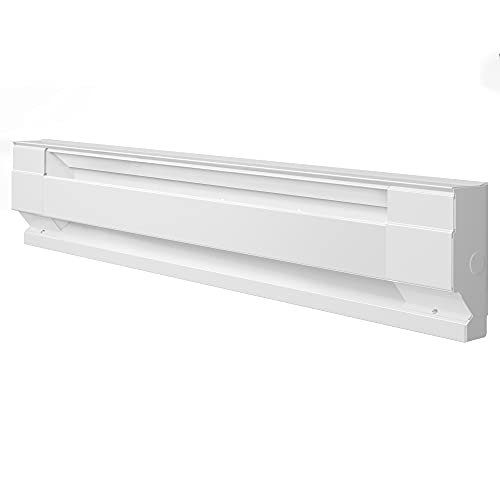
Cadet F Series 36 in. Baseboard Heater 3F750W, 750/563W — Best for Small Zones and Knee Walls
Every sunroom layout has an awkward remainder: the short wall beside the door, the knee wall under a low window run, the corner that stays cold because the main heater’s convection never quite reaches it. Cadet’s F Series 36-inch unit is built for that remainder. Its verified title is a model of honest specification — 2,560 BTU at 240V where it makes 750 watts, 1,925 BTU at 208V where it makes 563 — which is exactly the dual-rating transparency this guide keeps asking for, because a buyer on 208V service who sizes with the 240V number will underheat the room.
Cadet is one of the longest-standing names in North American baseboard heat, and the F Series is its basic, serviceable convection line: no fan, no noise, nothing much to fail. Use it as a supplement in a layout anchored by a KING or a Brava pair, or as the sole heater in a genuinely small three-season room — a tiny enclosed porch of 50–70 square feet. What it is not is a main heater for a medium glass room, and no honest review should let its low commitment tempt you into undersizing the room’s primary heat.
Strengths
- Dual rating stated honestly in the title — 750W at 240V, 563W at 208V
- Three-foot footprint fits knee walls and short wall sections nothing else here fits
- Simple convection design from a long-established baseboard brand
Trade-offs
- Modest output — a supplement or small-room unit, not a medium sunroom’s anchor
- Thermostat is a separate purchase
- Output at 208V drops by a quarter; 208V buildings must size with 563W
| Specification | Detail (from verified listing) |
|---|---|
| Output | 750W at 240V / 563W at 208V (per verified listing title) |
| Heat | 2,560 / 1,925 BTU (per verified listing title) |
| Length | 36 in (per verified listing title) |
| Voltage | 240/208 volt (per verified listing title) |
Best for: knee walls, short sections, and supplementing the cold corner of a layout anchored by a bigger unit / Not suited for: medium or large glass rooms as the only heater
Check the current price on Amazon

Stelpro Prima 500W 240V Low-Profile Baseboard Heater — Best Low-Profile Pick
The Prima’s design brief is discretion. Its verified title states a build 25% shorter than standard models, quiet convection, hardwired 240V operation, and coverage up to 50 square feet — again, a standard-room figure to derate for glass. In a three-season room, low sills are common: the window wall often starts close to the floor, and a standard-height baseboard can foul the trim or look clumsy beneath it. A low-profile unit slides into that architecture gracefully, and 500 watts is a sensible size for a small enclosed porch, a mudroom-style sunroom entry, or as a toe-warming supplement under a reading chair’s window.
Discipline about scale applies as ever. Fifty square feet of glass room is a small room, and the Prima is a small heater; pairing two of them along a longer low wall is a legitimate, good-looking strategy that also spreads heat more evenly than one concentrated source. Thermostat is sold separately. On a shared circuit, two Primas draw barely 4.2 amps combined at 240V, leaving generous headroom for the anchor heater — one of the quiet advantages of composing a layout from small verified units instead of gambling on one oversized one.
Strengths
- Low-profile build — 25% shorter than standard, per the verified title — suits low sills and knee walls
- Quiet convection for a seating room
- Small draw makes it easy to compose multi-unit layouts on one circuit
Trade-offs
- 500W is strictly small-zone duty; undersizing a whole room with it helps no one
- Thermostat sold separately
- Coverage claim needs the usual glass-room derating
| Specification | Detail (from verified listing) |
|---|---|
| Output | 500W at 240V (per verified listing title) |
| Coverage | Up to 50 sq ft in a standard room (per verified listing title) |
| Profile | 25% shorter than standard models (per verified listing title) |
| Voltage | 240V, hardwired (per verified listing title) |
Best for: small porches, low-sill walls, and as a paired supplement along a glass wall / Not suited for: any room over ~50 sq ft of glass-heavy space as the sole source
Check the current price on Amazon

Stelpro Brava 1000W / 240V with Built-In Thermostat Kit Bundle — Best with Thermostat Included
Most picks in this guide end with the same footnote — thermostat sold separately — and this bundle exists to delete it. The verified title describes a Brava heater at 1,000 watts on 240V (750 watts at 208V) with a built-in two-pole thermostat kit in the box, and it prints the unit’s full dimensions, 47⅛ inches long by 2⁹⁄₁₆ high, so you can measure the wall before ordering rather than after. For a single-heater room — a small sunroom, an enclosed porch — a built-in thermostat is the simplest possible control scheme: no wall box, no extra wiring run, one dial on the unit.
Know the built-in thermostat’s honest limitation before choosing it. A thermostat mounted on the heater reads the temperature at the heater, low on the wall where the warm air is just leaving — so the room’s far corner will run cooler than the dial suggests, and the unit may cycle more than a wall thermostat would. In a small room that barely matters; in a long room it does. Two-pole control is the right kind, since it can switch both legs of the 240V circuit for a true off. Sized honestly — a small, reasonably tight three-season room — this is the least-friction pick in the guide.
Strengths
- Thermostat included — a two-pole built-in kit, per the verified title
- Full dimensions printed in the title for pre-purchase measuring
- Dual rating stated: 1000W at 240V, 750W at 208V
Trade-offs
- Built-in thermostats sense temperature at the unit, not across the room
- 1,000W caps it at small-room or paired duty
- Less precise control than a wall-mounted programmable or smart thermostat
| Specification | Detail (from verified listing) |
|---|---|
| Output | 1000W at 240V / 750W at 208V (per verified listing title) |
| Dimensions | 47 1/8 in L × 2 9/16 in H (per verified listing title) |
| Thermostat | Built-in 2-pole kit included (per verified listing title) |
| Voltage | 240V (per verified listing title) |
Best for: small three-season rooms wanting the simplest possible single-unit install / Not suited for: long rooms needing sensing away from the heater, or anyone wanting programmable/smart control
Check the current price on Amazon

Cadet Electric Baseboard Heater, 208/240VAC — Best Dual-Rating Flexibility
Some buyers genuinely do not know whether their building delivers 208 or 240 volts — a condo, a rented outbuilding, a room whose panel schedule is illegible. This Cadet is the pick for them: its verified title rates it for 208/240VAC residential service and prints the current draw at each — 3.61 amps and 4.17 amps respectively — which tells a knowledgeable buyer the unit is a roughly 750–1,000 watt class heater and, more importantly, that the manufacturer has rated it for both services rather than leaving the question to chance.
The trade-off for that flexibility is specification thinness: the title gives amperage rather than a headline wattage and length, so confirm the physical size and exact output on the product’s specification sheet before composing a layout around it. Used with that one check done, it is a rational choice for the uncertain-service buyer and for anyone standardising heaters across properties with mixed services. Like every pick here it is a hardwired convection unit needing a line-voltage thermostat, sold separately.
Strengths
- Rated for both 208V and 240VAC service, stated in the verified title
- Current draw at each voltage printed in the title — real sizing data
- Cadet’s residential baseboard line is widely serviced
Trade-offs
- Title omits headline wattage and length — confirm both on the spec sheet
- Thermostat sold separately
- A compromise pick: buyers certain of 240V service may prefer a purpose-rated unit
| Specification | Detail (from verified listing) |
|---|---|
| Voltage | 208/240VAC (per verified listing title) |
| Current | 3.61 / 4.17 amps AC (per verified listing title) |
| Phase | 1 phase (per verified listing title) |
| Use | Residential (per verified listing title) |
Best for: buildings where the service might be 208V or 240V and the buyer refuses to guess / Not suited for: precision layouts that need a stated wattage and length up front
Check the current price on Amazon
Comparison Table
| Pick | Badge | Key spec | Best for |
|---|---|---|---|
| KING 6K2415-BW K Series Baseboard Heater, 6 ft / 1500W / 240V | Best Overall | 1500W / 240V, 6 ft | the main glass wall of a small-to-medium three-season room, as the anchor of the heating layout |
| Stelpro Brava 1250W 240V Baseboard Heater (AB51252W) | Best Quiet Convection Pick | 1250W / 240V, quiet convection | a pair flanking a medium sunroom, or a single unit in a small, better-insulated three-season room |
| Cadet F Series 36 in. Baseboard Heater 3F750W, 750/563W | Best for Small Zones and Knee Walls | 750W @240V / 563W @208V, 36 in | knee walls, short sections, and supplementing the cold corner of a layout anchored by a bigger unit |
| Stelpro Prima 500W 240V Low-Profile Baseboard Heater | Best Low-Profile Pick | 500W / 240V low-profile | small porches, low-sill walls, and as a paired supplement along a glass wall |
| Stelpro Brava 1000W / 240V with Built-In Thermostat Kit Bundle | Best with Thermostat Included | 1000W / 240V with thermostat kit | small three-season rooms wanting the simplest possible single-unit install |
| Cadet Electric Baseboard Heater, 208/240VAC | Best Dual-Rating Flexibility | 208/240VAC dual-rated, amps stated | buildings where the service might be 208V or 240V and the buyer refuses to guess |
How to Choose a 220 Volt Baseboard Heater for a 3 Season Room: Size for Glass, Not for Bedrooms
Bedroom sizing rules — often quoted around 10 watts per square foot for a normally insulated room — will betray you in a three-season room. A glass-heavy, lightly insulated sunroom can need half again to twice that figure to hold a comfortable temperature on a cold, windy autumn evening, because its heat loss is dominated by single or older double glazing and air leakage, not by floor area alone. Start from the room’s dimensions, then adjust honestly: floor-to-ceiling glass on two or three sides, a roof panel of polycarbonate, an uninsulated slab — each pushes you toward the higher end. The coverage figures printed in manufacturers’ titles, including several quoted in this guide, assume a standard room; derate them by roughly a third to a half for glass.
Then compose the layout. Heat belongs under the glass, where the cold downdraught forms, and a long room usually heats more evenly from two mid-size units on different walls than from one maximum-size unit at one end. Use the picks like building blocks: a 1,500W KING or a Brava pair as the anchor, a Cadet 750W or a Prima on the knee wall or short section, all of it checked against the circuit maths in the next section. Finally, leave the furniture out of it: baseboards need clear air — sofas and storage bins parked against them both waste the heat and create a genuine hazard.
- Measure the room and count the glass: more glass and more exposure means more watts per square foot.
- Put heat under the windows first; the downdraught is the comfort problem.
- Prefer two mid-size units over one hero unit in long or L-shaped rooms.
- Keep every heater’s full length clear of furniture, curtains and storage.
A last sizing honesty check: a three-season room has a temperature floor below which electric baseboard stops being the right tool. If you intend to hold 70°F in the room through genuine winter in a cold climate, the honest answer is usually insulation, better glazing, or a different heating system — not ever more baseboard. These picks own the shoulder seasons brilliantly; respect the boundary.
The Circuit Maths: How Much Baseboard Can One 240V Circuit Carry?
Heating is a continuous load, and electrical code treats it that way: a circuit feeding fixed electric heat should be loaded to no more than 80% of its breaker rating for continuous duty. On a 20-amp 240V circuit, that means 16 usable amps — about 3,840 watts of heater. On a 15-amp circuit, 12 amps — about 2,880 watts. Those two numbers are the real ceiling on your layout, and they explain why a long sunroom sometimes needs two circuits: a KING 1,500W plus a Brava 1,250W plus a Cadet 750W totals 3,500 watts, which fits the 20-amp ceiling with little to spare and does not fit a 15-amp circuit at all.
Convert any heater to amps with the title figures: amps = watts ÷ volts. The dual-rated picks complicate this in an instructive way — a heater that makes 1,000 watts at 240V makes only 750 at 208V, and it draws its current accordingly; the Cadet dual-rating pick prints both amp figures in its title precisely so this maths can be done without guessing. On 208V service, use the 208V output for room sizing and the 208V amps for circuit sizing, every time.
All of this work — new circuits, breaker sizing, hardwired connections — is licensed-electrician territory in most jurisdictions, and baseboard installs also carry placement rules about receptacles above heaters and clearances. Get the circuit plan approved before the heaters are ordered; discovering the ceiling after the drywall is open is the expensive order of operations.
Thermostats: The Half of the System Buyers Forget
A baseboard heater without a thermostat plan is half a purchase. Every pick here except the Brava bundle needs a line-voltage thermostat — not a low-voltage thermostat from a furnace system, which cannot switch 240V heater current. The options, in ascending order of intelligence: a built-in unit thermostat (simplest, senses at the heater), a mechanical or electronic wall thermostat (senses room air properly), a programmable line-voltage model (setback schedules for a room used at predictable times), and a smart line-voltage thermostat such as the Mysa Smart Thermostat V2 or the meross Matter model — both verified in our research with 120–240V ratings printed in their titles — which add app control, scheduling and geofencing to dumb resistance heat.
Two sizing rules govern the match. The thermostat’s wattage or amperage rating must meet or exceed the total heater load it switches — a thermostat rated 2,500W cannot control 3,500W of baseboard, a mismatch we flag because it is common and quietly dangerous. And a single-pole thermostat never fully disconnects a 240V heater — one leg stays live — so two-pole models are the safer default for rooms where the heater will be serviced or where children can reach the dial. For a three-season room used on weekend mornings and autumn evenings, a programmable or smart thermostat is not a luxury: pre-warming the room before you carry the coffee out is the entire point of the room.
Living With the Room: Shoulder-Season Patterns That Make Baseboards Shine
A three-season room has a daily rhythm that suits zoned electric heat unusually well. The room is coldest at dawn, pleasant by solar gain at midday even in spring, and chilly again by evening — a pattern that punishes whole-house heating (which would overheat the interior rooms to serve the glass box) and rewards a dedicated zone with its own thermostat and schedule. Programme the baseboards to pre-warm the room thirty to forty-five minutes before its predictable uses — morning coffee, the evening read, weekend lunches — and to set back, not switch off, between them. Setback depth is the subtle art: dropping to a freeze-safe background in the depths of an unused week saves real money, while shallow setbacks on a daily cycle keep recovery quick and the room’s furnishings and plants out of the deep-chill zone entirely.
Moisture is the room’s second climate problem and the one buyers forget. Warm house air meeting cold glass makes condensation; condensation makes mould at the frames and sills. Baseboard heat under the glass is, quietly, a condensation control system: the rising warm air washes the pane and raises its surface temperature above the dew point more of the time. That is one more reason the guide insists on placing heat under the windows rather than on the house wall — the comfortable layout and the dry layout are the same layout. On the coldest evenings, a small amount of ventilation or a dehumidifier may still be needed; watch the corners and the north-facing panes, where the story shows first.
Furnishing the heated room completes the system. Keep the baseboards’ full length clear, as the mistakes section demands, and then go one step further: arrange seating in the convection path rather than against the cold glass, use rugs to take the slab’s chill off feet (a cold floor makes a warm room feel five degrees cooler), and consider the ceiling fan, if the room has one, on its winter setting to push pooled warm air back down. None of these cost a watt of heater capacity, and together they are worth roughly a size class of heater — the cheapest capacity in this entire guide.
A Worked Example: Sizing a Real Sunroom From These Picks
Make the method concrete with a typical room: a 10-by-14-foot sunroom, 140 square feet, glass on two sides, a polycarbonate roof panel, slab floor, in a climate where autumn evenings fall to around freezing. Bedroom maths would say 1,400 watts and be wrong. Applying this guide’s glass-room range of roughly 15–20 watts per square foot gives a target of about 2,100–2,800 watts. A natural composition from the picks: the KING 1,500W along the long glass wall as the anchor, and a Stelpro Brava 1,250W on the short glass wall — 2,750 watts total, at the top of the range because the roof panel and slab both argue upward. Combined draw at 240V is about 11.5 amps, comfortably inside a 20-amp circuit’s 16-amp continuous ceiling, with the thermostat — a programmable line-voltage model rated well above the load — sensing at sitting height on the house wall.
Now shrink the example: an 8-by-10-foot enclosed porch, better built, single glass wall. Eighty square feet at the same range targets roughly 1,200–1,600 watts — but the room’s shorter walls change the composition. The Brava bundle at 1,000W, with its included thermostat, plus a Prima 500W under the low sill on the side wall gives 1,500 watts, two gentle sources instead of one, and the simplest control scheme in the guide. Total draw is about 6.3 amps — a circuit so unstressed that the electrician’s visit is mostly about placement and code clearances.
The pattern to copy is not the specific shopping list; it is the sequence. Measure, apply the glass-room range honestly, compose from verified units whose outputs you can state, sum the amps against the circuit ceiling, and place the sensing where people sit. Any sunroom in this guide’s audience can be sized in fifteen minutes with that sequence and a tape measure — which is fifteen minutes that decides whether the room gets used in October or merely looked at.
Extending the Season: Pairing Heat With the Room’s Other Systems
A three-season room’s season is negotiable at both ends, and the baseboard system this guide builds is the enabling layer for most of the negotiations. In spring, the room becomes usable weeks before the garden does, because a sunny midday plus stored morning heat from the baseboards bridges the cold edges of the day. In autumn, the same system holds the room’s usefulness until the genuinely cold weather arrives. Owners who add ceiling insulation or shade and thermal curtains over the largest glass are not changing the heater maths so much as changing the room the maths describes — every improvement to the envelope is worth watts the circuit never has to carry, and the worked example in this guide can be rerun, happily downward, after each improvement.
The room’s relationship with the house deserves one deliberate decision. Many three-season rooms keep a door to the interior that can stand open, letting house heat spill in — a fine strategy in mild weather and a quiet tax in cold, when the glass room becomes the house’s largest heat leak wearing a door frame. The zoned baseboard approach assumes the door mostly closed and the room heated as its own climate, which is both the comfortable and the honest accounting. If your household prefers the open-plan pattern, size the baseboards as the supplement they will actually be, and accept that the house system is doing unmeasured work.
Plants, pipes and furnishings vote on the setback policy too. A sunroom full of tender plants has a minimum temperature set by biology, not by energy preference; a room with any plumbing in its walls has a freeze floor set by physics. The programmable thermostat’s background setting should be chosen as the highest of those floors — energy savings never outrank a burst pipe or a dead collection of orchids. Set that floor deliberately, write it on the thermostat’s schedule notes, and the system will protect the room through every unattended cold snap without a single anxious drive home.
How to Install a Hardwired Baseboard Heater in a Sunroom (Planning Overview)
This is a planning overview so you can scope the work and brief an electrician intelligently. Hardwired 240V installation is governed by electrical code, and in most places the circuit work requires a licensed electrician and a permit. The steps below describe a competent install in order — where a step is code or licence territory, that is stated, not implied.
- Confirm the circuit plan first: total heater wattage against the 80% continuous-load ceiling of the intended 240V circuit, with breaker and wire sized by the electrician.
- Mark heater positions under the glass, keeping full lengths clear of doors’ swing, curtains and planned furniture, and respecting manufacturer clearances from the floor and adjacent walls.
- Run or extend the 240V circuit to the thermostat location and on to each heater, in the order the chosen control scheme requires.
- Mount the heaters level on the wall studs or with appropriate anchors, keeping the convection fins unobstructed.
- Connect each heater and the line-voltage thermostat per the manufacturer’s wiring diagram for two-pole or single-pole control as designed — connections inside approved boxes only.
- Set the thermostat, restore power at the breaker, and verify each unit warms evenly along its length with no discolouration, smell beyond the initial new-element burn-off, or breaker warmth.
- Test the room on a cold evening and note the far corner’s temperature versus the thermostat reading; adjust layout expectations — or add the supplement unit — based on measurement, not hope.
Label the breaker with the room it serves. A three-season room’s heat is exactly the circuit a future owner will puzzle over, and a labelled panel is a small kindness that prevents a cold weekend.
Common Buying Mistakes
Sizing with bedroom rules. Ten watts per square foot heats a bedroom. A glass room can need half again to double. Derate every standard-room coverage claim in this guide accordingly.
Buying a 120V plug-in baseboard by mistake. They share names and photos with hardwired units and cannot do this job. Every pick here has its 240V-class rating in its verified title — imitate that check on any substitute.
Overloading one circuit. Continuous heating loads are capped at 80% of breaker rating. Do the watts-to-amps maths before ordering the third heater.
Forgetting the thermostat’s own rating. The thermostat must be rated for the total load it switches, and it must be a line-voltage model. A furnace thermostat on a 240V heater circuit is a dangerous mismatch.
Parking furniture against the heater. It strangles convection and creates a fire risk. A baseboard’s full length needs clear air, permanently.
Using 240V output figures on a 208V building. Dual-rated heaters make roughly a quarter less heat at 208V. Size the room with the lower number, as the dual-rated titles in this guide let you do.
Final Recommendation
For most three-season rooms, start with the KING 1,500W under the main glass wall and be honest about what remains: if the room is long, add the Stelpro Brava on the opposite wall rather than hoping one heater reaches; if the room is small and tight, the Brava bundle with its included thermostat is the simplest complete answer. Fill knee walls and cold corners with the Cadet 750W or the low-profile Prima, keep the whole layout inside the circuit ceiling, and finish with a line-voltage thermostat rated for the total load — smart if the room is used on a schedule, which three-season rooms almost always are.
Buyers weighing hardwired heat for other rooms should read our wider Best 220 Volt Heater roundup next, and those whose sunroom also needs summer help will find the circuit discussion in the Best 220 Volt Air Conditioner guide directly relevant — the same 240V discipline governs both sides of the year.
Best 220 Volt Heater Best 220 Volt Air Conditioner Best 220 Volt Garage Heater Best 20 Gallon 220 Volt Water Heater Best 220 Volt Hot Tub
Frequently Asked Questions
How many watts does a 3 season room actually need?
More than a normal room of the same size. Standard-room guidance is around 10 watts per square foot; a glass-heavy, lightly insulated sunroom commonly needs roughly 15–20 watts per square foot to stay comfortable on cold shoulder-season evenings. When in doubt, compose two mid-size units rather than maxing one.
Can one 240V circuit run all my baseboards?
Up to its continuous-load ceiling: about 3,840 watts on a 20-amp 240V circuit, or about 2,880 watts on a 15-amp circuit. Add up the heaters’ wattages (using 208V figures on 208V service) and keep the total under the ceiling for your circuit.
Why does my heater make less heat on 208V?
Resistance heaters produce output proportional to the square of the voltage ratio, so a unit rated 1,000W at 240V makes about 750W at 208V. The dual-rated picks in this guide print both figures in their titles — size your room with the number that matches your building.
Do I need a special thermostat for baseboard heat?
Yes — a line-voltage thermostat rated at or above the total heater load it switches. Smart options exist: the Mysa Smart Thermostat V2 and meross Matter thermostat both carry 120–240V ratings in their verified titles and add scheduling and app control.
Can I plug a 240V baseboard into an outlet?
No. These are hardwired appliances on a dedicated circuit, installed to code. Plug-in baseboards are 120V portables — a different, much weaker category that this guide deliberately excludes.
Where should the heaters go in the room?
Under the glass, where cold downdraughts form, spread across walls rather than concentrated at one end, with their full length kept clear of furniture and curtains.