Disclosure: airfryerkitchensupply.com is reader-supported. When you buy through links on our site, we may earn an affiliate commission at no extra cost to you.
Where to Buy
This guide covers the best 14000 btu 220 volt window air conditioner — what actually exists, what we verified, and which picks fit which rooms and budgets. Every model in this guide was verified against Amazon’s own product data before it earned a link, and the short version of this guide is honest: a true window-chassis air conditioner that is exactly 14,000 BTU and wired for 220–230 volts is one of the rarest combinations in the category. The picks below are the closest verified matches — one exact-capacity inverter window unit whose voltage variant you must confirm on the listing, two 14,000 BTU 230V through-the-wall units, and three genuine 230V window units one size up. Use the links to check the current price on Amazon and, just as importantly, to confirm the voltage and plug printed on the listing before you order.
- Keystone 14,000 BTU Window Mounted Inverter Air Conditioner (Best Exact-Capacity Window Chassis) — Check on Amazon
- LG 14,000 BTU Through the Wall Air Conditioner, 230/208V (Best Confirmed 230V at Exactly 14,000 BTU) — Check on Amazon
- TCL 14,000 BTU Smart Through-the-Wall Air Conditioner with Heater, 230V (Best 230V Exact-Capacity Pick With Heat) — Check on Amazon
- LG 18,000 BTU Window Air Conditioner with Heat, 230/208V (Best True Window Chassis on 230V Power) — Check on Amazon
- LG 18,000 BTU Dual Inverter Window Air Conditioner, 230V (Best Premium 230V Window Pick) — Check on Amazon
- Frigidaire 18,000 BTU Smart Window Air Conditioner with Heater, 208/230V (Best 230V Pick for Heating and Cooling) — Check on Amazon
If you are shopping for the best 14000 btu 220 volt window air conditioner, you have probably already discovered the problem: most 14,000 BTU window units sold in the United States are wired for a standard 115-volt household outlet, and most 230-volt window units start at 18,000 BTU and go up from there. The exact intersection of 14,000 BTU and 220–230 volts is a genuinely thin slice of the market, and this guide will not pretend otherwise. Instead of padding the list with standard-voltage models and hoping you do not notice, we verified what actually exists, labeled every pick with its real voltage and chassis type, and explained exactly which compromise each one asks you to make.
That honesty matters because the voltage half of this search is not a preference — it is a wiring fact about your room. A 230-volt air conditioner needs a 230-volt receptacle on a dedicated circuit, usually with a tandem or perpendicular plug that will not fit a normal outlet. If your room already has that receptacle — common in older homes, workshop conversions, and rooms that once held a large older unit — then a 230V model is the right tool and a 115V model on an adapter is not a safe substitute. If your room does not have the receptacle, the cheapest path is usually a 115V 14,000 BTU unit, not an electrician visit, and the guide below explains how to make that call before you spend anything.
Capacity is the other half of the decision. Fourteen thousand BTU is the classic size for a large living room, an open-plan kitchen and dining space, or a primary bedroom suite — roughly 550 to 700 square feet depending on ceiling height, sun exposure, and how many people and heat-producing appliances share the space. Every pick here sits at 14,000 BTU or one step above it, and the step-up models are included for a practical reason: on a 230-volt circuit, the 18,000 BTU class is where the selection, the inverter technology, and the heating options actually live.
In this guide
Quick Picks
Six verified picks, ordered by how closely they match the exact brief. Badges are used again at the top of each full review so you can scan either list.
- Best Exact-Capacity Window Chassis: Keystone 14,000 BTU Window Mounted Inverter Air Conditioner — the only verified true window-chassis unit at exactly 14,000 BTU in this guide, with an inverter compressor and remote control — but its listing title does not state the voltage, so confirming the 230V variant on the listing page is a mandatory step, not a formality. — Check on Amazon
- Best Confirmed 230V at Exactly 14,000 BTU: LG 14,000 BTU Through the Wall Air Conditioner, 230/208V — exactly 14,000 BTU on confirmed 230/208-volt power, rated for 700 square feet, with electronic controls and a remote — in a through-the-wall chassis that needs a wall sleeve instead of a window. — Check on Amazon
- Best 230V Exact-Capacity Pick With Heat: TCL 14,000 BTU Smart Through-the-Wall Air Conditioner with Heater, 230V — 14,000 BTU on confirmed 230V power with a built-in heater, dehumidifier mode, remote, and voice-assistant support through Wi-Fi — again in a through-the-wall chassis. — Check on Amazon
- Best True Window Chassis on 230V Power: LG 18,000 BTU Window Air Conditioner with Heat, 230/208V — a genuine window chassis on confirmed 230/208V power with supplemental heat, cooling up to 1,000 square feet, a remote, and a 24-hour timer — one capacity step above the brief. — Check on Amazon
- Best Premium 230V Window Pick: LG 18,000 BTU Dual Inverter Window Air Conditioner, 230V — dual-inverter drive on confirmed 230V power with Wi-Fi, voice control, and an Energy Star listing claim — the quietest, steadiest way to cool a large room from a window. — Check on Amazon
- Best 230V Pick for Heating and Cooling: Frigidaire 18,000 BTU Smart Window Air Conditioner with Heater, 208/230V — 18,000 BTU of cooling plus a 16,000 BTU heater on 208/230V power, with dehumidification, Wi-Fi, and a remote — a four-season window unit for big rooms. — Check on Amazon
How These Picks Were Chosen
We started with a simple rule: no model could appear here unless its listing data could be checked directly, and no model could be described as something it is not. Every pick below was cross-checked against the manufacturer’s listing, and the specifications in each mini spec box come only from that verified listing data — voltage, capacity, coverage, and control type exactly as the listing states them. Where a listing does not print a specification, the review says so instead of guessing.
From there we ranked by fit to the brief in a strict order. First, does the unit actually run on 208/230 volts, since that is the hard electrical constraint? Second, is it a window chassis, a through-the-wall chassis, or a hybrid that can do both? Third, how close is the cooling capacity to 14,000 BTU? A verified 230V through-the-wall unit at exactly 14,000 BTU ranks above a 115V window unit at the same capacity for this particular keyword, because changing a sleeve is a carpentry job while changing a circuit is an electrical one — but both kinds of compromise are flagged in plain language in each review.
We also weighed the things that decide whether you keep a big air conditioner after the first month: inverter compressors that can idle down instead of cycling on and off, supplemental heat for shoulder seasons, remote and smart controls, and how much window or wall opening the chassis demands. Noise claims are treated cautiously throughout — we describe the technology that tends to make a unit quieter rather than printing decibel figures we cannot verify for your exact installation.
The 6 Best 14000 BTU 220 Volt Window Air Conditioner Options, Verified
A note on ordering before you read: the first pick is the only true window-chassis unit at exactly 14,000 BTU, and its listing does not print the voltage in its title, so it carries an explicit verification step. Picks two and three are exactly 14,000 BTU and confirmed 230V, but they are through-the-wall chassis. Picks four through six are true window units on confirmed 230V power, one capacity step up. Read the chassis and voltage lines first; they are the whole ballgame for this search.
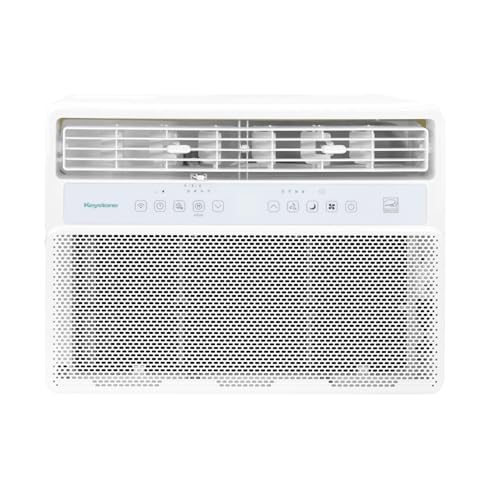
Keystone 14,000 BTU Window Mounted Inverter Air Conditioner — Best Exact-Capacity Window Chassis
This Keystone is the closest thing to the exact product this search describes: a window-mounted chassis, an inverter compressor, and exactly 14,000 BTU of cooling rated for rooms up to 650 square feet. Inverter drive is a real advantage at this size, because a 14,000 BTU unit is powerful enough to short-cycle a room it slightly overcools, and an inverter that can throttle down holds temperature more evenly and usually runs quieter at part load.
The catch is stated in its own spec box above: the verified listing title does not print the voltage. Keystone sells window inverter units in more than one electrical configuration, and the only responsible way to buy this model for a 220-volt brief is to open the listing, confirm the voltage and plug type in the product specifications, and only then check out. If the listing in front of you says 115 volts, it is not the unit for a 230V receptacle — walk away and take pick two or three instead.
Strengths
- Exactly 14,000 BTU in a true window chassis — no wall sleeve required
- Inverter compressor modulates output instead of hard on/off cycling
- Rated coverage up to 650 sq. ft. matches the classic 14,000 BTU room size
Trade-offs
- Voltage is not stated in the listing title and must be confirmed before ordering
- Window inverter models at this capacity are a small niche, so stock can be inconsistent
- Like all big window units, it is heavy and a two-person install
| Capacity | 14,000 BTU (listing title) |
| Type | Window mounted inverter air conditioner (listing title) |
| Coverage | Rooms up to 650 sq. ft. (listing title) |
| Controls | Remote control (listing title) |
| Voltage | Not stated in listing title — verify on the listing before ordering |
Who should shortlist it? Anyone whose window opening is standard, whose room is in the 550–650 square foot range, and who is willing to do the two-minute voltage check on the listing. The inverter also makes this the most forgiving pick if your room is at the small end of the range: instead of blasting cold air and shutting off, it can settle into a lower steady output, which is exactly the behavior you want in a bedroom-adjacent living space.
Installation is conventional window-unit work: a sturdy sill, the included mounting hardware properly leveled with a slight outward tilt for condensate, side panels sealed, and foam insulation in the gaps. What it does not need — if the listing confirms the 230V variant — is any change to the window itself. Budget an afternoon, a second pair of hands, and a careful read of the plug before the box is opened, because discovering a plug mismatch with the unit half-lifted is the classic failure mode of this entire category.
Best for: buyers who want exactly 14,000 BTU in a window chassis and will verify the voltage variant on the listing first / Not suited for: anyone who needs guaranteed 230V confirmation without a listing check — take the through-the-wall or step-up picks instead
Check the current price on Amazon
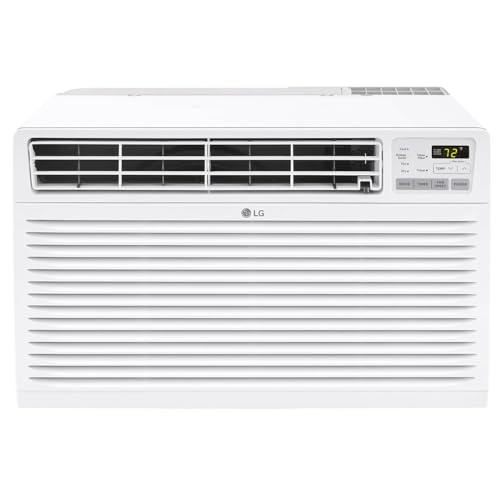
LG 14,000 BTU Through the Wall Air Conditioner, 230/208V — Best Confirmed 230V at Exactly 14,000 BTU
If the non-negotiable parts of your brief are the capacity and the voltage — exactly 14,000 BTU, definitely 230 volts — this LG is the most honest match in the guide. Its verified listing states both numbers outright: 14,000 BTU, 230/208V, cooling up to 700 square feet, with electronic controls and a remote. There is no verification homework and no variant ambiguity.
What you trade away is the window. This is a through-the-wall chassis, designed to slide into a wall sleeve — the framed, flashed opening that many apartments, condos, hotels, and older homes already have. If your room already has a sleeve, this is arguably a better installation than any window unit: more secure, better sealed, and it leaves the window free. If your room does not have a sleeve, adding one is a real construction job involving cutting the wall, framing, and weatherproofing, and that cost belongs in your decision.
Strengths
- Capacity and voltage both confirmed in the listing — 14,000 BTU at 230/208V
- Through-the-wall install is permanent, secure, and frees the window
- 700 sq. ft. coverage is the strongest rating among the exact-capacity picks
Trade-offs
- Requires an existing wall sleeve or a construction project to add one
- Cannot be moved to another room or taken with you easily
- No supplemental heat in this configuration
| Capacity | 14,000 BTU (listing title) |
| Voltage | 230/208V (listing title) |
| Coverage | Cools 700 sq. ft. (listing title) |
| Controls | Electronic control with remote (listing title) |
Through-the-wall units reward a specific kind of buyer: someone who knows the room, knows the circuit, and wants the question settled for a decade. The sleeve standard matters — measure your existing sleeve’s interior dimensions and compare them with the chassis before ordering, because ‘universal’ in this category means ‘fits most sleeves with a trim kit’, not ‘fits everything’. LG’s electronic controls and remote are conventional and proven, which at this size is a compliment: the failure points on big units are compressors and control boards, and boring, mature controls are a feature.
Electrically, this is the straightforward pick of the six. A 230/208V unit on a dedicated circuit with the correct receptacle is a plug-in installation once the sleeve is ready. If you are replacing a dead through-the-wall unit, this is very likely the least-friction path in the entire guide — same hole, same circuit, same capacity class, modern controls.
Best for: rooms that already have a wall sleeve and a 230V circuit, and replacements for dead through-the-wall units / Not suited for: renters or anyone who cannot modify a wall — a window chassis is the only realistic route
Check the current price on Amazon
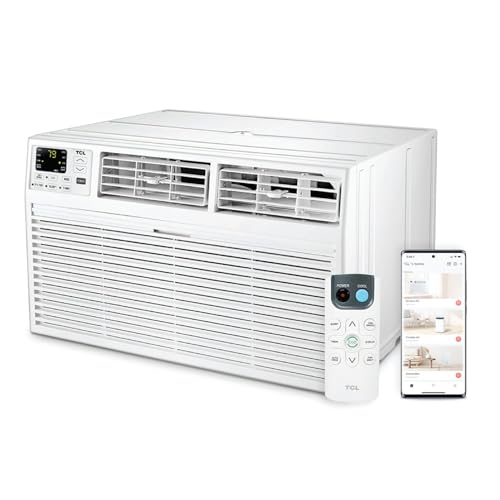
TCL 14,000 BTU Smart Through-the-Wall Air Conditioner with Heater, 230V — Best 230V Exact-Capacity Pick With Heat
The TCL takes the same honest foundation as the LG above — exactly 14,000 BTU, confirmed 230V, through-the-wall chassis — and adds the two features that most often decide between otherwise similar units: supplemental electric heat and smart control. The heater will not replace a furnace, but in a room that runs cold in October and April, a wall unit that can take the chill off without firing the whole heating system earns its keep twice a year.
Wi-Fi control with Alexa and Google Assistant support sounds like a luxury until you live with a wall unit mounted high or across a large room; scheduling, pre-cooling before you get home, and adjusting the setpoint from the sofa are the features owners actually use. The dehumidifier mode is the third quiet win — in humid climates, a muggy 74 degrees feels worse than a dry 76, and a dedicated dry mode handles shoulder-season stickiness without overcooling.
Strengths
- Exact 14,000 BTU and confirmed 230V, like the LG, plus a built-in heater
- Wi-Fi scheduling and voice control suit high or distant installations
- Dehumidifier mode handles humid shoulder seasons without overcooling
Trade-offs
- Through-the-wall chassis still requires a sleeve — no window option
- Smart features depend on your Wi-Fi reaching the unit reliably
- Supplemental heat is for shoulder seasons, not primary winter heating
| Capacity | 14,000 BTU (listing title) |
| Voltage | 230V (listing title) |
| Extras | Heater, dehumidifier, remote control (listing title) |
| Smart | Wi-Fi, works with Alexa and Google Assistant (listing title) |
Choose between this TCL and the LG above on two questions. First, do you want heat? If the room is a sunroom, a finished basement, a workshop, or any space that is used year-round but heated unevenly, the TCL’s heater is a genuine functional difference, not a badge. Second, do you want the app? If the unit will live in a rental unit you manage, a guest room, or a space you want to pre-cool remotely, smart control pays for itself in convenience quickly.
If the answer to both is no, the LG’s simpler proposition is the better buy. Either way, the sleeve measurement advice from the LG review applies word for word: interior sleeve dimensions first, order second. And as with every 230V pick here, confirm that your receptacle’s configuration matches the plug before the delivery truck is booked.
Best for: year-round rooms with a wall sleeve that need shoulder-season heat and remote scheduling / Not suited for: buyers who want the simplest possible cool-only unit, or any room without a sleeve
Check the current price on Amazon
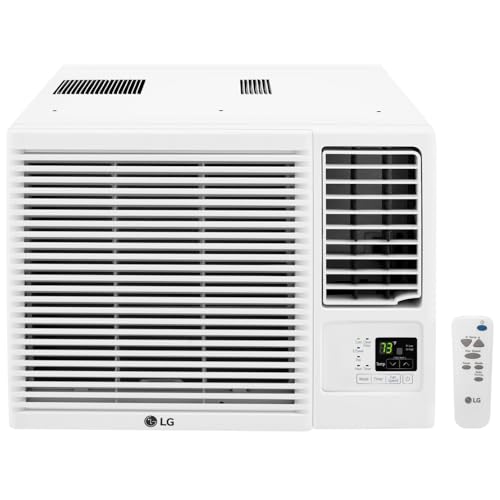
LG 18,000 BTU Window Air Conditioner with Heat, 230/208V — Best True Window Chassis on 230V Power
This is the pick for the buyer whose brief is really ‘window chassis, 230 volts, big room’ and whose 14,000 BTU figure was an estimate rather than a measurement. It is a true window unit — no sleeve, no wall work — running on confirmed 230/208V power, with supplemental heat, a remote, two speeds, and a 24-hour timer, rated by its listing to cool up to 1,000 square feet. In the real 230V window market, this class of machine is the mainstream; the 14,000 BTU 230V window unit is the unicorn.
The step up in capacity cuts both ways and the review should say so plainly. In a 700–1,000 square foot space — a big open-plan floor, a garage conversion, a small commercial room — 18,000 BTU is simply correct sizing, and a 14,000 BTU unit would run flat out and still lose ground on hot afternoons. In a 550 square foot room, the same unit is oversized: it will cool the air fast, satisfy the thermostat before it has wrung out the humidity, and leave the room cold and clammy. Sizing honesty is worth more than a matching number on the box.
Strengths
- True window installation on confirmed 230/208V power — the mainstream 230V format
- Supplemental heat extends the unit’s usefulness into spring and autumn
- Capacity headroom suits open-plan spaces up to its 1,000 sq. ft. rating
Trade-offs
- Oversized for rooms under roughly 650 sq. ft. — short-cycling and humidity problems follow
- Heavier than the 14,000 BTU class; check window and sill strength
- Two fan speeds is basic next to the inverter pick below
| Capacity | 18,000 BTU (listing title) |
| Voltage | 230/208V (listing title) |
| Coverage | Cools 1,000 sq. ft. (listing title) |
| Controls | Remote, 2 speeds, 24-hour timer (listing title) |
Think of this LG as the default answer when the room is genuinely large. Finished basements with low ceilings are the exception that proves the sizing rule — they often need less capacity than their square footage suggests because they are shaded and earth-sheltered — while sun-drenched great rooms with west-facing glass need every BTU of the rating and sometimes more. The 24-hour timer is the feature to use aggressively: pre-cooling a big space before the afternoon peak is both more comfortable and easier on the unit than a cold start at 5 p.m.
On the electrical side, nothing here is exotic: a dedicated 230V circuit and the matching receptacle, which is precisely the infrastructure this search assumes you have. If you are upgrading from an older 230V window unit, measure the old chassis and your window width anyway — modern big-chassis units are not all the same width, and discovering a two-inch problem on installation day is a rite of passage best avoided.
Best for: large rooms, open-plan floors, and garage conversions with a 230V receptacle and a strong window / Not suited for: rooms under about 650 sq. ft., where the exact-capacity picks will dehumidify better
Check the current price on Amazon
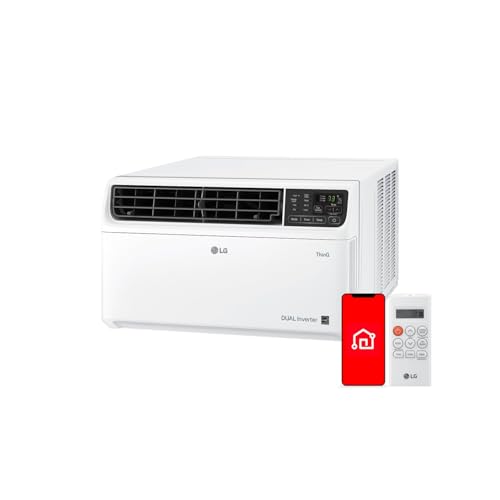
LG 18,000 BTU Dual Inverter Window Air Conditioner, 230V — Best Premium 230V Window Pick
If the budget stretches, this is the most refined machine in the guide. LG’s dual inverter platform on a confirmed 230V window chassis addresses the two complaints that define big window air conditioners — noise and temperature swing — at the source: a compressor that varies its speed continuously instead of slamming on and off. The listing also carries an Energy Star designation and ultra-quiet positioning, and while we do not print unverifiable decibel numbers, the underlying technology genuinely is the quiet approach to large-capacity cooling.
Wi-Fi through LG ThinQ plus Alexa and Google Assistant compatibility rounds out a package aimed at rooms where the unit is a permanent fixture rather than a seasonal appliance. At 18,000 BTU this is a machine you install once, seal carefully, and manage from your phone — scheduling around your day, nudging the setpoint at night, and letting the inverter sip power while it holds the room steady.
Strengths
- Dual inverter drive is the strongest noise and efficiency technology in this guide
- Confirmed 230V window chassis — no sleeve, no variant ambiguity
- Full smart control: app scheduling plus Alexa and Google Assistant
Trade-offs
- Premium tier pricing within this category — check price on Amazon
- Still 18,000 BTU: oversizing a small room wastes the inverter’s finesse
- Smart features add setup steps that the basic picks do not have
| Capacity | 18,000 BTU (listing title) |
| Voltage | 230V (listing title) |
| Drive | Dual Inverter (listing title) |
| Smart | Wi-Fi and remote, LG ThinQ, Alexa and Google Assistant compatible (listing title) |
The inverter changes the ownership experience in ways a spec sheet undersells. Conventional big units cool in bursts: full blast, thermostat satisfied, silence, warm creep, full blast again. An inverter unit finds the speed that exactly offsets the heat leaking into the room and stays there, which means steadier temperature, steadier humidity removal, and a steadier, lower sound floor. For a primary living space or a bedroom suite — the rooms 14,000-to-18,000 BTU units usually serve — that steadiness is the difference between an appliance you tolerate and one you forget.
Buy it if your room is honestly in the 700–1,000 square foot class, your 230V receptacle is in place, and the unit will stay installed for years. The premium buys refinement you will feel every day, not features you will use once. If the room is smaller or the installation is temporary, the money is better spent on an exact-capacity pick and good sealing foam.
Best for: permanent installations in large living spaces where noise and steady temperature matter most / Not suited for: small rooms, temporary installs, or buyers who will never use app control
Check the current price on Amazon
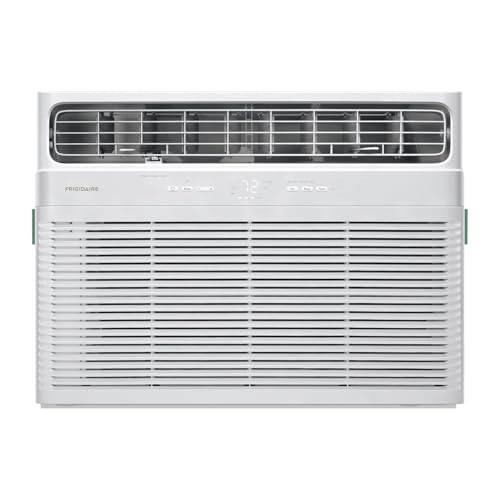
Frigidaire 18,000 BTU Smart Window Air Conditioner with Heater, 208/230V — Best 230V Pick for Heating and Cooling
Frigidaire’s entry is the four-season argument in this guide: 18,000 BTU of cooling, a 16,000 BTU supplemental heater, dehumidification, Wi-Fi, and a remote, all in a window chassis running on 208/230V power. The heating capacity deserves emphasis — at 16,000 BTU it is substantially more than the token heat strips fitted to many combination units, enough to genuinely warm a large room in cool weather rather than merely taking the edge off.
That makes this the natural pick for spaces that live on their own climate island: the room over the garage, the finished attic, the workshop, the rental flat with uneven central heat. One appliance, one window, one circuit, and the room is handled in January as well as July — with the honest caveat, repeated in the trade-offs, that electric resistance heat is the most expensive way to warm a room and should supplement, not replace, an efficient primary system where one exists.
Strengths
- The strongest heater in this guide at 16,000 BTU — real shoulder-season and mild-winter capacity
- Confirmed 208/230V window chassis with smart control and dehumidification
- One unit covers cooling, heating, and drying for an outlying room
Trade-offs
- Electric heat is costly to run as a primary source in cold climates
- 18,000 BTU cooling is oversized for smaller rooms, as with picks four and five
- Combination units have more components and more to maintain
| Cooling | 18,000 BTU (listing title) |
| Heating | 16,000 BTU heater (listing title) |
| Voltage | 208V/230V (listing title) |
| Extras | Dehumidifier, Wi-Fi and remote control (listing title) |
Run the ownership math before you fall for the four-season pitch. If the room needs heat twenty nights a year, this unit is a bargain in convenience. If it needs heat a hundred nights a year in a cold climate, a dedicated efficient heat source will cost less to run, and this Frigidaire becomes an expensive habit. The dehumidifier mode, by contrast, is cheap to run and underused: in a basement-adjacent or coastal room it can be the difference between a space that smells stored and a space that feels lived in.
Against the LG dual inverter pick, the trade is refinement versus versatility. The LG cools more quietly and efficiently; the Frigidaire heats far more seriously and still cools the same class of room. Pick the one that matches the season that bothers you most.
Best for: outlying rooms — over-garage, attic, workshop, granny flat — that need real heat as well as cooling on a 230V circuit / Not suited for: cooling-only briefs, small rooms, or homes where electric heat would become the primary winter system
Check the current price on Amazon
Comparison Table
| Pick | Badge | Key Spec | Best For |
|---|---|---|---|
| Keystone 14,000 BTU Window Mounted Inverter Air Conditioner Check on Amazon | Best Exact-Capacity Window Chassis | 14,000 BTU inverter, window mounted, up to 650 sq. ft., remote | buyers who want exactly 14,000 BTU in a window chassis and will verify the voltage variant on the listing first |
| LG 14,000 BTU Through the Wall Air Conditioner, 230/208V Check on Amazon | Best Confirmed 230V at Exactly 14,000 BTU | 14,000 BTU, 230/208V, through-the-wall, up to 700 sq. ft. | rooms that already have a wall sleeve and a 230V circuit, and replacements for dead through-the-wall units |
| TCL 14,000 BTU Smart Through-the-Wall Air Conditioner with Heater, 230V Check on Amazon | Best 230V Exact-Capacity Pick With Heat | 14,000 BTU, 230V, through-the-wall, heater and dehumidifier, Wi-Fi | year-round rooms with a wall sleeve that need shoulder-season heat and remote scheduling |
| LG 18,000 BTU Window Air Conditioner with Heat, 230/208V Check on Amazon | Best True Window Chassis on 230V Power | 18,000 BTU, 230/208V, window chassis, heat, up to 1,000 sq. ft. | large rooms, open-plan floors, and garage conversions with a 230V receptacle and a strong window |
| LG 18,000 BTU Dual Inverter Window Air Conditioner, 230V Check on Amazon | Best Premium 230V Window Pick | 18,000 BTU, 230V, dual inverter, Wi-Fi and voice control | permanent installations in large living spaces where noise and steady temperature matter most |
| Frigidaire 18,000 BTU Smart Window Air Conditioner with Heater, 208/230V Check on Amazon | Best 230V Pick for Heating and Cooling | 18,000 BTU cooling, 16,000 BTU heat, 208/230V, Wi-Fi | outlying rooms — over-garage, attic, workshop, granny flat — that need real heat as well as cooling on a 230V circuit |
How to Choose a 14000 BTU 220 Volt Window Air Conditioner
Start with the circuit, not the catalog
The defining fact of this search is that ‘220 volt’ describes your wiring, not a product feature you can shop around. In modern North American terms the supply is 208/230/240V-class power delivered to a special receptacle — typically a NEMA 6-15 or 6-20 outlet with horizontal or tandem blades — on a dedicated breaker. Look at the receptacle in your room before you look at a single product page. If it is a standard parallel-blade household outlet, you do not have 230V service in that room, and every pick in this guide except a 115V alternative is the wrong purchase until an electrician changes that.
If you do have the receptacle, note its exact configuration and amperage, and compare it with the plug shown on the product listing. Adapters between 230V plug patterns are not a safe or code-compliant shortcut; the correct solutions are a unit whose plug matches, or an electrician swapping the receptacle to match the unit. Both are cheap decisions made on paper and expensive ones discovered with a 100-pound appliance in your hallway.
Window chassis versus through-the-wall chassis
A window unit hangs in the window opening, supported by the sill and a bracket, and can be removed in minutes. A through-the-wall unit slides into a metal sleeve set permanently into an exterior wall. The two are not interchangeable even when the dimensions look close: through-the-wall units vent through their rear and sides in patterns designed for a sleeve, and suffocating one in a window — or a window unit in a sleeve — can wreck its airflow and its lifespan.
For this search the practical rule is simple. If your home already has a sleeve, the exact-capacity 230V through-the-wall picks are the cleanest fulfillment of the brief that exists. If it does not, a true window chassis at 18,000 BTU on your existing 230V receptacle is almost always a better decision than cutting a new hole in the wall to satisfy a capacity number — the cooling difference between 14,000 and 18,000 BTU matters only if the room actually needs it, which the next section covers.
Size the room before you defend the number
Fourteen thousand BTU maps to roughly 550–700 square feet under ordinary conditions: eight-to-nine-foot ceilings, average insulation, a couple of occupants. Push the estimate up for west-facing glass, a kitchen’s worth of appliances, high ceilings, or a room that bakes above an uninsulated garage. Push it down for basement rooms and heavily shaded north-facing spaces. If your honest calculation lands at 800 square feet or more, the 18,000 BTU picks in this guide are not a compromise at all — they are the correct size, and the 14,000 BTU figure in the search was simply an underestimate.
Undersizing and oversizing fail differently. An undersized unit runs constantly and loses the battle on the hottest afternoons, but dehumidifies well on ordinary days. An oversized conventional unit short-cycles: loud blast, quick chill, clammy air. An oversized inverter unit is the most forgiving mistake, because it can idle down — one more reason the Keystone and LG inverter picks punch above their paper fit for borderline rooms.
What 230 Volts Actually Buys You
Voltage itself does not make an air conditioner cool better. What the 230V class buys is access: the largest window chassis, the strongest supplemental heaters, and commercial-grade through-the-wall units are built for 230V because the same wattage draws half the current it would at 115V, which keeps conductors and plugs manageable at high capacity. At exactly 14,000 BTU you are at the boundary — big enough that manufacturers offer both voltages, small enough that the 115V versions dominate the shelves.
There is also an efficiency footnote worth knowing. Two otherwise identical units at different voltages will have near-identical operating costs; the energy bill follows the BTU output and the efficiency ratio, not the plug. So do not pay a premium for 230V as a feature. Pay for the chassis that fits your opening, the capacity that fits your room, and the drive technology — inverter or conventional — that fits how you live with noise.
How to Install a Large 230V Window Air Conditioner Safely
The installation itself is standard large-window-unit work, with one electrical step moved to the very front where it belongs.
- Verify the receptacle and plug match before unboxing: compare the plug pattern on the listing with the outlet in the room, and confirm the circuit is dedicated and correctly breakered. If anything mismatches, stop and call an electrician — this is a small job before installation day and a miserable one during it.
- Prepare the window: clean the sill, check it is solid enough for a heavy chassis, fit the mounting bracket or support if the unit requires one, and confirm the window opens wide enough for the chassis width with the side panels accounted for.
- With a second person, lift the unit into place from inside, set it on the sill with a slight outward tilt — typically a quarter inch — so condensate drains outside, and secure it exactly as the manual specifies, including any bracket screws into the sash.
- Extend the side panels, then seal every gap with the included foam and additional weatherstripping where needed. Air leaking around the unit is capacity you paid for and are throwing outdoors.
- Lower and lock the window against the unit’s top rail, fit the safety lock or screw the sash as directed, and only then plug the unit in — directly into the receptacle, never through an extension cord or power strip.
- Run the unit through its modes: cool at the lowest setpoint, fan speeds, timer, and heat if fitted. Confirm condensate drips outside, listen for rattles, and re-seat panels or add foam wherever vibration or light leaks appear.
After the first week, check the filter — large units moving large air volumes load their filters faster than new owners expect — and make filter cleaning a monthly habit in season. A clogged filter on a 14,000–18,000 BTU unit quietly taxes capacity, efficiency, and coil health all at once.
Common Buying Mistakes
Assuming 14,000 BTU means 230V. At this capacity most window units are 115V. Voltage is a separate specification that must be confirmed on every single listing — including, as pick one shows, listings whose titles do not print it.
Buying a through-the-wall unit for a window. The chassis look similar in photos and behave differently in metal. A sleeve unit in a window loses its designed airflow path; a window unit in a sleeve can overheat. Match the chassis to the opening you actually have.
Using an adapter or extension cord to solve a plug mismatch. High-draw appliances on adapters and cords are a fire risk and a warranty problem. The correct fixes are a matching receptacle or a different unit — both cheaper than the alternative.
Oversizing a bedroom to ‘cool it faster’. A conventional oversized unit satisfies the thermostat before it dehumidifies, leaving the room cold and damp. Size to the room; step up only when the space, sun load, or occupancy honestly demands it.
Ignoring the window’s structure. Units in this class are heavy. A rotted sill or a flimsy sash is a safety issue, not a cosmetic one — reinforce or choose a through-the-wall route before installation day.
Final Recommendation
Here is the short version. If your room has a wall sleeve and a 230V circuit, the LG 14,000 BTU through-the-wall unit is the brief fulfilled exactly, and the TCL adds heat and smart control to the same foundation. If your room has a window and a 230V receptacle, the honest market answer is the 18,000 BTU class: the LG with heat for large spaces, the LG dual inverter for quiet refinement, and the Frigidaire when four-season duty matters. And if you want exactly 14,000 BTU in a window above all else, the Keystone inverter is the one verified candidate — with a mandatory two-minute voltage check on its listing before you buy.
If none of those compromises appeal, the remaining honest option is to revisit the premise: an electrician can often add or convert a circuit for less than the price difference between tiers in this guide, and a standard 115V 14,000 BTU window unit is a deep, competitive category. What you should not do is buy a 115V unit for a 230V-only plan, or a 230V unit for a room that lacks the receptacle, and hope an adapter saves the day.
- Keystone 14,000 BTU Window Mounted Inverter Air Conditioner — Check on Amazon
- LG 14,000 BTU Through the Wall Air Conditioner, 230/208V — Check on Amazon
- LG 18,000 BTU Dual Inverter Window Air Conditioner, 230V — Check on Amazon
Best 15 000 Btu 220 Volt Air Conditioner Best 120 Volt Window Air Conditioner Best 12000 Btu 550 Sq Ft 115 Volt Window Air Conditioner Energy Star Best 18 Volt Electric Vacuum Best 16 Volt Lithium Cordless Hand Vac
Frequently Asked Questions
Does a 14,000 BTU 220 volt window air conditioner actually exist?
Almost — and the ‘almost’ is the honest answer this guide is built on. Exactly 14,000 BTU at 230 volts exists in through-the-wall chassis from major brands, verified above. In a true window chassis, the verified market at this capacity is dominated by 115V models, with one inverter window unit whose listing requires a voltage confirmation. Buyers who need window plus 230V plus certainty usually step up to the 18,000 BTU class, where 230V window units are mainstream.
Can I plug a 230V air conditioner into a regular outlet with an adapter?
No. A 230V unit needs a 230V receptacle on a dedicated circuit; plug adapters do not change the voltage your wiring delivers and are not a safe or code-compliant solution for a high-draw appliance. If your room lacks the receptacle, either choose a 115V unit or have an electrician install the correct circuit.
Is 14,000 BTU enough for a 700 square foot room?
It is the upper edge of the classic sizing range. In a shaded room with standard ceilings it can hold; in a sunny, open-plan, or kitchen-heavy 700 square feet it will struggle on the hottest days. That borderline case is exactly where the 18,000 BTU picks — especially the inverter model, which can idle down on mild days — become the safer sizing decision.
What is the difference between a window unit and a through-the-wall unit?
A window unit mounts in the window opening and is removable; a through-the-wall unit slides into a permanent metal sleeve set into the wall. They are not interchangeable even at the same BTU, because their venting is designed for different installations. Measure and identify your opening first, then shop the chassis that matches it.
Will a 230V air conditioner cost less to run than a 115V one?
Not meaningfully. Running cost follows cooling output and efficiency, not voltage. The 230V class matters because it unlocks larger capacities and stronger heaters at manageable current draw — an access advantage, not an efficiency discount. Inverter drive, by contrast, genuinely can reduce consumption in part-load conditions.
Can these units heat as well as cool?
Some can. Among the picks, the TCL through-the-wall unit and the two LG and Frigidaire window models above include supplemental electric heat — the Frigidaire’s heater is the strongest at a verified 16,000 BTU. Treat electric heat as excellent shoulder-season and backup heating, and an expensive primary heat source in cold climates.