Disclosure: airfryerkitchensupply.com is reader-supported. When you buy through links on our site, we may earn an affiliate commission at no extra cost to you.
Where to buy
Every pick below is sold on Amazon and was verified against its actual listing — capacities, wattages, and dough claims included. Prices move too often to print responsibly, so check price on Amazon through the links instead.
- Cuisinart 14-Cup Food Processor DFP-14BCNY — Best Overall for baking.
- Cuisinart Pro Classic 7-Cup DLC-10SYP1 — Best for Pie Crusts and Smaller Households.
- KitchenAid 9-Cup Food Processor KFP0921 — Best with a Whisk for Baking Extras.
- Hamilton Beach Professional Stack & Snap 70815 — Best for Dough Plus Vegetable Prep.
- Hamilton Beach Stack & Snap 14-Cup 70585 — Best Big Bowl with a Mini Bowl Included.
- Breville Sous Chef 12-Cup BFP710 — Best Premium.
Why Baking Makes Its Own Demands on a Food Processor
The best food processors for baking are chosen by a different test than the best processors for chopping. Baking asks a processor to do the two jobs at the opposite ends of its range: cut cold butter into flour for pie crust — a job of speed and restraint, where ten seconds too long melts the butter and ruins the flake — and knead dough, a job of torque and patience, where the motor must keep turning against a stiffening ball of dough without stalling or walking across the counter. A machine that chops onions beautifully can fail at both. What separates the baking-capable processors is that their manufacturers engineer and explicitly list dough work, size their bowls to real flour quantities, and drive the blade with enough torque to finish a knead in about a minute.
The flour arithmetic is the first filter. A processor kneads comfortably with a flour load matched to its bowl — roughly, a standard single pie crust (about 1.5 cups of flour) in almost any full-size bowl, a double crust or a pizza dough (3 to 4 cups of flour) in a 9- to 14-cup bowl, and family bread quantities only in the largest bowls with the strongest motors. Every pick in this guide has kneading or dough work in its verified listing or is a recognized dough-capable design, and the reviews state plainly what scale of baking each one suits. The second filter is everything around the dough: grating cold butter and cheese, slicing apples and potatoes for gratins and galettes, chopping nuts, and pureeing fillings — the prep work that fills a baking day.
All six machines were verified against their real Amazon listings, so the wattages, capacities, and job lists quoted here are the manufacturers’ own. The lineup: two Cuisinarts that anchor the category at 14 and 7 cups, a KitchenAid that adds a whisk to the baking toolkit, two Hamilton Beach Stack & Snap models with different party tricks, and a premium Breville for bakers who process in volume.
In this guide
Quick Picks
- Best Overall: Cuisinart 14-Cup DFP-14BCNY — a 720-watt flagship whose listing covers mincing, dicing, shredding, pureeing, and kneading dough, with a bowl sized for family baking. Check the current price on Amazon.
- Best for Pie Crusts and Smaller Households: Cuisinart Pro Classic 7-Cup DLC-10SYP1 — 600 watts in a 7-cup bowl; pie crusts and pizza dough for smaller households, done fast. Check the current price on Amazon.
- Best with a Whisk for Baking Extras: KitchenAid 9-Cup KFP0921 — kneads dough, and adds a whisk accessory for whipped cream and meringue-adjacent jobs, with all-in-one storage. Check the current price on Amazon.
- Best for Dough Plus Vegetable Prep: Hamilton Beach Professional 70815 — a 12-cup processor with an extra-large 3-inch feed chute, spiralizer, and kneading among its listed jobs. Check the current price on Amazon.
- Best Big Bowl with a Mini Bowl Included: Hamilton Beach Stack & Snap 70585 — a 14-cup main bowl plus an included 4-cup mini bowl, 3 speeds, and a 500-watt motor. Check the current price on Amazon.
- Best Premium: Breville Sous Chef 12-Cup BFP710 — a 12-cup premium build aimed at large-batch chopping, slicing, and shredding for serious home bakers. Check the current price on Amazon.
How These Picks Were Chosen
Dough capability was the gate. We required kneading or dough work to appear in the manufacturer’s own verified listing, or the model to be a dough-rated design in its line, because a processor not engineered for dough will tell you so — loudly, by stalling — the first time a stiff pizza dough forms. Every candidate was verified on this site’s product data: exact model and ASIN, bowl capacity, motor wattage, and the precise job list in the listing title. Anything unverifiable was excluded, and no specifications beyond the verified titles are claimed.
Within the dough-capable pool, we ranked on the full baking workflow: flour capacity per batch, the speed and control for cutting butter into flour (a pulse question), feed tube size for the vegetables and fruit that accompany baking, and the accessories that replace other appliances — a whisk, a mini bowl, a spiralizer. We deliberately spanned sizes from 7 to 14 cups because baking households differ more in scale than in kind: a couple baking a weekly pie and a family producing four loaves need the same functions at different volumes.
The 6 Best Food Processors for Baking

Cuisinart 14-Cup Food Processor DFP-14BCNY — Best Overall
The DFP-14BCNY is the default answer for a baking household, for the simple reason that it has the most headroom on every baking variable: a 720-watt motor, a 14-cup bowl that takes family-scale flour loads, and a listing that runs the full repertoire — mincing, dicing, shredding, puree, and kneading dough. Pie crust is where it first wins you: flour, salt, and cold butter cubes pulse to a coarse meal in seconds, evenly, without the butter warming that hand-cutting risks on a warm day. Dough is where it keeps you: a pizza or bread dough forms a ball and kneads cleanly, the motor unbothered by loads that stall lesser machines.
Strengths
- 720 watts and 14 cups — the most dough headroom in this guide for family baking batches.
- The full listed repertoire, including kneading, from the category’s most established flagship line.
- Deep replacement-parts availability — bowls, blades, and discs remain orderable for years.
Trade-offs
- Small jobs — a single small crust’s worth of crumbs, a handful of nuts — are less even in the big bowl.
- The largest footprint here; it needs a real home on the counter or in a cabinet.
- Upper price tier; check the current price on Amazon.
| Mini spec box — verified from the manufacturer’s listing | |
|---|---|
| Capacity | 14 cups |
| Motor | 720 watts |
| Jobs listed | Mincing, dicing, shredding, puree, kneading dough |
| Model | DFP-14BCNY, stainless steel |
If baking is a weekly rhythm in your house — bread on Saturday, pie on Sunday, pizza on Friday — this is the machine that keeps up without ever being the limiting factor. Its size also future-proofs the purchase: the batch you cannot imagine today, for the holiday or the school bake sale, is a batch this bowl already handles. For most baking households, the search starts and ends here.
Best for: committed home bakers who knead and make crusts weekly at family scale. / Not suited for: small households that bake occasionally and would feel the footprint daily.
Check on Amazon — check the current price on Amazon before ordering.

Cuisinart Pro Classic 7-Cup DLC-10SYP1 — Best for Pie Crusts and Smaller Households
The Pro Classic is the small-household baker’s Cuisinart: the same dough-capable DNA — its listing includes kneading — with a 600-watt motor driving a 7-cup bowl. That power-to-size ratio is the story: 600 watts is flagship power, and in a 7-cup bowl it makes pie crust almost unfairly easy and handles pizza dough for two to four people without strain. For a couple or small family whose baking is a pie a week and dough on Fridays, the 7-cup bowl is not a compromise — small flour loads actually process more evenly in a bowl sized to them, exactly as small chopping loads do.
Strengths
- 600 watts in a 7-cup bowl — the strongest power-to-size ratio in this guide, ideal for crusts and modest doughs.
- Kneading is an explicitly listed job, not an afterthought.
- Compact enough for smaller kitchens while remaining a true full-function processor.
Trade-offs
- Flour capacity caps out at smaller-family dough batches; big bread days need the 14-cup.
- No whisk or mini-bowl extras in the classic package.
- Classic design — fewer modern storage conveniences than the KitchenAid.
| Mini spec box — verified from the manufacturer’s listing | |
|---|---|
| Capacity | 7 cups |
| Motor | 600 watts |
| Jobs listed | Mincing, dicing, shredding, puree, kneading dough |
| Model | DLC-10SYP1 |
Pie bakers in particular should look hard at this one. A single or double crust is its home territory: the butter cuts in fast and cold, the dough gathers with a tablespoon-by-tablespoon addition of ice water through the tube, and the bowl is small enough that nothing hides in the corners. If your baking identity is pies, galettes, and a Friday pizza for a small household, this is the most precisely fitted machine in the guide.
Best for: pie-focused and small-household bakers who want flagship power in a 7-cup bowl. / Not suited for: large-batch bread bakers.
Check on Amazon — check the current price on Amazon; it sits in the upper-mid tier.
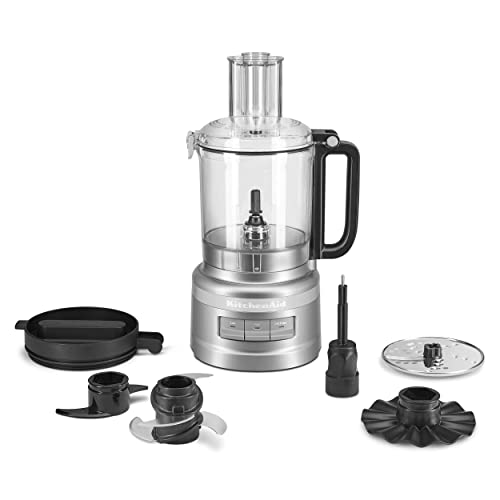
KitchenAid 9-Cup Food Processor KFP0921 — Best with a Whisk for Baking Extras
The KFP0921 is the baking pick for households whose repertoire extends past dough into the whipped and emulsified: it kneads dough (an explicitly listed job), and it adds a whisk accessory — a rarity in processors — for whipped cream, egg-white foams for sponge cakes, and emulsified glazes and dressings between bakes. The four-blade multipurpose design chops evenly through the bowl, the 9-cup capacity is the balanced middle for family baking, and KitchenAid’s all-in-one storage packs the whole accessory set into the bowl, which matters in a kitchen already storing baking pans.
Strengths
- Whisk accessory included — whipped cream and foams without hauling out a mixer.
- Dough kneading is a listed job, backed by a family-size 9-cup bowl.
- All-in-one in-bowl storage and an easy-clean bowl keep a baker’s kitchen orderly.
Trade-offs
- The whisk handles light foams; heavy meringue volume still belongs to a stand mixer.
- Upper price tier for its class; check the current price on Amazon.
- More accessories mean more parts to wash after a full baking day.
| Mini spec box — verified from the manufacturer’s listing | |
|---|---|
| Capacity | 9 cups |
| Blade system | Four-blade multipurpose design |
| Accessories | Whisk accessory; all-in-one storage; easy-clean bowl |
| Jobs listed | Chop, slice, shred, whisk, knead dough |
Think of this as the cake baker’s processor. The dough and crust work is fully covered, and then the whisk quietly absorbs the jobs that punctuate a cake day — whipped cream for serving, a foam for a sponge, a glaze whisked smooth. Households that bake cakes and pastries more than bread will use that whisk weekly and wonder how a processor ever shipped without one.
Best for: cake and pastry bakers who want dough capability plus a whisk in one machine. / Not suited for: bread-only bakers, who will not use the whisk enough to justify the tier.
Check on Amazon — check the current price on Amazon before you buy.
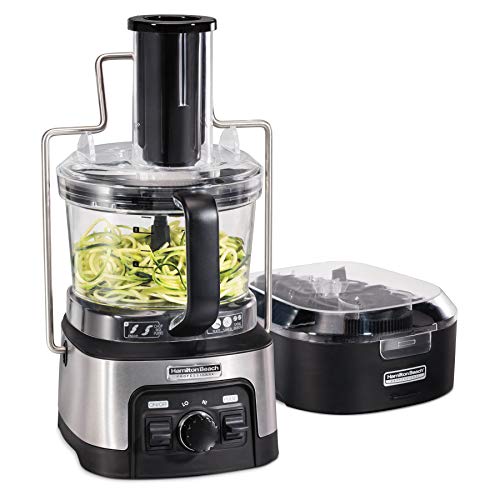
Hamilton Beach Professional Stack & Snap 70815 — Best for Dough Plus Vegetable Prep
The 70815 is the prep-heavy baker’s machine: a 12-cup bowl, an extra-large 3-inch feed chute that fits whole vegetables, a veggie spiralizer in its function set, and kneading listed among its jobs. The chute is the headline for baking households that also cook seriously — whole potatoes for a gratin, whole onions, blocks of cheese pass without pre-cutting, which collapses the prep time of a baking-and-dinner day. The Stack & Snap assembly removes the twist-lock struggle, and the professional trim positions it as the serious end of Hamilton Beach’s line.
Strengths
- Extra-large 3-inch feed chute — whole vegetables and cheese blocks, minimal pre-cutting.
- Kneading is a listed job, backed by a 12-cup bowl for family dough batches.
- Spiralizer function adds vegetable prep range no other pick here offers.
Trade-offs
- A big, full-featured machine with the parts count to match — more to wash and store.
- The spiralizer is a bonus most pure bakers will rarely use.
- Check the current listing for the exact included disc set before ordering.
| Mini spec box — verified from the manufacturer’s listing | |
|---|---|
| Capacity | 12 cups |
| Feed chute | Extra-large 3-inch, fits whole vegetables |
| Functions | Slicing, shredding, kneading, spiralizing |
| Model | 70815, stainless steel |
Choose this one if your baking bleeds into big cooking — the holiday prep day, the gratin-and-pie Sunday, the household where the processor is the prep department for everything. The dough capability keeps it honest as a baking pick, and the chute and capacity make it the fastest pair of hands in this guide for the vegetable work that surrounds the baking.
Best for: bakers who also do heavy vegetable prep and want one large, chute-friendly machine. / Not suited for: minimalists or small kitchens counting parts and footprint.
Check on Amazon — check the current price on Amazon; it sits in the mid-to-upper tier.

Hamilton Beach Stack & Snap 14-Cup 70585 — Best Big Bowl with a Mini Bowl Included
The 70585 solves the big-bowl problem from inside the box: alongside its 14-cup main bowl it includes a 4-cup mini food processor bowl, so the same 500-watt, 3-speed base handles a family dough batch in the morning and a cup of chopped nuts or a small crumb mixture in the afternoon, each in a bowl sized to the job. The blades are dishwasher-safe stainless steel, and the Stack & Snap design keeps assembly simple across both bowls. For baking households whose work spans the full range of scales, that two-bowl answer is more useful than any single specification.
Strengths
- Two bowls in the box — 14-cup for dough and batches, 4-cup mini for crumbs, nuts, and small mixtures.
- 3-speed 500-watt motor covers the range from pulsing crust to kneading.
- Dishwasher-safe stainless blades and easy stack-and-snap assembly.
Trade-offs
- 500 watts is adequate for dough but below the Cuisinart flagships’ headroom on the stiffest loads.
- Two bowls and their parts are the most storage-hungry setup here after the 70815.
- No whisk accessory for the whipped side of baking.
| Mini spec box — verified from the manufacturer’s listing | |
|---|---|
| Capacity | 14-cup bowl plus included 4-cup mini bowl |
| Motor | 500 watts, 3 speeds |
| Blades | Dishwasher-safe stainless steel |
| Model | 70585 |
The mini bowl deserves its own sentence of praise, because bakers constantly make small dry mixtures — graham crumbs for a crust, a streusel topping, a cup of ground nuts — that a 14-cup bowl handles badly. Having the small bowl ride along with the big machine means one appliance genuinely covers a baking day end to end. If your baking swings between scales, this is the pragmatic pick.
Best for: bakers whose work spans family dough batches and small crumb-and-nut mixtures daily. / Not suited for: bakers wanting maximum dough torque or a whisk.
Check on Amazon — check the current price on Amazon; it sits in the mid-range tier.

Breville Sous Chef 12-Cup BFP710 — Best Premium
The Sous Chef 12 is the premium entry: Breville’s build quality and design polish around a 12-cup bowl, positioned by its listing for chopping, slicing, and shredding large batches with precision. A candor note belongs in this review: the verified listing title for this model emphasizes processing and meal-prep work rather than naming kneading, so while the Sous Chef line is built around powerful, precise processing — and its slicing and shredding for tart and gratin work is the point of the machine — bakers whose primary job is heavy dough should confirm the dough tools in the current listing, or default to the Cuisinart picks above, whose kneading is explicit. What the Breville unquestionably offers a baker is the finest prep work in the guide: even slices for apple tarts and potato gratins, clean shredding, and a machine that feels engineered rather than assembled.
Strengths
- Premium build and precision — the best slicing and shredding finish in this guide for tart and gratin work.
- 12-cup capacity suits large-batch prep for entertaining and holiday baking.
- Breville’s design and materials are a clear step above the field.
Trade-offs
- Premium pricing — the highest tier in this guide; check the current price on Amazon.
- Dough tools are not named in the verified listing title; confirm before buying if kneading is your main job.
- A substantial machine that expects a permanent counter home.
| Mini spec box — verified from the manufacturer’s listing | |
|---|---|
| Capacity | 12 cups |
| Finish | Brushed stainless steel |
| Focus | Chop, slice, shred, and dice in large batches |
| Model | BFP710 (BFP710BSS) |
Buy the Breville if your baking is presentation baking — tarts with fanned apple slices, gratins with uniform potato coins, pastry prep at entertaining scale — and you value the precision and build enough to pay the premium. Pair it with the honest caveat above about dough, and it is a superb, if specialized, baking companion.
Best for: precision-focused bakers doing large-batch tart, gratin, and pastry prep. / Not suited for: dough-first bakers (choose a Cuisinart) or budget shoppers.
Check on Amazon — check the current price on Amazon before ordering.
Comparison Table
| Pick | Badge | Key spec | Best for |
|---|---|---|---|
| Cuisinart 14-Cup DFP-14BCNY | Best Overall | 14-cup, 720W, kneading listed | Weekly family baking |
| Cuisinart Pro Classic 7-Cup | Best for Pie Crusts and Smaller Households | 7-cup, 600W, kneading listed | Pies and small-household dough |
| KitchenAid 9-Cup KFP0921 | Best with a Whisk | 9-cup, whisk, kneading listed | Cakes and pastries |
| Hamilton Beach Professional 70815 | Best for Dough Plus Vegetable Prep | 12-cup, 3-inch chute, spiralizer | Big prep days |
| Hamilton Beach Stack & Snap 70585 | Best Big Bowl with Mini Bowl | 14-cup + 4-cup mini bowl, 500W | All scales of baking work |
| Breville Sous Chef 12 BFP710 | Best Premium | 12-cup, premium build | Precision tart and gratin prep |
How to Choose a Food Processor for Baking
Start with flour capacity, because it quietly decides which machines can even attempt your recipes. As a working rule drawn from how these bowls behave: a 7-cup processor kneads a single pizza dough or double pie crust comfortably; a 9- to 12-cup machine handles family pizza night and most sandwich loaves; a 14-cup bowl is the home of multi-loaf and holiday batches. Exceeding a bowl’s comfortable flour load does not produce a slightly worse dough — it produces a stalled motor, a bowl that walks, and a dough that never comes together. Buy the bowl that fits your largest regular bake, not your largest imaginable one, and split the rare giant batch in two.
Next, verify dough engineering rather than assuming it. The reliable signal is the manufacturer’s own job list: the Cuisinart and KitchenAid picks here name kneading in their listings, which means the drive, blade geometry, and duty cycle were designed for it. A machine that never mentions dough may still make a soft pizza dough, but stiff, low-hydration doughs — bagels, some breads — will punish it. Torque, not headline wattage, is the relevant quality, and it shows in whether the machine maintains blade speed as the dough ball forms and stiffens.
Then weigh the supporting cast. Pie and pastry bakers live on pulse control for cutting butter — short, responsive pulses that leave pea-sized pieces instead of a paste — so test how a control scheme pulses before valuing anything else. Cake bakers should weigh the whisk (KitchenAid) and the mini bowl for crumbs and streusels (Hamilton Beach 70585). Everyone should weigh the feed tube: apples, potatoes, and cold butter blocks all pass through it, and a wide chute like the 70815’s 3-inch tube removes the pre-cutting step from tart and gratin prep. Finally, parts and cleanup: baking days generate flour-dusted everything, so dishwasher-safe bowls and blades and a design without flour-trapping seams will decide whether the machine is loved in month six.
The Cold-Butter Principle: Why Processor Crust Works So Well
Flaky crust is a temperature story before it is a technique story. The flakes are layers of flour separated by pieces of solid butter; in the oven, the butter melts and its water becomes steam, puffing the layers apart. Anything that melts the butter before the oven — warm hands, a warm kitchen, a slow cutting-in process — collapses that structure into a tough, greasy crumb. Hand-cutting with a pastry blender takes minutes of friction in a bowl that is warming the whole time. The food processor’s advantage is brutal speed: ten seconds of pulsing does the cutting while the butter is still fridge-cold, and the metal bowl and blade add almost no heat in that time. This is why experienced bakers who resisted processors for years converted on crust alone, and why pulse quality — short, clean, responsive bursts — outranks raw power for the pastry side of this guide’s picks.
The same principle explains the processor’s one crust limitation: it cannot feel. A baker’s fingers know when the mixture is right; the machine only knows time, so the baker’s job shifts from doing to watching — peering through the bowl for pea-sized pieces, pinching a sample, adding water a spoonful at a time. Bakers who adapt to that supervisory role get crust that is, on average, flakier than their hand-made version, because the butter stayed colder. Bakers who set the machine running and walk away get the tough crust they feared, and blame the tool. Every pick in this guide pulses responsively enough for the supervisory method; the rest is attention, and attention is free.
How to Make Pie Crust and Dough in a Food Processor
For pie crust, the processor method is short enough to memorize. Chill everything — flour briefly in the freezer if your kitchen is warm, butter cubed and cold. Add flour, salt, and any sugar to the bowl and pulse twice to mix. Scatter the cold butter cubes over the flour and pulse in short bursts — roughly eight to twelve one-second pulses for a standard crust — until the mixture looks like coarse meal with pea-sized butter pieces visible; those pieces are the flake, so stop while you can still see them. Add ice water a tablespoon at a time through the feed tube, pulsing once after each, and stop the moment the mixture holds together when pinched — it will still look shaggy, and that is correct. Turn it out, press it into a disc with your hands (do not knead it smooth), wrap, and chill. Every error in processor crust comes from one of two directions: pulsing past the pea stage, or adding water until it looks like dough in the bowl, by which point it is overworked and overwet.
One more crust variation belongs in every processor baker’s repertoire: crumb crusts. Graham crackers, sandwich cookies, or wafers go into the bowl in a half-bowl load, pulsed to an even crumb — fine for a press-in crust, slightly coarser if you like texture — then mixed with melted butter right in the bowl with a few final pulses, so the whole crust base is made in one vessel with one washing. It is the fastest crust in baking, and the reason crumb-crust pies survive busy weeks in households that own these machines.
For yeast dough, the sequence inverts: dry ingredients in first, then the liquid added gradually through the tube with the machine running, until the dough forms a ball that rides the blade and cleans the bowl’s sides. Then let the machine knead — typically well under a minute or two of processing replaces many minutes of hand kneading, because the blade works the dough continuously. Stop when the dough is smooth and elastic; over-processing heats dough and can tear its structure, so set a timer rather than wandering off. Rest and rise the dough as your recipe directs. Two machine-care rules ride along: never exceed your bowl’s comfortable flour load (split big batches), and if the motor strains or the base starts to walk, stop, divide the dough, and finish in two runs — the machine is giving you information, not a challenge.
Beyond Dough: Everything Else a Processor Does on a Baking Day
It is easy to buy a processor for dough and forget that dough is twenty minutes of a baking day while prep is two hours. Walk a real Saturday: the shredding disc turns a cold block of butter into shreds that chill fast and cut into flour beautifully for biscuits — a trick pastry cooks swear by, because shredded frozen butter distributes into flour more evenly than cubes. The slicing disc fans apples for a tart and potatoes for the gratin that shares the oven. The chopping blade makes graham and cookie crumbs for crusts, chops the nuts for the topping, purees the fruit filling, and grates the cheese for the savory bake. A processor that only kneaded would be a poor purchase; the picks in this guide were chosen because the whole day, not just the dough, runs through them.
Two of those prep jobs deserve specific technique. For crumbs: break cookies or crackers into the bowl in a modest load — about half the bowl — and pulse to the texture the crust needs, checking early, because the line between crumbs and powder is a few pulses and powder packs into a dense, hard crust. For nuts: chill them, pulse in short bursts, and stop at chopped — the same oil-release physics that governs almond meal applies, and walnuts destined for a topping become walnut paste if you hold the button while reaching for the flour. Cold ingredients, modest loads, short pulses: the baking processor’s entire technique fits in one sentence, and the machines above reward it with the kind of prep speed that changes what a home baker attempts on a weeknight.
Processor, Stand Mixer, or Hands: An Honest Division of Labor
Because baking households often own or covet all three, here is the division of labor this guide’s recommendations assume. The food processor owns crusts — nothing cuts cold butter into flour faster or colder — and it owns prep: slicing, shredding, chopping, crumbs. It shares dough with the stand mixer: the processor is faster and better for pizza and pastry doughs at household scale, the mixer better for big, stiff, or long-kneaded bread doughs and for creaming and whipping in volume. Hands own the finishing: shaping, folding, and the judgment calls no machine makes. A household equipping from zero should usually buy in the order this guide implies — processor first if cooking prep dominates, mixer first only if cakes and bread in volume are truly the center of the kitchen — and should distrust any single appliance, however premium, that claims to retire the other two. The six picks here were chosen to be excellent at the processor’s actual third of that triangle, with the KitchenAid’s whisk and the big bowls’ dough capacity honestly extending its reach without pretending to erase the borders.
Common Buying Mistakes
The classic mistake is buying a processor for baking without checking that dough is a listed job, then discovering the omission with a stalled motor and a bowl of shaggy flour. The second is size mismatch in both directions: a 14-cup bowl that makes a single crust unevenly, or a 7-cup bowl asked to knead a double bread batch weekly. Third, bakers over-value wattage and under-value pulse quality, then wonder why their crust butter disappears — crust is a finesse job, and finesse lives in the pulse. Fourth, shoppers forget the mini-load problem entirely: crumbs, streusel, and nut meals are half of baking’s processing, and a big-bowl-only setup handles them badly, which is the quiet genius of the 70585’s included mini bowl.
Fifth, people treat the processor as a stand mixer substitute for creaming butter and sugar or whipping large meringues; it is not one, and recipes will suffer — the processor’s baking kingdom is crusts, doughs, and prep, with the KitchenAid’s whisk covering light foams at the border. Sixth, buyers skip reading the flour limits in the manual and burn out a motor on an oversized dough; the limits exist because torque is physics, and respecting them is the difference between a decade of service and a sad smell in November.
Flour Loads by Bowl Size: A Practical Reference
Because the flour question decides more purchases than any other, here is the consolidated guidance this guide’s reviews apply, stated as comfortable working ranges rather than absolute limits — your model’s manual is the final authority for its own tested maximum. In a 7-cup bowl, plan on pie crusts of any household size, pizza dough for two to four, and small enriched doughs; the Pro Classic’s 600 watts make it the strongest small-bowl kneader here. In a 9- to 12-cup bowl, family pizza night, standard sandwich loaves, and double crusts with filling prep all fit in stride — this is the KitchenAid’s and the Hamilton Beach Professional’s territory. In a 14-cup bowl, multi-loaf sessions and holiday production open up, with the Cuisinart’s 720 watts and the 70585’s two-bowl flexibility covering both the dough and the small mixtures around it.
Two qualifiers keep that table honest. First, hydration changes everything: a wet, slack dough is easier on a motor than a stiff, dry one at the same flour weight, so bagel and pretzel doughs should be sized a step down from the ranges above. Second, enriched doughs — butter- and egg-heavy brioche styles — are usually better finished with the butter worked in stages, and the processor handles the initial dough beautifully while the baker judges the enrichment by hand. Use the ranges to choose the machine, use the manual to set the batch, and use your eyes for the dough itself; that combination is how these machines last for years of baking instead of one heroic, fatal afternoon.
Final Recommendation
Most baking households should buy the Cuisinart 14-Cup: the power, the bowl, and the explicit kneading pedigree cover crusts and doughs at family scale with headroom to spare. Small households and pie specialists should take the Pro Classic 7-Cup, cake bakers the whisk-equipped KitchenAid 9-Cup, and bakers whose work swings between big doughs and small crumb mixtures the two-bowl Hamilton Beach 70585.
Going deeper on dough? Our guides to the best food processors for dough and the best food processors for kneading dough compare the dough specialists head to head. The best food processors for 4 people covers the family-size class generally, the best food processors for making nut butter handles the nut side of baking prep, and the best food processors for almond meal covers grinding your own baking meals. Best Food Processors For Dough Best Food Processors For Kneading Dough Best Food Processors For 4 People Best Food Processors For Making Nut Butter Best Food Processors For Almond Meal
Frequently Asked Questions
Can I make cookie dough and batter in a food processor?
Stiff cookie doughs — shortbread, slice-and-bake, crumbly scone mixtures — actually suit the processor well, because they are closer to crust than to cake batter: cut the butter in, add the dry and wet components with minimal mixing, and stop before the dough warms. Soft, aerated batters are the opposite case: the processor combines without incorporating air, so cakes and muffins mixed entirely in a processor bake up dense. Use the processor for the crust-family doughs and for prep, and give aerated batters to a mixer, as this guide’s division of labor suggests.
Can a food processor really knead bread dough as well as a stand mixer?
For most home doughs — pizza, focaccia, standard sandwich loaves at family scale — yes, and faster: the blade develops dough in about a minute of processing. A stand mixer wins on very large batches, very stiff doughs in quantity, and hands-free long kneads. The processor’s limits are flour capacity per batch and heat from over-processing; respect both, and the results are genuinely comparable for the doughs most households make.
How much flour can I put in a food processor for dough?
Match the load to the bowl: roughly up to 3 cups of flour in a 7-cup bowl, 3 to 4 cups in a 9- to 12-cup bowl, and more only in a 14-cup machine — and always defer to your model’s manual, which states its tested limit. Overloading is the main cause of stalled motors and uneven dough. When in doubt, split the batch; two good doughs beat one ruined one and a strained machine.
Why does my processor pie crust come out tough?
Almost always over-processing: pulsing past the pea-sized butter stage, or adding water until the dough looks finished in the bowl. The butter pieces must stay visible and cold, and the mixture should only just hold when pinched. Also check that your butter and water were genuinely cold — a warm kitchen can melt the butter during processing even with perfect pulsing.
Do I need a special dough blade for a food processor?
Some models include a plastic dough blade designed to fold and push dough rather than cut it; others knead with the standard blade. Either works when the machine is dough-rated. What matters is that kneading appears in the manufacturer’s listed jobs for your model — that is the signal the whole drive system was engineered for dough loads. The picks in this guide were chosen on exactly that signal.
Can a food processor cream butter and sugar or whip cream for baking?
Creaming butter and sugar properly is a stand mixer’s job; a processor will combine them but not aerate them the same way, and cakes will show it. Whipped cream in small amounts is different: a whisk-equipped model like the KitchenAid 9-cup in this guide handles it well. Buy the processor for crusts, doughs, and prep — its true strengths — and let it borrow the light whipping jobs only.
Can a food processor replace a stand mixer in a small baking kitchen?
For many small kitchens, honestly, yes — if your baking centers on pies, tarts, pizza, flatbreads, and prep-heavy bakes, the processor covers the core work and the stand mixer becomes the optional second machine. The households that genuinely need the mixer are those built around large bread loaves, big cake batters, and meringue in volume. Choose based on your five most-baked recipes: if three or more are crusts, doughs, or prep, the processor is your first machine, and this guide’s picks are ranked for exactly that kitchen.
How do I keep dough from climbing the blade or the bowl from walking?
Dough climbs when the batch is too wet and loose for the bowl, and bowls walk when a stiff dough ball throws the machine off balance at speed. The fixes are mechanical: keep flour loads inside your bowl’s comfortable range, add liquid gradually so the dough forms a cohesive ball rather than a slurry, and set the machine on a dry, flat surface — a slightly damp towel under the base adds grip on slick stone counters. If the base still travels, your batch is telling you it is too large; split it and knead in two runs.
What size processor is best if I mostly bake pies?
A 7- to 9-cup machine is the pie baker’s sweet spot: the bowl is small enough that a single crust’s butter and flour process evenly, large enough for a double crust plus filling prep like slicing apples. That is why the 600-watt Pro Classic leads this guide’s pie recommendations — its power-to-size ratio was effectively designed by the pie use case. Bakers who also make family bread and pizza in volume should step up to the 12- to 14-cup class instead.
Is a bigger processor always better for a baking household?
No. Baking includes many small jobs — crumbs, streusel, a cup of nuts, a single crust’s butter — that a big bowl does unevenly. The right size is the one matched to your largest regular dough batch, and households whose work spans scales are often best served by a big machine with a mini bowl option, like the Hamilton Beach 70585, rather than by the largest bowl alone.

