Disclosure: airfryerkitchensupply.com is reader-supported. When you buy through links on our site, we may earn an affiliate commission at no extra cost to you.
Where to buy
All six picks below are sold on Amazon. Listings change between color and bundle variants, and prices move often enough that we do not print them — use these links to check price on Amazon and confirm exactly what is in the box before you order.
- Cuisinart Pro Classic 7-Cup DLC-10SYP1 — Best Overall for families of four.
- Hamilton Beach 10-Cup Food Processor 70730 — Best Value Full-Size.
- KitchenAid 7-Cup Food Processor KFP0718 — Best for Tidy Storage.
- Cuisinart Elemental 8-Cup FP-8SV — Best Mid-Size All-Rounder.
- BLACK+DECKER 8-Cup Food Processor — Best Budget Full-Feature.
- KitchenAid 9-Cup Food Processor KFP0921 — Best for Bakers and Batch Cooks.
Sizing a Processor for a Household of Four
The best food processors for 4 people live in a different size class than the minis couples buy, and getting the size right is the whole game. Four people means a soup base built on two onions and three carrots, a slaw from half a cabbage, hummus that needs to survive two lunches, and pie dough that cannot be made in a toy bowl. A 7- to 10-cup work bowl is the honest working range for a family of four: big enough that a family-size batch circulates and chops evenly, small enough that the machine still fits under standard cabinets and does not demand its own zip code on the counter. Go much larger — 12 to 14 cups — and weeknight loads like one onion start bouncing around the bowl instead of cutting; go smaller and every family recipe becomes a two-batch negotiation.
Every pick in this guide sits between 7 and 10 cups, and each was verified against its actual Amazon listing, so the capacities, motor ratings, and included accessories stated here are what the manufacturer itself publishes, not retailer folklore. The six machines split into clear personalities: a classic Cuisinart that does everything well, a Hamilton Beach that undercuts everyone on value, a KitchenAid designed around storage, an 8-cup Cuisinart for slicing-heavy kitchens, a budget BLACK+DECKER with a full attachment set, and a 9-cup KitchenAid that adds a whisk and dough capability for families who bake. One of them fits your family’s cooking; the reviews below are organized to help you find it fast.
A note on expectations: at this size a food processor genuinely replaces a shelf of gadgets. It shreds the cheese, slices the potatoes, chops the mirepoix, purees the soup, and mixes the pie crust. What it still does not do is blend smoothies like a blender or whip egg whites like a stand mixer — and any listing that promises otherwise is selling, not informing. Buy for the jobs your family actually does weekly and the machine will earn its counter space within a month.
In this guide
Quick Picks
- Best Overall: Cuisinart Pro Classic 7-Cup DLC-10SYP1 — a 600-watt classic that minces, dices, shreds, purees, and kneads for a family of four without drama. Check the current price on Amazon.
- Best Value Full-Size: Hamilton Beach 10-Cup 70730 — the biggest bowl here, a bowl scraper in the box, and slicing, shredding, mincing, and pureeing at a value tier. Check the current price on Amazon.
- Best for Tidy Storage: KitchenAid 7-Cup KFP0718 — every blade and disc stores inside the bowl, a 2-in-1 feed tube, and an easy-clean work bowl. Check the current price on Amazon.
- Best Mid-Size All-Rounder: Cuisinart Elemental 8-Cup FP-8SV — a 350-watt, 8-cup machine with medium-to-fine slicing discs for salad-heavy family cooking. Check the current price on Amazon.
- Best Budget Full-Feature: BLACK+DECKER 8-Cup Food Processor — 450 watts, an S-blade, and shred, slice, chop, and puree functions at a budget tier. Check the current price on Amazon.
- Best for Bakers and Batch Cooks: KitchenAid 9-Cup KFP0921 — a four-blade multipurpose design, whisk accessory, dough capability, and all-in-one storage. Check the current price on Amazon.
How These Picks Were Chosen
We set the floor at 7 cups and the ceiling at 10, because that is the range where a family of four cooks in single batches without the machine becoming a countertop appliance garage. Every candidate was then verified against the airfry site’s own product data: model number, capacity, motor wattage where published, and the functions and accessories the listing title actually claims. Anything we could not verify was excluded, and the verification details for each pick are recorded in this article’s source file.
Ranking weighed the jobs family cooking repeats most: chopping large vegetable loads evenly, shredding cheese and cabbage without the disc bogging down, pureeing soups and sauces smooth, and — for the baking households — mixing and kneading dough. We also weighed feed tube size (whole potatoes and blocks of cheese versus pre-cutting everything), parts storage, and cleanup, because a family processor that is annoying to wash gets used twice and abandoned. Prices and ratings are deliberately not printed; both change constantly, and the links take you to the live figures.
The 6 Best Food Processors for 4 People

Cuisinart Pro Classic 7-Cup DLC-10SYP1 — Best Overall
The Pro Classic is the machine the modern food processor category was built on, sized here at 7 cups with a 600-watt motor — the strongest ratio of power to bowl size in this guide. For a family of four it is the safe, do-everything answer: it minces garlic and herbs, dices onions by the pair, shreds cheese and carrots, purees soups, and kneads pizza and pie dough, which Cuisinart explicitly lists among its jobs. The 7-cup bowl is the smallest here, but it is the right small: a family soup base fits, a double pie crust fits, and weeknight loads still chop evenly because the bowl is not oversized for them.
Strengths
- 600-watt motor — the most power per cup in this guide, so dense loads and dough do not stall it.
- The full classic repertoire: mincing, dicing, shredding, pureeing, and kneading dough in one machine.
- Cuisinart’s blade and disc ecosystem is mature, with replacement parts easy to find years later.
Trade-offs
- At 7 cups it is the smallest bowl here; very large meal-prep days may want the 10-cup Hamilton Beach.
- The design is classic rather than modern — no in-bowl storage system or fancy feed tube.
- It sits in the upper tier of this group on price; check the current price on Amazon.
| Mini spec box — verified from the manufacturer’s listing | |
|---|---|
| Capacity | 7 cups |
| Motor | 600 watts |
| Jobs listed | Mincing, dicing, shredding, puree, kneading dough |
| Model | DLC-10SYP1 |
Families who cook from scratch most nights will feel the difference the motor makes. Shredding a block of cheddar for four-person mac and cheese, the Cuisinart-class drive does not slow and whine the way budget motors do, and dough comes together in the bowl in under a minute of processing rather than a sticky ten minutes by hand. If your household of four includes anyone who bakes, or a weekly pizza night, this is the pick to beat.
Best for: families of four who cook from scratch and want one proven machine for chopping, shredding, pureeing, and dough. / Not suited for: shoppers who want the largest bowl or the lowest price in this class.
Check on Amazon — check the current price on Amazon before ordering.

Hamilton Beach 10-Cup Food Processor 70730 — Best Value Full-Size
The 70730 is the capacity pick: a full 10-cup bowl, the largest in this guide, at a value-tier price. Its signature extra is the bowl scraper included in the box — a small thing that solves a real annoyance, letting you scrape down the bowl sides without removing the lid and stopping the job. The function list covers the family repertoire: slicing, shredding, mincing, and pureeing. For a family of four that meal-preps — a big slaw, a vat of soup base, a double batch of hummus — the extra bowl volume over the 7- and 8-cup picks is the difference between one batch and two.
Strengths
- 10-cup bowl, the largest here — true single-batch cooking for four, including meal-prep quantities.
- The included bowl scraper lets you push food back into the blade path without opening the lid.
- Full function set — slice, shred, mince, puree — at a value price tier.
Trade-offs
- The big bowl is less happy with small loads; a single small onion will need a scrape-down or two.
- Fit and finish are value-tier — functional plastics rather than premium heft.
- No whisk or dough-specific blade positioning; bakers should look at the KitchenAid 9-cup.
| Mini spec box — verified from the manufacturer’s listing | |
|---|---|
| Capacity | 10 cups |
| Included extra | Easy-clean bowl scraper |
| Jobs listed | Slicing, shredding, mincing, puree |
| Model | 70730 |
This is the machine for the family that cooks big on Sunday and reheats smart all week. A 10-cup bowl takes a whole cabbage for slaw, two pounds of carrots for soup, or the full output of a garden zucchini glut. The scraper earns its keep on hummus and nut-based sauces, where stopping to open and scrape is otherwise a three-time-per-batch ritual. If your household of four leans toward batch cooking, this is the most capacity per dollar in the guide.
Best for: meal-prepping families of four who want maximum bowl capacity at a value tier. / Not suited for: cooks who mostly process small loads, or bakers who need a whisk and dough setup.
Check on Amazon — check the current price on Amazon; it sits in the value tier for full-size processors.
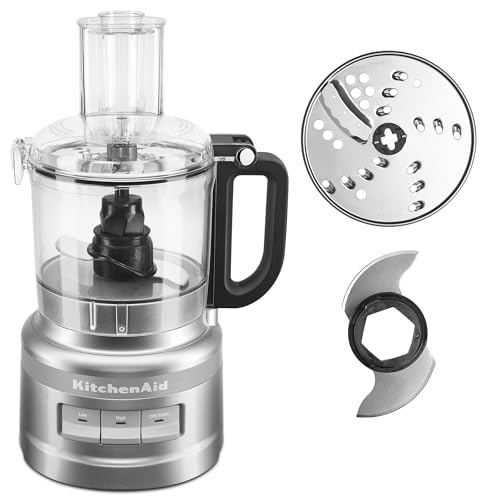
KitchenAid 7-Cup Food Processor KFP0718 — Best for Tidy Storage
KitchenAid designed the KFP0718 around the problem nobody lists in specs: where do the blades and discs live? In this machine, everything stores inside the work bowl, so the processor occupies one tidy footprint instead of colonizing a drawer with sharp accessories. The bowl itself is an easy-clean design with sealed, leak-resistant construction, the feed tube is a 2-in-1 design that handles both large items and slender ones like carrots and celery, and three speed controls — high, low, and pulse — cover the texture range family cooking needs.
Strengths
- All-in-one in-bowl storage for blades and discs — the tidiest ownership experience in this guide.
- 2-in-1 feed tube processes both wide items and thin vegetables without everything being pre-cut.
- Three speed controls plus an easy-clean bowl make daily family use low-friction.
Trade-offs
- 7 cups ties for the smallest bowl here; batch cooks may prefer 9 or 10 cups.
- The storage system means the bowl is occupied by parts — you unpack before you process.
- Mid-to-upper price tier for its capacity class; check the current price on Amazon.
| Mini spec box — verified from the manufacturer’s listing | |
|---|---|
| Capacity | 7 cups |
| Controls | 3 speed controls |
| Feed tube | 2-in-1 feed tube |
| Storage | All-in-one storage inside the bowl; easy-clean work bowl |
Choose this one if your kitchen storage is the binding constraint — an apartment-size kitchen feeding four, a galley layout, a household where the processor shares a cabinet with the slow cooker. The in-bowl storage also makes it the safest pick around curious kids, since every sharp edge lives inside a closed bowl rather than loose in a drawer. Performance on family staples — chopping, slicing, shredding, pureeing — is squarely in class; it is the ownership experience that sets this model apart.
Best for: families of four short on storage who want a full-featured processor that packs away neatly. / Not suited for: maximum-capacity batch cooking or the tightest budgets.
Check on Amazon — check the current price on Amazon before you buy.

Cuisinart Elemental 8-Cup FP-8SV — Best Mid-Size All-Rounder
The Elemental 8-Cup is Cuisinart’s modern mid-size design: an 8-cup bowl, a 350-watt motor, and slicing discs described as medium to fine — a pairing aimed squarely at families whose processing is heavy on vegetables. Think potato gratins for four, cucumber and onion salads, carrot coins for soup, coleslaw by the bowl. The 8-cup capacity splits the difference in this guide: meaningfully bigger than the 7-cup classics for family loads, still compact enough to live on the counter of a normal kitchen.
Strengths
- Medium-to-fine slicing discs suit the salad, gratin, and soup prep family cooking repeats most.
- 8-cup bowl is the balanced middle of this guide — family batches in one load, weeknight loads still even.
- Cuisinart build and parts availability, in a more modern design than the Pro Classic.
Trade-offs
- 350 watts is adequate, not muscular; very dense dough work is better left to the 600-watt Pro Classic.
- The disc focus is slicing; confirm the exact disc set in the listing if shredding is your priority.
- No in-bowl storage system, so discs need a home in a drawer or cabinet.
| Mini spec box — verified from the manufacturer’s listing | |
|---|---|
| Capacity | 8 cups |
| Motor | 350 watts |
| Discs | Medium to fine slicing discs |
| Model | FP-8SV |
This is the pick for the family whose processor comes out for vegetables five nights a week. Slicing quality is where mid-size processors separate: even slices cook evenly, and the Elemental’s disc setup is built for exactly the gratins, scalloped potatoes, and big salads a family of four rotates through. If your cooking is more dough and shredding than slicing, the Pro Classic above is the better Cuisinart; if it is vegetable prep, this is the one.
Best for: vegetable-heavy family cooking that lives on slicing — salads, gratins, soups, slaws. / Not suited for: heavy dough work or shoppers who want maximum wattage.
Check on Amazon — check the current price on Amazon; it sits in the mid-range tier.

BLACK+DECKER 8-Cup Food Processor — Best Budget Full-Feature
Budget processors usually cut the attachment set to cut the price. This BLACK+DECKER does the opposite: an 8-cup bowl, a 450-watt motor — stronger on paper than several pricier picks here — a stainless S-blade, and an easy-assembly design with attachments to shred, slice, chop, and puree. The easy-assembly point is not marketing fluff for a family machine: the bowl and lid go together without the alignment wrestling that makes some processors annoying at 6 p.m. with hungry kids nearby.
Strengths
- 450-watt motor and 8-cup bowl — full-size family specs at a budget tier.
- Complete function set: shred, slice, chop, and puree with the included attachments.
- Easy-assembly bowl and lid reduce the friction of weeknight use.
Trade-offs
- Budget-tier materials and finish; it feels like the price, even though it performs above it.
- No premium extras — no whisk, no storage system, no bowl scraper.
- Long-term parts availability is thinner than Cuisinart’s or KitchenAid’s ecosystems.
| Mini spec box — verified from the manufacturer’s listing | |
|---|---|
| Capacity | 8 cups |
| Motor | 450 watts |
| Blade | Stainless steel S-blade |
| Jobs listed | Shred, slice, chop, puree; easy assembly |
For a family equipping a first kitchen, replacing a dead machine without a big outlay, or putting a processor in a vacation home that feeds four, this is the rational buy. It will chop the onions, shred the cheese, slice the potatoes, and puree the soup, and the money saved versus the premium picks buys a lot of groceries. Manage expectations on feel and longevity rather than performance, and it is the value standout of this guide alongside the Hamilton Beach.
Best for: budget-conscious families of four who still want the full slice/shred/chop/puree function set. / Not suited for: buyers prioritizing premium build, storage systems, or baking extras.
Check on Amazon — check the current price on Amazon; it sits in the budget tier.
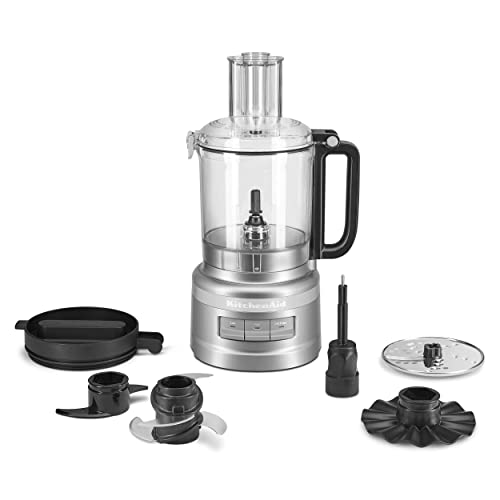
KitchenAid 9-Cup Food Processor KFP0921 — Best for Bakers and Batch Cooks
The KFP0921 is KitchenAid’s fuller-featured family machine: a 9-cup bowl, a four-blade multipurpose design intended to chop more evenly through the whole load, a whisk accessory for whipping and emulsifying, explicit dough-kneading capability in its listing, and the same all-in-one storage philosophy as its 7-cup sibling — everything packs into the bowl. For a family of four that bakes — pizza Fridays, weekend pie, sandwich bread experiments — the combination of capacity, whisk, and dough handling in one footprint is the most complete package in this guide.
Strengths
- Four-blade multipurpose design plus a whisk accessory — the broadest tool set here.
- Dough kneading is an explicitly listed job, backed by a 9-cup bowl sized for family dough batches.
- All-in-one storage keeps the larger accessory set tidy instead of drawer-filling.
Trade-offs
- The most full-featured pick is also in the upper price tier of this guide; check the current price on Amazon.
- More accessories means more parts to wash after a baking session.
- At 9 cups it is still a step below the 10-cup Hamilton Beach for pure batch volume.
| Mini spec box — verified from the manufacturer’s listing | |
|---|---|
| Capacity | 9 cups |
| Blade system | Four-blade multipurpose design |
| Accessories | Whisk accessory; all-in-one storage; easy-clean bowl |
| Jobs listed | Chop, slice, shred, whisk, knead dough |
Think of this as the family kitchen’s second-in-command after the stove. It handles the weeknight chopping, the Saturday dough, the whipped cream for dessert, and the big batch of salsa for the week’s lunches, then packs its own accessories away. Families who bake weekly will use the whisk and dough capability constantly; families who never bake should save the premium and take the Pro Classic or the Hamilton Beach instead.
Best for: baking families of four who want capacity, a whisk, and dough capability with tidy storage. / Not suited for: non-bakers, who would pay for accessories they never touch.
Check on Amazon — check the current price on Amazon before ordering.
Comparison Table
| Pick | Badge | Key spec | Best for |
|---|---|---|---|
| Cuisinart Pro Classic 7-Cup | Best Overall | 7-cup, 600W, kneads dough | Scratch-cooking families |
| Hamilton Beach 10-Cup 70730 | Best Value Full-Size | 10-cup, bowl scraper included | Meal prep and big batches |
| KitchenAid 7-Cup KFP0718 | Best for Tidy Storage | 7-cup, in-bowl storage, 2-in-1 tube | Small kitchens feeding four |
| Cuisinart Elemental 8-Cup FP-8SV | Best Mid-Size All-Rounder | 8-cup, 350W, slicing discs | Vegetable-heavy cooking |
| BLACK+DECKER 8-Cup | Best Budget Full-Feature | 8-cup, 450W, full attachments | Full functions on a budget |
| KitchenAid 9-Cup KFP0921 | Best for Bakers and Batch Cooks | 9-cup, whisk, kneads dough | Baking families |
How to Choose a Food Processor for a Family of Four
Bowl size first, and be honest about your recipes. A family of four’s everyday loads — soup bases, slaws, dips with leftovers — run 5 to 9 cups of raw ingredients. A 7-cup bowl handles most of them; a 9- or 10-cup bowl handles all of them including meal-prep doubles. But remember the working-capacity rule: processors chop well at about two-thirds of stated volume and handle liquids at about half, so a “7-cup” machine is really a 4.5-cup chopper and a 3.5-cup soup pureer per batch. If your family purees big soups often, that arithmetic pushes you toward the 10-cup end of this guide.
Motor power matters more at this size than in minis, because the loads are denser: a full bowl of carrots, a block of cheese on the shredding disc, a ball of pizza dough. The 600-watt Cuisinart Pro Classic shrugs at jobs that make 350-watt machines work hard, and that headroom shows up as even chopping instead of a pureed bottom layer under a chunky top. That said, wattage is not destiny — blade geometry and disc design matter, and the 450-watt BLACK+DECKER outperforms its tier. Judge power together with the jobs listed in the manufacturer’s own description: a machine that explicitly lists kneading is engineered for torque in a way a chop-only machine is not.
Feed tube size is the hidden spec that decides daily happiness. A wide tube swallows halved potatoes and blocks of cheese; a narrow one forces you to pre-cut everything, quietly returning the knife work the machine was bought to eliminate. Two-in-one tubes, like KitchenAid’s, add a slim inner pusher for carrots and celery so thin vegetables do not flop sideways and slice unevenly. If your family eats a lot of salads and gratins, weight the tube and the disc set as heavily as the motor.
Weight and noise deserve a sentence each. Family processors in this class are light enough to move one-handed but heavy enough to stay planted while shredding; suction or rubberized feet matter when a machine walks during dough work, so check the listing photos for feet if your counters are slick stone. Noise is real — these are loud appliances for ten to thirty seconds at a time — and no model in this class is meaningfully quieter than another, so do not pay a premium for quiet claims; just do not run one next to a sleeping baby at midnight.
Finally, count the parts and picture the cleanup. A family processor with a bowl, lid, pusher, blade, and two discs is six items through the wash after every big cook. All six picks here use dishwasher-safe removable parts (confirm the specifics on the listing for the variant you choose), and the KitchenAid models’ in-bowl storage turns the parts problem into a storage solution. The best processor for a family of four is the one the cook is still happy to wash in month six.
How to Use a Family-Size Processor: A Weeknight Workflow
The families who love their processors use them as a prep system, not a single-task gadget. A typical weeknight workflow for four: start with the driest, least staining job — breadcrumbs or cheese on the shredding disc — then the chopping blade for the onion, carrot, and celery base, then any sauce or puree last, since wet jobs are the ones that demand a full wash anyway. Working dry-to-wet means a quick brush or rinse between jobs instead of a full scrub, and the whole dinner’s prep fits in about ten minutes.
Technique details that scale to family loads: cut vegetables into even chunks no bigger than the feed tube or about 1 to 1.5 inches for bowl chopping, because even input is the only route to even output. Pulse sturdy vegetables rather than running continuously — five or six pulses, a shake or scrape, then a few more — so the bottom does not puree while the top is still chunky. For shredding cheese, chill the block well; cold cheese shreds cleanly while warm cheese smears and clumps on the disc. For dough, add flour first, then liquid through the tube with the machine running, and stop the moment the dough forms a ball that cleans the bowl sides — over-processing dough in a processor heats and toughens it.
For soups, puree in batches at half the bowl volume with the lid vented or the tube pusher loosened if your model allows, because hot liquids expand and climb. Let the machine do the safety thinking: never reach into a bowl until the blade has fully stopped and ideally been removed, and teach kids that the processor is an adult tool with no exceptions. Store blades and discs in their bowl or a designated container, not loose in a drawer — most processor injuries happen at the sink and in the drawer, not during cooking.
Family Workloads, Translated: What Actually Fits in 7 to 10 Cups
Manufacturers rate bowls by brim volume, but families cook in recipes, so here is the translation. A soup base for four — two onions, three carrots, three celery stalks — is roughly 5 cups of raw chunks: it chops in one load in any bowl in this guide, though the 7-cup models will want it pulsed in two additions so the first half has room to fall. A family coleslaw from half a green cabbage plus two carrots produces about 6 cups shredded; the shredding disc processes it continuously through the tube, so bowl volume matters less than tube size, and every pick here manages it. A double pie crust uses about 2.5 cups of flour and processes comfortably even in the 7-cup Cuisinart. Pizza dough for two family-size pizzas runs near 4 cups of flour — this is where bowl size and motor torque start to matter, and the 9- and 10-cup picks plus the 600-watt Pro Classic are the comfortable choices.
Liquids are the strictest limit. Pureeing a family soup — say 8 cups of finished soup — should be done in two or three batches at roughly half-bowl volume each, whatever machine you own, because hot liquid climbs the bowl as it spins. Hummus for a family’s week, built on two cans of chickpeas, finishes near 3.5 cups and fits everywhere here. Salsa for a party weekend, 5 to 6 cups, fits the 9- and 10-cup bowls in one careful batch and the smaller bowls in two. The pattern to internalize: dry chopping forgives, wet pureeing does not, and dough cares about torque more than volume. Buy the bowl for your most common load, not your most extreme one, and batch the extremes.
Blades and Discs, Explained for Family Cooking
Every machine here revolves around three tools. The S-blade (chopping blade) sits at the bowl’s bottom and does the chopping, mincing, and pureeing; its quality shows in how evenly it handles mixed loads. The shredding disc rides at the top of the bowl and grates cheese, cabbage, carrots, and potatoes as the pusher feeds them through the tube — disc sharpness and drive torque decide whether cheese comes off in clean shreds or smears. The slicing disc, same position, cuts coins and slices whose evenness decides whether your gratin cooks evenly or in layers of raw and burnt. Some discs are reversible — slice on one face, shred on the other — which halves the parts count, a real benefit in a family kitchen.
Beyond the core three, the extras in this guide each solve a specific family problem. A whisk accessory (KitchenAid 9-cup) whips cream and emulsifies dressings and mayonnaise, replacing a hand mixer for small jobs. A dough capability — an engineered blade-and-motor pairing, explicitly listed on the Pro Classic and the KFP0921 — turns flour and water into pizza dough in about a minute of processing. A bowl scraper (Hamilton Beach 70730) pushes the puree that climbs the walls back into the blade without opening the lid. A four-blade multipurpose design (KFP0921) adds cutting levels inside the bowl to reduce the puree-at-the-bottom problem. None of these extras is essential; each is worth real money if it matches a job your family repeats weekly, and worth nothing if it does not. Read the listing for the exact variant you are buying, because accessory bundles are where manufacturers quietly differ between otherwise identical model numbers.
Common Buying Mistakes
The most common mistake at this size is buying for the biggest meal of the year instead of the typical week. A 14-cup machine bought for Thanksgiving makes fifty ordinary dinners slightly worse, because ordinary loads are too small for its bowl. The 7- to 10-cup range in this guide is sized for the other 364 days. The second mistake is ignoring the feed tube and then pre-cutting everything forever — measure your expectations against the tube, not the bowl. Third, shoppers chase wattage alone and buy a powerful motor attached to a flimsy disc set; shredding and slicing quality lives in the discs and the drive, not the wattage line.
Fourth, families forget to check what is actually in the box. Whisk accessories, dough blades, and disc sets vary by variant and bundle; the listing title is the contract, which is why every pick here was verified against its own listing rather than a review roundup. Fifth, buyers skip the storage question until the discs are living in three different drawers — if your kitchen is small, the KitchenAid in-bowl storage designs are not a gimmick but the feature you will appreciate longest. And sixth, people run the processor continuously for minutes on dense loads; these motors are built for bursts with pauses, and treating them like blenders shortens their lives.
When a Family of Four Should Size Up or Down Instead
Households of four are not all the same shape, and two variations justify leaving this size class. The first is the household that is really two adults plus two small children: your actual processed volume today is closer to a couple’s, and a 7-cup machine — or even one of the minis from our two-person guide — will chop more evenly for the next few years than a 10-cup bowl that toddlers’ portions rattle around in. Buy the 7-cup end of this guide and let the machine grow into the family. The second is the household of four that regularly cooks for eight: grandparents on Sundays, team dinners, church suppers. If doubling recipes is your normal, the honest answer is a 12- to 14-cup machine, accepting that small weeknight loads will need a scrape-down; the 10-cup Hamilton Beach in this guide is the bridge choice, big enough for most doubles while still behaving on family loads.
There is also the two-machine strategy, which more families land on than appliance marketing admits: a mid-size processor in this class for the slicing, shredding, and batch work, plus an inexpensive 3-cup mini for the nightly garlic-and-herb jobs, so the big bowl is not dirtied for a tablespoon of minced ginger. The combined footprint is still smaller than a 14-cup flagship, the combined cost is often lower, and each machine works at the load size it was designed for. If your family’s cooking spans tiny daily jobs and big weekly ones, that pairing — not a single compromise machine — is the setup that will still make sense in five years.
A Family Meal-Prep Session, Start to Finish
To see how these machines earn their keep, walk through a realistic Sunday session for a family of four. You start with the shredding disc: a block of cheddar for the week’s mac and cheese and quesadillas, then two zucchini and three carrots for a slaw — five minutes, one disc, no wash yet beyond a rinse of the bowl. Swap to the S-blade for the soup base: onions, carrots, celery pulsed to an even chop, tipped into the pot. Without washing more than a rinse, the bowl takes two cans of chickpeas, tahini, lemon, and garlic for the week’s hummus; the scraper-equipped and four-blade models finish it smooth with one scrape-down. Last, because it is the job that dirties everything, the dough: flour, salt, yeast, and water become Friday’s pizza dough in about a minute of processing, portioned and refrigerated.
Total elapsed processing time is under half an hour, the knife never really came out, and the dishwasher holds one bowl, one lid, two discs, a blade, and a pusher. That session — repeated weekly — is what the 7- to 10-cup class is for, and it is the standard against which to judge every claim in this guide. A machine that makes that session faster and less annoying is worth its price; a machine that complicates any step of it will be back in its box by the third Sunday, whatever its wattage.
Final Recommendation
Most families of four should buy the Cuisinart Pro Classic 7-Cup: the 600-watt motor, the full job list including dough, and decades of parts support make it the safest long-term appliance in this guide. If your household meal-preps in volume, the Hamilton Beach 10-Cup gives you the biggest bowl and a bowl scraper at a value price. Baking families should step up to the KitchenAid 9-Cup for its whisk and dough capability, and storage-strapped kitchens to the 7-cup KitchenAid that packs its parts inside itself.
Still deciding on size? Our guides to the best food processors for 2 persons cover the mini end if your household is smaller than you thought, while the best food processors for dough and the best food processors for kneading dough go deeper for baking households. The best big mouth food processors round up wide-tube models, and the best food processors for home use compares this whole class. Best Food Processors For 2 Persons Best Food Processors For Dough Best Food Processors For Kneading Dough Best Big Mouth Food Processors Best Food Processors For Home Use
Frequently Asked Questions
Can a family food processor grind meat or make baby food?
Yes to both, with technique. Cubed, very cold meat in small batches pulses into a grind suitable for burgers and dumplings — work in short bursts so friction does not warm the meat, and sanitize every part afterward. For baby food, the same machines puree steamed vegetables and fruits smoothly, especially if you add a little of the cooking liquid; several families in this size class use the family processor for a Sunday batch of purees and freeze portions. Purpose-built baby food makers exist for the steaming step, but the pureeing itself is squarely a processor job.
What size food processor does a family of 4 need?
Seven to ten cups is the working range. A 7-cup bowl covers most family recipes in one batch; 9 to 10 cups covers meal-prep doubles and big slaws without batching. Remember that effective chopping capacity is about two-thirds of the stated size, so if your recipes regularly start with 6 cups of raw vegetables, choose the 9- or 10-cup end.
Can a food processor knead bread dough for a family?
Yes, within limits. Models that explicitly list kneading — the Cuisinart Pro Classic and the KitchenAid 9-cup in this guide — handle pizza dough and pie crust for four quickly and well. Heavy, large sandwich loaves can strain mid-size motors; work with the flour quantities the manufacturer specifies, add liquid gradually through the tube, and stop as soon as the dough forms a ball.
Is a 350-watt motor enough for family-size loads?
For chopping, slicing, and pureeing vegetables, yes — the 8-cup Cuisinart in this guide is built around that output. Where a stronger motor earns its keep is sustained dense work: shredding hard cheese in quantity and kneading dough. If those are weekly jobs for your family, weight the 450- to 600-watt picks more heavily.
Food processor or stand mixer for a family that bakes?
They overlap on dough but specialize differently. A processor makes pie crust and pizza dough faster and handles all the chopping and shredding a stand mixer cannot. A stand mixer wins for large bread batches, meringues, and creaming. Baking families who also cook savory food daily usually get more weekly use from the processor; dedicated bread bakers should own both eventually, processor first.
How do I get even chopping instead of puree at the bottom and chunks on top?
Cut ingredients into even pieces before loading, fill the bowl no more than two-thirds, and pulse instead of running continuously. Stop to scrape the sides down once mid-job — models with a bowl scraper make this a lid-on operation. Even input plus pulsing is the entire technique; continuous running is what creates the layered result.
How long should a family food processor last, and what wears out first?
A mid-size processor from the brands in this guide should serve a family for many years of weekly use. What wears first is rarely the motor: it is the plastic bowl’s locking tabs, the lid seal, and blade sharpness. That is why parts availability matters when choosing between brands — Cuisinart and KitchenAid bowls, blades, and discs remain orderable long after purchase, which turns a cracked bowl from a replacement-machine event into a small parts order. Treat the blade kindly (hand-wash when you can, store it in the bowl), avoid thermal shock on the bowl, and run the motor in bursts rather than long continuous grinds, and the machine you buy for a family of four today is plausibly the one teaching your kids to make salsa.
Are the parts on these family processors dishwasher-safe?
The removable bowls, lids, blades, and discs on mainstream family processors are generally dishwasher-safe — the KitchenAid models here specifically tout easy-clean bowls — but confirm on the listing for your exact variant, keep blades on the top rack or hand-wash them to protect the edge, and never immerse the motor base.


