Disclosure: airfryerkitchensupply.com is reader-supported. When you buy through links on our site, we may earn an affiliate commission at no extra cost to you.
Where to buy
Every pick in this guide to the best affordable hand mixers is sold on Amazon, and that is where we recommend buying. Hand mixers are small, light and easy to return, and Amazon’s listings show the exact configuration — colour, included attachments, storage case or not — before you commit. Use the links in this section for the fastest route to each pick, or the Check on Amazon buttons inside each review if you want to read the full listing first. Mixer prices move often, especially by colour, so check the current price on Amazon rather than trusting any number from an older roundup.
- Hamilton Beach 6-Speed Electric Hand Mixer with QuickBurst (62682G) — Best Overall: Check the current price on Amazon
- Hamilton Beach Power Deluxe 6-Speed Electric Hand Mixer (62692) — Best Budget: Check the current price on Amazon
- Cuisinart Power Advantage Plus 9-Speed Hand Mixer (HM-90S) — Best Full Kit: Check the current price on Amazon
- Hamilton Beach Professional 5-Speed Electric Hand Mixer (62651) — Best for Frequent Bakers: Check the current price on Amazon
- KitchenAid 6 Speed Hand Mixer with Flex Edge Beaters (KHM6118) — Best for Cakes: Check the current price on Amazon
- KitchenAid Go Cordless Hand Mixer (KHMR762) — Best Cordless: Check the current price on Amazon
A quick note before the picks: a hand mixer is the highest-value tool in baking, because the jobs it does — batters, frostings, whipped cream, egg whites, mashed potatoes — are the jobs home bakers actually do every week. The six models below were chosen because they do those jobs with control, not just power. A cheap hand mixer that blasts flour across the kitchen on speed one is not a bargain at any price, and several were cut from this list for exactly that reason.
Introduction
The best affordable hand mixers share a secret that the spec sheets never mention: they are judged in the first five seconds of every recipe. That is when flour either folds in gently or erupts across your counter, when cold butter either creams smoothly or gets thrown against the bowl wall in lumps. Affordable hand mixers used to fail that test routinely — one violent speed disguised as six, motors that faded the moment a dough thickened. The current generation from the established kitchen brands is different. Slow, genuinely gentle first speeds, anti-splatter ramps and beaters designed to release batter instead of hoarding it have all reached the budget tier, and this guide exists to separate the models that have them from the ones still pretending.
What a hand mixer cannot do also belongs in the introduction, because honesty here saves returns later. No hand mixer kneads lean bread dough well; the dough hooks included with some picks below are for bringing soft, enriched doughs together, not for ten minutes of resistance work while you hold the machine against it. If bread is your weekly ritual, a stand mixer is the right tool and no badge in this guide will pretend otherwise. Within its true brief — everything from cake batter to meringue — though, a good affordable hand mixer is not a compromise purchase. It is the correct tool, at a drawer-sized footprint, for the majority of home baking.
Every pick below was verified as a real, currently sold model through the maker’s own listing before writing began. Each carries a badge for the baker it suits best, because the differences at this tier are about fit, not quality rankings: the best affordable hand mixer for a twice-a-year baker is a different machine from the best one for someone who creams butter every Saturday. The reviews give each model its strengths, its honest trade-offs and a verdict; the buying guide after them explains speeds, beaters and motors in full; and the how-to section covers the technique that makes any of these mixers perform at their best.
In this guide
Quick Picks
Six hand mixers, six different answers to “affordable”, one shared standard: a gentle first speed, a motor that holds up in thick batter, and attachments that match the badge. Here is the short version.
Hamilton Beach 6-Speed Electric Hand Mixer with QuickBurst (62682G) — Best Overall. The default recommendation, because its 250-watt motor has honest headroom for thick cookie dough and stiff frosting, not just thin batters, and the QuickBurst button adds a surge of power at the exact moment a mix turns heavy. Add the snap-on storage case and a first speed slow enough for flour, and it is the complete budget package. Check on Amazon
Hamilton Beach Power Deluxe 6-Speed Electric Hand Mixer (62692) — Best Budget. The same proven 250-watt platform as the overall pick, with a whisk included for cream and egg whites, at the sharpest end of the budget tier. It earns the budget badge because a whisk included in the box means whipped cream and meringue need no extra purchase later — the hidden cost that makes cheaper mixers expensive. Check on Amazon
Cuisinart Power Advantage Plus 9-Speed Hand Mixer (HM-90S) — Best Full Kit. Nine speeds, SmoothStart anti-splatter, and beaters, whisk, dough hooks and a spatula stored in one case. It is the pick for organised bakers, because SmoothStart ramps up gently on the three lowest speeds, keeping flour in the bowl, and because a complete kit in the box ends the lost-attachment problem for good. Check on Amazon
Hamilton Beach Professional 5-Speed Electric Hand Mixer (62651) — Best for Frequent Bakers. A DC motor with a true slow start and stainless steel beaters, built for people who mix several times a week. It earns its badge because the slow-start first speed genuinely prevents the flour-cloud problem when adding dry ingredients, and low-speed torque is where thick batters are actually mixed. Check on Amazon
KitchenAid 6 Speed Hand Mixer with Flex Edge Beaters (KHM6118) — Best for Cakes. Its beaters carry a soft edge that sweeps the bowl wall as they turn, folding the outer layer of batter back into the mix. It earns the cake badge because flex edge beaters scrape the bowl while mixing, reducing unmixed pockets and scraping stops — the small frustration at the heart of every cake bake. Check on Amazon
KitchenAid Go Cordless Hand Mixer (KHMR762) — Best Cordless. No cord at all: mix at the island, at the stove, at the table where the cake is cooling, with seven speeds and a Soft Start. It earns its badge because no cord means nothing to drag through batter or wash around, and the removable battery swaps in seconds when a long baking day demands it. Check on Amazon
How These Picks Were Chosen
Every model here was verified against the manufacturer’s current listing data before writing — no discontinued favourites, no model numbers from memory. The affordable brief was then applied strictly: each pick sits in the budget or entry tier of the hand mixer market, and two premium designer models were excluded on price positioning alone. Within the brief, we weighted the factors that decide daily satisfaction with a hand mixer: a first speed gentle enough for flour, motor behaviour in thick batter rather than in thin liquid, beater design and how it washes, the attachment set actually included in the box, and storage — because a mixer whose beaters live loose in a drawer is a mixer with missing beaters by Christmas.
Badges were assigned by baker type, not by a single league table. Hand mixers fail in predictable ways — splashing starts, fading motors, lost attachments, aching wrists on long whips — and each pick below is the model that best avoids one of those failures at an affordable price. Where the market is thin, the guide says so: there is no truly cheap hand mixer with a metal body and a full attachment kit, and pretending otherwise would just send you hunting for a product that does not exist.
The 6 Best Affordable Hand Mixers

Hamilton Beach 6-Speed Electric Hand Mixer with QuickBurst (62682G) — Best Overall
This is the hand mixer for anyone who wants one dependable tool for cakes, cookies, whipped cream and the occasional batch of mashed potatoes without paying for features they will never touch. It suits first-apartment kitchens, occasional bakers and anyone replacing a worn-out mixer on a tight budget. It is less suited to bakers who knead heavy bread dough weekly, because no hand mixer in this class is built for that job.
Strengths
- 250-watt motor has honest headroom for thick cookie dough and stiff frosting, not just thin batters
- QuickBurst button gives a short extra surge of power exactly when a batter turns heavy mid-mix
- Snap-on storage case keeps the beaters attached to the mixer, so nothing gets lost in a drawer
Trade-offs
- Traditional beaters are not the easiest shape to clean in the corners, and dough can climb them on thick mixes
- No dough hooks or whisk in the box, so attachments for bread or meringue cost extra later
- Plastic housing keeps it light but does not feel as solid as the metal-bodied models above it in price
| Motor | 250 watts |
| Speeds | 6, plus QuickBurst boost |
| Attachments | Traditional beaters |
| Storage | Snap-on storage case |
| Extra feature | Bowl Rest edge notch |
What makes this model the default affordable recommendation is how little it asks you to think about. The speed lever sits where your thumb already rests, the first speed is genuinely slow enough to fold flour into a batter without dusting the counter, and the Bowl Rest notch on the back lets you set the mixer down on the rim of the bowl between additions instead of laying it on the counter in a puddle of batter. Those are small things, but they are the things you notice every single time you bake.
In longer sessions the motor is the story. Affordable hand mixers often quote peak wattage and then fade when a dough thickens; this one holds its speed through oatmeal cookie dough and cream-cheese frosting without the pitch of the motor climbing into strain. It will still slow on a double batch of stiff dough, and that is your cue to finish by hand rather than force it. Treat it as a batter-and-dough-assist tool rather than a kneading machine and it lasts for years.
For hand-mixer buyers specifically, the case is the sleeper feature: hand mixers live in drawers, drawers eat loose beaters, and a case that clips the whole kit together is the difference between a complete tool and a frustrating one two years from now. It is a small, unglamorous reason this model keeps its Best Overall badge year after year.
Best for: occasional and regular bakers who want one dependable, complete hand mixer / Not suited for: weekly bread bakers who need real kneading power
Check the current price on Amazon
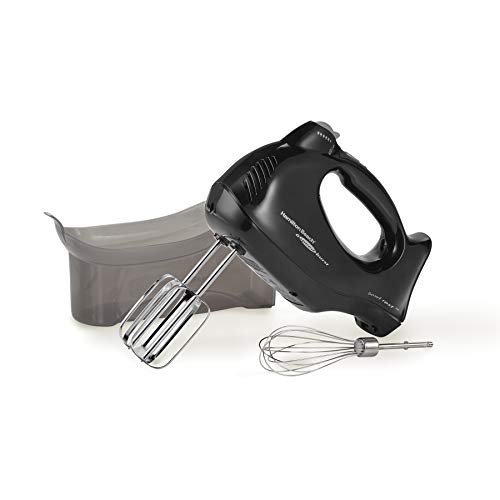
Hamilton Beach Power Deluxe 6-Speed Electric Hand Mixer (62692) — Best Budget
The Power Deluxe is the value middle ground of the Hamilton Beach range: the same proven 250-watt platform as the basic model, with a whisk added for cream and egg whites. It suits bakers who whip as often as they mix, and buyers whose budget is firm but who refuse to buy a mixer that cannot make meringue. It is less suited to bread bakers, who should step up to the version with dough hooks instead.
Strengths
- Whisk included, unlike the base model, so whipped cream and meringue need no extra purchase
- Same reliable 250-watt motor and QuickBurst boost as the best-selling base model
- Bowl Rest and storage case carry over, keeping counters and drawers tidy
Trade-offs
- Beaters are the traditional shape, not the easier-cleaning open profile
- Still no dough hooks, so bread work stays limited
- Design is functional rather than attractive; it looks like the budget tool it is
| Motor | 250 watts |
| Speeds | 6, plus QuickBurst boost |
| Attachments | Traditional beaters and whisk |
| Storage | Snap-on storage case |
| Extra feature | Bowl Rest edge notch |
Think of this model as the answer to a specific question: what if I like the basic Hamilton Beach but I also make whipped cream twice a month? The whisk changes the machine’s range more than any spec-sheet number does. Beaters can whip cream, but slowly and with more splatter; a balloon whisk at the higher speeds gets you soft peaks quickly and gives you the control to stop before you overshoot into butter.
Everything else is the familiar, sensible package — six speeds with a slow enough first gear, a burst button for the moment a frosting thickens, and a case that keeps the whole kit together. It is not exciting, and that is precisely its appeal: it is the affordable mixer you stop thinking about, which is what a kitchen workhorse is supposed to be.
The budget logic is worth stating plainly: the cheapest hand mixer in any shop is usually a false economy once you price the whisk it lacks. This model includes the whisk at the bottom of the range, which is why it, and not a cheaper no-name alternative, holds the budget badge in this guide.
Best for: budget buyers who whip cream and egg whites as often as they mix batter / Not suited for: bread bakers who need dough hooks in the box
Check the current price on Amazon

Cuisinart Power Advantage Plus 9-Speed Hand Mixer (HM-90S) — Best Full Kit
Cuisinart’s 9-speed is the specification hunter’s affordable hand mixer: nine speeds, SmoothStart anti-splatter, and a storage case that holds the beaters, whisk, dough hooks and even a spatula. It suits organised bakers who want the full attachment set in one tidy package. It is less suited to anyone who prefers the lightest possible mixer, since the full-featured body carries a little more weight.
Strengths
- SmoothStart ramps up gently on the three lowest speeds, keeping flour in the bowl
- Most complete kit here: beaters, whisk, dough hooks and spatula, all stored in the case
- Nine speeds with a simple control layout that is easy to learn
Trade-offs
- Slightly heavier than basic models during long whipping sessions
- Case storage is tidy but bulky in a shallow drawer
- Beater shape is conventional, without the easy-clean or flex-edge tricks of rivals
| Motor | 220 watts |
| Speeds | 9, with SmoothStart |
| Attachments | Beaters, whisk, dough hooks, spatula |
| Storage | Snap-on storage case holds attachments |
Cuisinart’s party trick is SmoothStart, and it is a good one. On the lowest three speeds the motor spools up gradually rather than snapping to speed, which means the first second of mixing — the second when flour clouds and milk splashes happen — stays calm. Paired with nine speeds, it gives this mixer the widest usable control range of any model in this guide at this tier.
The storage case deserves its own mention because it solves the actual problem of owning attachments: losing them. Everything clips into one case that stands in a cupboard, so the dough hooks you need twice a year are findable when you need them. For bakers who value a complete, self-contained kit over shaving the last few dollars off the price, this is the hand mixer to beat.
Nine speeds earn their keep at the extremes of hand mixing: the bottom of the range folds whipped egg whites into a batter without knocking the air out, and the top builds a stable meringue without your arm giving up first. If your baking is varied and your standards are real, this is the kit that respects both.
Best for: organised, varied bakers who want every attachment in one stored kit / Not suited for: buyers who prioritise the lightest possible mixer
Check the current price on Amazon

Hamilton Beach Professional 5-Speed Electric Hand Mixer (62651) — Best for Frequent Bakers
This is the pick for bakers who are tired of the two classic cheap-mixer problems: the violent first-speed blast that throws flour everywhere, and the thin beaters that bend. Its DC motor starts slowly and pulls with more low-speed torque. It suits frequent bakers working in smaller kitchens who still want a hand mixer’s storage footprint. It is not the pick for bargain hunters, since it sits at the top of the affordable hand mixer band.
Strengths
- Slow-start first speed genuinely prevents the flour-cloud problem when adding dry ingredients
- DC motor delivers stronger low-speed torque, which is where thick batters are actually mixed
- Stainless steel beaters and whisk feel a class above the chrome beaters on budget models
Trade-offs
- Five speeds instead of six or nine gives slightly less fine control at the top end
- Highest price of the hand mixers in this guide, though still firmly in the affordable tier
- No dough hooks included, which is an odd omission at this level
| Motor | High-performance DC motor |
| Speeds | 5, with slow-start first speed |
| Attachments | Stainless steel beaters and whisk |
| Storage | Snap-on storage case |
Motor type is the detail most buyers never see on the box, and it is the reason this mixer behaves differently. A DC motor makes its torque down low, so speed one and two do real work — creaming cold butter, folding thick brownie batter — instead of merely stirring until you reach the higher speeds. Combined with the slow start, it makes the first ten seconds of every recipe calmer and cleaner.
The build matches the brief. The stainless beaters have a satisfying weight, the whisk is properly shaped, and the storage case clicks on with the attachments inside rather than rattling loose. If your baking is weekly and varied — a cake on Saturday, whipped cream for a pie, frosting for a school event — this is the hand mixer in this guide most likely to still feel like the right tool five years from now, and the one we would buy with our own money at this tier.
Frequency is the key word in its badge. A twice-a-year baker will never notice what this motor does differently; a twice-a-week baker will notice it in the first minute, in the way cold butter creams instead of clattering around the bowl. Buy it when your baking habit is already established, and it will feel less like an upgrade than like a correction.
Best for: frequent bakers who mix several times a week and value low-speed control / Not suited for: strict bargain hunters or bakers who need dough hooks included
Check the current price on Amazon

KitchenAid 6 Speed Hand Mixer with Flex Edge Beaters (KHM6118) — Best for Cakes
Flex Edge beaters carry a soft edge that sweeps the bowl wall as they turn, cutting down the stop-and-scrape routine every baker knows. This model suits bakers who hate unmixed pockets at the bottom of the bowl and anyone who creams butter and sugar often. It is less suited to buyers who need dough hooks included, since the kit centres on the flex beaters and whisk.
Strengths
- Flex Edge beaters scrape the bowl while mixing, reducing unmixed pockets and scraping stops
- Pro whisk included for cream and egg whites
- Integrated storage clip keeps beaters attached without a separate case
Trade-offs
- Flex edges are a wear item over years of use and eventually need replacing
- No dough hook in the box
- Six speeds, not nine, so slightly less top-end finesse than the Cuisinart 9-speed
| Speeds | 6 |
| Attachments | Flex Edge beaters, Pro whisk |
| Storage | Integrated storage clip |
| Cleaning | Dishwasher-safe beaters |
Every baker knows the rhythm: mix, stop, scrape, mix, stop, scrape. The Flex Edge beater exists to break that rhythm. Its flexible edge rides the bowl wall and folds the outer layer of batter back into the path of the beaters, so creamed butter actually creams evenly and the last spoonful of flour at the bottom of the bowl gets incorporated instead of appearing as a white streak in the finished cake.
The trade-off is honest: a flexible edge is a consumable in a way plain steel is not, and heavy dough work is not this beater’s friend — switch to sensible speeds and let the whisk handle the light work it was designed for. For cake, cookie and frosting bakers, though, this is the most thoughtfully specialised affordable hand mixer in the guide, and the one that most visibly improves the texture of finished bakes.
Why cakes, specifically? Because cake batter is where unmixed pockets do their damage — a streak of unmixed flour or a lump of uncreamed butter survives to the slice. A beater that continuously sweeps the bowl attacks the exact failure mode of the category, which is worth more to a cake baker than two extra speeds.
Best for: cake, cookie and frosting bakers who hate stop-and-scrape mixing / Not suited for: bakers who need dough hooks or who mix heavy doughs often
Check the current price on Amazon

KitchenAid Go Cordless Hand Mixer (KHMR762) — Best Cordless
A cordless hand mixer sounds like a luxury until you have mixed at a kitchen island, a holiday rental or a counter with one badly placed outlet. This model suits bakers who move around the kitchen, cook in small or older spaces, and hate cord management. It is not suited to marathon baking days without a charging routine, and it costs more than corded rivals of similar mixing ability.
Strengths
- No cord at all: mix anywhere, with nothing to drag through batter or wash around
- Soft Start brings ingredients together gently instead of splashing
- Removable battery is part of the KitchenAid Go system and swaps in seconds
Trade-offs
- Battery discipline required; a flat battery mid-recipe means a pause to recharge or swap
- Premium price for the cordless convenience
- Seven speeds and beaters only; no whisk or hooks in the kit
| Power | Cordless, removable battery included |
| Speeds | 7, with Soft Start |
| Attachments | Stainless steel beaters |
| Build | Metal body |
Cordless tools win or lose on whether freedom changes how you work, and for hand mixing it genuinely does. You can whip cream at the stove, mix a glaze at the table where the cake is cooling, and store the mixer in a drawer without winding a cord. The Soft Start matters more here than on corded models because you are often working in a serving bowl rather than a deep mixing bowl, where splashes escape more easily.
The honest limits are runtime and price. A hand mixer sips power compared with most cordless tools, so a charge covers many ordinary mixing jobs, but a full day of holiday baking calls for either a charged spare battery or a corded backup. Buy it because your kitchen layout makes cords a daily annoyance, not as a novelty, and it earns its premium.
In a hand mixer guide, this is also the glimpse of where the category is going: the cord was always the hand mixer’s clumsiest feature, snagging on bowl rims and limiting where you can work. If your kitchen has one outlet in the wrong place — and most older kitchens do — this model solves a problem the other five picks simply route around.
Best for: bakers in small or older kitchens who are tired of fighting the cord / Not suited for: marathon baking days without a spare battery, or strict budgets
Check the current price on Amazon
Comparison Table
The table compresses the six picks into the facts that decide most hand mixer purchases: the badge, the key specification behind it, and who should buy it. Use it to shortlist, then read the full review of your shortlist before you buy.
| Pick | Badge | Key spec | Best for |
|---|---|---|---|
| Hamilton Beach 6-Speed Electric Hand Mixer with QuickBurst (62682G) Check on Amazon | Best Overall | 250W motor, 6 speeds + QuickBurst | Occasional and regular bakers who want one dependable, complete hand mixer |
| Hamilton Beach Power Deluxe 6-Speed Electric Hand Mixer (62692) Check on Amazon | Best Budget | 250W motor, 6 speeds, includes whisk | Budget buyers who whip cream and egg whites as often as they mix batter |
| Cuisinart Power Advantage Plus 9-Speed Hand Mixer (HM-90S) Check on Amazon | Best Full Kit | 9 speeds, SmoothStart, storage case with attachments | Organised, varied bakers who want every attachment in one stored kit |
| Hamilton Beach Professional 5-Speed Electric Hand Mixer (62651) Check on Amazon | Best for Frequent Bakers | DC motor with slow start, stainless beaters | Frequent bakers who mix several times a week and value low-speed control |
| KitchenAid 6 Speed Hand Mixer with Flex Edge Beaters (KHM6118) Check on Amazon | Best for Cakes | Flex Edge beaters scrape the bowl as you mix | Cake, cookie and frosting bakers who hate stop-and-scrape mixing |
| KitchenAid Go Cordless Hand Mixer (KHMR762) Check on Amazon | Best Cordless | Cordless with removable battery, 7 speeds, soft start | Bakers in small or older kitchens who are tired of fighting the cord |
How to Choose an Affordable Hand Mixer: Speeds, Beaters and Motors
Three things decide whether a hand mixer is good, and wattage is not one of the top three. First, the lowest speed. You will use the bottom gears for the most delicate work — folding flour, starting a batter, adding liquid — and a mixer whose slowest speed is still frantic will splash and overwork everything it touches. Look for slow-start or anti-splatter features and treat them as headline features, not garnish. Second, the beaters. Traditional wire beaters are fine all-rounders; open, easy-clean profiles rinse clean in seconds; flex-edge beaters scrape the bowl as they go; and a proper balloon whisk transforms whipped cream and egg whites. The beater set in the box shapes your baking more than any other line on the spec sheet. Third, motor behaviour under load: a good affordable mixer holds its speed as a batter thickens, changing pitch smoothly rather than labouring. DC motors, like the one in the Professional pick, make their torque at low speeds, which is exactly where hand mixing happens.
After those three, consider the practicalities. Weight matters more than buyers expect: you hold a hand mixer for the entire job, and a heavy flagship becomes a wrist workout during a long whip. Storage matters too — a snap-on case or storage clip keeps the kit together in a drawer, and a cord that locks to either side suits left- and right-handed bakers equally. Finally, count the attachments you will genuinely use. Dough hooks earn their place only if soft doughs are in your repertoire; a whisk earns its place for almost everyone.
Hand Mixer vs Stand Mixer: The Honest Boundary
A hand mixer guide should tell you when not to buy one. A hand mixer wins on price, storage and speed of setup: drawer to mixing in ten seconds, one bowl and two beaters to wash. It loses on anything that requires sustained force or sustained time. Kneading bread dough, mixing double batches, and creaming very large quantities of butter are stand mixer jobs, because a stand mixer’s frame absorbs the resistance your arm would otherwise absorb, and its bowl is sized for the volume. The boundary case is the keen baker in a small kitchen: if that is you, buy the best hand mixer you can — the full-kit or professional picks in this guide — and accept the dough limit knowingly, rather than buying a cheap hand mixer and resenting it.
Budget framing helps here too. “Affordable” for a hand mixer buys genuine quality, because the machine is simple: the best models in this guide are not stripped-down versions of expensive ones, they are the mature designs of their category. Spend up within the tier for the features your baking actually uses — slow starts if you bake with flour daily, a whisk if you whip weekly, cordless if your outlets are in the wrong places — and check the current price on Amazon for the exact colour and configuration you choose, since hand mixer pricing shifts with colour more than almost any other kitchen tool.
How to Use a Hand Mixer Without the Mess: Technique That Matters
Most hand mixer mess is technique, not equipment. Work through these steps and even a basic model will behave; skip them and the best model in this guide will still decorate your kitchen.
- Use a deeper bowl than you think you need. Batter climbs as it aerates. A bowl with headroom is the cheapest anti-splatter device in the kitchen, and it lets you tilt the mixer to reach the bowl’s edges.
- Start at the lowest speed, every time. Begin with the beaters buried in the mixture, switch on at speed one, and only raise the speed once the loose flour or liquid is incorporated. Switch off before lifting the beaters out.
- Move the mixer, not just the mixture. Trace slow circles and figure-eights around the bowl, tilting slightly so the beaters sweep the bottom and walls. Parking the mixer in the centre leaves a ring of unmixed batter at the edge.
- Add dry ingredients in stages. A third at a time, folded in at the lowest speed, keeps the flour in the bowl and prevents the tough, overworked crumb that comes from dumping and blasting.
- Rest the mixer on the bowl rim between additions. Models with a bowl-rest notch are designed for this; with others, set the mixer down on a folded towel rather than a batter-slick counter.
- For whipped cream and egg whites, chill and commit. Cold cream whips faster and holds better. Use the whisk if you have one, go to a high speed once the liquid stage passes, and stop the moment you reach the peaks you want — both cream and whites pass from perfect to grainy in seconds.
- Wash the beaters immediately. A rinse under the tap takes ten seconds now or ten minutes of soaking later. Most beaters in this guide are dishwasher-safe; check your model’s listing and keep coated or flex-edge pieces out of harsh cycles if advised.
One more habit protects the motor: let thick mixtures come to the mixer, not the other way round. If a dough or frosting is so stiff that the mixer slows audibly and stays slow, stop and finish by hand or with a sturdy spoon. A hand mixer is a sprinter, not a weightlifter, and respecting that line is why the affordable models in this guide routinely last for years.
Common Buying Mistakes
Buying on wattage and speed count alone
A long speed list and a big wattage number are the two easiest specs to print and the two least useful to compare across brands. What you feel in use is the slowest speed’s gentleness and the motor’s composure in thick batter. Judge by those — they are what the reviews above concentrate on — and treat headline numbers as a rough sanity check only.
Ignoring what is missing from the box
A mixer with beaters only is an unfinished purchase for most bakers. The first meringue or soft dough sends you back to buy a whisk or hooks, and proprietary attachments are rarely priced kindly. The full-kit pick in this guide often works out cheaper in total than a bare mixer plus its missing pieces.
Choosing the heaviest model for long whipping jobs
Feature-rich hand mixers carry more weight, and you hold every gram of it for the whole job. If your baking involves long whips — big meringues, large frostings — a lighter model with a proper whisk will serve your wrist better than a heavier flagship. Match the machine to the longest job you regularly do, not the shortest.
Expecting dough hooks to make it a bread machine
Dough hooks on a hand mixer bring soft doughs together; they do not knead lean bread dough while you hold the machine against its pull for ten minutes. Bakers who try burn out motors and blame the brand. If bread is weekly, that is stand mixer territory, and this guide’s sister guides cover the affordable options there.
Storing beaters loose in a drawer
Loose beaters get separated, bent and lost, and a hand mixer with one beater is a paperweight. Models with storage cases or clips exist precisely because this is the most common way hand mixers “break”. If your pick has no case, give the kit a pouch or a dedicated corner from day one.
Final Recommendation
For most people, the answer is the Hamilton Beach 6-Speed Hand Mixer — Best Overall Check the current price on Amazon: it does the whole ordinary job — batters, frostings, cream, potatoes — with control and a complete storage solution, at the affordable tier’s centre. If the budget is firm, the Power Deluxe — Best Budget Check the current price on Amazon — adds the whisk that makes a budget mixer complete. Bakers who mix several times a week should step up to the Hamilton Beach Professional for its motor manners, varied bakers to the Cuisinart 9-speed for its kit, cake bakers to the KitchenAid Flex Edge for its bowl-sweeping beaters, and anyone whose kitchen fights them over outlets to the KitchenAid Go Cordless.
- Hamilton Beach 6-Speed Electric Hand Mixer with QuickBurst (62682G) — Best Overall: Check the current price on Amazon
- Hamilton Beach Power Deluxe 6-Speed Electric Hand Mixer (62692) — Best Budget: Check the current price on Amazon
- Cuisinart Power Advantage Plus 9-Speed Hand Mixer (HM-90S) — Best Full Kit: Check the current price on Amazon
Related guides in this series: Best Affordable Mixers Best Affordable Kitchen Mixers Best Affordable Electric Mixers Best Affordable Mixers For Baking Best Affordable Commercial Drink Mixers
Related guides
Frequently Asked Questions
How many speeds does a hand mixer really need?
Five well-chosen speeds cover nearly everything; more speeds help at the extremes. The bottom of the range is what matters most — a genuinely slow speed for folding flour — followed by a top speed fast enough for meringue. Nine-speed models earn their keep for bakers who move between delicate folding and hard whipping in the same recipe; occasional bakers will not miss the extra gears.
Can a hand mixer knead bread dough?
Only soft, enriched doughs, and only to bring them together and give them a short knead. Lean bread dough needs sustained force a hand mixer — and the arm holding it — is not built for. If bread is a weekly habit, buy a stand mixer; if it is an occasional soft roll or brioche, the dough-hook models in this guide handle it well.
Are cordless hand mixers worth it?
They are worth it when your kitchen makes cords a daily problem: one badly placed outlet, an island you prefer to work at, or a lot of mixing in serving bowls around the room. The KitchenAid Go in this guide mixes as well as corded rivals for ordinary jobs. They are not worth it as a novelty, or for marathon baking days without a spare battery plan.
What is the difference between beaters and a whisk attachment?
Beaters are generalists: they mix, cream and mash. A balloon whisk is a specialist for incorporating air — whipped cream, egg whites, light foams — and it works faster with less splashing because its wires slice through liquid rather than pushing it. If you whip more than a few times a month, a mixer with a whisk in the box is the better buy.
How do I stop my hand mixer splashing?
Use a deeper bowl, start on the lowest speed with the beaters submerged, add dry ingredients in stages, and switch off before lifting the beaters out. Models with slow-start or SmoothStart features automate the gentlest part of that technique, which is why they feature so prominently in this guide — but technique alone fixes most splashing even on a basic model.
How long should an affordable hand mixer last?
Years of weekly use is a fair expectation for the models in this guide, because hand mixer loads are modest and the mechanisms are simple. Longevity killers are abuse, not time: forcing stiff dough, dropping beaters loose into drawers, and letting batter dry into the vents. Treat it as the reviews suggest and a budget hand mixer is one of the longest-lived tools in the kitchen.


