Disclosure: airfryerkitchensupply.com is reader-supported. When you buy through links on our site, we may earn an affiliate commission at no extra cost to you.
Where to buy
Every pick in this guide to the best affordable commercial drink mixers is sold on Amazon, and that is where we recommend buying. Commercial drink equipment splits into two families that are constantly confused — spindle mixers, which aerate shakes and malts, and bar blenders, which crush ice for frozen drinks — and Amazon’s listings let you verify the configuration, motor rating and certification of each model before you commit. Use the links in this section for the fastest route to each pick, or the Check on Amazon buttons inside each review. Commercial equipment pricing moves with configuration and supply, so check the current price on Amazon rather than trusting any figure quoted elsewhere.
- Hamilton Beach Commercial HMD200 Single-Spindle Drink Mixer — Best Overall: Check the current price on Amazon
- Hamilton Beach Commercial HMD400 Triple-Spindle Drink Mixer — Best for Rush Volume: Check the current price on Amazon
- Hamilton Beach Commercial MixStation Drink Mixer (HMD1000) — Best for Mix-In Drinks: Check the current price on Amazon
- Hamilton Beach Commercial Tempest Blender (HBH650) — Best for Frozen Drinks: Check the current price on Amazon
- Waring BB300 Blade Blender, 48 oz — Best Bar Blender Value: Check the current price on Amazon
- Hamilton Beach DrinkMaster Retro Drink Mixer (730N) — Best Budget for Home Bars: Check the current price on Amazon
One clarification before the picks, because it decides everything that follows: five of these six machines are genuine commercial equipment — NSF certified, duty-rated, built for inspected kitchens and daily service. The sixth, the DrinkMaster, is a home machine included deliberately and badged honestly as the home-bar option, because many readers of this search run a home bar, a food stall at home scale, or a very small operation and deserve a truthful budget answer rather than a commercial price tag. Its review states its limits plainly.
Introduction
The best affordable commercial drink mixers are bought to solve a texture problem, and the first job of this guide is to name it correctly. A milkshake, a malt and a frappe get their character from air: a spindle mixer agitates the drink from above and folds air through it, producing the light, frothy body that defines a proper soda-fountain drink. A blender cannot do this — its blades shear and densify — and a spindle mixer cannot do what a blender does, which is destroy ice and frozen fruit for smoothies and frozen cocktails. Shops that confuse the two machines serve disappointing versions of both drinks. This guide covers both families, badged by the menu they serve, because “commercial drink mixer” in real buying language means “the machine my drinks are made on”, and that machine depends entirely on the menu.
“Affordable” in commercial equipment means something sterner than it does in home appliances. A commercial machine is a revenue tool: it must be certified for inspected kitchens, rated for the duty cycle of a service, and repairable rather than disposable. The affordable tier here is therefore not the cheapest drink equipment on the internet — unbranded machines without certification were excluded from this guide no matter how attractive their specifications looked — it is the entry tier of genuine commercial equipment from the two makers who define the category, Hamilton Beach Commercial and Waring. Within that tier, the value differences are real: spindle count, programmability and horsepower map directly onto drinks per hour and menu range.
Every pick was verified as a real, currently sold model through the manufacturer’s own listing before writing began, including its certification claims. The reviews give each machine its strengths, its trade-offs and a verdict keyed to menu types — shake-led, mix-in-led, frozen-led — because that is how operators actually choose. The buying guide after the reviews works through duty ratings, certification and the spindle-versus-blender decision in operational detail; the how-to section covers setting up a drink station that survives a rush; and the FAQ answers the questions new operators ask most, starting with the one about ice.
In this guide
Quick Picks
Six machines for six drink programmes, held to one commercial standard: certified, duty-rated and honest about what they cannot do. Here is the short version.
Hamilton Beach Commercial HMD200 Single-Spindle Drink Mixer — Best Overall. The classic spindle machine: three speeds, cup-activated hands-free operation and NSF certification. It earns the top badge because it is purpose-built for shakes, malts and fountain drinks, with the texture only a spindle mixer gives — the correct tool for the category’s defining drinks. Check on Amazon
Hamilton Beach Commercial HMD400 Triple-Spindle Drink Mixer — Best for Rush Volume. Three independent spindles on one rail, each with its own motor and three speeds. It earns the volume badge because three drinks at once triples throughput at the shake station — and throughput, not mixing quality, is what a rush actually tests. Check on Amazon
Hamilton Beach Commercial MixStation Drink Mixer (HMD1000) — Best for Mix-In Drinks. A programmable, variable-speed machine built to fold hard mix-ins — candy, cookies, frozen pieces — into shake and soft-serve bases. It earns its badge because programmable cycles give consistent results across staff and shifts, which is the entire business model of a mix-in menu. Check on Amazon
Hamilton Beach Commercial Tempest Blender (HBH650) — Best for Frozen Drinks. A 3 HP commercial blender with a 64-ounce jar for the frozen half of the drink world. It earns its badge because a 3 HP motor powers through ice and frozen fruit without stalling — the failure that defines underpowered bar blenders in their first summer. Check on Amazon
Waring BB300 Blade Blender, 48 oz — Best Bar Blender Value. A 1.5 HP bar blender with dead-simple toggle controls and NSF certification. It earns the value badge because simple toggle controls survive wet hands, gloves and busy shifts — the controls are the feature, at the affordable end of genuine commercial blending. Check on Amazon
Hamilton Beach DrinkMaster Retro Drink Mixer (730N) — Best Budget for Home Bars. The home version of the soda-fountain idea: a retro spindle mixer with a 28-ounce steel cup. It earns its badge because real spindle action gives home shakes the aerated texture a blender cannot — at a home price, with home-duty limits stated honestly in its review. Check on Amazon
How These Picks Were Chosen
Verification for commercial equipment goes beyond confirming a model exists. Each pick was checked against the manufacturer’s own listing for its configuration, motor rating and — critically — its NSF certification, because certification is the line between commercial equipment and home equipment with commercial styling. Unbranded and uncertified machines were excluded regardless of specification or price, as were home blenders marketed with commercial language. What remained is the genuine entry tier of the category: Hamilton Beach Commercial’s spindle and blender lines and Waring’s bar line, the equipment small operators actually run.
Badges were assigned by menu, because menus are what differ between buyers. A shake-led diner, a mix-in dessert shop and a frozen-drink bar need three different machines, and a single ranking would mislead all three. The home pick is badged and fenced as home equipment with unusual explicitness, because the worst outcome this guide could produce is a small operator buying a home machine for inspected commercial service on our recommendation. Where a tier is thin — there is no certified commercial spindle mixer meaningfully cheaper than the HMD200 from a major maker — the guide says so rather than filling the slot with an uncertified alternative.
The 6 Best Affordable Commercial Drink Mixers

Hamilton Beach Commercial HMD200 Single-Spindle Drink Mixer — Best Overall
The classic spindle drink mixer, built for commercial duty: one spindle, three speeds, cup-activated hands-free operation and NSF certification for inspected kitchens. It suits cafes, diners, ice-cream shops and serious home soda-fountain fans who blend shakes and malts one cup at a time. It is not a blender — it will not crush ice or make smoothies — so frozen-drink menus need a different machine.
Strengths
- Purpose-built for shakes, malts and fountain drinks, with the texture only a spindle mixer gives
- Hands-free operation: slide the cup in and it runs, freeing staff for the next task
- NSF certification and commercial build suit inspected, high-volume environments
Trade-offs
- One cup at a time; throughput is capped by the single spindle
- Does not crush ice or blend frozen fruit — it is a mixer, not a blender
- Commercial pricing puts it above home milkshake makers
| Configuration | Single spindle |
| Speeds | 3 |
| Certification | NSF certified |
| Operation | Hands-free, cup-activated |
Spindle mixers survive in commercial kitchens because they do one thing blenders cannot: they aerate. A spindle agitates a shake from the top while folding in air, producing the light, frothy body that defines a proper malt or milkshake, where a blender’s blades make a denser, heavier drink. If your menu is shakes, malts, frappes and drink-mix blending, this is the correct tool and a blender is the compromise.
The HMD200’s commercial details matter at volume: three speeds cover soft serve through hard ice cream mix-ins, the cup trigger means no button to hold, and the motor is a universal type rated for the stop-start rhythm of a service line. For a small shop doing steady shake business, it is the affordable entry into genuine commercial equipment — buy the triple-spindle version only when the queue at the counter proves you need it.
As the overall pick, it is also the reference point for the whole category: every other machine in this guide is either this machine multiplied, this machine modernised for mix-ins, or the other family entirely. If your menu is the classic fountain menu, your decision is already made — the only remaining question is how many spindles your rush requires.
Best for: cafes, diners and ice-cream shops whose menu is shakes, malts and fountain drinks / Not suited for: frozen-drink and smoothie menus that need ice crushing
Check the current price on Amazon

Hamilton Beach Commercial HMD400 Triple-Spindle Drink Mixer — Best for Rush Volume
Three HMD spindles on one rail, each with its own motor, for shops where shakes are a headline product and the counter gets a rush. It suits busy ice-cream parlours, diners and cafes making drinks to order in parallel. It is more machine than a small cafe needs — if one spindle keeps up, the single is the smarter buy.
Strengths
- Three drinks at once triples throughput at the shake station
- Each spindle runs independently, so different drinks and speeds run side by side
- Same NSF-certified, hands-free commercial platform as the single-spindle model
Trade-offs
- Takes serious counter width and costs accordingly
- Utilisation decides value: idle spindles are wasted money
- Still a mixer, not a blender — no ice crushing or frozen fruit
| Configuration | Triple spindle, independent motors |
| Speeds | 3 per spindle |
| Certification | NSF certified |
| Operation | Hands-free, cup-activated |
The maths of the triple spindle is queue maths. A shake takes the same time to mix on any spindle; the only way to serve three customers at once is three spindles. Each motor on the HMD400 runs independently with its own three speeds, so a malt, a shake and a frappe can all be working simultaneously, each hands-free once the cup is seated.
Shops should buy this machine from evidence, not optimism: when the single-spindle station regularly has a drink waiting, the triple pays for itself in served customers rather than in specs. The platform’s commercial virtues — NSF certification, cup activation, motors built for stop-start duty — carry over unchanged. What changes is simply capacity, and capacity is exactly what a rush is made of.
The operational detail that sells it in practice is staffing: one person can run three drinks on the HMD400 while taking the next order, because every spindle is hands-free once the cup is seated. In a small shop, that is not a convenience — it is the difference between a shake programme that needs a dedicated operator and one that does not.
Best for: busy shake-led shops where the counter regularly queues at the drink station / Not suited for: small cafes whose single spindle never develops a queue
Check the current price on Amazon

Hamilton Beach Commercial MixStation Drink Mixer (HMD1000) — Best for Mix-In Drinks
The MixStation is the modern answer to the spindle mixer: a programmable, variable-speed machine built to fold hard mix-ins — candy, cookies, frozen fruit pieces — into soft-serve and shake bases without destroying them. It suits dessert shops and cafes whose menu is built on blended-in toppings. Purists after the classic aerated malt texture, and shops on the tightest budgets, should look at the spindle models.
Strengths
- Programmable cycles give consistent results across staff and shifts
- Variable speed handles hard mix-ins that defeat a spindle mixer’s agitator
- Designed for easy cleaning, which decides real-world hygiene at volume
Trade-offs
- Costs more than the spindle classics it complements
- Consistency system only pays off if your menu actually uses mix-ins
- Different texture profile from a spindle mixer — less aeration, more fold-in
| Motor | 3/4 HP |
| Controls | Programmable, variable speed |
| Certification | NSF certified |
| Design note | Built for drinks with hard mix-ins; easy-clean jar system |
Mix-in drinks broke the spindle mixer. A spindle agitator whips a shake beautifully but bounces off frozen candy pieces and cookie chunks, and staff end up finishing drinks by hand with a spoon — slowly, and differently every time. The MixStation’s programmable jar system attacks exactly that: set a cycle for each menu item, and the machine folds mix-ins through the base at controlled speeds, the same way on every shift.
The 3/4 HP motor and variable speed give it a range the spindles cannot match, from gentle folding to thorough blending, and the easy-clean design acknowledges that a machine staff avoid cleaning is a machine that fails inspection. For a dessert-focused menu, this is the affordable commercial pick that matches how drinks are actually sold now — loaded, customised and consistent.
Consistency deserves its commercial framing: a mix-in shop sells the same named drink hundreds of times, and its reputation is the average of all of them, not the best one. A programmable machine raises the average and removes the staff-experience lottery from the product. That, more than the motor, is what the premium over a spindle buys.
Best for: dessert shops and cafes whose menu is built on customised mix-in drinks / Not suited for: classic malt shops or the tightest equipment budgets
Check the current price on Amazon

Hamilton Beach Commercial Tempest Blender (HBH650) — Best for Frozen Drinks
When the “drink mixer” a shop actually needs is a blender — frozen margaritas, smoothies, crushed-ice drinks — the Tempest is Hamilton Beach Commercial’s affordable high-performance answer, with a 3 HP motor and a 64-ounce jar. It suits bars and smoothie cafes blending frozen drinks back to back. Shops whose menu is spindle shakes should buy a spindle mixer instead; the textures are different products.
Strengths
- 3 HP motor powers through ice and frozen fruit without stalling
- 64 oz jar batches drinks for speed during a rush
- NSF-certified commercial build with a jar and blade system made for daily service
Trade-offs
- A blender’s texture is denser than a spindle shake; it does not aerate the same way
- Loud, like every high-performance blender; plan placement accordingly
- Costs more than bar blenders with weaker motors — the power is the point
| Motor | 3 HP |
| Jar | 64 oz / 1.8 litre |
| Certification | NSF certified |
| Use case | Frozen drinks and smoothies at commercial volume |
Frozen drinks are a power problem. Ice and frozen fruit stall weak blenders, leave chunks, and burn out motors mid-season; a 3 HP commercial machine turns that load into a routine. The Tempest is built around that reality, with the jar, blade and motor sized to blend frozen drinks continuously through a service, and the timer-and-go workflow bars need when every drink is made to order.
It earns its place in a drink mixer guide because buyers constantly confuse the two machines. If your menu says shakes and malts, buy a spindle. If it says frozen, blended or smoothie, buy this. Many successful shops own both, each doing the job the other does badly — and of the two, the blender is usually bought first because frozen drinks anchor most modern menus.
The affordability argument for stepping up to 3 HP is replacement arithmetic: a weaker bar blender that dies in its second summer costs more than this machine costs once. Frozen duty is the harshest work in the drink station, and it is the one place in this guide where we advise buying power ahead of need.
Best for: bars and smoothie cafes blending frozen drinks back to back / Not suited for: shake and malt menus that need spindle aeration
Check the current price on Amazon

Waring BB300 Blade Blender, 48 oz — Best Bar Blender Value
Waring’s Blade series is the affordable workhorse bar blender: a 1.5 HP motor, dead-simple toggle controls and a 48-ounce jar, built for bars and restaurants blending drinks all evening. It suits bars, cafes and restaurants that need commercial reliability without high-performance blender prices. Frozen-drink specialists blending the thickest smoothies all day may want the 3.5 HP Xtreme line instead.
Strengths
- Simple toggle controls survive wet hands, gloves and busy shifts
- 1.5 HP is honest bar power for ice and frozen drink bases
- NSF certified with a jar size matched to drink service, not bulk prep
Trade-offs
- Two speeds plus pulse is the whole repertoire; no programs or variable dial
- 48 oz jar is drink-sized, not batch-prep sized
- Copolyester jar is tough but the stainless version suits some kitchens better
| Motor | 1.5 HP |
| Jar | 48 oz copolyester |
| Controls | 2-speed toggle with pulse |
| Certification | NSF certified |
Bar blenders live a hard life: wet counters, sticky syrups, ice in every load, and staff who have no time for touchscreens. The BB300’s toggle switch is its best feature — high, low, pulse, off — operable by feel, and the 1.5 HP motor behind it is sized for the actual bar workload of drinks rather than nut butters and soups.
Waring’s commercial lineage shows in the details that matter at month six rather than day one: a jar and blade assembly designed to be replaced rather than discarded, and certification that keeps the machine legal in an inspected kitchen. For a bar adding or replacing a drink blender on a budget, this is the sensible professional choice — powerful enough for the menu, simple enough for the staff, and priced like equipment rather than jewellery.
Value in a bar blender is measured in training time as much as in drinks: a machine a new bartender can run correctly on their first shift, without a manual, protects both the drinks and the machine. The BB300’s two-speed honesty is exactly that protection, and it is why this older, simpler design still earns a badge against newer rivals.
Best for: bars, cafes and restaurants needing certified, simple, durable drink blending / Not suited for: high-volume smoothie specialists who need 3 HP-class power
Check the current price on Amazon
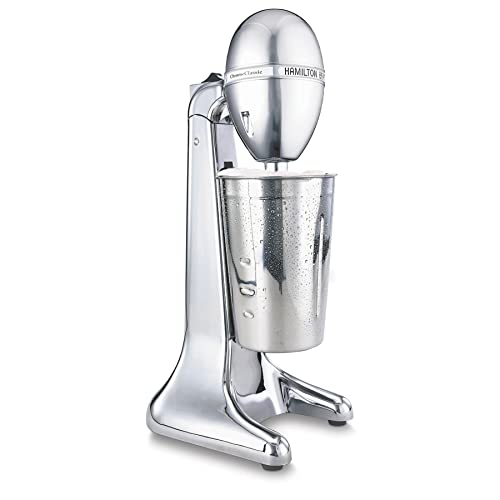
Hamilton Beach DrinkMaster Retro Drink Mixer (730N) — Best Budget for Home Bars
The home version of the soda-fountain idea: a retro countertop spindle mixer with a 28-ounce steel cup for milkshakes, malts, frappes and protein drinks at home. It suits families, home entertainers and anyone who wants diner-style shakes without commercial prices or duty ratings. It is not certified or built for commercial service, and high-volume shops must buy the commercial models above.
Strengths
- Real spindle action gives home shakes the aerated texture a blender cannot
- Large 28 oz steel cup handles family-size shakes in one batch
- Far cheaper than commercial spindles while covering home needs completely
Trade-offs
- Home duty only: not NSF certified and not built for shop volume
- Two speeds is the whole control range
- Tilting head and cup are one more appliance to store
| Cup | 28 oz stainless steel mixing cup |
| Speeds | 2 |
| Design | Retro countertop drink mixer, chrome finish |
Most home “milkshake makers” are just small blenders, and their shakes taste like it — dense and icy. The DrinkMaster keeps the genuine spindle mechanism, agitating from above and folding in air, so a home shake comes out light and frothy the way a diner shake should. The big steel cup doubles as the serving vessel for a shareable batch, and the retro chrome body is honestly part of the appeal on a home counter.
Set expectations correctly and it delights: it mixes shakes, malts, protein drinks and cocktail frappes, and it will not crush ice for smoothies or survive a commercial shift. For home use a few times a week, its mechanism is the real thing at a home price, which is why it anchors the affordable end of the drink mixer guide.
Its presence in a commercial guide needs one more sentence of honesty: if there is any chance your operation will be inspected, or your shake volume will grow past a handful a day, skip this pick and buy the HMD200. The DrinkMaster is for homes, and it is excellent there — the badge says home bar because that is the truth of the machine.
Best for: home bars, families and entertainers who want real diner-style shakes at home / Not suited for: any inspected commercial operation or high-volume service
Check the current price on Amazon
Comparison Table
The table compresses the six picks into the facts that decide commercial purchases: the badge, the key specification behind it, and the operation each machine belongs in. Shortlist by menu, then read the full reviews.
| Pick | Badge | Key spec | Best for |
|---|---|---|---|
| Hamilton Beach Commercial HMD200 Single-Spindle Drink Mixer Check on Amazon | Best Overall | Single spindle, 3 speeds, NSF certified, hands-free cup activation | Cafes, diners and ice-cream shops whose menu is shakes, malts and fountain drinks |
| Hamilton Beach Commercial HMD400 Triple-Spindle Drink Mixer Check on Amazon | Best for Rush Volume | Three independent spindles, 3 speeds each, NSF certified | Busy shake-led shops where the counter regularly queues at the drink station |
| Hamilton Beach Commercial MixStation Drink Mixer (HMD1000) Check on Amazon | Best for Mix-In Drinks | 3/4 HP, programmable variable speed, remix function for hard mix-ins | Dessert shops and cafes whose menu is built on customised mix-in drinks |
| Hamilton Beach Commercial Tempest Blender (HBH650) Check on Amazon | Best for Frozen Drinks | 3 HP blender, 64 oz jar, NSF certified, for frozen drinks | Bars and smoothie cafes blending frozen drinks back to back |
| Waring BB300 Blade Blender, 48 oz Check on Amazon | Best Bar Blender Value | 1.5 HP bar blender, 2-speed toggle + pulse, NSF certified | Bars, cafes and restaurants needing certified, simple, durable drink blending |
| Hamilton Beach DrinkMaster Retro Drink Mixer (730N) Check on Amazon | Best Budget for Home Bars | Home spindle-style mixer, 28 oz steel cup, 2 speeds | Home bars, families and entertainers who want real diner-style shakes at home |
How to Choose a Commercial Drink Mixer: Menu First, Machine Second
Write your menu down before you look at a single machine, because the menu is the specification. List every drink, mark which are aerated (shakes, malts, frappes), which are frozen (smoothies, frozen cocktails, crushed-ice drinks) and which are mix-in creations, and count how many of each a busy hour demands. Aerated drinks point to spindles; the count sizes the spindle number. Frozen drinks point to a blender; the count and the ice load size the horsepower. Mix-in drinks point to a programmable machine like the MixStation. Most new operators discover their menu is two of the three — which is why so many successful shops own a spindle and a blender, each doing the job the other does badly, rather than one machine compromising both.
Then apply the commercial filters, which are not optional. Certification: equipment in an inspected kitchen needs NSF certification or your local equivalent, full stop — it is the first thing to verify on any listing, and every commercial pick in this guide carries it. Duty: a machine rated for the drinks-per-day your rush implies will outlast a cheaper one run past its rating, and replacement cost belongs in the price comparison. Serviceability: jars, blades, cups and agitators wear; choose makers whose wear parts are stocked and replaceable, as both makers in this guide are. Finally, workflow: hands-free activation, controls usable with wet hands, and cleaning that staff will actually do at closing time decide whether the machine you bought is the machine your shop experiences.
The Real Cost of a Drink Station: Throughput, Waste and Replacements
Commercial affordability is arithmetic over years, not a sticker. A drink station’s true cost is the machine, plus the drinks it cannot serve during a rush because it is too slow, plus the remakes from inconsistent manual mixing, plus the replacement when an under-rated machine dies in its second season. Measured that way, the triple spindle that looks expensive in April is cheap by August if it serves the queue the single spindle turned away, and the programmable mix-in machine pays for itself in remakes that never happen. The opposite error also exists: spindles that never run are capital asleep on your counter. The discipline is to buy from evidence — a week of honest counts at your current station — rather than from hope or fear.
Budget framing for the search’s tier, stated plainly: the machines in this guide are the affordable end of certified commercial equipment. Below them sits home equipment, represented honestly by the DrinkMaster pick, suitable only where no inspection and no volume apply. Above them sit sound-enclosed, fully programmable flagship blenders and bespoke fountain setups whose extra money buys quiet and automation, not better drinks. For most small operations, the right purchase is in this guide’s tier, sized by the menu exercise above — and checked at the current price on Amazon for the exact configuration, since commercial configurations vary.
Space-Saving Options: Wall-Mount Spindles and Counter Planning
Counter space is the scarcest resource in most drink operations, and it deserves a section of its own in an affordability guide, because space you do not have to rent is money you do not have to spend. Hamilton Beach Commercial’s wall-mount spindle mixer, the HMD300, exists for exactly this arithmetic: it mounts to the wall, hangs the cup at working height and uses zero counter, while making the same aerated spindle drink as the counter models in this guide. Its verified configuration is a single spindle with two speeds and two-way activation, NSF certified like its siblings. For food trucks, kiosks, concession stands and micro-cafes where the counter is fully committed, it is frequently the only way a shake programme fits at all.
Even where a wall-mount is unnecessary, plan the station’s footprint before ordering. A triple spindle needs its full width plus cup staging on both sides; a high-performance blender needs depth for its jar and clearance above it, plus a home for a spare jar. Measure the station in its working state — machine, cups, ingredients, a staff member’s elbows — rather than from the machine’s catalogue dimensions. Operators who skip this step discover at installation that the affordable machine they bought needs a counter they do not own, which is the most expensive kind of affordable there is.
How to Set Up a Commercial Drink Station That Survives a Rush
Equipment is half the station; layout and routine are the other half. Set yours up in this order before your first busy service.
- Place the machine where the drinks are finished, not where there is space. The drink station should sit between ingredient storage and the pass, so a drink travels in one direction: cup, ingredients, machine, garnish, out. Every backtrack doubles during a rush.
- Standardise the cup and the fill line. Spindle mixers and blenders both reward consistency: one cup size, ingredients measured to a line, the same sequence every time. Consistency is what lets any staff member produce the menu’s drinks, not just the one who invented them.
- Programme and label before service. On programmable machines, set each menu drink’s cycle in a quiet hour and label it. On manual machines, write the speed and time for each drink on a card at the station. A rush is no time for memory.
- Stage mix-ins and garnishes within arm’s reach. The machine’s cycle is fixed; the variable is staff movement. Everything a drink needs should be reachable without a step, or the station’s throughput is set by walking, not mixing.
- Rinse between drinks, deep-clean at close. A rinse cup or jar rinse between flavours prevents carry-over; agitators, jars and cups get a full wash at close, every close. Machines in this guide are designed for it — the routine is what makes certification meaningful in practice.
- Keep one spare wear kit on the shelf. A spare jar or cup set and a spare agitator or blade assembly turn a mid-service failure from a closed station into a two-minute swap. It is the cheapest insurance in the building.
- Log the counts for a week. Drinks per hour, per machine, at peak. That log is the evidence your next equipment decision — a second spindle, a bigger blender — should be made from.
Run that routine and the affordable machines in this guide will feel like a system rather than a purchase. Skip it, and even flagship equipment produces a chaotic station — the rush exposes workflow, not horsepower.
Drink Mixer Maintenance: The Routine That Protects the Investment
Commercial drink equipment dies of neglect more often than of workload, and the neglect is almost always sugar. Syrups and dairy dry into a glaze that seizes agitator shafts, glues jar seals and feeds exactly the growth your health inspector is looking for. The defence is a rhythm, not an effort: rinse the working parts between drinks so nothing dries on, wash cups, jars and agitators in hot detergent at close, and let everything air-dry fully before reassembly so seals and bearings are not stored wet. Weekly, run the machine and listen — a spindle or blender that has changed its sound is telling you about a bearing or a blade before it tells the whole room mid-service.
Monthly, inspect the wear parts you stocked spares for: jar seals for nicks, agitator discs for wear, blender blades for dullness and play. Replace from the shelf kit and reorder the spare the same day, so the kit is never empty when the next failure chooses its moment. None of this is skilled work, and all of it is cheaper than the alternative — the affordable machines in this guide are built to be maintained this way, which is a large part of what makes them affordable over years rather than merely cheap on the day.
Common Buying Mistakes
Buying a blender to make milkshakes
The category’s defining error. A blender shears a shake dense and heavy; the aerated, frothy body customers expect comes only from a spindle’s agitation. Shops make this mistake because blenders are familiar, then spend a season wondering why the shakes review badly. If shakes and malts are on the menu, a spindle is not optional — and if frozen drinks are also on the menu, the answer is both machines, not a compromise.
Ignoring certification until the inspection
Uncertified equipment in a commercial kitchen is a liability discovered at the worst possible moment. Verify NSF certification on the manufacturer’s own listing before purchase — every commercial pick in this guide was checked this way — and be especially wary of home machines wearing commercial styling and commercial language.
Under-sizing for the rush you actually get
Drink demand is spiky: a machine sized for the average hour fails in the peak twenty minutes, which is when the money is. Size spindles and blender power for your honest peak, using a week of counts, and remember that a second drink waiting is the signal to add capacity — not a queue out the door.
Skipping the spare jar, cup and agitator
Wear parts fail at peak, by definition, because that is when they are working hardest. A station with no spare jar or agitator closes when a part does. The spares for the machines in this guide are stocked and inexpensive relative to a lost evening of drinks; buy them with the machine.
Judging a bar blender by its programme list
Touchscreens and drink programmes impress in a showroom and slow a wet-handed bartender in service. For most bars, positive mechanical controls — toggles, paddles — are faster, more durable and easier to train. Programmes earn their cost in mix-in and smoothie operations where consistency across staff is the product; elsewhere, simplicity is the feature.
Final Recommendation
Let the menu decide, then buy the badge that matches it. Shake- and malt-led operations should buy the HMD200 — Best Overall Check the current price on Amazon — and graduate to the HMD400 — Best for Rush Volume Check the current price on Amazon — when the queue proves the need. Mix-in menus should buy the MixStation’s consistency. Frozen-led menus should buy power: the Tempest — Best for Frozen Drinks Check the current price on Amazon — for volume, or the Waring BB300 for certified value. Home bars should buy the DrinkMaster and enjoy the real thing at a home price. Every machine here is the affordable end of genuine equipment for its job — which is the only kind of affordable a business should buy.
- Hamilton Beach Commercial HMD200 Single-Spindle Drink Mixer — Best Overall: Check the current price on Amazon
- Hamilton Beach Commercial HMD400 Triple-Spindle Drink Mixer — Best for Rush Volume: Check the current price on Amazon
- Hamilton Beach Commercial Tempest Blender (HBH650) — Best for Frozen Drinks: Check the current price on Amazon
Related guides in this series: Best Affordable Mixers Best Affordable Mixers For Streaming Best Affordable Recording Mixers Best Affordable Sound Mixers Best Affordable Kitchen Mixers
Related guides
Frequently Asked Questions
What is the difference between a drink mixer and a blender?
A spindle drink mixer agitates from above and folds air into the drink, producing the light, frothy texture of a proper milkshake, malt or frappe. A blender’s blades shear ingredients at high speed, which crushes ice and frozen fruit but makes shakes dense. They are different tools for different drinks, and most full-menu shops own both.
Can a commercial drink mixer crush ice?
A spindle mixer cannot — ice belongs in a blender. Spindle machines are built to aerate liquid and soft ingredients; hard ice loads damage agitators and stall motors. If crushed or blended ice is on your menu, buy a commercial blender like the Tempest or BB300 picks in this guide, sized to your volume.
How many spindles does my shop need?
One spindle per drink you need to make simultaneously at peak. A single spindle serves steady, low-volume shake trade; when a second drink regularly waits for the spindle during your rush, you have outgrown it. The triple-spindle pick exists for shake-led shops whose peak is a queue, and its value is entirely in that peak.
Does my drink equipment need NSF certification?
If your kitchen is inspected — which means effectively every commercial food and drink operation — yes. Certification is the verified line between commercial and home equipment, and inspectors can require uncertified machines to be removed. Every commercial pick in this guide is NSF certified; the one home pick is labelled as home equipment explicitly.
Are programmable drink mixers worth it?
For mix-in menus and multi-staff operations, yes: a programmed cycle makes the same drink on every shift, which protects both quality and brand. For a single-operator classic shake shop, a manual spindle’s simplicity serves just as well. Programmability buys consistency across people; if there is only one person, there is less to buy.
How long should commercial drink equipment last?
Certified machines from the makers in this guide are built for years of daily service, with wear parts — jars, cups, agitators, blades — replaced as they wear rather than the machine being replaced. Longevity depends on matching the machine’s duty rating to your volume and on the cleaning routine; the setup section above covers both.


