Disclosure: airfryerkitchensupply.com is reader-supported. When you buy through links on our site, we may earn an affiliate commission at no extra cost to you.
Where to buy
Ask anyone who has priced a bedroom from scratch — is a bed frame worth it, or is it the one line item you can delete and sleep exactly as well? This article’s answer: the frame is worth it for most households, but probably not the frame, or the budget, you first had in mind. The bed frame models below are the reference points this verdict is built on — each one was verified against Amazon’s own catalogue data before it earned a place here, so the value argument rests on real products rather than brochure claims: Zinus 14 Inch Rumi Metal Bed Frame Queen; Zinus Allen Mid Century Wood Platform Bed Frame Queen; Zinus Maya Upholstered Bed Frame Queen; ZINUS Vivek Deluxe Wood Platform Bed Frame Queen; Zinus 14 Inch Ellie Bamboo Platform Bed Frame Queen; Zinus 14 Inch Elias Metal Platform Bed Frame Full. Check the current price on Amazon for any of them before you decide, because the worth-it maths in this article is about tiers and trade-offs, not a fixed number.
Key Takeaways
- A bed frame is worth it for almost everyone who owns a mattress they care about: it provides the even support the mattress was designed for, deletes the box spring on platform models, and lifts the bed to a height that makes daily life measurably easier.
- The frame is a supporting purchase, not the star — the mattress should always command the larger share of a bedroom budget, and a mid-tier platform frame protects that investment rather than competing with it.
- Fourteen-inch platform frames quietly add a room’s worth of under-bed storage, which in small homes can be the single most valuable thing the purchase delivers.
- A mattress on the floor works as a short-term arrangement, but moisture, dust, warranty support requirements and daily accessibility all argue for a frame over any longer horizon.
- All six frames compared here are verified platform models from one brand family, so the differences below are real design choices — material, height, headboard, noise — not marketing fog.
Is a Bed Frame Worth It? What It Actually Buys You
It is a fair question, usually asked in one of two situations: you have just bought a mattress and the total at checkout is making you look for something to cut, or you have been sleeping with the mattress on the floor for months and a friend has finally said something. Is a bed frame worth it, or is it furniture theatre — a product the industry sells because bedrooms in photographs have them?
The short answer is that a frame is one of the few bedroom purchases whose value you can actually itemise. It supports the mattress the way the mattress was designed to be supported, it lifts the bed to a height your knees and back will thank you for twice a day, it lets air move under the mattress, and on a modern platform frame it deletes the box spring — a whole second purchase — from the bill. Set against that: a frame costs money a mattress does not strictly need to function tonight, and a bad frame is worse than none, because it creaks, flexes and lies to you about supporting anything.
This article works through the verdict properly: what a frame buys you, what skipping one quietly costs, where the money should stop (a frame is a supporting act, never the star), and which of the verified platform frames below represents the honest value at each tier. If the mattress-on-floor life genuinely suits you, we will say so — there is a section below on exactly when to skip this purchase entirely.
In this guide
Quick Picks: The Bed Frame Models That Frame the Verdict
Best Overall Value — Zinus 14 Inch Rumi Metal Bed Frame Queen: The default answer to this article’s question: a heavy-duty steel platform with 14 inches of clearance that replaces frame and box spring in one quick-assembly purchase. If a frame is worth it at all, it is worth it in roughly this shape. Check the current price on Amazon.
Best Wood Design Value — Zinus Allen Mid Century Wood Platform Bed Frame Queen: Proof that ‘worth it’ can include how a room feels: solid wood, wood slat support and a mid-century profile that makes the bed look intentional. You pay over the metal frames for material and design — and here, both are real. Check the current price on Amazon.
Best for Light Sleepers — Zinus Maya Upholstered Bed Frame Queen: The quiet candidate: an upholstered frame whose listing leads with noise-free sleep, wrapped around wooden slats and a sturdy framework. Worth the upholstery premium if frame noise is a real entry in your sleep problems. Check the current price on Amazon.
Best Traditional Wood Frame — ZINUS Vivek Deluxe Wood Platform Bed Frame Queen: The complete-package traditionalist: wood platform plus a proper headboard in one purchase. Worth it when the alternative is buying a bare frame now and a headboard later at a worse total. Check the current price on Amazon.
Best for Small Rooms — Zinus 14 Inch Ellie Bamboo Platform Bed Frame Queen: The storage maximiser with a lighter footprint: 14 inches of clearance, bamboo construction and a minimalist profile. The listing itself leads with ample underbed storage — which is exactly the reason to choose it. Check the current price on Amazon.
Best for Full-Size Beds — Zinus 14 Inch Elias Metal Platform Bed Frame Full: The full-size proof of the category’s value: steel platform support, no box spring and easy assembly at the size tier where budgets are tightest. If it is worth it here, the case only strengthens as beds get bigger. Check the current price on Amazon.
How These Picks Were Chosen
The six frames here were not chosen as the six prettiest beds on Amazon; they were chosen because together they map the real decision. All are queen size except one full, all are platform designs that remove the box spring from the equation, and all come from a single manufacturer whose listings were verified through the site’s Amazon catalogue connection — Zinus — which makes the comparison unusually clean: same brand family, different materials, heights and design intents. Metal workhorse, mid-century wood, upholstered, deluxe wood with headboard, bamboo, and a compact full-size metal option.
The criteria were the ones that decide whether a frame feels worth it in year three rather than week one: support type (slat spacing and material), whether a box spring is genuinely unnecessary, stated assembly approach, under-bed clearance as usable storage, and headboard presence. Aesthetics were treated as a legitimate criterion rather than a guilty pleasure — a frame is the largest piece of furniture in the room — but never allowed to outrank structure. As with every article in this series, ratings and review counts played no part: they fluctuate, and they cannot tell you whether a frame suits your mattress and your room.
The 6 Platform Frames That Make the Case
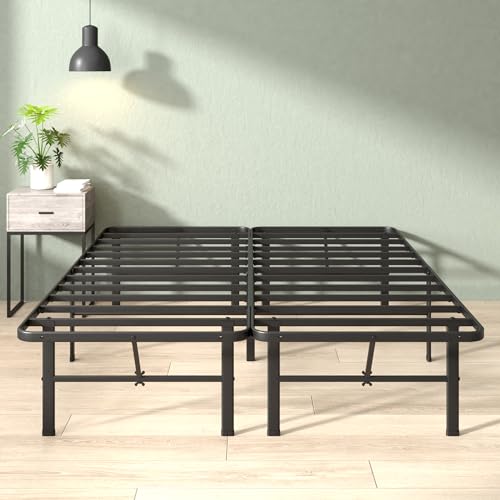
Zinus 14 Inch Rumi Metal Bed Frame Queen — Best Overall Value
The Rumi is the frame equivalent of a well-made basic tool: a 14-inch steel SmartBase platform, verified in the listing as heavy-duty steel with quick assembly, that supports the mattress directly and needs no box spring. It has no headboard and no design ambitions beyond a clean black finish — everything it costs is structure.
Strengths
- Deletes the box spring purchase entirely — the hidden saving that reframes its price
- 14-inch clearance converts the under-bed void into real, bin-sized storage
- Steel platform support suits foam and hybrid mattresses that need even backing
Trade-offs
- No headboard: pillows slide and the wall takes the wear unless you add one
- Industrial look — it is honest furniture, not a style statement
- Metal frames ask for fully tightened bolts to stay silent; assembly care matters
| Key specs (from the verified listing) | |
|---|---|
| Size | Queen |
| Height | 14 inches |
| Support | Steel platform, no box spring needed |
| Assembly | Quick assembly design |
The Rumi’s value case is that it refuses to waste money. There is no upholstery to clean, no styling premium, no second foundation to buy — the budget goes into steel and geometry, which are the parts of a frame you actually feel. Fourteen inches of clearance is the other half of the argument: in apartments and small bedrooms, the volume under a queen bed is one of the largest storage spaces in the home, and this frame makes all of it reachable. If you buy one frame from this article and stop reading, this is the one the verdict points to.
Best for: most queen-bed households wanting support, storage and simplicity in one purchase / Not suited for: buyers who want a headboard and a furniture look included — Check on Amazon

Zinus Allen Mid Century Wood Platform Bed Frame Queen — Best Wood Design Value
The Allen is the design-led counterpoint to the Rumi: a solid wood platform frame in a mid-century style, with wood slat support and a low-profile silhouette, verified in the listing with easy assembly and no box spring needed. It costs more than the steel options because wood and design do — the question is whether the room notices.
Strengths
- Solid wood construction and slats — the traditional, repairable way to build a bed
- Design value is genuine: it finishes a room in a way a bare steel base cannot
- Platform support keeps the no-box-spring saving intact
Trade-offs
- Low profile means minimal under-bed storage — measure before you fall for the look
- Wood costs more than steel for the same structural job
- Low bed height is a poor match for anyone who finds getting up from low furniture hard
| Key specs (from the verified listing) | |
|---|---|
| Size | Queen |
| Material | Solid wood |
| Support | Wood slats, no box spring needed |
| Profile | Low profile, mid-century design |
The Allen asks the most interesting worth-it question in this roundup: how much of a frame’s value is allowed to be aesthetic? The honest answer is more than purists admit. You look at your bed more than any other object you own, guests see the bedroom, and a frame that makes the room feel finished delivers that satisfaction daily for a decade. The Allen’s premium over the Rumi buys exactly that, on top of equivalent platform fundamentals. What it must not do is seduce a storage-poor household: the low profile is a real functional sacrifice, and in a small flat the Rumi’s clearance is worth more than the Allen’s lines.
Best for: households furnishing a room they will live in for years and want the bed to anchor it / Not suited for: storage-first buyers — the low profile gives back the under-bed volume — Check on Amazon

Zinus Maya Upholstered Bed Frame Queen — Best for Light Sleepers
The Maya wraps the platform formula in upholstery, with an asymmetric headboard as its design signature. The verified listing emphasises durable wooden slats, a sturdy framework and noise-free sleep — a combination aimed squarely at couples and light sleepers, for whom a frame’s worst crime is announcing every movement at 3 a.m.
Strengths
- Upholstery damps contact noise and softens the headboard for sitting up
- Stated noise-free design intent matches what light sleepers actually need
- Wooden slat platform keeps mattress support orthodox
Trade-offs
- Fabric needs more care than steel or wood and shows wear sooner in hard-use homes
- The asymmetric headboard is a strong look — love it or it will bother you daily
- Upholstery adds cost that buys comfort and quiet, not extra structure
| Key specs (from the verified listing) | |
|---|---|
| Size | Queen |
| Support | Wooden slats, no box spring needed |
| Headboard | Upholstered, asymmetric design |
| Design goal | Noise-free sleep (per listing) |
Upholstery on a frame does two jobs: it pads the headboard for readers and it damps the small knocks and rattles that hard frames transmit. For a couple where one partner’s sleep is fragile, eliminating a noise source is not a styling choice but a nightly quality-of-life purchase, and it should be priced against other sleep spending accordingly. The counterweight is maintenance: fabric asks for occasional care and forgiveness it may not get in a house with muddy paws. Buy the Maya for the quiet, keep it for the headboard, and be honest about the fabric’s life in your household before ordering.
Best for: light sleepers and couples where one partner’s movement currently ends the other’s night / Not suited for: households with pets or toddlers likely to test fabric with claws and spills — Check on Amazon

ZINUS Vivek Deluxe Wood Platform Bed Frame Queen — Best Traditional Wood Frame
The Vivek Deluxe is the frame for buyers who want the bed finished in one decision: a wood platform with an integrated headboard, wood slat support and no box spring requirement, in queen size. It is the most conventional product in this roundup, deliberately — it exists for the large group of buyers whose ideal bedroom looks like a bedroom.
Strengths
- Frame and headboard in one purchase — no second decision, no mismatched finishes
- Wood slat support is the mattress-friendly classic
- A complete bed transforms a room faster than any other single furniture buy
Trade-offs
- Headboard-included means headboard-committed: the look is set for the frame’s life
- Larger, heavier delivery and assembly than the headboard-free metal options
- Costs more than bare platforms because it is more furniture, not more support
| Key specs (from the verified listing) | |
|---|---|
| Size | Queen |
| Material | Wood |
| Support | Wood slats, no box spring needed |
| Headboard | Included |
There is a budgeting trap the Vivek avoids: the bare frame bought cheaply, followed months later by a headboard bought separately, usually costs more in total than the complete bed bought once — and matches worse. The Vivek’s proposition is administrative as much as physical: one decision, one delivery, one assembly, and the bedroom’s main furniture is finished. For households that know they want the conventional complete bed, that consolidation is the value. For households still deciding their room’s direction, the modular route keeps options open, and the Rumi plus patience is the better buy.
Best for: buyers who want one complete, conventional bed — frame and headboard — done properly / Not suited for: minimalists and frequent movers who prefer headboard-free simplicity — Check on Amazon

Zinus 14 Inch Ellie Bamboo Platform Bed Frame Queen — Best for Small Rooms
The Ellie takes the Rumi’s high-clearance idea and rebuilds it in bamboo with a minimalist design, at the same useful 14-inch height. The verified listing highlights wood slat support, durable construction and — unusually honest marketing — ample underbed storage as the headline, which tells you exactly which household this frame is for.
Strengths
- 14-inch clearance with a lighter visual footprint than a tall steel base
- Bamboo construction suits buyers minimising metal in the bedroom
- Minimalist design disappears into small rooms instead of dominating them
Trade-offs
- No headboard included, like the Rumi
- Bamboo and wood slats ask for the same assembly care as other wood frames
- The storage advantage only matters if you actually store things under the bed
| Key specs (from the verified listing) | |
|---|---|
| Size | Queen |
| Height | 14 inches |
| Material | Bamboo |
| Support | Wood slats, no box spring needed |
Compare the Ellie directly with the Allen to see the worth-it fork clearly: same brand family, same platform idea, opposite priorities. The Allen spends its budget on profile and presence; the Ellie spends it on clearance and lightness of look. In a small room, storage volume is not a bonus feature, it is rent you are already paying being put to work — a queen footprint of organised storage can free an entire cupboard elsewhere. If your home has storage to spare, the Ellie’s advantage evaporates and the Allen or Vivek become the better spend. Context, as ever in this category, is the verdict.
Best for: small bedrooms and apartments where under-bed storage volume is genuinely needed / Not suited for: buyers wanting a headboard or a bold furniture statement — Check on Amazon

Zinus 14 Inch Elias Metal Platform Bed Frame Full — Best for Full-Size Beds
The Elias applies the metal platform formula to full size: 14-inch steel support, no box spring needed, easy assembly. It matters to this article because full-size beds live in the rooms where the worth-it question is sharpest — spare rooms, teenagers’ rooms, first apartments — where every furniture pound competes.
Strengths
- Full platform support at the size where budgets are most contested
- No box spring keeps the total cost of a spare-room bed honest
- Steel construction shrugs off the knocks of multi-purpose rooms
Trade-offs
- Full size only in this listing — no queen or king variant in this roundup
- Bare platform look, no headboard
- As with all steel frames, bolt-tightening discipline decides long-term silence
| Key specs (from the verified listing) | |
|---|---|
| Size | Full |
| Height | 14 inches |
| Support | Steel platform, no box spring needed |
| Assembly | Easy assembly (per listing) |
Guest rooms and teens’ rooms are where frame spending goes to be resented, because the bed is used less and the budget is contested. The Elias makes the correct argument for those rooms: support and height are not luxuries that scale with use, they are the minimum a mattress needs, and a cheap platform delivers them fully. What you give up versus the queen models is choice, not quality — the full-size catalogue is thinner everywhere. For a first apartment with a full mattress, this tier of frame plus the best mattress the remaining budget allows is the allocation this article recommends without hesitation.
Best for: full-size mattress owners, teens’ rooms, guest rooms and first apartments / Not suited for: queen and king households — this listing is full size only — Check on Amazon
Comparison Table
| Pick | Badge | Key spec | Best for |
|---|---|---|---|
| Zinus 14 Inch Rumi Metal Bed Frame Queen | Best Overall Value | Queen; 14-inch steel platform; no box spring needed; quick assembly; heavy-duty steel | most queen-bed households wanting support, storage and simplicity in one purchase |
| Zinus Allen Mid Century Wood Platform Bed Frame Queen | Best Wood Design Value | Queen; solid wood; wood slat support; low profile; no box spring needed | households furnishing a room they will live in for years and want the bed to anchor it |
| Zinus Maya Upholstered Bed Frame Queen | Best for Light Sleepers | Queen; upholstered asymmetric headboard; wooden slats; noise-free design goal | light sleepers and couples where one partner’s movement currently ends the other’s night |
| ZINUS Vivek Deluxe Wood Platform Bed Frame Queen | Best Traditional Wood Frame | Queen; wood platform with headboard; wood slat support; no box spring needed | buyers who want one complete, conventional bed — frame and headboard — done properly |
| Zinus 14 Inch Ellie Bamboo Platform Bed Frame Queen | Best for Small Rooms | Queen; 14-inch bamboo platform; wood slat support; ample underbed storage (per listing) | small bedrooms and apartments where under-bed storage volume is genuinely needed |
| Zinus 14 Inch Elias Metal Platform Bed Frame Full | Best for Full-Size Beds | Full size; 14-inch metal platform; steel support; no box spring needed; easy assembly | full-size mattress owners, teens’ rooms, guest rooms and first apartments |
What a Bed Frame Actually Buys You, Item by Item
Strip the purchase down to its components and a frame buys five things. First, support geometry: slats or a solid deck hold the mattress flat and evenly, which is what the foam or coils inside were designed to rest on — a mattress bridging gaps or sagging between rails feels older than it is. Second, airflow: a mattress sitting on a breathable platform dries from below, which matters in humid climates and small, warm rooms. Third, height: getting in and out, sitting on the edge to dress, and making the bed all become easier at a sensible height, and the benefit compounds daily.
Fourth, storage and cleanliness: clearance underneath is either a dust zone or genuine storage volume, and the 14-inch profiles in this roundup turn it into the latter — suitcases, shoe boxes and spare bedding disappear under the bed instead of filling cupboards. Fifth, the room itself: a bed is the largest object in most bedrooms, and a frame with a deliberate headboard and finish is most of the room’s furniture character in one purchase. Price those five things separately — a storage unit, a dehumidifying routine, a step stool’s worth of convenience — and the frame’s cost starts to look less like a luxury and more like a bundle discount.
The Hidden Cost of the Wrong Frame (and of No Frame)
The costs of skipping or under-buying a frame arrive slowly, which is why they are underestimated. A mattress on the floor in a cool or humid room can trap moisture against its underside; check underneath monthly if you floor-sleep, because the first sign is a smell you cannot wash out of foam. A mattress on a worn, widely spaced support develops body impressions faster, and many mattress warranties assume adequate support — a cheap frame that voids the protection on an expensive mattress is the worst bargain in the bedroom.
The wrong frame also taxes you daily in small coins: squeaks that wake a partner, a bed height that makes sheet-changing a wrestling match, sharp metal corners at shin level, a headboard that rattles against the wall every time someone sits up. None of these appear on a listing. All of them decide whether the purchase feels worth it by month two. This is why the verdict in this category is less ‘frame or no frame’ and more ‘frame bought once, properly, at the tier your mattress deserves.’
Frame vs Adjustable Base: Where the Extra Money Goes
Readers weighing this article against the adjustable question should know exactly what the upgrade buys. An adjustable base takes the frame’s support job and adds movement: motors, a remote, incline positions. Everything else — the need for even support, correct height, a mattress that suits the structure — stays the same, and the price roughly multiplies. If your evenings are spent in bed and positions matter to you, that multiplication can be justified, and our companion verdict works through it in detail. If you sleep flat and leave, the adjustable premium buys you a remote you will stop touching — and a strong flat frame like the ones here keeps the change in your pocket for the mattress, where it does measurable work.
The Five-Year View: What the Frame Protects
Run the numbers over the horizon a frame actually serves. A platform frame bought once typically carries two mattresses across its life, which means its cost is not competing with this year’s mattress budget — it is underwriting the next decade of sleep purchases. Every mattress you buy from now on lands on support that is already correct, already the right height, already silent. Compare that with the household that re-litigates support with every mattress: a foundation here, a set of rails there, a plywood sheet in an emergency. The frame’s worth-it case is partly that it ends the recurring improvisation.
There is also a hygiene dividend that rarely makes the listings. A mattress lifted on a breathable platform can be vacuumed under, aired from below and inspected — you will see the dust, the lost socks and, in warmer climates, the first signs of any pest problem months earlier than a floor mattress would reveal them. The bed becomes maintainable furniture instead of a sealed block on the carpet. Owners rarely cite this in week one; by year two, the households that have cleaned under both kinds of bed have strong opinions, and they do not favour the floor.
Finally, count the room’s flexibility. A framed bed can be moved, repositioned and re-made as the room’s life changes — nursery corner today, desk wall tomorrow — without a furniture crisis each time. A mattress on the floor anchors the room’s layout by sheer awkwardness. Flexibility is soft value, but across ten years of real households it is the kind that quietly accumulates, and it belongs in an honest verdict alongside the steel and the slats.
Who Should Buy a Frame — and Who Can Wait?
Buy a frame if you own or are buying a mattress you expect to keep for years, if your bedroom is short on storage, if getting in and out of a floor-level bed has started to register in your knees, or if your current support is a tired box spring or wide rails you would not trust a new mattress to. Buy one, specifically, before you upgrade the mattress: the frame is the foundation decision, and it should be in place and settled when the mattress arrives.
Skip it — for now — if you are in genuinely temporary housing measured in months, if you are floor-sleeping deliberately to test a firmer surface, or if every spare pound is needed to escape a mattress that is actively hurting your sleep. In those cases the floor is a rational waiting room. Just set a review date: the arrangement that is sensible for a season quietly becomes a five-year habit in many homes, and the frame’s case strengthens with every month it is postponed.
There is a middle group worth naming: households whose mattress is fine but whose bed situation is improvised — a hand-me-down frame of the wrong size, rails borrowed from another bed, a box spring older than the mattress it carries. For them the frame is not an upgrade but a correction, and corrections are the easiest purchases to justify in any room. If your bed wobbles, tilts, squeaks or sits at a height nobody chose, you are not asking whether a frame is worth it; you are asking which one, and the six above are ordered to answer exactly that.
When Sleeping on the Floor or a Mattress Alone Is Good Enough
The floor experiment deserves respect: many people sleep well on a firm mattress on the floor for months, and if you are between homes, in a first apartment, or testing whether a firmer sleep surface suits you, floor sleeping costs nothing and answers honestly. A simple mattress foundation or bunkie board placed on an existing sturdy frame can also rescue a sagging setup for far less than a new frame. And if your current frame is sound but ugly, a headboard-only refresh changes the room for less money than a whole new bed.
What the alternatives cannot do is give you storage, airflow and a finished bed height at once — that bundle is the frame’s whole argument. So treat the alternatives as diagnostics and stopgaps: if a month on the floor leaves you missing the bed’s height every single morning, you have your answer, and it cost nothing to learn. If you barely notice the difference, save the frame money for the mattress, where your body will actually register it.
One more alternative deserves a straight answer: the traditional frame-and-box-spring combination you may already own. If it is level, silent and supportive, it is not obsolete — the platform frames in this article beat it on storage, simplicity and total cost when starting from zero, not on some dramatic sleep difference. Do not replace a working setup to follow a format. Replace it when it creaks, sags or strands a new mattress on support it was not designed for, and replace it with a platform so the next purchase is the last of its kind.
How to Choose a Bed Frame That Earns Its Money
Choose in this order: size, support, height, then looks. Size is dictated by your mattress, and queen buyers should note how completely the verified range serves them — full-size sleepers get the Elias pattern rather than the whole catalogue. Support means slats close enough and strong enough for your mattress type; foam mattresses are the least forgiving of wide gaps. Height is two numbers, not one: the frame’s platform height plus your mattress depth decides both the sit-on-the-edge feel and the storage volume underneath, so measure your storage bins against the clearance before falling for a low-profile look.
Then be honest about assembly and moving. Quick-assembly steel designs suit renters and frequent movers; solid wood frames reward households that will assemble once and stay. Material sets the room’s tone and the maintenance: metal is wipe-clean and neutral, wood warms a room and shows dust less, upholstery softens and silences but asks for occasional fabric care. Finally, hold the tier line: a frame should cost a clear fraction of the mattress it carries. If the frame budget is eating the mattress budget, step the frame down a tier — the Rumi exists to prove how little structure actually costs.
A last word on timing: frames are at their most worth it when bought before or with a mattress, not after a year of making do. The support habits a mattress forms in its first months — where it flexes, where it settles — stay with it. If a mattress purchase is on your horizon, let the frame decision ride along with it, sized for the mattress that is coming rather than the one that is leaving.
How to Check Your Current Setup Before You Spend
Before ordering, run a five-minute audit of your current sleep setup. Photograph the support your mattress rests on now and look at the gaps honestly — wide-spaced rails or a tired box spring explain more ‘mattress problems’ than mattresses do. Measure the room’s traffic path: a frame’s footprint is close to the mattress size, but a headboard’s depth and your walkway around the bed decide whether the room feels calm or cluttered. Then measure your storage: the tallest bin or suitcase you intend to slide underneath sets the minimum clearance, and that single measurement eliminates half the catalogue more reliably than any style preference.
On delivery day, assemble on a rug or blanket to protect floors and parts, tighten every fastener fully, and then — the step everyone skips — re-tighten after two weeks, when wood and metal have settled under load. Most frame squeaks are born in that settling, and five minutes with the Allen key in week two is the difference between a silent decade and a noisy one. Keep the spare hardware in a labelled bag taped under the bed; future-you, mid-move, will be grateful.
While the audit is fresh, check the wall behind the bed and the floor beneath it. A frame changes both relationships: headboards protect paint from pillows and heads, and raised clearance changes how you clean. If your current setup has been hiding a scuffed wall and a dust ecosystem, that is not an argument against the floor years — it is simply the maintenance bill arriving, and a frame is how you stop it accruing.
Common Buying Mistakes
Cutting the frame to upgrade the mattress, then putting the new mattress on a dying support. A premium mattress on wide, sagging rails wears like a budget one. Support first, or at least support honestly.
Buying for the photograph. Low-profile frames look serene in listings and strand storage, tall sleepers and older knees in real rooms. Let your clearance measurement and your sit test outrank the styling shot.
Ignoring the box-spring question until checkout. Platform or not is a whole second purchase hiding inside the first. Every frame here is a platform; if the frame you love is not, add the foundation to its real price before comparing.
Under-tightening at assembly and blaming the frame. Squeaks blamed on cheap metal are usually loose bolts. Tighten fully, re-tighten at two weeks, then judge.
Matching the frame to the mattress you are replacing. Frames outlast mattresses. Buy the frame for the next mattress’s size and type, not the outgoing one’s quirks.
Forgetting the headboard until the wall complains. Pillows migrate, heads lean, paint scuffs. If you choose a headboard-free platform like the Rumi or Ellie, plan the wall’s protection — a separate headboard, cushions, or simply accepting the look — as part of the purchase, not as a surprise.
Final Recommendation
Is a bed frame worth it? Yes — for almost every household that plans to stay in its home and its mattress for more than a few months, and the real decision is not whether but which. The Rumi is the default recommendation: structure, storage and simplicity at the value end. The Allen and Vivek serve buyers who want the bed to look like furniture. The Maya buys quiet and softness for light sleepers. The Ellie suits storage-hungry small rooms, and the Elias covers smaller beds and tighter budgets without cutting the platform corner. None of this requires buying in a hurry: a frame is a decade-long decision, and a week spent measuring, auditing and comparing will be repaid every night of that decade. Measure twice, buy once, and sleep on the result for a decade.
If you are still deciding between flat and motorised, the comparison continues in Adjustable Bed Frame Vs Bed Frame and the adjustable verdict itself is at Is An Adjustable Bed Frame Worth It. For the full model range see Bed Frame Reviews, the selection criteria are expanded in Bed Frame Buying Guide, the honest downsides are weighed in Bed Frame Pros And Cons, and the measuring method is in How To Choose A Bed Frame.
Shortlist again, in verdict order: Zinus 14 Inch Rumi Metal Bed Frame Queen; Zinus Allen Mid Century Wood Platform Bed Frame Queen; Zinus 14 Inch Ellie Bamboo Platform Bed Frame Queen. Check the current price on Amazon for each before ordering — the tier gaps between them are where the value decision actually happens.
Frequently Asked Questions
Is a bed frame worth it if my mattress is old?
Support it properly anyway, but sequence your spending: if the mattress is near the end of its life, buy the frame that suits the mattress you will buy next, not the one you are retiring. A good frame outlasts a mattress, so let the frame be the long-term decision and the mattress the replaceable one.
Do I still need a box spring with these frames?
No — all six frames in this roundup are platform designs whose slats support the mattress directly, which is part of their value case: one purchase does the job two used to. Check your mattress maker’s support requirements if you use any other frame, because some mattresses still specify particular foundations.
How much under-bed clearance is actually useful?
Enough for the boxes you own. Around 12 to 14 inches of clearance — the zone the Rumi and Ellie occupy — swallows standard storage bins, suitcases and shoe organisers. Measure your tallest bin before ordering rather than assuming, because two inches of shortfall turns storage back into a dust shelf.
Will a metal frame be noisy?
Noise comes from loose joints and flex, not from metal itself. The listings here emphasise sturdy steel construction and, in the Maya’s case, noise-free sleep as a stated design goal. Tightening every bolt fully at assembly — and re-checking after the first month as parts settle — is the owner’s half of the bargain.
Is a bed frame worth it in a rented room?
Usually yes, and renters are arguably the strongest case: a frame protects the mattress (and your deposit’s cleaning argument), adds storage when cupboards are scarce, and leaves with you. Favour the tool-light, quick-assembly metal designs like the Rumi or Elias, which move flats without drama.
How long should a decent frame last?
A steel or solid-wood platform frame should comfortably outlast one mattress and serve the next — think in terms of a decade rather than a product cycle. That lifespan is the core of the worth-it case: amortised over ten years of nightly use, even the premium wood frames here cost very little per night.

