Disclosure: airfryerkitchensupply.com is reader-supported. When you buy through links on our site, we may earn an affiliate commission at no extra cost to you.
Where to buy
Every frame in this bed frame review was verified against Amazon’s catalog data — exact model, size, and the construction claims in its own listing — and all six are sold on Amazon. Check price on Amazon at each listing, because frame pricing moves with size and finish in ways a static number here would misstate within weeks. The short version: the Zinus Rumi metal platform is the default recommendation for most bedrooms, the Zinus Allen wood platform is the pick when the frame is furniture rather than infrastructure, and the Zinus Maya upholstered frame is the soft, quiet option for light sleepers.
Introduction: a bed frame review that starts with what frames actually do
This bed frame review exists because the bed frame is the most under-thought purchase in the bedroom. Shoppers spend weeks on a mattress and minutes on the structure holding it, then blame the mattress for the squeak, the sag, and the wobble that were the frame’s doing all along. A frame has four jobs: hold the mattress at a height that suits the sleeper and the room, support it evenly enough that the mattress wears and feels as designed, stay silent and rigid for years of nightly load cycles, and — in platform designs — replace the box spring entirely. This review examines those four jobs in depth across six verified platform frames, all from Zinus, whose range effectively defines the value tier of this category: a metal SmartBase-style frame, two wood platforms, an upholstered design, a bamboo frame, and a full-size metal option for smaller rooms. That single-brand focus is deliberate and is stated openly: these are the frames the most buyers actually cross-shop, they share one maker’s sizing and slat standards, and comparing within the range exposes the real decision in this category, which is rarely brand — it is material, height, and whether the frame is invisible infrastructure or visible furniture. If you want the wider market shortlist, our companion roundup covers it; this review is the deep dive.
Two exclusions deserve stating at the outset. Adjustable bases are a different product category with motors, remotes, and a different decision entirely, and they are covered by their own guides on this site rather than folded into a platform review where they would distort every comparison. Traditional bed frames that require a box spring are likewise outside this review’s scope — not because they are obsolete for everyone, but because the platform design has become the default recommendation for modern mattresses, and mixing the two architectures in one review serves neither. What remains is the honest center of the category: six platform frames, four materials, two heights, two sizes, and the accumulated mechanics of what makes a bed feel solid at 3 a.m. in year five.
In this guide
How These Frames Were Evaluated
Each frame was verified through the Amazon catalog data available to this site, and the analysis below relies only on what each listing itself states — construction material, height, size, support type, and assembly claims — combined with the well-established mechanics of how platform frames behave. The evaluation criteria were five. Support: slat or platform design and what it means for mattress feel and warranty-friendly support. Silence and rigidity: the frame’s likely behavior under years of movement, judged by joint and material choices. Height and storage: what the underbed space does or does not allow. Assembly reality: what the listing promises and what that style of frame typically demands of the person with the Allen key. And role in the room: whether the frame disappears under bedding or earns its place visually with a headboard and finish. No prices and no fixed ratings appear anywhere in this review; check price on Amazon, where both change. One standing caution applies to every pick: match the frame’s slat spacing and support claims to your mattress maker’s requirements before ordering, because a mattress warranty can hinge on its foundation. A final note on sizes: five of the six frames are reviewed in queen, the market’s center of gravity, and the sixth in full, deliberately — the construction arguments in this review transfer across each model’s size range, but heights, clearances, and prices do not, so verify the exact size’s listing before treating any queen-specific observation as your own.
The Models in Depth
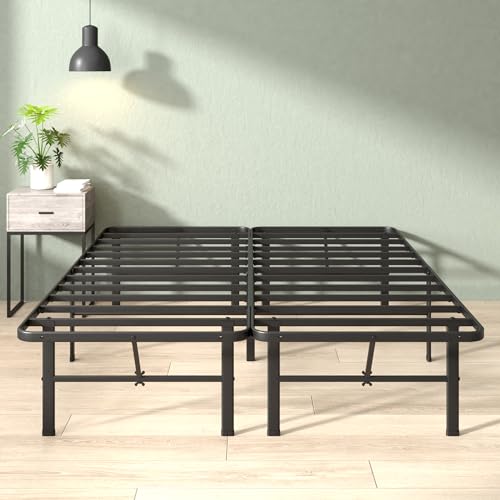
Zinus 14 Inch Rumi Metal Bed Frame (Queen) — Best Metal Platform
The Rumi is the frame this review keeps returning to as the reference point, because its verified listing states the value-tier formula in its purest form: a 14-inch metal platform, no box spring needed, heavy-duty steel construction in the maker’s SmartBase style, and quick assembly, in black, queen size. Fourteen inches is the consequential number. It lifts the mattress to a finished sleeping height most adults find easy to get in and out of, and it opens genuine underbed storage beneath — bins, seasonal bedding, the suitcase that lives nowhere else. The steel platform’s grid-style support is the other half of the appeal: where wood slats can flex, bow, or (rarely) crack, a steel grid is indifferent to load distribution and does not change character over the years. It suits the practical majority: mattress owners who want support solved permanently, storage users, and anyone whose aesthetic plan for the frame is “the bedding covers it.” It does not suit shoppers furnishing a room where the frame itself is a design statement — black steel under a duvet is infrastructure, and it knows it.
Strengths
- Steel platform support is even, durable, and indifferent to mattress type — the safest support story in this review
- 14-inch height delivers real underbed storage and an easy finished sleeping height
- No box spring needed, and quick-assembly design suits renters and frequent movers
Trade-offs
- Utilitarian black steel look contributes nothing visually beyond the bed skirt or bedding that hides it
- Metal frames demand tight, correct assembly to stay silent — a loose joint will announce itself at night
- The open grid feel is very firm; sleepers wanting any give from their foundation should look at slatted wood
Key specs (from the verified listing)
- Size: Queen (per listing)
- Height: 14 inch
- Construction: Metal, heavy-duty steel SmartBase-style platform
- Support: Platform — no box spring needed
- Assembly: Quick assembly (per listing)
Live with the Rumi and its virtues compound quietly. The mattress feels like itself, because the platform neither sags nor springs; the underbed becomes a storage system rather than a dust archive; and the frame survives moves, rearrangements, and years without developing the creaks that plague joined wood. Its discipline is assembly: steel frames are silent exactly as long as every connector is fully tightened, and the experienced move is to re-check fasteners after the first weeks of settling. Do that, and the Rumi becomes the piece of the bedroom you never think about again, which is the highest praise a frame in this role can earn.
Best for: most queen bedrooms wanting permanent, even support plus underbed storage / Not suited for: design-led rooms where the frame must be visible furniture

Zinus Allen Mid Century Wood Platform Bed Frame (Queen) — Best Wood Aesthetic
The Allen is the counter-argument to the Rumi within the same maker’s range: a solid wood platform frame in a mid-century profile, with wood slat support, no box spring needed, and a low-profile design, per its verified listing. Where the metal frame hides, the Allen is meant to be seen — warm wood, tapered mid-century lines, and a silhouette that makes the bed the room’s furniture rather than its cargo. The low profile is a real choice with real consequences: the finished bed sits lower and sleeker, which suits modern rooms and lower ceilings, and underbed storage largely disappears as a feature. Slat support changes the feel subtly too — wood slats have a trace of flex that takes the hard edge off a firm mattress in a way a steel grid never will. It suits design-conscious buyers, guest rooms that double as styled spaces, and anyone whose previous metal frame made the room feel like a warehouse. It does not suit storage hunters or sleepers who need a high bed for easy standing.
Strengths
- Solid wood mid-century design makes the frame genuine furniture, not hidden infrastructure
- Wood slat support adds a whisper of flex that flatters firm mattresses
- Low profile suits modern rooms, low ceilings, and a grounded aesthetic
Trade-offs
- Low height means minimal underbed storage — the Rumi’s bins will not fit here
- A lower finished bed is harder for some sleepers to rise from, especially with a thin mattress
- Wood frames reward careful assembly and occasional fastener checks to stay creak-free
Key specs (from the verified listing)
- Size: Queen (per listing)
- Construction: Solid wood platform, mid-century design
- Support: Wood slat support — no box spring needed
- Profile: Low profile
The Allen’s case is that the bedroom is a room, not a storage problem. In person, a wood platform changes how the whole bed reads: the mattress becomes a cushion on furniture, the room gains a horizon line, and the bed invites rather than looms. The ownership notes are the usual wood ones — assemble on a soft surface to protect the finish, tighten methodically, and expect to re-snug hardware after the first month as wood and hardware settle into each other. Buyers torn between this and the Rumi are really choosing which problem they have: if it is storage and permanence, buy steel; if it is a room that feels unfinished no matter what hangs on the walls, buy the wood.
Best for: styled bedrooms and guest rooms where the frame should be seen and the profile low / Not suited for: underbed storage, high-bed needs, or maximum set-and-forget support

Zinus Maya Upholstered Bed Frame (Queen) — Best Upholstered and Quiet
The Maya takes the platform idea and wraps it in fabric: its verified listing describes an upholstered frame with an asymmetric headboard, durable wooden slats, a sturdy framework, and — the phrase that matters most to its buyers — noise-free sleep, with no box spring needed. Upholstery changes the bed’s daily physics. The headboard becomes a backrest for reading and screens instead of a wall hazard; the padded rails forgive the shin and hip collisions that metal and wood frames collect in the dark; and fabric-wrapped joints and surfaces damp the small knocks and creaks that wake light sleepers. The asymmetric headboard is a deliberate design gesture that will divide opinion exactly as intended — it gives the Maya a boutique-hotel character the other frames here do not attempt. It suits couples where one partner sleeps lightly, readers-in-bed, and rooms that want softness at their center. It does not suit households with pets that treat upholstery as a scratching post, or anyone who wants a frame they can hose down and forget.
Strengths
- Upholstered headboard and rails make the bed softer to live with — reading comfort and forgiven collisions
- Noise-free positioning suits light sleepers and couples on different schedules
- Wooden slat platform support with no box spring needed keeps the sleep surface modern and even
Trade-offs
- Fabric upholstery needs vacuuming and spot care that wood and steel never ask for
- The asymmetric headboard is a strong style statement that will not blend into every room
- Padded frames are bulkier to move and to fit through tight stairwells and doors
Key specs (from the verified listing)
- Size: Queen (per listing)
- Construction: Upholstered frame with asymmetric headboard
- Support: Durable wooden slats — no box spring needed
- Listing focus: Noise-free sleep, sturdy framework
The Maya is the emotional pick of this review, and it earns that status on night-time evidence: the 2 a.m. return to bed that does not wake a partner, the morning read propped against a real backrest, the absence of the metallic punctuation that frames so often add to a night’s sleep. Its costs are maintenance and commitment — upholstery asks for a vacuum brush and prompt spot-cleaning, and the headboard’s asymmetry is a look you choose on purpose. For the light-sleeping, reading, softness-valuing household, no other frame in this set solves the same problems, because no other frame is trying to.
Best for: light sleepers, couples, and readers who want a soft, quiet, upholstered centerpiece / Not suited for: pet-heavy homes, minimal-maintenance shoppers, or tight-space moves

ZINUS Vivek Deluxe Wood Platform Bed Frame (Queen) — Best Classic Wood with Headboard
The Vivek is the traditionalist of the set: a deluxe wood platform frame with a headboard, wood slat support, and no box spring needed, per its verified listing. Where the Allen goes low and mid-century, the Vivek keeps the classic proportions — a proper headboard to dress a wall, a frame that reads as a bed first and a design object second. That makes it the easiest frame here to recommend across generations and room styles: it suits a primary bedroom being furnished for the long term, a guest room that should feel finished rather than staged, and buyers who found the Allen’s low profile impractical and the Maya’s asymmetry too much. Slat support gives the same slight flex as the Allen, flattering firm mattresses, and the all-wood construction keeps the room’s material palette simple to coordinate with existing dressers and nightstands. It does not suit the storage-first buyer — classic proportions do not hide fourteen inches of bins — or the ultra-modern room that wants the bed to vanish.
Strengths
- Classic wood design with a real headboard suits the widest range of rooms and tastes
- Wood slat platform support, no box spring needed, with the slight flex firm mattresses appreciate
- The safe long-term primary-bedroom choice in this set — nothing about it will date quickly
Trade-offs
- Conventional height offers less underbed storage than the 14-inch frames
- Less visually distinctive than the Allen’s mid-century lines or the Maya’s upholstery
- Wood construction wants the usual care: level floor, tightened hardware, settled-in re-checks
Key specs (from the verified listing)
- Size: Queen (per listing)
- Construction: Wood platform with headboard
- Support: Wood slat support — no box spring needed
If the Allen is the frame for a room with a point of view, the Vivek is the frame for a room with a life: it accommodates changing bedding, changing art, and changing taste without arguing with any of it. Ownership is undramatic in the best way — assemble carefully, keep it level, and the slatted platform simply supports the mattress as intended, year after year. In a review full of stronger personalities, the Vivek’s restraint is its recommendation: most bedrooms do not need a statement at their center, they need a well-made wooden bed, and that is precisely the product this is.
Best for: primary bedrooms and guest rooms wanting classic wood, a headboard, and broad compatibility / Not suited for: maximum storage height or a strongly modern, low-profile look

Zinus 14 Inch Ellie Bamboo Platform Bed Frame (Queen) — Best Natural Material and Storage Height
The Ellie pairs the Rumi’s most useful dimension — 14 inches of height, with the ample underbed storage its listing calls out — with the material story none of the other frames can tell: bamboo. Its verified listing describes a 14-inch bamboo platform with wood slat support, no box spring needed, a minimalist design, and durable construction, finished in brown, queen size. Bamboo’s appeal is partly aesthetic — a warm, fine-grained look that sits between the Allen’s statement wood and plain painted frames — and partly values-driven, for buyers who prefer fast-growing materials in their furniture. The minimalist profile keeps the visual weight low despite the practical height, and slat support gives the sleep surface its slight, mattress-friendly flex. It suits storage-needing buyers who disliked the Rumi’s industrial steel, eco-leaning shoppers, and rooms in natural, Scandinavian, or warm-minimal styles. It does not suit buyers who want a headboard — the Ellie’s minimalism is headboard-free in spirit — or the absolute rigidity of a steel grid.
Strengths
- 14-inch height restores full underbed storage in a warm natural material
- Bamboo construction offers a distinctive fine-grained look and a fast-growing material story
- Minimalist design keeps a tall frame visually light in smaller rooms
Trade-offs
- Slat support flexes slightly where steel would not — very firm-mattress purists may prefer the Rumi
- No headboard presence for readers who lean back or rooms needing a visual anchor
- Natural finishes show dust and scuffs differently than black steel; expect light upkeep
Key specs (from the verified listing)
- Size: Queen (per listing)
- Height: 14 inch
- Construction: Bamboo platform, minimalist design, brown finish
- Support: Wood slat support — no box spring needed
- Storage: Ample underbed storage (per listing)
The Ellie quietly resolves the review’s central tension — storage versus beauty — better than any other frame here. The Rumi stores more ruthlessly and the Allen looks more deliberate, but the Ellie is the frame a storage-needing buyer can also enjoy looking at every morning. Its ownership rhythm is wood’s rhythm: level it, tighten it, re-check it once settled. For the natural-materials household, or any bedroom where black steel feels like a compromise accepted rather than a choice made, the Ellie is the 14-inch answer.
Best for: storage plus natural materials — warm rooms, eco-leaning buyers, natural and Scandi styles / Not suited for: headboard readers, or buyers wanting the hardest, most rigid platform feel

Zinus 14 Inch Elias Metal Platform Bed Frame (Full) — Best for Smaller Rooms
The Elias applies the proven 14-inch metal platform formula to the full size, and its verified listing is correspondingly plain: a 14-inch metal platform, steel support, no box spring needed, easy assembly, full size. That plainness is the review’s point — not every bedroom is a queen bedroom, and smaller rooms, teen rooms, first apartments, and guest rooms with real floor constraints deserve the same permanent support and storage logic as the main bedroom, scaled honestly. The full-size footprint frees floor area that a queen consumes, while the 14-inch height keeps underbed storage doing the work a small room desperately needs from every piece in it: out-of-season clothes, spare bedding, and luggage all disappear beneath. Steel support keeps the sleep surface even for a single sleeper or a couple in a small space. It suits space-pressed households unwilling to accept a flimsy frame as the price of a smaller bed. It does not suit couples who already know a full is too narrow — no frame fixes mattress width — or rooms where the bed should read as furniture.
Strengths
- Full-size footprint frees real floor space while keeping 14-inch storage height
- Steel platform support is even and durable, with no box spring to buy or store
- Easy-assembly metal design suits apartments, teen rooms, and guest rooms that change often
Trade-offs
- Full width is a genuine constraint for two adults — a sizing limit, not a frame flaw
- Same utilitarian metal look as the Rumi, with the same assembly discipline required for silence
- Buyers who later upsize to queen start over; the frame does not convert
Key specs (from the verified listing)
- Size: Full (per listing)
- Height: 14 inch
- Construction: Metal platform, steel support
- Support: Platform — no box spring needed
Small rooms punish weak furniture twice: the frame must work harder as storage, and its failures are closer to the sleeper. The Elias answers with the same engineering as its queen-sized sibling and no apology for the smaller footprint. For the first apartment, the teen outgrowing a childhood bed, or the guest room that hosts real adults, it is the size-honest recommendation of this review — proof that the platform formula scales down without becoming a lesser product.
Best for: smaller rooms, first apartments, teen and guest rooms needing support plus storage in a full size / Not suited for: couples who need queen width, or design-led rooms
Comparison Table
| Pick | Badge | Key spec | Best for |
|---|---|---|---|
| Zinus Rumi Metal 14″ | Best Metal Platform | Steel platform, 14 inch, queen | Permanent support plus underbed storage |
| Zinus Allen Wood | Best Wood Aesthetic | Solid wood slats, low profile, queen | Styled rooms, firm mattresses |
| Zinus Maya Upholstered | Best Upholstered and Quiet | Upholstered, asymmetric headboard, queen | Light sleepers and readers |
| ZINUS Vivek Deluxe Wood | Best Classic Wood with Headboard | Wood slats with headboard, queen | Long-term primary bedrooms |
| Zinus Ellie Bamboo 14″ | Best Natural Material and Storage Height | Bamboo slats, 14 inch, queen | Storage in warm, natural rooms |
| Zinus Elias Metal (Full) | Best for Smaller Rooms | Steel platform, 14 inch, full | Small rooms, teens, guests |
Three decisions organize the table: material (steel for rigidity, wood and bamboo for warmth and slight flex, upholstery for quiet softness), height (14 inches if storage matters, low or classic profiles if looks lead), and size honesty (the full-size Elias serves small rooms without pretending to be a couple’s queen).
Reading a Frame Listing Like an Engineer
Frame listings reward a skeptical reading order. Start with the support surface — grid, slats, or solid platform — because it decides feel, airflow, and mattress compatibility more than any other line. Move to dimensions that are actually dimensions: frame height, and where stated, slat spacing and underbed clearance, converting every one against your mattress thickness, your bins, and your room before reading another word. Treat material words precisely: “solid wood” and a named material like the Ellie’s bamboo are claims with content; “wood-look” and unnamed “sturdy construction” are claims without it, and the frames in this review were chosen partly because their listings name their materials. Discount assembly adjectives entirely — every maker promises easy assembly — and instead note the design’s joint logic: bolted steel and bracketed wood rails can be tightened, re-tightened, and moved; glued and cam-locked joints forgive less. Finally, read the size in the title as a contract. A queen frame is a specific rectangle, and the full-size Elias exists in this review as a reminder that the best frame in the wrong size is simply the wrong frame. Listings that survive this reading order — material named, support described, dimensions stated — are the ones worth the deeper review the models above received.
How to Choose Within This Range
Start with the mattress, because the frame serves it. Check your mattress maker’s foundation requirements — slat spacing, center support, and whether a platform is approved — and let any conflict veto a frame regardless of its charms. Then decide the frame’s visibility. If bedding and a bed skirt will cover it, buy infrastructure: the Rumi’s steel grid and storage height. If the frame shows, buy furniture: Allen for modern wood, Vivek for classic wood, Maya for upholstery, Ellie for natural warmth. Next, measure height honestly — frame height plus mattress thickness should land the bed’s top where your household’s knees and habits prefer, and 14-inch frames under thick mattresses make tall beds that delight storage users and annoy shorter sleepers. Finally, respect the room’s logistics: upholstered and headboard frames need door and stair clearance, metal platforms forgive tight moves, and every frame in this review assembles in the room it will live in, which is where it should be built. Shoppers who want the full cross-brand market picture alongside this deep dive should read our Best Bed Frame roundup and the Bed Frame Buying Guide before deciding.
Platform or box spring?
Every frame here is a platform, which settles the question for this range — but it is worth knowing what you are opting out of. A box spring adds height, a little bounce, and a second large object to buy, move, and eventually replace; a platform adds storage options, a firmer and more consistent feel, and one less failure point. Modern mattresses, foam and hybrid especially, are designed with platforms in mind, which is why the entire value tier of the category has moved this way. The remaining box-spring loyalists are innerspring traditionalists chasing a specific feel — a legitimate preference, simply not the one this range serves.
Beyond queen: sizing the rest of the house
The queen dominates this review because it dominates bedrooms, but the sizing logic extends. The full-size Elias pattern — steel, 14 inches, platform — is the template for teen rooms, first apartments, and guest rooms where floor area is the scarce resource; twin and twin-XL versions of the same platform idea serve dorms and children’s rooms with the same permanence argument. The mistake to avoid is cascading sizes carelessly: a household that buys a full today for a growing teenager should expect to re-buy at queen, while a guest room’s full is a decade-long decision that the Elias class of frame is built to honor. In rentals and multi-unit living, add one more sizing consideration — a frame that assembles quietly, moves in pieces, and stores flat between tenancies is worth more than its specification sheet suggests, which is another quiet argument for the metal platforms in this set.
How to Assemble and Keep a Platform Frame Silent
Assemble on the floor the frame will occupy, on a rug or blanket that protects both floor and finish, with every part inventoried before the first bolt. Most platform frames in this class assemble with a single included tool and one pair of hands in well under an hour; a second pair of hands earns its keep at exactly two moments — flipping a queen frame upright without racking it, and seating long rails while bolts are started. Work in the maker’s sequence, leave every fastener finger-loose until the frame is square, then tighten in a cross pattern so the structure pulls true instead of racking. Level matters more than force: a frame on an uneven floor rocks microscopically with every movement, loosening joints and inventing noises that get blamed on materials. Shim a leg before overtightening a bolt. After the first two weeks of real sleeping — the settling period in which wood compresses, hardware seats, and steel joints find their working positions — go around every fastener once more; this single half hour is the difference between a frame that is silent for years and one that develops a biography of creaks. Thereafter, silence maintenance is minimal: check fasteners when you rotate the mattress, keep slats seated in their holders, and address the first small noise immediately, because small noises are loose joints asking politely before they begin asking loudly.
The Platform Frame, Explained: Slats, Grids, and What Your Mattress Actually Feels
To judge any frame in this review, it helps to understand the two support languages it might speak. A steel grid platform, like the Rumi and Elias use, presents the mattress with a continuous, unyielding lattice. Nothing flexes, nothing bows, and the mattress’s own layers do all the conforming work — which is why grid platforms make mattresses feel exactly as their makers tuned them, and slightly firmer than the same mattress on any yielding base. A slatted platform, used by the Allen, Vivek, Ellie, and Maya, presents a series of wood slats with gaps between them. Slats flex microscopically under load, which rounds the edge off very firm mattresses, and the gaps ventilate the mattress underside, a small but real benefit for foam, which appreciates airflow. Slat systems carry two obligations grids do not: spacing matters (gaps too wide let foam sag between slats and can conflict with a mattress maker’s foundation terms), and slats must stay seated, because a shifted slat concentrates load where the mattress least wants it. Neither language is superior in the abstract. Grid support is the choice of permanence and neutrality; slats are the choice of slight give and airflow. What is never acceptable is a support surface that sags, bows, or moves — and every frame in this review, grid and slat alike, is built to the standard of staying flat and still, which is the entire mechanical job.
Height, Room Scale, and the Storage Equation
Frame height is a three-way trade among storage, accessibility, and proportion, and this range spans it deliberately. The 14-inch frames convert the bed’s footprint into the room’s most efficient storage volume — the space is already paid for in floor area, so filling it with bins is nearly free capacity — while also raising the sleeping surface to a height that suits most adults’ sit-to-stand mechanics, especially under thinner modern mattresses. The cost is visual and, for shorter sleepers under thick mattresses, ergonomic: a tall bed in a small room looms, and a sleeping surface that requires a small climb is a nightly annoyance disguised as a specification. Low-profile design, the Allen’s route, inverts the trade: the bed grounds the room, ceilings feel higher, and the profile flatters modern and Japanese-influenced interiors — while storage shrinks to whatever flat items slide beneath and some sleepers find the rise from a low bed genuinely harder. Classic headboard height, the Vivek’s middle path, splits the difference and explains its own perennial popularity. The practical method is arithmetic before aesthetics: frame height plus your mattress’s thickness equals your bed’s working height; compare that number against the chairs you sit in comfortably, and let your knees arbitrate before your eyes overrule them.
Renters, Movers, and Second Homes: the Ownership Angle
A frame’s second life matters more than its first photograph. Renters and frequent movers should read this range through the lens of disassembly: the metal platforms, Rumi and Elias, break down into compact, flat components, tolerate repeated assembly cycles at their steel joints, and ask nothing of a landlord’s walls or floors beyond felt pads. Wood frames move well too but reward gentler handling — joints that are forced apart at an angle, rather than unbolted in sequence, loosen permanently. Upholstered frames are the movers’ burden: bulky, awkward through stairwells, and vulnerable to the scuffs that moving blankets exist to prevent. Second homes and cabins invert some of this logic — there, the frame is assembled once and expected to host a decade of guests without attention, which argues for steel’s indifference or classic wood’s stability over upholstery’s care needs. Guest rooms in a primary home sit between the two: they are seen by the people whose opinions the household cares about, which is the Vivek’s and Allen’s natural stage, while the room’s bed must also absorb the occasional child trampoline test, which is steel’s. Matching the frame to the household’s actual pattern of moves, guests, and attention is the least glamorous and most predictive step in this entire review.
What Wears Out First: A Durability Reading of the Range
Frames rarely die dramatically; they degrade at joints and contact points, and each material here has a known first symptom. Steel platforms announce trouble as noise at a connector that has worked loose — cured by the wrench, prevented by the post-settling re-tighten this review keeps recommending. Wood frames announce it as a hairline creak at a rail joint or a slat that has begun to bow under a sleeper’s habitual side; rotating slats’ positions and keeping the frame level spreads that wear across years. Bamboo behaves like the fine hardwood it functionally is, with the same joint discipline and a finish that prefers coasters of habit — felt pads under anything stored against it — over any special product. Upholstery ages on a different clock entirely: the Maya’s structure will outlast its fabric’s freshness unless the fabric is vacuumed, spot-cleaned promptly, and kept from pet claws, which is why this review scopes its badge to households whose habits suit it. The through-line is that durability in this category is mostly a maintenance posture, not a purchase price — every frame here can serve a decade, and the ones that do not were usually assembled once and never touched again.
Common Buying Mistakes
The first mistake is buying the frame after the mattress without checking foundation requirements, then discovering a slat spacing the mattress maker does not approve. The second is ignoring total bed height — frame plus mattress — until the bed is built and oddly tall or low. The third is expecting storage from a low-profile design, or a furniture look from a steel grid; each frame here is honest about which it is. The fourth is under-tightening at assembly and concluding the frame is noisy, when the noise was an installation step skipped. The fifth is buying upholstery into a pet-scratching household or bare steel into a room that needed warmth. The sixth is forgetting the move: frames are the bulkiest thing in the bedroom, and a household that relocates often should weight assembly simplicity accordingly.
Final Recommendation
For the majority of queen bedrooms, the answer is the Zinus Rumi: permanent steel support, storage height, and no decisions left to regret. Every frame in this review will support a mattress competently; the recommendations differ because bedrooms, bodies, and habits differ, and matching the frame to those is the whole exercise. When the frame must be furniture, choose by style — Allen for modern wood, Vivek for classic wood with a headboard, Ellie for natural bamboo at storage height. When quiet and softness lead, the Maya stands alone in this set. And for smaller rooms, the Elias keeps the formula honest in a full size. Continue the bedroom project with the companion pieces in this series: Bed Sheet Set Review, Nightstand Review, and Bed Frame Pros And Cons, alongside the roundup at Best Bed Frame.
Frequently Asked Questions
Do platform frames really replace a box spring?
Yes — every frame in this review is designed to support a mattress directly, and its listing says so. The platform provides the even, firm foundation modern mattresses are built for. What you give up is the box spring’s slight bounce and extra height, which is a feel preference, not a support requirement.
Which is quieter, metal or wood?
Neither material is inherently quiet; assembly and joint design decide. Metal frames are silent when every connector is fully tightened and stay that way; wood frames are silent when hardware is snugged and re-checked after settling. The upholstered Maya has the quietest brief of all, because padding damps the contact noises other frames transmit.
How much underbed storage does a 14-inch frame give?
Enough for standard storage bins, luggage, and seasonal bedding — the 14-inch frames here (Rumi, Ellie, Elias) are chosen partly for exactly that clearance. Low-profile and classic-height frames trade most of that space away for their looks, so measure your bins against the frame’s clearance before ordering.
Will these frames work with any mattress type?
Platform support suits foam, latex, hybrid, and modern innerspring mattresses, but the authority is your mattress maker: check its stated requirements for slat spacing and center support, and follow them over any general advice, including this review’s, because warranty coverage follows the maker’s terms.
How long should a value-tier platform frame last?
Steel platforms are effectively indefinite barring damage; wood and bamboo frames last for years with level placement and periodic fastener checks; upholstery’s lifespan is set by fabric care. In all cases the frame should outlast the mattress it first supports — if it does not, the cause is almost always assembly or floor level, not the product class.
Can I put one of these frames on carpet?
Yes, with one adjustment: carpet lets legs settle unevenly as the pile compresses, so re-level and re-tighten after the first weeks, exactly as the assembly guidance above describes. On hard floors, fit felt or rubber pads under the legs from day one — they protect the floor, damp vibration, and keep a metal frame from telegraphing every movement into the room below.
Is a headboard necessary?
Functionally, no — the Ellie and Rumi thrive without one. Practically, a headboard protects the wall, anchors pillows, and gives readers a backrest, which is why the Vivek and Maya include one. Decide by habit: nightly readers and wall-leaners should buy the headboard; minimalists and storage-first buyers can skip it without losing support.

