Disclosure: airfryerkitchensupply.com is reader-supported. When you buy through links on our site, we may earn an affiliate commission at no extra cost to you.
Where to buy
If you are researching bed frame pros and cons, the verified models referenced throughout this analysis are a practical place to ground the trade-offs in real products: Zinus 14 Inch Rumi Metal Bed Frame Queen; Zinus Allen Mid Century Wood Platform Bed Frame Queen; Zinus Maya Upholstered Bed Frame Queen with Asymmetric Headboard; ZINUS Vivek Deluxe Wood Platform Bed Frame Queen with Headboard; Each link goes to the verified listing for that exact model, so you can confirm dimensions, included parts and current configuration, and check price on Amazon before deciding whether the pros outweigh the cons for your bedroom.
Every bedroom has one, most buyers choose it in an afternoon, and almost nobody analyses it — which is why bed frame pros and cons reward a closer look than the category usually receives. The fixed bed frame is simultaneously the best value in the bedroom and the most commonly under-bought piece of furniture in the house, and both facts follow from the same cause: its virtues are quiet and its failures are quieter.
This analysis examines the genuine advantages and drawbacks of the modern fixed frame — platform, slat and upholstered designs of the kind most households now buy — grounded in verified current models. Every model named with a link was cross-checked process, and the construction details quoted, from slat support to heights, come from those listed titles rather than from category folklore.
The comparison running beneath the whole piece is the adjustable base, examined in the companion analysis linked below. Neither category wins in general; each wins in a kind of household. Read the pros here as the case for simplicity, value and permanence, and the cons as the honest price of a surface that will never move — then decide which currency your bedroom prefers to pay in.
How This Bed Frame Pros And Cons Analysis Was Built
This analysis was built on three rules. First, only construction and features confirmed in listing-verified product titles are treated as facts; the rest is labelled as category experience and framed as such. Second, the modern platform frame — not the antique rail set — is the subject, because that is what the market sells and what the verified examples represent: no box spring, slat or steel support, heights and styles spanning minimal metal to upholstered statement pieces.
Third, each pro and con had to pass the five-year test. A virtue that fades by spring was demoted; a friction that repeats nightly or silently shortens a mattress’s life was promoted, however unglamorous. The result deliberately gives unusual weight to dull topics — slat spacing, assembly, centre support — because in this category the dull topics are where satisfaction is actually decided.
In this guide
What Are the Real Advantages? The Pros of Bed Frames, Examined

Pro 1: Simplicity is a genuine, compounding advantage
A fixed bed frame does one thing — hold the mattress at the right height, silently and without instruction — and does it for decades. There is no remote to lose, no motor to age, no firmware of any kind, and no manual thicker than a page. In a household already rich in devices that demand attention, a major piece of furniture that demands none has a value that spec sheets cannot express and owners feel every day.
That simplicity extends to everyone who interacts with the bed. Guests understand it, children cannot break its settings, movers can carry it, and a partner’s preferences cannot be overridden by a preset. The verified examples in this analysis — steel and wood platform designs from the listing-checked pool — share that character: assemble, place the mattress, sleep. For many households, that is not a lack of features; it is the feature.
Simplicity also ages gracefully. A fixed frame bought well does not become obsolete, does not lose compatibility with the next mattress trend, and does not date the room as technology changes around it. Buyers who keep furniture for a long time — the majority, whatever the market implies — should weight this heavily, because the frame is likely to outlive two mattresses.
Model example: Zinus Allen Mid Century Wood Platform Bed Frame Queen — verified spec from its Amazon title: Solid wood; wood slat support; no box spring needed (from Amazon title). Check the current price on Amazon.
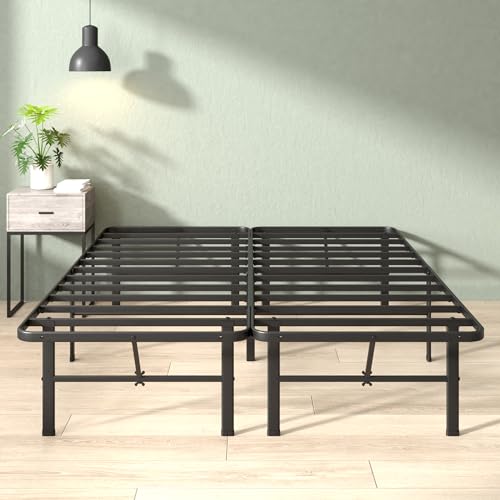
Pro 2: Modern platform frames removed the box spring — and its costs
The contemporary fixed frame is not the creaking rail set of memory. Platform designs with wood slat or steel support hold the mattress directly, and ‘no box spring needed’ is stated plainly in the verified titles of every standard example in this analysis. Removing the box spring removes its cost, its height, its dust volume and one more object to move house with, while giving the mattress the firm, even support modern designs expect.
Slat and platform support also suit the mattresses households actually buy now, including foam and hybrid designs that ask for solid, closely spaced support. The Zinus examples verified here span metal, solid wood, bamboo and upholstered constructions, which shows how thoroughly the platform idea has absorbed every style the market wants — the support question is settled; only the look remains to choose.
Height becomes a design choice rather than an accident: low-profile wood platforms for a calm, modern room, taller metal frames — the 14-inch examples in this analysis — where underbed storage matters. That range, available within one simple category, is a quiet pro: the fixed frame adapts to the household’s storage and style without adding a single moving part.
Model example: Zinus 14 Inch Rumi Metal Bed Frame Queen — verified spec from its Amazon title: 14 in height; no box spring needed; steel (from Amazon title). Check the current price on Amazon.

Pro 3: Value for money is the strongest in the bedroom
Measured purely as support per unit of money, nothing in the bedroom competes with a fixed frame. The category’s engineering is mature, its materials are honest, and competition is fierce, so a modest budget buys genuinely sturdy steel or solid wood that will outlast far more expensive furniture in the same room. Money not spent on the frame is money available for the mattress, where spending differences are felt in the body every night.
That value holds across styles. The upholstered Maya example in this analysis shows that a soft, designed look with a statement headboard exists inside the fixed category, while the bamboo Ellie-style designs show sustainability-flavoured materials at ordinary prices. Buyers are not choosing between economy and taste; the category offers both, which cannot be said of motorised alternatives at anything like the same spend.
Running costs complete the argument: there are none. No electricity, no batteries, no replacement electronics, no service visits — a fixed frame’s total cost of ownership is its purchase price plus the occasional tightened bolt. Over a decade, that flat line compares favourably with any appliance-like furniture, and households budgeting honestly should draw it.
Model example: Zinus Maya Upholstered Bed Frame Queen with Asymmetric Headboard — verified spec from its Amazon title: Upholstered; wooden slats; no box spring needed (from Amazon title). Check the current price on Amazon.

Pro 4: Stability, silence and shared sleep come naturally
A well-built fixed frame is a stable, quiet platform: no motor hum, no movement lag, no mechanical sympathy when a partner shifts. ‘Noise free sleep’ is claimed in the verified title of the upholstered example here, and while any frame can be made to creak by poor assembly, the category’s best designs — sturdy frameworks, sound slat seating, honest joinery — make silence the default rather than a feature to activate.
Shared sleep is uncomplicated because the surface is shared by definition and moves for nobody. There are no negotiations about incline, no remotes on one side only, and no centre divide unless the household chooses a particular design. For couples whose routines already align, that enforced simplicity is restful in itself; the bed makes no decisions, so the sleepers need not either.
Stability also serves the room: a fixed frame stays where it is placed, supports sitting on the edge without complaint, and tolerates the ordinary abuses of life — children treating it as geography, luggage landing on it, the dog claiming the foot. Furniture that absorbs household reality without comment earns a kind of trust no feature list can confer.
Model example: ZINUS Vivek Deluxe Wood Platform Bed Frame Queen with Headboard — verified spec from its Amazon title: Wood slat support; headboard; no box spring needed (from Amazon title). Check the current price on Amazon.
What Are the Real Drawbacks? The Cons, Examined Honestly
Con 1: A fixed frame cannot change position — the whole trade in one line
Everything an adjustable base does, a fixed frame does not. Reading in bed means pillows engineered into a slope that slides; unwinding with feet raised means cushions that migrate; a partner who wants elevation gets it alone, on their side, by textile means. Households that live in bed will feel this absence nightly, and no quality of slat or steel compensates for a movement that does not exist.
The honest framing is that this con is decisive for one kind of household and irrelevant to another. Sleep-only users lose nothing at all — flat is the position they would choose with infinite adjustment available. Lifestyle-in-bed users lose the central benefit of the rival category, and for them the companion analysis of adjustable frames, linked below, is required reading before any purchase.
Partial workarounds exist and should be priced honestly: wedge pillows, reading cushions and adjustable pillows each solve one activity imperfectly and add clutter permanently. If the full set of workarounds approaches the price difference to a base, the household has its answer — the frame was never really the cheaper option for its actual life.
Con 2: Cheap fixed frames punish buyers who under-spend
The category’s low entry prices conceal its sharpest trap: a flimsy frame is worse than none, because it flexes, squeaks, loosens and can void the support assumptions a good mattress was designed around. Thin rails, sparse slats and optimistic weight claims are concentrated exactly where first-time buyers shop hardest, and the savings are repaid in noise and sag within the year.
The defence is verification, and this analysis’s examples show what to look for: named support construction in the title — wood slat support, steel support, sturdy framework — honest materials, and a design whose assembly you can picture staying tight. Spend to the level where those phrases are true, confirm slat spacing suits your mattress type on the listing, and the category’s famous longevity becomes available to you too.
Assembly quality is the buyer’s half of the bargain. A good frame assembled loosely will creak like a bad one, so the unglamorous hour of careful tightening, level placement and a re-check after the first week belongs in the honest cons ledger: the fixed frame asks for one competent hour, and punishes households that skip it with a soundtrack.
Con 3: Style and height are fixed at purchase
A fixed frame’s look, height and headboard are decisions you will live inside for years, and the category offers no later adjustment beyond replacement. Low-profile platforms that felt serene in the shop can feel impractical beside tall nightstands or for sleepers who prefer a high bed; tall storage frames can dominate a small room. The con is not any particular style — it is the permanence of the choice.
Mattress changes can reopen the question: a thicker new mattress on a tall frame produces a climbing-into-bed height nobody ordered, while a slim mattress on a low platform can strand nightstands at the wrong altitude. Households expecting to change mattresses should buy the frame with that range in mind, favouring middle heights unless a specific look is worth the constraint.
Headboards concentrate the permanence: an upholstered statement piece defines the room, for better and worse, across every bedding change. Detachable or headboard-free designs — several verified examples here stand alone happily — trade a little drama for a decade of flexibility, and in rooms that evolve often, flexibility is the wiser luxury.
Con 4: Support quality is invisible until it fails the mattress
A frame’s most important job is the one nobody sees: even, adequate support across the whole mattress, year after year. Slats spaced too widely for a foam mattress, a centre that sags under two sleepers, a platform that flexes at the edge — each quietly shortens mattress life and degrades sleep in ways owners misattribute to the mattress itself. The frame is the foundation, and foundations fail silently.
This con has a practical remedy, which is diligence at purchase: confirm slat spacing and centre support against your mattress maker’s requirements, favour designs that name their support construction plainly — as the verified examples here do — and re-check tightness and slat seating seasonally. The remedy works, but it is a remedy the buyer must perform; the category will not perform it for you.
Weight honesty belongs in the same ledger. Frames carry sleepers plus mattress plus life — sitting, children, luggage — and designs bought at the edge of their capacity age loudly. Buy support with margin, as you would any structural purchase, and the fixed frame’s legendary lifespan becomes a realistic expectation rather than a slogan.
Who Should Buy a Fixed Bed Frame — and Who Should Look at Adjustable Instead?
Buy fixed if your bed is for sleeping first and your household values simplicity, value and permanence: you fall asleep without ceremony, you keep furniture for years, and you would rather put the budget difference into the mattress, where your body will notice it nightly. Buy fixed, too, if you move home often, live up stairs, or simply refuse on principle to own furniture with a remote control — the refusal is more common, and more reasonable, than marketing suggests.
Buy fixed if your room’s style matters and you have found the frame that sets it: the low wood platform, the tall storage-friendly metal design, the upholstered headboard that anchors the scheme. Within the verified examples alone, the stylistic range is wide enough that most rooms can be served without a single motor being involved in the decision.
Look at adjustable instead if your bed doubles as your reading chair, cinema seat and recovery couch, and pillows have been failing those jobs for years. Look, too, if positional comfort is a nightly theme you and your partner share — or can split a configuration to solve. The companion analysis linked below makes that case in full, and households on the fence should read both before spending on either.
How Should You Check a Bed Frame Before You Order?
Start underneath: confirm the support construction in the listing’s own words — slat spacing, centre support, platform type — and match it to your mattress maker’s requirements, especially for foam and hybrid designs. This single check prevents the category’s most expensive failure, a good mattress undermined by inadequate support, and it costs five minutes before ordering instead of a mattress’s lifespan after.
Measure the finished height, not the frame height: frame plus mattress against your nightstands, your preference for sitting on the edge, and anyone in the household for whom a high or low bed is a daily physical negotiation. Then measure the room route — doors, stairs, turns — because even simple frames arrive as long rails that defeat optimistic corners.
Finally, verify materials and assembly honestly: named woods or steel rather than mystery composites, hardware you can picture tightening, and instructions you are willing to follow completely, including the re-tightening check after the first week. A fixed frame’s silence and stability are assembled, not shipped, and the buyer is the final stage of its manufacture.
Common Buying Mistakes
Mistake one is buying the cheapest frame under a good mattress. The mattress then performs to the frame’s standard, not its own, and the household concludes the mattress was overrated. Support is a system; fund the foundation to the level the surface deserves.
Mistake two is ignoring slat spacing for modern mattresses. Foam and hybrid designs assume close, even support, and a frame chosen by looks alone can silently violate that assumption for years. Check the number against the mattress maker’s requirement before ordering, every time.
Mistake three is choosing height and headboard by photograph. A frame lives at body scale, beside real nightstands, under real bedding, and its permanence means a whimsical choice becomes a daily one. Favour the design you can imagine unchanged in five years over the one that photographs most dramatically today.
Mistake four is assembling loosely and blaming the frame. Skipped bolts, uneven floors unaddressed, and no re-check after settling produce the squeaks that give the category its undeserved reputation. One careful hour at setup, and one ten-minute check a week later, are the entire maintenance contract — honour them.
Final Recommendation
For most households, buy the best fixed frame your mattress deserves: support verified, height deliberate, style you can live inside for years, assembled with unusual care. Spend the savings where your body will register them. Only when the bed must also be a chair, a couch and a refuge should the household graduate to the adjustable analysis — and many excellent bedrooms never need to.
Keep reading the cluster before you decide: Adjustable Bed Frame Pros And Cons and How To Choose A Bed Frame cover the closest comparisons, while Bed Frame Buying Guide and Adjustable Bed Frame Buying Guide help you choose and set up with confidence. Readers weighing the neighbouring frame type should also see How To Choose An Adjustable Bed Frame.
How Do the Pros and Cons Play Out Over Five Years of Ownership?
Year one is dominated by assembly and its aftermath: the careful hour, the re-tightening check, and then the long silence that is this category’s true product. The pros are at their least visible in this year precisely because they consist of nothing happening — no noise, no sag, no attention demanded — and new owners occasionally mistake that absence of event for absence of value. It is the opposite: the frame is doing its entire job, perfectly, by being forgotten.
Years two and three usually bring the first mattress conversation, and here the fixed frame quietly proves itself. A sound platform accepts the new mattress without compatibility drama, the height decision made years earlier either accommodates the new thickness gracefully or teaches its lesson, and the household learns whether it bought flexibility or a constraint. Frames chosen at middle heights with honest support pass this year without comment, which is again the point.
Years four and five belong to the room’s evolution: bedding changes, decor drifts, perhaps a move or a rearrangement. The fixed frame’s lightness and simplicity pay their dividend here, carried by two people in minutes and re-established in a new room within the hour, while its style either continues to anchor the scheme or is repainted, re-dressed or replaced without financial drama. Low sunk cost is a form of freedom that only becomes visible at this distance.
Across the span, the pattern mirrors the adjustable analysis from the other side: the pros compound when the household’s life is sleep-centred and stable in its tastes, and the cons — chiefly the unmoving surface — compound only when the bed is asked to be furniture it is not. Five years rarely change a fixed frame; they reveal, with unusual clarity, what the household actually needed from its bed.
What Does a Fixed Frame Do to the Rest of the Bedroom?
It leaves the room alone, which is rarer than it sounds. No outlets are claimed, no remotes colonise the nightstand, no charging cables migrate to the bedside, and the room’s lighting can stay arranged for sleep rather than for activities. Bedrooms that serve as pure rest spaces — a deliberate and defensible design philosophy — are only fully achievable on a fixed frame, because every other category of bed brings its ecosystem with it.
It sets the room’s visual key with unusual authority. The frame and headboard are typically the largest designed object in the bedroom, and their material — warm wood, black steel, soft upholstery, pale bamboo — quietly dictates what every later purchase must harmonise with. That authority is the style con and the style pro in a single fact: chosen well, one decision furnishes the room’s character for a decade; chosen hastily, one decision argues with every cushion thereafter.
It also governs the room’s practical geometry for years: underbed storage or its absence, cleaning access beneath, the walkway widths that remain once the frame’s true footprint is placed. Tall storage frames repay small rooms daily, while low platforms repay them in visual calm, and neither repayment can be renegotiated without replacing the frame. Measuring the room’s life, not just its walls, is the buyer’s real task.
Finally, it keeps the bedroom’s technology budget at zero, which some households experience as a genuine relief. In a home where the kitchen, office and car all demand updates, accounts and attention, a bedroom whose largest object needs nothing — no charge, no pairing, no subscription of care — is a considered choice about where complexity is welcome to live. That philosophy deserves respect rather than correction.
A Tale of Two Households: When the Same Frame Succeeds and Fails
In the first household, sleep is sacred and swiftly achieved. The frame — solid wood, mid-height, assembled with uncommon care — holds a good mattress in silence, the room stays dark and device-free, and the owners’ only thought about their bed frame across five years is that they never think about it. For them the pros are not a list; they are the absence of every item on anyone else’s list of complaints.
In the second household, the bed is headquarters: novels, laptops, Sunday films, a partner who props pillows into engineering projects nightly. The same excellent frame becomes the stage for a nightly negotiation with cushions, and its central con — it will never move — is felt not as a specification but as a recurring small defeat. Their eventual adjustable purchase is not an upgrade of the frame; it is a correction of the original diagnosis.
The moral matches its adjustable twin: a fixed frame amplifies the fit between a household and flat, silent, permanent support, and it punishes only the mismatch. Audit the bed’s jobs for one honest week before buying either category. If the audit reads ‘sleep, and only sleep’, the fixed frame is not the compromise option — it is the correct one, and its pros will compound in the currency of undisturbed nights.
The Verdict Scorecard: Weighing the Trade-Offs Side by Side
Score the decision on the five axes that actually separate households. Sleep purity: is the bed for sleep alone, swiftly and well? Support honesty: will you verify slats, spacing and centre support against your mattress’s requirements? Style permanence: can you live inside this frame’s look and height for years? Value order: does the frame’s economy genuinely release money to the mattress? And activity load: how much reading, screen time and lounging will the bed honestly host?
A household strong on the first four and light on the fifth is the household the pros were written for, and it should buy the best fixed frame it can verify and then forget the category for a decade. A heavy score on the fifth axis is the one result that should redirect the purchase — not toward a fancier fixed frame, which cannot move either, but toward the adjustable analysis and its different ledger entirely.
Notice what the scorecard omits: brand theatre and showroom drama. Fixed frames are decided underneath and over time — support, silence, height, assembly — and the models in this analysis were chosen because their verified titles state those dull virtues plainly. In this category, the boring listing is usually the honest one, and the honest one is usually the right one.
Answer from the last month of real nights rather than from aspiration. The frame you are buying for is the one that will hold next Tuesday’s ordinary sleep, and a frame matched to that reality will be praised in the only way this category seeks: by never being mentioned at all.
Questions to Ask Yourself the Night Before You Order
First: what is my mattress asking of this frame? Requirements for slat spacing and support live in the mattress’s documentation, and they outrank every aesthetic preference in this purchase. If you cannot state them, the evening’s task is reading, not ordering — because the frame that flatters the room while undermining the mattress is the most expensive mistake available at this price.
Second: how will this height feel at the edges of the day? Sitting to dress, rising at night, making the bed, lifting a child in and out — finished height is a physical relationship renewed daily, and five minutes spent simulating it honestly is worth more than any number of styled photographs. Include every regular user of the bed in the simulation, especially the shortest and the least mobile.
Third: what changes first — the mattress, the room, or our address? A frame bought across an expected change should be bought for flexibility: middle height, adaptable style, weight two people can carry without choreography. A frame bought into stability can commit fully to a look and a height, and enjoy the commitment. Naming the next change in advance is how the permanence con is managed rather than suffered.
Fourth: am I willing to assemble this properly? The category’s silence and stability are installed by the buyer, bolt by bolt, and the honest answer shapes the right purchase: households that will not spend the careful hour should favour the simplest constructions and the fewest joints, and schedule the re-tightening check before the first night rather than after the first squeak.
How to Live With a Fixed Frame Well, Once It Is Yours
Begin with the ritual the category asks exactly once: assemble slowly, tighten completely, level deliberately, and sleep. Then, a week later, repeat the tightening pass while the frame settles into the floor and its own joints. That second pass — ten minutes, easily forgotten — is the difference between the silent decade owners describe and the creaking year they complain about, and it belongs on the calendar, not in memory.
Treat the underbed as a decision rather than a default. Storage frames earn their height only if what lives beneath is organised, accessible and worth the dust it gathers; low frames earn their calm only if the household resists colonising the clearance with overflow. Decide what the space is for in the first month, and the frame’s geometry becomes an asset instead of an accident slowly filling with evidence.
Rotate your attention seasonally in the smallest possible way: a glance at slats when the mattress is turned, a hand on the bolts when bedding changes for winter, a listen for the first new sound and the curiosity to fix it that week. Fixed frames do not ask for maintenance so much as for witness — brief, regular proof that someone still owns the object — and they repay that witness with the longest silent service in the house.
Finally, let the frame disappear. Its success state is invisibility: nights that begin without a thought for what holds them. Resist upgrading it on restlessness, and spend the household’s furniture energy where change is actually felt — the mattress in its season, the bedding in its years. The frame’s reward for good buying is that you get to forget it, completely, for a very long time.
Fixed vs Adjustable, Head to Head in One Evening
Imagine the same evening on both surfaces. At nine, reading: the fixed household builds its pillow slope, rebuilds it once, and reads its hour in good-enough comfort on a surface that cost a fraction of the alternative and will ask for nothing all night. The adjustable household presses a button and reads in tailored comfort. The gap is real and it is also, for many households, plainly not worth a motor — both judgements are available from the same scene, which is why this site publishes the two analyses as a pair.
At eleven, sleep: the fixed bed is already in its only and perfect configuration, and its owners are asleep inside the time the other household spends flattening, saving and settling. Simplicity’s dividend is paid in exactly these unnoticed minutes, nightly, and compounded across years it is not small. Furniture that is ready before you are has a claim on the tired that feature lists consistently undervalue.
At three in the morning the fixed bed’s case completes itself: silence, stillness, nothing on standby, nothing to fail, a room that is entirely off. For sleepers who guard the bedroom’s purity — no glow, no hum, no machinery — this is not nostalgia; it is a specification, and the fixed frame is the only category that meets it absolutely. Knowing that this matters to you is genuine self-knowledge, and it outranks every trend in the furniture market.
Dawn settles nothing, which is the honest conclusion of this analysis. Both households slept in furniture that did its job. The fixed frame’s pros are real, its cons are real, and they are the same facts viewed from different evenings. Buy for your evenings, verify the support underneath, assemble with care — and whichever surface you choose, choose it as the household you actually are.
What This Analysis Asks You to Remember
Remember that the construction quoted here was verified, not vibes: slat support, steel support, heights, headboards and the absence of any box-spring requirement all trace to listing-checked product titles, and anything beyond them belongs to the exact listing of the exact model you choose. In a category sold by lifestyle photography, that grounding is the reader’s protection, and it is the standard this site applies to every model it links.
Remember, too, that the frame is the mattress’s foundation and should be funded and checked as one: support first, silence through assembly, height by the body’s daily experience. Households that internalise those three priorities almost never regret a fixed frame, because almost every regret in this category traces to one of them being skipped at purchase.
And remember the disappearing trick that defines success here. A fixed frame bought well is furniture you will stop seeing within a month and stop thinking about within a year, while it holds every night you sleep for a decade. In a house full of objects competing for attention, that is not a modest achievement — it is the entire argument, and it is enough.
A Final Word on Deciding Without Regret
No furniture decision is permanent in the way buyers fear at the moment of purchase, and fixed frames are the least permanent-feeling of all once owned: they can be repainted, re-dressed, moved to a guest room, or passed along without a single compatibility question being asked by anyone. What cannot be recovered is the mattress life quietly spent on inadequate support, or the years of nightly pillow engineering in a household that needed movement all along. The antidote is the discipline this analysis has repeated from several directions — verify the support, measure the finished height, audit the bed’s real jobs, assemble as if silence depended on it, because it does — and then commit without second-guessing. Households that follow it rarely regret the frame, because the frame was chosen by evidence rather than by photograph.
It is worth closing on the category’s genuine achievement, whatever you decide. The modern fixed frame — slatted, platformed, freed of the box spring, available in steel, solid wood, bamboo and upholstery at honest prices — is one of the most completely solved products in the home, and its capabilities can be checked against listing-confirmed listings before a penny moves, as they have been throughout this article. That maturity is itself the deepest pro: you are not gambling on anything. Choose the solved product in the configuration your evenings require, assemble it like you mean it, and let it vanish into a decade of unconsidered, undisturbed sleep.
One more consideration belongs in the record, because it decides real purchases and appears in few guides: the fixed frame as a gift of calm within a household. A bedroom with nothing to charge, pair, update or troubleshoot is a room that lowers the shoulders on entry, and for sleepers whose days are saturated with devices, that emptiness is not a missing feature — it is the feature, purchased deliberately and enjoyed nightly. Children cannot desync it, guests cannot misconfigure it, and a power cut cannot strand it mid-gesture. If that calm describes what your household is actually shopping for, let it decide: buy the best-supported, best-assembled version of stillness you can verify, spend the savings on the mattress and the bedding, and do not apologise for valuing the nights exactly as they are.
Decide this week, while the audit of your evenings is still fresh, and decide it completely: support verified, height measured, style chosen for the five-year eye rather than the five-minute one. A fixed frame rewards decisiveness like few purchases can, because once it is assembled well it simply leaves the stage — and the sooner it leaves, the sooner the long, quiet service that justifies it can begin.
That is the whole case, stated once more without decoration: verify underneath, choose deliberately, assemble carefully, and then enjoy years of nights in which the frame is the one thing in the bedroom you never have to think about at all.
Frequently Asked Questions
Are platform bed frames better than traditional frames?
For most modern households, yes: platform designs remove the box spring, support today’s mattress types directly, and offer heights and styles traditional rails cannot. The verified examples in this analysis are all platform designs stating no box spring is needed. Traditional frames still suit households with a box spring they intend to keep.
Do bed frames affect how a mattress feels?
Yes, materially. Even, adequate support lets a mattress perform as designed, while sparse slats or a sagging centre change its feel and shorten its life. Matching frame support to the mattress maker’s requirements is the most important check in this category.
How long should a bed frame last?
A well-built fixed frame, assembled carefully and checked occasionally, can serve for many years across multiple mattresses — that longevity is one of its core pros. Cheap frames are the exception that proves the rule, which is why this analysis urges buying to the level where construction claims are plainly stated.
Why does my bed frame squeak?
Usually assembly or movement points: bolts that were never fully tightened or have loosened, slats shifting in their seats, or a frame flexing on an uneven floor. Re-tighten everything, seat the slats, level the frame, and most squeaks end — persistent noise after that points to an under-built design.
What height bed frame should I choose?
Choose by finished height with your mattress: comfortable edge-sitting, nightstands at a sensible level, and any household member’s ease of getting in and out. The verified examples span low-profile designs to 14-inch frames with underbed storage, so treat height as a deliberate decision, not a default.
Is an adjustable base better than a fixed frame?
It is better at position and worse at simplicity, cost and weight — which is why this site examines both in paired analyses. Sleep-focused households usually belong with fixed frames; households that live in bed should read the adjustable pros and cons linked below before deciding.

