Disclosure: airfryerkitchensupply.com is reader-supported. When you buy through links on our site, we may earn an affiliate commission at no extra cost to you.
Where to buy
Both sides of this adjustable bed frame vs bed frame comparison are sold through Amazon with the exact models below. On the adjustable side, start with the Tami Tami T600 for the full feature set or the Marsail queen base at a value tier. On the fixed side, the Zinus Rumi steel platform is the practical benchmark. Check price on Amazon for each before deciding — and read the verdict sections below first, because the right answer depends on how you actually use your bed.
Adjustable Bed Frame vs Bed Frame: The Short Answer First
Choosing between an adjustable bed frame vs bed frame designs is really choosing what your bed is for. A fixed bed frame is furniture: it holds the mattress flat, silently, for a decade, and asks nothing of you. An adjustable bed frame is machinery: it inclines the head and foot, offers presets like zero gravity, and turns the bed into a place you read, watch, work and recover in — at a higher price, with a motor, a remote and a mattress-compatibility checklist. Neither is universally better. The honest split is this: if you only sleep in bed, a good fixed frame wins on simplicity, storage and value. If you live in bed for hours beyond sleeping, an adjustable base changes daily life in ways pillows cannot imitate. This comparison walks both sides with verified models, scores the rounds that actually matter — comfort positions, mattress compatibility, storage, noise, moving house, and long-term ownership — and ends with a verdict by sleeper type, so you can decide once and sleep on it for years. One framing helps before the rounds begin: a fixed frame is a purchase, while an adjustable base is a purchase plus a habit. The frame’s value is fully delivered on night one; the base’s value is delivered across thousands of small moments — the inclined chapter before sleep, the raised feet after a long day, the morning stretch in zero gravity. Households that build those moments into their routine rate adjustable bases among their best furniture buys. Households that do not, rate them as heavy, expensive platforms. Both verdicts are honest reports of the same products, which is why this comparison scores behaviour, not just hardware.
In this guide
Quick Picks
Six verified representatives — three adjustable bases and three fixed frames — so every claim in the rounds below is anchored to a real model you can check:
- Best Adjustable Overall: Tami Tami T600 Adjustable Bed Frame Queen — head and foot incline, massage, zero gravity, dual USB and a nightlight in one mid-tier base. Check price on Amazon
- Best Adjustable Value: Marsail Adjustable Bed Frame Queen — massage, zero gravity and a USB charging station at a value-tier position. Check price on Amazon
- Best Adjustable for Smaller Rooms: DUMOS Full Size Adjustable Bed Frame — a full-size electric base with zero gravity and 750 lb support for guest rooms and smaller bedrooms. Check price on Amazon
- Best Fixed Frame Overall: Zinus 14 Inch Rumi Metal Bed Frame Queen — a heavy-duty steel platform with 14 inches of clearance and no box spring needed. Check price on Amazon
- Best Fixed Wood Frame: Zinus Allen Mid Century Wood Platform Bed Frame Queen — solid wood, mid-century lines and slat support for buyers choosing looks plus simplicity. Check price on Amazon
- Best Fixed Upholstered Frame: Zinus Maya Upholstered Bed Frame Queen — an asymmetric upholstered headboard and noise-free build — the fixed frame that fights back on comfort. Check price on Amazon
How This Comparison Was Judged
Each side was judged on the criteria buyers actually feel after the first month. Positional comfort: what positions exist, how they are reached, and whether both partners share them. Mattress compatibility: which mattress types each frame supports or ruins. Space and storage: what happens under the bed. Noise and reliability: motors and remotes versus bolts and slats, across years rather than weeks. Assembly and moving: what delivery day and moving day look like. And ownership cost in qualitative tiers — purchase tier, replacement parts, and what eventually wears out. Every product named was verified against the Amazon catalogue before inclusion; specifications quoted come from the manufacturers’ own listing titles, and no prices or ratings are printed because both change constantly — use the check-price links to see today’s figures.
The Adjustable Side: Three Bases Reviewed

Tami Tami T600 Adjustable Bed Frame Queen — Best Adjustable Overall
The T600 is the adjustable side of this comparison at its most complete: massage, a zero-gravity preset, charging on both sides of the bed and a nightlight, driven by a quiet motor and a wireless remote. It suits couples who read, watch and wind down in bed and want the full feature set without stepping into luxury-brand pricing.
Strengths
- Massage, zero gravity and head/foot incline in one base
- Dual-side USB, side pockets and nightlight solve real nightly annoyances
- Quiet motor with wireless remote; fold-out assembly
Trade-offs
- Heavier and harder to move than any fixed frame
- Massage is vibration-based, not deep-tissue
- Needs a compatible flexible mattress to articulate properly
Key specs (from the manufacturer’s listing):
- Size: Queen
- Adjustment: Head and foot incline with zero-gravity preset
- Extras: Massage, dual-side USB, side pockets, nightlight
- Remote: Wireless remote
What separates the T600 in daily use is how many small frictions it removes. Dual-side USB means neither partner monopolises charging; the side pockets hold the remote where you can actually find it; and the nightlight matters more than spec sheets suggest the first time you get up at 3 a.m. The massage is a vibration timer feature rather than therapy — pleasant for winding down, not a medical device — and the five-minute assembly claim is realistic because the base folds out rather than bolting together. Against a fixed frame it costs more and weighs far more, but as an adjustable package it is the benchmark the other bases here are judged against.
Living with the T600, owners settle into a rhythm: head up for the evening, zero gravity for the last half hour, flat or near-flat for sleep, feet slightly raised on heavy-leg days. The nightlight and pockets stop being features and become infrastructure. The remote lives in its pocket, the massage timer becomes a sleep cue, and the base quietly reorganises how the bedroom is used — the bed absorbs the reading chair’s job entirely.
Best for: couples who live in bed — reading, screens, winding down — and want the full adjustable feature set / Not suited for: minimalists who only sleep in bed, or anyone with a stiff innerspring mattress that cannot bend
Check on Amazon — check price on Amazon.

Marsail Adjustable Bed Frame Queen — Best Adjustable Value
Marsail’s queen base covers the adjustable essentials — head and foot incline, zero gravity, massage and a USB charging station — at a value position in the category. It is the adjustable pick for buyers who want the experience first and the badge prestige never.
Strengths
- Full core feature set: incline, zero gravity, massage
- USB charging station built in
- Value positioning within adjustable bases
Trade-offs
- Finish and remote feel simpler than premium bases
- LED light is a minor, love-it-or-ignore-it extra
- Same mattress-compatibility limits as any adjustable base
Key specs (from the manufacturer’s listing):
- Size: Queen
- Adjustment: Head and foot incline, zero-gravity preset
- Extras: Massage, LED light, USB charging station
- Assembly: Easy assembly design
The Marsail makes its compromises in finish rather than function: the core articulation, presets and charging are all present, while trim and remote feel are a step simpler than the T600. For the comparison that matters here — adjustable versus fixed — it is the strongest evidence that the adjustable premium has shrunk: the gap between this base and a good fixed platform frame now buys a genuinely different bed, not a gadget. Pair it with a flexible foam or hybrid mattress, keep the remote on the charging side of the bed, and it delivers the zero-gravity evening routine that converts most sceptics.
Living with the Marsail means the same positional routine as premium bases — incline for evenings, zero gravity before sleep — with slightly plainer materials under your hands. The charging station becomes the household’s overnight dock, and the massage earns its keep as a wind-down timer. Nothing about the daily experience feels budget; the savings show only in trim and remote finish, which most owners stop noticing within a month.
Best for: first-time adjustable buyers who want the real experience at a value tier / Not suited for: buyers who prioritise premium fit and finish over features per pound spent
Check on Amazon — check price on Amazon.

DUMOS Full Size Adjustable Bed Frame — Best Adjustable for Smaller Rooms
The DUMOS brings adjustability to the full-size bed — the guest room, the teenager’s room, the smaller primary bedroom — with a 750 lb support rating, zero gravity and built-in USB. It proves the adjustable-versus-fixed question is no longer only a king-and-queen conversation.
Strengths
- Adjustable features in a full-size footprint
- 750 lb support rating is strong for the class
- USB built in; fold-out easy assembly
Trade-offs
- Full size is cosy for two adults
- Fewer mattress choices in full than queen
- Storage space under the base is limited by the mechanism
Key specs (from the manufacturer’s listing):
- Size: Full
- Capacity: 750 lb weight support (per listing)
- Adjustment: Head and foot incline, zero-gravity preset
- Extras: Built-in USB ports, wireless remote
Full-size adjustable bases are rarer than queen and king, which makes the DUMOS strategically interesting: it lets a smaller room have the reading incline and raised-foot evenings without upsizing the whole bed. The support rating is generous for the size, and the assembly follows the fold-out pattern that makes modern bases manageable for one person. Its limits are the size’s limits — two adults sleep closer than on a queen — and the usual adjustable caveats about mattress flexibility and under-bed storage apply in full.
Living with the DUMOS in a smaller room, the surprise is how much presence an adjustable base has in a compact space — the bed becomes the room’s chair, desk and sofa for one. Guests consistently rate it the best guest bed they have slept in, which is the quiet argument for putting adjustability in the spare room: a week of inclined reading and raised-foot sleep converts visitors completely.
Best for: guest rooms, teens and smaller bedrooms that still want real adjustability / Not suited for: couples who already find a queen tight
Check on Amazon — check price on Amazon.
The Fixed Side: Three Frames Reviewed
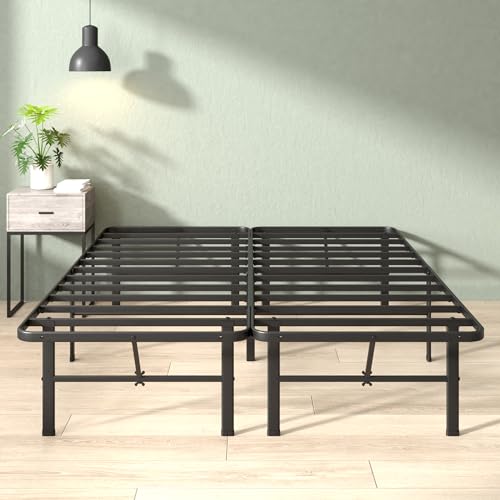
Zinus 14 Inch Rumi Metal Bed Frame Queen — Best Fixed Frame Overall
The Rumi is the fixed frame at its most practical: a heavy-duty steel platform, fourteen inches of under-bed clearance, quick assembly and no box spring to buy, haul or eventually sag. For the fixed side of this comparison, it is the value benchmark.
Strengths
- Heavy-duty steel platform; no box spring needed
- 14-inch clearance gives real under-bed storage
- Quick assembly; works with any mattress type
Trade-offs
- Completely flat — no incline for reading or reflux routines
- Steel aesthetic is plain next to wood or upholstered frames
- No headboard included at this configuration
Key specs (from the manufacturer’s listing):
- Size: Queen
- Material: Heavy-duty steel SmartBase foundation
- Height: 14 inches, under-bed storage clearance
- Box spring: Not needed — platform support
Everything the Rumi does, it does by subtraction. No motors to fail, no remote to lose, no compatibility questions — any mattress that fits a platform works, including the stiff innersprings an adjustable base would ruin. The fourteen-inch height converts the under-bed void into genuine storage, the thing adjustable bases structurally cannot offer. What you give up is everything positional: the mattress lies flat, forever, and if your evenings involve reading or screens in bed, the workaround is pillows, not presets. Judged as furniture rather than machinery, it is close to unbeatable per unit of money spent.
Living with the Rumi is defined by absence: no sounds, no decisions, no maintenance rituals beyond an annual bolt check. The under-bed space fills with the flat, bulky things apartments never have room for, and the frame disappears from your attention entirely — which, for furniture, is the highest praise available. Years pass; the Rumi simply continues, and that reliability compounds into real value.
Best for: storage-hungry rooms, guest beds, and anyone who wants buy-once simplicity / Not suited for: bed readers and anyone whose routine needs an inclined back or raised legs
Check on Amazon — check price on Amazon.

Zinus Allen Mid Century Wood Platform Bed Frame Queen — Best Fixed Wood Frame
The Allen is the fixed frame as furniture: solid wood, mid-century lines, a low profile and proper slat support. It is the pick for buyers who look at the adjustable-versus-fixed question and realise what they actually want is a beautiful, silent, flat bed.
Strengths
- Solid wood build with genuine furniture presence
- Wood slat support; no box spring needed
- Low profile suits modern bedrooms and thick mattresses
Trade-offs
- Flat only — no positional features at all
- Wood finish choices are narrower than upholstered options
- Heavier to reposition than a folding steel frame
Key specs (from the manufacturer’s listing):
- Size: Queen
- Material: Solid wood foundation
- Support: Wood slat support, no box spring needed
- Profile: Modern low-profile design
Wood slats give the Allen a slightly kinder support feel than steel mesh, and the solid-wood build answers the fixed frame’s core promise — a decade of silent service with nothing to plug in. The low profile suits modern rooms and makes thick mattresses sit at a sensible height. In the head-to-head it concedes every positional feature, obviously; its counter-argument is that most people sleep flat, most mattresses last longer undisturbed, and a frame that never needs a firmware-free remote never interrupts a night. If your bed is for sleeping and your room is for looking at, the Allen is the fixed side’s strongest closer.
Living with the Allen, the bed becomes the room’s visual anchor — guests comment on it, and the low wooden profile makes even a thick mattress look intentional. It creaks less than owners expect from wood, asks for nothing but dusting, and pairs with any bedding style from minimal to layered. Its flatness stops registering as a limitation for households whose evenings happen in the living room.
Best for: design-led bedrooms that want a flat, silent, long-lived platform / Not suited for: anyone who reads, works or watches in bed every night
Check on Amazon — check price on Amazon.

Zinus Maya Upholstered Bed Frame Queen — Best Fixed Upholstered Frame
The Maya is the fixed frame’s answer to the adjustable comfort argument: a padded, asymmetric headboard you can actually lean against, wooden slats and a noise-free build. It cannot incline — but for reading against pillows, it narrows the gap more than any other fixed frame here.
Strengths
- Padded asymmetric headboard you can lean on
- Noise-free positioning with sturdy framework
- Wooden slat support; no box spring needed
Trade-offs
- Headboard is fixed-angle — pillows still do the inclining
- Fabric upholstery needs periodic cleaning
- No positional or powered features
Key specs (from the manufacturer’s listing):
- Size: Queen
- Design: Upholstered frame with asymmetric headboard
- Support: Durable wooden slats, no box spring needed
- Build: Sturdy framework, noise-free sleep positioning
Upholstery changes the fixed-frame equation because the headboard becomes usable furniture: padded support for reading, a softer visual anchor for the room, and no cold metal or hard wood behind your shoulders. Zinus pairs it with a sturdy, squeak-resistant framework and slat support, so the Maya sleeps as quietly as it looks soft. It still loses the true zero-gravity position and raised-leg evenings, and fabric headboards ask for occasional vacuuming and care with hair products. But for couples split on this decision — one wants adjustable, one wants a calm, pretty room — the Maya is the compromise candidate.
Living with the Maya, the headboard becomes the most-touched furniture in the room: leaned on nightly, soft behind shoulders, and forgiving of the pillow forts readers build against it. The asymmetric design keeps the room from looking like a catalogue set. Owners do add a fabric-care habit — a vacuum pass when the bedding changes — and in exchange get the fixed frame that feels least like a compromise.
Best for: readers who lean rather than incline, and rooms that need a soft focal point / Not suited for: buyers who need genuine head elevation for their nightly routine
Check on Amazon — check price on Amazon.
Comparison Table
| Pick | Badge | Key spec | Best for |
|---|---|---|---|
| Tami Tami T600 Adjustable Bed Frame Queen | Best Adjustable Overall | Queen, massage, zero gravity, dual-side USB | couples who live in bed — reading, screens, winding down — and want the full adjustable feature set |
| Marsail Adjustable Bed Frame Queen | Best Adjustable Value | Queen, massage, zero gravity, USB charging station | first-time adjustable buyers who want the real experience at a value tier |
| DUMOS Full Size Adjustable Bed Frame | Best Adjustable for Smaller Rooms | Full size, zero gravity, 750 lb support, built-in USB | guest rooms, teens and smaller bedrooms that still want real adjustability |
| Zinus 14 Inch Rumi Metal Bed Frame Queen | Best Fixed Frame Overall | Queen steel platform, 14-inch height, no box spring needed | storage-hungry rooms, guest beds, and anyone who wants buy-once simplicity |
| Zinus Allen Mid Century Wood Platform Bed Frame Queen | Best Fixed Wood Frame | Queen solid wood platform, slat support, low profile | design-led bedrooms that want a flat, silent, long-lived platform |
| Zinus Maya Upholstered Bed Frame Queen | Best Fixed Upholstered Frame | Queen upholstered, asymmetric headboard, wooden slats | readers who lean rather than incline, and rooms that need a soft focal point |
Round by Round: Where Each Side Actually Wins
Evenings in bed: reading, screens and winding down
Adjustable wins, and it is not close. A powered head incline holds your back at a supported angle with your neck neutral, which stacked pillows imitate badly and briefly before sliding. Zero gravity — knees slightly above the heart, back reclined — is a genuinely different resting position that fixed frames cannot offer at all. The upholstered Maya narrows the gap for readers with its padded headboard, but leaning is not inclining. If your bed hosts two hours of evening life daily, this round alone can settle the decision.
Sleep itself: the flat hours
Here the sides converge. Most people sleep flat or nearly flat, and a quality fixed platform supports a mattress exactly as designed, with zero mechanical noise and zero failure modes. Adjustable bases sleep identically when flat — the mattress rests on a solid deck — but add faint possibilities a fixed frame never has: a remote knocked at night, a motor hum during adjustment, a power cut mid-incline. None are common; all are exclusive to the powered side. For pure sleep, fixed frames win on silence and simplicity; adjustable bases tie on support and win only if you actually sleep inclined.
Mattress compatibility
Fixed wins on breadth. Any mattress works on a platform: foam, hybrid, latex and the stiff traditional innersprings that an adjustable base would damage by bending. Adjustable bases require flexible mattresses — most modern foam and many hybrids qualify — and thick, stiff or border-pocketed designs can resist articulation or wear faster. If you love your current mattress and it is a traditional innerspring, that fact alone may decide this comparison: keep it, and the fixed frame is your answer.
Storage and small rooms
Fixed wins clearly. A 14-inch platform like the Rumi turns the under-bed void into suitcases, seasonal bedding and storage boxes. Adjustable mechanisms occupy that space with motors, linkages and a deck that must stay clear to move; most adjustable bases offer little to no usable under-bed storage. In small apartments, that lost volume is a real, monthly cost — weigh it honestly against the evening comfort the adjustable side returns.
Noise, reliability and the ten-year view
Fixed frames have almost nothing to fail: bolts can loosen and be retightened, slats can crack and be replaced cheaply. Adjustable bases add motors, control boxes, remotes and wiring — mature, generally reliable technology, but with more parts, more cost when something does fail, and a remote that will eventually be lost or sat on. Both sides last for years; the fixed side lasts with less attention. Buyers who hate maintenance should score this round heavily.
Assembly and moving house
Modern adjustable bases fold out and assemble in minutes without tools, which surprises most buyers — but they are heavy, awkward two-person carries, and moving one between rooms or homes is a project. Fixed frames assemble with basic tools in under an hour, break down flat, and move easily. Renters who move every year or two should count this round double; settled homeowners can mostly ignore it.
What a Year of Ownership Actually Looks Like
Month one with an adjustable base is novelty: every preset gets tested, guests get demonstrations, and the remote is a toy. By month three the novelty compresses into two or three positions you genuinely use — typically a reading incline, zero gravity, and flat — and the base becomes invisible infrastructure, like good lighting. The ownership tasks are small but real: keeping the remote findable, replacing its batteries, keeping cables clear of the mechanism, and remembering the base needs power, which matters in outages and in rooms with scarce outlets. A fixed frame’s year looks different: nothing happens, repeatedly, and that is its feature. It is tightened once, perhaps, and otherwise simply holds the mattress while life happens on top of it. Neither ownership story is bad — but they suit different temperaments. People who enjoy their devices choose adjustable happily; people who want their furniture to vanish choose fixed, and both are right about themselves.
The mattress pairing question, answered by type
Memory foam and latex pair with adjustable bases naturally — they bend without internal structures to damage. Hybrids vary: pocketed coils flex better than continuous-coil designs, and the maker’s adjustable-base approval is the deciding document. Traditional innersprings are the fixed frame’s home turf; bending them risks noise, damage and voided warranties. On a fixed platform, every type works, with one check: slat spacing. Foam mattresses want closely spaced slats so foam does not sag between them, while some makers specify maximum gaps for warranty coverage. Whichever side you choose, the mattress and frame are a system — buy them as one decision, not two.
Room by room: where each side earns its place
In the primary bedroom, the verdict follows your evenings: readers, streamers and couples who decompress in bed get daily value from adjustable; lights-out sleepers get the same sleep from fixed at a lower tier. In guest rooms, a fixed platform is the default for reliability, though the DUMOS shows how an adjustable guest bed becomes the room everyone requests. In children’s and teenagers’ rooms, fixed frames win on durability and simplicity — motors and remotes meet their match in a ten-year-old. In small apartments, the storage math usually rules: a 14-inch fixed platform is a closet you sleep on. And in rooms planned for ageing in place, adjustable earns a serious look, because incline and raised positions tend to grow more useful over a decade, not less.
The Cost Picture, in Tiers Rather Than Numbers
Prices move too much to print, but the tier structure is stable. A quality fixed platform sits in the budget-to-mid tier of bedroom furniture. A feature-complete adjustable base sits one to two tiers higher, and split configurations higher again, because you are buying two mechanisms. Ownership costs follow the same shape: the fixed frame’s lifetime extras are near zero, while the adjustable base may eventually want a remote, a motor or a control box — each a modest part, but a part that exists. Electricity use is trivial on both sides (adjustable bases draw meaningfully only while moving). The fairest framing is cost per use: an adjustable base used in position twice a day amortises quickly into pennies per evening, while one bought for features used twice a year is an expensive flat frame. Be honest about which buyer you are, and the tier math decides itself. Check price on Amazon for the current figures on both sides before committing.
How to Choose Between an Adjustable and a Fixed Frame
Run this checklist honestly. One: count your in-bed awake hours per week — under three, lean fixed; over seven, lean adjustable. Two: identify your mattress — stiff innerspring means fixed, flexible foam or hybrid keeps both options open. Three: measure your storage reality — if the under-bed space is spoken for, adjustable costs you that volume. Four: split the difference where couples disagree — split-king adjustable bases exist for two different positions, and an upholstered fixed frame with good pillows is the budget compromise. Five: think in tiers, not prices — adjustable bases sit one to two tiers above comparable fixed frames, and the honest question is whether the positions, used nightly, are worth a tier to you. Six: consider the room’s future — guest rooms and children’s rooms rarely justify motors; a primary bedroom you age in might, since incline features tend to matter more, not less, over a decade.
How to Set Up Either Frame So It Sleeps Quietly
Whichever side you choose, setup decides whether it stays silent. For a fixed platform: level the frame on the floor first, tighten every bolt in a cross pattern, then re-tighten after the first week as parts seat; check slat spacing matches your mattress maker’s guidance; and add felt pads where the frame meets a hard floor. For an adjustable base: unfold it on a clear floor with two people, connect the control box before placing the mattress, route cables away from the moving linkages, test every preset empty, then load the mattress and test again; keep the remote’s charging or storage spot consistent from night one. For both: photograph the underside connections before the mattress goes on — future you, troubleshooting at midnight, will be grateful. Finish either setup the same way: lie on the finished bed, have a partner adjust or shift, and listen. Silence at setup almost always means silence for years; a noise found now is a bolt or a cable, found later it is a frustrating mystery buried under a heavy mattress.
Common Buying Mistakes
Buying an adjustable base for a mattress that cannot bend is the costliest mistake in this category — check flexibility before ordering. The mirror mistake is buying a fixed frame while planning nightly bed-based work and reading, then fighting pillows for years. Ignoring under-bed storage until the adjustable base arrives and the suitcases have nowhere to live is a classic. So is comparing headline features instead of nightly ones: massage and LED lights impress in week one, while incline range, motor quietness and remote design are what you feel in year three. Finally, forgetting the split: couples with different position preferences should look at split configurations or accept the compromise consciously, rather than discovering it on the first night. A subtler mistake is assuming the decision is permanent in both directions: a fixed frame can later host an adjustable base inside it, and an adjustable base spends most nights flat — the categories overlap more in practice than in marketing. Finally, do not let delivery logistics decide for you. Both frame types arrive in boxes that look intimidating; both assemble faster than the box suggests, and retailers of both handle returns of unassembled items routinely. Decide on the decade, not the delivery day.
How Each Type Is Built — and Why Construction Decides Longevity
An adjustable base is three systems wearing one cover. The deck is the platform the mattress rests on, usually in hinged sections for back, seat and legs. The actuators are the quiet workhorses — small linear motors that push the sections through their arcs, rated for thousands of cycles and typically the component that defines the base’s lifespan. The control system ties it together: a control box under the deck, a wired or wireless remote, and increasingly an app. Construction quality shows in the deck’s rigidity when inclined (a flexing deck makes the mattress feel uneven), in motor noise under load, and in cable management — tidy, protected wiring survives years of movement; loose cables eventually find the linkages. The T600 and Marsail both follow the modern fold-out pattern, which keeps the frame’s structure factory-aligned instead of depending on home assembly precision.
A fixed frame’s construction is simpler and therefore easier to judge. Steel platforms like the Rumi rely on weld quality and tube gauge: heavier steel, clean welds and a centre support rail are what separate a decade-long frame from a squeaky year. Wood frames like the Allen live or die on joinery and slat quality — solid wood slats with close spacing, properly finished, on a frame whose corners lock square. Upholstered frames like the Maya add a third discipline: the padding and fabric must be dense and tightly fitted, because a headboard is touched and leaned on daily. In all three fixed types, the support surface is the mattress’s foundation in the literal sense — uneven or widely spaced support shortens mattress life and can void its warranty, which is why slat spacing appears in so many mattress makers’ terms. Judge a fixed frame the way you would judge a chair: pick it up, look at the joints, and distrust anything that flexes in the showroom — or in the listing photos, look for centre rails, slat counts and steel thickness, the details honest listings state plainly.
The Scorecard: Criterion by Criterion
Positional comfort goes to adjustable by a wide margin — it is the entire point of the category, and the T600 and Marsail deliver it fully. Mattress support when flat is a tie: both decks support a mattress as designed, and sleepers who never incline will feel no difference. Mattress compatibility goes to fixed, which accepts every mattress type including the stiff innersprings adjustable bases exclude. Storage goes to fixed by the full height of a 14-inch platform. Silence goes to fixed, with the caveat that good adjustable motors are genuinely quiet while moving and silent at rest. Assembly is a surprise tie — modern adjustable bases fold out in minutes, fixed frames bolt together in under an hour — but moving house goes to fixed on weight alone. Reliability and maintenance go to fixed, whose entire failure list is loose bolts and cracked slats. Features and future-proofing go to adjustable: positions tend to become more valuable as households age, and a base bought at forty serves different needs at sixty without replacement. Aesthetics split by taste — the wood frames — wood and upholstered fixed frames are furniture, while adjustable bases hide inside or beneath whatever frame surrounds them. Count the criteria that match your life, weight the top two double, and the scorecard will usually name your winner without further agonising.
Before you order: measurements that prevent returns
For either side, measure the mattress first — nominal sizes vary, and a base or frame must match the actual length and width. For adjustable bases going inside an existing decorative frame, measure the inside clearances and confirm the base’s legs and deck fit with room for the mechanism to move; check the retainer bar keeps the mattress from sliding when inclined. For fixed platforms, measure the doorways and stair turns the frame must pass through, and the under-bed height you actually need — storage bins come in standard heights, so match the frame’s clearance to the bins you own or plan to buy. Note outlet positions for adjustable bases: the control box needs power, and an extension solution across a walkway is a trip hazard in the dark. Ten minutes with a tape measure prevents the most common return in this category, which is not dissatisfaction — it is geometry.
The Hybrid Paths Most Couples Actually Take
Real households rarely split as cleanly as this comparison’s two sides. The most common hybrid is the adjustable base inside a decorative fixed frame: the room keeps its wooden or upholstered look, the sleepers keep their positions, and the only casualty is under-bed storage. It works when clearances are measured carefully and the frame’s slats or platform are removed so the base sits at the right height. The second hybrid is staged ownership: a quality fixed platform now, an adjustable base later, reusing the same mattress if it is a flexible type — a path that argues for buying a foam or approved hybrid mattress even if you start fixed, keeping the upgrade door open. The third is the room split: adjustable in the primary bedroom where evenings happen, fixed platforms in every other room, which concentrates the budget where the positions are used nightly. And the fourth is the pillow-and-wedge compromise — an upholstered fixed frame like the Maya plus proper reading pillows — which genuinely satisfies light readers at a fraction of the adjustable tier. None of these is a failure to decide; each is the comparison applied honestly to a specific household, which is what the rounds above are for.
Final Recommendation
Choose adjustable if your bed is a living space: the Tami Tami T600 is the complete package, the Marsail delivers the experience at a value tier, and the DUMOS full base extends it to smaller rooms. Choose fixed if your bed is for sleeping and your room needs the storage: the Zinus Rumi for practicality, the Allen for wood, the Maya for a lean-able headboard. Explore the clusters next: Adjustable Bed Frame Reviews, Bed Frame Reviews, Adjustable Bed Frame Buying Guide, Bed Frame Buying Guide, Is An Adjustable Bed Frame Worth It, and Adjustable Bed Frame Pros And Cons.
Frequently Asked Questions
Is an adjustable bed frame worth it over a regular bed frame?
For sleepers who only sleep in bed, usually not — a good fixed frame supports the mattress identically when flat. For anyone who reads, watches, works or winds down in bed for hours, or who sleeps better inclined, the adjustable base earns its tier difference nightly. The deciding factor is awake hours in bed, not sleep quality.
Can I put any mattress on an adjustable bed frame?
No. Adjustable bases need flexible mattresses — most foam and many hybrid designs qualify. Stiff traditional innersprings can be damaged by repeated bending. Check the mattress maker’s guidance for adjustable-base compatibility before pairing them.
Do adjustable bed frames fit inside a regular bed frame?
Many adjustable bases are designed to sit inside or replace the slat area of a decorative frame, but clearances vary by model. Measure the inside dimensions of the frame and compare them with the base’s footprint and leg height before assuming a drop-in fit.
Which is quieter, an adjustable or a fixed bed frame?
A well-built fixed frame is silent by design. Adjustable bases are quiet in operation — modern motors are soft — but they do make some sound while moving, and they have more parts that can develop noises over years. For absolute silence, fixed wins.
How long do adjustable bed frames last compared with fixed frames?
Both are multi-year products. Fixed frames typically outlast adjustable bases because they have almost no wear parts beyond bolts and slats. Adjustable bases depend on motors and electronics, which are reliable but finite; expect the frame structure to outlive its powered components.
Can two people use different positions on one adjustable bed?
Only on split configurations, where each side articulates independently — typically split king, which is two twin XL bases. A single queen or king base moves as one surface, so partners share one position; that is the most common surprise for couples.