Disclosure: airfryerkitchensupply.com is reader-supported. When you buy through links on our site, we may earn an affiliate commission at no extra cost to you.
Where to buy
Every smoker below is sold on Amazon. Check the current price on Amazon at each listing before deciding — smoker pricing moves with the season, and the listing page always has today’s number.
- Masterbuilt 30-inch Digital Electric Smoker MB20071117 — check price on Amazon
- EAST OAK 30-inch Electric Smoker — check price on Amazon
- Smokehouse Big Chief Electric Smoker — check price on Amazon
- Char-Broil Analog Electric Smoker — check price on Amazon
- Masterbuilt MPS 230S Propane Smoker — check price on Amazon
- Pit Boss 3-Series Electric Vertical Smoker — check price on Amazon
Wood chip BBQ smokers are the quiet workhorses of backyard smoking. Instead of chunks buried in charcoal, they feed on small wood chips — in a tray, a loader tube or a pan over an element — and they pair those chips with an electric element or a propane burner that holds the temperature for you. The best wood chip bbq smokers make a specific trade: you give up the deepest, fire-driven smoke of a charcoal pit, and in return you get repeatability. Set the temperature, load the chips, and the smoker produces the same ribs this Saturday as it did last Saturday, while you are free to do something other than tend a fire.
That trade suits more people than barbecue purists admit. Chips smolder at lower temperatures than chunks, so these smokers shine at the gentler end of the craft — fish, cheese-adjacent cooks with care, jerky, sausages, poultry — as well as the standard brisket-and-ribs repertoire. The six picks below were each confirmed against Amazon listing data by brand and model before earning a link. They span digital electric cabinets, an analog budget box, a propane chip-tray smoker for people who distrust elements, and the decades-old Big Chief, which plays by its own rules entirely. Read them by how you cook: how much food, how much control you want, and how smoky you honestly like it.
In this guide
Quick Picks
- Best Overall — Masterbuilt 30-inch Digital Electric Smoker MB20071117: digital temperature control plus a side wood chip loader you can refill without opening the door. Check the current price on Amazon
- Best Viewing Window — EAST OAK 30-inch Electric Smoker: a clear window and built-in meat probe, with a side chip loader rated for long uninterrupted smoking. Check the current price on Amazon
- Best for Fish and Jerky — Smokehouse Big Chief: the classic low-temperature chip pan smoker that has been curing salmon and jerky for generations. Check the current price on Amazon
- Best Budget — Char-Broil Analog Electric Smoker: a simple dial-controlled chip smoker that covers the fundamentals for the least money. Check the current price on Amazon
- Best Propane — Masterbuilt MPS 230S: a gas-fired chip tray smoker with strong heat recovery and no cord to manage. Check the current price on Amazon
- Best Vertical Electric — Pit Boss 3-Series Electric Vertical Smoker: a tall four-rack cabinet with a wood chip tray and a wide, gentle temperature range. Check the current price on Amazon
How These Picks Were Chosen
The defining filter was the fuel system: the smoker had to genuinely cook with wood chips — a chip tray, chip loader or chip pan as a designed part of the machine — not merely tolerate a handful of chips thrown in as an afterthought. Every candidate was then verified with a brand-and-model search; only products whose listed title matched the intended model received a buy link. Listings resolving to replacement trays, covers or chip bags were rejected.
Evaluation weighted four things. First, smoke delivery: how the chip system meters smoke over time, whether you can add chips without opening the door and dumping your heat, and how long one load honestly lasts. Second, temperature behavior: the range the cooker can hold, how evenly the cabinet heats top to bottom, and whether control is digital or a dial you learn by feel. Third, capacity in food terms — racks that fit ribs, room for a brisket, vertical space for hanging sausage. Fourth, the ownership details: element or burner access for cleaning, drip management, cord and hose practicality, and how the door seals. Each pick below leads on a different combination of those four, which is why the badges describe jobs rather than a single ranking.
The 6 Best Wood Chip BBQ Smokers

Masterbuilt 30-inch Digital Electric Smoker MB20071117 — Best Overall
This is the wood chip smoker against which the category is judged. A digital controller holds the temperature you set, four chrome racks stack a family-size load, and the signature side wood chip loader lets you add chips through a tube from outside — no door opening, no heat dump, no face full of smoke. It suits the cook who smokes often and values repeatability: weeknight chicken, weekend ribs, a brisket that runs while you sleep in on Saturday. It is not for the cook chasing the deepest charcoal-pit smoke; electric heat with chips gives a cleaner, milder smoke profile, and honesty requires saying so up front.
Strengths
- Side chip loader refills smoke without opening the door — the feature that defines the class.
- Digital control holds a steady temperature for long, unattended stretches.
- 710 square inches across four racks handles a brisket or several racks of ribs.
Trade-offs
- Smoke flavor is milder than charcoal-and-chunk cookers.
- The element tops out at moderate temperatures — this is a smoker, not a searing grill.
- Electronics and an outdoor life mean a cover and dry storage matter.
The loader is more than a convenience; it changes your smoke strategy. Instead of front-loading a big tray of chips that burns out in the first hour, you feed small amounts across the cook, keeping fresh smoke rolling while the meat’s surface is still receptive. Dry chips in this machine — soaking is a charcoal-grill habit that mostly makes steam here. Run the water pan for low cooks to buffer the element’s cycling, keep the top vent mostly open so smoke flows rather than stagnates, and the MB20071117 will produce the most consistent results in this guide with the least effort per cook.
Best for: frequent smokers who want repeatable results and mid-cook chip refills / Not suited for: maximum smoke intensity or high-heat grilling
Check the current price on Amazon

EAST OAK 30-inch Electric Smoker — Best Viewing Window
The EAST OAK takes the same digital-electric formula and fixes its most annoying habit: cooking blind. A clear viewing window and a built-in meat probe let you watch bark develop and track internal temperature without opening the door, and its side chip loader is designed for long, uninterrupted smoking from a single load. It suits visual cooks — people who learn by watching color — and anyone smoking in a household where “just checking” every hour used to wreck the temperature. It is not for the minimalist who sees a window as one more surface to clean; smoke film does build on the glass and wants a wipe between cooks.
Strengths
- Window plus built-in probe means fewer door openings and steadier temperatures.
- Side chip loader built for long runs on a single load of chips.
- 725 square inches of cooking area in a tidy 30-inch cabinet.
Trade-offs
- Window needs regular cleaning to stay useful.
- Like all electrics here, smoke intensity is moderate rather than pit-deep.
- Digital controls add a failure point a dial smoker does not have.
There is a real cooking advantage hiding in the window: bark judgment. Color tells you when ribs are ready to wrap and when a brisket’s bark has set, and on a windowless smoker every look costs you heat and time. The probe closes the other information gap — internal temperature without a door opening. Together they make the EAST OAK the best teaching smoker in this group, because beginners can finally see what “ready to wrap” actually looks like instead of guessing from a clock. Keep chips dry, load the loader fully for long cooks, and wipe the glass while it is still warm.
Best for: cooks who judge by color and want probe feedback without opening the door / Not suited for: buyers who hate cleaning glass or want the simplest possible machine
Check the current price on Amazon

Smokehouse Big Chief Electric Smoker — Best for Fish and Jerky
The Big Chief is not a smaller version of the other smokers here; it is a different tradition. An aluminum cabinet, a simple electric element, and a chip pan that you slide in and out — no thermostat, no digital anything — running at the low, gentle heat that fish, jerky and cheese-adjacent smoking actually want. Its rated capacity is a genuine 50 pounds of meat, spread across easy-loading racks, which is why fishing families and jerky makers have sworn by it for decades. It suits the angler with a salmon season to process and the jerky maker running batch after batch. It is not for brisket — the Big Chief does not reach or hold the temperatures and bark-building environment that big barbecue cuts want, and pretending otherwise helps no one.
Strengths
- Low, gentle heat is exactly right for fish, jerky and delicate smoking.
- Huge batch capacity with simple front-loading racks.
- Almost nothing to break: element, pan, cabinet, cord.
Trade-offs
- No temperature control — the weather influences the cooking temperature.
- Not a brisket or high-heat machine in any honest sense.
- Chip pan refills mean briefly opening the unit.
Use the Big Chief the way its generations of owners do: brine the fish, dry it until a pellicle forms — that tacky surface is what smoke sticks to — then run pan after pan of mild chips, alder for salmon above all, and let time do the work. For jerky, the steady low heat dries as it smokes, which is precisely the goal. The absence of a thermostat is a limitation in July and a different limitation in January, so experienced owners smoke by the clock and the thermometer they add themselves, and crack the door if a hot day pushes temperatures up. Within its tradition, nothing in this guide touches it.
Best for: fish smokers, jerky makers and big delicate batches / Not suited for: brisket, ribs or any cook needing strong heat
Check the current price on Amazon
Char-Broil Analog Electric Smoker — Best Budget
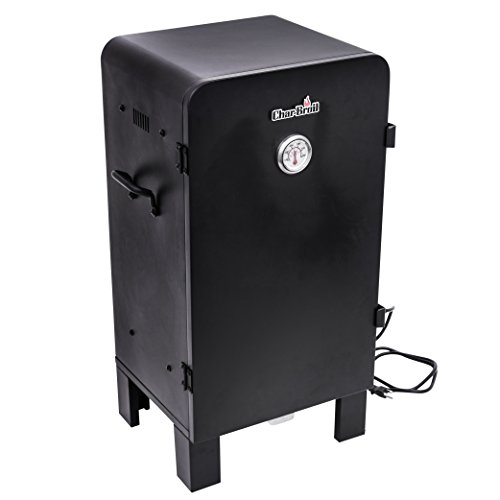
The Char-Broil Analog covers the wood chip fundamentals for the least money in this guide: an insulated cabinet, an electric element, a chip box, and a simple analog dial instead of a digital controller. It suits the curious beginner and the second-smoker buyer — someone who wants a dedicated fish and chicken machine next to a charcoal grill — and it teaches a useful lesson: a dial you learn by feel can hold a temperature more honestly than a cheap digital display you merely believe. It is not for the cook who wants set-and-forget precision or a window and probes; you will add your own thermometer and check it like every generation before digital.
Strengths
- Lowest cost of entry into real chip smoking with an insulated cabinet.
- Simple analog control with very little to fail.
- Compact footprint suits small patios and storage.
Trade-offs
- Dial settings require a learning curve and your own thermometer to verify.
- Capacity is modest — plan cooks accordingly.
- No loader: adding chips means opening the door.
The right way to run this smoker is with a cheap grate-level thermometer and a notebook. Mark where the dial sits for your common temperatures on a calm day, note how wind shifts it, and within three cooks the “analog” part stops feeling like a compromise. Its chip box delivers a respectable smoke for chicken, ribs and pork shoulder, and its small cabinet heats quickly and recovers fast after door openings — a genuine advantage over big boxes when you are smoking two racks of ribs, not ten. As a first smoker or a specialist second, it earns its place.
Best for: beginners and budget buyers who will learn a dial / Not suited for: precision cooks or large loads
Check the current price on Amazon

Masterbuilt MPS 230S Propane Smoker — Best Propane
Not everyone trusts an electric element, and the MPS 230S is the answer: a propane-fired cabinet with a wood chip tray over the burner, four racks, and the fast heat recovery that gas gives you every time the door opens. It suits cooks smoking away from an outlet — camps, cabins, tailgate-adjacent setups — and anyone in a cold climate, where gas heat shrugs off weather that makes electric elements labor. It is not for the cook who wants to set a digital temperature and ignore the smoker for six hours; propane cabinets hold temperature well but reward periodic checks, and you are managing a fuel tank as well as a smoker.
Strengths
- Gas heat recovers quickly after door openings and ignores cold weather.
- No cord — smoke anywhere a propane tank is welcome.
- Four racks and a proper chip tray for full-size cooks.
Trade-offs
- Temperature control is a burner valve, not a digital setpoint.
- Propane is a running cost and a tank to keep filled.
- Flame-based heat needs the usual gas-appliance respect and ventilation.
Propane changes the smoking rhythm in one welcome way: loading chips or checking meat costs you almost nothing, because the burner restores cabinet temperature in minutes rather than the long climb an element needs. The chip tray over the burner smolders steadily, and most owners find a tray lasts a good stretch of a cook before a refill. Keep a spare tank — running dry at hour five of a brisket is a rite of passage you can skip — and learn your valve settings in calm weather first. For off-grid and cold-climate smoking, this is the chip smoker to beat.
Best for: off-outlet smoking, cold climates and fast recovery / Not suited for: digital set-and-forget cooks
Check the current price on Amazon
Pit Boss 3-Series Electric Vertical Smoker — Best Vertical Electric
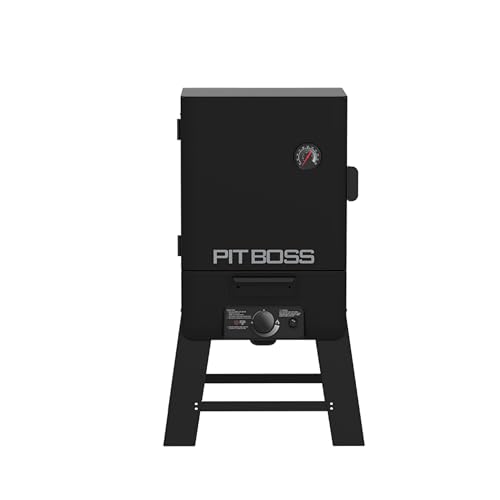
The Pit Boss 3-Series stretches the electric chip smoker tall: four racks in a vertical cabinet, a wood chip tray, and a wide temperature range that runs low enough for delicate work and high enough for poultry that needs crisper skin. It suits the cook who smokes mixed loads — sausage hanging out up top, ribs in the middle, a pan of beans below — and who wants the cabinet format with a brand’s parts network behind it. The analog-style control approach means you are learning the cooker’s dial rather than typing a number, a small discipline most owners adapt to quickly. It is not the pick for window-watchers; you cook by probe and by schedule here.
Strengths
- Tall four-rack cabinet suits mixed loads and hanging items.
- Wide, gentle temperature range covers fish through poultry.
- Wood chip tray system is simple and easy to clean.
Trade-offs
- No viewing window — you cook by thermometer.
- Control is dial-based rather than digital setpoint.
- Vertical cabinets stack heat — top and bottom racks cook at different rates; rotate on long cooks.
Vertical cabinets reward cooks who think in zones. The racks nearest the element run hotter; delicate items belong high, robust cuts low, and a mid-cook rotation evens out a big load. The chip tray sits where it can smolder steadily, and because the cabinet is tall, smoke has a long path over the food — owners often find the Pit Boss’s smoke presence a pleasant step up from shorter electrics. Add a dual-probe thermometer, keep the tray ash brushed out so chips smolder rather than suffocate, and this becomes the high-capacity electric of the group.
Best for: mixed vertical loads and sausage in an electric cabinet / Not suited for: cooks who want a window or digital setpoint
Check the current price on Amazon
Comparison Table
| Pick | Badge | Key spec | Best for |
|---|---|---|---|
| Masterbuilt MB20071117 30-inch | Best Overall | Digital control, side chip loader, 710 sq in | Repeatable everyday smoking |
| EAST OAK 30-inch | Best Viewing Window | Window, built-in probe, side loader, 725 sq in | Visual cooks, learners |
| Smokehouse Big Chief | Best for Fish and Jerky | Low fixed heat, chip pan, 50 lb capacity | Fish, jerky, big delicate batches |
| Char-Broil Analog Electric | Best Budget | Analog dial, insulated cabinet, chip box | First smoker, small loads |
| Masterbuilt MPS 230S | Best Propane | Gas burner, chip tray, 4 racks | Off-outlet and cold-weather smoking |
| Pit Boss 3-Series Electric Vertical | Best Vertical Electric | 4-rack cabinet, chip tray, wide temp range | Mixed loads, sausage |
Compare listings directly: Masterbuilt MB20071117, EAST OAK 30-inch, Big Chief, Char-Broil Analog, Masterbuilt MPS 230S, Pit Boss 3-Series.
How to Choose a Wood Chip BBQ Smoker
Start with the heat source, because it decides your lifestyle. Electric cabinets are the set-and-hold option: a thermostat cycles an element, you add chips on a schedule, and the cook proceeds with minimal attention. Propane gives faster recovery and freedom from outlets at the cost of tank management and valve-based control. The Big Chief’s fixed low heat is a third philosophy entirely — a specialist tool that does one temperature beautifully. Choose by where and how you will actually smoke, not by which fuel sounds most authentic.
Judge the chip system, not the chip marketing. Three questions matter: Can you add chips without opening the door? How long does one load genuinely smolder? Does the system let you meter smoke — small additions over time — or does it burn everything in the first hour? Side loaders (Masterbuilt, EAST OAK) answer all three best. Trays and pans are workable but cost you a door opening per refill, which is why long cooks favor loader designs.
Match capacity to your real loads. A 30-inch electric cabinet with four racks handles a brisket, or four racks of ribs with a rib rack, or two shoulders and sides — most households, most weekends. Bigger is not better if you mostly smoke for two: small cabinets heat faster, recover faster and use chips more efficiently. The exception is batch work — jerky and fish reward the Big Chief’s sprawling racks in a way no brisket cabinet can match.
Insulation and seals decide winter. An insulated cabinet with a door that latches tight holds temperature while an element sips power; a thin, leaky box in January wind will struggle to hold any temperature at all. If you smoke year-round in a cold climate, weight insulation heavily — or choose the propane pick, whose burner has heat to spare.
Plan the thermometer situation. Built-in probes (EAST OAK) are genuinely useful. Everyone else should budget for a dual-probe thermometer: one probe for cabinet air at grate level, one for the meat. Cabinet dials and door thermometers are approximations, and in chip smokers — where you open the door less and trust the machine more — accurate remote readings are the whole game.
How to Smoke Ribs in a Wood Chip Smoker, Step by Step
Step 1 — Prep the ribs. Remove the membrane from the bone side (a paper towel gives you the grip), trim loose flaps, and apply your rub at least an hour ahead — overnight is better. A dry surface is the foundation of bark, even in an electric cabinet.
Step 2 — Load dry chips and preheat. Fill the chip tray or loader with dry chips — hickory for a classic profile, apple or cherry for a gentler one — and bring the smoker fully to temperature before the ribs go in. Cold-starting meat in a warming cabinet steams it in its own moisture and dulls the smoke.
Step 3 — Smoke unwrapped for the first stretch. This is when the meat takes on the most smoke and the bark forms. Keep the vent open enough for smoke to flow; stagnant smoke turns bitter. Add chips on schedule — small, regular additions beat one giant load.
Step 4 — Wrap when the bark is set. When the surface is deep mahogany and the rub does not smear under a fingertip, wrap in foil or butcher paper with a little liquid if you like. In a chip smoker this is typically well into the cook; judge by color, not the clock.
Step 5 — Finish to tenderness, then rest. Ribs are done when the meat pulls back from the bone ends and a toothpick slides between the bones with little resistance, or when the rack bends and the surface cracks as you lift it from one end. Rest wrapped for twenty to thirty minutes before slicing — even ribs benefit.
Wood Chip Craft: Getting Real Smoke From Small Wood
Chips are not small chunks; they behave differently and reward different technique. A chip has far more surface area for its mass, so it ignites and burns out quickly — that is why chip smokers are designed around repeated small doses rather than one big load. The craft is in the dosing. In a loader smoker, add a small handful at intervals through the first half of the cook, while the meat is cool and wet enough to collect smoke. In a tray smoker, resist the urge to mound the tray; a level layer smolders evenly, while a heap suffocates at the bottom and flares at the top.
Soaking chips is the most persistent myth in this category. In an electric or propane chip smoker, wet chips mostly delay smoke while the water steams off, then burn at the same rate — you have traded smoke time for steam. The exception is a chip box on a screaming-hot gas grill, where a brief soak can slow ignition. In a dedicated chip smoker, dry chips, dosed steadily, win every time.
Species choice matters more with chips because the smoke is the main event. Hickory is the assertive classic for pork; mesquite is stronger still and best used in short early doses or blended. Alder is the traditional fish wood — clean and light. Apple and cherry are the gentle all-rounders for poultry and ribs, with cherry adding a beautiful color to the surface. Pecan sits between hickory and fruitwood and may be the most versatile chip of all. Keep two or three species on hand, log what you used, and let your own palate — not a chart — build your preferences.
Common Buying Mistakes
Expecting charcoal-pit smoke from an electric cabinet. Chip smokers make clean, moderate smoke. If your heart is set on deep offset flavor, buy a charcoal cooker; if you want consistency and convenience with honest wood flavor, you are in the right category — just calibrate the expectation.
Buying a brisket cabinet for a fish hobby. If your real smoking life is salmon, trout and jerky, the Big Chief’s low heat and huge racks serve you better than any digital cabinet, and cost less to run. Match the machine to the food you actually smoke most.
Ignoring the refill question. A smoker you cannot refuel with chips mid-cook will give you smoke for the first hour and steamed meat for the next five. Check how chips are added before you fall in love with a control panel.
Trusting the door thermometer. On every class of smoker in this guide, the built-in gauge is a rough guide at best. A remote probe at grate level is not an accessory; it is the instrument panel. Budget for one.
Running the vent closed to “keep the smoke in.” Smoke needs to flow. A closed vent makes stale, bitter smoke and can smother a propane burner’s clean combustion. Keep exhaust moving and control smoke with chip dosing, not suffocation.
Forgetting the drip plan. Electric cabinets concentrate drippings near an element. Use the water pan as intended, line what the manual allows you to line, and clean the drip tray before it becomes a smoke source of its own — old grease smoke is nobody’s flavor.
Final Recommendation
For the widest range of cooks, buy the Masterbuilt MB20071117: the side loader and digital control make it the most complete wood chip smoker here. If you cook by eye, the EAST OAK 30-inch and its window-and-probe setup will suit you better. Fish and jerky specialists should skip the cabinets entirely and take the Smokehouse Big Chief. On a budget, the Char-Broil Analog covers the fundamentals honorably; off the grid or in deep cold, the Masterbuilt MPS 230S propane cabinet is the resilient choice; and for tall mixed loads, the Pit Boss 3-Series earns its footprint.
More from this cluster: Best Wood Chip Smokers, Best Wood Chip Smokers For Fish, Best Wood Fired Electric Smokers, Best Electric Wood Smokers, Best Food Smokers.
Electric Chip Smokers in Cold Weather: What to Expect
Every winter, new owners of electric chip smokers conclude their machine is broken. It usually is not — it is physics. An electric element has a fixed maximum output, and a cold, windy day pulls heat out of a cabinet faster than a summer day does. The symptoms are a slow climb to temperature, a ceiling lower than the dial promises, and longer cooks across the board. The smokers in this guide differ in how gracefully they handle it: insulated cabinets hold their heat far better than thin ones, and the propane MPS 230S simply out-powers the weather.
The countermeasures are practical. Preheat longer and start with hot water in the pan, so the element is not spending its budget boiling cold water. Keep the door shut — every peek in January costs minutes, not seconds. Shelter the smoker from wind, which strips more heat than cold air alone; a patio corner makes a measurable difference. Load the cabinet sensibly: a full load of cold meat is a heat sink, so big winter cooks benefit from letting meat lose its refrigerator chill on the counter briefly before it goes in, within safe food-handling limits. And plan the cook longer, starting earlier rather than raising the temperature to compensate — rushing a brisket is how winter cooks actually fail.
There is an upside hiding here: cold weather is when chip smokers earn their keep against charcoal. A charcoal fire in wind and cold demands constant attention, while the electric cabinet, once sheltered and preheated, simply works longer hours. Owners who smoke through the winter tend to become the most loyal chip-smoker cooks of all, because the machine lets them keep a year-round habit that fire-tending would have made seasonal.
Building a Chip Smoker Pantry: Woods, Brines and Tools That Matter
A chip smoker rewards a small, well-chosen pantry more than a garage of gadgets. Start with three chip species — a fruitwood (apple or cherry), a middle wood (pecan or oak), and an assertive wood (hickory) — bought in modest bags and stored dry, off the floor, where they will not absorb garage smells. Chips stale slowly but surely; a bag that has sat open through two summers will smoke like cardboard. Date your bags and buy in quantities your cooking rate justifies.
For the fish and jerky side of this craft, add the curing basics: a reliable scale for weighing salt and cure accurately, kosher salt, brown sugar, and a dedicated container for brining that fits your refrigerator. Precision matters more here than in barbecue rubs, because brines and cures are chemistry, not seasoning — weigh them, write the ratios down, and repeat what worked. A notebook, or a notes file, is genuinely the highest-value tool in the pantry: chip species, dose timing, temperatures and results, cook by cook.
On tools, three earn their drawer space. A dual-probe thermometer, already recommended throughout this guide, is the instrument panel. A pair of heat-resistant gloves makes handling trays, pans and hot racks unhurried and safe. And a stiff brush sized to your chip tray keeps the ash from insulating the chips — a tray brushed out between loads smolders noticeably better than one left to cake. Everything else — fancy rubs, injector kits, designer wood blends — can wait until your notes tell you exactly which problem you are solving.
Smoking Poultry and Sausage in a Chip Smoker
Barbecue’s big cuts get the attention, but chip smokers quietly excel at the foods that fill the weeks between briskets. Poultry is the first: a whole chicken in an electric cabinet, smoked with apple or cherry chips, comes out with mahogany skin and meat that stays moist because the cabinet’s gentle, enclosed heat does not blast it the way a grill does. The craft points are dry skin (uncovered in the refrigerator overnight), a fully preheated smoker so the skin starts rendering immediately, and a finish at the cabinet’s higher end if you want bite-through skin — or a brief pass under a hot broiler or grill, which no purist will fault you for on a weeknight.
Sausage is the second specialty, and it is where the vertical Pit Boss and the low-running Big Chief earn their keep. Fresh sausages want moderate heat and steady smoke until they are cooked through, and cabinets let you run a mixed batch — different flavors on different racks — without the flare-ups a grill gives you. Smoked sausage also freezes beautifully, which makes a Saturday batch a month of easy dinners. Kielbasa, bratwurst and Italian links all take well to hickory or pecan chips; keep the doses modest, because sausage’s high surface-to-volume ratio drinks in smoke quickly.
Vegetables deserve a sentence of their own: corn, peppers, onions and even blocks of firm cheese (smoked at the lowest possible temperature, in cool weather, with the door discipline the Big Chief teaches) all come out of a chip smoker better than they went in. A smoker that only cooks brisket is a tool used six times a year; a chip smoker used for chicken, sausage and vegetables earns its patio space every week.
Maintaining a Wood Chip Smoker So It Smokes Clean for Years
Chip smokers fail quietly: not with a breakdown, but with a slow drift toward bitter food as residue builds. The maintenance that prevents it is short and specific. After every cook, empty the chip tray or loader ash — ash insulates the next load of chips and makes it smolder unevenly — and wipe the drip tray or pan while the residue is still warm and soft. Grease left through a week of patio heat becomes the stale smoke you will taste in the next cook.
Monthly, in season, give the cabinet a deeper pass: racks washed or brushed, the water pan descaled, the door gasket checked for tears and compression, and the interior walls scraped only where deposits flake. Do not strip the interior to shiny metal; a thin, hard seasoning layer is protective. On electric models, vacuum or brush element areas clear of debris with the unit unplugged and cold, and check the cord for weather damage. On the propane MPS 230S, inspect the burner ports and hose connections as you would any gas appliance, and keep the chip tray from warping out of shape by never quenching it with water while hot.
Storage decides lifespan more than use does. A cover that fits, a dry spot, and a door left latched against pests will carry any of these machines through many seasons. In humid climates, an occasional empty hot run — thirty minutes at full temperature with no food — dries the cabinet and burns off the beginnings of off-odors. Owners who keep this light routine routinely report a decade from a mid-priced cabinet; owners who close the door on a dirty smoker in October meet a science project in April.
Frequently Asked Questions
Do wood chips need to be soaked before smoking?
Not in a dedicated chip smoker. Dry chips smolder sooner and cleaner; soaked chips mostly steam first. Dose dry chips in small amounts across the early cook for the steadiest smoke.
How long does one load of chips last?
It varies with the machine and temperature, but plan on roughly an hour of meaningful smoke per tray or loader fill in most electric cabinets — which is exactly why mid-cook refill access matters so much in this category.
Can a wood chip smoker cook a brisket properly?
Yes — the digital and propane cabinets here hold brisket temperatures all day and produce tender, genuinely smoky results. The smoke depth will be milder than a charcoal offset’s, and bark will be a little softer; many cooks consider that a fair trade for sleeping through the night.
What chips are best for beginners?
Apple or pecan. Both are forgiving — hard to oversmoke with — and suit pork, poultry and ribs. Add hickory once you know you like a stronger profile, and treat mesquite as a spice: a little, early, blended.
Electric or propane chip smoker — which is better?
Electric wins on set-and-hold precision and running cost where you have an outlet. Propane wins on heat recovery, cold-weather strength and smoking away from power. Neither is universally better; your patio and climate decide.
How do I keep the smoke from tasting bitter?
Keep the exhaust vent flowing, use dry chips in modest doses, and never let old grease build up in the drip path. Bitterness in chip smokers is almost always stale smoke or dirty equipment, not the wood species.
Can I use wood chunks or pellets instead of chips in these smokers?
Chunks are too large for most trays and loaders — they burn unevenly and can jam a loader tube. Pellets work in some trays but burn hotter and faster than chips and are not what these chip systems were metered for; if you experiment, use small amounts and watch the first run closely. For the Big Chief, chips are the designed fuel, full stop. When in doubt, feed the machine the fuel it was built around.
How much electricity does an electric chip smoker use on a long cook?
Less than most people fear: the element cycles on and off to hold temperature rather than running flat-out, so a long low cook draws modest power overall — comparable to running a small household appliance intermittently through the day. Cold, windy weather increases cycling and therefore consumption, which is one more reason shelter and insulation pay for themselves.
What is the difference between a chip smoker and a pellet smoker?
A pellet smoker burns compressed wood pellets as both fuel and smoke source, feeding them automatically with an auger — the heat itself is wood-fired. A chip smoker gets its heat from electricity or gas and uses chips purely for smoke flavor. Pellet smokers generally produce a more continuous smoke and double as decent grills; chip smokers are simpler, usually cost less, run lower and gentler (which fish and jerky prefer), and their smoke is easier to start and stop. Households that smoke delicate foods lean chip; households that want one wood-fired cooker for everything lean pellet.
Can I smoke in a chip smoker on an apartment balcony?
That depends on your lease and local rules, which you should check first — many buildings restrict any smoke-producing appliance. Where it is allowed, the electric models here are the considerate choice: no open flame, modest smoke output that you control by chip dosing, and a compact footprint. Keep doses small, mind the wind direction toward neighbors, and never leave any smoker unattended on a balcony.
Do I need to season a new electric chip smoker?
Yes — run it empty at a high setting for the better part of an hour before the first cook, with a small load of chips for the second half. This burns off manufacturing oils and coats the interior with its first layer of smoke seasoning. Every machine in this guide benefits, and your first chicken will taste like chicken instead of packaging.
Where should I place a chip smoker on my patio?
On a level, non-combustible surface, outdoors, with clearance from siding, railings and overhangs, and close enough to an outlet that the cord is not a trip hazard stretched across a walkway. A spot sheltered from the prevailing wind will make every cook easier and every winter cook possible. Never run any smoker — electric included — in a garage or enclosed porch: smoke and carbon monoxide both need open air.


