Disclosure: airfryerkitchensupply.com is reader-supported. When you buy through links on our site, we may earn an affiliate commission at no extra cost to you.
Where to buy
Every smoker below is sold on Amazon. Check the current price on Amazon at each listing before deciding — the listing page always shows today’s number.
- Smokehouse Big Chief Electric Smoker — check price on Amazon
- Smokehouse Little Chief Front Load Smoker — check price on Amazon
- Masterbuilt 30-inch Analog Electric Smoker MB20070210 — check price on Amazon
- EAST OAK 30-inch Electric Smoker — check price on Amazon
- Char-Broil Analog Electric Smoker — check price on Amazon
- HAKKA Commercial Electric Smoker DSH-S50B — check price on Amazon
Fish is the food that exposes ordinary smokers. The best wood chip smokers for fish are not the ones with the most power or the fanciest controls — they are the ones that can hold a genuinely low temperature for hours, deliver gentle wood chip smoke without cooking the fillets into leather, and give delicate flesh room to dry and take smoke evenly. A brisket smoker run at its lowest setting is usually still too hot and too aggressive for salmon done properly; a fish smoker is a different instrument, built around restraint. That is why this guide is led by the Smokehouse tradition — machines designed from the start for the catch — with cabinet smokers included only where their low-end control honestly earns a place.
Every pick was confirmed by brand and model before earning a link. Between them they cover the whole fish-smoking life: the weekend angler with two salmon, the fishing family processing a season, the beginner who wants one forgiving machine, and the serious preserver running batch after batch. We will also be plain about method, because with fish the smoker is only half the craft — brining and pellicle formation decide as much as the machine does, and the how-to section below treats them with the seriousness they deserve.
In this guide
Quick Picks
- Best Overall for Fish — Smokehouse Big Chief: the classic low-heat chip pan smoker with 50 lb of rack capacity for real catches. Check the current price on Amazon
- Best for Small Catches — Smokehouse Little Chief: the same gentle tradition in a light, compact front-loader for a few fillets at a time. Check the current price on Amazon
- Best Cabinet Control — Masterbuilt 30-inch Analog Electric MB20070210: a 535 sq in cabinet whose analog control lets you run genuinely low for fish, then turn up for other work. Check the current price on Amazon
- Best Fish-and-More Cabinet — EAST OAK 30-inch: a window, a built-in probe and a side chip loader for households that smoke fish and barbecue in one machine. Check the current price on Amazon
- Best Budget — Char-Broil Analog Electric: a simple, insulated chip cabinet that covers fish fundamentals for the least money. Check the current price on Amazon
- Best for Serious Volume — HAKKA DSH-S50B: an 8-rack commercial-style electric smoker for preserves, gifts and market-scale batches. Check the current price on Amazon
How These Picks Were Chosen
Fish rewrote our scoring. The first criterion was low-temperature character: can the machine live at the gentle heats fish wants, without surging? Fixed-low-heat designs (the Chiefs) score perfectly by construction; cabinets were admitted only if their control range honestly reaches down. The second was smoke gentleness — chip pans and metered trays over anything that blasts. The third was rack design for fish: enough racks, spaced for fillets and whole fish, easy to load without tearing delicate flesh. The fourth was capacity matched to real catches, from two fillets to a season’s salmon.
Verification was the same discipline as the rest of this program: brand-and-model searches, links only where the returned title matched the intended product. We also applied a fish-specific honesty filter — any machine whose minimum practical temperature would cook fish hard rather than smoke it was excluded, however good a brisket smoker it might be. What remains is a short list where every pick can be trusted with a good catch.
The 6 Best Wood Chip Smokers for Fish

Smokehouse Big Chief Electric Smoker — Best Overall for Fish
If you smoke fish seriously, this is your machine, and it has been for generations of anglers. The Big Chief pairs a simple electric element with a chip pan in a tall aluminum cabinet, running at a low, steady heat that sits right where fish smoking lives. There is no thermostat to fight and no digital anything — the design’s genius is that its one temperature is the correct one. The 50 lb rated capacity across its racks means a real catch — a limit of salmon, a season’s trout — processes in one batch instead of a week of shifts. It suits fishing families, gift-givers at the holidays, and anyone whose fish smoking is measured in pounds rather than fillets. It is not a barbecue machine: brisket and ribs want heat this cabinet does not make, and we will not pretend otherwise.
Strengths
- Low, gentle heat purpose-built for fish — no control fighting, ever.
- 50 lb batch capacity with easy front-loading racks.
- Almost nothing to break; decades-long service is the norm.
Trade-offs
- Temperature floats with the weather — hot days need a cracked door, cold days a sheltered spot.
- Chip pan refills mean opening the cabinet briefly.
- Useless for high-heat barbecue, by design.
Big Chief fish technique is a handed-down craft: brine the fish, dry it to a pellicle, then feed the pan alder chips in rounds while the cabinet does its slow work. Because the heat is gentle, the fish dries as it smokes, concentrating flavor instead of steaming it away — the texture people describe as “real smoked salmon” comes from exactly this. Owners learn their local weather as an ingredient, and the machine rewards that learning for decades. For fish, nothing else in this guide is close.
Best for: anglers and families smoking fish in real quantity / Not suited for: barbecue cuts or cooks who want a thermostat
Check the current price on Amazon

Smokehouse Little Chief Front Load Smoker — Best for Small Catches
The Little Chief is the Big Chief’s tradition at kitchen scale: the same element-and-pan simplicity and gentle heat, in a light front-loading cabinet sized for two to four fillets, a small trout haul, or a test batch of a new brine. It suits the occasional angler, the small household, and the beginner who wants to learn fish smoking on a machine that cannot really be operated wrong. Its limits are its sibling’s, in miniature: no thermostat, weather-sensitive heat, and no business cooking brisket. Within fish, those limits barely register — the machine’s native temperature is the one you would choose anyway.
Strengths
- The simplest possible route to properly smoked fish.
- Light and compact — stores on a shelf, sets up in minutes.
- Perfect batch size for learning brines and woods.
Trade-offs
- Small capacity — a big catch means multiple batches.
- No temperature control of any kind.
- Fish and jerky only; not a general smoker.
The Little Chief’s real gift is frequency. Because setup is trivial and batches are small, owners smoke fish the week they catch it instead of stockpiling freezer bags for a production day that never comes. It is also the finest teaching tool in this guide: every variable — brine strength, drying time, chip species, pan count — can be tested on two fillets, with the results eaten the same day. Start here, and upgrade only when your catch, not your curiosity, demands it.
Best for: small catches, beginners and small households / Not suited for: volume processing
Check the current price on Amazon
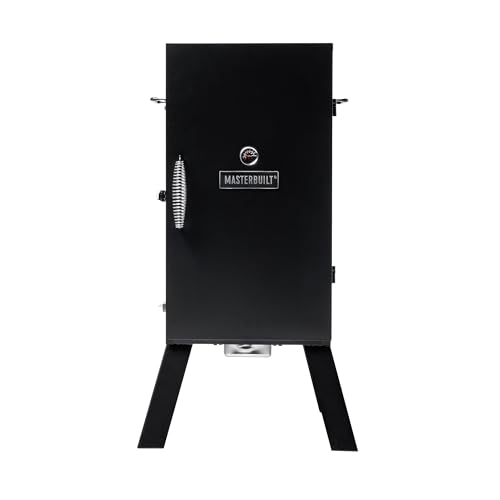
Masterbuilt 30-inch Analog Electric Smoker MB20070210 — Best Cabinet Control
Some households want one cabinet that smokes fish on Saturday and ribs on Sunday, and the analog Masterbuilt 30-inch is the honest bridge. Its analog temperature control and 535 square inches of rack space let you run the cabinet genuinely low for fish — with the chip tray delivering measured smoke — then turn the same machine up for poultry and pork during the week. It suits the mixed-menu household that cannot justify a fish-only machine. It is not as set-and-forget as its digital sibling, and for fish you will work the dial with a probe thermometer’s help; analog control is a skill, repaid in flexibility. It is also not a Chief: its low end is a setting you manage, not a nature the machine was born with.
Strengths
- One cabinet honestly capable of fish-low and barbecue temperatures.
- Analog simplicity — no electronics to fail outdoors.
- 535 sq in across chrome racks suits fish and family barbecue alike.
Trade-offs
- Dial control needs a probe thermometer and a learning curve.
- Chip refills require opening the door.
- Low-end stability depends on your dial discipline and the weather.
For fish specifically, run this Masterbuilt with the water pan filled, the dial at its lowest stable setting verified by your probe, and chips dosed in small tray loads. The cabinet’s insulation helps it hold the gentle end more steadily than thin boxes can. Mark your dial positions for fish days and barbecue days in a notebook; within a month the analog control stops feeling approximate and starts feeling like knowledge. As a single-machine answer for a fish-and-barbecue household, it is the strongest pick here.
Best for: households wanting fish and barbecue from one cabinet / Not suited for: cooks wanting digital precision or a fish-only specialist
Check the current price on Amazon

EAST OAK 30-inch Electric Smoker — Best Fish-and-More Cabinet
The EAST OAK brings modern cabinet conveniences to the fish brief: a clear viewing window and built-in meat probe so you can watch fillets take color without opening the door, and a side chip loader designed for long, uninterrupted smoking from a single load. For fish, the window is more than a luxury — delicate fillets tell you their state by color and surface, and every avoided door opening keeps the cabinet’s gentle heat where it belongs. It suits the household that smokes fish regularly and barbecue often, and wants one digital machine for both. It is not the cheapest route, and the window wants a wipe between cooks to stay honest.
Strengths
- Window and probe mean fish is monitored without heat loss.
- Side loader doses chips without opening the door.
- 725 sq in handles fish batches and barbecue loads alike.
Trade-offs
- Window needs regular cleaning.
- Digital controls are a long-term maintenance item.
- Lowest settings still need watching on hot days for delicate fish.
The EAST OAK’s fish workflow is the most modern here: brine, dry, load, and then manage the cook from outside the glass — color through the window, temperature from the probe, smoke from the loader. For cooks who smoke fish for the table rather than the freezer — a side of salmon for guests, trout for the weekend — that visibility turns a nervous cook into a relaxed one. It will never be a Chief for a fifty-pound catch, and it does not need to be.
Best for: regular fish smokers who also barbecue, and cooks who judge by color / Not suited for: bulk fish processing or the tightest budgets
Check the current price on Amazon
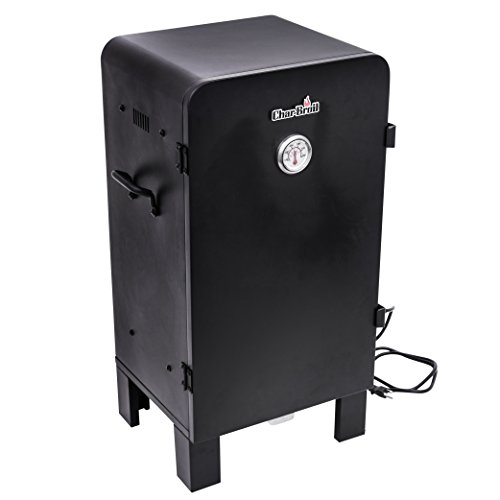
Char-Broil Analog Electric Smoker — Best Budget
The Char-Broil Analog is the budget door into fish smoking with a real cabinet: insulated walls, an electric element, a chip box, and a simple dial. For fish, its virtues are the format’s virtues — a contained, gentle environment where chips smolder steadily and fillets dry as they smoke — at the lowest cost in this guide. It suits the curious beginner and the angler who wants a dedicated fish cabinet next to a grill without a flagship spend. You will add your own thermometer and learn the dial’s personality, as with every analog machine; and capacity is modest, which for most households’ fish smoking is a fact, not a flaw.
Strengths
- Lowest cost into a genuine insulated chip cabinet.
- Simple, durable control scheme with little to fail.
- Compact size suits small patios and fish-sized loads.
Trade-offs
- Dial requires your own thermometer to run fish temperatures confidently.
- Modest capacity for big catches.
- No loader — chip refills open the door.
Fish forgives this machine’s simplicity because fish smoking is itself simple: low heat, clean chips, time. Run the Char-Broil with a grate-level probe, keep the chip box dosed lightly — fish oversmokes faster than any meat — and it will turn out salmon and trout that embarrass the price tag. As a first fish smoker that can also handle chicken and ribs for two, it is the easiest recommendation in this guide to defend.
Best for: budget buyers and beginners smoking fish at home scale / Not suited for: big catches or digital-control seekers
Check the current price on Amazon

HAKKA Commercial Electric Smoker DSH-S50B — Best for Serious Volume
At the far end of the fish-smoking life sits the preserver: the person smoking for a smokehouse-style output — gifts by the dozen, a fishing club’s season, a farm stand’s worth of product. The HAKKA DSH-S50B is built for that person: a commercial-style electric cabinet with eight racks, giving an enormous amount of fish room in one footprint, with the straightforward controls of a working machine rather than a lifestyle appliance. It suits serious volume and semi-commercial ambition. It is not a casual purchase in size, capacity or intent, and a household smoking four fillets a month will find it absurd — which is precisely the point of including it with honest framing.
Strengths
- Eight racks of capacity for true batch production.
- Commercial-style build intended for repeated, heavy use.
- One batch replaces a day of small-smoker shifts.
Trade-offs
- Far more machine than a casual fish smoker needs.
- Large footprint and a serious storage commitment.
- Utilitarian controls — you bring the thermometers and the craft.
Volume changes technique: with eight racks, rotation becomes part of the recipe, loads must be sized and spaced for airflow, and brining becomes a system rather than a bowl. The HAKKA rewards that professionalism with throughput no home cabinet approaches. If your fish smoking has outgrown two Chiefs running side by side — a real milestone some anglers actually reach — this is the machine that consolidates the operation.
Best for: preservers, fishing clubs and semi-commercial batches / Not suited for: casual or small households
Check the current price on Amazon
Comparison Table
| Pick | Badge | Key spec | Best for |
|---|---|---|---|
| Smokehouse Big Chief | Best Overall for Fish | Low fixed heat, chip pan, 50 lb capacity | Real catches, salmon seasons |
| Smokehouse Little Chief | Best for Small Catches | Compact front-load, chip pan | A few fillets, learning |
| Masterbuilt MB20070210 30-inch Analog | Best Cabinet Control | Analog dial, 535 sq in, chip tray | Fish + barbecue in one cabinet |
| EAST OAK 30-inch | Best Fish-and-More Cabinet | Window, probe, side loader, 725 sq in | Table fish and barbecue |
| Char-Broil Analog Electric | Best Budget | Insulated cabinet, dial, chip box | First fish smoker |
| HAKKA DSH-S50B | Best for Serious Volume | 8 racks, commercial style | Preserving at scale |
Compare them side by side: Big Chief, Little Chief, Masterbuilt Analog 30, EAST OAK 30, Char-Broil Analog, HAKKA DSH-S50B.
How to Choose a Wood Chip Smoker for Fish
Low temperature is the whole brief. Fish smokes best at heats most barbecue smokers treat as a warm-up. Before falling for capacity or controls, ask one question: what is the lowest temperature this machine will genuinely hold on a calm day? The Chiefs answer by construction. Cabinets answer with their control range — and your probe thermometer verifies the answer on your patio, where it counts.
Choose your tradition: specialist or bridge. A Chief does fish superbly and nothing else. A cabinet does fish well and barbecue too. Households that smoke fish monthly and barbecue weekly are bridge households; anglers who smoke every catch are specialist households. The wrong tradition is the only real mistake available here, because every machine in this guide does its own job well.
Racks matter more than raw size. Fish cooks flat and in layers. Count racks and their spacing, not just square inches: fillets need air around them, whole fish need vertical room, and a rack you can slide out to check a delicate fillet without tearing it is worth two you cannot. Front-loading designs (both Chiefs) are kindest to fragile loads.
Smoke gentleness beats smoke volume. Fish takes smoke quickly and punishes excess with bitterness. Chip pans and small trays that deliver a measured, mild smoke suit fish better than systems designed to blast a brisket. Whatever you buy, plan to dose at half your pork instinct and adjust upward across batches.
Match capacity to your catch, honestly. Two fillets a month is a Little Chief life. A salmon season is a Big Chief life. A fishing club is a HAKKA life. Oversized machines dry small loads unevenly and discourage the frequent, small smokes that build skill — the most common way fish smokers go wrong is buying for the catch they dream about instead of the one in the cooler.
How to Smoke Fish Properly: Brine, Pellicle, Smoke
Step 1 — Choose and portion the fish. Oily fish — salmon, trout, mackerel, sablefish — smoke best because their fat carries flavor and resists drying. Portion fillets to even thickness so they finish together; tail pieces will be done first and can come off early.
Step 2 — Brine, and write it down. A dry brine of salt and brown sugar (with any aromatics you favor) applied generously and refrigerated for several hours to overnight seasons the fish, firms the flesh and draws out moisture. Weigh the salt. Fish brining is chemistry with narrow margins, and the batch you loved must be repeatable.
Step 3 — Rinse, dry, and form the pellicle. Rinse the brine off, pat dry, and air-dry the fillets — refrigerated or in front of a small fan — until the surface turns tacky and matte. This pellicle is the single most skipped and most important step in fish smoking: smoke adheres to it, and without it your fish will taste faintly smoked no matter how good the machine is.
Step 4 — Smoke low with mild wood. Alder is the classic fish wood; apple and cherry are gentle alternatives. Run the smoker at its gentlest, feed chips in modest rounds, and let time work. In a Chief, this is the machine’s native state. In a cabinet, hold the lowest stable temperature your probe confirms and resist turning it up to hurry — hurrying is how fish becomes jerky’s dry cousin.
Step 5 — Judge doneness by the flake. The fish is done when it flakes at the thickest point under gentle pressure and the flesh has turned from translucent to opaque, with the surface a deep, lacquered color. Overcooked smoked fish is dry fish; pull it when it is just ready and let carryover finish the work.
Step 6 — Rest, chill, and store like you mean it. Cool the fish before wrapping so condensation does not soften the surface you built. Refrigerated promptly, smoked fish keeps for days and improves overnight as smoke mellows; for longer storage, vacuum-seal and freeze. Label every package with the date, the brine and the wood — your future batches are only as good as your records.
Wood Choices for Fish: Alder and Its Supporting Cast
Fish narrows the wood palette in a useful way. Alder is the reference: the Pacific Northwest tradition pairs it with salmon so completely that “alder-smoked” is nearly a synonym for the dish. Its smoke is light, slightly sweet and clean, seasoning the fish without auditioning for the lead role. If you buy one chip for fish, buy alder.
Apple is the gentle understudy — mild, fruity, and kind to white fish and trout, and the safest choice for a first batch because it is nearly impossible to oversmoke with in reasonable doses. Cherry adds a touch more depth and a beautiful color to the surface, suiting salmon for the table. Pecan, used lightly, bridges toward a more assertive profile for oily fish like mackerel. Oak is the strong end of the acceptable range — a component in blends rather than a soloist for delicate fillets.
And then there is what to avoid. Hickory, the pork king, overwhelms most fish in all but the smallest doses; mesquite is stronger still and belongs nowhere near a trout. The governing principle is that fish is a quiet food: the wood should be heard as harmony, never as the melody. Keep two fish woods — alder and apple cover almost everything — dose them modestly, and let the quality of the catch be the flavor people remember.
Common Buying Mistakes
Buying a barbecue smoker and hoping its lowest setting is low enough. For fish, “lowest setting” on a brisket cabinet is often still a cooking temperature, not a smoking one. That is why the Chiefs — machines that cannot run hot — lead this guide. Verify the low end before you buy, not after the first leathery salmon.
Skipping the pellicle and blaming the smoker. No machine can fix a wet surface. If your smoked fish tastes weak, the cause is almost always brining or drying, not the box it smoked in. Master the prep and every pick here performs.
Oversmoking with barbecue instincts. Pork shoulders forgive heavy smoke; salmon does not. Fish batches should start with half the chips your barbecue habits suggest. You can always add a pan in the next batch; you cannot subtract bitterness from this one.
Buying capacity for the dream catch. A HAKKA is a wonderful machine for a fishing club and a lonely one for a couple with a trout stream. Honest capacity matching is the difference between a smoker used weekly and one used twice.
Ignoring food safety in the gentle zone. Low-temperature smoking lives near temperatures where care matters: brine properly, keep fish cold until it goes in, smoke in reasonable ambient conditions, chill promptly afterward, and when in doubt, finish delicate loads with a brief hotter phase. Tradition and safety are compatible — the tradition itself evolved the brining steps that keep the food safe.
Storing smoked fish casually. The cook ends at the refrigerator, not the smoker door. Unwrapped smoked fish dries and picks up fridge flavors within a day; wrap or vacuum-seal it, label it, and respect its keeping window.
Final Recommendation
For most fish smokers, the answer is the Smokehouse Big Chief — the right temperature by birth, capacity for a real catch, and a service life measured in decades. Small households and learners should start with the Little Chief and let their catch decide when to grow. Households that need fish and barbecue from one cabinet should take the Masterbuilt Analog 30-inch for control or the EAST OAK 30-inch for visibility, with the Char-Broil Analog as the budget route. And the rare, wonderful household that has outgrown all of that has the HAKKA DSH-S50B waiting.
Related reading: Best Wood Chip Smokers, Best Wood Chip Bbq Smokers, Best Apple Wood For Smokers, Best Electric Wood Smokers, Best Food Smokers.
Hot-Smoked Versus Cold-Smoked Fish: Know Which Game You Are Playing
Confusion between these two methods causes more disappointment — and more food-safety risk — than any equipment choice, so let us be precise. Hot smoking cooks the fish in warm smoke until it flakes; it is what every machine in this guide does, it is served warm or chilled as a finished food, and it keeps for days refrigerated. The Chiefs’ gentle heat produces a drier, more traditional hot-smoked style, close to the old smokehouse product; cabinets produce a moister, more modern one. Both are legitimate, and the difference is texture and tradition, not quality.
Cold smoking is a different discipline entirely: smoke applied at temperatures low enough that the fish remains essentially raw in texture, after a cure does the preserving work — lox and traditional kippers live here. None of these machines is a true cold smoker out of the box, and improvising cold smoking without understanding curing is the one genuinely unsafe experiment in this hobby. If cold-smoked fish calls to you, learn it as its own craft, with proper cures, refrigeration and guidance, and treat these chip smokers as your hot-smoking instruments. Knowing which game you are playing is what keeps the results delicious and the tradition safe.
Building a Fish Smoking Ritual: From Catch to Table Without Waste
The anglers who smoke fish best treat it as a rhythm, not an event. The catch is iced immediately and processed the same day — fish smoked fresh is a different food from fish smoked after a week of good intentions. Brining happens in a dedicated container that lives in the refrigerator during season, with the household’s proven ratio taped to its lid. Drying racks sit where air moves. The smoker lives ready: pan clean, chips stocked, a small notebook in a zip bag beside it.
Waste is the quiet enemy this ritual defeats. Trimmings and bellies — too rich or thin for fillet batches — become their own prized small smokes. Heads and frames, where local custom and comfort allow, give stock before they leave the kitchen. The notebook closes the loop: date, catch, brine, wood, pans, weather, verdict. By the second season, that notebook is worth more than any upgrade in this guide, because it converts luck into method. The machines here are simple; the ritual is the technology, and it is available to every owner willing to keep it.
Troubleshooting Fish Smokes That Miss the Mark
Problem: the fish is dry and tough. → The heat ran too high or the cook ran too long — the two are usually the same event. Verify your cabinet’s actual temperature with a probe at rack level rather than trusting the dial, pull the fish at the first clean flake rather than the last, and choose oilier fish or thicker portions for the next batch. In a Chief, a hot summer day is the usual culprit; smoke in the morning or crack the door.
Problem: the fish tastes like a campfire, bitter and harsh. → Too much smoke, too fast, from too-assertive wood. Halve the chip dose, switch to alder or apple, and make sure the vent is moving air — stagnant smoke is bitter smoke. Also check the surface: fish that went in without a pellicle sometimes gets a harsh, uneven smoke deposit that reads as bitterness.
Problem: the fish barely tastes smoked. → Work the prep before the machine: longer brine, a proper tacky pellicle, and smoke applied while the surface is cool. Then check the chips — old, damp chips from an open garage bag produce weak, musty smoke. Fresh dry alder in a Chief has been flavoring salmon for decades; if it is not working, the variable is almost never the box.
Problem: white beads (albumin) all over the surface. → The fish cooked too hot, too fast, squeezing protein to the surface. It is cosmetic more than culinary, but it signals the fix: lower heat, a gentler ramp, and patience. Brining also reduces it — one more reason the brine is not optional.
Whole Fish, Fillets and Steaks: Matching the Cut to the Rack
Not all fish enters the smoker in the same shape, and the shape changes the method. Fillets are the standard: even thickness where possible, skin on for structure (skin also protects the flesh from the rack and peels away cleanly after smoking), laid with space between them so smoke and drying air reach every surface. Thick center-cut pieces are the most forgiving; thin tail sections finish early and should be pulled first or grouped together on their own rack zone.
Whole fish — trout above all — smoke beautifully and present dramatically. They need vertical room and a light hand: brine reaches the cavity as well as the surface if you pack a little of the dry brine inside, and the fish is done when the flesh at the backbone flakes. Whole fish also dry more slowly than fillets, so allow the pellicle step its full time; a rushed whole fish is the classic source of a washed-out smoke.
Steaks and thick cuts from large fish behave most like meat: they tolerate the cabinet smokers’ slightly higher low end, take a stronger wood in moderation, and reward a probe thermometer more than thin fillets do. Across all three shapes, one rule holds: never crowd. A rack loaded edge to edge steams its contents in their own moisture, and steamed fish in a smoker is the saddest sentence in this guide. Smoke fewer pieces, better — the machines here, from the Little Chief up, all reward restraint.
Seasoning, Storage and the Life of a Fish Smoker
A fish smoker develops a personality, and it is mostly the smell of every fish it has ever smoked. That seasoning is an asset inside the cooking chamber — a well-used Chief smells like a smokehouse, which is to say, correct — but it demands honest housekeeping at the boundaries. Racks should be washed after fish batches, not merely brushed: fish oils go rancid in a warm garage, and rancid oil is the one flavor no brine can outrun. The chip pan gets emptied and wiped while its residue is fresh. Drip paths, where a model has them, get the same respect.
Storage separates the decade machines from the three-year ones. The Chiefs’ aluminum cabinets are nearly immortal if kept dry; steel cabinets want a cover and a dry corner, with their electronics out of the weather. In humid climates, an occasional empty run at working temperature dries a stored cabinet and refreshes it. And dedicate the machine: a smoker that lives as a fish smoker stays a great fish smoker, while one that alternates with greasy pork work will lend every fillet a faint echo of barbecue — pleasant to some, a betrayal to purists, and entirely avoidable with a second inexpensive machine or dedicated racks.
Frequently Asked Questions
What temperature is best for smoking fish?
True smoked fish is made at low temperatures — the gentle range the Chiefs produce by design and cabinets reach at their lowest stable settings. Hotter cooks produce cooked fish with smoke flavor, which can be delicious, but the classic preserved texture and depth come from the low, slow method described in this guide.
Why does my smoked fish taste bland even after hours of smoke?
Almost always the pellicle. If the surface went into the smoker wet or merely dry-but-not-tacky, smoke slides off instead of adhering. Dry the brined fish until the surface is visibly matte and feels tacky to a fingertip, and the same machine and chips will taste twice as smoky.
Which fish smoke best for beginners?
Salmon is the most forgiving — oily, sturdy, and happy with a wide range of brines and woods. Trout is a close second. Lean white fish can be smoked but dries quickly and demands the gentlest handling; learn on salmon first.
Can I smoke fish and meat in the same machine?
Yes, with housekeeping: clean the racks between uses, and know that fish aromas linger in a cabinet’s seasoning for a cook or two. Households that smoke both often dedicate racks to fish. A Chief used for fish should stay a fish machine — its low heat cannot burn off fish oils the way a hot cabinet can.
How long does smoked fish keep?
Properly brined, smoked, cooled and refrigerated in sealed wrapping, it keeps for days and is often best on day two as the smoke mellows. Vacuum-sealed and frozen, it keeps far longer. When in doubt about a package’s history, discard it — fish rewards respect.
Do I need a special smoker for fish, or will my electric cabinet do?
Your cabinet will do if it genuinely holds low temperatures — verify with a probe at its lowest setting on a calm day. If its floor is a cooking heat, it will make hot-smoked fish (good, but different) rather than classic smoked fish. The Chiefs exist because their floor is the correct temperature by construction.
Can I smoke shellfish and other seafood in these smokers?
Yes, with adjustments. Oysters and scallops smoke quickly and take flavor fast — short sessions, mild wood, close attention. Shrimp smoke in minutes at cabinet temperatures and are easy to overshoot into rubber; treat them as a quick hot-smoke, not a smokehouse project. Crab is usually smoked already-cooked, briefly, for flavor. The principle across all seafood: the smaller and more delicate the item, the shorter the smoke and the milder the wood.
What is the best first fish to smoke in a new machine?
A side of salmon, skin on, with a simple salt-and-brown-sugar dry brine and alder chips. It is the most forgiving fish, the most traditional pairing, and the clearest teacher: brine, pellicle, gentle smoke, the flake test — the whole craft in one afternoon, with a result that will make you want a second season. Trout is the right second fish, and mackerel — oily, bold, magnificent smoked — the third.
How do I keep fish from sticking to the racks?
Three habits: smoke skin-on whenever the cut allows, so the skin takes the sticking and releases the flesh; oil the rack lightly before loading, while it is cold; and dry the fish properly — a good pellicle is also a release layer. If a fillet does stick, slide a thin spatula under it with patience rather than lifting by the flesh. In the Chiefs, the racks’ design and the fish’s own skin solve most of it; in cabinets, a light rack oiling is the whole secret.
Is smoked fish a good gift, and how do I package it?
It is one of the great homemade gifts — which is why the Big Chief’s holiday batches are a tradition. Cool the fish completely, wrap portions tightly, then vacuum-seal if you can; include the wood and brine on a small label, because recipients always ask. Keep it refrigerated until it changes hands, and tell the recipient its keeping window plainly. A well-made, well-labeled package of alder-smoked salmon carries more regard than most things that arrive in December.
Can I use these smokers for cheese and nuts?
Nuts, happily — they take a short, gentle smoke beautifully in any of these machines. Cheese is the demanding one: it needs smoke at temperatures low enough not to melt, which in practice means the Chiefs on a cool day, or a cabinet at its lowest setting with the cheese set high and the session kept short, sometimes over a tray of ice. Wrap smoked cheese and let it mellow in the refrigerator for days before judging it; eaten fresh off the smoke, it tastes harsher than it will become.
Do I need to soak the wood chips for fish smoking?
No. In these electric machines, dry chips smolder sooner and cleaner, and fish — which takes smoke quickly — especially benefits from the control dry chips give you. Wet chips steam first, delaying smoke into the phase when the fish’s surface is drying and less receptive. Keep chips dry, dose them modestly, and let the pellicle do the work of catching the smoke.
How much does it cost to run a fish smoker?
Very little: a small electric element cycling at low heat, and a few pans of chips per batch. The Chiefs are among the cheapest cooking appliances in this entire guide series to operate. The real investment in fish smoking is the catch and your time — which is another way of saying the machine is the smallest part of the craft, and the craft itself is the reward.


