Disclosure: airfryerkitchensupply.com is reader-supported. When you buy through links on our site, we may earn an affiliate commission at no extra cost to you.
Where to buy
Every smoker below was confirmed before receiving a link, with cooking area and configuration taken from the live listing. In this category ‘wide’ is claimed loosely by sellers, so each review states what is actually wide about the machine.
Masterbuilt 40-inch ThermoTemp Propane Smoker (MB20051316) (Best Overall Wide): check price on Amazon
Pit Boss 3-Series Propane Gas Vertical Smoker (Best Capacity per Footprint): check price on Amazon
Masterbuilt MPS 230S Propane Smoker, 30-inch (Best Classic): check price on Amazon
Masterbuilt GS30D Propane 2-Door Smoker (Best Two-Door Design): check price on Amazon
Dyna-Glo DGY784BDP 36-inch Vertical LP Gas Smoker (Best Mid-Size Wide): check price on Amazon
PIQUEBAR Propane Smoker with Cover (3 Racks) (Best Value Wide): check price on Amazon
Looking for the best wide propane smokers usually means one specific frustration: standard vertical smokers are tall and narrow, and the food is not. A full rack of ribs must be cut in half, a brisket must be folded or trimmed to a shadow of itself, and a turkey fits only if it stands to attention. The best wide propane smokers solve the geometry problem — wide racks, 40-inch-class cabinets, or horizontal layouts — while keeping propane’s virtues: instant heat, no cords, no pellet supply chain, and temperature you can set with a dial and a tank that lasts for many cooks.
An honest definition before the picks: the propane smoker market builds mostly vertical cabinets, so ‘wide’ here means the widest genuine options that exist — 40-inch cabinets with racks a brisket can lie on, 36-inch verticals with generous rack width, and wide-body designs. Where a pick’s width is about rack space rather than the cabinet’s stance, the review says so. What none of these machines require is cutting a rack of ribs in half to fit, which is the test that matters.
Propane also changes the ownership bargain versus electric and pellet smokers. There is no element to burn out and no auger to jam; there is a burner to keep clean, a tank to keep filled, and a water pan and chip tray to manage. The cooks who love propane smokers tend to be the ones who want fire they can see and adjust. The picks below span the wide end of that world, from the big ThermoTemp cabinet to a value three-rack design.
In this guide
Quick Picks
Masterbuilt 40-inch ThermoTemp Propane Smoker (MB20051316) — Best Overall Wide. The wide cabinet done properly: 40 inches, 960 sq in, and a thermostat-controlled burner that holds your set temperature like an oven instead of a campfire.
Pit Boss 3-Series Propane Gas Vertical Smoker — Best Capacity per Footprint. 983 sq in across four racks in a vertical footprint, with a wide temperature range from 100°F to 300°F and Pit Boss’s HVR controller.
Masterbuilt MPS 230S Propane Smoker, 30-inch — Best Classic. The benchmark 30-inch propane smoker: simple, proven and honestly sized — the machine against which the wider picks justify themselves.
Masterbuilt GS30D Propane 2-Door Smoker — Best Two-Door Design. The two-door answer to heat loss: a separate lower door for the chip tray and water pan, so servicing the smoke does not dump the cooking chamber’s heat.
Dyna-Glo DGY784BDP 36-inch Vertical LP Gas Smoker — Best Mid-Size Wide. The 36-inch middle ground: wider and taller than the 30-inch class, in black powder coat, from a brand that has built vertical smokers for decades.
PIQUEBAR Propane Smoker with Cover (3 Racks) — Best Value Wide. A heavy-duty vertical propane smoker with three removable racks and a cover in the box — the value route into wide propane smoking.
How These Picks Were Chosen
Verification ran model by model: configuration, cooking area and fuel all had to match the live listing. Several nominally ‘wide’ smokers turned out to be standard narrow cabinets in wide marketing language and were cut; what remains is wide by measurement, not by adjective.
Judging prioritised rack geometry first — can comp-style ribs and a packer brisket lie flat? — then temperature control, because propane smokers live or die by their burner and valve quality: the difference between a dial that holds 225°F and one that hunts is the difference between smoking and firefighting. Build followed: door seals, rack quality, and whether the chip tray and water pan can be serviced without opening the whole cabinet and dumping the heat. Tank practicality — consumption, gauge access, hose routing — rounded out the scoring.
No static prices and no fixed ratings appear in this guide. Propane smokers are heavily promoted around holidays; each pick is placed in its tier in words, and the links let you check the current price on Amazon when you are ready.
The 6 Best Wide Propane Smokers

Masterbuilt 40-inch ThermoTemp Propane Smoker (MB20051316) — Best Overall Wide
The ThermoTemp is the propane smoker for people who love propane’s fuel and hate propane’s traditional weakness — temperature babysitting. Its thermostat control works like the dial on a kitchen oven: set the temperature and the burner modulates to hold it, rather than you playing the valve-and-vents game every hour. The 40-inch cabinet delivers the width this guide exists for: 960 square inches across racks that take full ribs and a proper brisket without origami, plus the height for hanging or standing larger cuts when the menu demands it.
Strengths
- Thermostatic temperature control — set it and the burner holds it
- 960 sq in in a genuinely wide 40-inch cabinet
- Full racks of ribs and packer briskets lie flat, uncut
Trade-offs
- Analog control means no app and no remote alerts — you are the monitoring system
- A 40-inch cabinet is a permanent patio resident
- Uses more propane per cook than the narrow 30-inch models, as physics requires
| Detail | Verified from the listing |
|---|---|
| Cooking area | 960 sq in (per Amazon title) |
| Size | 40-inch vertical cabinet |
| Control | Analog thermostat temperature control |
| Model | MB20051316 |
Living with the ThermoTemp recalibrates what a propane cook feels like: light it, set the dial, load the chip tray, and the remaining jobs are the pleasant ones — spritzing, wrapping, resting. The wide racks change menu planning entirely; two briskets or a rib programme for a party become a layout exercise rather than a Tetris problem. Keep the burner ports clean and the door seal honest, and it holds temperature through weather that would have a basic valve-controlled smoker drifting. It is the first recommendation here for anyone whose cooks are big and whose patience for fire-tending is small.
Best for: Big cooks who want propane without the babysitting / Not suited for: Anyone wanting app monitoring
Check the current price on Amazon

Pit Boss 3-Series Propane Gas Vertical Smoker — Best Capacity per Footprint
The Pit Boss 3-Series earns its ‘wide’ place on capacity: 983 square inches over four racks is the most cooking space in this roundup, stacked vertically so the patio footprint stays modest. The four-rack layout is the party configuration — ribs on two levels, shoulders below, beans catching drips at the bottom — and the racks are wide enough for full rib racks laid flat. The temperature range deserves attention at both ends: 300°F for poultry that needs crisper skin, and a low end around 100°F that opens up gentle work like jerky and cheese-adjacent projects most smokers cannot attempt.
Strengths
- 983 sq in over 4 racks — the most space here
- 100°F to 300°F range covers delicate and hot smoking
- Vertical design keeps the footprint patio-friendly
Trade-offs
- Four racks mean four levels of temperature variation to learn
- Valve-style control needs more attention than the ThermoTemp’s thermostat
- Door and rack hardware are working-grade rather than premium
| Detail | Verified from the listing |
|---|---|
| Cooking area | 983 sq in, 4-rack (per Amazon title) |
| Temperature range | 100°F to 300°F |
| Control | HVR Controller |
| Features | Wood chip tray |
The 3-Series is the entertainer’s propane smoker: when the guest list grows, you add a rack’s worth of food rather than a second cook. Its learning curve is the vertical smoker’s classic one — the top racks run a touch different from the bottom, and rotating food once mid-cook is the professional habit that evens it out. Propane consumption is reasonable for the volume, and the chip tray loads without drama. If your cooks are one brisket at a time, the Masterbuilt 230S below is simpler; if your smoker regularly feeds a crowd, this is the wide propane answer.
Best for: Crowd cooking and multi-rack menus / Not suited for: Set-and-forget minimalists
Check the current price on Amazon

Masterbuilt MPS 230S Propane Smoker, 30-inch — Best Classic
Every category has a reference product, and in propane smokers it is the MPS 230S. Thirty inches of vertical cabinet, a straightforward burner and valve, a chip tray and water pan — the design is the distilled essence of the propane smoker, refined over years of production. Its racks are the standard width this guide’s bigger picks improve on, which is exactly why it belongs here: for shoulders, chickens, ribs cut to fit or cooked in a rack, and the general run of family smoking, it has satisfied more owners than everything else in this list combined.
Strengths
- Proven, simple design with very little to go wrong
- Easy temperature management for a valve-controlled smoker
- Compact footprint and the friendliest tier among the Masterbuilts here
Trade-offs
- Standard-width racks: full rib racks may need a rib rack or a trim
- No thermostat — holding 225°F is a skill you practise, not a dial you set
- Capacity tops out well below the 40-inch and 4-rack picks
| Detail | Verified from the listing |
|---|---|
| Size | 30-inch (per Amazon title) |
| Fuel | Propane |
| Design | Vertical cabinet |
| Finish | Black |
The 230S is the right first propane smoker and, for many households, the right only one. It lights instantly, comes to temperature quickly, and teaches the fundamentals — chip loading, water pan management, valve feel — without electronic intermediaries. Its limits are the honest limits of its class: width and automation. Buy it if your menu fits it, and it will serve for years; buy the ThermoTemp instead if you already know your cooks are brisket-and-ribs-at-scale, because upgrading later costs more than starting wide.
Best for: First propane smoker and everyday family cooks / Not suited for: Full-length ribs and briskets uncut, every time
Check the current price on Amazon

Masterbuilt GS30D Propane 2-Door Smoker — Best Two-Door Design
The GS30D solves the vertical smoker’s most annoying physics problem with a door. On a single-door smoker, every chip refill and water top-up opens the whole cabinet and costs you temperature you then wait to recover. The two-door design gives the burner, chip tray and water pan their own lower door: service the fire through the bottom while the food cooks undisturbed above. It is an old idea — this model has been the two-door reference for years — and it remains a genuinely better mousetrap for cooks who smoke long and reload chips often.
Strengths
- Separate lower door preserves chamber heat during chip and water service
- Proven two-door layout with a long production history
- Full vertical capacity for shoulders, poultry and rib programmes
Trade-offs
- An older design: no thermostat, no electronics, valve control only
- Two doors mean two seals to keep clean and honest
- Standard cabinet width — its advantage is access, not rack width
| Detail | Verified from the listing |
|---|---|
| Design | 2-door propane smoker (per Amazon title) |
| Fuel | Propane |
| Access | Separate lower door for chips/water |
| Class | 30-inch vertical |
In practice the GS30D rewards the cook who smokes in long sessions with frequent chip attention — the very cooks where single-door heat loss compounds into temperature chaos. Refills become a ten-second errand instead of a five-minute recovery, and the water pan stays topped up, which keeps the chamber’s humidity where brisket bark likes it. It is not the widest cabinet here and it does not pretend to be; it is the access champion. If your frustration with vertical smokers has been heat management rather than rack width, this is your pick.
Best for: Long cooks with frequent chip reloads / Not suited for: Width-first buyers
Check the current price on Amazon
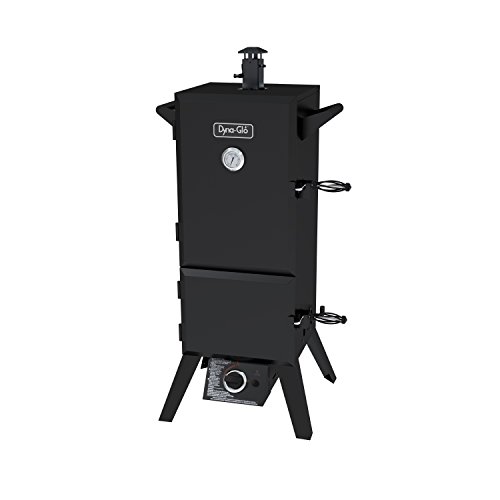
Dyna-Glo DGY784BDP 36-inch Vertical LP Gas Smoker — Best Mid-Size Wide
Dyna-Glo’s 36-inch vertical LP smoker occupies the sensible middle of this guide: meaningfully more cabinet than the 30-inch classics — the extra height and rack room show up exactly where cooks feel it, in rib racks that fit and shoulders that do not crowd — without the 40-inch ThermoTemp’s footprint and appetite. The black powder-coat finish is the working smoker’s choice: it shrugs off the cosmetic insults of a life spent full of smoke and grease, and the cabinet’s proportions make it the easiest of the larger picks to site on a normal patio.
Strengths
- 36-inch cabinet steps up space without the largest footprint
- Powder-coat finish wears its working life gracefully
- Straightforward LP design — light, set, smoke
Trade-offs
- Valve control, not thermostatic — plan on periodic checks
- Fewer refinements than the newest Masterbuilt and Pit Boss designs
- Mid-size means the biggest party cooks still need planning
| Detail | Verified from the listing |
|---|---|
| Size | 36-inch vertical (per Amazon title) |
| Fuel | LP gas |
| Finish | Black powder coat |
| Model | DGY784BDP |
The Dyna-Glo is the pick for the cook who has measured the 30-inch class and found it wanting, but who balks at a 40-inch cabinet’s presence. Its smoking behaviour is classic propane: quick to temperature, responsive to the valve, dependent on the water pan for stability on windy days — site it out of the wind and it settles in contentedly. Long production history means covers, racks and advice are easy to find, which is a real ownership virtue in a category full of one-season models. A dependable, honestly sized wide smoker.
Best for: Stepping up from 30-inch smokers / Not suited for: App and thermostat seekers
Check the current price on Amazon

PIQUEBAR Propane Smoker with Cover (3 Racks) — Best Value Wide
The PIQUEBAR’s pitch is completeness at a value tier: a heavy-duty vertical cabinet, three removable smoking racks with room for the rib-and-shoulder repertoire, and — the detail that signals a maker who understands ownership — a cover included, because a propane smoker lives outdoors and dies by weather faster than by use. Removable racks matter more than they sound: they come out for cleaning, they rearrange for a tall bird, and they let you load a cook at the kitchen counter and carry it to the cabinet rack by rack.
Strengths
- Cover included — outdoor life accounted for from day one
- 3 removable racks rearrange for tall cuts and easy cleaning
- Heavy-duty cabinet at a value tier
Trade-offs
- Newer brand: long-term parts and support are less proven than Masterbuilt or Dyna-Glo
- Valve control with the usual learning curve
- Fit and finish are working-grade rather than polished
| Detail | Verified from the listing |
|---|---|
| Racks | 3 removable smoking racks (per Amazon title) |
| Fuel | Propane gas |
| Extras | Cover included |
| Build | Heavy duty, black |
For a first wide propane smoker on a careful budget, the PIQUEBAR covers the fundamentals without the omissions that make cheap smokers expensive later — the racks, the cover, a cabinet with some steel in it. Expect to learn its valve’s personality over the first few cooks, as with every non-thermostatic propane smoker, and expect to be the quality-control department on assembly day. Do that, and it smokes ribs, shoulders and chicken with the same fire-and-wood honesty as the famous names — because at the end of the day, the smoke does not read the badge.
Best for: Budget-conscious first wide smoker / Not suited for: Buyers who prioritise brand heritage and parts networks
Check the current price on Amazon
Comparison Table
| Pick | Badge | Key spec | Best for |
|---|---|---|---|
| Masterbuilt 40-inch ThermoTemp Propane Smoker (MB20051316) | Best Overall Wide | 40-in, 960 sq in, thermostat control | Big cooks who want propane without the babysitting |
| Pit Boss 3-Series Propane Gas Vertical Smoker | Best Capacity per Footprint | 983 sq in, 4 racks, 100–300°F | Crowd cooking and multi-rack menus |
| Masterbuilt MPS 230S Propane Smoker, 30-inch | Best Classic | 30-in classic vertical propane | First propane smoker and everyday family cooks |
| Masterbuilt GS30D Propane 2-Door Smoker | Best Two-Door Design | 2-door, heat-preserving chip access | Long cooks with frequent chip reloads |
| Dyna-Glo DGY784BDP 36-inch Vertical LP Gas Smoker | Best Mid-Size Wide | 36-in vertical LP, powder coat | Stepping up from 30-inch smokers |
| PIQUEBAR Propane Smoker with Cover (3 Racks) | Best Value Wide | 3 racks, cover included, value tier | Budget-conscious first wide smoker |
How to Choose a Wide Propane Smoker
Measure your food before you measure cabinets. A competition rack of spare ribs runs long; a packer brisket longer. The rack width and depth in the verified specs are the numbers that decide whether those foods lie flat — and food that lies flat cooks evenly, barks uniformly and needs no mid-cook surgery. That is the entire promise of this guide’s category, so hold every candidate to it: if the seller will not state rack dimensions, the 40-inch and four-rack picks above state their capacity plainly enough to judge.
Next, decide how much temperature management you want to own. A thermostatic model like the ThermoTemp converts propane smoking into an oven-like set-and-hold experience. Valve-controlled models — most of this list — hold temperature well once you learn the individual burner’s feel, but they ask for periodic checks and they respond to weather: wind across the burner and a cold day both move the dial’s meaning. Neither is wrong; they suit different cooks. The two-door GS30D is the middle path for tinkerers: manual control, but chip service that does not punish the cook with heat loss.
Then think in tanks and time. Propane smokers sip fuel compared with their size — a standard tank serves many long cooks — but a wide cabinet burns more than a narrow one, and running dry at hour seven is a self-inflicted wound. Keep a spare tank or a gauge, and route the hose where feet and mower wheels do not go. Finally, weight the unglamorous build points: door seals you can replace, racks that are genuinely removable and washable, and a chip tray sized for the cook length you favour — small trays mean frequent reloads, which is precisely what the two-door design exists to forgive.
Propane Smoking Technique: Water, Chips and Wind
Three variables decide a propane cook, and all three are manageable once named. The water pan is your temperature ballast and humidity source: fill it for long cooks, keep it topped up, and expect the cabinet to run steadier with it full. The chip tray is your smoke metronome: a tray of dry chips gives a strong early smoke that fades, so long cooks want either a larger tray, a reload rhythm, or chunks mixed with chips for a longer burn — and the smoke you want is thin and blue, not the white billow that follows a fresh, cold tray.
Wind is the propane smoker’s weather. A breeze across the cabinet leaches heat and can worry a burner flame; siting the smoker in a sheltered corner — with proper clearance from structures — does more for temperature stability than any accessory. In cold weather, everything takes longer and burns more gas; in summer, watch that your lowest setting does not run hotter than your target, and crack the door briefly rather than fighting the valve. Master those three, and a propane smoker becomes one of the most honest cooking tools you own.
Capacity Planning: Feeding Four, Fourteen or Forty
Wide propane smokers earn their floor space at gatherings, so plan capacity the way caterers do: by the protein, not the person. A pork shoulder feeds a crowd generously and forgives holding; ribs are space-hungry for their yield — a rack serves two to three people and occupies a full rack’s width while doing it; brisket is one magnificent centrepiece per wide rack. The four-rack Pit Boss turns this arithmetic into abundance: shoulders low, ribs mid, beans and sides wherever the drips fall kindly. The 40-inch ThermoTemp does the same trick horizontally, with racks wide enough that a brisket and a rib programme share a level without touching.
Sequencing is the second half of capacity. Foods that rest well — shoulders and brisket, wrapped and held in a cooler for hours without harm — should cook first and free the cabinet for the fast, serve-immediately items: chicken, sausages, ribs timed to the table. A wide smoker run in waves feeds forty from a cabinet that never holds forty people’s food at once, and the propane advantage shows here: recovery after a door opening is fast, and the next load can go in while the first rests.
Leftovers are the third half, and the honest one: smoked food reheats beautifully and freezes honestly, so cooking to the cabinet’s comfortable capacity rather than the guest list’s exact appetite is a strategy, not a risk. The cooks who love their wide smokers plan the second meal while loading the first — tomorrow’s pulled pork sandwiches are already in today’s bottom rack.
Propane Safety and Tank Craft
Propane is a mature, safe fuel with a short list of non-negotiables, and a wide smoker deserves them stated once, clearly. Store tanks upright, outdoors, never in a closed garage or basement; keep the smoker itself outdoors with the clearances its manual specifies from walls, eaves and anything that burns; and make the soapy-water leak test a ritual whenever a connection is remade — after a tank swap, after moving the smoker, after winter storage. Bubbles are information; act on them before any flame exists.
Tank management is the craft half. A gauge or the bathroom-scale trick (weigh the tank, subtract its stamped tare weight) turns fuel from a mystery into a number, and the number you want before a long cook is generous. Keep the spare-tank habit if your cooks run overnight: swapping a tank at hour nine is a two-minute errand with a spare and a cancelled brisket without one. Hoses age in sunlight — inspect them each season for cracking, and route them where feet, pets and mower wheels do not travel.
Burner care closes the loop: spider webs and debris in burner tubes are the classic cause of a lazy, yellow, underperforming flame after storage, and a thin brush or pipe cleaner through the ports restores the blue, eager flame a smoker wants. Do these small things and propane repays you with the most appliance-like behaviour of any live-fire fuel: turn, light, cook, for years.
Getting Real Smoke Flavour From a Propane Cabinet
Propane burns clean and nearly flavourless, which means every note of smoke in the food comes from the wood you add — and that makes woodcraft the propane cook’s core skill. Chips smoke fast and hot: a tray gives a strong early burst that suits the first hours of a cook, when meat takes on smoke most readily. Chunks burn slower and longer. Most experienced propane smokers blend: chips for the opening, a chunk or two settled in the tray for the long middle, and an acceptance that the final wrapped hours need no smoke at all — the meat is sealed, and the fire’s job by then is pure heat.
Smoke quality is visible: aim for the thin, blue, almost-invisible stream that signals clean combustion. Thick white smoke is unburned compounds looking for food to land on, and it tastes like it. The usual causes are a fresh tray of cold chips dumped on all at once, chips soaked into a steaming swamp (dry chips smoke cleaner; the soaking tradition survives mostly as tradition), or a tray sitting in direct flame. Small loads, dry wood, and patience between reloads produce the blue ribbon every time.
Wood choice follows the food as it does on any smoker: hickory and oak for beef and the bold end of pork, apple and cherry for poultry, pork’s sweeter moods and anything delicate, mesquite in small, confident doses. Because a propane cabinet adds no flavour of its own, it is actually the purest classroom for learning these woods — what you taste is the wood and the meat, with nothing in between to blame.
Winter, Wind and Altitude: Propane in Hard Weather
Propane smokers work all year, but the seasons negotiate. Cold thickens everything: the cabinet takes longer to reach temperature, the burner works harder to hold it, and tank pressure falls as the tank itself chills — a tank that feels adequate in October can feel tired in January at the same fill. The counters are plain: start with a fuller tank in winter, shelter the smoker from wind with proper clearance, allow a longer preheat, and consider that the water pan, filled warm, is ballast you will be grateful for by hour three.
Wind remains the chief enemy at any temperature, worrying the flame and stripping the cabinet’s heat unevenly — one side of a wide rack can run meaningfully cooler in a gale, which is what the mid-cook rotation habit exists to forgive. Altitude thins the air and leans the burn; cooks at elevation learn their valve’s new personality over a cook or two and typically find slightly longer times and a slightly gentler hand on the dial. None of this is a reason to park the smoker until spring — brisket in February is one of the hobby’s great pleasures — it is a reason to keep the cheat card from the setup section updated by season.
From Smoker to System: Racks, Pans and Modest Upgrades
A wide propane smoker becomes a system through small, unglamorous additions. A second thermometer at rack level — the truth-teller this guide keeps prescribing. A rib rack for the days when even a wide cabinet meets a party bigger than itself, standing racks on edge to multiply capacity. A heavy drip pan or foil regime that keeps the cabinet’s floor a cleaning task of minutes. And a cover that fits, because propane smokers live outdoors and their burners, valves and igniters age in weather, not in use.
Resist the upgrade spiral beyond that list. The smoker’s virtues are simplicity and fire; every electronic addition should have to argue its way in against the day it fails at hour six of a brisket. The owners who love these machines longest tend to run them nearly stock for years, spending their money on tanks, wood and meat — the consumables that end up on the table — and their attention on the cheat card, the rotation and the rest. A wide cabinet, honestly run, is already the whole idea.
Holding and Resting: The Hour After the Cook
A wide smoker’s last gift is what happens after the fire is out. Briskets and shoulders improve through a long, wrapped rest — an hour at minimum, several in a dry cooler for the big cuts — during which the temperature coasts down through the zone where juices redistribute and fibres relax. The wide cabinet helps here too: it holds a resting, wrapped brisket at serving warmth for a useful while with the burner long off, buying the cook a buffer between ‘done’ and ‘dinner’ that smaller smokers cannot offer. Plan the rest into the schedule from the start — meat finished early and resting is a triumph; meat finished late is a negotiation — and let the smoker’s size work for your timing, not just your capacity.
Transporting and Storing a Wide Smoker
Wide smokers are patio furniture with a fire inside, and their size writes their storage rules. Most will live outdoors year-round under a fitted cover — which makes the cover’s quality and the patio’s shelter part of the purchase, and makes the PIQUEBAR’s included cover a more serious feature than it first appears. Site the smoker where the cover can come off without a wrestling match and where the tank swap is a straight walk, not an obstacle course; a smoker that is awkward to reach is a smoker whose leak tests and burner checks quietly stop happening.
If the smoker must move — a house move, a competition, a borrowed garden — empty it completely, remove the racks and trays and pack them separately, secure the tank for transport according to its own rules (upright, ventilated, never in a sealed hot vehicle), and treat the cabinet as the awkward, top-heavy furniture it is: two people, gloves, and a ramp rather than a lift. Reassemble with the full first-day discipline — leak test included — because transport is exactly the disturbance those tests exist for. A wide smoker moved carefully arrives as the same smoker; moved casually, it arrives as a project.
Reading Smoke and Meat Together
The last skill a wide propane smoker teaches is simultaneity: reading the thin blue smoke, the cabinet thermometer’s calm, the meat’s colour at the check, and the clock’s indifference, all at once, and changing only the one thing that needs changing. Beginners change three variables and learn nothing; the cheat card, the rotation habit and the scheduled checks exist to slow the cook down to one decision at a time. By the fifth cook on a wide cabinet, the decisions feel less like interventions and more like a conversation with a machine whose moods you have learned — which is, in the end, all that smoking expertise has ever been, on any fuel, at any width.
A Note on First Tanks and First Fires
Buy the first tank from a source you trust, light the first fire with the manual open, and let the first cook be chicken. Every wide propane smoker in this guide rewards that humility with a decade of obedience.
How to Set Up a Wide Propane Smoker and Run Your First Cook
Propane smokers reward a careful first day: leak checks, a seasoning burn, and one forgiving cook before anything expensive goes on the wide racks.
- Assemble on a level surface, then leak-test every gas connection with soapy water before the first lighting — bubbles mean stop, tighten, and test again.
- Season the empty cabinet: run it at smoking temperature with a tray of chips for an hour or two to burn off manufacturing residues and lay down the first smoke patina.
- Calibrate your expectations with a second thermometer at rack level during the seasoning run, and learn what your dial’s markings mean in real degrees at the rack where food sits.
- Load the first cook forgivingly: chicken halves or a pork shoulder, water pan full, chips loaded, and the smoker sited out of the wind with safe clearance.
- Practise the service rhythm: check chips and water on a schedule, through the lower door if your model has one, and note how much temperature moves when you do — that is your smoker’s personality, recorded.
- Track the tank: note the starting weight or gauge reading, and set your personal rule for when a cook starts only on a tank with a known margin.
- Finish with the clean while the cabinet is warm: racks out and washed, chip ash emptied cold the next day, burner ports checked clear, cover on once everything is cool and dry.
After three cooks, write your smoker’s cheat card: dial position for 225°F on a calm day, chip tray duration, water pan top-up interval. Every wide propane smoker has these numbers and no two are identical — the card turns your fourth cook into the first one that feels like mastery.
Common Buying Mistakes
Cutting the food to fit a narrow smoker — forever. If your menu is whole ribs and brisket, buy the width once. A rib rack and trimmed briskets are workarounds; a wide cabinet is the solution, and it costs less than years of compromise.
Skipping the leak test. Propane connections get disturbed in assembly and moving. Soapy water takes two minutes and is the entire safety case — do it every time a connection is remade.
Chasing temperature with the valve every ten minutes. Propane cabinets settle slowly. Make a small adjustment, wait fifteen minutes, then judge. Most ‘unstable smoker’ stories are an impatient hand on the dial.
Letting the water pan run dry mid-cook. A dry pan removes your temperature ballast and humidity at once. Top it up on schedule — ideally through a two-door design or with minimal door-open time.
Smoking in the wind and blaming the burner. Site the smoker sheltered with safe clearance. Wind is a fuel and stability thief that no valve setting fully compensates for.
Starting a long cook on an unknown tank. Hour seven is the wrong time to meet an empty tank. Gauge it, weigh it, or keep a spare — and make it a rule, not a hope.
Final Recommendation
For most wide-smoker buyers, the Masterbuilt ThermoTemp 40-inch is the answer: real width, 960 square inches, and a thermostat that removes propane’s one traditional chore. Crowd cooks should look at the Pit Boss 3-Series and its four racks; heat-management purists at the two-door GS30D; the classic starting point is the MPS 230S; the mid-size step-up is the Dyna-Glo 36-inch; and the value route in is the PIQUEBAR with its cover included.
Whichever cabinet lands on your patio, do the leak test, the seasoning burn and the forgiving first cook. Wide propane smoking is a simple pleasure — fire, wood and food that finally fits — and an hour of setup buys years of it.
Related reading: Best Wifi Smokers · Best Built Vertical Propane Smokers · Best 2 Door Gas Smokers · Best Wifi Pellet Grills · Best Wifi Meat Thermometer For Smokers · Best Air Purifier For Smokers
Frequently Asked Questions
What makes a propane smoker ‘wide’?
In practice, rack width and cabinet class. Standard vertical smokers force full racks of ribs to be cut and briskets to be trimmed hard; wide models — 40-inch cabinets, 36-inch verticals and high-capacity four-rack designs like the picks here — let that food lie flat and cook evenly. Always judge by the verified cooking area and rack layout, not the adjective.
How long does a propane tank last in a smoker?
A standard barbecue tank serves many long cooks — propane smokers sip fuel at smoking temperatures. Wide cabinets burn more than narrow ones, and cold, windy weather increases consumption. The safe habit is a gauge or a spare tank, and never starting an overnight cook on a tank of unknown level.
Do propane smokers hold 225°F well?
Thermostatic models like the Masterbuilt ThermoTemp hold it like an oven. Valve-controlled models hold it well once you learn the burner, provided the water pan is full and the smoker is out of the wind — expect to check periodically rather than never. A rack-level thermometer tells you the truth either way.
Can I use wood chunks instead of chips?
Yes, and many cooks prefer them: chunks burn longer and steadier than chips, which give a quicker, stronger burst. A mix — chips for early smoke, a chunk or two for duration — suits long cooks. Keep wood in the tray or box designed for it, and aim for thin blue smoke rather than white billows.
Propane, electric or pellet — which smoker should I choose?
Propane offers instant heat, no electricity requirement and honest fire at a modest running cost, with manual or thermostatic control depending on the model. Electric is the simplest and most set-and-forget at small sizes; pellet adds app control and automation at the highest purchase and fuel cost. For wide cabinets and off-grid capability, propane is the natural choice — which is why this category exists.
How do I stop my propane smoker’s temperature swinging?
Work the checklist: water pan full, smoker sheltered from wind, small valve adjustments with fifteen minutes to settle, door openings kept brief (or through the lower door on two-door models), and burner ports clean. If swings persist, verify with a rack-level thermometer — sometimes the cabinet gauge, not the temperature, is what is wandering.

