Disclosure: airfryerkitchensupply.com is reader-supported. When you buy through links on our site, we may earn an affiliate commission at no extra cost to you.
Where to buy
The vertical meat smokers below are sold through Amazon, with configurations that shift between the bare smoker and bundles with covers, chimneys and rib racks. Follow the links to each model’s current listing and check price on Amazon before deciding — and if a bundle includes a cover or a charcoal chimney, count it, because you will want both.
- Weber Smokey Mountain Cooker 18-inch — check price on Amazon
- Weber Smokey Mountain Cooker 22-inch — check price on Amazon
- Masterbuilt 40-inch Digital Electric Smoker — check price on Amazon
- Masterbuilt 710 WiFi Digital Electric Smoker — check price on Amazon
- Cuisinart 18-inch Vertical Charcoal Smoker COS-118 — check price on Amazon
- Realcook 20-inch Vertical Charcoal Smoker — check price on Amazon
The best vertical meat smokers are united by a shape and divided by everything else. The shape — a tall chamber with heat at the bottom, racks stacked above it and a lid or door at the top — is the oldest serious design in home barbecue, because it does the essential thing well: it surrounds meat with rising heat and smoke for hours while using a small footprint and a modest amount of fuel. Within that shape, the fuel decides the experience. Charcoal bullets like the Weber Smokey Mountain burn real wood-and-charcoal fire and produce the deepest traditional flavor, at the cost of fire craft. Electric cabinets like the Masterbuilts trade some of that depth for a steadiness that borders on appliance-like. Both are legitimate answers to the same question — how do I turn tough cuts into tender ones, reliably, in my own yard?
This guide is organized by the meat rather than the marketing. If brisket is your religion, the 22-inch Weber is your smoker. If Saturday ribs for the family with zero drama is the goal, the big Masterbuilt electric earns its recommendation. Every pick was verified against Amazon’s catalog, and the charcoal models’ long production histories mean the designs described here are the mature, sorted versions — a meaningful advantage in a category where small design flaws become decade-long annoyances.
In this guide
Quick Picks
- Best Overall — Weber Smokey Mountain 18-inch: the definitive vertical charcoal smoker — two cooking grates, a water pan, porcelain-enameled steel and a generation of refined design behind it. Check the current price on Amazon
- Best for Brisket and Big Cuts — Weber Smokey Mountain 22-inch: the same proven design scaled up, with the grate room whole packer briskets and large gatherings actually require. Check the current price on Amazon
- Best Set-and-Forget — Masterbuilt 40-inch Digital Electric: a four-rack electric cabinet with about 970 square inches and a side wood chip loader, for cooks who want the meat without the fire management. Check the current price on Amazon
- Best Smart Smoker — Masterbuilt 710 WiFi: a WiFi-connected digital electric cabinet with four racks, monitored and adjusted from your phone. Check the current price on Amazon
- Best Budget Charcoal — Cuisinart COS-118 18-inch: a vertical charcoal smoker with an integrated thermometer, water bowl and dual vents, at an entry price for learning real-fire smoking. Check the current price on Amazon
- Best Value Alternative — Realcook 20-inch Vertical: a 20-inch charcoal vertical with more room than the 18-inch class, for cooks who want size on a strict budget. Check the current price on Amazon
How These Picks Were Chosen
Meat smokers were judged by what happens to meat inside them. Temperature stability came first, because low-and-slow cooking is a hours-long negotiation with a target range, and smokers that hold their range with minimal intervention produce consistent results for ordinary humans. The charcoal models were judged on vent control, charcoal basket capacity and how long a load of fuel honestly burns; the electrics on control precision and smoke delivery. Capacity was judged per cut, not per square inch: a smoker’s worth is whether a whole brisket lies flat, whether ribs fit without surgery, whether a turkey stands clear of the lid. Construction — porcelain enamel, steel quality, door and lid fit — mattered because these smokers live outdoors for years and because air leaks are temperature chaos in physical form. Finally, we weighed the ecosystem: a smoker with a decade of owners behind it has covers, replacement grates, modifications and answers available in a way a new design cannot match. Every model was verified so names and configurations match Amazon’s listings. We also made a deliberate editorial choice worth stating: this guide contains no pellet smokers, not because pellets are unwelcome at the meat — the pellet cabinet guide in this series covers them fully — but because the charcoal-versus-electric contest is the historic heart of vertical meat smoking, and six slots spent there teach a reader more than six slots scattered across every fuel at once. If your mind is already made up for pellets, skip ahead to that guide with our blessing; if it is not, the contest below is the one worth your attention.
The 6 Best Vertical Meat Smokers
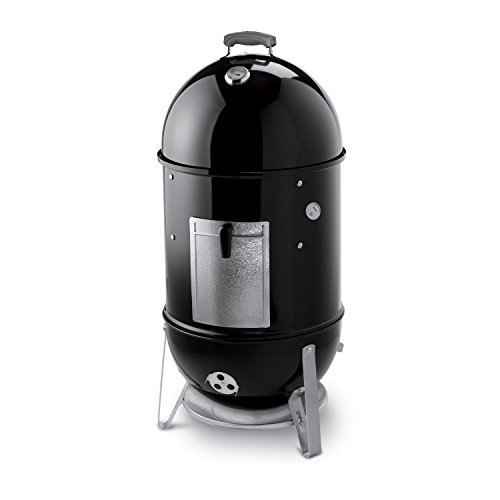
Weber Smokey Mountain Cooker 18-inch — Best Overall
The Smokey Mountain is the vertical smoker against which the category is measured, and its design explains why: a porcelain-enameled bullet with two cooking grates, a water pan that buffers the charcoal fire below, vents that give the cook real authority over temperature, and a build that shrugs off decades of weather. It suits the cook who wants to learn genuine charcoal smoking on the design that teaches it best. It does not suit anyone who wants to press a button — there is a fire to build, and the first cooks are an education.
Strengths
- Exceptional temperature stability for a charcoal cooker once the vents are set — long, calm burns are its signature
- Two full grates handle a family-scale cook: butts above, ribs below, or a flock of chicken parts
- Porcelain-enameled steel and Weber’s parts support give it a decades-long service horizon
Trade-offs
- Accessing the lower grate mid-cook means lifting the upper section — plan cooks so you rarely need to
- A whole packer brisket fits the 18-inch grate tightly; the 22-inch exists for a reason
- Charcoal craft is required: fuel, vents and weather are the cook’s job
What makes the 18-inch Smokey Mountain special is not any single feature but the absence of flaws. The water pan turns the fire’s spikes into steam-buffered steadiness. The vents respond predictably, so a small adjustment now is a small temperature change in twenty minutes — the rhythm every charcoal cook must learn, taught by a cooker that does not lie to you. Its size is the sweet spot for most households: big enough for two butts or a serious rib cook, small enough to heat efficiently and store kindly. Barbecue forums are full of owners who bought one, learned on it, and simply never needed another smoker. That is the strongest verdict any product in this guide can earn. Check the current price on Amazon
Best for: cooks who want the definitive charcoal bullet for family-scale smoking / Not suited for: button-press convenience seekers or frequent whole-brisket cooks

Weber Smokey Mountain Cooker 22-inch — Best for Brisket and Big Cuts
The 22-inch Smokey Mountain is the same honest design with the one change that matters for big meat: grate diameter. A whole packer brisket lies flat without curling up the walls, a turkey has headroom, and rib racks stop negotiating for space. It suits brisket devotees, gathering cooks and anyone whose cooks outgrew the 18-inch class. It does not suit small households — it burns more charcoal to heat a bigger chamber, and an under-filled 22 is an inefficient way to smoke two chicken thighs.
Strengths
- Full-size grates fit whole packer briskets flat — the cut that defines serious smoking
- The same vent control, water pan stability and enamel build as the 18-inch
- Capacity for genuine gatherings without moving to a different style of cooker
Trade-offs
- More charcoal per cook and a larger footprint to store
- The bigger chamber takes longer to settle for small cooks
- Lower-grate access is even more of a production at this size — plan the loading order
Brisket is the cut that exposes smoker compromises, because it is wide, long and cooked longer than any other common cut. On smaller grates, cooks resort to draping it over a rib rack or a wood chunk to make it fit, shrinking it into place as it cooks — a workable trick that nobody prefers. The 22-inch removes the trick from the process: the brisket lies flat, cooks evenly, and the only remaining challenges are the honorable ones of fire and patience. If your smoking ambitions are written in brisket, this is the vertical to buy first rather than second. Check the current price on Amazon
Best for: brisket cooks and gathering-scale charcoal smoking / Not suited for: small households cooking small loads

Masterbuilt 40-inch Digital Electric Smoker — Best Set-and-Forget
The 40-inch Masterbuilt electric is the vertical meat smoker for cooks whose priority is the plate, not the process. Digital controls hold temperature, the side wood chip loader feeds smoke without opening the door, and four racks with roughly 970 square inches stage a serious amount of meat. It suits busy hosts, beginners who want results before craft, and anyone running a second smoker for sides and overflow. It does not suit smoke maximalists — electric smoke is clean and mild by nature, and no technique fully closes that gap.
Strengths
- Digital temperature holding turns long cooks into monitoring exercises
- Side chip loader preserves heat and smoke — the door stays shut for hours
- Four racks and near a thousand square inches cover family and small-gathering cooks
Trade-offs
- Milder smoke profile than charcoal, most noticeable on brisket
- Requires outdoor power and reasonable shelter for the electronics
- Maximum temperatures suit smoking, not searing — it is a specialist
The case for this smoker is written in weekends. A pork butt loaded at breakfast is ready for dinner with perhaps three minutes of total attention, and ribs come out with a consistency that lets a beginner serve confidently in their first month. Competition-level bark and smoke depth belong to the charcoal world, but most home smoking is not competition — it is feeding people well, repeatedly, without surrendering the day. The big Masterbuilt is the best tool in this guide for that actual job, and owners who later add a charcoal cooker usually keep it in service for exactly the cooks it does best. Check the current price on Amazon
Best for: hosts and beginners wanting tender meat with appliance-level effort / Not suited for: deep-smoke purists or off-grid cooking

Masterbuilt 710 WiFi Digital Electric Smoker — Best Smart Smoker
The 710 WiFi takes Masterbuilt’s electric cabinet formula — four chrome racks, a wood chip loader, about 711 square inches — and adds the connection that changes the cook’s geography: WiFi monitoring and control from a phone. It suits tech-comfortable hosts who want to smoke while doing other things in other places. It does not suit cooks who distrust apps on principle, or anyone whose patio WiFi is weak — a connected smoker at the edge of coverage is a frustration with a power cord.
Strengths
- WiFi control and monitoring — check and adjust the cook from indoors or across town
- Digital electric steadiness with the side-loading smoke system
- Four racks in a mid-size footprint that fits ordinary patios better than the 40-inch class
Trade-offs
- App dependence adds a failure mode manual smokers never meet
- Electric smoke remains mild; connectivity does not change the flavor physics
- Mid-size capacity will feel small on the biggest gathering days
Connectivity earns its keep in one specific way: it converts dead monitoring time into lived time. The parent who can check a butt’s progress from the sideline of a Saturday game, the host who adjusts temperature from the kitchen while preparing sides — these are real hours returned, and for many cooks they are the difference between smoking monthly and smoking weekly. The 710’s underlying cabinet is the proven Masterbuilt formula, so the smart layer is an addition to competence rather than a substitute for it. Buy it if your phone is already how you run your house; the manual models in this guide will serve everyone else with fewer passwords. Check the current price on Amazon
Best for: connected-home cooks who want to monitor long cooks from anywhere / Not suited for: app skeptics or weak-patio-WiFi homes

Cuisinart 18-inch Vertical Charcoal Smoker COS-118 — Best Budget Charcoal
The COS-118 is Cuisinart’s entry into the bullet format: an 18-inch vertical charcoal smoker with an integrated thermometer, a water bowl and dual vents for airflow control, at a price that lowers the cost of learning real-fire smoking. It suits beginners deciding whether charcoal smoking is their craft, and cooks adding a second, smaller cooker. It does not suit anyone expecting Weber-grade enamel, fit and parts support — the price difference is real, and it lives in those details.
Strengths
- The classic bullet layout — two levels, water bowl, dual vents — at an entry tier
- Integrated thermometer and straightforward assembly lower the beginner’s barrier
- 18-inch grates cover the standard learning menu: butts, ribs, chicken, a small brisket flat
Trade-offs
- Lighter construction and seals than the Smokey Mountain; expect to manage air leaks as it ages
- Temperature control is less refined — the cook works a little harder for the same steadiness
- Smaller long-term parts and accessory ecosystem
Budget charcoal smokers should be judged as teachers, and the COS-118 teaches the right lessons: fire building, vent discipline, water pan management and the patience that is smoking’s real curriculum. Its food, in the hands of a cook a few sessions in, is honestly smoked meat — the design is the classic one, and charcoal does not check the badge before flavoring dinner. What the Weber premium buys is ease and longevity, not a different category of result. If you are testing the waters of charcoal, this is a rational first boat. Check the current price on Amazon
Best for: beginners learning charcoal smoking without a premium commitment / Not suited for: buyers wanting buy-once-for-decades construction

Realcook 20-inch Vertical Charcoal Smoker — Best Value Alternative
The Realcook 20-inch splits the difference between the 18-inch budget class and the 22-inch Weber: a larger vertical charcoal smoker at a budget-tier price, for cooks whose constraint is money but whose cooks are not small. It suits families and gathering cooks testing charcoal at scale. It does not suit perfectionists — at this tier, expect to seal a door, add a gasket or accept small imperfections as the tuition of the price.
Strengths
- 20-inch grates give big-cut room that the 18-inch class cannot
- Vertical charcoal format with the water-pan stability of the classic design
- The size-per-dollar equation is the strongest in this guide
Trade-offs
- Fit and finish trail the Weber; small modifications are part of ownership at this tier
- Thermometer and hardware are basic — a probe thermometer is essential
- Brand support and parts depth are thinner than the category leaders
There is a proud tradition in barbecue of inexpensive cookers made excellent by their owners, and the Realcook is built for that tradition. Out of the box it smokes meat properly; with a gasket here and a better thermometer there, it smokes meat impressively, and the cook learns more about airflow from sealing one leaky door than from a year of a perfect cooker. If your budget is firm and your cooks are large, it is the honest path to both. Check the current price on Amazon
Best for: budget cooks who need big-grate room and enjoy tinkering / Not suited for: buyers wanting flawless fit and finish out of the box
Comparison Table
| Pick | Badge | Key spec | Best for |
|---|---|---|---|
| Weber Smokey Mountain 18-inch | Best Overall | Charcoal bullet, 2 grates, water pan, enamel steel | Family-scale charcoal smoking |
| Weber Smokey Mountain 22-inch | Best for Brisket | Charcoal bullet, full-size grates for packer briskets | Big cuts and gatherings |
| Masterbuilt 40-inch Electric | Best Set-and-Forget | Electric, digital, side chip loader, ~970 sq in, 4 racks | Effortless long cooks |
| Masterbuilt 710 WiFi | Best Smart | Electric, WiFi control, 4 racks, ~711 sq in | Remote-monitored cooking |
| Cuisinart COS-118 | Best Budget Charcoal | Charcoal bullet, 18-inch, water bowl, dual vents | Learning real-fire smoking |
| Realcook 20-inch | Best Value Alternative | Charcoal vertical, 20-inch grates | Big cooks on a budget |
How to Choose the Best Vertical Meat Smoker
Start with the fuel, because it decides your Saturdays. Charcoal smoking is a craft with a learning curve measured in cooks: you will manage vents, read weather and develop opinions about lump versus briquettes. Its reward is the deepest traditional flavor and a cooker with no electronics to fail. Electric smoking is a routine: load, set, monitor occasionally, eat well. Its reward is consistency and time. Honest self-knowledge settles this faster than any review — the smoker that matches the cook you are gets used; the one that matches the cook you admire gets sold.
Size by your defining cut. If brisket is central to your ambitions, grate diameter is the specification that matters and the 22-inch class is your floor. If ribs and butts are the menu, the 18-inch class and the mid-size electrics cover them with room to spare. Poultry is the vertical shape’s gift — chickens and turkeys cook beautifully in tall chambers — but check lid clearance for the birds you actually buy at the holidays. Write your three most-cooked items on paper and measure the smokers against them, not against a showroom fantasy.
Then weigh build against budget with clear eyes. The Weber premium purchases enamel, fit, vent precision and a parts pipeline — qualities that compound over a decade of cooks. The budget charcoal models purchase the same fundamental design with lighter execution, and their owners close the gap with gaskets and patience. Electric cabinets shift the question to electronics: digital controls and WiFi are conveniences whose value depends entirely on how much you will use the monitoring you are paying for.
Finally, consider the second-order costs: charcoal smokers want a chimney starter, fuel storage and ash disposal; electrics want an outdoor outlet and shelter; both want covers, probe thermometers and grate replacements someday. The smoker is the platform. Budget the platform’s life, not just its arrival.
Meat by Meat: What Each Cut Wants from a Vertical Smoker
Brisket wants three things: room to lie flat, temperature that does not wander for half a day, and smoke that keeps coming gently. That is why the 22-inch Weber leads brisket conversations and why the big electric’s steadiness flatters beginners’ first briskets even if the smoke is milder. Pork butt wants forgiveness — it is the most tolerant cut in barbecue — and repays any smoker in this guide with success, which is why it should be every new owner’s first cook. Ribs want rack logistics: they are flat, numerous and often cooked alongside other food, so grate count and rib-rack accessories matter more than raw chamber size. Poultry wants headroom and a decision about the water pan — moisture for tenderness, or a dry pan when crisp skin is the goal — and it cooks fast enough that the electrics’ convenience barely matters while the charcoal cookers’ flavor shines. Sausage and jerky, the process meats, want low temperatures held precisely, which is electric’s home ground and charcoal’s hardest trick. Read your own menu against that map and the right smoker usually names itself.
Running a Charcoal Bullet: Fire Craft in a Vertical Smoker
The charcoal bullet’s core technique is a controlled, slow burn rather than a fire that must be fed. The classic approach fills the charcoal ring generously, lights a small number of coals in a chimney, and nests them into the center of the unlit fuel — the burn then spreads gradually outward over hours, which is how a single load lasts through a long cook. Vents do the governing: bottom vents set the burn rate, and small adjustments made early prevent the temperature chases that ruin beginners’ afternoons. The water pan is the fire’s partner, absorbing spikes and adding the humidity that keeps bark from hardening into armor.
Weather is the variable the craft exists to manage. Wind feeds a bullet oxygen and can push temperatures up; cold steals heat from the walls; rain on a hot lid is a theft you can hear. Experienced owners respond with placement — a sheltered corner — and with vent discipline rather than panic. The reward for learning this is difficult to overstate: a cook who can hold a charcoal bullet steady owns a skill that transfers to every live-fire cooker ever made, and produces the flavor that made this smoker shape famous. The electrics in this guide are excellent machines. The charcoal bullets are an education that also makes dinner.
How to Smoke Your First Pork Butt in a Vertical Smoker
Choose the butt for your first cook because it forgives everything you are about to do imperfectly. Trim only the hardest fat, season generously with your rub the night before or the morning of, and let the meat sit out briefly while the smoker comes to temperature — cold meat takes smoke better, so do not overdo the counter time. Stabilize the smoker first: charcoal lit and vents set, or the electric at temperature with chips loaded and the water pan filled. Meat goes on fat-side in the orientation your smoker’s heat dictates — toward the heat source as a shield is the common logic — and then the most important technique in smoking applies: leave it alone.
Monitor with probes, not with door openings. The butt will stall for hours in the middle of the cook as moisture evaporates from its surface; this is physics, not failure, and the vertical smoker’s steadiness is built for it. Wrap or do not wrap according to your bark preference when the stall has run its course and the color is right. The cook is done when the probe slides into the meat with almost no resistance — tenderness, not a number, is the verdict — and after a rest, the butt should pull apart with forks and minimal persuasion. Clean the smoker while it is warm, note what you would change, and know that you have just learned eighty percent of smoking. The remaining twenty percent is brisket, and it is mostly patience wearing a different cut.
Bark, the Smoke Ring and Other Ideas Worth Understanding Properly
Vertical smoker owners chase two visual trophies, and both are widely misunderstood. Bark — the dark, crusty exterior on a brisket or butt — is not burnt anything; it is the product of rub, smoke, rendered fat and time interacting at the meat’s surface. It forms best when the surface stays moist early (the water pan’s humidity helps), when smoke is thin and continuous rather than thick and intermittent, and when the cook resists wrapping too early. Vertical cabinets and bullets are naturally good bark environments because their enclosed chambers hold humidity and smoke around the meat evenly, which is one reason their owners become loyal. The electric caveat applies here too: bark forms fine in an electric cabinet, but its flavor leans cleaner, and cooks chasing the deepest bark eventually find themselves reading about charcoal.
The smoke ring — the pink band just under the surface — is chemistry, not a quality grade. It forms when combustion gases interact with the meat’s myoglobin before heat sets the color, and it stops forming once the surface gets hot, which is why cold meat straight from the refrigerator rings more readily. Electric smokers famously produce little or no ring because their “combustion” is a smoldering tray rather than a fire, while charcoal bullets produce it naturally. The ring has essentially no flavor. Judging a smoker — or a cook — by it is the barbecue equivalent of judging a book by its cover font, and knowing that will save you from chasing a cosmetic effect at the expense of tenderness, which is the trophy that actually matters.
Hanging Meat: The Vertical Smoker’s Other Mode
Racks are the default, but the vertical chamber invites a second technique: hanging. Ribs hung from hooks at the top of the chamber cook in the rising heat with no grate marks, no flipping and a remarkably even exposure, because every side of the meat faces moving air rather than a hot surface. Chickens hang beautifully too, and sausages were practically designed for it. Bullets and cabinets with sufficient height can adopt the technique with a hanging rack or hook system, and cooks who try it on ribs often become converts — the texture differs subtly from rack-cooked ribs, with a more uniform render and a presentation that starts conversations.
Hanging has rules. Clearance is the first: meat must hang clear of the fire and the water pan, with room for heat to circulate, which makes the technique a better fit for taller chambers and moderate loads. The second is security — a hook failure drops dinner into the coals, so purpose-made hooks and a check of the meat’s attachment point (a sturdy bone or a proper loop of butcher’s twine) are not optional details. The third is drippings: hung meat drips directly toward the heat, which in a bullet means the water pan earns its keep, and in a drum-style cooker becomes part of the flavor. Treat hanging as a second instrument your vertical smoker can play, learn it on a rack of ribs, and you will understand your chamber’s airflow better than a season of ordinary cooks would teach you.
Common Buying Mistakes
Buying the 18-inch for a brisket habit. The workarounds — draping, trimming to fit — are real, but a cook who smokes brisket monthly will feel the grate size every time. Match diameter to your defining cut.
Judging electric smokers by charcoal standards. Electrics make milder smoke, and that is a style, not a defect. Buy one for steadiness and convenience with open eyes, and it will delight you; buy one expecting offset depth and it never will.
Skipping the chimney starter. Charcoal lit with lighter fluid flavors meat with regret. A chimney and a couple of fire starters are the cheapest quality upgrade in charcoal smoking. The chimney also standardizes your fire: the same number of lit coals, lit the same way, produces a repeatable start, and repeatability is the substrate every other smoking skill grows in, cook after cook, year after year, without fail, in all weathers and for all cuts of meat, large and small alike, in every backyard everywhere.
Opening the smoker to look. Every peek costs heat and time, and meat does not improve under observation. Probes exist precisely so the lid can stay shut. If you are looking, you are not cooking — the old line survives because it is true. Build the habit structurally instead of relying on willpower: put the probe display where you spend your time, set alarms for the temperatures that actually require action, and give yourself one scheduled opening — for spritzing, wrapping or loading the second item — so curiosity has an appointment instead of a habit.
Ignoring air leaks on budget cookers. A leaky door or lid seam is a vent you cannot close, and it will fight your temperature control for years. A gasket kit is a small, transformative fix — budget models should be bought with one in the cart. The test is simple: on a calm day with vents set, a smoker that creeps upward in temperature is breathing somewhere it should not be, and the smoke trails escaping at the seams will show you exactly where.
Forgetting the rest. Brisket and butt improve dramatically with a proper rest, and cooks who slice immediately blame the smoker for dryness the rest would have fixed. The smoker’s job ends at tenderness; the rest is yours. Rest in a cooler or a low oven, wrapped, and let the juices redistribute — the difference between a good brisket and a great one is frequently nothing more than the hour nobody wanted to wait.
A Word on Thermometers: The Instrument Every Vertical Smoker Deserves
Every smoker in this guide ships with some form of temperature readout, and every serious owner eventually replaces its authority with a probe thermometer. The reasons are physical. A lid or door thermometer measures the air where it is mounted — often the hottest or most draft-exposed point in the chamber — and it ages, sticks and drifts. Your meat, meanwhile, cooks at grate level, in a chamber whose temperature varies by design from bottom to top. A dual-probe thermometer — one probe clipped at the grate beside the meat, one in the meat itself — replaces folklore with knowledge, and it is the single purchase that most improves a beginner’s results on any smoker at any price. Wireless and WiFi models extend the same knowledge to your pocket, which is the honest core of what smart smokers sell. Buy the probes before the second cook, mount them consistently, and your smoker’s personality — its hot spots, its habits in wind, its true temperature against the dial — becomes data instead of suspicion. Cooks talk about “knowing their cooker”; this is literally how the knowledge is acquired.
Final Recommendation
For most people, the Weber Smokey Mountain 18-inch is the vertical meat smoker to own: proven, stable, sized for real family cooking and built for decades. Brisket-first cooks should go straight to the 22-inch. If your priority is results without fire craft, the Masterbuilt 40-inch electric is the set-and-forget answer, and the 710 WiFi adds remote control for connected households. Beginners on a budget will learn happily on the Cuisinart COS-118 or the larger Realcook. Complete your research with the rest of the vertical series — Best Vertical Cabinet Smokers for the all-fuel cabinet view, Best Vertical Gas Smokers for propane’s case, Best Vertical Pellets Smokers for the pellet specialists, and Best Vertical Offset Smokers for the traditional firebox design. Charcoal fans comparing shapes should also see Best Traditional Smokers.
Seasoning and Caring for a Vertical Smoker Across the Years
A vertical smoker’s first cook should be an empty one. The seasoning run — interior lightly oiled, a few hours of heat and smoke with no food — burns away manufacturing residue and begins the polymerized coating that protects steel and flavors everything after it. From then on, care is a rhythm rather than a project. Grates get brushed while warm. Ash leaves a charcoal smoker before it can drink moisture and turn corrosive — ash plus water is lye, and it eats fire bowls quietly between cooks. The water pan gets emptied rather than left to become a science project, and grease is treated as the fire hazard it is rather than as seasoning’s cousin.
Storage decides longevity more than use does. A cover that fits, a spot out of the worst weather, and vents left slightly open so the interior dries rather than mildews — these unglamorous choices are why some ten-year-old bullets look seasoned and others look abandoned. Electric cabinets add one item: keep the electronics dry and the chip tray clean, because a smoker that lives outdoors is always negotiating with moisture. Do these things and the smoker you buy from this guide is plausibly the smoker you cook on in a decade, which reframes the price differences entirely — the Weber premium, divided by fifteen years of Saturdays, is one of the cheapest luxuries in outdoor cooking, and even the budget models reward care with years they were not priced to give.
Frequently Asked Questions
What size vertical smoker do I need for a whole brisket?
A whole packer brisket wants a grate around 22 inches to lie flat without touching the walls. The 18-inch class can manage with draping tricks or by separating point and flat, but cooks who smoke brisket regularly should buy the 22-inch class and skip the workarounds. Note that briskets shrink substantially as they cook — a brisket that barely fits at hour one fits comfortably by hour six — so a slight initial squeeze on an 18-inch grate is a workable compromise for the occasional cook, provided the meat is not folded against itself, which creates undercooked contact patches.
How long does a load of charcoal last in a bullet smoker?
With a full ring and the gradual-burn method, a well-managed bullet like the Smokey Mountain commonly runs through a long cook — butt or brisket territory — on one load in mild weather. Cold, wind and high target temperatures shorten that; sheltered placement and full fuel loads are the cook’s insurance.
Is an electric smoker really smoking, or just roasting?
It is really smoking: wood chips smolder in the cabinet and the meat cooks low and slow in that smoke for hours. The flavor is milder and cleaner than charcoal’s because the heat source contributes nothing of its own. Whether that trade suits you is a palate question, not a legitimacy one. A useful experiment, if you have access to both styles, is to cook the same cut on each and serve them blind to your own table: households regularly surprise themselves about which plate empties first, and the answer — not the internet’s hierarchy — should direct your money.
Do I need the water pan, and what goes in it?
For most cooks, yes — plain water. It buffers temperature swings, adds humidity and catches drippings. Some cooks use sand for pure thermal mass or run the pan dry for poultry skin. Avoid sugary liquids and elaborate mixtures; they add mess and risk, not flavor.
Can a vertical smoker cook for a large party?
The larger models can: the 22-inch Weber and the 40-inch Masterbuilt stage multiple butts or many racks of ribs across their levels. The planning trick is to cook in waves and use resting — a butt held warm and rested frees the smoker for the next load while improving the meat. Party cooking is a scheduling exercise as much as a smoking one: work backward from serving time, give every long cook a buffer hour, and remember that rested meat waits patiently while late meat does not. The vertical shape is secretly excellent at this because its racks let finished and finishing items share the chamber at different levels.
How do I stop a charcoal smoker from running too hot?
Close the bottom vents partway — small moves, made early — and confirm the water pan is filled. Overshooting usually comes from lighting too much fuel at the start or chasing temperature with large vent swings. If a cooker chronically runs hot, check for air leaks at the door and lid, which act as vents you cannot close.
Lump charcoal or briquettes — which suits a vertical smoker?
Briquettes are the usual recommendation for long vertical cooks because they burn evenly, predictably and for a long time — the three virtues a bullet smoker is built around. Lump burns hotter and cleaner-flavored for some palates but less uniformly, with more variation between bags. Beginners should start with briquettes and earn their opinions; the smoker will happily burn either once its cook is in charge.
How often should I add wood for smoke?
In a charcoal bullet, wood chunks buried in the charcoal ring release smoke gradually as the burn reaches them — place a few chunks through the ring at setup rather than adding them during the cook. In an electric cabinet, the chip tray wants refreshing every few hours on long cooks, ideally through a side loader so the door stays shut. In both cases, thin continuous smoke beats occasional clouds.


