Disclosure: airfryerkitchensupply.com is reader-supported. When you buy through links on our site, we may earn an affiliate commission at no extra cost to you.
Where to buy
Propane cabinet smokers ship as large freight items, and listings vary between the bare smoker and bundles with covers. The links below reach each model’s current Amazon listing; check price on Amazon and confirm what is included — particularly whether a cover or hose-and-regulator set is in the box — before comparing one listing with another.
- Masterbuilt 40-inch ThermoTemp Propane Smoker — check price on Amazon
- Masterbuilt MPS 230S Propane Smoker 30-inch — check price on Amazon
- Dyna-Glo 36-inch Vertical LP Gas Smoker — check price on Amazon
- Pit Boss 3-Series Gas Vertical Smoker — check price on Amazon
- Pit Boss 3-Series Propane Gas Vertical Smoker with HVR Controller — check price on Amazon
- Maison Backyards 4-Rack Vertical Propane Smoker — check price on Amazon
The best vertical gas smokers occupy a particular sweet spot in barbecue: they offer the cabinet shape’s capacity and door access, the push-button convenience of propane, and freedom from the electrical outlet that tethers electric and pellet cabinets to the house. A propane burner also produces serious heat on demand, which means a gas cabinet recovers temperature quickly after the door opens and reaches cooking temperature faster than an electric element can. For cooks whose patio has no convenient outdoor power — or who want to smoke at a cabin, a tailgate or a competition site — gas is not a compromise fuel. It is the enabling one.
The honest trade is control. A simple propane burner with a manual valve asks the cook to be the thermostat, adjusting for wind and weather as the cook proceeds. The better designs in this guide close that gap: Masterbuilt’s ThermoTemp line treats the burner with a genuine thermostat, and Pit Boss’s HVR controller aims at the same steadiness. The six picks below were all verified against Amazon’s catalog. Two famous names are conspicuously absent — we searched Amazon’s catalog data for the Cuisinart COS-244 and Char-Broil’s vertical propane models during research and found no matching unit listings, so rather than invent entries for them, this guide covers the gas cabinets that are verifiably on sale.
In this guide
Quick Picks
- Best Overall — Masterbuilt 40-inch ThermoTemp: a thermostat-controlled propane cabinet — set the temperature and the burner manages itself — with four racks and roughly 960 square inches of cooking space. Check the current price on Amazon
- Best Value — Masterbuilt MPS 230S 30-inch: the straightforward propane cabinet: a burner, a chip tray, a water pan and honest capacity at the category’s friendliest tier. Check the current price on Amazon
- Best for Capacity — Dyna-Glo 36-inch Vertical LP Gas: a tall, roomy propane cabinet built for cooks who fill racks — holiday birds, rib batches and big weekends. Check the current price on Amazon
- Best Compact Gas Cabinet — Pit Boss 3-Series Gas Vertical: a four-rack propane cabinet in a smaller footprint, finished in Pit Boss’s red hammertone, for patios where the 40-inch class will not fit. Check the current price on Amazon
- Best Temperature Control — Pit Boss 3-Series Propane with HVR Controller: a propane cabinet with a controller designed to hold temperature more precisely than a manual valve, across four racks and about 983 square inches. Check the current price on Amazon
- Best Budget — Maison Backyards 4-Rack Vertical Propane: a four-rack propane cabinet with adjustable heat control and a cover in the box, aimed at first-time gas smokers. Check the current price on Amazon
How These Picks Were Chosen
Gas cabinets were judged first on the quality of their temperature control, because that is where the category separates. A thermostat-controlled burner — one that cycles or modulates to hold a set temperature — transforms propane from a hands-on fuel into a set-and-monitor one, and we weighted that heavily. Manual-valve models were judged on burner quality, valve sensitivity and how owners’ typical experience reads: a fine, responsive valve makes manual control pleasant; a coarse one makes it a wrestling match. Second came capacity in usable terms — racks, spacing and whether the cabinet’s shape suits the tall items gas cabinets are often bought for. Third, construction: door seal, steel gauge and burner protection from drippings, because a gas cabinet lives outdoors with an open flame at its base and grease management is a safety feature, not housekeeping. Finally, the practical gas questions — hose and regulator inclusion, tank access, ignition reliability — because a smoker that is annoying to light gets smoked in less often. Every model was verified, and models we could not verify in Amazon’s catalog were excluded rather than described from memory. That verification discipline cost this guide a couple of famous names, and we consider that a fair trade: a buying guide’s first obligation is that everything in it can actually be bought, in the configuration described, on the day you read it.
The 6 Best Vertical Gas Smokers

Masterbuilt 40-inch ThermoTemp Propane Smoker — Best Overall
The ThermoTemp is the gas cabinet for people who love propane’s freedom but not its babysitting. Its thermostat holds a set temperature by managing the burner the way an oven manages itself, which removes the defining chore of gas smoking. The 40-inch cabinet gives four racks and roughly 960 square inches — genuine event capacity. It suits hosts, batch cooks and anyone whose smoking spot lacks power. It does not suit minimalists on a budget; the thermostat and the size both cost money, and small households will heat a lot of empty cabinet.
Strengths
- Thermostat temperature control — set it and the burner maintains it, a rarity among propane smokers
- Four racks and about 960 square inches handle big cooks without a second smoker
- Propane heat recovers fast after door openings and needs no electrical outlet
Trade-offs
- Premium tier within the gas category
- A thermostat is one more component than a manual valve — long-term service is a consideration
- Large footprint and appetite for propane on the longest cooks
What the ThermoTemp really sells is attention. A long brisket cook on a manual gas smoker is a day of small corrections — a nudge after a gust of wind, a check after the afternoon warms up. The thermostat absorbs those corrections into the machine, and the cook’s day changes from managing to monitoring: a probe thermometer, an occasional glance, a chip tray refresh. Combined with the 40-inch cabinet’s honest capacity, that makes this the gas smoker we would hand to someone feeding a crowd at a place with no power and no patience for fire tending. It is the category’s convenience ceiling, priced like it. Check the current price on Amazon
Best for: crowd cooks and off-grid smoking with oven-style temperature control / Not suited for: small households or strict budgets

Masterbuilt MPS 230S Propane Smoker 30-inch — Best Value
The MPS 230S is the classic propane cabinet formula executed by the brand that popularized it: a 30-inch vertical box, a burner with a manual control, a wood chip tray and a water pan. It suits beginners who want gas convenience without the ThermoTemp’s price, and experienced cooks adding a portable-capable second smoker. It does not suit cooks who hate adjusting a valve — on this smoker, you are the thermostat, especially when the weather moves.
Strengths
- The proven Masterbuilt propane layout at the category’s accessible tier
- 30-inch size balances real capacity against patio footprint and propane use
- Simple mechanical design — little to configure and little to fail
Trade-offs
- Manual temperature control drifts with wind and ambient temperature
- Chip tray refills mean door openings and brief heat loss
- Built-in temperature readouts on this class are approximate; a probe thermometer is essential
The MPS 230S teaches gas smoking the honest way. You learn what a burner valve does to a cabinet across a windy afternoon, how a water pan steadies the swings, and how smoke from a chip tray rises and fades — skills that transfer to every smoker you will ever own. Its results, once the cook and the cabinet understand each other, are the full propane experience: real smoke, real bark, no cord. For the buyer who wants the category’s essence at its fairest price, and who accepts that the thermostat is the person standing next to it, this remains the value benchmark. Check the current price on Amazon
Best for: beginners and value buyers willing to manage a burner manually / Not suited for: cooks wanting set-and-forget temperature holding
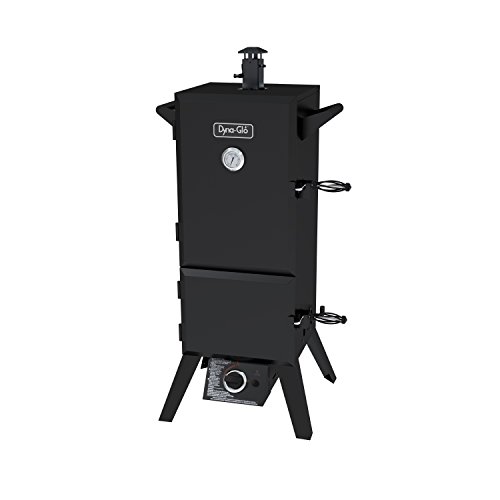
Dyna-Glo 36-inch Vertical LP Gas Smoker — Best for Capacity
Dyna-Glo’s 36-inch vertical LP model is the big-box answer in this guide: a tall propane cabinet built around volume, for the cook whose problem is fitting the food rather than finessing the fire. It suits holiday cooks, rib specialists and anyone smoking for gatherings where a 30-inch cabinet means cooking in shifts. It does not suit solo households, and its manual control asks the same attentiveness as any non-thermostat gas smoker — across a bigger box.
Strengths
- Generous vertical capacity for tall items and multi-rack batch cooks
- Propane burner delivers strong heat for fast preheats and quick recovery
- A long-running model line with the parts-and-covers ecosystem that longevity creates
Trade-offs
- Manual burner control — the cook manages temperature through weather changes
- Large cabinets amplify stratification; rack rotation matters more here
- Size and propane consumption are wasted on small weekly cooks
Capacity is a feature that only reveals its value on the biggest days, and the Dyna-Glo is bought for those days: the weekend when three racks of ribs, a butt and a tray of beans all need smoke at once, or the holiday when the bird needs a tall, calm chamber. Vertical gas cabinets earn their keep exactly there, because the burner has the power to hold a big box at temperature in a way a small electric element cannot. Pair it with a probe thermometer and a willingness to rotate racks once on long cooks, and it is the gathering-sized gas cabinet at a sane tier. Check the current price on Amazon
Best for: big-batch and holiday cooks needing vertical propane capacity / Not suited for: small households or unattended-cook seekers
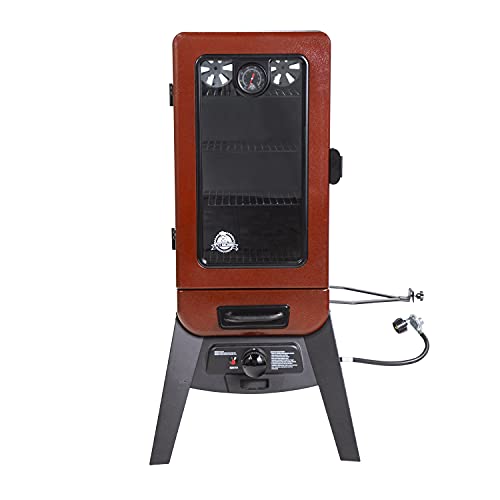
Pit Boss 3-Series Gas Vertical Smoker — Best Compact Gas Cabinet
The 3-Series Gas brings Pit Boss’s cabinet design down to a footprint that fits ordinary patios: four racks in a vertical propane box with the brand’s red hammertone finish. It suits smaller households that want gas freedom without a 40-inch appliance, and cooks who value a cabinet that looks like equipment rather than a utility box. It does not suit event-scale cooks, for whom the same brand’s larger and pellet lines exist.
Strengths
- Four racks in a compact vertical footprint — real cabinet capacity, modest patio claim
- Propane operation frees it from outlet placement entirely
- Distinctive finish and Pit Boss’s dealer-and-parts presence behind it
Trade-offs
- Manual-class temperature control; plan on a probe thermometer and occasional adjustment
- Capacity ceiling arrives quickly on gathering days
- Like all propane cabinets, wind placement affects temperature stability
Compact gas cabinets are an underrated answer to a common situation: the cook who wants to smoke monthly, well, without dedicating a patio corner to a refrigerator-sized appliance. The 3-Series Gas covers the realistic menu — a butt, a few racks of ribs, a chicken or two, a tray of sausage — with the propane virtues intact: fast heat, no cord, genuine smoke from the chip tray. It will not host the neighborhood, and it does not pretend to. For the household whose smoking life is sized like its actual dinners, that honesty is the feature. Check the current price on Amazon
Best for: smaller households wanting propane freedom in a modest footprint / Not suited for: event-scale batch cooking

Pit Boss 3-Series Propane Gas Vertical Smoker with HVR Controller — Best Temperature Control
This 3-Series variant attacks the manual gas smoker’s central weakness with its HVR controller, designed to hold the set temperature more precisely than a cook chasing a valve. Four racks and roughly 983 square inches give it capacity beyond the compact class. It suits cooks who want gas flavor and freedom with steadier hands-off behavior. It does not suit purists of mechanical simplicity — a controller is a component, and components eventually feature in service conversations.
Strengths
- HVR controller aims at thermostat-class steadiness from a propane burner
- Four racks and about 983 square inches — the roomiest of the 3-Series gas cabinets
- Wood chip tray smoke with propane’s fast recovery after door openings
Trade-offs
- Controller adds cost over the manual 3-Series models
- Still a propane cabinet in the wind — placement and shelter remain the cook’s job
- Newer control systems have shorter track records than the manual classics
The interesting question this model answers is how much of the ThermoTemp’s convenience can be had in a smaller, lighter cabinet. The HVR approach narrows the temperature swings that make manual gas smoking a supervised activity, which matters most on the long cooks — brisket and butt — where a cook’s attention is the scarcest ingredient. If your cooks are long, your site is breezy and your patience for valve-tending is short, this is the gas cabinet in the guide designed around your exact complaint. Check the current price on Amazon
Best for: long-cook fans who want steadier propane temperatures without the 40-inch class / Not suited for: mechanical-simplicity purists

Maison Backyards 4-Rack Vertical Propane Smoker — Best Budget
The Maison Backyards cabinet is the entry ticket: four racks, adjustable heat control and a cover included in the box, at the tier where a first smoker should live. It suits beginners testing whether smoking is their hobby, and cooks who need a portable propane cabinet for a second location. It does not suit anyone expecting thermostat behavior or heavy-gauge construction — at this price, the honest offer is a functional box, a burner and a start.
Strengths
- Four chrome-coated racks give a genuine cabinet layout from day one
- Adjustable heat control and a waterproof cover included — the basics, complete
- The most accessible entry in this guide to vertical propane smoking
Trade-offs
- Manual control with the drift that implies; a probe thermometer is mandatory equipment
- Lighter construction than the Masterbuilt and Pit Boss cabinets
- A newer brand’s long-term parts support is less proven
Budget smokers should be judged by whether they teach the craft and produce real food while doing it, and on that standard the Maison Backyards earns its place. The layout is correct — vertical cabinet, four racks, water pan logic, chip-based smoke — so everything a beginner learns transfers upward when the hobby takes hold. Expect to manage the burner, expect to verify temperature with your own thermometer, and expect the results to be genuinely smoked meat rather than a simulation. That is all a first smoker owes anyone. Check the current price on Amazon
Best for: first-time smokers and second-location cabinets on a budget / Not suited for: buyers expecting thermostat control or heavy-gauge steel
Comparison Table
| Pick | Badge | Key spec | Best for |
|---|---|---|---|
| Masterbuilt 40-inch ThermoTemp | Best Overall | Thermostat-controlled propane, 4 racks, ~960 sq in | Hands-off gas smoking at event scale |
| Masterbuilt MPS 230S 30-inch | Best Value | Manual propane, 30-inch cabinet, chip tray | Learning gas smoking at a fair price |
| Dyna-Glo 36-inch Vertical LP | Best for Capacity | Tall propane cabinet, multi-rack volume | Holiday and gathering cooks |
| Pit Boss 3-Series Gas | Best Compact | 4 racks, compact propane cabinet | Smaller patios and households |
| Pit Boss 3-Series HVR | Best Temperature Control | HVR controller, 4 racks, ~983 sq in | Long cooks with steadier temps |
| Maison Backyards 4-Rack | Best Budget | Adjustable heat, 4 racks, cover included | First-time gas smokers |
How to Choose the Best Vertical Gas Smoker
The first decision is control philosophy, and it divides this guide cleanly. Thermostat-class models — the ThermoTemp and, in its way, the HVR-equipped Pit Boss — hold temperature themselves and suit cooks who want propane’s freedom without its supervision. Manual models — the MPS 230S, the Dyna-Glo, the compact Pit Boss and the Maison Backyards — cost less, contain less to fail, and ask the cook to manage the burner through weather and time. Neither philosophy is superior; they are answers to different temperaments. The cook who enjoys tending will find a thermostat boring and expensive. The cook who hosts parties will find a manual valve one job too many.
Size comes second, and with gas cabinets the rule is to buy for the biggest cook you do twice a year. Propane’s strong heat makes large cabinets practical — a big box is not a burden to heat the way it can be for a small electric element — so the penalty for sizing up is mostly footprint and tank consumption, not performance. Still, a 40-inch cabinet smoking one chicken is a waste of both, and compact models exist precisely because most households’ real menu is modest.
Third, think about where the smoker will live, because gas cabinets are unusually placement-sensitive. Wind is the enemy of a propane burner’s stability: a cabinet in a sheltered corner holds temperature like a different machine from the same cabinet on an exposed deck. Plan a level, sheltered spot, a safe distance from structures per the manufacturer’s guidance, and a short, sane path for the tank. Cooks who solve placement before purchase get the steadiness they paid for; cooks who do not blame the valve for the weather.
Finally, budget the companions: a reliable dual-probe thermometer, a spare tank or at least a gauge so a long cook never ends at an empty cylinder, a cover if one is not included, and wood chips in the species you actually cook with. The smoker is the platform; those accessories are what make its second year better than its first. Add one more line to that budget that owners learn the hard way: a second set of racks or a rib rack insert, bought while your model is current, because rack geometry is model-specific and the day you want to smoke six racks of ribs is the wrong day to discover the extra racks are discontinued. Small foresight, bought cheap, is the difference between a smoker that grows with its cook and one that quietly caps their ambitions.
Propane Craft: Tanks, Burners and Temperature Swings
A standard propane tank holds enough fuel for many cooks, but “many” hides the only number that matters: whether it holds enough for this cook. Long brisket sessions on big cabinets are the ones that find the bottom of a tank, and they find it at hour nine. The disciplines are simple — start long cooks on a full or near-full tank, keep a spare for the season’s biggest days, and weigh or gauge the tank rather than guessing by shaking it. A tank that runs dry mid-cook is not a disaster if caught quickly, because a cabinet holds heat while you swap; it is a disaster only when nobody notices for an hour.
Temperature swings on manual models follow patterns a cook can learn. Wind steals heat from the cabinet’s surfaces and disturbs the burner; afternoon sun adds heat the morning did not have; a full load of cold meat drags the first hour down before the cook stabilizes. The experienced gas cook reads these like weather: small valve adjustments made early and patiently, never large corrections chased back and forth. Overshooting is the beginner’s signature — a big valve opening in response to a dip creates a spike, which creates a closure, which creates a dip. The thermostat models exist to break exactly that cycle, and manual cooks break it with restraint: adjust a little, wait fifteen minutes, and let the cabinet’s thermal mass tell you the truth.
How to Set Up and Run a Vertical Gas Smoker Safely
Assembly and first use deserve the same care as the hundredth. Set the cabinet on level ground outdoors, with the clearances from structures and overhangs that the manual specifies — propane produces real combustion, and the cabinet belongs in open air, never in a garage or enclosed porch. Before the first cook, check every gas connection with the soapy-water test: brush the solution on the hose fittings and regulator connections, open the tank valve, and watch for bubbles that betray a leak. Tighten or replace anything that bubbles; never hunt a leak with a flame. Inspect the hose for cracks and the burner for blockages — spiders are genuinely fond of burner tubes, and a partially blocked burner is the commonest cause of a new smoker that will not heat evenly.
Season the cabinet as you would any smoker: a light coat of oil inside, a few hours at moderate temperature with wood chips smoking, no food. For the cook itself, light the burner per the manual’s sequence, preheat with the water pan filled, and let the temperature stabilize before the meat goes in — propane heats fast, and the temptation to rush is the fuel’s main hazard to quality. During the cook, keep the tank valve and hose arrangement tidy and visible, add chips in small, planned door openings, and monitor meat and cabinet temperatures with probes rather than the door gauge. At the end, close the tank valve first and let the burner consume what is in the line before closing its control — a small habit that keeps the system clean and the next lighting predictable. Gas smoking’s safety record in careful hands is excellent; these unglamorous routines are the reason.
Gas vs Electric vs Pellet: The Cabinet Fuel Decision in Full
Since the cabinet shape stays constant across fuels, this category is the cleanest place in barbecue to compare what each fuel actually does. Electric cabinets are the calmest: silent, steady, cheap to run, mild in smoke, and chained to an outlet. They win on process foods — sausage, jerky, fish — and on weeknight convenience. Pellet cabinets are the most automated: digital controllers, app monitoring, genuine wood flavor, and a fuel bill plus moving parts as the price. They win on big mixed cooks where the cook wants to be elsewhere. Gas cabinets sit between and apart: more smoke presence than electric, more heat authority than either, no cord at all, and a control burden that ranges from oven-like (thermostat models) to fully manual.
The deciding questions are practical rather than philosophical. Where will the smoker live? No power at the spot argues gas immediately. What do you cook? Low-temperature process work argues electric; brisket for a crowd argues pellet capacity or gas heat; a bit of everything argues gas’s versatility. How do you want to spend the cook day? Monitoring from indoors argues pellet or thermostat gas; standing happily by the cooker argues manual gas or charcoal. And what does your climate do? Cold winters punish small electric elements, wind punishes propane valves, and pellets ask only for dry storage and electricity. Run your own answers down that list and the fuel usually chooses itself — which is why this series treats the fuels in separate guides rather than pretending one ranking could serve everyone.
Getting More Smoke from a Gas Cabinet
The standing complaint about gas smokers is smoke intensity, and it is usually a technique problem wearing a product costume. A gas burner is so efficient that a chip tray placed over it can smolder too fast — a brief, thick burst early, then nothing for hours — or, if the tray is starved of heat, barely smoke at all. The fixes are craft, not purchases. Start the chips as the cabinet preheats so the first, heaviest smoke coincides with cold meat, which absorbs smoke most readily. Use dry chips for a quicker light or briefly soaked chips to stretch the smolder — and know that the barbecue world argues about soaking with religious intensity; the observable truth is that soaked chips delay smoke rather than deepen it, which is sometimes exactly what a long cook needs. Refill in small amounts at planned intervals instead of one large load, keeping a thin, continuous smoke rather than alternating clouds and absence.
Cabinet management matters as much as the tray. A gas cabinet with its vents choked down holds smoke around the food longer, at the cost of watching temperature more closely on manual models. Cold meat, a full water pan and a cabinet that is not opened every twenty minutes all concentrate smoke where it belongs. And manage expectations honestly at the end: a gas cabinet will give you clearly smoked, properly flavored food with a smoke ring that fools nobody’s eyes but pleases everybody’s palate. The cook who needs offset-depth smoke should buy the offset; the cook who needs very good smoked food on a Tuesday, with no cord and no fire watch, is holding the right guide.
Common Buying Mistakes
Expecting a manual valve to behave like a thermostat. The most common disappointment in this category is a fuel misunderstanding, not a product defect. If you want set-and-forget, buy the thermostat class; if you buy manual, budget your attention along with your money.
Ignoring wind. A propane cabinet on an exposed, breezy deck will swing in temperature no matter how good the burner is. Placement is part of the product you are buying — choose the sheltered corner as deliberately as the smoker.
Trusting the door thermometer. Door gauges on gas cabinets are approximate and measure the door, not the rack. A probe thermometer at rack level is not an accessory in this category; it is the instrument panel.
Starting a long cook on a mystery tank. Nobody knows how much propane is in a tank by looking at it. Long cooks start on full tanks or they end as oven finishes — plan the fuel like you plan the meat.
Skipping the leak check. Thirty seconds with soapy water at setup and at each tank change is the cheapest safety practice in outdoor cooking. Bubbles mean stop, tighten or replace — never “watch it.”
Buying capacity for imaginary gatherings. A 40-inch cabinet is glorious twice a year and oversized fifty weekends. Buy for your real calendar, and let the biggest twice-a-year cook — not a hypothetical reunion — set the size.
Treating the first cook as the verdict. A new gas cabinet runs hot, smokes oddly and smells of its own manufacturing until it is seasoned and its cook has learned its valve. Judge any propane smoker after the third cook, not the first — and season it before the first, or the first will taste like the factory. The same patience applies to the cook’s own learning curve: the second brisket on any manual smoker is measurably better than the first, because the hands have learned the valve’s language. Quitting a category over its first cook is like quitting an instrument over its first lesson.
Leaving the tank connected and open all season. Close the tank valve after every cook. It is a one-second habit that protects against slow leaks, curious valves and the slow bleed of a forgotten burner knob — and it makes the leak check at the next cook a meaningful ritual rather than a formality. While you are building habits, add the simplest one in outdoor cooking: glance at the flame before the food goes on. A steady blue flame is the burner’s way of saying the system is healthy; anything else is a question to answer before it becomes a story. Habits like these are unglamorous, unphotogenic and entirely responsible for the fact that experienced gas cooks describe their smokers as “boringly reliable” — which is the highest praise any outdoor appliance can honestly earn over many long years of faithful service.
Who Should Not Buy a Gas Cabinet Smoker
Honest guides name the buyers a category serves badly, and gas cabinets have three. The first is the smoke maximalist: if your standard is the deep, bark-heavy result of a stick burner, a chip tray over a propane flame will read as a sketch of the thing you love, and no thermostat will fix that. Read the offset guide in this series and spend your money there. The second is the true set-and-forget cook on a manual budget — the person who wants to load a brisket and think about it at dinner. Electric and pellet cabinets were invented for that person, and a manual gas smoker will spend a year disappointing them before being sold. The thermostat models in this guide are the exception that proves the rule, priced accordingly.
The third is the indoor-adjacent cook: propane combustion belongs outdoors in open air, full stop. If your only space is a balcony governed by strict rules, an enclosed porch or a garage dream, gas is not your fuel regardless of how good these cabinets are — check your local rules and your building’s terms before the freight is booked, and let an electric cabinet serve the spaces propane cannot. Naming these exclusions is not a criticism of the category. It is the difference between a smoker that gets used weekly for a decade and one that gets listed for sale after a season, and the gas cabinets above deserve owners who will love what they actually are.
Final Recommendation
Most buyers should start with the control question. If you want propane’s freedom with oven manners, the Masterbuilt ThermoTemp 40-inch is the guide’s top pick, with the Pit Boss HVR model as the smaller alternative. If you are happy managing a burner — and many cooks genuinely enjoy it — the MPS 230S is the value benchmark, the Dyna-Glo the capacity pick, the compact Pit Boss the patio-friendly one, and the Maison Backyards the honest budget start. Before deciding, read the neighboring vertical guides: Best Vertical Cabinet Smokers for the all-fuel cabinet view, Best Vertical Meat Smokers for the meat-first roundup, Best Vertical Pellets Smokers if pellet convenience tempts you, and Best Vertical Offset Smokers for the fire-managed tradition. Propane-curious shoppers comparing across fuels will also find Best Gas Meat Smokers useful.
Maintaining a Propane Cabinet Between Cooks and Across Seasons
Gas cabinets age in specific places, and a short maintenance rhythm protects all of them. The burner is the heart: keep its ports clear, brush away rust and debris, and check at each season’s start that the flame pattern is even and blue rather than lazy and yellow, which signals blockage or a tired regulator. The hose and regulator are the second station — inspect for cracks, stiffness and insect tenants, and replace on suspicion rather than on failure, because these are inexpensive parts guarding an expensive hobby. The cabinet itself asks for the usual smoker care with one gas-specific addition: grease management is fire management. Drips that accumulate near a propane burner are not a seasoning asset; empty the tray, wipe the floor of the cabinet, and never let a season’s grease meet a summer’s first preheat.
Storage discipline is the rest of the story. Close the tank valve, disconnect if the smoker will sit for months, and store the tank outdoors, upright and shaded — never indoors, never in a garage corner by a pilot light. Cover the cabinet; propane smokers live outside by design, but covers keep water out of seams and burners, and water is what turns a five-year smoker into a two-year one. Finally, light the smoker once in the off-season if it sits for months, just to confirm ignition and flame before the day you actually need it. Ten minutes of prevention in March is worth a ruined cook in July, and gas cabinets reward the habit more than most outdoor equipment because their failures are so consistently small, cheap and foreseeable.
Frequently Asked Questions
How long does a propane tank last in a vertical gas smoker?
It depends on cabinet size, temperature and weather, but a standard tank typically covers many ordinary cooks and multiple long ones. The practical rule is not the average but the discipline: start long cooks on a full tank, keep a spare during your biggest cooking season, and use a gauge or weight check instead of guessing. Experienced gas cooks also keep the exchange rhythm in mind — a tank exchanged at the start of the season, rather than nursed to emptiness, turns fuel from a variable into a constant, and constants are what long cooks are built on, from the first hour to the last.
Are gas smokers as good as charcoal for flavor?
Gas cabinets burn wood chips for smoke, so the smoke flavor is real but generally cleaner and milder than a charcoal fire’s, where the fuel itself is wood-derived. Many cooks prefer exactly that balance for poultry, ribs and fish. For the deepest smoke character, charcoal and offset designs remain the reference — see the offset guide in this series. It is also worth saying that “milder” is not a synonym for “worse” at the table: plenty of competition-style palates find charcoal smoke heavy on delicate meats, and a gas cabinet’s cleaner profile lets rubs and the meat itself carry more of the flavor. Judge by the plate you want to serve, not by a hierarchy you read somewhere.
Can I use a vertical gas smoker in winter?
Yes — propane burners produce strong heat that handles cold better than small electric elements do. Wind is the bigger enemy than temperature: shelter the cabinet, allow a longer preheat, and expect somewhat higher fuel use. Thermostat models adjust automatically; manual models need a touch more valve.
Do I need a water pan with a gas smoker?
For most cooks, yes. The water pan buffers the burner’s heat swings — especially valuable with manual control — adds humidity that helps smoke adhere, and catches drippings before they reach the burner area. Run it dry or foiled only when a drier cooking environment is the goal, as with poultry skin. One refinement worth adopting early: fill the pan with hot water rather than cold when you top it up mid-cook. A quart of cold water is a heat debt the burner must repay at exactly the moment you have opened the door and already spent heat; hot water keeps the cabinet’s rhythm undisturbed, and small courtesies to the temperature curve are what separate steady cooks from swinging ones.
Is a thermostat-controlled propane smoker worth the premium?
If your cooks are long or your attention is divided — hosting, working, parenting — yes: the thermostat converts propane into a monitor-only fuel and removes the category’s main chore. If your cooks are shorter and you enjoy tending, a manual model plus a probe thermometer delivers the same food for less money.
Can I convert a propane cabinet smoker to natural gas?
Not unless the manufacturer explicitly offers a conversion for that model. Burner orifices and regulators are fuel-specific, and improvising conversions is a safety hazard rather than a project. If natural gas is your goal, shop for a model designed for it from the start.
Why does my gas smoker’s temperature swing so much?
On manual models, the usual causes are wind exposure, large valve corrections that overshoot, and a dry or forgotten water pan removing the cabinet’s thermal buffer. Move the cabinet to shelter, adjust the valve in small steps with fifteen minutes between them, and keep the pan filled. If swings persist in calm weather with those habits in place, have the burner and regulator inspected.
What wood chips work best in a propane cabinet?
The same species logic as any smoker: fruitwoods and other mild chips for poultry, pork and fish; hickory-style stronger chips for beef in moderation. Chips sized for smoker trays — not chunks meant for charcoal — smolder most predictably over a gas burner. Start with one mild and one stronger variety and let your own cooks, not tradition, settle the house preference.

