Disclosure: airfryerkitchensupply.com is reader-supported. When you buy through links on our site, we may earn an affiliate commission at no extra cost to you.
Where to buy
Every vacuum in this guide is sold on Amazon and was verified against Amazon’s catalog data before inclusion. Jump straight to a listing here, or read the reviews first — cat hair and litter stress a vacuum in different ways, and the right pick depends on which problem dominates your home.
- BISSELL Pet Hair Eraser Turbo Plus Lightweight Vacuum (24613) — Check the current price on Amazon
- Shark Navigator Lift-Away Vacuum NV360 — Check the current price on Amazon
- Eureka PowerSpeed Lightweight Upright NEU280 — Check the current price on Amazon
- Levoit Cordless Vacuum Cleaner LVAC-200 — Check the current price on Amazon
- Tineco A30S Cordless Vacuum Cleaner — Check the current price on Amazon
- Shark Cyclone PET Handheld Vacuum AA701 — Check the current price on Amazon
One framing note: this guide treats hair and litter as the two separate jobs they are. Hair is a brush-roll problem — it wraps, tangles, and chokes airflow. Litter is a hard-floor problem — dense granules that a spinning brush can scatter like a tiny hockey puck unless the vacuum can switch to suction-only or pass large debris cleanly. The picks below were chosen to cover both jobs across corded, cordless, and handheld formats.
The two-problem brief: hair tangles, litter scatters
Most “pet vacuum” marketing talks about hair, because hair photographs well in a before-and-after shot. Cat owners know the second problem is the daily one: litter, tracked grain by grain from the box to the hallway, the bathroom, and somehow the bed. The best vacuums for cat hair and litter have to win both fights. For hair, the deciding features are a brush roll that resists tangling — or clears itself — plus sealed filtration so the dander you just collected does not exhaust back into the room; the BISSELL’s SmartSeal Allergen System and the Shark’s HEPA filtration speak to exactly that. For litter, the deciding features are hard-floor behavior: a brushroll shutoff or a soft suction mode so granules are swallowed rather than flicked, a head that seals against bare floor, and enough debris passage that a pile of spilled litter does not jam the intake.
Format matters as much as features here. A corded upright is still the deep-clean answer for carpeted cat homes — unlimited runtime, strong agitation, big capacity. Cordless sticks have become the daily-driver answer for litter tracking, because the vacuum you grab for a ninety-second cleanup is the vacuum that actually keeps litter under control; two of our picks (Levoit and Tineco) are anti-tangle cordless sticks, presented transparently as different expressions of that format — one lighter and lay-flat, one more powerful with a bigger bin. And a dedicated handheld, the Shark Cyclone PET, is the litter-box-side tool for the constant small spills that do not justify hauling out a full-size machine. Households with one cat on hard floors and households with three cats on carpet will weight these formats differently, and the buying guide after the reviews helps you place yourself.
In this guide
Quick Picks
Best Overall — BISSELL Pet Hair Eraser Turbo Plus (24613). A tangle-free brush roll, specialized pet tools, and a sealed allergen system in a lightweight upright — the most complete cat-house package here. Check the current price on Amazon
Best for Litter on Hard Floors — Shark Navigator Lift-Away NV360. Brushroll shutoff for suction-only hard-floor passes, HEPA filtration, and a lift-away pod for stairs and furniture — the litter-and-hair all-rounder. Check the current price on Amazon
Best Budget — Eureka PowerSpeed NEU280. A lightweight upright with an upgraded cyclone system for pet hair on carpet and hard floors, with a washable filter to keep running costs down. Check the current price on Amazon
Best Cordless for Daily Litter Duty — Levoit LVAC-200. Anti-tangle design, up to 50 minutes of runtime, and a 180° lay-flat body that slides under the furniture cats shed on. Check the current price on Amazon
Best Cordless Power — Tineco A30S. 200AW of suction, a ZeroTangle brush, a 1L bin, and up to 60 minutes — the cordless pick for larger, carpeted, multi-cat homes. Check the current price on Amazon
Best for Litter Spot Cleanup — Shark Cyclone PET Handheld (AA701). A pet-focused handheld with an XL dust cup and upholstery tool — the litter-box-side tool for tracked granules and couch hair. Check the current price on Amazon
How These Picks Were Chosen
Every pick was verified through Amazon’s catalog data — exact model, format, and stated features confirmed before inclusion. Only complete vacuum cleaners were eligible: no replacement filters, brush heads, or attachments standing in for machines. Where a listing states a measurable spec — suction in air watts, runtime in minutes, bin size, filtration type — we report it as stated. Where suction is described with a marketing term rather than a number (the handheld’s “HyperVelocity Suction”), we report the term as the maker’s language and do not convert it into invented figures.
Our criteria map to the two-problem brief. Hair: anti-tangle or tangle-free brush technology, specialized pet tools, sealed or HEPA filtration. Litter: hard-floor mode or brushroll shutoff, debris handling, and a format you will actually grab daily. Whole-home practicality: bin capacity against shedding volume, washable filters against litter dust, weight against stairs, and runtime against floor area. We deliberately spread the picks across three corded uprights at different positions, two cordless sticks with different strengths, and one handheld, because the honest answer to “which vacuum for a cat home” is a small system, not a single hero product.
The 6 Best Vacuums for Cat Hair and Litter

BISSELL Pet Hair Eraser Turbo Plus Lightweight Vacuum (24613) — Best Overall
BISSELL builds its Pet Hair Eraser line for exactly this brief, and the Turbo Plus’s verified feature list reads like the two-problem checklist: a tangle-free brush roll that keeps long cat hair from winding itself into a rope, powerful pet hair pick-up, the SmartSeal Allergen System to keep what you collect sealed in, specialized pet tools for upholstery and stairs, and an easy-empty dirt tank. In a lightweight upright format, that is the most complete single-machine answer in this guide for a carpeted cat home — the hair fight is handled by the brush roll, the dander fight by the sealed system, and the litter fight by an upright’s strong suction through a head that handles carpet and floor transitions all day.
Strengths
- Tangle-free brush roll attacks the number-one cat-hair failure mode directly.
- SmartSeal Allergen System keeps collected dander and dust contained — meaningful in a cat home, stated by the maker.
- Specialized pet tools extend it to couches, stairs, and the cat tree.
Trade-offs
- Corded: the leash is the price of unlimited runtime and full power.
- As an upright, it is less nimble for a ninety-second litter sweep than a cordless stick — many owners will pair it with the handheld below.
- Bagless tanks need regular emptying in heavy shedding seasons, or suction falls off.
Key specs (from the listing)
- Format: lightweight corded upright
- Brush: tangle-free brush roll
- Filtration: SmartSeal Allergen System
- Extras: specialized pet tools, easy-empty dirt tank
Buy the Turbo Plus as the anchor machine of a cat home: the weekly deep clean that resets carpets, the sofa after a shedding weekend, the stairs where hair collects in the corners. It is the pick we would hand to a multi-cat household with carpet and say “start here.”
Best for: carpeted multi-cat homes needing one anchor upright. / Not suited for: buyers who want a cordless-only setup.

Shark Navigator Lift-Away NV360 — Best for Litter on Hard Floors
The NV360 earns its slot on one feature cat owners should learn to look for: brushroll shutoff. On hard floors — where litter lives — you can stop the brush and vacuum with suction alone, so granules are drawn in instead of being flicked across the room by a spinning roll. Add HEPA filtration, swivel steering for working around the litter box and furniture legs, a 0.9-quart dust cup, and Shark’s Lift-Away pod that detaches for stairs and upholstery with the included tools, and you have the most litter-literate upright in this guide. It is also explicitly positioned by its listing for carpet and pet hair, so the carpet side of the brief is covered when the brush comes back on.
Strengths
- Brushroll shutoff enables true suction-only litter pickup on hard floors — no scattering.
- HEPA filtration suits homes where cat dander is a concern.
- Lift-Away pod converts it for stairs, furniture, and above-floor cleaning.
Trade-offs
- The 0.9-quart cup fills fast in shedding season; expect frequent empties in multi-cat homes.
- Corded, like all the uprights here — plan your outlet path around the litter area.
- No anti-tangle brush claim: long hair will need periodic brush-roll clearing.
Key specs (from the listing)
- Format: corded upright with Lift-Away pod
- Filtration: HEPA
- Features: brushroll shutoff, swivel steering
- Dust cup: 0.9 qt
- Tools: upholstery and crevice tools included
Choose the NV360 if your cat geography is hard floors with a litter box at the center — kitchens, bathrooms, laundry rooms, hallways — and you want one machine that treats litter as a first-class job rather than an afterthought. It is also the natural pick for mixed-floor homes that want the lift-away flexibility for stairs.
Best for: hard-floor homes and litter-box areas, mixed-floor homes with stairs. / Not suited for: buyers who hate emptying a smaller dust cup.

Eureka PowerSpeed NEU280 — Best Budget
The PowerSpeed NEU280 is the value anchor: a lightweight upright with an upgraded cyclone system, positioned by its listing for pet hair and for carpet and hard floor cleaning, with a washable filter. The washable filter is a bigger deal in a cat home than it sounds — litter dust loads filters faster than ordinary household dust, and a filter you rinse instead of replace keeps both suction and running costs where they belong. Eureka describes the model as senior-friendly, which in practical terms means light and simple to push — a real consideration if the cat home also has stairs or an owner who will not wrestle a heavy machine.
Strengths
- Lightweight upright format that is easy to carry and push daily.
- Washable filter keeps up with litter dust without recurring filter purchases.
- Cyclone system and pet-hair positioning cover both carpet and hard floors.
Trade-offs
- No sealed allergen system or HEPA claim in the verified listing — dander-sensitive homes should look at the BISSELL or Shark.
- No anti-tangle brush technology stated; plan on periodic brush clearing with long-haired cats.
- Budget construction means more plastic in the build than the premium picks.
Key specs (from the listing)
- Format: lightweight corded upright
- System: upgraded cyclone
- Filter: washable
- Positioning: pet hair, carpet and hard floor
The PowerSpeed is the honest budget answer: it covers the brief’s basics — pet hair on both floor types, manageable weight, cheap upkeep — without pretending to the sealed filtration or tangle-free engineering of the top picks. For a first cat, a small apartment, or a second machine for the litter floor, it is the sensible spend.
Best for: budget buyers, small homes, and second-machine duty on the litter floor. / Not suited for: dander-sensitive households wanting sealed HEPA filtration.
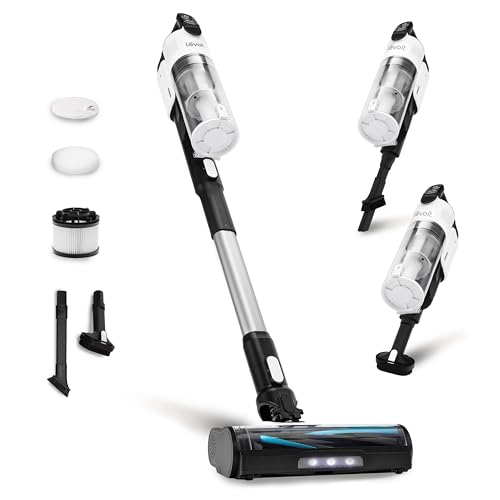
Levoit Cordless Vacuum Cleaner LVAC-200 — Best Cordless for Daily Litter Duty
Litter control is a frequency game, and frequency is where cordless wins. The Levoit LVAC-200’s verified listing leads with anti-tangle design for pet hair, up to 50 minutes of runtime, a lightweight build, and a 180° lay-flat design that slides under sofas and beds — which is precisely where tracked litter and shed hair migrate. As a daily driver it covers carpets and hard floors, so the route from litter box to hallway to living room is one continuous pass with no outlet changes and no brush drama.
Strengths
- Anti-tangle design addresses hair wrap, the cordless category’s classic weakness.
- 180° lay-flat body reaches under the furniture cats actually shed on.
- Up to 50 minutes covers a full daily route in most homes on one charge.
Trade-offs
- Cordless bins are modest; heavy shedding homes will empty often.
- Runtime is a maximum figure — high-power modes will use it faster.
- As a stick, it complements rather than replaces a deep-clean upright in carpeted multi-cat homes.
Key specs (from the listing)
- Format: cordless stick, rechargeable
- Brush: anti-tangle for pet hair
- Runtime: up to 50 minutes (maker-stated)
- Design: 180° lay-flat, lightweight
Choose the Levoit if tracked litter is your daily annoyance and your floors are mostly hard with area rugs. It turns the litter route into a two-minute habit instead of a weekly event, and habits are what actually keep a cat home clean.
Best for: daily litter tracking control on hard floors and mixed floors. / Not suited for: very large carpeted homes as the only vacuum.

Tineco A30S Cordless Vacuum Cleaner — Best Cordless Power
The A30S is the cordless pick with numbers: 200AW of suction, up to 60 minutes of runtime, a 1L dustbin that is genuinely large for a stick, a ZeroTangle brush, and PureCyclone separation, positioned for pet hair on carpet and hard floor. Those specs map directly onto the multi-cat brief — the bin swallows a serious shedding session, the runtime covers a whole house, the suction figure is the strongest stated in this guide, and the anti-tangle brush keeps long hair from becoming a maintenance project. We present it transparently alongside the Levoit: same format family, different strengths — the Tineco is the power-and-capacity expression, the Levoit the light-and-lay-flat one.
Strengths
- 200AW stated suction is the strongest figure in this guide — carpet hair stands little chance.
- 1L bin is large for a cordless stick, suiting multi-cat shedding volume.
- ZeroTangle brush plus up to 60 minutes runtime covers big homes in one session.
Trade-offs
- More power and capacity mean more weight in hand than the lightest sticks.
- Maximum runtime assumes the gentlest mode; max suction sessions will be shorter.
- Premium cordless positioning — budget buyers should stay with the Eureka.
Key specs (from the listing)
- Format: cordless stick
- Suction: 200AW (maker-stated)
- Runtime: up to 60 minutes (maker-stated)
- Bin: 1L
- Brush: ZeroTangle, PureCyclone tech
Choose the A30S if you want one cordless machine to carry a larger or carpeted cat home — multiple cats, multiple floors, real area to cover. It is the closest thing in this guide to a cordless-only answer, with the uprights remaining the deep-clean insurance for the heaviest carpet situations.
Best for: larger and carpeted multi-cat homes wanting maximum cordless capability. / Not suited for: buyers prioritizing the lightest possible stick.

Shark Cyclone PET Handheld Vacuum (AA701) — Best for Litter Spot Cleanup
Every cat home needs a tool that lives within arm’s reach of the litter box, and the Cyclone PET is built for that station: a handheld with pet hair pickup as its headline purpose, an XL dust cup for a handheld — because litter is dense and fills small cups fast — and an upholstery tool that doubles duty on couch hair and cat-tree platforms. Shark describes its suction with the term HyperVelocity; we report that as the maker’s language rather than a measured figure, since the listing states no numeric suction for this model. What is verifiable is the format and purpose, and for tracked litter on tile, spilled litter on the mat, and hair on the sofa arm, format and purpose are the job.
Strengths
- Purpose-built for pet hair pickup in a grab-and-go handheld format.
- XL dust cup suits dense litter loads better than typical handheld cups.
- Uplift tooling covers upholstery, stairs, and car interiors between full cleans.
Trade-offs
- A spot tool, not a whole-home machine — it complements a full-size vacuum.
- No numeric suction figure is stated in the verified listing.
- Handhelds need filter attention often in litter-dust environments.
Key specs (from the listing)
- Format: cordless handheld (model AA701)
- Dust cup: XL
- Tools: upholstery tool included
- Suction: described by maker as HyperVelocity (no numeric figure stated)
Station the Cyclone PET by the litter box and the tracked-litter problem shrinks to a ten-second habit after every scoop. It is the cheapest quality-of-life upgrade in this guide, and the pick owners of the big machines most often wish they had bought sooner.
Best for: litter-box stations, tracked-litter spot duty, upholstery touch-ups. / Not suited for: whole-room or whole-home cleaning.
Comparison Table
| Pick | Badge | Key spec | Best for |
|---|---|---|---|
| BISSELL Pet Hair Eraser Turbo Plus — Check on Amazon | Best Overall | Tangle-free brush roll, SmartSeal Allergen System | Carpeted multi-cat homes |
| Shark Navigator NV360 — Check on Amazon | Best for Litter on Hard Floors | Brushroll shutoff, HEPA, Lift-Away pod | Hard floors, litter areas, stairs |
| Eureka PowerSpeed NEU280 — Check on Amazon | Best Budget | Lightweight cyclone upright, washable filter | Small homes, second machine |
| Levoit LVAC-200 — Check on Amazon | Best Cordless for Daily Litter Duty | Anti-tangle, up to 50 min, 180° lay-flat | Daily tracking control |
| Tineco A30S — Check on Amazon | Best Cordless Power | 200AW, ZeroTangle, 1L bin, up to 60 min | Large carpeted cat homes |
| Shark Cyclone PET AA701 — Check on Amazon | Best for Litter Spot Cleanup | Handheld, XL dust cup, upholstery tool | Litter-box station duty |
How to Choose a Vacuum for Cat Hair and Litter
Diagnose your dominant problem first. Hair-dominant homes (long-haired cats, carpet) should weight anti-tangle brush technology and sealed filtration. Litter-dominant homes (hard floors, enthusiastic diggers) should weight hard-floor behavior — brushroll shutoff like the NV360’s, or a daily cordless habit. Most homes have both problems in different rooms, which is why this guide is built as a small system.
Take filtration seriously in a cat home. What a vacuum collects should stay collected. Sealed systems (BISSELL’s SmartSeal) and HEPA filtration (Shark NV360) are the two verified approaches here. This is a cleanliness point, not a medical one: a vacuum that exhausts fine litter dust and dander back into the room is undoing its own work.
Match the format to the routine. Weekly deep cleans: a corded upright. Daily litter routes: a cordless stick you will actually grab. Constant small spills: a handheld at the litter station. Readers exploring adjacent formats can compare Best Canister Vacuums For Pet Hair, Best Hardwood Floor Vacuums For Pet Hair, and Best Corded Handheld Vacuums For Pet Hair, and those who want automation can look at Best Robot Vacuums For Pet Hair And Berber Carpet.
Respect the consumables. Litter dust eats filters. A washable filter (Eureka) or an easy-empty tank you will actually empty (all the bagless picks here) keeps suction honest. A vacuum with choked filtration loses to a modest vacuum with clean filters every time.
Plan for the litter box geography. The ten feet around the box is the highest-traffic litter zone on earth. Whatever you buy, test it there first: pickup without scattering, edge cleaning against the wall, and a head that fits beside the box. That zone, cleaned daily, is 80 percent of the litter battle.
How to Vacuum Litter Without Scattering It (and Keep Hair From Winning)
Technique matters as much as the machine. Approach spilled litter slowly and let suction do the work — fast passes with a spinning brush are what turn a pile into a scatter pattern across the whole floor. On hard floors, use brushroll shutoff if your vacuum has it (the NV360 does); on cordless sticks, start on a lower suction setting for the first pass over a dense spill, then raise power for the residue. Work from the edges of the tracked trail toward the box, and finish with a slow pass along baseboards, where granules collect in the seam.
For hair, the routine is maintenance: empty the bin before it passes the fill line — overfilled bins are the silent cause of “my vacuum stopped picking up hair” — clear the brush roll on the schedule your cat’s coat dictates (anti-tangle designs stretch that schedule; they do not abolish it), and wash or replace filters before litter dust cakes them. Keep the litter station stocked: a mat that traps granules at the box exit, the handheld within reach, and a small brush for the mat itself. Ten seconds after each scoop beats an hour on Saturday, every single week.
Upholstery deserves its own thirty seconds of technique, because couches and cat trees are where hair weaves itself into fabric rather than lying on top of it. Work upholstery with the dedicated tool — the BISSELL’s specialized pet tools or the handheld’s upholstery tool — in short, overlapping strokes against the fabric’s nap, then reverse direction; hair that resists one direction often releases to the other. For the cat tree, the same tool on a weekly pass keeps the platforms from becoming felted monuments. And when a cushion cover is removable and washable, washing beats vacuuming — the vacuum’s job is the furniture you cannot throw in the machine.
Litter Types Behave Differently Under a Vacuum
Not all litter is the same cleaning problem, and matching your vacuum habits to your litter type prevents most frustration in this category. Fine clumping clay — the most common type — tracks the farthest because the grains are small and light enough to ride on paws and fur across whole rooms; it is also the type most prone to brush scatter, which is why the shutoff-and-suction technique matters so much with it. Crystal litter tracks less per grain but the grains are larger and harder, and a vacuum head needs the clearance to swallow them rather than snowplow them; a slow first pass at the pile’s edge works better than driving into its center. Pellet litters — paper, wood, or pine — track least of all and mostly stay near the box, but the pellets are the largest debris a household vacuum meets, and small handhelds and narrow stick heads can jam on a dense spill; sweep the worst of a pellet spill with a dustpan first and let the vacuum take the residue and dust.
One caution that applies to every type: litter dust is fine, abrasive, and relentless on filtration. Whatever litter you use, the filter routine in the care section is not optional maintenance — it is the difference between a vacuum that performs in month twelve as it did in week one and one that quietly fades. Homes that switch litter types often find their vacuum opinions change with the switch, which is worth remembering before blaming a machine: the vacuum did not change, the debris did.
Cat Hair by Coat, and Homes by Layout
Hair load varies more by cat than by vacuum. A single short-haired cat on hard floors produces a light, manageable load that the Levoit or even the handheld can carry almost alone. Long-haired breeds and multi-cat homes multiply the volume and the tangle factor together — that combination is what anti-tangle brush rolls and the BISSELL’s sealed system were built for, and it is where bin capacity (the Tineco’s 1L) stops being a spec-sheet number and becomes the difference between finishing the house and stopping twice to empty. Shedding is also seasonal: most indoor cats blow coat in spring and fall, and a vacuum routine that feels adequate in January can feel overwhelmed in April. Buy for your April, not your January.
Layout shapes the format answer just as much. Single-floor homes can live happily with one good machine of any format. Stairs change the math: a heavy upright that nobody carries becomes a downstairs-only vacuum, which is why lift-away designs like the NV360 and lightweight machines like the Eureka exist in this guide. Apartments add noise and storage to the equation — a cordless stick that hangs in a closet beats an upright that lives in the corner of the bedroom. And homes with a dedicated litter room or basement box should think in stations: the full-size machine where the carpet is, the handheld where the litter is, and no expectation that one tool covers both geographies gracefully.
The Supporting Cast: Mats, Boxes, and Habits That Make Any Vacuum Look Better
The best vacuum in this guide will still lose to a bad litter setup, so a short word on the system around the machine. A large, textured litter mat at the box exit traps a meaningful share of tracked granules before they reach open floor — it is the cheapest litter-control device that exists, and the handheld empties it in seconds. Box placement matters too: a box on hard floor near a wall, with the vacuum route in mind, beats a box on carpet in a corner behind furniture. Covered boxes and high-sided boxes reduce the initial scatter that creates the tracking problem in the first place.
Habits close the loop. Scoop daily and spot-vacuum the exit zone while you are there; brush long-haired cats regularly, because hair removed by a brush is hair the vacuum never meets; and keep the vacuum itself maintained — bin emptied, brush checked, filter washed or replaced — because in a cat home the vacuum is not an appliance you use occasionally, it is infrastructure. Infrastructure gets maintained, or it fails at the worst moment, usually the day before guests arrive.
Reading Vacuum Specs Without Getting Played
Vacuum specifications are a dialect worth learning before you spend money in this category. Air watts (AW), the unit in the Tineco’s 200AW figure, is the most honest suction measure commonly printed, because it describes power at the cleaning head where the work happens. Amps and generic watts describe what the motor draws, not what the floor feels, and are useful mainly for comparing within a single brand’s line. Some listings — the Shark handheld’s “HyperVelocity” language is this guide’s example — use branded terms with no number at all; treat those as descriptions of intent, not performance data, and let format and purpose carry the decision, as we did in that review. Runtime figures on cordless machines are best-case numbers at the gentlest setting; a useful rule is to plan your home against roughly half to two-thirds of the headline if you expect to use stronger modes on carpet. Bin capacity, by contrast, is a hard number you can trust and should: in a shedding home it predicts your emptying frequency with embarrassing accuracy.
Filtration language deserves the same literacy. “HEPA” on the NV360 refers to a defined filter standard. A named proprietary system like SmartSeal describes the maker’s own sealed design — meaningful, but the maker’s own framing. Neither term should be read as a health promise; both should be read as “this machine is designed to keep fine particles in,” which is what you can legitimately ask of a vacuum in a dander-heavy home.
What We Left Out, and Why
Three exclusions shaped this guide. First, carpet spot cleaners and pet stain machines: they are excellent tools for accidents, but they are not vacuums for hair and litter, and mixing them in would blur the brief — several appear in pet-vacuum searches and were set aside on that basis. Second, air purifiers: they surface constantly in pet-hair searches, they do nothing for litter on the floor or hair on the sofa, and they belong to a different guide entirely. Third, replacement parts and accessories — filters, brush heads, belts — which are ineligible here by rule: a pick must be a complete machine. Within the eligible field, we favored models whose pet and litter-relevant features are stated in their own listings over models with bigger general marketing, because a cat home punishes vague vacuums in very specific ways.
A Worked Example: Setting Up One Litter Station Properly
To make the system concrete, here is the setup we would build around a single litter box in a typical hard-floor laundry room or bathroom, using only picks from this guide. The box sits on a large trapping mat against the wall, with clearance on the exit side where the cat steps out — that clearance is where most granules land, and it should be vacuumable without moving furniture. The Shark Cyclone PET lives on a hook or shelf within arm’s reach, charged and ready; its job is the ten-second pass over the mat and the exit zone after each scoop, which at twice a day keeps the tracked trail from ever establishing itself. Once a week, the room gets a full pass with the NV360 — brushroll off, suction only, slow along the baseboards — which resets the corners, the seam behind the box, and the route to the door.
The rest of the house runs on the same logic at lower intensity: the cordless stick (Levoit for lightness, Tineco for power) does a midweek sweep of the hallway trail and the living-room rug edges, and the anchor upright (BISSELL, or the NV360 in hard-floor homes) does the weekly deep clean of carpets and upholstery. Notice what this example does not contain: any heroic cleaning sessions. The total weekly effort is less than one old-fashioned Saturday vacuum marathon, spread into habits too small to resent — and the home stays at a standard the marathon never achieved, because litter and hair are daily processes and the system finally treats them that way.
Common Buying Mistakes
Buying for hair and forgetting litter. A carpet hero with a spinning brush and no shutoff will redecorate your bathroom with litter. Check hard-floor behavior before you buy.
Believing runtime headlines. Cordless runtimes are maximum-mode figures. Size your home against a realistic fraction of the headline, especially if you run high suction on carpet.
Skipping the bin-emptying discipline. Every bagless pick here performs exactly as well as its emptiest day. In shedding season, that means emptying after every session, not every week.
One machine for every job. The upright-plus-handheld pairing outperforms any single premium machine at the daily reality of cat ownership. Budget for the system, not the hero.
Ignoring filter costs and care. Litter dust is abrasive and constant. Washable filters and available replacements are ownership features, not fine print.
Final Recommendation
Anchor a carpeted cat home with the BISSELL Turbo Plus — check the current price on Amazon. Center a hard-floor, litter-heavy home on the Shark NV360 and its brushroll shutoff — check the current price on Amazon. On a budget, the Eureka PowerSpeed covers the basics honestly — check the current price on Amazon. For daily cordless control, take the Levoit for lightness and lay-flat reach — check the current price on Amazon — or the Tineco A30S for power and capacity — check the current price on Amazon. And whatever else you buy, station the Shark Cyclone PET by the litter box — check the current price on Amazon. Small-space owners may also find Best Mini Pet Vacuums useful alongside this guide.
Related guides
Frequently Asked Questions
Why does my vacuum scatter cat litter everywhere?
A spinning brush roll flicks dense granules before suction can capture them. The fixes are a brushroll shutoff or suction-only mode on hard floors (the NV360 offers shutoff), a slower first pass, and starting cordless sticks on a lower setting over dense spills.
Are anti-tangle brush rolls worth it for cat hair?
Yes, especially with medium and long coats. Designs like BISSELL’s tangle-free roll, Levoit’s anti-tangle, and Tineco’s ZeroTangle stretch the interval between manual brush cleanings from days to weeks. They reduce maintenance; they do not eliminate it.
Corded or cordless for a cat home?
Corded uprights remain the deep-clean and carpet answer; cordless sticks win the daily litter war because they get used. Most cat homes end up happiest with one of each, plus a handheld at the litter station if tracking is heavy.
How often should I vacuum with cats?
The litter zone benefits from daily attention — which is why a grab-and-go cordless or handheld matters — while whole-home hair control typically needs two to three full sessions a week, more in shedding season. Frequency with a light tool beats intensity with a heavy one.
Does HEPA filtration matter for cat owners?
It matters for cleanliness: sealed and HEPA systems keep fine dander and litter dust from exhausting back into the room. The NV360’s HEPA and BISSELL’s SmartSeal are the verified options here. We make no health claims — it is about the vacuum not undoing its own work.
How do I get cat hair off stairs?
Stairs collect hair in the tread corners where a full upright head cannot reach. The two verified answers in this guide are the NV360’s Lift-Away pod, which detaches so you carry the suction to the step with its tools, and the Cyclone PET handheld for quick passes. Work top-down, use the crevice or upholstery tool in the corners, and expect stairs to need attention more often than flat rooms — everything the house sheds eventually migrates to them.
What about cat hair in the car?
It accumulates faster than almost anywhere else, because car fabric grips hair and the cabin is small.
The same handheld that stations at your litter box moonlights as the car tool — the Cyclone PET’s upholstery tool and XL cup suit seat fabric and floor mats very well, and ten minutes with it before a passenger ride is the difference between apologizing for the hair and not thinking about it at all. Keep expectations format-appropriate: the handheld handles the visible hair and the tracked litter in the footwells; embedded hair in trunk carpet wants the upright’s tools on a detail day.
When should I replace my vacuum’s filter?
Follow the maker’s schedule as a ceiling, not a target: in a litter-dust environment, inspect monthly. Washable filters (the Eureka’s, and washable designs generally) should be rinsed when they look grey rather than white and dried completely — a full day — before refitting, because a damp filter in a dusty machine cakes instantly. A vacuum that smells dusty while running is telling you its filtration is overdue.
Can a robot vacuum handle cat hair and litter instead?
Partly. A robot is genuinely good at daily surface maintenance — the tracked-litter route and the tumbleweeds of hair in corners — and many cat homes use one as the between-cleans layer. Its limits are deep carpet cleaning, stairs, upholstery, and the concentrated mess immediately around the box, all of which still belong to the machines in this guide. Think of a robot as a third layer of the system, not a replacement for the first two; our linked robot roundup covers models chosen for pet hair specifically.
How do I vacuum around a cat that hates the vacuum?
Routine and predictability help more than any product feature: vacuum on a schedule, in the same order of rooms, so the cat can choose its retreat in advance, and never chase the cat’s hiding spot with the machine. Cordless sticks and handhelds are noticeably less theatrical than a full upright for quick jobs, which is another practical reason the litter station setup works — a ten-second handheld pass barely registers, while a ten-minute upright session empties the room.
Is a bagged vacuum better than bagless for cat homes?
Bagged machines seal debris away neatly at emptying time and suit owners who dislike dust clouds at the bin, at the cost of ongoing bag purchases and gradually declining suction as the bag fills. Every pick in this particular guide is bagless, because the verified models that best matched the hair-and-litter brief — anti-tangle brushes, shutoff, sealed systems, washable filters — were bagless designs. If bagged is your preference, the canister and bagged-pet roundups linked in this guide cover that branch of the family.
What is the best vacuum for litter on hardwood specifically?
Of these picks, the NV360, because brushroll shutoff lets you clean with suction alone, and the Levoit LVAC-200 for daily route duty. Technique matters too: slow passes, edges first, and a trapping mat at the box exit to cut the load.


