Disclosure: airfryerkitchensupply.com is reader-supported. When you buy through links on our site, we may earn an affiliate commission at no extra cost to you.
Where to buy
Every one of these towels for absorbing food fat was verified against Amazon’s own product data connection before it earned a link. Start with the T-shin Oil-Absorbing Paper for Fried Food if you want the purpose-built blotting sheet, the Utopia Kitchen Flour Sack Towels if you want the reusable classic, or the Belinlen Bamboo Paper Towels for a washable roll format. The remaining verified picks: Epakh Oil Absorption Sheets, Bambooee Paper Towel Replacement Roll, and the Zuperia Bar Mop Towels. Check the current price on Amazon from these links — we print no fixed prices, because they change too often to publish honestly.
The two families of fat-absorbing towels
The best towels for absorbing food fat split into two families that solve the same greasy problem opposite ways, and choosing between them is the real decision in this guide. If you are comparing towels for absorbing food fat, you are draining fried chicken, blotting tempura, resting bacon, or skimming a broth — and the fat has to go somewhere. Family one is the disposable blotting sheet: purpose-made oil-absorbing paper that takes the fat with it into the bin, leaving nothing to wash. Family two is the reusable towel: flour sack cotton, bar mop cotton, and washable bamboo rolls that absorb fat at the draining rack and then go through the laundry. Both families are represented below with their economics stated honestly, because neither is universally right.
Why not just use ordinary paper towels, the roll already on your counter? Because the products here are built differently for this job. Blotting sheets are sized and thickened for food contact — laying under tempura, floating on soup — where a general paper towel sheds fibers and disintegrates. Flour sack towels are lint-free, thin, and huge, draining a batch of fried food without the lint a terry towel leaves and without tearing when saturated. Bamboo reusable rolls are engineered to survive washing after greasy duty that would retire a paper towel in one pass. The category exists because fat is the hardest thing a kitchen textile meets: it saturates, it clings, it goes rancid in a stored towel, and it punishes cheap materials immediately.
There is also a restaurant habit worth stealing before the reviews: mise en place applies to draining as much as to ingredients. The sheet is cut or torn, the rack is set over its towel, the skimming rounds are beside the pot — all before the oil reaches temperature. Frying is a timed performance, and the cook who starts arranging towels while the tempura waits in the basket has already lost the crispness this guide is about. Read the picks below as stations to set, not just products to buy.
A note on honesty in this category: absorbency claims in listings are unstandardized marketing. This guide verifies what each product is — material, size, count, format — from listing data, and describes fat performance in practical terms (what job each product suits) rather than invented absorption numbers. Where a listing’s own words make a claim, the review attributes it as the maker’s framing.
In this guide
Quick Picks
| Pick | Badge | Why it is here |
|---|---|---|
| T-shin Oil-Absorbing Paper, 50 Sheets | Best Blotting Sheets for Fried Food | Extra thick sheets sized 19.7 x 21.8 cm, made for fried food and tempura |
| Epakh Oil Absorption Sheets, 100 Pcs | Best for Soups & Broths | 7-inch round food-grade sheets that float on broth and lift the fat film |
| Utopia Kitchen Flour Sack Towels, 12-Pack | Best Reusable Draining Towel | 28 x 28 in 100% cotton, lint-free — the classic draining-rack towel |
| Belinlen Bamboo Paper Towels, 6 Rolls | Best Washable Roll | 120 machine-washable reusable sheets on tear-off rolls, 11 x 12 in |
| Bambooee Paper Towel Replacement Roll | Best Established Reusable | The original bamboo roll: 30 reusable sheets per roll |
| Zuperia Bar Mop Towels, 24-Pack | Best Heavy-Duty Cotton | 16 x 19 in 100% cotton, high absorbency, built for restaurant-grade mess |
How These Picks Were Chosen
All six products were verified — the two blotting papers and the bamboo rolls fresh on 2026-11-22 via this site’s API connection, the flour sack and bar mop towels in the same verification run — with each listing title matched to the product named and each ASIN taken from the listing response. Specifications printed below (sheet counts, dimensions, materials, washability) come from those verified listings only. API prices were used solely as an internal sanity check that each pick sits in its stated tier; none are printed.
Deduplication shaped the list. The Utopia flour sack towel is sold in 6, 12, and 24-packs under separate listings — one product, linked once at the 12-pack. The Epakh sheets come in 100 and 150-count rounds of the same sheet — one product, linked once. The Belinlen bamboo rolls similarly appear in multiple roll counts. What remains is six genuinely different tools: two disposable papers with different geometries (flat sheets for frying, rounds for soup), two reusable roll formats (Belinlen’s multi-roll set, Bambooee’s original), and two woven cotton towels (the flour sack’s thin lint-free weave, the bar mop’s heavier absorbency).
Deliberately excluded: generic paper towel rolls (a commodity this guide cannot improve on and the search’s intent goes beyond), facial oil-blotting sheets that surface in “oil absorbing” searches (a cosmetics product, not a kitchen one), and food-service wipes sold for surface cleaning rather than food contact. The keyword is about fat and food, and every pick touches food.
The 6 Best Towels for Absorbing Food Fat

1. T-shin Oil-Absorbing Paper — Best Blotting Sheets for Fried Food
The T-shin sheets are the specialist tool: extra thick oil-absorbing paper made for fried food and tempura, in a 50-sheet pack of 19.7 x 21.8 cm sheets. The technique they exist for is the tempura master’s one — fried food lands on the sheet, the sheet drinks the surface oil, and the food reaches the plate crisp instead of pooling. It suits fry cooks, tempura and tonkatsu makers, and anyone whose fried food currently rests on a paper towel that tears and sticks. It is less suited to high-volume frying on a budget (disposables are a per-sheet cost forever) and to soup duty, where the round Epakh sheets are shaped for the pot.
Strengths
- Purpose-built for fried food: extra thick, food-contact format
- Sheet size suits a draining tray or a plate of tempura
- Zero cleanup — the fat leaves with the sheet
Trade-offs
- Disposable economics: heavy fryers will feel the per-sheet cost
- 50-sheet pack is a trial quantity for a frying household
- One job only — it is not a general kitchen towel
| Spec | Verified detail |
|---|---|
| Format | Disposable oil-absorbing paper sheets |
| Sheet size | 19.7 x 21.8 cm |
| Pack | 50 sheets, extra thick |
| Stated use | Fried food and tempura |
Why a dedicated sheet beats the counter roll for this job comes down to two failures of general paper towels: they shed (embossing and fibers end up on a crisp crust) and they saturate unevenly, leaving one corner of the tray dry and the other swimming. A thicker, uniform blotting sheet drains evenly and lifts away clean. The honest limit is throughput: a sheet handles a batch, not an afternoon of frying, and restaurants of fried food should read this pick as the home cook’s tool. For the Friday-night tempura or the schnitzel run, it is the most professional result in the guide — and the benchmark the reusable picks are compared against on crispness.
Best for: tempura, tonkatsu, schnitzel, and any fried food where crispness is the point. / Not suited for: high-volume frying or soup skimming.
Check on Amazon — check price on Amazon before ordering.
2. Epakh Oil Absorption Sheets — Best for Soups & Broths
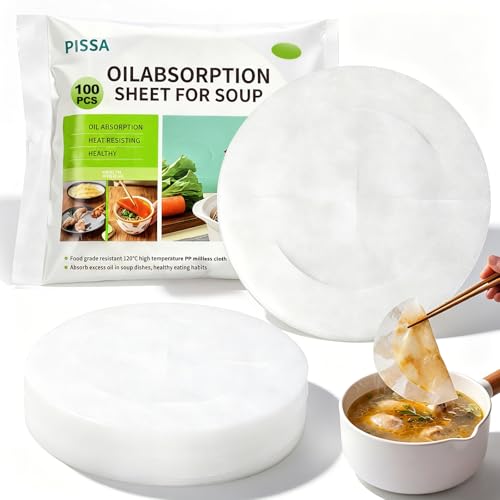
The Epakh sheets answer the other fat problem: the film floating on a soup, broth, hot pot, or stew. These are 7-inch round, food-grade oil-absorbing sheets — 100 pieces in the verified pack — designed to be laid on the surface of a hot liquid, where they take up the oil film and lift out. It is a technique with deep roots in East Asian home cooking, and the round format is the point: it matches the pot. The sheets also serve frying duty per the listing (grease skimming for broth, hot pot, frying). They suit broth makers, hot pot households, and anyone who refrigerates stock and hates the fat-cap chisel. They are not a draining towel for a tray of fried chicken — geometry again.
Strengths
- Round 7-inch format matches pots and bowls — the soup specialist
- Food-grade paper, stated on the listing
- 100-count pack suits regular broth and hot pot cooking
Trade-offs
- Disposable, like all blotting papers
- Surface skimming removes surface fat only — it will not degrease a sauce emulsified throughout
- Round sheets are awkward under a flat tray of fried food
| Spec | Verified detail |
|---|---|
| Format | Disposable round oil-absorbing sheets |
| Diameter | 7 in |
| Pack | 100 sheets, food grade |
| Stated use | Soup, broth, hot pot, frying grease |
Technique notes, because this product rewards them: lay the sheet gently on the surface rather than stirring it in, give it a few seconds of contact, and lift from one edge — the fat comes with the sheet. On a wide pot, work in overlapping passes. The Epakh’s sibling listing (a 150-count of the same sheet) confirms this is one product in two pack sizes; the guide links the 100. Against the chill-and-skim alternative — refrigerating stock until the fat hardens into a cap — the sheets win on weeknights: same soup, no overnight wait. Against the T-shin, the division of labor is clean: rounds for liquids, flats for fried solids, and a serious frying-and-broth household can justify both small packs.
Best for: soups, broths, hot pot, and stock makers who skim as they cook. / Not suited for: draining trays of fried food.
Check on Amazon — check price on Amazon for pack options.

3. Utopia Kitchen Flour Sack Towels — Best Reusable Draining Towel
The flour sack towel is the reusable answer with a century of kitchen history: a large, thin, lint-free cotton square — here 28 x 28 inches, 100% cotton, in a 12-pack — that drains fried food on a rack, lines a basket, and washes clean for the next round. Thin is the virtue: a flour sack absorbs surface fat readily, releases it in the wash better than a plush towel, and leaves no lint on a crust. It suits households that fry regularly and dislike disposables. It is less suited to the soup-skimming job (no towel is) and to anyone who will not manage the laundry discipline greasy towels demand — hot washes, prompt cycles, no fabric softener.
Strengths
- 28 x 28 in of lint-free cotton: covers a draining rack in one towel
- Thin weave absorbs surface fat and washes out cleaner than terry
- 12-pack matches the rotation greasy duty requires
Trade-offs
- Grease lives in the laundry system now — technique matters (see the care section)
- White cotton shows turmeric and tomato history; accept the patina or dedicate a frying subset
- Not a blotting sheet: food rests on it, fat wicks, but the last surface sheen is the papers’ game
| Spec | Verified detail |
|---|---|
| Material | 100% cotton flour sack weave |
| Size | 28 x 28 in |
| Pack | 12 towels |
| Stated use | Cleaning and drying; highly absorbent (maker’s framing) |
The pack-size honesty note: Utopia sells this same towel in 6, 12, and 24-packs, and the guide links the 12 as the household quantity — enough for a frying rotation with spares in the wash, not so many that storage becomes the problem. In use, drape the towel over a wire rack rather than laying food on a flat towel on a plate: air beneath plus absorbency above is the crispness equation, and the towel’s size makes the drape generous. After service, the towel goes into a hot wash promptly — the care section below explains why greasy cotton should never sit, and why a dedicated “fry set” of four towels, rotated hard and replaced without sentiment when they hold a stale smell, is the professional home pattern.
Best for: regular fryers who want the reusable, lint-free draining classic. / Not suited for: soup skimming or laundry-averse households.
Check on Amazon — check price on Amazon for pack sizes.
4. Belinlen Bamboo Paper Towels — Best Washable Roll
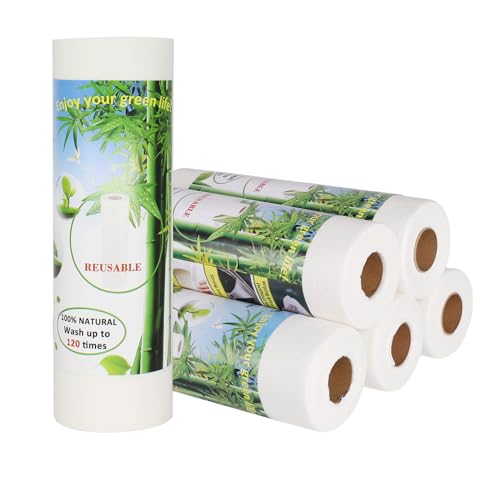
Belinlen’s set reimagines the paper towel roll as a reusable: six rolls of tear-off bamboo sheets, 120 sheets total at 11 x 12 inches, heavy duty and machine washable. For fat duty, the pitch is the middle path — tear a sheet, drain or blot, toss it in the wash rather than the bin, and let the roll format keep the habit identical to the paper routine it replaces. It suits households transitioning away from disposables who fry and wipe daily. It is less suited to cooks who want a big draping towel (these are sheet-sized, not towel-sized) and to anyone expecting bamboo sheets to behave like cotton in the wash — follow the maker’s care guidance, as bamboo fibers ask for gentler treatment than cotton.
Strengths
- Roll format: the reusable that fits the paper towel habit and holder
- Machine washable sheets, bought in a 120-sheet system
- 11 x 12 in sheets are plate-and-batch sized for draining duty
Trade-offs
- Sheet-sized, not towel-sized — no rack draping
- Bamboo fiber care is gentler than cotton’s hot-wash regime
- Grease-heavy sheets need prompt washing to avoid set-in odor
| Spec | Verified detail |
|---|---|
| Format | Reusable tear-off roll sheets (bamboo) |
| Quantity | 6 rolls, 120 sheets |
| Sheet size | 11 x 12 in |
| Care | Machine washable (per listing) |
The Belinlen also appears in a 4-roll, 80-sheet set in the verified data — the same product family, linked here at the 6-roll set as the better household system. The honest expectation-setting for all reusable bamboo: a sheet is not immortal, and its working life is measured in many washes rather than endless ones; the economics still favor it heavily against disposables for daily wipers, and fat duty — where a paper towel dies in one use — is where the advantage is largest. Keep a small laundry bag by the stove for used sheets, wash them as a load of their own, and the roll by the cooker becomes infrastructure instead of a purchase you keep re-making.
Best for: households replacing the paper towel habit with a washable roll. / Not suited for: rack-draping draining or hot-wash-only laundry routines.
Check on Amazon — check price on Amazon for roll counts.
5. Bambooee Paper Towel Replacement Roll — Best Established Reusable
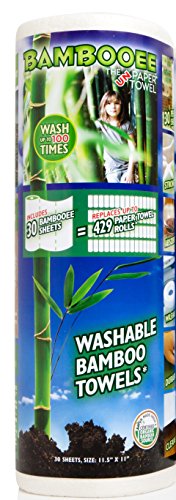
Bambooee is the name that started the reusable bamboo roll category — a 30-sheet roll of bamboo paper towel replacements, sold with a tree planted per roll per the listing’s own statement. As a fat towel, it plays the same role as the Belinlen sheets — blot, drain small batches, wipe the greasy stovetop, wash, repeat — in the original single-roll format. It suits smaller households and first-time reusable buyers who want to trial the format before committing to a multi-roll system. It is less suited to heavy daily fryers, for whom 30 sheets in rotation runs tight, and its per-sheet economics favor the bigger Belinlen set at volume.
Strengths
- The category’s original: an established, proven format
- Single-roll purchase is the low-commitment trial
- Tree planted per roll, per the maker’s stated program
Trade-offs
- 30 sheets is a small rotation for a frying household
- Sheet size is not stated in the verified title — confirm on the listing
- Same bamboo care gentleness as all bamboo reusables
| Spec | Verified detail |
|---|---|
| Format | Reusable bamboo sheets on a roll |
| Quantity | 30 sheets per roll |
| Sheet size | Not stated in verified listing title |
Why keep two bamboo rolls in a six-pick guide? Because they answer different buying moments honestly: Bambooee is the trial — one roll, learn the habit, discover whether your household actually washes and reuses — and Belinlen is the commitment the trial graduates to. Recommending only the big set would oversell the first purchase; recommending only the trial would underserve the daily fryer. The environmental framing on the listing (a tree per roll) is the maker’s program, reported here as stated; buyers motivated by impact should weigh the simpler arithmetic that any reusable sheet displaces dozens of disposals across its life, whichever brand’s roll is on the holder.
Best for: first-time reusable buyers and smaller households. / Not suited for: high-volume daily frying rotations.
Check on Amazon — check price on Amazon before buying.

6. Zuperia Bar Mop Towels — Best Heavy-Duty Cotton
The bar mop is the professional kitchen’s towel: a thick, thirsty cotton rectangle — here 16 x 19 inches, 100% cotton, high absorbency, in a 24-pack with the classic blue stripe — built for restaurant duty. For fat, its role is the heavy work around the frying: draining trays lined double, bacon batches, the greasy stovetop and splatter field after a fry session, all at a per-towel cost that makes heavy rotation painless. It suits production home kitchens — big families, batch cookers, holiday fryers. It is less suited to delicate draining where lint matters (bar mops are work towels, and the flour sack’s lint-free weave owns the tempura tray) and its smaller size means two towels where the flour sack uses one.
Strengths
- Thick, high-absorbency cotton: the heavy-duty option
- 24-pack economics built for hard rotation and replacement
- Restaurant-proven format, sized for trays and two-handed work
Trade-offs
- Not lint-free like flour sack — keep it off the most delicate crusts
- 16 x 19 in is a working towel, not a rack drape
- Thick cotton holds grease in the wash cycle; hot water discipline required
| Spec | Verified detail |
|---|---|
| Material | 100% cotton |
| Size | 16 x 19 in |
| Pack | 24 towels, blue stripe |
| Stated use | High absorbency kitchen towels for restaurants, cooks, bartenders, homes |
The blue stripe is not decoration: in professional kitchens, striped towels are a sorting system — this color works this station — and home fryers can steal the trick by dedicating the striped pack to fat duty so greasy towels never migrate to glassware. That system thinking is the bar mop’s real lesson: at 24 to a pack, you stop rationing towels and start rotating them properly, which is the difference between a kitchen that smells faintly of old oil and one that does not. Pair the Zuperia with the flour sack and the division is complete — bar mops for volume and mess, flour sacks for the delicate draining finish.
Best for: batch frying, big households, and the greasy cleanup around the fryer. / Not suited for: delicate lint-free draining duty.
Check on Amazon — check price on Amazon for the 24-pack.
The table compresses the system into one view: two disposable papers divided by geometry, two reusable rolls divided by commitment, and two cottons divided by delicacy. Most households will land on one paper plus one reusable — the table is organized so that pair is easy to see: pick your row from the fat’s location (tray, pot, or everywhere), then your column from your laundry philosophy.
Comparison Table
| Pick | Badge | Key spec | Best for |
|---|---|---|---|
| T-shin Oil-Absorbing Paper | Best Blotting Sheets | 50 sheets, 19.7 x 21.8 cm, extra thick | Tempura, crisp frying |
| Epakh Sheets | Best for Soups | 100 round sheets, 7 in, food grade | Broths, hot pot |
| Utopia Flour Sack Towels | Best Reusable Draining | 12-pack, 28 x 28 in cotton, lint-free | Draining racks |
| Belinlen Bamboo Rolls | Best Washable Roll | 6 rolls, 120 sheets, 11 x 12 in | Paper-towel replacement |
| Bambooee Roll | Best Established Reusable | 30-sheet roll | Trial, small households |
| Zuperia Bar Mops | Best Heavy-Duty | 24-pack, 16 x 19 in cotton | Batch work, cleanup |
How to Choose Towels for Absorbing Food Fat
Match the tool to the fat’s location. Fat sitting on a surface — a schnitzel’s sheen, tempura’s drip — wants a blotting sheet or a draining towel under the food. Fat floating on a liquid wants the round skimming sheet. Fat everywhere — the stovetop, the splatter zone, your hands — wants the working towels. Most frying households discover they have two of the three problems, which is why this guide’s picks combine well rather than compete: a paper for the finish, a cotton for the field.
Then decide your disposal philosophy honestly. Disposables (T-shin, Epakh) deliver the cleanest result with zero laundry and a permanent per-use cost — rational for occasional fryers and for cooks who value the result over the routine. Reusables (flour sack, bar mop, bamboo rolls) invert it: near-zero marginal cost, a laundry discipline forever. The discipline is not optional decoration; greasy textiles washed late, cold, or with softener become the stale-smelling towels everyone recognizes. If your household will not run a prompt hot wash, buy the papers and do not feel guilty — a system you follow beats a virtue you abandon.
Size and count close the decision. Draining wants area (the flour sack’s 28 inches, the T-shin’s tray-sized sheet); blotting wants handiness (the bamboo sheets); skimming wants the pot’s diameter (the Epakh’s 7-inch round, in passes for wide pots). Counts are rotation math: how many fry sessions happen between laundry days? The packs in this guide — 12 flour sacks, 24 bar mops, 120 bamboo sheets, 50–100 papers — are sized to real answers to that question.
How to Drain Fried Food and Wash Greasy Towels
- Drain on a rack, absorb from above and below. Fried food goes from the oil onto a wire rack set over a towel or sheet: air circulates, drips fall, and a second sheet laid gently on top blots the upper surface. Food piled on a flat towel steams in its own fat — the rack is the crispness secret.
- Blot, do not press. A light lay-and-lift with a blotting sheet or bamboo sheet takes the sheen; pressing squeezes the crust and can tear delicate batters. Tempura gets one gentle touch per side, no more.
- Skim soup while it simmers gently. Lay the round sheet on the surface, wait a few seconds, lift from the edge. Repeat across the surface. A rolling boil emulsifies fat into the liquid where no sheet can reach it — skim at a bare simmer or off the heat.
- Work in one layer. However good the towel, a pile is a steam room. Drain in a single layer with air between pieces, hold finished batches in a low oven on a clean rack if the fry run is long, and let each batch meet its towel alone.
- Salt after draining.
- Wash greasy towels promptly and hot. Rinse or soak if the wash must wait, wash hot with a full dose of detergent, and skip fabric softener entirely — softener coats cotton and kills the absorbency you bought. Bamboo sheets follow their maker’s gentler guidance; keep their load separate.
- Dry completely, store honestly. A towel that smells stale out of the wash gets one more hot wash with a booster; a towel that still smells after that retires to garage duty. Do not let a rancid towel back into food service — your nose is the quality control.
- Never pour the problem down the sink. The fat these towels collect belongs in the bin (sheets) or the wash (towels), not chased down a drain with hot water, where it sets in the pipes. Wipe pans into the bin first, then wash.
Salt draws moisture; salting on the rack after the blot keeps crusts crisp and seasoning where it belongs.
Common Buying Mistakes
- Using one product for every fat problem. A draining towel cannot skim soup; a soup sheet cannot drain a tray. The category splits by geometry, and buying against the split produces the “these don’t work” reviews.
- Resting fried food on a flat towel and calling it drained. Without a rack, the bottom crust sits in its own oil and steams soft. Towel plus rack is the system; the towel alone is half of it.
- Killing cotton absorbency with fabric softener. The category’s most common self-inflicted wound — softener coats fibers, fat and water bead instead of absorbing, and the towel gets blamed. Hot wash, full detergent, no softener.
- Letting greasy towels sit. Fat oxidizes; a towel washed next week smells like it. Prompt washing is not fussiness, it is the difference between a reusable system and a rancid one.
- Buying facial blotting papers for the kitchen. “Oil absorbing sheets” searches surface cosmetic products in tiny sizes. Check the listing’s stated use and dimensions — food-grade, kitchen-sized, like the two papers here.
- Storing the papers by the stove’s heat. Blotting sheets and bamboo rolls live best in a dry drawer away from the fryer’s splatter zone — a grease-spotted “clean” sheet defeats its own purpose, and paper products near open flame are a hazard with no upside. Keep the working stack at arm’s reach but out of the field of fire, literally.
- Expecting skimming to fix an emulsified sauce.
Once fat is whisked or boiled into a liquid, no sheet retrieves it. Skim early, skim gently, and build sauces with the fat decision made before the boil, not after.
The honest ledger: cost and waste across a year of frying
Run the two families’ arithmetic the way your household actually cooks. A weekly fryer using disposables consumes a few sheets per session — the T-shin and Epakh packs are sized in the dozens to hundreds, so a pack is a season’s supply, and the annual cost is a modest, predictable line. The same household on reusables spends once on a rotation (a flour sack 12-pack, a bar mop 24-pack, or a bamboo roll system) and then pays in laundry: a share of a hot wash per session, detergent, and the minutes of a routine. Across a year, heavy fryers come out ahead on reusables by a wide margin; monthly fryers may never amortize the rotation and are honestly better served by the papers. This guide prints no prices, so run your own numbers from the listings — the structure above is the part that does not change with promotions.
Waste follows the same shape with one correction: reusables are not zero-waste, they are waste-deferred and waste-shifted — water, energy, detergent, and eventually the towels themselves. Disposables are waste-immediate but tiny per unit and, in the papers’ case, grease-laden paper that goes to landfill rather than recycling either way. The defensible position is the one matched to your volume: high-volume households minimize impact with reusables washed efficiently (full loads, hot but not boiling, air-dried when possible), and low-volume households minimize it by not buying a rotation that sits unused. Virtue in this category is a usage pattern, not a product label.
One more line in the ledger: quality of result. The papers deliver the most consistent finish; the reusables deliver 95% of it with better economics at volume. Cooks should decide which of those they are buying — the last 5% of crispness for the tempura night, or the system for the other fifty weeks — and this guide’s structure, with a paper and a cotton at the top of the list, is built for households that answer “both, on different nights.”
Final Recommendation
Build by problem. For crisp fried food, the T-shin sheets give the professional finish, with the Utopia flour sacks as the reusable draining foundation under the rack. For broths and hot pots, the Epakh rounds are the shaped tool. For the everyday grease economy, choose your reusable system — Belinlen’s rolls at volume, Bambooee as the trial — and back it with the Zuperia bar mops for the heavy field work. Check price on Amazon from the links above, and remember the whole category in one line: get the fat off the food, off the surface, and out of the kitchen — with the right sheet or towel for each.
If this guide changes one habit, let it be the setup: rack out, towel under it, sheet beside it, skimming rounds by the pot — before the oil is hot. The products above are inexpensive; the thirty seconds of arrangement is the actual upgrade, and it is free every time you remember it.
Related guides in this series: Best Flour Sack Dish Towels For Embroidery, Best Drying Kitchen Towels, Best Chef Kitchen Towels, Best Bang For Buck Dish Towels.
Why fried food goes soggy: the physics your towel is fighting
A crust leaves the fryer crisp because its surface water has been driven off and its structure set. Three enemies attack it in the first two minutes. Steam: the food’s interior is still releasing vapor, which condenses on the crust from inside — pile fried food in a heap and each piece steams its neighbors. Pooling oil: surface fat that cannot escape sits against the crust, re-soaking it from outside. Contact: a flat, impermeable surface — a plate, a tray — traps both steam and oil against the bottom crust, which is why the bottom always dies first.
Every tool in this guide exists to break that triangle. The rack lifts food off the contact surface and lets steam escape downward. The towel or sheet under the rack receives the drips so they cannot pool and wick back. The blotting sheet on top removes the surface oil before it migrates inward. Spacing the pieces — one layer, air between — handles the neighbor-steaming problem that no towel can. Cooks who internalize the triangle stop blaming their batter for failures that were really drainage architecture, and the towel stops being an afterthought and becomes part of the recipe.
Temperature completes the picture: drain immediately, while the oil is fluid and the steam is moving outward. Food left sitting in the fryer basket “to drain later” drains into a cooling, thickening film instead. The thirty seconds after frying are when towels and sheets earn their entire existence — have them laid out before the food goes into the oil, not after it comes out.
Fat duty by cuisine: matching the pick to the pan
Japanese frying — tempura, tonkatsu, agedashi. The T-shin’s home cuisine, and the standard is highest here: a whisper of oil on the plate is a flaw. Sheets under and over, rack beneath, serve within minutes. Southern and American frying — chicken, catfish, hushpuppies. Volume changes everything: the flour sack drape and the bar mop rotation carry the load, with sheets reserved for the serving platter if the occasion demands polish. European schnitzel and cutlets. Thin, wide pieces want the wide tools — a flour sack under the rack, a bamboo sheet’s gentle blot on top — because a small sheet on a big cutlet means handling the food too much.
Broth cuisines — pho, ramen, hot pot, consommé. The Epakh’s rounds, used at the table-side pot and in the stockpot alike. Skimming as you cook keeps the broth bright without the overnight chill-and-cap routine. Bacon and breakfast. The bar mop’s shift: a folded mop under the rack takes a full pan’s worth of drippings across a batch, and the same pack handles the stovetop field afterward. Stir-fry and sauté cleanup. Not draining at all, but the bamboo rolls’ daily economy — the greasy wok wipe, the splatter field, the oily hands — is where reusable sheets quietly out-earn every other pick in this guide across a year of ordinary cooking.
Frequently Asked Questions
What is the best way to drain fried food without paper towels?
A wire rack over a flour sack towel, with a blotting sheet or bamboo sheet laid gently on top of the food. The rack provides airflow, the towel catches the drips lint-free, and the top sheet removes the surface sheen. That system — embodied by the Utopia flour sacks plus any sheet pick in this guide — matches or beats the paper towel routine on crispness, which is why restaurants of fried food drain on racks, not on paper.
Do oil-absorbing sheets work on soup?
Yes — that is the round sheets’ home ground. A food-grade sheet laid on the surface of a broth or hot pot takes up the floating fat film as it makes contact; lift it out and repeat across the surface. The limits are physical: the sheet removes surface fat only, works best at a gentle simmer or off the boil, and cannot retrieve fat that has been emulsified into the liquid by hard boiling or whisking.
Flour sack or bar mop towels for frying?
Different stations. Flour sacks are thin and lint-free — the draining and finishing towel, safe against delicate crusts. Bar mops are thick and thirsty — the volume towel for trays, bacon batches, and the greasy cleanup field. A serious frying kitchen runs both, often with a stripe system to keep them sorted; a casual one should start with the flour sacks, whose delicacy covers more of the search’s intent.
Can flour sack towels replace paper towels entirely?
For draining and most drying, yes — that is their traditional role, and the 12-pack rotation in this guide is sized for it. The honest exceptions are the jobs where disposables are genuinely better: blotting a delicate tempura crust at service, skimming a broth (a round sheet’s job), and any mess you would rather bin than launder. Most households that switch keep one small pack of papers for those moments and let the flour sacks carry the other ninety percent.
How many times can reusable bamboo towels be washed?
Many times — that is their economic premise — but not forever, and makers’ guidance varies by product, so follow the care instructions on the listing you buy. Practically: expect a long working life of repeated washes with gradual softening, retire sheets that tear or hold odor after a proper hot wash, and keep the rotation large enough (the Belinlen system’s 120 sheets, or Bambooee rolls restocked) that no single sheet is washed to death weekly.
Why do my kitchen towels stop absorbing?
Two usual causes: fabric softener or dryer sheets coating the fibers, and grease buildup from late or cool washing. The recovery wash is hot water, a full detergent dose, no softener — repeated once if needed. Prevention is the routine in this guide’s care section: prompt, hot, softener-free washing, complete drying. A towel that still repels water and smells stale after two recovery washes has retired; demote it to the garage and promote a fresh one.
Can I use these towels for draining bacon?
Yes — bacon is the bar mop and flour sack’s easiest assignment. Drain the rashers on a rack over a towel as with any fried food; the towel takes the drippings, and a bamboo sheet blots the top if you serve immediately. Two bacon-specific notes: the drippings are worth saving if you cook with them, so drain over a rack set above a tray when you want the fat collected rather than absorbed; and bacon grease sets as it cools, so the towel goes into the wash promptly, before the fat firms into the fibers.
What about draining food from an air fryer?
Air-fried food carries far less surface fat, but the same triangle applies in miniature: a brief rest on a rack over a flour sack or a bamboo sheet keeps the underside from steaming against a plate, and a light blot handles any rendered sheen on items like skin-on chicken or sausages. The blotting papers are overkill for most air fryer loads — save them for the deep fryer, where they earn their cost — and never line the air fryer basket itself with loose paper or towels during cooking; draining happens after cooking, on the counter, as with every method in this guide.
Are oil-absorbing papers food safe?
The picks here are sold for food contact — the Epakh states food-grade paper explicitly, and the T-shin is made for fried food and tempura. That is the check to run on any product in this space: the listing should state food use plainly, with dimensions suited to cookware. Cosmetic blotting papers and industrial absorbents share the search terms but not the purpose, and this guide excluded them for exactly that reason.


