Disclosure: airfryerkitchensupply.com is reader-supported. When you buy through links on our site, we may earn an affiliate commission at no extra cost to you.
Where to Buy
Kitchen towels are sold through Amazon in packs, and the listing details that decide drying performance are weave, size, and fibre — all stated on the page. Every pick here has a verified listing, so you can check price on Amazon for the pack size you want. Read the full reviews for which towel suits which job, then the buying guide: drying is a specific task, and the best towel for glassware is not the best towel for a sink of pans.
The verified picks in this guide are available through Amazon: Utopia Kitchen Flour Sack Towels, 12 Pack; Zeppoli Classic Dish Towels, 15 Pack; LANE LINEN Cotton Kitchen Towels, 6 Pack; Amazon Basics Organic Cotton Waffle Weave Towels, 6 Pack; COTTON CRAFT Waffle Terry Kitchen Towels, 12 Pack; All-Clad Dual-Purpose Kitchen Towels. Use those links to check price on Amazon for the exact size, colour, or configuration you need, and read the live listing for current delivery and returns details before ordering.
The best drying kitchen towels are the ones that actually move water off dishes instead of pushing it around, and the difference is fibre and weave, not branding. Cotton terry drinks water and holds it; flat flour-sack cotton dries glassware without lint; waffle weave splits the difference with structure that keeps working when damp. A kitchen needs at least two of these behaviours, which is why most good kitchens run two towel types rather than searching for one towel that does everything.
This guide compares six verified cotton towel sets chosen specifically for drying: flour sack towels, classic terry dish towels, a soft everyday set, an organic waffle set, a waffle-terry hybrid pack, and a premium dual-purpose set. We cover absorbency honestly — including how towels perform after fifty washes, why fabric softener quietly ruins drying towels, and how many towels a working kitchen actually rotates through in a week.
In this guide
Quick Picks
Utopia Kitchen Flour Sack Towels, 12 Pack — Best for Glassware — Check price on Amazon
Large, flat, lint-free cotton squares that dry glassware and polish stemware without leaving a trace — the professional’s drying towel.
Zeppoli Classic Dish Towels, 15 Pack — Best Value Workhorse — Check price on Amazon
Classic herringbone-striped cotton terry in a big pack — the everyday drying rotation for households that wash up constantly.
LANE LINEN Cotton Kitchen Towels, 6 Pack — Best Everyday Set — Check price on Amazon
A soft, quick-drying six-pack sized for ordinary kitchens that want one towel type to do most jobs decently.
Amazon Basics Organic Cotton Waffle Weave Towels, 6 Pack — Best Waffle Weave — Check price on Amazon
Waffle structure in organic cotton: the weave’s pockets keep the towel working when damp and speed drying afterwards.
COTTON CRAFT Waffle Terry Kitchen Towels, 12 Pack — Best for Heavy Drying — Check price on Amazon
Waffle on one side, terry character in the weave, cafe-sized and sold by the dozen — built for sinks full of pans.
All-Clad Dual-Purpose Kitchen Towels — Best Premium — Check price on Amazon
A denser, better-finished cotton towel with a smooth side and a terry side — the premium pick for cooks who buy kitchen tools once.
How These Picks Were Chosen
We chose for drying, not for looks. Absorbency first: 100% cotton in every pick, because polyester blends shed water rather than absorbing it and microfibre — capable as it is — is a different product with a different feel that many cooks dislike on glassware. Weave second: we deliberately included flat, terry, and waffle constructions so the guide covers glassware, general drying, and heavy pan duty. Size third: a drying towel must wrap a dinner plate and fold over a hand; the sets here run from standard to generously oversized.
We also weighted wash behaviour: towels that survive hot washing without shrinking into dishcloths, edges that stay hemmed, and lint behaviour that improves rather than worsens after the first washes. Pack size mattered at the tier level — a drying rotation needs numbers, not a precious pair. No fixed prices or ratings appear; check the live listing for the current pack and price.
The 6 Best Drying Kitchen Towels

Utopia Kitchen Flour Sack Towels, 12 Pack — Best for Glassware
Flour sack towels are the drying specialist: a plain, flat cotton weave, generously sized, that absorbs well and — the decisive trait — releases almost no lint, so glasses come off the towel clear rather than flecked. Caterers and bars run these for a reason. They dry fast on the line too, because there is no pile to hold water, which keeps the rotation turning in a busy kitchen.
They are not the towel for a soaked countertop or a roasting tin; the flat weave absorbs less total water than terry. Buy them as the glassware-and-finishing towel alongside a terry workhorse, wash them hot, and keep fabric softener away — softener coats the fibres and turns any drying towel into a water-pusher.
In long service, flour sacks develop the softness of old linen while keeping their lint discipline, which is why cooks keep a favourite set for years and relegate newcomers to pan duty. They also iron beautifully if you are the kind of household that irons a towel for guests — a small ceremony that costs nothing and makes a laid table feel considered. Store them folded flat rather than bunched; the flat weave creases kindly and stacks like paper.
A final judgement on the Utopia Kitchen Flour Sack Towels, 12 Pack: it earns its badge in this guide — Best for Glassware — not by winning every comparison but by being the most honest version of its format at its tier. Buyers whose situation matches its ‘best for’ line will find it disappears into daily use, which is what this category of product is for; buyers outside that line should take the guide’s steer to the pick whose strengths match their actual rooms, habits, and constraints, rather than forcing a mismatch and blaming the product for it.
Strengths
- Lint-free drying for glassware and stemware
- Large size wraps plates and folds over a hand comfortably
- Thin weave dries fast between uses, keeping rotation fresh
Trade-offs
- Absorbs less total water than terry
- Too thin for big spills or heavy pans
- Plain white working look, not decorative
Best for: glassware, stemware, and finishing drying / Not suited for: mopping large spills
Check on Amazon — check the current price on Amazon for the exact variant you want.

Zeppoli Classic Dish Towels, 15 Pack — Best Value Workhorse
The Zeppoli set is the rotation answer: fifteen honest cotton towels with the classic stripe, absorbent terry character, and a pack size that means a clean dry towel is always available while others are in the wash. For family kitchens doing two or three wash-ups a day, that arithmetic matters more than any premium feature.
Expect working towels, not heirlooms: they soften and absorb better after the first few washes, edges are serviceable rather than luxurious, and the blue stripe is the traditional kitchen uniform. At this tier, the correct strategy is exactly this — numbers, hot washes, and replacement without regret after long service.
The Zeppoli pack’s economics reveal themselves in year two: fifteen towels rotating means each rests between washes, and cotton that rests lasts. When individual towels eventually thin, they leave the rotation one by one into rag duty and the pack’s survivors carry on — a graceful decline no three-pack can imitate. Households that label one stripe colour for the glassware job find the system self-policing, because even a helpful teenager can learn ‘stripes never touch the pan’.
A final judgement on the Zeppoli Classic Dish Towels, 15 Pack: it earns its badge in this guide — Best Value Workhorse — not by winning every comparison but by being the most honest version of its format at its tier. Buyers whose situation matches its ‘best for’ line will find it disappears into daily use, which is what this category of product is for; buyers outside that line should take the guide’s steer to the pick whose strengths match their actual rooms, habits, and constraints, rather than forcing a mismatch and blaming the product for it.
Strengths
- Big pack keeps a clean towel always in rotation
- Cotton terry absorbs properly for everyday drying
- Improves over the first washes as fibres open up
Trade-offs
- Working-grade finishing, not premium
- White shows kitchen stains honestly
- Needs the no-softener rule like every drying towel
Best for: family kitchens with constant washing-up / Not suited for: small households wanting a few premium towels
Check on Amazon — check the current price on Amazon for the exact variant you want.

LANE LINEN Cotton Kitchen Towels, 6 Pack — Best Everyday Set
Not every kitchen wants a two-towel system. The Lane Linen set is the balanced middle: cotton towels soft enough for hands, absorbent enough for dishes, sized for ordinary sinks, and quick to dry on a hook between uses — which matters in small kitchens where towels live on the oven handle rather than a line.
Six is the minimum sensible rotation for a couple or small family; heavy wash-up households should pair this set with a bulk pack rather than stretching it. The towels wash well and keep their shape, and the soft hand feel makes them the ones guests get handed without thinking.
Lane Linen’s set suits the household that cooks nightly but washes up once, in one session: six towels is exactly a day’s drying plus hand duty with a spare for the spill that always happens. Owners in small flats praise the quick dry time most — a towel washed in the evening is ready by morning without a tumble dryer, which is a running-cost virtue as much as a convenience. Pair it with a single flour sack set later and the small kitchen is complete.
A final judgement on the LANE LINEN Cotton Kitchen Towels, 6 Pack: it earns its badge in this guide — Best Everyday Set — not by winning every comparison but by being the most honest version of its format at its tier. Buyers whose situation matches its ‘best for’ line will find it disappears into daily use, which is what this category of product is for; buyers outside that line should take the guide’s steer to the pick whose strengths match their actual rooms, habits, and constraints, rather than forcing a mismatch and blaming the product for it.
Strengths
- Balanced absorbency and softness for mixed jobs
- Quick-drying between uses on a hook
- Keeps shape through regular washing
Trade-offs
- Six-pack is a minimum rotation, not a generous one
- Not the lint-free specialist for fine glassware
- Mid-tier finishing
Best for: couples and small kitchens wanting one all-round set / Not suited for: large families needing bulk rotation
Check on Amazon — check the current price on Amazon for the exact variant you want.

Amazon Basics Organic Cotton Waffle Weave Towels, 6 Pack — Best Waffle Weave
Waffle weave earns its place in drying because the recessed pockets do two jobs: they add surface area for absorbency, and they keep air moving through the towel so it dries faster and smells fresher between washes. This organic cotton set is the structured option — the towel that still performs on the third plate when a flat towel has gone soggy.
Waffle is a compromise by design: not as lint-free as flour sack on glass, not as thirsty at first contact as deep terry. As the single-towel answer for a small kitchen it is arguably the smartest shape here, and the organic fibre is a genuine material preference rather than a label.
The waffle set’s second-year character is a softening of the grid: the pockets relax, the towel becomes drapier, and its absorbency stays while its structure mellows — many owners prefer them at this stage. Waffle also packs small, which makes a set the natural travel and caravan towel for people who cook away from home and refuse disposable paper. If a waffle towel ever starts to smell before its wash is due, the cause is almost always being hung bunched; the weave needs its air.
A final judgement on the Amazon Basics Organic Cotton Waffle Weave Towels, 6 Pack: it earns its badge in this guide — Best Waffle Weave — not by winning every comparison but by being the most honest version of its format at its tier. Buyers whose situation matches its ‘best for’ line will find it disappears into daily use, which is what this category of product is for; buyers outside that line should take the guide’s steer to the pick whose strengths match their actual rooms, habits, and constraints, rather than forcing a mismatch and blaming the product for it.
Strengths
- Waffle pockets sustain absorbency when damp
- Dries fast and resists the stale-towel smell
- Organic cotton fibre
Trade-offs
- Not the choice for lint-free glass polishing
- Mid-size suits ordinary sinks, not catering trays
- Structure softens with age, gradually becoming a flat towel
Best for: small kitchens wanting one towel type that does most jobs / Not suited for: glassware specialists
Check on Amazon — check the current price on Amazon for the exact variant you want.
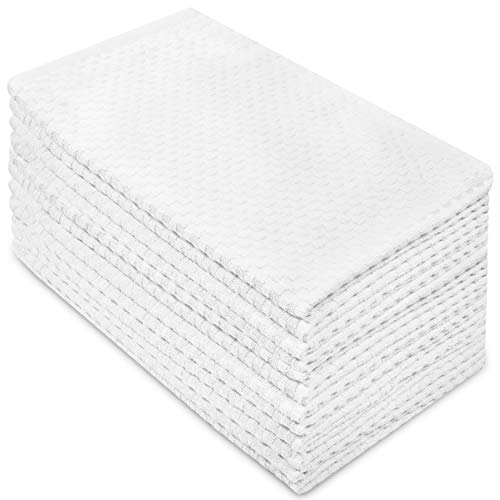
COTTON CRAFT Waffle Terry Kitchen Towels, 12 Pack — Best for Heavy Drying
When the sink holds a roasting tin, two pans, and the Sunday glasses, you want a towel with structure and thirst together. The Cotton Craft waffle-terry format — the Euro cafe style — is sized for two-handed work, absorbs heavily, and the dozen-pack means the rotation survives a full cooking day without rationing.
These are working towels with a cafe aesthetic: white, substantial, and improved by hot washing. They are more towel than a tiny kitchen needs and exactly right for households that cook seriously. Keep them off the glassware-polishing duty only if you also own flour sacks; in practice many cooks use them for everything and accept a trace of lint as the price of power.
Cafe-format towels like the Cotton Craft set reward the household that treats the kitchen as a workplace: hung on a rail in a row, they dry between shifts, take the hottest washes without complaint, and their size makes them the towel reached for when a stockpot needs two hands and full attention. Caterers’ habits transfer: date the rotation informally by wear, keep the best four for service, and let the veterans take the oven-adjacent abuse — though never as oven gloves.
A final judgement on the COTTON CRAFT Waffle Terry Kitchen Towels, 12 Pack: it earns its badge in this guide — Best for Heavy Drying — not by winning every comparison but by being the most honest version of its format at its tier. Buyers whose situation matches its ‘best for’ line will find it disappears into daily use, which is what this category of product is for; buyers outside that line should take the guide’s steer to the pick whose strengths match their actual rooms, habits, and constraints, rather than forcing a mismatch and blaming the product for it.
Strengths
- Heavy absorbency for pans and big wash-ups
- Dozen pack sustains a full cooking day
- Cafe sizing suits two-handed drying
Trade-offs
- Substantial towels need drawer space
- White shows every stain of a working life
- Overkill for a minimal kitchen
Best for: serious home cooks and big wash-up loads / Not suited for: minimal kitchens with one small sink
Check on Amazon — check the current price on Amazon for the exact variant you want.

All-Clad Dual-Purpose Kitchen Towels — Best Premium
The All-Clad towels bring the brand’s kitchen-tool seriousness to textiles: a dual-purpose construction with a smoother face for glass and a terry face for water, dense cotton, and finishing that survives the wash without curling into a tube. If your kitchen towels live on display and work daily, this is the set that does both without apology.
Premium towels change the arithmetic rather than the physics: you buy fewer, wash them just as hot, and replace them less often. They still obey the same rules — no softener, no using the good towel to pull a tray from the oven and scorch it — but as a drying instrument, this is the most refined verified option in the guide.
The All-Clad set’s long game is appearance under discipline: washed hot and kept from softener, the dual faces keep their distinct characters and the hems stay flat, so the towels look intentional on the rail year after year. They are the set most likely to be bought again identically when they finally retire — the definition of a premium staple. Keep one sacrificial cheap towel in the same drawer for the jobs that scar, and the premium set never has to take the damage.
A final judgement on the All-Clad Dual-Purpose Kitchen Towels: it earns its badge in this guide — Best Premium — not by winning every comparison but by being the most honest version of its format at its tier. Buyers whose situation matches its ‘best for’ line will find it disappears into daily use, which is what this category of product is for; buyers outside that line should take the guide’s steer to the pick whose strengths match their actual rooms, habits, and constraints, rather than forcing a mismatch and blaming the product for it.
Strengths
- Dual faces: smooth for glass, terry for water
- Dense cotton and finishing that keeps its shape
- Premium longevity suits buy-once kitchens
Trade-offs
- Premium tier; rotation costs more to build
- Fewer per pack than bulk options
- Too nice to sacrifice to oven duty — keep a sacrificial towel
Best for: cooks who keep few, good tools and use them daily / Not suited for: households needing the cheapest cost per towel
Check on Amazon — check the current price on Amazon for the exact variant you want.
Comparison Table
| Pick | Badge | Key spec | Best for |
|---|---|---|---|
| Utopia Kitchen Flour Sack Towels, 12 Pack | Best for Glassware | 28×28 in flat cotton, 12 pack | glassware, stemware, and finishing drying |
| Zeppoli Classic Dish Towels, 15 Pack | Best Value Workhorse | 100% cotton, 15 pack, classic stripe | family kitchens with constant washing-up |
| LANE LINEN Cotton Kitchen Towels, 6 Pack | Best Everyday Set | 100% cotton, 6 pack, quick dry | couples and small kitchens wanting one all-round set |
| Amazon Basics Organic Cotton Waffle Weave Towels, 6 Pack | Best Waffle Weave | Organic cotton waffle, 6 pack, 15×25 in | small kitchens wanting one towel type that does most jobs |
| COTTON CRAFT Waffle Terry Kitchen Towels, 12 Pack | Best for Heavy Drying | Waffle terry cotton, 12 pack, 16×28 in | serious home cooks and big wash-up loads |
| All-Clad Dual-Purpose Kitchen Towels | Best Premium | 100% cotton, dual-purpose, 17×30 in | cooks who keep few, good tools and use them daily |
How to Choose Drying Towels: Weave, Size, and Rotation
Choose by weave first. Flat flour-sack cotton is the glassware and finishing weave: absorbent enough, lint-free, fast to dry. Terry is the thirst weave: loops drink the most water and suit the bulk of a wash-up. Waffle is the structure weave: pockets sustain performance when damp and speed the towel’s own drying. A complete kitchen runs two of the three; a small kitchen should run waffle or a balanced terry and accept the compromise knowingly.
Size second. A drying towel must fold over the hand that holds the plate and wrap a dinner plate’s rim; undersized towels are why people finish drying with a tea towel in each hand and water on the floor. Third, rotation: count your wash-ups per day and own at least three days of towels, because a damp towel hung overnight in a closed kitchen is tomorrow’s stale towel. Pack sizes in this guide exist because rotation is the real specification.
Why Your Towels Stopped Drying (and How to Fix It)
The commonest cause of a towel that pushes water around is fabric softener and dryer sheets, which coat cotton fibres in a water-resistant film. The towel feels soft and performs terribly. The fix is a hot wash with a cup of white vinegar or a strip-wash cycle to remove the coating, then a permanent rule: drying towels are washed with detergent only. Tumble drying itself is fine and even helps open the fibres.
The second cause is age and grease: kitchen towels accumulate cooking oils that detergent alone stops shifting. A periodic soak with an oxygen-based booster before the hot wash restores most towels. The third cause is simply fibre death — cotton loops break down after hundreds of washes — at which point the honest move is demotion to rag duty and a fresh rotation pack, which is exactly why the bulk formats in this guide exist.
Matching the Towel to the Job: Glassware, Pans, Hands, and Counters
A working kitchen asks four different things of cloth, and the failures start when one towel is asked for all four. Glassware wants a flat, lint-free surface and a towel dry enough to finish the job — flour sack, used only for glass, kept out of the grease economy entirely. Pans and general drying want thirst and size: terry or waffle-terry, big enough to hold a hot roasting tin’s base while the other hand works — and note that holding is not lifting; a drying towel is not an oven cloth and must never become one. Hands want softness and a dedicated towel by the sink, changed daily, because the hand towel is the one that touches food next. Counters want a cloth, honestly — a separate, cheaper, sacrificial cloth for spills and surfaces, so the drying towels never absorb raw-chicken juice or hob grease and then meet the glasses.
Colour-coding is how restaurants keep this straight and it works at home without any fuss: one colour or pattern per job, stripes for glass, plain for pans, a third for hands. The sets in this guide make that easy — the Zeppoli stripe, the white flour sacks, the cafe whites can each own a job. The system sounds elaborate for exactly one wash-up; by the end of a cooking week it is the difference between glasses that sparkle and glasses that wear a faint film of everything else that happened in the kitchen.
How Many Towels, How Often Washed: The Rotation Maths
Count backwards from your laundry rhythm. A household that washes up twice a day and launders twice a week needs, at minimum, two drying towels and one hand towel per day across four days — call it a dozen working towels plus glassware towels — or the rotation collapses into reusing damp towels, which is where streaks and odours breed. The bulk packs in this guide exist because this arithmetic is unforgiving: twelve and fifteen packs are not excess, they are the correct specification for a family kitchen on a twice-weekly laundry cycle. Smaller households laundering more often can run the six-packs happily.
Wash temperature deserves a straight answer: working kitchen towels should be washed hot enough to shift grease and keep them hygienic — follow the care label, but cotton drying towels are built for hot washing and this is one place not to default to cold eco cycles for everything. Dry fully before folding. Retire towels by demotion, not disposal: when a drying towel’s absorbency fades after long service, it becomes the counter cloth, then the garage rag, and only then leaves the house. A towel bought in a good cotton pack can serve in some capacity for years, which is the quiet economics behind buying cotton in the first place.
Towel Fibres Beyond Cotton: Linen and Blends, Honestly Assessed
Linen is cotton’s serious rival in the drying drawer and deserves its paragraph. A linen towel absorbs well, dries glassware with the same lint discipline as flour-sack cotton, and outlasts cotton by years — linen fibres strengthen wet and resist the thinning that ends a cotton towel’s life. Its costs are a higher tier, a crisper hand that softens only over many washes, and a tendency to crease like it means it. Households that buy linen usually buy a few for glassware and keep cotton for the heavy rotation, which is the correct division: linen’s longevity is wasted on pan duty, and cotton’s cheap abundance is wasted on nothing.
Blends require the translator’s eye this guide applies everywhere. A cotton-rich blend with a small synthetic fraction for strength can be a perfectly good towel; a ‘cotton feel’ towel that is mostly polyester is a different product wearing a costume, and it will push water around glassware exactly as its fibres predict. Microfibre, assessed honestly, absorbs impressively and suits counters, cars, and windows — and many cooks still dislike it on dishes for its grabby hand-feel and its plastic nature. The guide’s cotton line-up is a deliberate choice, not an oversight: for the specific job of drying dishes and glassware by hand, cotton’s combination of absorbency, feel, washability at heat, and price in bulk remains the benchmark the others are measured against.
Setting Up a Kitchen That Dries Properly: Rails, Hooks, and Habits
The best towels underperform in a kitchen with nowhere to hang them, so the last piece of the drying system is furniture. A rail beats a hook: a towel spread on a rail dries across its whole area, while a towel on a hook dries at the fold and stays damp at the bunch. Oven-handle hanging is the universal compromise and works if the towel is spread flat along the handle rather than threaded and bunched. Two hanging points — one by the sink for hands, one near the draining board for dishes — prevent the cross-contamination that quietly undoes the two-towel system, because a towel’s job is decided by where it hangs as much as by what it is.
Habits complete the setup. The draining board itself should be allowed to do the first half of drying: dishes racked for ten minutes need a finishing towel, not a bath. Hot items dry faster than cold, so the order of work — pans first while they hold the wash water’s heat, glasses last with the driest towel — is a small professional rhythm worth copying. And the end-of-day habit that protects everything else: yesterday’s towels go in the basket, today’s come out of the drawer, no exceptions negotiated at midnight. Kitchens that run this way describe drying as a non-event, which is the entire ambition of this guide.
The Professional Kitchen’s Towel System, Translated for Home
Professional kitchens run towels as a system with rules a home cook can steal wholesale. Towels are colour- or stripe-coded by station so a cloth that wiped a board never dries a glass; they are changed on a schedule rather than on appearance, because a towel’s working life is measured in tasks, not in how dirty it looks; and they are laundered as a dedicated load at heat, because a professional kitchen understands that the towel is a food-contact surface one step removed. The home translation needs no special equipment: two colours, a daily change, a hot dedicated wash. What it produces is the thing home cooks actually envy in restaurant kitchens — not the stove, but the absence of low-level chaos at the sink.
The other professional habit worth stealing is the side towel’s discipline: one towel lives at the cook’s side for the session, handles the hundred small grips and wipes of cooking, and is understood to be the sacrificial one — while the drying towels, the finishing instruments, never touch a hob, a board, or a spill. Home kitchens blur this line constantly and then wonder why the glasses film. Draw the line with the packs in this guide — bulk towels for the side work, the best weaves reserved for finishing — and the whole drawer starts performing like it was specified rather than accumulated.
Storing and Organising the Towel Drawer
The towel drawer is a small system with outsized daily effects. Fold by job, not by size: glassware towels in one stack, work towels in another, hand towels in a third, so the right towel is the one the hand finds without thought. Keep the rotation honest by loading clean towels at the back or bottom of each stack — first in, first out — which prevents the same four towels from being washed to death while the rest of the pack ages unused in the drawer. A pack’s longevity is a property of the whole pack being worked evenly, and the drawer is where that evenness is either arranged or lost.
Retired towels should leave the drawer on schedule: a towel demoted to rag duty that stays in the drying stack will be grabbed for glassware by a helpful guest exactly once, which is once too many. Keep the rags in a different place entirely — under the sink, in the utility cupboard — and the drawer’s discipline holds itself. None of this is housekeeping theatre; it is the logistics that let a dozen honest cotton towels run a family kitchen for years, which was the promise on the pack.
How to Set Up a Kitchen Towel Rotation That Always Dries
Step 1 — Assign jobs. Designate one weave for glassware (flour sack), one for general drying (terry or waffle). A towel used on a greasy pan never touches the wine glasses again that day.
Step 2 — Hang for air. After each use, hang the towel fully open over a rail or oven handle — never scrunched on a hook. Airflow between uses is what prevents the stale smell.
Step 3 — Retire daily. A drying towel works one day, then goes to the wash basket. Drying with yesterday’s damp towel is how glasses get streaks and kitchens get odours.
Step 4 — Wash hot, no softener. Hot wash with detergent only. Add an oxygen booster soak monthly for working towels.
Step 5 — Dry fully. Line or tumble until completely dry before folding; a towel folded damp mildews in the drawer and takes the drawer with it.
Common Buying Mistakes
Using fabric softener. It coats the fibres and destroys absorbency while making the towel feel luxurious. Detergent only, forever.
One towel for everything. The pan towel, the hand towel, and the glass towel are three jobs. Mixing them puts grease on glassware and bacteria on hands.
Hanging towels scrunched. A bunched towel stays damp, grows odour, and dries nothing the next morning. Hang fully open.
Buying two beautiful towels. Rotation is the specification. A dozen honest towels outperform a precious pair in every real kitchen.
Using drying towels as oven cloths. Scorched, holed towels dry badly and burn hands. Keep a separate, sacrificial oven cloth.
Final Recommendation
Build the classic pair if you can: flour sacks for glassware plus a terry or waffle-terry bulk pack for the heavy work — that combination covers nearly every kitchen. Small kitchens should take the waffle set or the Lane Linen six-pack as the single-system answer, bulk households the Zeppoli rotation, and buy-once cooks the All-Clad set. Whatever you choose, the no-softener rule and a real rotation will improve your drying more than any upgrade in the towel itself.
Shortlist again with live listings open: Check on Amazon — Utopia Kitchen Flour Sack Towels, 12 Pack; Check on Amazon — Zeppoli Classic Dish Towels, 15 Pack; Check on Amazon — LANE LINEN Cotton Kitchen Towels, 6 Pack; Check on Amazon — Amazon Basics Organic Cotton Waffle Weave Towels, 6 Pack; Check on Amazon — COTTON CRAFT Waffle Terry Kitchen Towels, 12 Pack; Check on Amazon — All-Clad Dual-Purpose Kitchen Towels. Confirm the details that matter for your home on the product page itself, then order once, correctly.
Related guides on this site: Best Kitchen Towels Best Flour Sack Towels Best Dish Towels Best Cotton Rugs Best Drying Kitchen Towels For Glassware
Frequently Asked Questions
Why do my new towels not absorb water?
New cotton carries spinning and finishing residues. Wash two or three times before judging, never with softener, and the fibres open up into full absorbency.
How many kitchen towels should I own?
At least three days’ worth for your wash-up frequency — for most households that means twelve to eighteen towels in rotation across glassware and general drying.
Are microfibre towels better for drying?
Microfibre absorbs well and suits counters and cars, but many cooks dislike its feel on glassware and it is a synthetic product. This guide is deliberately cotton; within cotton, weave choice matters more than brand.
How often should drying towels be washed?
After one day of use. A towel that dried yesterday’s dishes is damp, loaded, and ready to streak today’s glassware and spread odour.
Can I restore towels ruined by fabric softener?
Usually, yes: a hot wash with white vinegar, or a dedicated strip wash, removes the coating. Repeat once if needed, then keep softener away permanently.
Should kitchen towels and bath towels be washed together?
They can share a hot wash without harm, but many households keep kitchen towels separate because of grease and food soil. What matters is temperature, full drying, and no fabric softener on anything meant to absorb.
Why do my white towels look grey?
Grease and detergent residue build up over months. A strip wash — a long hot soak with detergent and an oxygen booster before the wash — restores most greying cotton. Washing working towels separately from delicates also helps.
Are bigger towels always better for drying?
Up to a point: a towel must wrap a plate and fold over a hand, which the 28-inch formats here do well. Beyond that, oversize towels become drawer bulk and laundry weight without drying any better.
Is this guide’s top pick right for every home?
It is right for the most common version of the need described in this guide. The reviews flag the specific households each pick does not suit — read the ‘not suited for’ line of the pick you are considering before ordering, because that line exists to save you a return.
How should I use the comparison table?
Use it to eliminate, not to choose: strike the picks whose key specification misses your situation, then read the full reviews of the survivors. The table compresses; the reviews carry the judgement.
How do I dry the towels themselves in a damp flat without a dryer?
Spread them fully on a rail or airer with space between them — never folded over each other — near airflow rather than heat. Cotton towels dried flat and fully before folding stay fresh; towels dried bunched in a steamy bathroom are tomorrow’s odour. In the worst weeks, a dehumidifier in the room does more for laundry freshness than any detergent choice.
Should I iron kitchen towels?
It is optional and mostly ceremonial for flat weaves — flour sacks iron beautifully and stack like linen — but terry and waffle gain nothing from it and lose loft. If you iron, iron the glassware towels only, and store them separately so the ceremony survives contact with the household.
Can the same towels dry dishes and clean the baby’s highchair?
Keep those economies separate. A towel that has wiped a highchair tray has joined the cleaning rotation, not the drying one, until it has been through a hot wash. The two-stack drawer system in this guide exists precisely so this decision never has to be made under time pressure — grab from the right stack and the hygiene takes care of itself.
What is the single habit that improves drying most?
Retiring the towel daily. A fresh, fully dry towel each morning outperforms any premium towel on its third day of service — which is why this guide spends so much of its length on rotation rather than on brands.


