Disclosure: airfryerkitchensupply.com is reader-supported. When you buy through links on our site, we may earn an affiliate commission at no extra cost to you.
Where to buy
The six towel sets below were verified against Amazon catalog data on 2026-11-22 by brand and model. Pack counts, dimensions and fibre details quoted here come from those verified listings. Prices are not printed because they change — check the current price on Amazon through the links.
- Williams-Sonoma All Purpose Pantry Towels (Set of 4) — Best Overall. Check the current price on Amazon.
- Utopia Kitchen Flour Sack Towels (12 Pack, 28″ x 28″) — Best Flour Sack. Check the current price on Amazon.
- COTTON CRAFT Waffle Terry Kitchen Towels (12 Pack) — Best Waffle Weave. Check the current price on Amazon.
- All-Clad Dual-Purpose Kitchen Towels — Best Premium. Check the current price on Amazon.
- Zeppoli Classic Dish Towels (15 Pack) — Best Bulk Value. Check the current price on Amazon.
- LIVINATI Bulk Kitchen Towels for Chefs (12 Pack) — Best Commercial Style. Check the current price on Amazon.
The best chef kitchen towels are not the prettiest towels in the drawer, and that is precisely the point. A working chef’s towel is a tool with four jobs: it is a potholder that is always within reach, a grip aid for wet hands and slick pan handles, a mop for the spill that happens mid-service, and a polishing cloth for the plate that goes out the door. Decorative tea towels with a printed rooster do none of those jobs well. The towels in this guide are the ones patterned on professional kitchens — cotton, absorbent, generously sized, cheap enough in packs to rotate hard, and plain enough that a bleach wash is a cleaning method rather than a tragedy.
The category divides by weave, and the reviews are organised so you can feel the difference before buying. Flour sack towels are thin, smooth and lint-free — the glass-polishing, dough-covering, everything-drying specialists. Terry and waffle towels carry texture that grabs water in bulk — the spill-and-drying-rack workhorses. Flat-weave pantry towels, the Williams-Sonoma style, split the difference with a smooth face and serious absorbency. And the bulk commercial packs — Zeppoli and LIVINATI — sell the professional kitchen’s real secret: towels work best as a system of many, laundered often, retired without sentiment.
One honest framing for home cooks: you do not need a chef’s towel because you cook like a chef; you need it because a home kitchen’s single sad towel, damp since Tuesday, is why hands get dried on jeans and hot trays get carried in a folded dishcloth of exactly the wrong thickness. A dozen proper towels, rotated daily and washed hot, quietly upgrades every other thing you do in the kitchen.
In this guide
Quick Picks
- Best Overall: Williams-Sonoma All Purpose Pantry Towels (Set of 4) — the benchmark flat-weave cotton towel: absorbent, sturdy, and finished like it means it.
- Best Flour Sack: Utopia Kitchen Flour Sack Towels (12 Pack) — big 28 x 28 inch lint-free cotton squares for glassware, dough and everything delicate.
- Best Waffle Weave: COTTON CRAFT Waffle Terry Kitchen Towels (12 Pack) — Euro café-style waffle texture that drinks spills and dries fast between uses.
- Best Premium: All-Clad Dual-Purpose Kitchen Towels — a dual-texture cotton towel from the cookware people, built for cooks who buy tools once.
- Best Bulk Value: Zeppoli Classic Dish Towels (15 Pack) — fifteen honest cotton towels per pack; the rotation system at its cheapest per towel.
- Best Commercial Style: LIVINATI Bulk Kitchen Towels for Chefs (12 Pack) — sized and built for restaurant work, at home in a serious home kitchen.
How These Picks Were Chosen
Every set was verified against Amazon’s catalog on 2026-11-22: searched by brand and model, matched to the returned listing title, ASIN taken from the listing response. The specifications this guide leans on — the Utopia flour sacks’ 28 x 28 inch size and 12-pack count, the Zeppoli’s 15-pack of 14 x 25 inch towels, the LIVINATI’s 15 x 25 inch chef format, the Williams-Sonoma set of four in 100% cotton — are stated in those verified listings.
The filter was professional function. Fibre first: every pick is cotton or cotton-dominant, because cotton absorbs, withstands hot washing and does not melt against a hot pan the way synthetic fibres can. Absorbency per towel second, judged by weave and weight rather than marketing words. Size third: a chef towel must be big enough to fold into a safe pan-grab and long enough to tuck at a waist or drape a shoulder — the picks cluster at working sizes, not hand-towel sizes. Pack economics fourth, because the professional method is rotation: enough towels that a clean, dry one is always available is worth more than one perfect towel. And launderability last and always: hot wash, no special handling, no decorative elements to protect.
Excluded: microfiber “kitchen towels” for the hot-pan reason above and their habit of feeling damp-grabby on glass, novelty printed towels whose inks stiffen the weave, and any towel sold singly at a price that makes rotation impossible — a chef towel you are precious about is a chef towel you will not use as one.
The 6 Best Chef Kitchen Towels

Williams-Sonoma All Purpose Pantry Towels (Set of 4) — Best Overall
If a home cook buys one set of towels from this guide, it should be the one the cooking-school graduates quietly stock. Williams-Sonoma’s All Purpose Pantry Towels are flat-weave 100% cotton, in a set of four, with the dense, smooth hand that absorbs like a terry towel while leaving glassware and screens lint-free like a flour sack. They suit serious home cooks, smaller households that wash often, and anyone who wants their working towels to also look correct hanging by the oven. The set of four is the smallest count here — heavy-volume cooks will want two sets or a bulk pack beside them — and the price per towel is the guide’s highest alongside the All-Clad.
Strengths
- The best single-towel performance here: absorbency, low lint and a finish that survives years of hot washes.
- Flat weave folds into a precise, safe pan-grab and tucks neatly at a waistband.
- Plain, professional styling that suits every kitchen and never dates.
Trade-offs
- Only four towels per set — rotation depth must come from a second set or a bulk partner.
- Premium per-towel pricing within this guide.
- White shows a working kitchen’s history; the black colourway hides it better.
| Mini spec — Williams-Sonoma Pantry Towels | |
|---|---|
| Count | Set of 4 |
| Fibre | 100% cotton |
| Weave | Flat-weave pantry style |
| Colour shown | White (also black) |
The pantry towel’s virtue is versatility measured across a whole cooking session: it dries hands, grips a wet knife handle safely, carries a hot sheet pan folded double, wipes a rim, and polishes the serving plate — five jobs, one towel, no compromises that matter. That is the definition of a chef’s towel, and this set does it with the best fabric hand in the guide. Buy two sets if you cook daily; the second set is the difference between a tool and a system.
Best for: serious home cooks wanting the best all-round working towel. / Not suited for: high-volume households needing a dozen towels per wash cycle on a budget.
Check on Amazon — check the current price on Amazon.

Utopia Kitchen Flour Sack Towels (12 Pack) — Best Flour Sack
Flour sack is the specialist weave, and Utopia’s are the category’s reference pack: twelve squares of 100% cotton at a full 28 x 28 inches. The fabric is thin, smooth and famously lint-free, which makes these the towels for drying glassware and cutlery without fibres, covering rising dough, straining, wrapping bread, and every delicate job where terry would leave evidence. They suit bakers above all, plus anyone whose kitchen includes good glasses and a bread habit. They are not the spill towel — a flour sack’s thinness is its virtue and its limit — so pair them with a terry or waffle pack for the wet work.
Strengths
- Genuinely lint-free drying: glassware and cutlery come away clean, not coated.
- The 28 x 28 inch size is a working square — dough cover, bread wrap, and double-folded pan-grab in one.
- Twelve per pack at a flour-sack price makes rotation and retirement painless.
Trade-offs
- Thin fabric saturates fast on big spills; keep a heavier towel for floods.
- Wrinkles readily out of the wash — functional, not presentational.
- White cotton shows stains honestly over a working life.
Bakers understand flour sacks the way mechanics understand rags: as the specific tool for jobs nothing else does properly. A proofing loaf under a damp flour sack, herbs rolled and stored in one, a just-washed wine glass dried without a single fibre — these are small perfections that compound across a year of cooking. At twelve to a pack, they also become the kitchen’s utility infielders: under the cutting board to stop it skating, lining a crisper drawer, wrapping the good knives for a move. No kitchen in this guide’s audience regrets owning them.
Best for: bakers, glassware owners and delicate drying jobs. / Not suited for: sole-towel duty in a spill-heavy kitchen.
Check on Amazon — check the current price on Amazon.
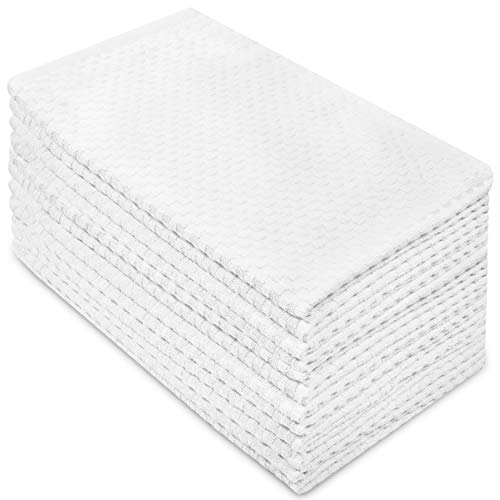
COTTON CRAFT Waffle Terry Kitchen Towels (12 Pack) — Best Waffle Weave
Waffle weave is engineering you can feel: the recessed squares multiply surface area, channel water into the fabric and let air through so the towel dries faster between jobs. COTTON CRAFT’s version — a 12-pack of 100% cotton waffle terry towels at 16 x 28 inches in Euro café style — is the pick for the drying rack and the spill. It suits busy family kitchens, anyone whose towels never fully dry on the hook (waffle’s airflow is the fix), and cooks who like a towel with grip and texture. The textured weave can catch on rough knife edges and graters, and white café styling, like all white cotton, keeps a visible diary of the kitchen’s curries.
Strengths
- Waffle structure absorbs fast and releases water to the air — the quickest-drying working towel here.
- Texture grips wet hands, jars and pan handles with real security.
- Twelve-pack café format looks professional hanging in a row.
Trade-offs
- Texture can snag on sharp edges and rough utensils.
- Not lint-free like flour sack — keep it off the good glassware.
- Waffle towels soften with washing; the first uses feel firmer than the fiftieth.
The damp-towel problem is the home kitchen’s quiet misery: one towel, used for everything, never dry, smelling faintly of its own workload by Wednesday. Waffle weave is the structural answer — a towel that dries itself between breakfast and dinner — and a 12-pack is the numerical answer. Between the two, a household can retire the damp-towel era entirely. If your kitchen has a hook of shame, this is the pack that redeems it.
Best for: drying racks, spills and kitchens fighting the permanently damp towel. / Not suited for: glassware polishing or very delicate work.
Check on Amazon — check the current price on Amazon.

All-Clad Dual-Purpose Kitchen Towels — Best Premium
All-Clad makes the pans chefs swear by, and its towel applies the same buy-it-once logic: a dual-purpose cotton towel, 17 x 30 inches, with two working faces — one smooth for polishing and glass, one textured for absorbency and grip — so a single towel covers jobs that usually take two. It suits cooks building a small, excellent kit, gift-buyers shopping for a serious cook, and anyone downsizing a drawer of mediocrity into a few tools that earn their space. It is a premium purchase bought in small counts; outfitting a whole rotation in All-Clad alone is a budget decision most households will sensibly decline.
Strengths
- Two faces, two jobs: polish and absorb in one towel — the dual-purpose name is literal.
- Generous 17 x 30 inch size folds into a substantial, safe pan-grab.
- Construction quality aimed at years, from a brand whose reputation rides on durability.
Trade-offs
- Premium pricing per towel; full rotations get expensive.
- Sold in small counts, so bulk buyers must look to the Zeppoli or LIVINATI.
- A towel this good tempts owners to baby it — resist; it is built to work.
Think of the All-Clad as the chef’s knife of this guide: not the whole kitchen, but the piece whose quality you feel every time it is in your hand. A sensible premium strategy pairs two or three of these as the finishing and hot-pan towels with a bulk pack for the mess work — excellence where it is touched most, economy where volume rules. As a gift for a cook who has everything, a small stack of these lands with exactly the right weight.
Best for: quality-first cooks, small excellent kits and gifts. / Not suited for: outfitting a high-volume rotation on a budget.
Check on Amazon — check the current price on Amazon.

Zeppoli Classic Dish Towels (15 Pack) — Best Bulk Value
Fifteen towels change a kitchen’s behaviour more than any single great towel can. The Zeppoli Classic pack — fifteen 100% cotton towels at 14 x 25 inches — is the rotation system in its purest form: a clean, dry towel whenever you reach, a laundry load when the drawer thins, and no towel precious enough to spare from the worst jobs. They suit families, heavy cooks, holiday and rental kitchens, and anyone converting from the one-towel life. The per-towel refinement is a step below the Williams-Sonoma — thinner hand, simpler finish — which is the honest trade that bulk pricing makes, and at fifteen deep, nobody notices.
Strengths
- Fifteen towels per pack: the deepest rotation in this guide per purchase.
- 100% cotton that washes hot and often without complaint.
- Cheap enough per towel to assign to oven duty, floor duty and the barbecue without flinching.
Trade-offs
- Thinner and plainer than the premium picks; a workhorse, not a showpiece.
- 14 x 25 inches is a standard working size, not the generous square bakers want.
- Expect to retire individuals over time — the pack system assumes it.
| Mini spec — Zeppoli Classic Dish Towels | |
|---|---|
| Count | 15 pack |
| Size | 14″ x 25″ |
| Fibre | 100% cotton |
| Role | Bulk rotation system |
Professional kitchens run on this arithmetic: towels are consumables with a service life, bought by the dozen, and the system’s hygiene comes from rotation, not from any towel’s heroics. The Zeppoli pack imports that arithmetic home at the friendliest price in the guide. Households that adopt it report the same small revelation — cooking is calmer when a dry towel is always one reach away — and the pack’s plainness is a feature: a towel nobody is precious about gets used as a towel should be.
Best for: families, heavy cooks and anyone building the rotation system cheaply. / Not suited for: buyers wanting a few thick, luxurious towels instead of many good ones.
Check on Amazon — check the current price on Amazon.

LIVINATI Bulk Kitchen Towels for Chefs (12 Pack) — Best Commercial Style
The LIVINATI pack is the closest thing here to what arrives at a restaurant’s back door: twelve white cotton towels at 15 x 25 inches, specified for chefs in commercial kitchens, without a decorative instinct in their bodies. They suit the most serious home cooks — the ones who cook daily, in quantity, and treat their kitchen as a workplace — plus home bakers running small businesses and anyone who wants the professional format exactly. Their commercial plainness is total: these towels will never be photographed for a lifestyle blog, and their white cotton will record every shift until the bleach wash resets it.
Strengths
- Commercial format and construction: sized, weighted and finished for service work.
- Twelve-pack depth for a true daily rotation with hot washes.
- White cotton tolerates the bleach-and-hot-water regime that keeps working towels hygienic.
Trade-offs
- Utilitarian looks — function in its purest, plainest form.
- White demands the bleach habit to stay presentable.
- Overkill for light cooks, who will never rotate twelve towels.
There is a confidence in buying the commercial article: no marketing had to be paid for, no pattern designed, nothing but cotton and stitching between you and the work. For the home cook whose kitchen produces daily dinners, weekend projects and the occasional feast for twelve, the LIVINATI pack is the professional’s answer at a home-kitchen scale. Pair it with the flour sacks for the delicate work and the kitchen is, towel-wise, fully professional.
Best for: serious daily cooks and home-based food businesses. / Not suited for: light cooks or anyone wanting towels that decorate.
Check on Amazon — check the current price on Amazon.
Comparison Table
| Pick | Badge | Key spec | Best for |
|---|---|---|---|
| Williams-Sonoma Pantry Towels ×4 | Best Overall | 100% cotton flat-weave | Best single all-round towel |
| Utopia Flour Sack Towels ×12 | Best Flour Sack | 28″ x 28″, lint-free cotton | Bakers, glassware, delicate jobs |
| COTTON CRAFT Waffle Towels ×12 | Best Waffle Weave | 16″ x 28″ waffle terry cotton | Spills, drying, fast drying |
| All-Clad Dual-Purpose Towels | Best Premium | 17″ x 30″, dual-texture cotton | Quality-first small kits |
| Zeppoli Classic Towels ×15 | Best Bulk Value | 14″ x 25″, 100% cotton | Families, deep rotation |
| LIVINATI Chef Towels ×12 | Best Commercial Style | 15″ x 25″, restaurant format | Serious daily cooks |
How to Choose the Best Chef Kitchen Towels for Your Cooking
Towel drawers fail by accident — a towel for every occasion except the ones that occur. Choose deliberately across weave, count and size, and the drawer becomes a system.
Weave follows the job
Keep three weaves in a working kitchen and every job has its tool. Flour sack for anything that must come away lint-free and dry: glassware, cutlery, screens, dough duty, herb storage. Waffle or terry for volume water: spills, draining boards, wet hands a dozen times an hour. Flat-weave pantry towels for the skilled middle: pan-grabbing, plate-wiping, hand-drying with a finish good enough for serving. A household that cooks seriously will use all three weekly; a light-cooking household can start with the flat-weave set and the bulk pack, and add flour sacks when baking enters their life.
Count is a feature
Professionals do not own better towels than you; they own more of them, and the surplus is what makes the system hygienic. A working home kitchen wants at least a dozen towels in rotation: two in use on any day (one for hands and pans, one for mess), a clean stack in the drawer, and the rest in the wash cycle. That arithmetic is why this guide favours packs — the Zeppoli fifteen and the LIVINATI and Utopia twelves deliver a system in one order, while the premium sets are best bought as the quality layer on top of a bulk foundation.
Size and the pan-grab test
A chef towel’s defining manoeuvre is the folded grab: folded into quarters, it must wrap a pan handle and cushion a palm against oven heat while carrying real weight. That demands a towel at least in the mid-teens of inches in its short dimension, with enough fabric to fold into genuine thickness. It is also a safety rule: never grab a hot pan with a damp towel — water conducts heat straight through to the hand — and never with a thin, single layer. The big flour sacks fold into excellent grabs; the All-Clad’s 17 x 30 was designed for exactly this; the hand-towel-sized novelties at the back of most drawers fail the test entirely and should be retired to bathroom duty.
Fibre: why cotton owns this category
Cotton absorbs more water per gram than synthetics, survives the hot washes working towels need, and — critically around ovens — chars rather than melts if it kisses a hot surface. Microfiber has its place in cleaning kits, but keep it away from hot pans and good glassware alike. Within cotton, judge by weave and weight in the hand rather than thread-count language borrowed from bedding; a towel’s job description is written in its texture.
How to Run a Chef’s Towel System at Home
- Assign two towels per cooking day. One lives at your waist or shoulder for hands and pan handles — kept dry, always. One lives by the sink for mess, spills and wet work. The discipline of keeping the pan towel dry is the system’s core safety habit.
- Fold for the grab. Fold the working towel into quarters before it ever meets a hot handle, so four layers stand between palm and pan. Practise the fold until it is automatic; in a busy moment, automatic is what happens.
- Retire towels daily, not weekly. A working towel goes to the laundry after a day of real cooking — two at most. This is why the count matters: rotation is hygiene, and a towel kept “one more day” is how kitchen cloths earn their smell.
- Wash hot, dry fully, skip the softener. Hot water and a thorough dry keep working cotton hygienic. Fabric softener coats fibres and measurably reduces absorbency — the one laundry product a towel drawer should never meet.
- Bleach the whites without guilt. White commercial and pantry towels are white precisely so they can be bleached back to hygienic brightness. That is the professional regime; coloured and patterned towels are the ones that cannot take it.
- Demote before you discard. A towel whose absorbency fades graduates to floor duty, then to the garage rag bag. A pack bought in bulk makes this lifecycle painless — which is, again, the point of the pack.
- Store folded in one drawer, by weave. Flour sacks together, waffle together, flat-weaves together. In the middle of service — yours or a dinner party’s — nobody should have to excavate for the right towel.
Common Buying Mistakes
- Buying decorative towels for working jobs. Printed, fringed and novelty towels are décor wearing a towel’s shape. They absorb poorly, wash worse and cannot be bleached. Hang one if you love it; work with the picks here.
- Owning too few. The one-towel kitchen is the root of most towel misery. Count is the cheapest quality upgrade in this entire category.
- Using microfiber at the oven. Synthetic fibres and hot metal are a bad pairing, and microfiber smears glass. Cotton is the professional fibre for reasons.
- Grabbing hot pans with a damp towel. Water conducts heat to the hand faster than the pan would alone. The pan towel stays dry — this is the system’s one non-negotiable rule.
- Washing with fabric softener. Softener films the fibres and strangles absorbency. If your towels have gone water-repellent, a hot wash with a cup of white vinegar in the rinse is the traditional rescue.
- Judging by thickness alone. A thick towel that stays damp all day loses to a waffle that dries between uses. Absorbency plus drying speed is the real performance pair.
Final Recommendation
Build the system in two moves. First, the foundation: a bulk pack — the Zeppoli fifteen for value or the LIVINATI twelve for the full commercial format — so rotation never fails. Second, the specialists: the Williams-Sonoma pantry set as the best all-round towel, the Utopia flour sacks for baking and glass, and the COTTON CRAFT waffle pack where spills and drying racks dominate. Add the All-Clad dual-purpose towels when you want the premium layer. That drawer — bulk, pantry, flour sack, waffle — is a professional towel system at home-kitchen scale, and it will out-work any single expensive purchase.
Related guides in this series: Best Dish Towels Ever, Best Dish Towels And Washcloths, Best Flour Sack Dish Towels For Embroidery and Best 800 Gram Towels.
Five Towel Techniques the Pros Rely On
A chef towel is a tool, and tools have techniques. These five, borrowed directly from professional practice, are what separate a towel that hangs in a kitchen from a towel that works in one. The waist tuck: fold the working towel lengthwise and tuck it through a waistband or apron string so it rides at the hip, always in the same place, findable without looking. Muscle memory is the point — in a busy moment, hands should not have to hunt. The handle wrap: when a pan moves from stove to oven or oven to counter repeatedly, wrap its handle in the dry towel once and leave it there; the wrap is both insulation and a warning to every other hand in the kitchen that the handle is hot.
The board anchor: a slightly damp towel spread under a cutting board stops the board skating across the counter — the cheapest knife-safety device in existence, and the reason one towel by the sink is allowed to be damp while the pan towel never is. The rim wipe: before a plate leaves the kitchen, a clean corner of the pantry towel circles the rim; it is the difference between home cooking and plated food, and it takes four seconds. The shoulder rest: during long sessions the second towel lives over the shoulder, not the oven door handle — oven doors open, handles heat up, and a towel that has been warming against a hot door is a nasty surprise for the hand that grabs it. Adopt the five techniques and the towels in this guide stop being linens and start being equipment.
Setting Up the Drawer: A Starter System for Every Budget
For the light cook — a few dinners a week, no baking programme — the minimum viable system is one bulk pack: the Zeppoli fifteen, split between the drawer, the wash and a small stack by the oven. It costs the least per year of any setup here and already beats the one-towel life beyond recognition. For the regular family cook, add specialisation: the bulk pack as the base, a Williams-Sonoma set as the good towels for serving and guests, and a flour sack pack when bread or good glassware enters the picture. That three-layer drawer handles everything a family kitchen produces, including the holiday fortnight.
For the serious cook or home food business, run the professional pattern: the LIVINATI twelves as the white working stock, bleached and hot-washed as a batch; the COTTON CRAFT waffles stationed at the sink and drying rack; flour sacks for finishing; and two or three All-Clad towels kept for the final touches where their dual faces shine. The total investment across all three tiers stays modest — towels are the cheapest professional upgrade a kitchen offers — and the return is paid every single day, in dry hands, safe handles and plates that leave the kitchen looking intended.
Stains, Smells and the Working Towel’s Second Life
A working towel’s enemies are turmeric, tomato, red wine and the sour smell of a towel that dried too slowly once too often. The professional answers are unglamorous and effective. Treat stains as a wash-day category, not a crisis: white cotton — the LIVINATI and pantry whites — takes a hot wash and, when needed, an oxygen or chlorine bleach cycle that resets it entirely; this is precisely why working kitchens buy white. Coloured and waffle towels get a pre-soak in hot water with a scoop of oxygen stain remover before their normal wash, which lifts most of what a week of cooking deposits.
The sour smell is a drying failure, not a washing failure: a towel that sat damp in a heap grows the smell in its fibres, and one hot wash followed by complete, prompt drying usually cures it; a towel that relapses twice has told you its absorbency is gone and its fibres are holding more than water. That towel graduates — to floor duty, to the garage, to the rag bag by the door for muddy paws — and the bulk-pack system absorbs the loss without a shopping trip. This lifecycle, from service to demotion to rag, is not a failure of the towels in this guide; it is the design. Buy in packs, rotate hard, demote without sentiment, and the drawer never contains a towel you are afraid to use.
Towels Beyond the Kitchen: The Ones That Escape
A good chef towel rarely stays in the kitchen, and planning for its travels makes a household run smoother. The barbecue claims towels by the half-dozen: heat, grease, sauce and the outdoors conspire to retire a towel per session, which is why grill cooks buy from the bulk end of this guide and why last season’s demoted Zeppolis find their second career beside the tongs. The bar and coffee corner wants flour sacks specifically — lint-free drying for glassware and portafilters, a drape over the drip tray, a polish for the good tumblers — and a dedicated pair that never meets oven duty keeps the standard honest. The bathroom is where retired kitchen whites often finish, as hand towels that can still be bleached without ceremony; a towel demoted in good order is a household economy, not a failure.
And the car and workshop inherit the end of the line: the flour sack that wrapped a headlight bulb, the waffle towel that dried a dog at the door, the pantry towel under a kneeling mechanic. None of this is misuse — it is the lifecycle the bulk packs were priced for. The only discipline worth keeping is direction: towels travel outward from the kitchen as they age, never back inward. The towel that has dried a car does not return to dry glasses, however clean it looks. One-way traffic, honestly observed, is what lets a household be relaxed about the whole system.
Building the Habit: The First Two Weeks With a Real Towel System
Households converting from the one-towel life usually fail in the first fortnight, not from cost but from habit gravity — the old towel keeps being reached for, the new stack stays folded, and the system never ignites. The fix is choreography, not willpower. On day one, remove the old towels from the kitchen entirely — to the rag bag, the bathroom, anywhere that is not the hook — so the new system is the only system available to a reaching hand. Put the working pair out: one at the waist point or oven-side hook for pans and hands, one at the sink for mess, with the clean stack visible in an open drawer or basket rather than hidden in a cupboard. Visibility is the mechanism; a system you can see is a system you use.
Through the first week, run the laundry rhythm deliberately: used towels into a designated basket each night, a hot wash when the basket fills, folded stock straight back to the visible stack. By the second week the rhythm stops being a project and becomes the kitchen’s background — a dry towel is simply always there, the way a sharp knife is always there in a kitchen that maintains one. That is the moment the purchase pays off, and it is also the moment to notice what the system still lacks: most households discover it is a weave, not a count — flour sacks for the baker, waffles for the spill-prone — and the second purchase, made from experience rather than guesswork, completes the drawer for years.
The Towel Audit: Sorting the Drawer You Already Own
Before any purchase in this guide, spend ten minutes with the drawer you have — the audit tells you which layer of the system you actually need. Tip every towel onto the counter and sort without mercy into four piles. Keepers: cotton towels that still absorb instantly when a corner is dipped in water — these join the new system today, whatever their age. Demotions: towels that absorb slowly, feel thin or carry a permanent shadow of stains — they go to floor, car and garage duty, where their remaining life is still useful. Décor: the printed, fringed and gifted towels that were never really towels — hang the one you love, release the rest, and stop asking them to do a job they were not built for. Departures: anything that smells after washing, sheds fibres into food’s vicinity, or has gone water-repellent beyond a strip wash’s rescue.
Most households discover the same audit result: three keepers, a drawer of demotions pretending to be a rotation, and a décor section larger than the working one. That result maps precisely onto this guide’s buying order — a bulk pack to become the rotation the demotions were impersonating, then specialists as cooking demands them. The audit also sets the count honestly: if the keeper pile plus one bulk pack reaches a dozen working towels, the system is complete and the premium layers can wait for a birthday. Ten minutes, four piles, and the drawer goes from archaeology to equipment — which is where every other improvement in this guide begins.
A Final Word on Buying With Confidence
No purchase in this guide will transform a kitchen on its own, and that is the towels’ honest charm: they are the cheapest professional system a home cook can adopt, working in dozens of small moments a day rather than one dramatic reveal. Buy the count before the luxury, the weave before the colour, and cotton before everything — then run the rotation, keep the pan towel dry, and let the drawer do what professional drawers have always done. A month from now, the measure of success will not be how the towels look hanging in a row. It will be that you stopped noticing them at all, because a clean, dry, capable towel was simply always where your hand expected it to be.
Start tonight, if you like, with the smallest possible version of the system: two towels out, one dry at the oven side and one working at the sink, and the rest of the drawer ignored. Even that miniature of the professional method will show you, within a single cooked dinner, why chefs organise their kitchens around a piece of cotton cloth — and why the full system in this guide tends to follow within the month.
Related guides
Frequently Asked Questions
What makes a towel a “chef” towel rather than a regular kitchen towel?
Function and format: cotton construction that absorbs seriously and survives hot washing, a working size that folds into a safe pan-grab, plain styling that tolerates bleach, and — in professional practice — enough of them to rotate daily. A chef towel is defined by the system it belongs to as much as by its weave.
How many kitchen towels should a home cook own?
At least a dozen in rotation for a household that cooks daily: two in use, a clean stack ready, and the rest cycling through the wash. Light cooks can run fewer, but below six, towels get kept past their hygienic day — the false economy this category exists to end.
Are flour sack towels really better for glassware?
Yes — their thin, smooth cotton is effectively lint-free, so glasses and cutlery dry without fibres, and the big squares handle volume quickly. Keep them for the dry, delicate work; their thinness saturates fast on spills, which is what the waffle and terry picks are for.
Can I use a kitchen towel as a potholder?
Yes, with the professional’s rules: fold it into quarters for real thickness, and make sure it is completely dry — a damp towel conducts heat to your hand dangerously fast. Purpose-made mitts still win for heavy roasting trays and long carries; the folded towel is the master of the quick grab and the pan-handle wrap.
Why have my towels stopped absorbing water?
Usually fabric softener or detergent build-up coating the fibres. A hot wash with white vinegar in the rinse, or a wash with no detergent at all, strips the film and restores most towels. After that, keep softener away from the towel load permanently.
How often should chef towels be replaced?
When absorbency fades despite a strip wash, when edges fray into strings, or when a towel keeps an odour through a hot wash. In a bulk rotation that is typically a graceful, one-at-a-time retirement — demote the tired ones to floor and garage duty and let the pack absorb the loss.


