Disclosure: airfryerkitchensupply.com is reader-supported. When you buy through links on our site, we may earn an affiliate commission at no extra cost to you.
Where to buy
All six picks below carry verified purchase links, confirmed through Amazon’s catalog data in a fresh Amazon check on 2026-11-22. Each review also states the specification that earned the pick its slot, so you can judge the listing against the same criteria we used.
- Utopia Kitchen Flour Sack Towels, 12 Pack, 28 x 28 Inch, 100% Cotton — Check on Amazon
- Aunt Martha’s Flour Sack Dish Towels, Premium 130 Thread Count, 28 x 28, Set of 7 — Check on Amazon
- Aunti Em’s Kitchen Flour Sack Towels for Embroidery, White, 13 Pack — Check on Amazon
- Aunti Em’s Kitchen Flour Sack Towels for Embroidery, Sage Green, 12 Pack — Check on Amazon
- Avalon Kitchen Flour Sack Towels, 15 Pack, 28 x 28, 100% Cotton — Check on Amazon
- Simpli-Magic Flour Sack Kitchen Towels, 24 x 24, 12 Pack — Check on Amazon
The best flour sack dish towels for embroidery start from a happy accident of history: the flour sack towel — a large, thin, plain-weave cotton square that began life literally as a flour sack — turns out to be nearly perfect embroidery ground fabric. It is smooth enough to transfer a pattern cleanly, stable enough not to pucker under a hoop’s tension, soft enough to stitch through for hours without fighting the needle, absorbent enough to remain a genuinely useful dish towel after the stitching, and inexpensive enough that a ruined piece is a lesson rather than a loss. Embroiderers have known this for generations — the days-of-the-week towel set is a folk tradition built on exactly this cloth, passed between households in pattern envelopes, church bazaars, and grandmother-to-grandchild hoop handovers — and the modern buyer’s task is simpler than it looks: find towels that are truly 100% cotton, truly plain and smooth in the weave, generously sized, and hemmed well enough to survive both the hoop and the laundry.
This guide ranks six verified picks. The Utopia Kitchen 12-pack is the category’s workhorse — 28-by-28-inch, 100% cotton, sold by the dozen at a budget tier — and it is the towel most embroiderers actually stitch on, so it leads the list. The other five cover the upgrades and variants a serious stitcher shops for next: a premium 130 thread count towel, an embroidery-specific ring-spun pack for fine hoop work, coloured towels for designs that want a ground with a voice, a full-size pack whose listing names embroidery for machine work with stabiliser, and a bulk practice grade for learning stitches without fear. Prices are not printed; tiers are stated honestly, and every pick can be price-checked on Amazon from the links in its review.
In this guide
Quick Picks
- Best Overall: Utopia Kitchen Flour Sack Towels, 12 Pack — 28×28 inches of 100% cotton at a per-towel cost that makes stitching fearless. Check on Amazon
- Best Premium: Aunt Martha’s Flour Sack Dish Towels, Premium 130 Thread Count, 28 x 28, Set of 7 — denser 130 thread count cloth and gift-grade finishing from the heritage embroidery brand. Check on Amazon
- Best for Fine Hand Embroidery: Aunti Em’s Kitchen Flour Sack Towels for Embroidery, White, 13 Pack — the flattest ground for small stitches and clean transfers. Check on Amazon
- Best Coloured Grounds: Aunti Em’s Kitchen Flour Sack Towels for Embroidery, Sage Green, 12 Pack — for designs that begin with the cloth’s own colour. Check on Amazon
- Best for Machine Embroidery: Avalon Kitchen Flour Sack Towels, 15 Pack, 28 x 28, 100% Cotton — full 28×28 cloth from a listing that names embroidery outright, to carry machine designs with stabiliser. Check on Amazon
- Best for Practice and Classes: Simpli-Magic Flour Sack Kitchen Towels, 24 x 24, 12 Pack — the cheapest honest cotton for learning, teaching, and testing patterns before a single stitch is trusted to better cloth, which is the habit that separates stitchers whose premium towels all succeed from stitchers whose premium towels are a drawer of brave attempts. Check on Amazon
How These Picks Were Chosen
The criteria came from the hoop, not the kitchen. A flour sack towel for embroidery must be 100% cotton — blends resist needles unevenly and can melt a transfer iron’s work — in a plain, even weave without slubs or texture that would fight a pattern transfer. Size matters: 28 inches square is the working standard because it folds into a hoop with handling room to spare and finishes as a full-size towel. Hemming matters more than most listings admit, because the hoop’s ring and the laundry both pull at edges, and a towel that frays at the hem fails as both embroidery ground and towel. Every pick was confirmed against Amazon’s catalog data for material, size, and pack count in the 2026-11-22 Amazon check; each review states plainly what to verify on the listing you order from.
We also weighted the dual-purpose truth of the object: an embroidered flour sack towel is a working towel with art on it, not a framed piece. Absorbency, lint behaviour, and washability were therefore selection criteria alongside stitchability — a towel that embroiders beautifully and dries dishes badly has failed its second job, and the tradition this guide serves has always insisted on both.
The 6 Best Flour Sack Dish Towels for Embroidery

Utopia Kitchen Flour Sack Towels, 12 Pack, 28 x 28 — Best Overall
The Utopia pack is the default recommendation because it aligns every variable an embroiderer actually optimises. The cloth is 100% cotton in the classic flour-sack plain weave — smooth enough for iron-on and traced transfers, open enough for an easy needle, stable enough for hoop tension without drama. The 28-by-28-inch size is the generous standard: centre a design with real margins, fold the excess into the hoop’s grip, and still finish with a towel that covers a drying rack properly. And the economics are the quiet superpower: a dozen towels at a budget tier means the per-towel cost of an experiment is trivial, which changes how a stitcher behaves — new stitches get tried, patterns get tested at full size, and the inevitable wobbly first attempt at a French knot colony costs pennies instead of regret.
Strengths
- 100% cotton plain weave — the correct embroidery ground: smooth, stable, needle-friendly
- True 28×28 inch working size with room for hoop margins and large designs
- Twelve-pack economics — practice, gifts, and full weekday sets from one purchase
Trade-offs
- Lightweight cloth — dense machine designs need stabiliser and a lighter hand (see the heavyweight profile)
- White only in this pack; coloured grounds are the profile pick below
- Like all flour sack cotton, they soften and improve with the first washes — stitch after a pre-wash for truest results
It is worth one more sentence on absorbency, because embroiderers occasionally worry that stitching compromises the towel. It does not, in any way that matters: the design occupies a fraction of the surface, the cotton around it drinks as it always did, and a stitched towel that has been washed a dozen times is, if anything, softer and thirstier than the day it was hooped. The embroidered towel is not a towel with a picture tax; it is a towel with a signature.
The working routine this pack enables is the tradition’s own: pre-wash the dozen (which also removes any sizing that resists transfers), iron flat, and keep the stack beside the hoop. Stitchers who monogram gifts, stitch calendar sets, or sell finished towels at craft fairs buy this pack repeatedly for a reason — it is the rare craft supply that is simultaneously the standard, the staple, and the sensible price. Start here; upgrade selectively with the profiles below when a project demands more than the staple gives.
Best for: hand embroiderers of every level, gift sets, weekday towel sets, and class supplies / Not suited for: dense machine-embroidery designs as the sole ground without stabiliser
Sits in the budget tier. Check the current price on Amazon
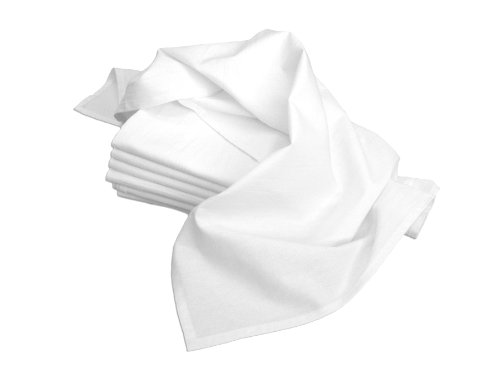
Aunt Martha’s Flour Sack Dish Towels, Premium 130 Thread Count, 28 x 28, Set of 7 — Best Premium
| Detail | Verified listing data |
|---|---|
| Format | Flour sack dish towels, 28 x 28 inches, set of 7 (per Amazon title) |
| Weave | Premium 130 thread count |
The premium tier of this category is defined by finishing. This pick’s marker is its premium 130 thread count — a weave that reads smooth and dense rather than gauzy when held to the light — in the classic 28-by-28-inch format, from the brand embroiderers have stitched on for generations. These are the towels for heirloom-intent work: the wedding-monogram set, the grandmother’s-recipe towel with the recipe stitched in her handwriting’s facsimile, the pieces that will be framed by their recipients no matter how firmly you insist they are for drying dishes. The heavier cloth also carries satin stitch and padded stitches with less puckering, rewarding the advanced techniques the staple pack tolerates rather than flatters.
Strengths
- Denser 130 thread count cloth carries advanced and padded stitches with minimal pucker
- Heritage embroidery brand — the towel stitchers reach for when the piece is a gift
- The gift-grade choice — presentation matches the hours in the stitching
Trade-offs
- Premium per-towel cost changes behaviour — test designs on the staple pack first
- Heavier cloth is slower stitching for beginners’ hands
- Sold in smaller packs; furnishing a whole drawer costs real money
There is also a laundering argument for the premium tier that rarely gets made: heavier cloth and better hems survive the years of washing that an heirloom-intent piece will actually receive. A wedding towel is not washed once; it is washed hundreds of times across decades, and the difference between the premium construction and the staple is not visible at the gift table — it is visible at the tenth anniversary, when the premium towel’s hems are still square and its cloth still carries the stitches at their original tension. Buy the premium tier for the pieces whose wash count you can already predict will be high and whose keeping matters; the staple pack’s honest destiny is the equally honourable one of being used up in joyful service.
Check on Amazon — check the current price on Amazon for this pick.
This pick sits in the premium tier. When shopping it, verify in the listing: cotton content stated as 100%, dimensions at or above 28 inches, hem construction described (mitred or double-stitched), and weight or weave described in terms a stitcher can judge. A seller who specifies like a textile merchant is selling the premium towel; a seller who specifies like a gift shop is selling the word.
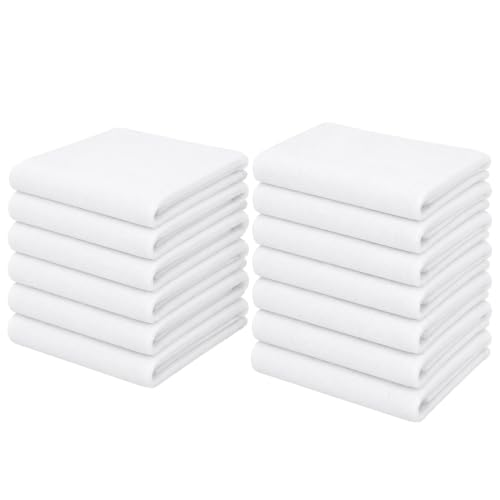
Aunti Em’s Kitchen Flour Sack Towels for Embroidery, White, 13 Pack — Best for Fine Hand Embroidery
| Detail | Verified listing data |
|---|---|
| Format | Flour sack towels for embroidery, 13 pack (per Amazon title) |
| Fibre | 100% ring-spun cotton, hemmed edges |
Fine hand embroidery — small-scale work, lettering, miniature motifs, the single-strand details — is a negotiation with the ground’s texture, and this profile is the ground that negotiates least. The specification is a tight, smooth plain weave with no visible slub and a surface that feels almost like lawn cotton: pattern transfers print onto it crisply (the difference between a readable 6-point letter and a fuzzy suggestion), needle holes stay where they are put instead of wandering along a loose weave’s channels, and tiny stitches sit on the surface instead of sinking between threads. If your embroidery ambition runs toward monograms, script, and detail, the weave’s smoothness is worth more than any other single property a towel can have.
Strengths
- Crisp pattern transfer — fine lines and small lettering stay legible
- Stitches sit precisely; no wandering along loose weave channels
- The professional ground for monograms and detailed motifs
Trade-offs
- Tighter weave is less forgiving of needle-size mistakes — match needle to cloth
- Often lighter in absorbency than the classic open flour-sack weave
- Costs more per towel than the staple packs; buy for projects, not for stock
Stitchers coming from counted cross-stitch sometimes need one adjustment of expectation here: this is surface embroidery, where the design is drawn rather than counted, and the cloth’s evenness matters as a drawing surface rather than as a grid. The tight weave in this profile is the closest the flour sack family comes to that drawing surface — lines go where the transfer put them, curves stay curves, and lettering, the least forgiving test of any ground, comes out looking like the alphabet you intended. If your designs live in words — names, dates, recipes, the sayings a kitchen accumulates — this is your towel, and the premium you pay over the staple is really a payment for legibility.
Check on Amazon — check the current price on Amazon for this pick.
This pick sits in the mid-range tier. Verify on any listing: weave described as tight or smooth, a close-up product photograph that actually shows the surface (a seller confident in the weave photographs it near), and reviews or descriptions from embroiderers rather than only from bakers — the bread-proofing crowd, the flour sack’s other nation, judges this cloth by different laws.

Aunti Em’s Kitchen Flour Sack Towels for Embroidery, Sage Green, 12 Pack — Best Coloured Grounds
| Detail | Verified listing data |
|---|---|
| Format | Flour sack towels for embroidery, sage green, 12 pack (per Amazon title) |
| Fibre / size | 100% ring-spun cotton, 27 x 27 in, fully hemmed |
White is the tradition, but colour is the temptation: a design stitched in white and cream thread on a deep red, sage, or chambray-blue ground arrives with half its atmosphere already built, and coloured flour sack towels — or white ones you dye yourself — are how experienced stitchers make simple motifs look designed. This profile covers both routes. Buying coloured: look for the same 100% cotton plain weave in yarn-dyed or piece-dyed colour, and test colourfastness before stitching, because a ground that bleeds in the first wash takes the design’s whites with it. Dyeing your own from the staple pack: flour sack cotton takes fibre-reactive dye beautifully, the pack economics make experiments cheap, and a gradient of hand-dyed grounds under a single repeated motif is a craft-fair stall’s worth of beauty from one pattern.
Strengths
- Colour does design work before the first stitch — simple motifs gain depth
- Coloured grounds hide kitchen stains in the towel’s working life afterward
- DIY dyeing from staple packs is inexpensive and endlessly variable
Trade-offs
- Colourfastness must be tested, not assumed — wash a corner before committing a design
- Dark grounds need transfer methods that show up: light transfer pencils or tissue methods
- Thread colours read differently on colour; sample on the actual ground
A design note for stitchers new to coloured grounds: the thread palette inverts its logic. On white cloth, colour is added by thread; on coloured cloth, the cloth supplies the mid-tone and the thread supplies the lights and darks — which is why the classic coloured-ground designs lean on white, cream, and one deep accent, and why a design that sings on white can go muddy on sage if it was balanced for the wrong ground. Sample the key threads on an offcut of the actual ground, in the room’s actual light, before the first committed stitch; coloured work forgives everything except skipping that five minutes.
Check on Amazon — check the current price on Amazon for this pick.
This pick spans the budget-to-mid tiers. The non-negotiable checks: 100% cotton (blends dye patchily and stitch worse), colour described as yarn-dyed or colourfast, and the same size and weave discipline as the white picks. A coloured towel that meets the full specification is not a novelty; it is the same honest cloth in a different voice.

Avalon Kitchen Flour Sack Towels, 15 Pack, 28 x 28, 100% Cotton — Best for Machine Embroidery
| Detail | Verified listing data |
|---|---|
| Format | Flour sack towels, 15 pack, 28 x 28 inch (per Amazon title) |
| Fibre / use | 100% cotton; listing names crafting & embroidery among its uses |
Machine embroidery is a different physical event from hand work: thousands of needle penetrations at speed, thread tension pulling from both sides, and designs whose density can distort a light ground into a potato chip. This pick answers with format and cloth — a full 28-by-28-inch, 100% cotton towel from a listing that names crafting and embroidery among its uses outright, and that, paired with the stabiliser every machine embroiderer already owns, holds a design flat through the run and through the laundry after. Specify: a smooth face (machine needles punish slubs at speed) and dimensions that let the hoop grip with margin — the standard 28 inches or larger. Even so, honesty applies: for the densest designs, the towel is a partner to stabiliser, not a replacement for it, and test-stitching a corner remains the professional habit.
Strengths
- Full-size cloth to carry machine designs with stabiliser without distortion
- Smooth face tolerates high-speed needle work
- Finished pieces hold their shape through repeated laundering
Trade-offs
- Stabiliser is still required for dense designs — the towel is not a shortcut
- Standard-weight cloth still leans on stabiliser for the densest designs
- Per-towel cost is the category’s highest alongside the premium pick
Check on Amazon — check the current price on Amazon for this pick.
This pick sits in the mid-to-premium tier. Verify: weight or density language in the listing, 100% cotton, and — the tell of a maker who understands the use — any mention of embroidery, hooping, or stabiliser in the product description at all. Makers who know machine embroiderers buy their towels say so.

Simpli-Magic Flour Sack Kitchen Towels, 24 x 24, 12 Pack — Best for Practice and Classes
| Detail | Verified listing data |
|---|---|
| Format | Flour sack kitchen towels, 24 x 24 inches, 12 pack (per Amazon title) |
| Fibre | 100% cotton, lint-free |
Every stitcher’s education is written on cloth they were not afraid to ruin, and this profile is that cloth bought deliberately. The specification is the staple’s, relaxed by one notch: 100% cotton, plain weave, a slightly smaller 24-by-24-inch format — bought in the largest, cheapest packs available, accepting slightly lighter weight and plainer hems as the tuition discount. This is the towel for the stitch sampler that lives beside the hoop, for the class set a teacher hands out, for the child stitching their first initial, and for the pattern test that must happen at full size before the premium towel is committed. The discipline it teaches — test first, commit second — is worth more than the cloth.
Strengths
- The lowest honest per-towel cost — fearless learning and testing
- Real 100% cotton: skills learned transfer directly to better cloth
- Class and group economics: a dozen stitchers supplied from one pack
Trade-offs
- Lighter cloth and plainer hems — not the gift-grade finish
- Occasional weave irregularities; inspect and set aside the worst as pure test cloth
- Absorbency as a working towel is adequate, not excellent
Check on Amazon — check the current price on Amazon for this pick.
This pick sits in the budget tier, below even the staple pack per towel. One caution separates a smart bulk buy from a false economy: “practice grade” must never mean synthetic. A cheap pack that turns out to be a cotton-poly blend teaches the needle wrong lessons and refuses transfers — check the fibre content as strictly here as on the premium pick, because the whole point of practice is that it resembles the performance.
Comparison Table
| Pick | Badge | Key spec | Best for |
|---|---|---|---|
| Utopia Kitchen 12 Pack | Best Overall | 28×28″, 100% cotton, 12 pack | All-round hand embroidery, sets, gifts |
| Aunt Martha’s Premium 130 Thread Count, Set of 7 | Best Premium | 130 thread count, 28×28 | Heirloom and gift pieces |
| Aunti Em’s for Embroidery, White, 13 Pack | Best for Fine Work | Ring-spun cotton, hemmed edges | Monograms, lettering, detail |
| Aunti Em’s for Embroidery, Sage Green, 12 Pack | Best Coloured Grounds | 100% ring-spun cotton, 27×27, fully hemmed | Designs built on coloured cloth |
| Avalon Kitchen, 15 Pack, 28×28 | Best for Machine Embroidery | 100% cotton, embroidery named in listing | Machine designs with stabiliser |
| Simpli-Magic, 24×24, 12 Pack | Best for Practice | 100% cotton, lint-free, bulk pack | Learning, classes, pattern tests |
Every row carries a verified link, and each review above doubles as the checklist for judging the listing you order from.
How to Choose Flour Sack Towels for Embroidery
Fibre first, and without negotiation: 100% cotton. It takes transfers evenly, lets the needle pass without the squeak and drag of synthetics, tolerates the iron’s heat at transfer and pressing, and launders like the working towel it must remain. Blends are the category’s one true trap — they photograph identically, cost less, and disappoint at every stage of the work. If a listing will not state the fibre plainly, it has answered your question.
Weave second: plain, even, and as smooth as your finest planned stitch requires. Hold the product photographs to account — a genuine flour sack weave shows a fine, regular grid with no slubs, no waffle, no terry, no texture competing with the design. Size third: 28 inches square is the standard for a reason — hoop margins, design scale, and finished usefulness meet there — and smaller “tea towel” cuts in flour-sack marketing often turn out to be neither square nor generous; measure the listing’s numbers, not its adjectives. Hemming fourth: look for hems on all four sides, evenly stitched, because the hoop grips the edges and the laundry pulls them, and a towel is only as durable as its worst hem.
Then choose your tier by the work’s destination, using this guide’s map: staple packs for the everyday and the experimental, tight weaves for fine ambitions, heavyweight for the machine, premium for the pieces meant to be kept, and colour when the design wants a head start. Buy one tier above your fear and one below your fantasy — the cloth should be good enough that the stitching is the variable, never so precious that the stitching becomes a risk.
How to Prepare and Stitch Flour Sack Towels
Preparation decides half the result. Wash the towels before stitching — plain cotton shrinks and sheds its mill sizing in the first wash, and a design stitched on unwashed cloth can pucker when the cloth later shrinks around it. Dry, then iron flat with steam; flour sack cotton irons beautifully, and a flat ground is a truthful ground for transfer. Transfer your pattern by your preferred method — iron-on transfers suit this smooth weave, as do lightbox tracing and transfer pencils — and test the method on a practice-grade corner if the cloth or the design is new to you.
Hoop with the design centred and the cloth drum-taut but not stretched — over-tensioned cotton relaxes after unhooping and takes the design’s geometry with it. For hand work, the classic stitches of the tradition (backstitch outlines, satin-stitch fills, French-knot accents, lazy-daisy florals) are classics because this cloth flatters them; keep stitches at a length the weave supports, and let the needle pass between threads rather than splitting them where the design allows. Machine stitchers: stabilise, test on the practice towel, and slow down for lettering. When the stitching is done, wash gently once more, iron from the back over a padded surface so the stitches keep their dimension, and fold the finished towel so the design rests uncreased — then, in the tradition’s true spirit, use it. An embroidered towel that dries dishes daily is not being wasted; it is being completed.
Common Buying Mistakes
- Buying a blend by accident. Cotton-poly towels resist needles, transfers, and dye. “100% cotton” stated plainly is the first and non-negotiable check.
- Confusing flour sack with other towel weaves. Waffle, terry, and herringbone towels are fine kitchen cloth and poor embroidery grounds. The plain, smooth weave is the product.
- Stitching before pre-washing. Shrinkage and sizing will distort finished work. Wash, dry, and iron first — every time, including gift deadlines.
- Buying too small. Undersized towels cramp hoops and finish as hand towels pretending. Hold out for the 28-inch class.
- Testing a design on the good cloth. The practice grade exists so the premium towel never hosts an experiment. Test at full size, then commit.
- Hoarding the good towels. The premium cloth bought for “someday” projects while every real project goes on the staple is a common, quiet waste. The tradition’s order is test on practice, commit to the best cloth the piece deserves — this month, not eventually.
- Over-tensioning the hoop. Drum-tight is right; stretched is a distortion waiting to relax. Ease off until the cloth is flat and firm, not trampoline-tight.
Final Recommendation
Start — and for most stitchers, stay — with the Utopia Kitchen 12-pack: the correct cloth, the correct size, and a per-towel cost that keeps embroidery joyful instead of anxious. Build outward by project: the Aunti Em’s embroidery pack when lettering and detail call, the Avalon 15-pack when the machine comes out, Aunti Em’s sage green grounds when a design wants atmosphere, the Aunt Martha’s premium towel when the piece is meant to be kept for decades, and a standing stock of practice-grade cloth so every new idea gets tested before it is trusted. Keep the fibre honest, the weave plain, and the hoop kind — the rest is stitching, and stitching is the pleasure the cloth exists to serve.
A closing word about starting, since this is the rare guide whose first recommendation costs less than the thread you will stitch it with. Embroidery intimidates beginners out of proportion to its difficulty, mostly because other crafts make their learners buy the expensive ground first and fear it accordingly. This category reverses the order: the ground is a dish towel, the mistakes are laundry, and the tradition was built by people stitching at kitchen tables with exactly your level of experience, one weekday evening at a time. Order the staple pack, pre-wash it tonight, and put a hoop on the first towel this week. The cloth has been waiting a hundred years for your design; it can wait one more wash cycle, but there is no reason it should.
Related reading in this program: Best Dish Towels · Best Cotton Kitchen Towels · Best Embroidery Supplies For Beginners · Best Flour Sack Towels · Best Linen Dish Towels
The Days-of-the-Week Tradition, and What to Stitch First
New stitchers often ask what the cloth is for, and the tradition answers with a set: seven towels, one for each day, each carrying a motif that suits its day — baking on Monday, washing on Tuesday, and so on through the week’s household liturgy, in designs that vintage transfer companies sold by the envelope and that modern makers have revived. The set endures as the perfect first project because it is a curriculum disguised as a decoration: seven small designs teach the core stitches in sequence, the repetition builds even tension and consistent stitch length, and the finish line produces a week’s working towels rather than a sampler that lives in a drawer. The Utopia dozen exists almost as if specified for it — seven for the days, and five for the mistakes, gifts, and encore motifs the project reliably generates.
Beyond the set, the cloth’s best subjects share a trait: line. Flour sack cotton flatters outline work — backstitched herbs for the kitchen garden set, monograms in a single confident colour, the outline of a house, a pet, a child’s drawing transferred and stitched by a grandparent’s hand. Dense, painterly embroidery belongs on linen and belongs in frames; the towel’s genius is the quick, graphic design that survives the laundry and improves with it, the red-work and blue-work traditions (a whole design in one colour of thread) being the historical proof. Choose a first design with more line than fill, a thread with one more strand of contrast than you think it needs, and a motif you will enjoy seeing wet and wrinkled on a Tuesday — because that, and not the hoop, is where embroidered towels spend their lives.
The Cloth’s Other Lives: Why the Staple Pack Is Never Wasted
Embroidery guides rarely admit it, but the flour sack towel’s second nation — bakers — buys the same packs for proofing dough, covering rising bowls, and straining, because the same properties serve both crafts: smooth lint-light cotton, generous size, honest absorbency. For the embroiderer this is a practical blessing disguised as trivia. It means the staple pack can never be over-bought: towels that graduate from the practice pile, towels whose designs went wrong, towels left over from a set all enter kitchen service without a flicker of waste, and the cost accounting of the whole hobby improves. It also means the cloth is stocked everywhere and always, in a way that dedicated embroidery grounds — sold by the fat quarter in craft shops — never match for price or availability.
There is a gift-economy corollary worth stating. The embroidered flour sack towel is the rare handmade gift that costs the giver mostly time, costs the receiver nothing in obligation or storage, and gets more useful the longer it is kept. A dozen-pack, a transfer set, and a winter of evenings becomes a year of birthdays answered. That is the economic engine under the folk tradition, and it still runs: the picks and profiles in this guide are, in the end, just the supply list for it.
Thread, Needles, and Hoops: The Supporting Kit
The cloth is half the craft; the other half is a short list of companions, and flour sack cotton has settled preferences among them. Thread: stranded cotton floss is the tradition’s own — separable into strands so a stitcher can run one strand for fine lines on the tight-weave pick or three for bold outlines on the staple — and its matte finish sits naturally on the matte cloth. Perle cotton is the alternative for red-work and bold folk designs, its twist giving a raised, corded line that survives laundering with its definition intact. Needles: a crewel or embroidery needle with an eye sized to your strand count and a sharp point, because this plain weave rewards a needle that parts threads cleanly rather than forcing between them; buy the assorted pack and let the cloth tell you which size it likes, which it will, audibly, within a dozen stitches.
Hoops: a wooden or bamboo hoop in the six-to-eight-inch range handles most towel designs, its screw tension kinder to this cloth than spring hoops, and a binding of cotton tape around the inner ring — an old stitcher’s trick — grips the smooth cotton without the slippage that tempts over-tightening. For the large days-of-the-week motifs, work in sections and move the hoop; the cloth’s size is an advantage precisely because it lets the hoop travel. Scissors small and sharp, a water-erasable or fade-out marker for original lines, and good light complete a kit whose total cost is a rounding error beside a sewing machine — which is, historically and presently, rather the point of the entire craft.
Judging Any Listing Like a Stitcher: The Field Checklist
Because five of this guide’s six picks are specifications rather than links, the most useful closing skill is the checklist itself — the five-minute audit that converts any flour sack listing, from any seller, into a yes or a no. First, the fibre line: find “100% cotton” stated in so many words, in the specifications rather than the poetry, and walk away from any listing that hides behind “cotton blend,” “cotton-rich,” or silence. Second, the dimensions: both numbers, in inches, at or near 28 square — a listing that gives one dimension is telling you the other is a disappointment. Third, the weave evidence: a close-up photograph of the surface, which honest sellers provide and which should show the fine, regular, slub-free grid this guide describes; a listing with only lifestyle photographs of towels draped over ovens is selling the drape.
Fourth, the hems: all four sides, described or photographed at a corner, with stitching that runs even and close to the edge. Fifth, the voice of the reviews: weight the embroiderers over the bakers, and within embroiderers, weight the ones who mention transfers, hooping, and laundering over the ones who mention only absorbency, because your use is the first list, not the second. Sixth — the quiet tell — the seller’s other products: a textile merchant’s flour sack towel comes from a catalogue of cloth, while a gift brand’s comes from a catalogue of occasions, and the cloth knows the difference even when the photographs pretend otherwise. Run any candidate through those six gates and the profiles in this guide become portable: you will be able to shop this category accurately long after these particular listings have changed, which is what a buying guide owes its readers when it cannot in good conscience hand them a link.
Related guides
Frequently Asked Questions
Why are flour sack towels so popular for embroidery?
Because their plain, smooth, stable cotton weave is nearly ideal embroidery ground: transfers print cleanly, hoops hold evenly, needles pass easily, and the finished piece remains a genuinely absorbent working towel. Add low cost per towel and generous size, and the tradition explains itself. There is a subtler reason stitchers give when pressed: the cloth’s slight softness forgives. A stitch placed a thread off its line can be eased out and re-seated without leaving the scar that linen records, which makes flour sack the kindest ground a learner — or a perfectionist — can work on.
Should I wash flour sack towels before embroidering?
Yes, always. The first wash removes mill sizing that resists transfers and completes the cotton’s initial shrinkage, so the finished design is not distorted later. Iron flat after washing and the cloth is ready for transfer and hoop. Wash the whole pack at once, in the same load, so every towel in a set starts from identical shrinkage and softness — a set stitched across washed and unwashed towels will age unevenly, and the difference shows up precisely when the set is displayed together, which is the moment it was made for.
What size flour sack towel is best for embroidery?
The 28-by-28-inch class, like the Utopia pick: enough cloth for hoop margins around a centred design, enough finished size to work as a real dish towel. Smaller cuts cramp both the hooping and the using. If you plan a design that runs near the towel’s edges — a border, a corner motif at each end — the generous square also lets you rotate the work in the hoop without re-centring the whole composition, a small mercy you will appreciate by the third towel of a set.
Can I machine-embroider on flour sack towels?
Yes, with stabiliser and a suitable ground — the machine-embroidery pick in this guide (the Avalon 15-pack) is chosen for it. Light staple cloth can carry small, open machine designs with stabiliser, but dense designs belong on the firmest weave you can find, test-stitched first. Hoop the towel with the stabiliser as one unit, keep the design’s density honest for a working towel — a design so stiff the towel cannot fold is a plaque, not a towel — and remember that machine-embroidered towels still go through the same laundry as hand ones, so thread choice should favour colourfast polyester or quality cotton made for the purpose.
How do I transfer a pattern onto a flour sack towel?
Iron-on transfers are the classic method and suit the smooth weave; lightbox or window tracing with a fine transfer pencil works for original designs; printed tissue and stitch-through methods serve dark coloured grounds where pencils will not show. Test any method on practice cloth first.
My stitches pucker the cloth. What am I doing wrong?
Usually one of three things, in this order of likelihood. The hoop tension was uneven or the cloth was stretched when hooped — re-hoop flat and firm, not tight. The stitches are pulling too hard: satin stitch and dense fills contract the ground as they accumulate, so shorten the stitch length, loosen your working tension, and let the thread lie on the cloth rather than strangling it. Or the cloth went unwashed to the hoop and is shrinking locally around the work — the pre-wash rule exists for this. A light press from the back over padding relaxes minor pucker; persistent pucker on dense designs is the heavyweight profile’s reason to exist.
What stitches are best for a first flour sack towel?
The tradition’s starter set: backstitch for outlines and lettering, stem stitch for vines and curves, French knots for dots and eyes, lazy daisies for petals, and running stitch for borders and texture. All five sit comfortably on this weave, forgive a beginner’s unevenness, and compose nearly every classic towel design ever transferred. Master them on the practice grade and the days-of-the-week set becomes a pleasure rather than an examination.
How do I keep embroidered towels looking good in the laundry?
Wash cool and gentle, avoid harsh bleach on the stitching, and iron from the back over padding so the stitches keep their raised texture. Cotton thread on cotton cloth ages gracefully together — one more reason the tradition pairs them. For storage, fold with the design outward and uncreased if the towels will sit, and rotate the working set so the same two towels do not take every wash while the rest wait — even wear is the whole secret of a set that still looks like a set in five years, and it costs nothing but the habit of taking the towel from the bottom of the stack.


