Disclosure: airfryerkitchensupply.com is reader-supported. When you buy through links on our site, we may earn an affiliate commission at no extra cost to you.
Where to buy
Table top mixers range from home stand mixers to commercial bench machines, and the two worlds are sold differently: home models come in color variants that share one ASIN family, while commercial units are often listed by equipment dealers with freight considerations. All six picks below were confirmed as live Amazon listings when this guide was prepared — check the current configuration and color before ordering.
- KitchenAid Artisan 5-Qt Tilt-Head Stand Mixer — check price on Amazon
- Hobart HL200 Legacy 20-Qt Tabletop Planetary Mixer — check price on Amazon
- Cuisinart SM-50 5.5-Qt Stand Mixer — check price on Amazon
- KitchenAid 5.5-Qt Bowl-Lift Stand Mixer — check price on Amazon
- Hamilton Beach 4-Qt Electric Stand Mixer — check price on Amazon
- Hobart 20-Qt Planetary Bench Mixer — check price on Amazon
The best table top mixers share one defining trait: they do serious mixing work without demanding floor space. But “table top” covers two very different tribes, and an honest guide has to serve both. The first tribe is the home countertop stand mixer — the KitchenAid-style machine that lives on a kitchen counter, kneads a loaf or two, whips cream, and earns its place in a household for twenty years. The second tribe is the commercial bench mixer — Hobart’s planetary machines and their kin — built for bakeries, cafes, school kitchens, and serious commissary work, where a 20-quart bowl and a gear-driven transmission run all day, every day, for decades. This guide covers the best of both tribes and tells you plainly where the border between them lies, because buying across that border in either direction is the classic mistake: home bakers seduced by commercial iron they cannot lift or store, and small businesses burning out home machines that were never built for service.
Within the home tribe, the real questions are bowl size, head style, and motor behavior under dough load. Within the commercial tribe, the questions are capacity per batch, transmission type, and serviceability. We will take them in that order. One framing note before the picks: the phrase “table top” is doing real work in this search, because it excludes the floor-standing planetary mixers that dominate big bakeries and the hand mixers that dominate small drawers. Everything here earns its place on a surface — and the surface, as the placement section later explains, is part of the purchase.
In this guide
Quick Picks
- Best Overall — KitchenAid Artisan 5-Qt Tilt-Head: The countertop standard: 5-quart bowl, 10 speeds, tilt-head access, and the largest attachment ecosystem in home baking. Check the current price on Amazon
- Best Commercial Tabletop — Hobart HL200 Legacy 20-Qt: A true commercial planetary mixer in tabletop form — 20-quart capacity, Hobart build, and a service network that keeps these running for decades. Check the current price on Amazon
- Best Mid-Range — Cuisinart SM-50 5.5-Qt: Twelve speeds, a 5.5-quart bowl, and a full accessory set in the box at a friendlier tier than the premium names. Check the current price on Amazon
- Best for Bread Dough — KitchenAid 5.5-Qt Bowl-Lift: The bowl-lift design stays planted under heavy dough loads, with 11 speeds including a gentle fold setting. Check the current price on Amazon
- Best Budget — Hamilton Beach 4-Qt: Planetary mixing action, seven speeds, and a carry handle for storage — the sensible first stand mixer. Check the current price on Amazon
- Best Heavy-Duty Bench Alternative — Hobart 20-Qt Planetary (Bench): A second Hobart path to 20-quart bench mixing with three fixed speeds and stainless bowl and accessories included. Check the current price on Amazon
How These Picks Were Chosen
We required every pick to be a genuine tabletop machine — designed to sit on a counter or bench and mix in place — and excluded hand mixers, immersion tools, and floor models. Home picks were judged on dough performance, bowl coverage, speed range, attachment ecosystems, and the manufacturer’s parts support, because a stand mixer is a decade-plus appliance. Commercial picks were judged on transmission, capacity honesty, and serviceability; in that world, a mixer is capital equipment. Every product and ASIN was verified against Amazon’s catalog before linking, and the spec boxes use only what the verified listings state. We print no prices and no rating counts — both change too fast to be honest — and we flag the weight and footprint realities that listings tend to whisper.
The 6 Best Table Top Mixers

KitchenAid Artisan 5-Qt Tilt-Head Stand Mixer — Best Overall
The Artisan is the default answer in home mixing for reasons that compound: a 5-quart bowl sized for real family baking, ten speeds that cover folding to whipping, a tilt-head that makes bowl and beater changes effortless, and an attachment ecosystem — pasta rollers, grain mills, ice cream makers, food grinders — that turns one appliance into a countertop system. It suits the home baker who bakes weekly and wants one machine for twenty years. It does not suit the baker whose weekly output is four loaves of stiff dough; that workload belongs to the bowl-lift model below or to the commercial tribe.
Strengths
- The most complete attachment ecosystem in home baking, powered from the front hub — the mixer you buy for bread becomes the pasta machine you did not have to store separately.
- Tilt-head access makes scraping, adding ingredients, and swapping tools genuinely one-handed operations.
- Decades of production mean parts, bowls, and beaters in every size and material are easy to find — repairability is a feature.
Trade-offs
- Under sustained heavy dough loads the tilt-head can flex and the motor works hard; it is a home machine and should be loaded like one.
- The included bowl and tools vary by listing configuration — confirm what is in the box.
- Premium home tier; budget buyers are honestly served by the Hamilton Beach below.
Key specs (from the verified listing): 5-Qt tilt-head stand mixer, KSM150PS · 10 speed settings · pouring shield included (per listing).
What the Artisan understands is rhythm: home baking is a sequence of small interruptions — add flour, scrape, swap to the hook, move the bowl to the counter — and the tilt-head design removes friction from every one of them. Owners keep these machines for decades not because they are indestructible but because they are pleasant, and pleasant appliances get used, maintained, and repaired instead of replaced. That is the whole case for it as Best Overall. Check the current price on Amazon
Best for: weekly home bakers, attachment-system builders, one-mixer households / Not suited for: heavy multi-loaf dough production, commercial service
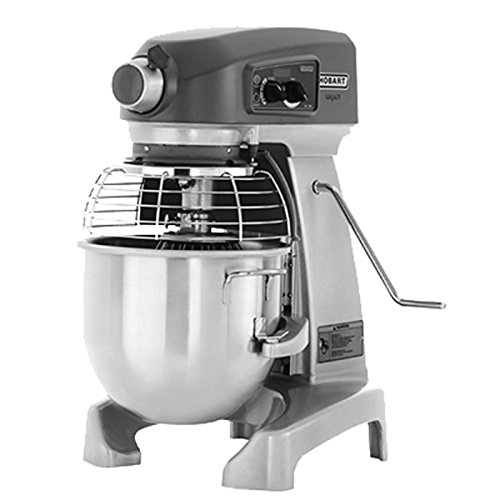
Hobart HL200 Legacy 20-Qt Tabletop Planetary Mixer — Best Commercial Tabletop
The HL200 is what “commercial tabletop” actually means: Hobart’s Legacy planetary design at 20 quarts, built to commercial standards of duty cycle, safety, and service, in a footprint that sits on a bench instead of the floor. It suits bakeries, cafes, pizzerias, school and church kitchens, and caterers whose batch sizes have outgrown home machines — and home users only if they genuinely mix at near-commercial volume and have the bench and the back for it. It does not suit a domestic kitchen in any ordinary sense, and this guide will not pretend otherwise.
Strengths
- True commercial planetary action and construction, rated for the duty cycles that destroy home mixers in months.
- 20-quart capacity changes batch math completely — dough and batter in production quantities, mixed once.
- Hobart’s service and parts network is the deepest in commercial mixing; these machines are maintained, not discarded.
Trade-offs
- Commercial pricing, commercial weight, commercial everything — plan the bench, the power, and the delivery accordingly.
- Overkill so complete for home use that it circles back to impractical: bowl size alone makes small batches awkward.
- Accessories and attachments are commercial-priced as well; budget the system, not the machine.
Key specs (from the verified listing): Hobart HL200-1STD Legacy planetary mixer · 20 Qt · tabletop unit · standard accessory kit (per listing).
The economics of the HL200 only make sense in production, where they make complete sense: a bakery’s mixer is not an appliance but a workstation, and downtime costs more than machinery. Hobart’s century of commercial presence means the technician in your area has seen your mixer before, the parts exist, and the machine’s second decade is as plausible as its first. If your mixing is measured in batches per day, this is the tabletop answer; if it is measured in loaves per week, the KitchenAid picks above are the honest ones. Check the current price on Amazon
Best for: bakeries, cafes, institutional kitchens, production caterers / Not suited for: home kitchens, small batches, casual bakers

Cuisinart SM-50 5.5-Qt Stand Mixer — Best Mid-Range
The SM-50 is Cuisinart’s well-aimed entry in the home tribe: a 5.5-quart stainless bowl — a touch larger than the Artisan’s — twelve speeds, and the three essential tools (chef’s whisk, mixing paddle, dough hook) plus a splash guard in the box. It suits home bakers who want full stand-mixer capability at a mid tier and do not need KitchenAid’s attachment universe. It does not suit attachment collectors; Cuisinart’s ecosystem is narrower, and buyers should choose with that trade consciously made.
Strengths
- Generous bowl and a twelve-speed range that gives fine low-speed control for folding and incorporating.
- Complete starter kit in the box — whisk, paddle, hook, and splash guard with pour spout, per the verified listing.
- Mid-tier pricing that undercuts the premium names while keeping die-cast seriousness.
Trade-offs
- Attachment ecosystem is a fraction of KitchenAid’s; pasta and milling ambitions point elsewhere.
- Long-term parts depth is good but not the decades-deep catalog of the market leader.
- Like all home tilt-heads, stiff dough in full bowls is its workload ceiling.
Key specs (from the verified listing): 5.5-Qt stainless steel bowl · 12 speeds · chef’s whisk, mixing paddle, dough hook, splash guard included (per listing).
The SM-50’s argument is completeness per dollar at the moment of purchase: unbox it and you can bake the full repertoire that day, with a bowl slightly larger than the class standard and speed control fine enough for genoise and meringue. For the large majority of home bakers — cakes, cookies, occasional bread, whipped everything — that is the whole requirement, met at a friendlier tier. Buy it for the baking you do, not the attachment catalog you might browse. Check the current price on Amazon
Best for: home bakers wanting full capability at mid tier, cake and batter specialists / Not suited for: attachment-system builders, heavy dough routines
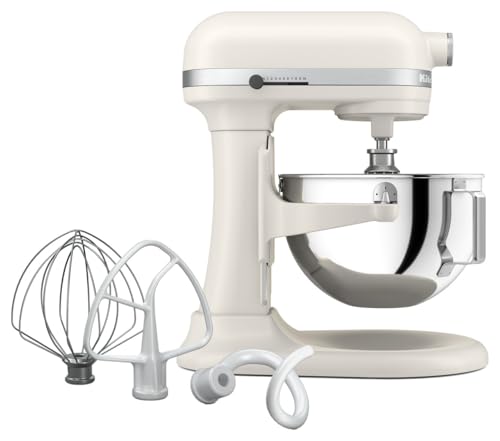
KitchenAid 5.5-Qt Bowl-Lift Stand Mixer — Best for Bread Dough
The bowl-lift design exists for one mechanical reason: stability under load. Instead of tilting, the head stays fixed and the bowl rises to it on a lifting mechanism, which keeps the machine planted and the drive aligned when a stiff dough tries to walk a lesser mixer across the counter. With eleven speeds including a half-speed fold setting, per the verified listing, this is the KitchenAid for bakers whose output leans toward bread. It suits committed home bakers and micro-bakery side projects. It does not suit bakers who swap bowls and tools constantly mid-recipe and love the tilt-head’s openness — the lift design trades that ease for strength.
Strengths
- Bowl-lift stability under heavy, stiff doughs — the home design that takes bread seriously.
- Eleven speeds with a dedicated gentle fold option, widening the delicate end of the range as well.
- Shares the KitchenAid attachment ecosystem and parts depth of the Artisan.
Trade-offs
- Taller profile — measure under-cabinet clearance before ordering, a classic bowl-lift gotcha.
- Bowl removal and tool swaps are a touch less fluid than the tilt-head’s.
- Still a home machine: daily multi-batch production belongs to the Hobart tribe.
Key specs (from the verified listing): 5.5-Qt bowl-lift stand mixer, KSM55 · 11 mixing speeds · flat beater, dough hook, wire whip, stainless bowl included (per listing).
Dough is where stand mixers go to be judged, because dough fights back — it climbs hooks, loads motors, and finds every flex in a frame. The bowl-lift’s fixed geometry is the home answer to that fight, and bakers who move up from a tilt-head for bread reasons rarely move back. Pair it with the discipline of correct dough hydration and batch sizing and it will knead for years without complaint. Check the current price on Amazon
Best for: bread-focused home bakers, heavier doughs, micro-batch sellers / Not suited for: low-clearance counters, constant tool-swappers

Hamilton Beach 4-Qt Electric Stand Mixer — Best Budget
Hamilton Beach’s stand mixer makes the budget case honestly: planetary mixing action — the beater orbits while spinning, covering the bowl the way premium machines do — seven speeds, a 4-quart bowl, and the three core tools, at an entry tier. The easy-carry handle is a small, telling detail: this machine expects to live in a cupboard and be lifted out, which is the true usage pattern of occasional bakers. It suits new bakers, small households, and anyone testing whether stand mixing fits their life. It does not suit daily bread production or large double batches.
Strengths
- Planetary mixing for full bowl coverage per the verified listing — the action that matters, present at a budget tier.
- Light enough, with a carry handle, to store away between uses — the right design for small kitchens.
- Splash guard and the three essential tools included.
Trade-offs
- 300-watt class power (per listing) sets a real ceiling on stiff dough and big loads.
- Four quarts is a family-size bowl, not a bake-sale bowl; double batches of cookies will test it.
- Build is honest plastic-and-metal budget construction, not a twenty-year heirloom.
Key specs (from the verified listing): 4-Qt electric stand mixer · 7 speeds · 300 watts · whisk, flat beater, dough hook included (per listing).
The budget pick’s job is to be right for the first two years of a baking life: cakes that come out even, doughs of reasonable size kneaded without arm fatigue, and a price that leaves money for ingredients and a good scale. Bakers who outgrow it will know exactly which premium machine they want and why — knowledge the Hamilton Beach bought them cheaply. That is a successful appliance by any measure. Check the current price on Amazon
Best for: new bakers, small kitchens, occasional baking, first stand mixer / Not suited for: heavy dough, large batches, commercial use

Hobart 20-Qt Planetary Bench Mixer — Best Heavy-Duty Bench Alternative
This second Hobart listing offers another route to the same destination: a 20-quart bench-type planetary mixer with three fixed speeds, a stainless steel bowl, and accessories included, per the verified listing, driven by a 1/2 HP motor. It suits the same production world as the HL200 — bakeries, institutions, commissaries — and gives buyers a configuration choice within the Hobart universe. It does not suit anyone who needed the HL200’s Legacy feature set specifically, nor, obviously, any home kitchen.
Strengths
- Commercial planetary mixing at full 20-quart bench scale with bowl and accessories in the listing.
- Three fixed speeds are the traditional commercial pattern — simple, robust, and matched to production tasks.
- Hobart parts and service depth applies, as with the HL200.
Trade-offs
- Two Hobarts in one guide means the buyer must compare configurations carefully — accessory kits and generations differ between listings.
- Commercial weight and pricing, with freight-class delivery realities.
- Fixed speeds trade the fine low-speed finesse home machines offer — irrelevant in production, worth knowing in a hybrid kitchen.
Key specs (from the verified listing): 20-Qt planetary mixer, bench type · 3 fixed speeds · stainless steel bowl and accessories · 1/2 HP (per listing).
Why include two Hobarts? Because commercial buyers think in configurations, not crowns: the right purchase depends on the accessory kit, the speed pattern, and the dealer support behind the specific listing. Presenting both verified paths lets a production kitchen choose its configuration with eyes open. What does not change between them is the tribe’s promise — capacity, duty cycle, and service measured in decades. Check the current price on Amazon
Best for: production kitchens comparing Hobart configurations, institutional buyers / Not suited for: home use of any ordinary kind
Comparison Table
| Pick | Badge | Key spec | Best for |
|---|---|---|---|
| KitchenAid Artisan 5-Qt | Best Overall | 5-Qt tilt-head, 10 speeds, full attachment hub | Weekly home bakers |
| Hobart HL200 Legacy | Best Commercial Tabletop | 20-Qt commercial planetary, tabletop | Bakeries and institutions |
| Cuisinart SM-50 | Best Mid-Range | 5.5-Qt bowl, 12 speeds, full tool kit | Home bakers at mid tier |
| KitchenAid 5.5-Qt Bowl-Lift | Best for Bread Dough | 5.5-Qt bowl-lift, 11 speeds with fold | Bread-focused bakers |
| Hamilton Beach 4-Qt | Best Budget | 4-Qt, 7 speeds, planetary action, carry handle | New and occasional bakers |
| Hobart 20-Qt Bench | Best Heavy-Duty Bench Alternative | 20-Qt, 3 fixed speeds, 1/2 HP | Production configuration choice |
How to Choose the Right Table Top Mixer
Decide your tribe first: home countertop or commercial bench. The test is duty cycle, not ambition. If the machine will mix a few times a week in family quantities, you are in the home tribe, and every commercial dollar is wasted on capacity you will never fill while making small batches worse. If the machine will mix daily, in batches, for customers, you are in the commercial tribe, and every home dollar is wasted on a machine whose motor and gears are counting down. Be honest about which life the mixer will actually live — this single decision eliminates half the shelf in both directions.
Size the bowl to your largest regular batch, not your largest imaginable one. Four quarts handles single loaves, standard cake batters, and family cookie batches. Five to five-and-a-half quarts adds double batches and bigger doughs. Twenty quarts is production. Oversized bowls mix small quantities badly — the beater cannot reach a single egg white’s worth of anything — so the holiday-batch argument for a huge bowl quietly ruins fifty ordinary Tuesdays. Buy for the regular batch.
Tilt-head versus bowl-lift is a workload question. Tilt-heads are pleasanter for varied baking with constant tool and bowl changes. Bowl-lifts are stronger and steadier for dough-heavy routines. Neither is better in the abstract; your recipe history decides. If your stand mixer will knead more than it whips, lift. If it will do a bit of everything with frequent swaps, tilt.
Read power claims skeptically and load behavior honestly. Wattage numbers are marketing-friendly and only loosely comparable across brands. What matters is how the machine behaves at the bottom of its speed range under a real dough: does it lug, strain, and heat, or turn steadily? Reviews and reputations carry this information better than spec sheets. Whichever home machine you choose, respect its flour-capacity guidance — overloading is the number-one killer of home stand mixers, ahead of age.
Budget the system around the machine. Home buyers: a second bowl is the highest-value accessory in baking (one for whites, one for yolks; one rising, one mixing), followed by the attachments you will genuinely use. Commercial buyers: budget the accessory kit, the bench or stand, the electrical work if required, and a service relationship. In both tribes, the mixer is the middle of the purchase, not the whole of it.
Consider refurbished and second-hand with a clear checklist. Stand mixers are among the safest used-appliance purchases because their failures are mechanical and audible. A used premium home mixer that runs quietly through its speeds, whose head does not wobble excessively, and whose bowl and tools are present is often a better buy than a new budget machine — the major brands’ parts support makes the risk manageable. Commercial Hobarts change hands constantly between kitchens for the same reason. What to avoid in either tribe: machines with a burnt smell from the vents, visible grease weeping at the head joint, or missing model plates, because parts ordering starts with that plate. Buy the seller’s maintenance story as much as the machine.
How to Use a Table Top Mixer for Dough, Batter, and Whipping
Technique is the same across the tribes; only the scale changes. For dough: add liquid to flour gradually with the hook at the lowest speeds, let the dough come together before judging it, and knead at the manufacturer’s recommended dough speed — usually the second setting, never high — because dough hooks are designed around that speed’s torque. Stop and scrape once early; dough that starts evenly finishes evenly. Respect the flour limit for your bowl size, and if a recipe must grow, split it into two batches rather than heroically overfilling — the second batch costs four minutes, the repair costs more. For batters: start slow whenever dry meets wet, or flour will redecorate the kitchen; the splash guard and pour shield in several of these listings exist because everyone learns this once. Cream butter and sugar at medium speed until the mixture visibly lightens — that color change is the leavening you are building. For whipping: the bowl and whisk must be grease-free for egg whites, room-temperature whites whip faster, and cream wants the opposite — cold bowl, cold cream, and the discipline to stop at soft peaks before butter begins. After any session, wash tools promptly (dough dries into cement), dry the bowl before storing, and leave the machine uncovered long enough to shed motor heat. These habits, not the badge on the head, are what make a tabletop mixer perform like the ones in bakery windows.
One more technique separates stand-mixer owners from stand-mixer enjoyers: the beater adjustment. Most quality machines allow the beater’s height to be fine-tuned so it clears the bowl bottom by a hair — close enough to sweep ingredients, far enough never to strike metal. If your mixer leaves a permanent unmixed layer at the bottom, or clicks against the bowl, consult the manual’s adjustment procedure before blaming the design; two minutes with a screwdriver transforms the mixing of every recipe you own. Commercial machines have their own version of this discipline in bowl and agitator clearance checks, which belong on the kitchen’s weekly maintenance list beside knife sharpening and oven calibration.
Where the Mixer Lives: Counter Space, Storage, and the Weight Question
Stand mixers fail a surprising number of households not in the bowl but in the room. A home stand mixer is a heavy, tall object that must either live permanently on the counter — consuming the most valuable real estate in the kitchen — or be lifted from storage every time it is used, which quietly decides how often it is used. Measure before you buy, in three dimensions: the footprint on the counter, the height under your upper cabinets both closed and with the head tilted or bowl lifted, and the depth that lets the machine sit without overhanging. Then be honest about the lift. Machines in this class run from the Hamilton Beach’s storage-friendly lightness to weights that make a low cupboard a genuine workout, and the commercial Hobarts are two-person, plan-the-route objects that belong on a dedicated bench, permanently, with their own circuit planning. Bakers who bake weekly should give the mixer a permanent counter home and design around it; bakers who bake monthly should weight storability as heavily as power, which is exactly the trade the budget pick in this guide was designed around. Apartment bakers have a third option worth naming: a smaller tilt-head stored on a rolling cart that parks in a closet and docks at the counter — the cart costs little and converts dead storage into a baking station. The mixer you can deploy in ninety seconds is the mixer that gets used; ergonomics is a baking feature.
Commercial buyers face the same logic at bench scale. A 20-quart bench mixer wants a stand or bench rated for its working weight — machine plus full bowl plus the dynamic load of a stiff dough trying to move it — positioned where flour, water, and finished product flow without crossing paths. Put the mixer where the work is, wire it properly, and leave service clearance behind it. Kitchens that treat placement as an afterthought spend years walking around a machine that should have been two feet to the left.
What Actually Breaks: Transmissions, Gears, and Honest Longevity
Ask repair technicians what kills stand mixers and the answers are refreshingly unglamorous. In home machines, the sacrificial gear — deliberately softer than the main drive, designed to strip and save the motor when the mixer is overloaded — is the most common failure, and it is a failure with a moral: the machine died protecting itself from its owner’s batch size. It is also, in the major brands, a replaceable part, which is why parts depth matters more than any single durability claim. Belt-driven designs wear belts; direct-drive and gear-driven designs wear more slowly and cost more. In commercial machines, the failures are bearings, belts, and switches after enormous cycle counts — the economics of service contracts exist because these machines are worth servicing. The practical guidance for buyers: choose brands whose parts diagrams and components are obtainable a decade out (KitchenAid and Hobart are the textbook examples in this guide, at their respective scales), learn your machine’s flour limit and treat it as law, and let the mixer cool during marathon sessions — heat is the silent partner in most overload failures. A stand mixer bought this way is not an appliance purchase; it is a twenty-year arrangement, and it should be priced per year rather than per feature.
Mixing by Task: What Each Job Asks of the Machine
It helps to stop thinking of “mixing” as one job. Cake batters ask for controlled incorporation — power in reserve, but mostly finesse at low and medium speeds, and a beater that reaches the bowl’s sides so butter and flour truly meet. Cookie doughs ask for torque in short bursts and a bowl that swallows a double batch without the dough riding up the beater. Bread dough asks the most: sustained torque at low speed, a frame that does not walk, and a hook geometry that kneads rather than merely stirring a lump in circles. Whipping asks for speed and reach — a whisk that can find a small volume of cream or two egg whites at the bottom of the bowl, which is where oversized bowls quietly fail small tasks. Meringues and genoise ask for all of it in sequence: reach, speed, and a bowl clean enough to hold a foam. When you read the picks in this guide against your own recipe history, weight them by your dominant tasks. The Artisan’s all-round scores, the bowl-lift’s dough bias, the SM-50’s batter-friendly speed range, and the budget pick’s honest small-batch competence are not marketing positions — they are the shapes of the baking lives each machine fits. And the Hobarts, of course, answer a different question entirely: not which tasks, but how many, how often, and for how many years.
Speed Settings Demystified: Stir, Fold, and the Dough Rule
Stand mixers advertise speed counts the way cameras advertise megapixels — the number is easy to print and only loosely related to results. What matters is the behavior at three points of the dial. At the bottom, a good mixer turns slowly and steadily enough to fold flour into a batter without developing gluten or throwing a flour cloud — the “stir” and half-speed settings on the KitchenAid picks in this guide exist for this, and bakers who bake delicate cakes feel the difference immediately. In the middle, the machine creams, mixes, and mashes with authority — the working range where most recipes live. At the top, it whips: the whisk needs genuine speed to build foams quickly, and a mixer that strains to reach it will make heavy work of meringue. Then there is the rule that overrides all of it for dough: knead at the low dough speed the manufacturer specifies, regardless of how many speeds the dial offers. Dough hooks are geared around that speed’s torque curve; kneading faster does not knead quicker, it merely heats the motor, climbs the dough, and shortens the transmission’s life. Read speed counts as a range indicator, judge the three behaviors that matter, and let recipes — not dials — set the pace.
A related habit separates experienced bakers from frustrated ones: add ingredients at the speed of the mess you are willing to clean. Liquids into a spinning bowl of flour at high speed is a kitchen redecoration strategy. Start slow, let the mixture take up the addition, then return to working speed. The splash guards and pour shields included with several picks here reduce the penalty, but technique eliminates it.
Common Buying Mistakes
- Buying commercial for home pride. A 20-quart Hobart mixing a single cake batter is not a flex; it is a mismatch that mixes small batches poorly and dominates the kitchen doing it.
- Burning out a home mixer in a business. The mirror mistake. A cottage bakery running a home tilt-head all day will learn about duty cycles from a repair bill.
- Ignoring under-cabinet clearance. Bowl-lift and tall tilt-head machines need vertical room both to sit and to open. Measure the counter’s airspace before ordering.
- Overloading the bowl with dough. Flour capacity is a real limit. Split batches; the mixer you save is your own.
- Choosing by wattage alone. Gearing and design matter more than the number on the box. Reputation under load is the spec that counts.
- Forgetting the second bowl. The cheapest workflow upgrade in baking, skipped by nearly everyone at purchase time.
- Storing the mixer where it will not be used. A stand mixer in a high cupboard is a stand mixer in early retirement. If the counter cannot hold it, plan the cart or the low, reachable shelf before the machine arrives.
- Letting the first dough be a double batch of the stiffest recipe you own. Learn any new mixer on a forgiving single batch; the machine’s limits are best discovered at half stakes, with a loaf still worth eating at the end.
Final Recommendation
For most households, the KitchenAid Artisan 5-Qt remains the table top mixer to buy: pleasant daily, capable weekly, and supported for decades, with an attachment system that grows the countertop instead of cluttering it — and it is the machine most likely to be handed down rather than thrown out, which is the truest review any appliance can earn. Bread-led bakers should choose the KitchenAid 5.5-Qt Bowl-Lift for its planted strength, and value-focused bakers the Cuisinart SM-50 for its complete kit at a mid tier. New and occasional bakers should start with the Hamilton Beach 4-Qt and upgrade with experience. And when the mixing becomes production — daily, batched, and sold — step honestly into the commercial tribe with the Hobart HL200 or its 20-Qt bench sibling, configured for your kitchen. The right tribe, the right bowl, and a second bowl in the cupboard: that is the whole secret.
More mixer guidance: Best Tilt Mixers, Best Small Kitchen Mixers, Best Kitchen Mixers For Baking, Best 10 Quart Mixers, and Best Small Food Mixers.
Frequently Asked Questions
What size stand mixer does a home baker actually need?
Four to five-and-a-half quarts covers essentially all home baking: single and double cake batters, family cookie batches, and one to two loaves of bread dough at a time. Go larger only if double batches are your weekly norm. Remember that bowl size is about batch size, not power — a 5-quart machine is not automatically stronger than a 4-quart one. And remember the small-batch corollary: if your most frequent job is a single small cake or a cup of whipped cream, the 4-quart class will serve those jobs better than a cavernous bowl whose beater cannot reach them.
Can a home stand mixer handle bread dough every week?
Yes, with the right model and honest loading. Bowl-lift designs like the KitchenAid 5.5-Qt are built for that routine; tilt-heads handle moderate doughs well when batches respect the flour limit. Weekly bread in reasonable quantities is normal home duty. Daily multi-loaf production is commercial duty and deserves commercial equipment. One more practice extends any mixer’s dough career: let the dough rest for ten minutes mid-knead — the autolyse-style pause lets flour hydrate and gluten relax, so the machine’s remaining work is easier and the loaf is better. The mixer rests, the baker rests, the bread improves; few techniques pay three ways.
What does “planetary mixing” mean?
The beater spins on its own axis while also orbiting the bowl, so the tool reaches the bowl’s full surface instead of one fixed circle — the same principle as a planet rotating while revolving. It is the action used by both the home picks and the Hobart commercial machines in this guide, and it is why these mixers need less scraping than old fixed-beater designs. The practical test at home: a properly adjusted planetary mixer incorporates a bowl of cookie dough with one scrape-down, not four.
Is a commercial bench mixer worth it for a serious home baker?
Almost never, and the reasons are practical rather than snobbish: small batches mix poorly in a 20-quart bowl, the machine’s weight and footprint dominate a home kitchen, and its purchase and accessory costs would fund a premium home setup plus years of ingredients. The honest exception is the home that is quietly becoming a business — at which point the purchase is a business decision and the Hobarts are the right answer.
Tilt-head or bowl-lift — which lasts longer?
Both designs last for decades when loaded within their purpose. Bowl-lifts tolerate heavy dough duty better because the head never moves under load; tilt-heads have a hinge that asks to be treated kindly. Longevity in practice is decided less by design than by loading discipline — the mixers that die young are almost always the ones that were overfilled. A useful habit for either design: after a heavy dough session, run the machine empty for ten seconds at low speed and listen. A healthy mixer sounds the same as it did when new; a new rattle, grind, or hesitation caught early is a cheap service visit instead of a transmission.
What attachments are actually worth buying?
For KitchenAid owners, the pasta roller and the food grinder earn their storage for most households; the ice cream maker delights seasonally; the grain mill serves a committed minority magnificently. The universal winner is unglamorous: a second bowl and a spare beater. Buy attachments against recipes you already cook monthly, not aspirations.
How do I stop dough from climbing the hook and stressing the mixer?
Climbing dough is usually a hydration and batch-size signal. Very stiff, under-hydrated dough grips the hook and rides it upward; a small increase in liquid, within the recipe’s tolerance, keeps the dough working in the bowl where it belongs. Overfilled bowls climb too — the dough has nowhere else to go. Knead at the recommended low dough speed, pause once to push the dough down and turn it, and the hook will do the rest. If climbing is constant across recipes, the batch is too big for the machine, and splitting it is the fix that also saves the transmission.
Stand mixer or hand mixer for a small kitchen?
Both, in sequence, is the honest answer for many small kitchens. A hand mixer covers quick batters and whipped cream in any bowl you own and stores in a drawer. A stand mixer earns counter or cupboard space when kneading, long creaming, and hands-free work enter your routine. If you must choose one and you bake bread or batch cookies, choose the stand mixer — the Hamilton Beach pick in this guide exists precisely for small kitchens that reached that point. And if you choose the hand mixer for now, choose a good one and keep the stand-mixer fund growing; kitchens evolve toward the baking their owners actually do, and the upgrade path in this category is a pleasure rather than a penalty.


