Disclosure: airfryerkitchensupply.com is reader-supported. When you buy through links on our site, we may earn an affiliate commission at no extra cost to you.
Where to buy
Small mixers sell under several names — compact stand mixer, mini stand mixer, hand-and-stand combo — so match the listing title to the exact model and bowl size in each review before ordering. Every pick below links to its Amazon listing so you can check price on Amazon and confirm which attachments are in the box, because small mixers vary more than most categories in what they include.
- Dash Everyday Stand Mixer, 3-Quart (Black) — Check the current price on Amazon
- KitchenAid Artisan Mini 3.5-Qt Tilt-Head Stand Mixer (Contour Silver) — Check the current price on Amazon
- Hamilton Beach 4 Qt Electric Stand Mixer (7 Speeds) — Check the current price on Amazon
- Hamilton Beach Classic Stand and Hand Mixer (64655) — Check the current price on Amazon
- Kitchen in the Box Stand Mixer, 3.5QT (White) — Check the current price on Amazon
- Delish by Dash Stand Mixer, 3.5-Quart (Aqua) — Check the current price on Amazon
The best small food mixers solve a specific kitchen problem: most home mixing jobs are small. A single batch of cookies, a loaf of sandwich bread, a bowl of whipped cream, pancake batter for two — none of these need a six-quart bowl or a machine that owns a whole cabinet. A compact mixer with a three- to four-quart bowl handles the everyday workload, stores in a fraction of the space, weighs little enough to move one-handed, and costs a fraction of a full-size flagship. That is why small food mixers have quietly become the sensible default for apartments, small households and anyone whose big mixer mostly gathers dust.
This guide covers the small end honestly, including its limits. Compact mixers knead lighter doughs happily and strain at stiff, large, whole-grain batches; their bowls fill faster; and the cheapest of them trade metal gearing for light weight. We picked six proven directions: the tiny 3-quart Dash for the smallest kitchens, KitchenAid’s Artisan Mini for buyers who want the real KitchenAid ecosystem in miniature, two Hamilton Beach designs covering pure stand and stand-plus-hand flexibility, a 10-speed Kitchen in the Box for small households, and the Delish by Dash 3.5-quart for style-led small kitchens. Each review states plainly who should skip it.
All models were cross-checked against Amazon’s catalog before earning a link. Prices are deliberately not printed — check price on Amazon for the configuration and color you want, because small appliances swing in price constantly.
Keep one question in front of you while reading: what are the three mixing jobs you do most, in order? Every pick below is the best answer to some ordering of that list — and the wrong answer to others. The reviews are written to let your list, not the spec sheets, do the choosing.
Finally, a note on how this guide treats the word ‘best.’ There is no single best small food mixer below — there are six best answers to six different kitchens, and the reviews are deliberately blunt about each pick’s ceiling so the wrong kitchen never adopts it. If you finish this page knowing exactly which pick is yours and exactly why the other five are not, the guide has done its job. If two picks still contend, choose by the job you do weekly rather than the job you do yearly; frequency is the tiebreaker that never lies.
In this guide
Quick Picks
Best for Smallest Kitchens — Dash Everyday Stand Mixer, 3-Quart (Black). A 3-quart, 6-speed tilt-head mixer small enough for a dorm-adjacent kitchen or a single shelf — the true mini of this lineup. Check on Amazon
Best Premium Small Mixer — KitchenAid Artisan Mini 3.5-Qt Tilt-Head Stand Mixer (Contour Silver). KitchenAid’s Artisan engineering shrunk to 3.5 quarts and a smaller footprint — the mini that still takes the full attachment hub. Check on Amazon
Best Value Stand Mixer — Hamilton Beach 4 Qt Electric Stand Mixer (7 Speeds). Planetary mixing, a 4-quart bowl, whisk, beater and dough hook plus a splash guard and carry handle — full stand-mixer function at a value tier. Check on Amazon
Best 2-in-1 — Hamilton Beach Classic Stand and Hand Mixer (64655). A 4-quart stand mixer whose motor head detaches into a hand mixer — two appliances in one small footprint. Check on Amazon
Best for One- and Two-Person Baking — Kitchen in the Box Stand Mixer, 3.5QT (White). A 3.5-quart, 10-speed compact mixer designed explicitly for one- to two-person households, with dishwasher-safe attachments. Check on Amazon
Best Style Pick — Delish by Dash Stand Mixer, 3.5-Quart (Aqua). A 3.5-quart, 5-speed compact mixer with a removable bowl and dough hooks included, in kitchen-display colors. Check on Amazon
How These Picks Were Chosen
We defined ‘small’ by bowl and footprint, not by marketing: every pick here has a bowl of about 4.5 quarts or less, a counter footprint a small kitchen can surrender, and a weight one person can lift into a cabinet without planning the maneuver. From the compact field we then filtered for models with real owner track records and available replacement attachments, because a mixer you cannot buy a second beater for is a disposable appliance.
We also insisted on a spread of philosophies. Tilt-head versus lift, dedicated stand versus hand-and-stand convertible, budget plastic versus metal-drive premium — small-mixer buyers disagree about all of these, and the right answer depends on your dough habits and storage. Each pick below represents one coherent answer, and the buying guide explains the trade-offs so you can choose your philosophy before you choose your model.
The 6 Best Best Small Food Mixers

Dash Everyday Stand Mixer, 3-Quart (Black) — Best for Smallest Kitchens
The Dash Everyday is for the smallest mixing jobs in the smallest spaces: one or two people, a batch of muffins, a small cake, whipped cream for dessert. It lives happily on a sliver of counter or in a cabinet, and its light weight makes it the mixer you actually pull out instead of avoiding.
Strengths
- 3-quart bowl sized honestly for one- and two-person batches
- Compact tilt-head body stores where full mixers cannot
- Simple 6-speed control anyone can learn in a minute
Trade-offs
- Not a bread machine — stiff dough overwhelms its motor and size
- Small bowl means double batches are off the table
- Light build can walk on the counter at high speed with heavy loads
Key specs: 3-quart stainless steel bowl; 6 speeds; tilt-head design; compact countertop footprint.
Judge the Dash by frequency, not power. For the weekly small jobs — batter, frosting, a single pizza dough portioned small — it is faster to grab, use and wash than any big mixer, and that convenience is the entire point of the category. Where it fails is equally clear: a full loaf’s worth of stiff dough makes it strain and wander, and holiday baking for a crowd means batch after batch. Owners who buy it as a small-job specialist love it; buyers who expect a flagship in miniature feel misled. Know which buyer you are and this little mixer makes its case easily.
Day to day, the Dash’s virtue is tempo: it is mixing before a full-size machine would be out of its box, and it is washed before that machine would be assembled. Owners in studios and first apartments consistently describe it as the appliance that made baking feel possible in their space. Keep its jobs small and frequent and it will be used more in a month than a flagship in a year.
Best for: Singles, couples and tiny kitchens doing small, frequent batches / Not suited for: Bread bakers, big families or holiday-batch cooking

KitchenAid Artisan Mini 3.5-Qt Tilt-Head Stand Mixer (Contour Silver) — Best Premium Small Mixer
The Artisan Mini is for the small kitchen that refuses to compromise: bakers who want KitchenAid build, the powered hub for pasta and grinding attachments, and a machine that will run for years — in a body noticeably smaller and lighter than the full Artisan. It handles everyday batches for two to four people with flagship manners.
Strengths
- Real KitchenAid metal build and hub compatibility in mini form
- 3.5-qt bowl is the sweet spot for small households
- 10 speeds with a gentle fold pace full-size rivals offer
Trade-offs
- Premium tier price for a compact machine
- Still not the tool for large or very stiff dough batches
- Attachments cost extra and add up quickly
Key specs: 3.5-quart bowl; 10 speeds; tilt-head; powered attachment hub; Contour Silver.
The Mini’s engineering brief was ‘same mixer, smaller,’ and it shows: the planetary mixing action reaches around the bowl properly, the motor note sounds unhurried rather than strained, and the machine sits planted instead of skating. For small households that bake weekly, it is the compact mixer most likely to still be in service in a decade. Its honest ceiling is batch size and very stiff dough — a single loaf yes, a double batch of bagels no. If your kitchen is small but your standards are not, this is the pick the rest of the list is measured against.
The Mini also changes what a small household attempts: pasta night becomes realistic with the hub roller, grinding for burgers is a ten-minute job, and the machine’s calm at low speed makes laminated and enriched doughs less intimidating. It holds a counter corner with the confidence of a permanent fixture. For small kitchens that cook seriously, that presence — capable, compact, always ready — is the product.
Best for: Quality-first small households that bake regularly / Not suited for: Budget buyers or anyone routinely mixing large batches

Hamilton Beach 4 Qt Electric Stand Mixer (7 Speeds) — Best Value Stand Mixer
This Hamilton Beach is the practical family’s small stand mixer: big enough for a standard cookie batch or a loaf, cheap enough to be a first stand mixer, and light enough — with a top carry handle — to live in a pantry and travel to the counter on baking day.
Strengths
- Planetary mixing action for full bowl coverage at this tier
- Includes whisk, flat beater, dough hook and splash guard
- Carry handle and lighter body suit store-away kitchens
Trade-offs
- 300-watt motor works harder on stiff dough than premium rivals
- Plastic-heavy build will not age like metal-drive machines
- Bowl capacity is honest for singles batches, not doubles
Key specs: 4-quart bowl; 7 speeds; 300 watts; planetary mixing; splash guard and carry handle; whisk, beater and dough hook included.
Value stand mixers live or die on whether the beater actually reaches the bowl’s edges, and Hamilton Beach’s planetary action — the head orbiting while the beater spins — is the right technology at this price. Cookies cream evenly, cake batter needs minimal scraping, and the dough hook handles a standard loaf respectably if you let it work at low speed. The splash guard earns its keep with flour. Accept the lighter build and modest motor for what they are, and this is the most stand mixer most small households will ever need, at a tier that makes the decision easy.
In family service the Hamilton Beach earns loyalty through logistics: the handle makes pantry-to-counter trips trivial, the splash guard keeps flour day civilized, and the attachments cover the school-bake-sale repertoire without a second thought. It is the mixer children learn on in many homes, forgiving of technique and quick to clean. Value, here, is measured in years of uncomplaining Tuesday evenings.
Best for: First stand-mixer buyers and small families on a budget / Not suited for: Heavy dough routines or buyers wanting a decade-plus flagship

Hamilton Beach Classic Stand and Hand Mixer (64655) — Best 2-in-1
Choose the Classic 2-in-1 if your mixing splits between stand jobs (cookie dough, bread) and quick hand jobs (mashed potatoes in the pot, a fast egg-white whip) and you refuse to store two machines. On its stand it is a proper little stand mixer with a bowl-rest feature; pop the head off and it is a capable hand mixer.
Strengths
- Stand and hand mixer in one compact unit — serious space saving
- 4-quart bowl and 6 speeds with QuickBurst for stand jobs
- Bowl-rest design steadies the hand mixer during pauses
Trade-offs
- 290 watts peak is modest in either mode
- Stand stability is good, not flagship-grade, under heavy dough
- Jack-of-two-trades: specialists beat it in each single role
Key specs: 4-quart bowl; 6 speeds with QuickBurst; 290 watts peak power; detachable hand mixer; model 64655.
Convertibles earn skepticism, but this one’s logic is sound: the motor a small stand mixer needs is roughly the motor a strong hand mixer needs, so sharing one is efficiency, not gimmick. In stand mode it creams, whips and kneads small batches credibly; in hand mode the bowl-rest lip is a small delight, letting you set the mixer on the bowl edge mid-job instead of dirtying the counter. Power is the ceiling in both modes — keep batches small and speeds low for dough. For a small kitchen counting appliances, it replaces two boxes with one honest tool.
The Classic’s dual life shows its worth across a week: stand mode for Saturday’s cookie dough, hand mode for Tuesday’s mashed potatoes in the pot, back on the stand for Sunday’s pancake batter. One cord, one shelf slot, one machine to learn. Households that track appliance usage find convertibles like this quietly topping the chart — versatility, in a small kitchen, is a performance spec.
Best for: Space-counting kitchens that mix both ways, in small batches / Not suited for: Power users in either category or large-batch bakers

Kitchen in the Box Stand Mixer, 3.5QT (White) — Best for One- and Two-Person Baking
This mixer is aimed with unusual honesty: it says on the listing that it is a small stand mixer for one to two people, and it is built exactly to that brief — compact body, 3.5-quart bowl, ten speeds for control, and attachments that go in the dishwasher so a small weeknight bake does not create a sink of hand-washing.
Strengths
- Sized and marketed honestly for 1–2 person households
- 10 speeds give fine control for a compact machine
- Dishwasher-safe attachments lower the cleanup barrier
Trade-offs
- Newer brand — long-term parts and service record still developing
- Compact bowl and motor cap your batch ambitions
- White finish shows turmeric-and-berry history proudly
Key specs: 3.5-quart bowl; 10 speeds; compact tilt-head body; dishwasher-safe attachments; White.
There is a refreshing clarity to a product that knows its buyer. Everything here serves small-batch ease: the footprint disappears into a corner, the speed range covers gentle folding through brisk whipping, and cleanup is a dishwasher cycle. The open question is longevity — the brand lacks the decades-long track record of the KitchenAid and Hamilton Beach picks, so you are trading proven service networks for a well-judged design at a friendly tier. For its stated job, small bakes for small households, it is one of the most sensibly specced options in this guide.
For its intended household — one or two people — this mixer’s sizing discipline pays off daily: the bowl matches the batch, so creaming is efficient, whipping is quick, and washing up is a single small bowl rather than a sink-filling one. The ten speeds make it a patient teacher for new bakers, with a low gear gentle enough to learn folding on. Small, honest and easy is a complete design philosophy.
Best for: Singles and couples baking small batches weekly / Not suited for: Buyers who prioritize established service networks or big batches
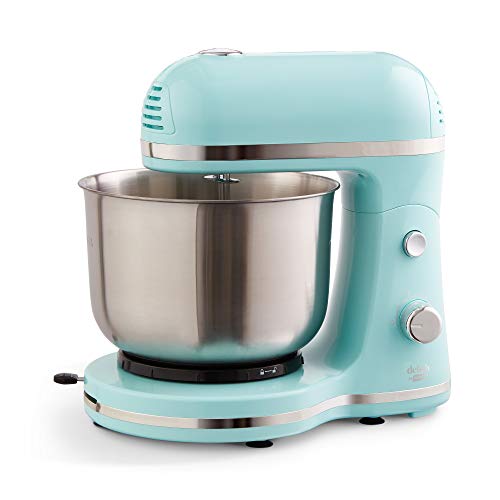
Delish by Dash Stand Mixer, 3.5-Quart (Aqua) — Best Style Pick
The Delish by Dash is for the small kitchen that keeps its mixer on the counter and wants it to look like it belongs there. Under the styling it is a competent compact: a removable 3.5-quart bowl for serving and washing, five speeds for everyday jobs, and dough hooks in the box for small bread and pizza batches.
Strengths
- Counter-worthy design in cheerful colors
- Removable bowl is handy for serving and cleaning
- Dough hooks included — not an extra purchase
Trade-offs
- 5 speeds is a narrower range than most rivals here
- Light compact build shares the class limits on stiff dough
- Style-led line: color availability varies by listing
Key specs: 3.5-quart removable bowl; 5 speeds; dough hooks included; Aqua.
Dash built its name on small appliances people enjoy looking at, and this collaboration model applies the formula to stand mixing. The removable bowl is the functional highlight — batter goes from mixer to oven dish to sink without a transfer step, and the whole machine stores easily when counter space wins the argument. Five speeds cover the realistic small-mixer repertoire; you lose fine low-speed finesse, not capability. As with all light compacts, small dough batches only. If your mixer will live in view and work in small batches, this is the charming, competent choice.
The Delish by Dash lives where cooking meets the rest of the home: on open shelving, in a bright corner, in photos of a kitchen its owner is proud of. That visibility drives use — a mixer you see is a mixer you reach for — and its competent compact performance backs up the styling. For small households that entertain in the kitchen itself, it is both tool and décor, and unashamed of either role.
Best for: Style-conscious small kitchens and light, frequent mixing / Not suited for: Precision bakers wanting wide speed ranges or heavy dough work
Comparison Table
| Pick | Badge | Key spec | Best for |
|---|---|---|---|
| Dash Everyday Stand Mixer, 3-Quart (Black) | Best for Smallest Kitchens | 3 qt, 6 speeds, tilt-head | Singles, couples and tiny kitchens doing small, frequent batches |
| KitchenAid Artisan Mini 3.5-Qt Tilt-Head Stand Mixer (Contour Silver) | Best Premium Small Mixer | 3.5 qt, 10 speeds, attachment hub | Quality-first small households that bake regularly |
| Hamilton Beach 4 Qt Electric Stand Mixer (7 Speeds) | Best Value Stand Mixer | 4 qt, 7 speeds, 300W | First stand-mixer buyers and small families on a budget |
| Hamilton Beach Classic Stand and Hand Mixer (64655) | Best 2-in-1 | 4 qt, 2-in-1 stand/hand, 290W peak | Space-counting kitchens that mix both ways, in small batches |
| Kitchen in the Box Stand Mixer, 3.5QT (White) | Best for One- and Two-Person Baking | 3.5 qt, 10 speeds, compact | Singles and couples baking small batches weekly |
| Delish by Dash Stand Mixer, 3.5-Quart (Aqua) | Best Style Pick | 3.5 qt, 5 speeds, removable bowl | Style-conscious small kitchens and light, frequent mixing |
How to Choose a Small Food Mixer: Bowl, Power and Honest Batch Math
Start with batch math. A 3-quart bowl creams butter and sugar for a standard cookie batch but crowds a double; 3.5–4 quarts is the practical sweet spot for small households, covering one loaf, one cake or one batch of cookies with headroom to whip. If your signature bake is a double batch of anything, you do not need a small mixer — you need a standard one, and no review should pretend otherwise.
Power in small mixers is about torque at low speed, not headline watts. Dough work happens at speed 1–2; a mixer that races at the top end but bogs and heats at the bottom will disappoint bread bakers. Planetary action — where the beater orbits the bowl — matters more than raw numbers for even mixing, and it is the feature to insist on in any stand model. Finally, weigh the machine, literally: a small mixer you store must be light enough that retrieving it is a non-event, or it will live unused in the cabinet it was meant to save.
Stand, Hand or 2-in-1: Picking Your Small-Mixer Style
A dedicated small stand mixer is the choice for hands-free work: kneading, long creaming, whipping while you do something else. A hand mixer — covered in depth in our guide to the best small hand held mixers — wins for speed, storage and in-pot jobs like mashed potatoes. A 2-in-1 like the Hamilton Beach Classic splits the difference for kitchens that genuinely do both and can store only one appliance.
Be honest about your top three mixing jobs. If two of them are dough or long creaming, buy the stand. If two are quick, small and in the serving bowl, buy the hand mixer. If your list is mixed and your cupboard is tiny, the convertible earns its place. The wrong style, faithfully used, still frustrates; the right style in a modest machine delights for years.
What Small Mixers Can and Cannot Knead
Small mixers knead small, moderate doughs well: a single loaf of sandwich bread, a pizza dough for two, a batch of dinner rolls — at low speed, with patience, and with the dough hook doing steady work. They struggle with large, stiff, low-hydration doughs: double bagel batches, heavy whole-grain loaves at full bowl capacity. The symptoms are heat, noise, counter-walking and, over time, gear wear.
The technique that extends every small mixer’s dough life is restraint: mix to combine, rest the dough ten minutes (the flour hydrates and gluten relaxes on its own), then knead in short low-speed runs. You will get better bread and a longer-lived machine. If bread is your main event and batches are ambitious, the KitchenAid Artisan Mini is the small pick with the most headroom — and even it will tell you, audibly, when a batch is too much.
Attachments and Add-Ons for Small Mixers: What Is Worth It
For stand models, the second bowl is the highest-value add-on in small-mixer life: batter in one, whipped cream in the other, no washing mid-recipe. A pouring shield earns its shelf space if you bake with flour weekly. Beyond that, value depends on platform: KitchenAid’s hub attachments (pasta, grinder, spiralizer) can retire whole appliances from a small kitchen, which is a space argument no other add-on can make.
For non-hub compacts, restraint wins: buy the beater you lost, not the bundle you might use. And across all small mixers, a flexible bowl scraper and a kitchen scale do more for results than any attachment — small bowls reward precise, weighed ingredients because there is less margin for a heavy-handed pour to hide in.
Small Mixer Care: Making a Compact Last
Compact mixers die of overload and storage neglect, not age. Keep loads within the bowl’s honest capacity, knead at low speed in short runs with rests, and never let the motor’s note sag and strain without intervening — split the batch or finish by hand. After use, wash attachments promptly (dried batter is a small mixer’s barnacle), wipe the head and hub area, and store with the cord loosely coiled rather than kinked.
Once a season, check beater shafts for play, inspect the cord at its entry points, and run the machine empty through its speeds to listen for new noises. On hub models, a fingertip of food-safe grease on the hub keeps attachments seating smoothly. These five-minute rituals are how a value compact reaches year seven and a premium compact reaches year twenty.
When to Size Up: Honest Signs a Small Mixer Is No Longer Enough
Size up when the workarounds become the routine: every recipe halved, dough finished by hand more often than not, holiday baking planned like a logistics exercise, or a second baker in the household doubling demand. A small mixer that is constantly at its ceiling is not being economical — it is being worn out ahead of schedule.
The graceful path is the one this cluster’s guides map: keep the small mixer for its speed and convenience (most owners do), and add capacity only where the pain actually is — a standard stand mixer for the big batches, while the compact keeps its weekday crown. Appliances, like kitchens, work best as a team with honest roles.
Small Mixer Speed Settings, Translated
Manufacturers count speeds; bakers need functions. Translate any small mixer’s dial into five jobs: stir (folding, starting flour, gentle combining), low (kneading and heavy batters), medium (creaming butter and sugar, most cake work), high (whipping cream), and maximum (egg whites to stiff peaks). A 6-speed Dash and a 10-speed Artisan Mini both cover these five jobs — the finer dials simply give you more than one way to land on each.
The practical test of a speed range is the bottom end. If speed one still throws flour, the mixer lacks a true stir gear, and you compensate by pulsing. Every pick in this guide was chosen with a usable low end, which is why the speed counts in the comparison table matter less than the reviews’ notes on control.
Scaling Recipes Down for Small Bowls — and When Not To
Halving a recipe for a 3-quart bowl is safe for batters and doughs, with two cautions: leavening scales linearly but watch the first bake’s timing (smaller masses bake faster), and egg-heavy recipes halve awkwardly — use the whole egg and accept a slightly richer result, or choose recipes written in grams and scale precisely with a scale.
Some things should not be scaled down: whipped components need enough volume for the beaters to engage, and very small dough batches knead poorly because the hook cannot gather them. For those, make the full small batch and freeze the surplus — cookie dough and bread both freeze beautifully. A small mixer rewards a freezer-friendly mindset.
Small Mixers for Special Diets: Gluten-Free and Plant-Based Notes
Gluten-free batters behave differently — often looser, sometimes grittier — and they reward the gentle low speeds and thorough planetary action of the better small mixers, because overmixing cannot develop gluten that is not there but can still toughen starches. A small bowl is an advantage here: alternative-flour baking is usually small-batch by nature and by ingredient cost.
Plant-based baking leans on aquafaba whipping and nut-butter-based doughs; the former needs a real whisk-capable top speed (the Artisan Mini and the stronger compacts deliver), the latter needs low-speed torque and patience. Every pick in this guide handles the realistic special-diet repertoire, provided batches stay in the small class these machines were built for.
The Two-Mixer Household: Pairing a Small Stand With a Hand Mixer
Many small kitchens graduate to a pairing: the compact stand mixer for dough and creaming, a hand mixer for the pot, the quick whip and the serving bowl. The pairing costs less counter than one large stand mixer and covers more situations — which is why this cluster publishes the hand-mixer guide alongside this one rather than treating the formats as rivals.
If you are building the pair over time, buy the format your next ten recipes need, and let the second arrive when its absence has annoyed you three times. That rule — buy on demonstrated annoyance, not anticipation — keeps small kitchens equipped rather than cluttered, and it is the philosophy behind every pick list in this series.
Small Mixers and the Science of Creaming
Creaming butter and sugar is the small mixer’s defining test, because the bowl’s modest volume concentrates the action: room-temperature butter, sugar added gradually, and a mid-range speed produce the pale, aerated base that cakes depend on. In a small bowl this takes less time than recipes written for big mixers suggest — watch the color and texture, not the clock, and stop when the mixture lightens visibly.
Two small-bowl advantages deserve note: ingredients stay in the beater’s path instead of hiding in a wide bowl’s corners, and temperature control is easier — a bowl of butter softens or chills to spec quickly. Bakers who master creaming in a compact mixer often produce more consistent cakes than big-mixer owners who set and forget. Small, here, is a genuine technique upgrade.
Key Takeaways
- Value answer: Hamilton Beach 4 Qt; premium answer: KitchenAid Artisan Mini — the full-size fork, in miniature.
- Tiniest kitchens: Dash Everyday 3-Qt; one machine, two jobs: Hamilton Beach Classic 2-in-1.
- Batch honesty: 3.5–4 quarts covers single standard batches; doubles belong to bigger machines.
- Dough rule: low speed, small batches, rest the dough — small mixers reward technique.
How to Use a Small Stand Mixer Well: Setup, Speeds and Cleanup
Step 1: Set up for the flour cloud. Small bowls plus flour plus speed equals a dusting. Start every dry-ingredient job at the lowest speed until the flour is incorporated — or use a splash guard if your model includes one — then raise speed.
Step 2: Learn the speed map. Low speeds fold and knead; middle speeds cream butter and mix batters; high speeds whip cream and egg whites. In a small bowl, ingredients reach the beater fast, so jobs finish sooner than big-mixer recipes suggest — watch the food, not the timer.
Step 3: Scrape once, properly. Stop midway through creaming and scrape the bowl’s bottom and sides with a flexible spatula. Small bowls mix evenly for their size, but a single deliberate scrape guarantees no butter pocket survives.
Step 4: Respect the dough ceiling. If the motor note drops and the head strains, the batch is too big or too stiff. Split it, add a spoon of liquid, or finish by hand. Two minutes of hand kneading is cheaper than a gearbox.
Step 5: Clean while it is easy. Bowl and beaters rinse clean in moments right after use; several picks here have dishwasher-safe attachments. Wipe the head and hub area with a damp cloth — flour migrates everywhere — and store the mixer with the bowl in place to protect the beater shaft.
Storage ritual that pays off: return the mixer to its spot with the bowl on and the beater you use most already fitted. The next session then starts in seconds — and in small-batch cooking, where the mixer competes with simply stirring by hand, those seconds are the difference between a machine that is loved and a machine that is furniture.
A final habit: the recipe card habit. Keep a small card in the bowl noting your regular recipes’ speeds and times on this machine — ‘cookies: speed 4, 2 min cream’ — because small mixers run faster than the big-mixer timings printed in most recipes. Three sessions of notes permanently calibrate you to your mixer, and the card rides in the bowl so it is always where the baking starts.
Common Buying Mistakes
Buying small, then batching big. The most common small-mixer regret is sizing for the everyday and then resenting the machine at the holidays. If December baking is your main event, size for December.
Starting on high with flour in the bowl. Every small-mixer owner does this once. Low speed first, always, or wear the recipe.
Kneading on high speed. Dough hooks are low-speed tools. High speed overheats compact motors and can walk a light mixer off the counter.
Ignoring the attachment list. Small mixers vary in what is included — a missing dough hook or whisk is a second purchase. Confirm the box contents on the listing before ordering.
Storing it somewhere annoying. A small mixer’s whole value is convenience. If retrieval is a chore, you will hand-mix instead and the machine becomes clutter with a cord.
Final Recommendation
For most small households, the Hamilton Beach 4 Qt is the value answer and the KitchenAid Artisan Mini is the premium one — the same fork in the road as the full-size market, in miniature. The Dash Everyday serves the tiniest kitchens, the Hamilton Beach Classic 2-in-1 serves the space-counters, and the Kitchen in the Box and Delish by Dash serve one- and two-person bakers with easy cleanup and counter appeal respectively.
Keep comparing within the cluster: Best Small Kitchen Mixers looks at the same problem from a storage-first angle, Best Small Hand Held Mixers covers the hand-mixer alternative, and Best Small Kitchenaid Mixers narrows to one brand’s small lineup. Check price on Amazon for your chosen model and color before ordering.
Ready to shop? Compare the picks directly: Dash Everyday Stand Mixer, 3-Quart (Black), KitchenAid Artisan Mini 3.5-Qt Tilt-Head Stand Mixer (Contour Silver), Hamilton Beach 4 Qt Electric Stand Mixer (7 Speeds), Hamilton Beach Classic Stand and Hand Mixer (64655), Kitchen in the Box Stand Mixer, 3.5QT (White), Delish by Dash Stand Mixer, 3.5-Quart (Aqua).
Frequently Asked Questions
What size bowl is best for a small household?
For one to four people, 3.5 to 4 quarts is the sweet spot: a standard cookie batch, a single loaf or a layer cake fits with room to whip. A 3-quart bowl suits one- and two-person cooking; go smaller than that only for truly tiny jobs.
Can a small stand mixer knead bread dough?
Yes — single-loaf, moderate-hydration doughs at low speed are squarely within a good small mixer’s ability, especially planetary models and the Artisan Mini. Large, stiff or double batches exceed the class; split them or finish by hand.
Is a 2-in-1 stand and hand mixer a good idea?
For small kitchens that do both kinds of jobs in small batches, yes — the Hamilton Beach Classic in this guide is proof the format works. Specialists outperform it in each role, so committed bakers should buy the dedicated stand mixer instead.
How long should a small mixer last?
Budget compacts give several years of regular small-batch service. Metal-drive premium models like the Artisan Mini are built for a decade or more. Lifespan tracks batch discipline more than brand: chronic overloading kills small mixers early.
Do small mixers work for holiday baking?
They work in batches. A small mixer can absolutely produce a holiday spread — sequentially. If your tradition is double and triple batches mixed at once, that is a standard-size mixer’s job, and forcing a compact to do it is how motors die in December.
What attachments matter most for a small mixer?
The core trio — flat beater, whisk and dough hook — covers nearly everything. Confirm they are included; on some compacts the hook or whisk is a separate purchase. Powered-hub attachments (pasta, grinding) are a KitchenAid Mini advantage, not a small-mixer standard.
Are small mixers good for elderly or arthritic hands?
Often better than big ones: lighter bowls, lighter machines and smaller batches reduce lifting and gripping demands. Tilt-head models avoid the lift-and-hold of bowl-lift designs, and a hand mixer or 2-in-1 can be easier still for very light jobs. Choose the format whose heaviest single lift — machine or bowl — suits the cook.
Can I use stand mixer attachments from a full-size model on a small one?
Hub attachments on KitchenAid models are broadly cross-compatible, including the Artisan Mini. Bowls and beaters are not — they are sized to each model. For other brands, assume attachments are model-specific unless the listing says otherwise.
Do small stand mixers work for pizza night?
Yes — a single pizza dough is an ideal small-mixer job at low speed. For a crowd, mix two sequential small batches rather than one doubled batch; the dough quality and the motor both prefer it.
How loud are small stand mixers?
Compact mixers are generally quieter than full-size machines simply because their motors are smaller, though hard dough work raises any mixer’s voice. Planetary models under normal batter loads are conversation-friendly; early-morning bakers will find the hand-mixer alternative in this cluster quieter still.
Can a small mixer handle meringue for a pavlova?
Yes — a pavlova’s whites are a standard single batch, well within a 3.5-quart bowl, and the better compacts here whip to stiff peaks reliably. Use a scrupulously clean, grease-free bowl; that matters more than the mixer’s size.
Is it worth buying a second bowl for a small mixer?
For bakers who make frosted cakes or anything with a whipped component, yes — it is the single most useful accessory in this category, eliminating the mid-recipe wash that breaks a bake’s rhythm. Confirm the bowl is the exact fit for your model before ordering; small-mixer bowls are not interchangeable across brands or, often, across a brand’s own lines.


