Disclosure: airfryerkitchensupply.com is reader-supported. When you buy through links on our site, we may earn an affiliate commission at no extra cost to you.
Where to buy
KitchenAid’s small lineup spans the Artisan Mini, the Classic 4.5-quart, and the brand’s compact hand mixers — and color variants share model numbers, so match the listing’s model code (KSM3316, K45SS, KHM512, KHM7210, KHMR762) to the review before ordering. Every pick below links to its Amazon listing so you can check price on Amazon. One naming caution: KitchenAid’s cordless hand mixer and its stand mixers are entirely different machines — confirm which type the listing describes.
- KitchenAid Artisan Mini 3.5-Qt Tilt-Head Stand Mixer (Black Matte) — Check the current price on Amazon
- KitchenAid Artisan Mini 3.5-Qt Tilt-Head Stand Mixer (Candy Apple Red) — Check the current price on Amazon
- KitchenAid Classic Series 4.5 Quart Tilt-Head Stand Mixer K45SS (Onyx Black) — Check the current price on Amazon
- KitchenAid 5 Ultra Power Speed Hand Mixer KHM512 (White) — Check the current price on Amazon
- KitchenAid 7 Speed Hand Mixer KHM7210 (Empire Red) — Check the current price on Amazon
- KitchenAid Go Cordless Hand Mixer KHMR762 (Porcelain White, Battery Included) — Check the current price on Amazon
Shoppers searching for the best small kitchenaid mixers have usually already decided the brand — for its metal build, its attachment hub, its parts availability measured in decades — and now face the harder question: which of KitchenAid’s smaller machines actually fits a smaller kitchen and a smaller household? The answer is not one model. KitchenAid’s small range includes a true mini stand mixer, an entry full-size stand mixer that still counts as compact next to the bowl-lift machines, and a hand-mixer line that many small kitchens should honestly choose instead.
This guide walks the whole small KitchenAid family with the brand knowledge a general roundup cannot offer: what the Artisan Mini shares with its big siblings (planetary action, the hub, the gearing philosophy) and where it is genuinely smaller; why the Classic K45SS is the value gateway to the ecosystem; and how the 5-, 7-speed and cordless hand mixers slot beneath them for drawer-based kitchens. We also include one honest unlinked note: KitchenAid’s cordless stand mixer concept (the KHMB732 designation that circulates in listings and forums) could not be confirmed as a current, matchable Amazon listing in our checks, so it is discussed without a purchase link rather than linked on a guess — see the buying guide for details.
Every linked model below was cross-checked against Amazon’s catalog, matching brand and model exactly before a link was earned. Prices are not printed; check price on Amazon, where KitchenAid’s color variants can differ.
One discipline runs through this guide and is worth naming: every linked listing was matched by exact model code, because KitchenAid’s range is a family of near-identical names separated by crucial details. When you shop beyond this page, keep that discipline — the code on the listing is the product; everything else is presentation.
Finally, a note on how this guide treats the word ‘best.’ There is no single best small KitchenAid below — there is a best stand mixer for the counter, a best one for the shelf that can stretch, and a best hand mixer for the drawer, and pretending one machine wins all three briefs would serve no kitchen. The reviews state each pick’s ceiling as plainly as its strengths. If you finish this page knowing which KitchenAid is yours — and which model code proves it — the guide has done its job.
In this guide
Quick Picks
Best Small KitchenAid Overall — KitchenAid Artisan Mini 3.5-Qt Tilt-Head Stand Mixer (Black Matte). The Artisan Mini in Black Matte: 3.5 quarts, 10 speeds and the full hub in KitchenAid’s most compact stand-mixer body. Check on Amazon
Best Statement Color — KitchenAid Artisan Mini 3.5-Qt Tilt-Head Stand Mixer (Candy Apple Red). The same Artisan Mini in KitchenAid’s signature Candy Apple Red — the small mixer as the kitchen’s centerpiece. Check on Amazon
Best Value into the Ecosystem — KitchenAid Classic Series 4.5 Quart Tilt-Head Stand Mixer K45SS (Onyx Black). The 4.5-quart Classic in Onyx Black — the most affordable route to a full-size KitchenAid stand mixer with hub and planetary action. Check on Amazon
Best Small KitchenAid Hand Mixer — KitchenAid 5 Ultra Power Speed Hand Mixer KHM512 (White). The KHM512 in white: five speeds and Turbo Beaters in a drawer — KitchenAid quality for kitchens with zero counter to spare. Check on Amazon
Best Hand Mixer for Bakers — KitchenAid 7 Speed Hand Mixer KHM7210 (Empire Red). Seven speeds, soft start and a Pro Whisk in Empire Red — the hand mixer for small-kitchen bakers who whip seriously. Check on Amazon
Best Cordless KitchenAid — KitchenAid Go Cordless Hand Mixer KHMR762 (Porcelain White, Battery Included). KitchenAid’s cordless hand mixer in Porcelain White with battery included — seven speeds and soft start, anywhere in the kitchen. Check on Amazon
How These Picks Were Chosen
We limited this guide to KitchenAid models that a small kitchen can genuinely host: the Artisan Mini stand mixer in its main colors, the Classic 4.5-quart as the stretch option, and the hand mixers that serve kitchens with no counter to give. Each stand pick had to carry the powered hub — it is half the reason to buy the brand — and each model had to be confirmable in Amazon’s catalog by exact model code.
We also applied the brand’s own logic: KitchenAid sells longevity, so we weighted metal construction, attachment and parts depth, and the likelihood that a beater bought today fits the machine in ten years. Where two picks are the same machine in different colors, we say so and explain why both appear — color is a real decision in a small, visible kitchen — while differentiating the roles they play for different buyers.
The 6 Best Best Small KitchenAid Mixers
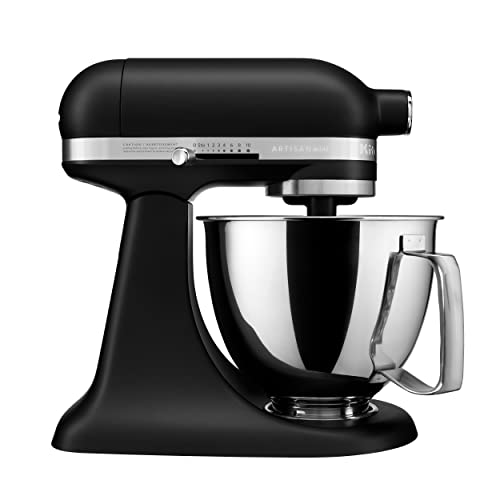
KitchenAid Artisan Mini 3.5-Qt Tilt-Head Stand Mixer (Black Matte) — Best Small KitchenAid Overall
The Black Matte Mini is the definitive small KitchenAid: for the apartment or small home that bakes weekly and wants the machine on the counter, looking composed, for years. It mixes single batches with flagship thoroughness and takes every hub attachment its big siblings take.
Strengths
- True mini footprint with full KitchenAid build and hub
- 10 speeds from gentle fold to fast whip
- Matte finish hides flour dust and fingerprints gracefully
Trade-offs
- Premium pricing for the compact class
- 3.5-qt bowl sets a firm single-batch ceiling
- Heavier than plastic compacts — it is metal, and feels it
Key specs: 3.5-quart bowl; 10 speeds; tilt-head; powered attachment hub; Black Matte; model family KSM3316.
The Mini succeeds because nothing about its mixing is miniaturized except the bowl and body. The planetary action, the speed range, the hub — all standard KitchenAid, which means attachments, replacement beaters and a decade of service are realistic expectations rather than hopes. Black Matte is the pragmatic color choice for a working counter: it shrugs off the visual evidence of baking day. If you are buying one small KitchenAid stand mixer and budget allows, the deliberation ends here; the remaining questions are color and which hub attachment comes first.
Black Matte Minis tend to become the counter’s anchor: the finish absorbs visual noise, the machine’s heft reads as permanence, and its weekly rhythm — dough Friday, batter Sunday, pasta when the hub attachment comes out — defines a small kitchen’s cooking life. Owners describe it less as an appliance and more as infrastructure. That is the Mini’s design brief, fulfilled in its most practical color.
Best for: Small kitchens wanting the definitive compact KitchenAid / Not suited for: Double-batch bakers or strict budget shoppers

KitchenAid Artisan Mini 3.5-Qt Tilt-Head Stand Mixer (Candy Apple Red) — Best Statement Color
Choose the red Mini when the mixer will live in view and you want it to be the room’s accent — the classic KitchenAid statement, scaled for a small counter. Mechanically it is identical to its matte sibling: 3.5 quarts, ten speeds, full hub, single-batch excellence.
Strengths
- Iconic Candy Apple Red finish, properly glossy
- Identical Mini engineering: hub, 10 speeds, planetary action
- A countertop anchor piece for small, neutral kitchens
Trade-offs
- Gloss shows every splash and fingerprint until wiped
- Same premium tier and batch ceiling as every Mini
- Red commits your kitchen’s accent color for years
Key specs: 3.5-quart bowl; 10 speeds; tilt-head; powered attachment hub; Candy Apple Red.
It would be dishonest to pretend color is trivial in a small kitchen: the mixer is always visible, so it is decor whether you planned it or not. Candy Apple Red is the color KitchenAid built its visual identity on, and on the Mini’s compact silhouette it reads as jewel-like rather than bulky. Everything said about the Mini’s mixing applies unchanged — thorough, calm, hub-equipped, single-batch. Buy this one because you will smile at it on the counter for a decade, which is a legitimate engineering-adjacent virtue: appliances that please get used.
The red Mini’s ownership story is emotional in the way good tools are: it is the wedding-registry triumph, the first-apartment splurge, the machine photographed with every birthday cake for a decade. KitchenAid’s red carries that heritage deliberately. Mechanically identical to its siblings, it simply earns more affection per batch — and affection, in a small kitchen where the mixer is always visible, is utility.
Best for: Visible-counter small kitchens wanting the classic KitchenAid look / Not suited for: Buyers who prefer appliances that disappear visually

KitchenAid Classic Series 4.5 Quart Tilt-Head Stand Mixer K45SS (Onyx Black) — Best Value into the Ecosystem
The K45SS serves the small kitchen that can stretch: 4.5 quarts swallows standard recipes whole, the hub opens the attachment world, and the Classic’s decades-long production run means parts and knowledge are everywhere. It is the small-KitchenAid choice for households whose batches are not small.
Strengths
- Standard-batch capacity at the ecosystem’s entry tier
- 59-point planetary mixing and full hub compatibility
- Long production history: parts, beaters and advice are abundant
Trade-offs
- Bigger and heavier than true compacts — measure first
- Feature set is classic, not modern: no soft-start flour mode
- Onyx Black shows flour dust prominently
Key specs: 4.5-quart bowl; 10 speeds; tilt-head; 59 touchpoints; Onyx Black; model K45SS.
The Classic is the mixer that made KitchenAid a household word, and its case in a small-kitchen guide is capacity per dollar within the brand: nothing else with the badge mixes a full standard batch for less. Its manners are proven rather than refined — strong, steady, a little utilitarian — and its accessory ecosystem is the deepest in this entire cluster of guides. Small kitchens should measure honestly (it needs real counter or a dedicated shelf), but those that can host it get the brand’s core promise with the least compromise on batch size.
Within the KitchenAid family, the Classic is the historian’s pick: the model whose production run spans generations of bakers, whose beaters are in every kitchen store, whose quirks are documented in a million recipe headnotes. A small kitchen choosing it buys into that continuity. Its service story — parts everywhere, knowledge everywhere — is the brand promise in its purest form.
Best for: Small kitchens with standard-size batches and long horizons / Not suited for: Tight storage, daily movers, or mini-footprint purists
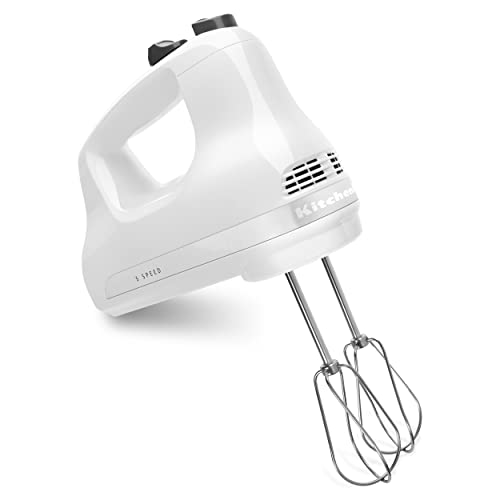
KitchenAid 5 Ultra Power Speed Hand Mixer KHM512 (White) — Best Small KitchenAid Hand Mixer
For the small kitchen whose stand-mixer space simply does not exist, the white KHM512 is the KitchenAid answer: it creams, mixes and whips the everyday repertoire, then vanishes into a drawer. It is also the natural companion pick for Mini owners who want an in-pot option.
Strengths
- Drawer storage — the smallest KitchenAid footprint of all
- Turbo Beaters rinse clean in seconds, no center post
- Lockable swivel cord suits any outlet position
Trade-offs
- Beaters only in the base kit — no whisk or hooks
- Five speeds is the simple end of the brand’s range
- White shows turmeric and berry stains over time
Key specs: 5 speeds; Stainless Steel Turbo Beater II; lockable swivel cord; White; model KHM512.
Brand loyalty meets reality here: plenty of KitchenAid households do their daily mixing with this hand mixer and save stand duty for weekends. The KHM512’s virtues are the family’s — a genuinely gentle first speed, beaters that do not clog, a body balanced for one-hand control. In white it matches the bright small kitchens it usually serves. If your ‘small KitchenAid’ search was really about counter space, this may be the most honest answer in the guide: the smallest KitchenAid is the one that lives in a drawer.
The white KHM512 is often the second KitchenAid in a house — bought when the stand mixer’s owner admits that most jobs are five-minute jobs. It inherits the family’s trust: the same beater design language, the same calm low speed. In white it disappears into bright drawers and reappears without ceremony, which is precisely the hand mixer’s job description.
Best for: Zero-counter kitchens and as a companion to a stand mixer / Not suited for: Bakers needing whisk, hooks or hands-free mixing
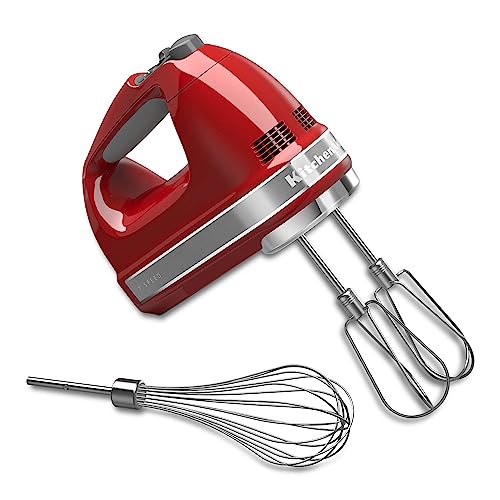
KitchenAid 7 Speed Hand Mixer KHM7210 (Empire Red) — Best Hand Mixer for Bakers
The red KHM7210 is for the drawer-kitchen baker with ambitions: meringues, whipped cream and folded batters handled with soft-start control and a proper whisk, in the brand’s Empire Red. It covers more baking ground than any other hand mixer in this guide except the 9-speed kit.
Strengths
- Pro Whisk included — real whipping ability
- Soft Start ends the flour-cloud problem
- Seven speeds with fine low-end control
Trade-offs
- No dough hooks — soft doughs stay out of reach
- Empire Red is a commitment in a small kitchen
- Costs meaningfully more than the 5-speed
Key specs: 7 speeds; Pro Whisk; Turbo Beater II; soft-start; lockable swivel cord; Empire Red; model KHM7210.
Within KitchenAid’s hand line, the 7-speed is the baker’s sweet spot: the whisk transforms it from a batter tool into a whipping instrument, and soft start makes its low end genuinely gentle — the two upgrades a baker feels in every session. Empire Red gives a drawer appliance an odd distinction: it is the one you will enjoy pulling out. Pair it with a Mini later and the small KitchenAid kitchen is complete; own it alone and most home baking is covered without a single inch of counter surrendered.
Empire Red on the KHM7210 makes a drawer tool feel like an occasion, and its whisk makes it perform like one: cream for the pie, whites for the cake, soft start keeping the counter clean throughout. Small-kitchen bakers who cook for others find this the most borrowed-and-returned-with-compliments item they own. It is the hand line’s sweet spot wearing the brand’s happiest color.
Best for: Small-kitchen bakers who whip and fold often / Not suited for: Dough-hook users or strict minimalists

KitchenAid Go Cordless Hand Mixer KHMR762 (Porcelain White, Battery Included) — Best Cordless KitchenAid
The Porcelain White Go is for the KitchenAid kitchen short on outlets or long on island: mix at the stove, the island or the table with no cord to route. This bundle includes the Go-system battery, and the seven-speed, soft-start performance matches the corded hand line’s manners.
Strengths
- Cordless freedom within the KitchenAid ecosystem
- Battery included — ready out of the box
- Soft Start and 7 speeds: full control, no cord
Trade-offs
- Runtime is finite; marathon days need charge planning
- Battery weight is noticeable on long whipping jobs
- Premium tier above the corded hand mixers
Key specs: Cordless; 7 speeds; Soft Start; stainless steel beaters; battery included; Porcelain White; model KHMR762.
KitchenAid’s Go system applies the brand’s seriousness to cordless: this is not a gadget mixer but the hand line’s equal, freed from the wall. Porcelain White suits the system aesthetic — clean, appliance-proud, designed to sit out charging rather than hide. The ownership discipline is simple: dock or charge it after use and it is always ready. For the small kitchen whose single outlet already serves the kettle and the toaster, cordless is not a luxury; it is the difference between mixing where you cook and cooking where you can mix.
The Porcelain White Go completes a KitchenAid kitchen’s logic: the stand mixer owns the counter, the cordless hand mixer owns everywhere else, and the Go battery system hints at a cordless ecosystem to come. Its charging ritual fits beside the kettle’s. For brand-loyal small kitchens, it is less a purchase than an adoption — the newest member of a family that tends to stay for decades.
Best for: Outlet-poor KitchenAid kitchens and island cooking / Not suited for: High-volume bakers who would rather never think about charge
Comparison Table
| Pick | Badge | Key spec | Best for |
|---|---|---|---|
| KitchenAid Artisan Mini 3.5-Qt Tilt-Head Stand Mixer (Black Matte) | Best Small KitchenAid Overall | 3.5 qt, 10 speeds, hub | Small kitchens wanting the definitive compact KitchenAid |
| KitchenAid Artisan Mini 3.5-Qt Tilt-Head Stand Mixer (Candy Apple Red) | Best Statement Color | 3.5 qt, 10 speeds, Candy Apple Red | Visible-counter small kitchens wanting the classic KitchenAid look |
| KitchenAid Classic Series 4.5 Quart Tilt-Head Stand Mixer K45SS (Onyx Black) | Best Value into the Ecosystem | 4.5 qt, 10 speeds, planetary | Small kitchens with standard-size batches and long horizons |
| KitchenAid 5 Ultra Power Speed Hand Mixer KHM512 (White) | Best Small KitchenAid Hand Mixer | 5 speeds, hand mixer, drawer-size | Zero-counter kitchens and as a companion to a stand mixer |
| KitchenAid 7 Speed Hand Mixer KHM7210 (Empire Red) | Best Hand Mixer for Bakers | 7 speeds + whisk, soft start | Small-kitchen bakers who whip and fold often |
| KitchenAid Go Cordless Hand Mixer KHMR762 (Porcelain White, Battery Included) | Best Cordless KitchenAid | Cordless, 7 speeds, battery included | Outlet-poor KitchenAid kitchens and island cooking |
Artisan Mini vs Classic 4.5-Qt: The Real Small-KitchenAid Decision
These two stand mixers answer different questions. The Artisan Mini asks: how small can a KitchenAid be without ceasing to be one? Its 3.5-quart bowl, compact body and full hub make it the true small-kitchen machine — but single batches are a hard ceiling. The Classic asks: how affordable can a full-capacity KitchenAid be? At 4.5 quarts it mixes standard recipes whole and costs less than the Mini, but it needs standard-mixer space and lifting commitment.
Decide by batch and by tape measure. If your recipes are written for standard mixers and you double nothing, both work — choose the Mini for space, the Classic for capacity and value. If you regularly double, only the Classic (or a bigger machine outside this guide) is honest. If your storage is a shallow shelf, only the Mini fits. Either way you keep the hub, the planetary action and the parts ecosystem — the brand’s core promise survives both choices.
About Cordless KitchenAid Mixers: Hand vs Stand, and a Unlinked note
KitchenAid sells a confirmed cordless hand mixer — the Go KHMR762, reviewed above with its listing verified. Cordless stand mixers are murkier territory. A model designation, KHMB732, circulates in discussions of a KitchenAid cordless stand mixer, but in repeated catalog checks we could not confirm a current Amazon listing that matches that model with confidence. Our rule is strict: no confident match, no purchase link. So if a cordless KitchenAid stand mixer is your goal, treat it as unlinked for now — shop the confirmed cordless hand mixer, or the corded Mini, and be wary of any listing whose model details do not line up exactly.
A related confusion deserves clearing: no KitchenAid hand mixer is made by or named for any other brand — if you see a listing blending KitchenAid with another maker’s name, it is a marketplace muddle, not a product. Always match the model code on the listing to the model code in the review; with KitchenAid, the code (KHM512, KSM3316, K45SS) is the identity, and color names are just finishes on it.
Getting the Most from the KitchenAid Hub in a Small Kitchen
The powered hub is the small kitchen’s secret weapon: one motor, many machines. The pasta roller replaces a pasta maker; the meat grinder replaces a grinder; the spiralizer and shredder retire single-purpose gadgets. In a kitchen counting cubic inches, a Mini plus two attachments can displace three appliances — the strongest argument for paying the brand premium at small size.
Sequence purchases by your actual cooking: pasta households first, bakers who grind meat second, everyone else as needed. Store attachments in a single bin near the mixer, and remember the hub cap comes off with a twist — the whole system is designed for small kitchens that multitask. One caution: hub attachments fit the stand mixers here (Mini and Classic), not the hand mixers; the hand line’s expansion is its beater and whisk accessories instead.
KitchenAid Colors and Finishes: A Practical Guide
KitchenAid sells identity as much as machinery, and in a small kitchen the finish is a long-term roommate. Gloss colors (Candy Apple Red, Empire Red) are joyful and show every splash; matte finishes (Black Matte) hide the evidence of work; whites and silvers integrate quietly into bright or stainless kitchens. There is no wrong answer, but there is a matching principle: choose the finish you will enjoy wiping — because you will wipe it, weekly, for years.
Practically: confirm the exact finish name on the listing, because KitchenAid’s reds and blacks have near-identical cousins, and prices can differ by finish on the same model code on the same day. The mixer is identical; pay for the color only if the color is the point — sometimes, legitimately, it is.
KitchenAid Attachments Worth Owning at Small Scale
Ranked by small-kitchen value: the pasta roller and cutter set (retires a machine, transforms a Tuesday), the fresh prep slicer/shredder (weekly utility), the meat grinder (burger and sausage control), and the grain mill for the committed. Each stores in a fraction of the appliance it replaces, which is the hub system’s whole argument at small scale.
Buy attachments one at a time, driven by a recipe you will make monthly, not by bundle discounts. A hub attachment used weekly is a bargain; three used annually are expensive shelf ornaments. The Mini and Classic in this guide accept the same hub line, so your attachment library survives a future upgrade — one of the quietest reasons to buy into the brand small.
Registering, Servicing and the Long KitchenAid Horizon
Register the mixer and save the model code somewhere durable — a photo of the label under the base works. That code unlocks exact-fit beaters, bowls and parts for the machine’s whole life, and KitchenAid’s service network is built around it. When a beater’s coating eventually wears or a bowl chips, replacements are a search by code, not a research project.
This service depth is the unglamorous core of the brand premium, and it is why this guide can recommend a decades-old Classic design without irony: the machine you buy today remains supportable. In a small kitchen, where every appliance must earn its place for years, supportability is not a footnote — it is the feature.
Small KitchenAid Myths, Corrected
Myth one: ‘The Mini is a toy version.’ It is a full planetary stand mixer with the hub, sized down in bowl and body — its mixing action and speed range are the family’s standard. Myth two: ‘Hand mixers cannot whip properly.’ With a whisk attachment and a deep bowl, the 7- and 9-speed models here produce firm meringues routinely. Myth three: ‘More speeds always means better.’ Control at the low end matters more than count at the top.
Myth four deserves emphasis because it circulates in listings: that KitchenAid’s cordless stand concept can be bought under another brand’s name, or that a hand mixer listing under a blended brand name is a KitchenAid product. It cannot and it is not — KitchenAid model codes are the identity, and this guide links only listings whose codes matched exactly.
Tilt-Head vs Bowl-Lift at Small Scale: Why This Guide Is All Tilt-Head
KitchenAid’s bowl-lift machines are superb — and they start at sizes this guide calls large. At small scale the brand’s answer is tilt-head, and for small kitchens that is fortunate: tilt-heads are shorter to store, simpler to load (the head swings clear of the bowl), and lighter to move. The trade is ultimate capacity and the bowl-lift’s stability under the heaviest doughs, which are not small-kitchen jobs anyway.
If your baking outgrows this guide — double batches weekly, heavy whole-grain loaves — the honest KitchenAid path is a bowl-lift model and the counter to host it. Until then, the tilt-head Mini and Classic cover the small-kitchen brief with the full hub and the full ecosystem, which is why they anchor this guide.
KitchenAid Hand Mixer Accessories: Completing the Kit
The hand line expands through its accessories: spare Turbo Beaters for back-to-back jobs, the Pro Whisk for models that ship without one, and storage solutions from cases to simple pouches. Compatibility is by model family, so order by the code on your mixer’s label — the same discipline this guide applies to stand-mixer bowls and beaters.
The most valuable accessory is arguably not KitchenAid’s at all: a deep, stable bowl that pairs with the mixer, as our hand-mixer guide discusses. Brand ecosystems are genuinely useful, but the best small KitchenAid setup is a system — mixer, bowl, scraper, scale — assembled with the same care as the mixer choice itself.
KitchenAid Across Generations: Why the Brand Dominates This Search
Ask why ‘small KitchenAid’ is a search at all, and the answer is inheritance: these mixers are handed down, listed in wills of kitchen goods, and sought used with confidence. The small models inherit that aura because they inherit the engineering — the same planetary action, hub standard and parts philosophy, compressed. A Mini bought today is plausibly the mixer a child learns on in fifteen years.
That horizon changes buying math. The relevant comparison is not this year’s price against a budget rival’s, but cost per decade of supported service. By that measure the Mini and Classic are often the economical choices in this entire cluster — a conclusion the brand’s resale listings support every day. Buy small, buy once, hand it down: that is the KitchenAid proposition at compact scale.
Pairing Within the Brand: The Complete Small KitchenAid Setup
The complete small KitchenAid kitchen, as this guide’s picks assemble it, is a Mini or Classic on the counter, a KHM-series hand mixer in the drawer, and one or two hub attachments chosen by your cooking — pasta for the Italian-leaning, the grinder for the burger serious. Each piece covers the others’ gaps, and the whole system stores in less space than one oversized stand mixer with its gadgets.
Sequence the purchases by pain: the stand mixer first if dough and batches lead, the hand mixer first if they do not (it is the cheaper, faster relief), attachments only when a recipe has been improvised-around three times. Built that way, the ecosystem grows by evidence — the same discipline this guide applied when it refused to link a single unverified model.
Buying a Small KitchenAid as a Gift
KitchenAid’s small machines are gift-grade objects — which makes the model-code discipline in this guide doubly important, because gifts are bought from listings at speed. For a new apartment, the KHM512 or the Mini are the canonical choices; for an established baker downsizing, the Classic or Mini in their preferred finish shows real thought.
Include the unglamorous extras that make the gift complete: the exact-fit second beater or bowl where offered, and a note of the model code for future parts. A KitchenAid given well is a decade-long presence in someone’s kitchen — the rare gift that appreciates in usefulness the longer it stays.
Key Takeaways
- True compact: Artisan Mini (Black Matte to hide the work, Candy Apple Red to celebrate it).
- Capacity value: Classic K45SS at 4.5 quarts — if your shelf can stretch.
- Drawer route: KHM512 for simple jobs, KHM7210 for bakers, Go Cordless KHMR762 for outlet-poor kitchens.
- Trust rule: buy by exact model code; the unverified cordless stand designation stays not linked in this guide.
How to Set Up and Care for a Small KitchenAid Mixer
Step 1: Check the beater clearance. KitchenAid tilt-heads have an adjustment screw in the hinge: the flat beater should clear the bowl bottom closely without striking it. A dime placed in the empty bowl is the classic test — the beater should move it slightly. Adjust once and your mixing improves permanently.
Step 2: Break in with an easy job. First session: whipped cream or a simple batter. Learn the speed map — stir speeds for folding and dough, mid for creaming, high for whipping — before attempting a stiff dough.
Step 3: Respect the flour rule. Add flour at the lowest speed in stages. KitchenAid’s smaller bowls reward the same patience as any compact: low and gradual beats fast and dusty.
Step 4: Wash like metal, store like furniture. Bowls and most beaters are dishwasher-friendly per model guidance, but the machine itself is a damp-cloth wipe only. Store stand models with the head down and bowl in place; hand models with beaters attached or cased.
Step 5: Keep the paperwork. Register the mixer and keep the model code handy — with KitchenAid, that code is your key to exact-fit beaters, bowls and attachments for the life of the machine, which is the point of buying the brand.
First-month calendar for a new KitchenAid: week one, whipped cream and a simple batter to learn the speeds; week two, a single loaf at low speed; week three, an attachment trial if you bought one; week four, your signature recipe, timed and noted. By the month’s end the machine’s settings for your cooking are muscle memory — the quiet goal behind every pick in this guide.
Record the code: photograph the model label under the base today and save it with your home records. Every future beater, bowl, attachment and service question starts with that code, and having it turns a twenty-minute research task into a twenty-second order. It is the smallest step in this guide and, over a KitchenAid’s decades of service, possibly the most valuable.
Common Buying Mistakes
Buying the Mini for double batches. The Artisan Mini is a single-batch machine by design. Chronic overfilling strains it and disappoints you; size up to the Classic if your recipes demand it.
Assuming every KitchenAid attachment fits every model. Bowl-specific beaters and bowls are sized per model family. Buy by model code, not by brand name alone.
Chasing an unverified cordless listing. If a ‘cordless KitchenAid stand mixer’ listing cannot show a matching model code and specifications, walk away — confirmed models like the Go hand mixer are the safe cordless route.
Ignoring the beater adjustment. An unadjusted beater leaves a layer of unmixed batter at the bowl’s bottom forever. The hinge screw exists precisely to fix this in two minutes.
Paying for color twice. Color variants of the same model can price differently on the same day. If two listings share a model code, the cheaper finish is the same mixer.
Final Recommendation
The small KitchenAid decision in one paragraph: buy the Artisan Mini for a true compact stand mixer (Black Matte to hide the work, Candy Apple Red to celebrate it), the Classic K45SS if your batches are standard and your shelf can stretch, the KHM512 if your KitchenAid must live in a drawer, the KHM7210 if that drawer baker whips seriously, and the Go Cordless if outlets rule your kitchen. The unconfirmed cordless stand model stays not linked until a listing can be verified — that discipline is what makes the links in this guide worth trusting.
Compare across the cluster before ordering: Best Small Kitchen Mixers for the all-brand storage view, Best Small Food Mixers for batch-first rankings, and Best Small Hand Held Mixers for the full hand-mixer field beyond KitchenAid. Then check price on Amazon by exact model code.
Ready to shop? Compare the picks directly: KitchenAid Artisan Mini 3.5-Qt Tilt-Head Stand Mixer (Black Matte), KitchenAid Artisan Mini 3.5-Qt Tilt-Head Stand Mixer (Candy Apple Red), KitchenAid Classic Series 4.5 Quart Tilt-Head Stand Mixer K45SS (Onyx Black), KitchenAid 5 Ultra Power Speed Hand Mixer KHM512 (White), KitchenAid 7 Speed Hand Mixer KHM7210 (Empire Red), KitchenAid Go Cordless Hand Mixer KHMR762 (Porcelain White, Battery Included).
Frequently Asked Questions
What is the smallest KitchenAid stand mixer?
The Artisan Mini: a 3.5-quart tilt-head with a compact body and lighter weight than the standard line, while keeping the powered hub and 10 speeds. It is the smallest stand mixer KitchenAid makes and the centerpiece of this guide.
Is the Artisan Mini powerful enough for bread dough?
For single-loaf, moderate doughs at low speed, yes — it shares the family’s planetary action and composed motor manners. Double or stiff low-hydration batches exceed its design; the Classic 4.5-quart or a bowl-lift model is the honest step up.
Do Artisan Mini attachments fit other KitchenAid mixers?
Hub attachments fit across the tilt-head and bowl-lift families that carry the powered hub, including the Mini and the Classic here. Bowls and beaters are model-specific — buy those by exact model code.
Should a small kitchen buy a KitchenAid hand mixer instead?
If counter and storage space are truly absent, yes — the KHM512 or KHM7210 covers most daily mixing from a drawer, at a fraction of a stand mixer’s cost and none of its footprint. Add the stand mixer later if bread and big creaming jobs arrive.
Does KitchenAid make a cordless stand mixer?
A cordless stand model designation circulates, but we could not confirm a current Amazon listing matching it with confidence, so this guide treats it as unlinked and links only the verified cordless option: the Go KHMR762 hand mixer. Verify any cordless stand listing’s model code very carefully before buying.
Which small KitchenAid is the best value?
Measured by capacity per dollar, the Classic K45SS — a full 4.5-quart ecosystem machine at the brand’s entry tier. Measured by space, the KHM512 hand mixer delivers KitchenAid quality for the least money and zero counter. The Mini is the premium answer, not the value one.
Is the Artisan Mini being replaced by a newer model?
KitchenAid refreshes colors and bundles periodically, but the Mini platform — 3.5-quart tilt-head with hub — is the brand’s standing compact offer, and its attachments and parts are fully supported. Buy the current listing by model code and you are buying the supported platform.
Can the Classic K45SS use the same bowls as the Artisan series?
No — bowls and beaters are model-family specific even within KitchenAid. The K45SS uses its own 4.5-quart bowl and beaters; the hub attachments, by contrast, are shared. Always order bowl-fit parts by the exact model code.
Are KitchenAid mixers worth it for occasional bakers?
If ‘occasional’ still means years of ownership, the service and parts horizon can justify the brand — especially the hand mixers, whose premium is modest. For truly rare use, the all-brand picks in our small kitchen mixers guide may fit the budget better.
Does the Artisan Mini come with a pouring shield?
Bundle contents vary by listing and color, which is why this guide insists on checking the exact listing’s included items before ordering. If a shield matters to your flour habits, confirm it in the box contents or budget it as an accessory.
How do I read a KitchenAid model code on a listing?
Look for the code pattern in the title or specifications — KSM3316 for the Artisan Mini family, K45SS for the Classic, KHM512/KHM7210/KHMR762 for the hand line. If the code is absent or inconsistent with the product description, treat the listing as unverified and shop elsewhere.
What does the Artisan Mini weigh, and does it matter?
It is noticeably lighter than the full Artisan line while remaining a metal machine — light enough for most owners to move one-handed between counter and cabinet, heavy enough to sit planted under load. That balance is deliberate: it is the weight class that makes a premium mixer compatible with small-kitchen storage habits.

