Disclosure: airfryerkitchensupply.com is reader-supported. When you buy through links on our site, we may earn an affiliate commission at no extra cost to you.
Where to buy
Analog DJ mixers are a connoisseur’s market where the same badge can span a working two-channel box and a hand-built flagship. Every model below was confirmed for its exact listing before earning a link — verify the exact model on the listing, especially in the rotary world, where similar names cover very different instruments. If you are buying used or imported, confirm voltage and power supply details before the mixer ships.
Allen & Heath XONE:96 — check price on Amazon
Allen & Heath XONE:92 Mk2 — check price on Amazon
Ecler WARM4 — check price on Amazon
Ecler WARM2 — check price on Amazon
Headliner R4 — check price on Amazon
Allen & Heath XONE:23 — check price on Amazon
Asking for the best sounding analog mixers dj-side is asking a narrower, more passionate question than analog mixing in general. DJ analog sound lives in three places: phono preamps that make vinyl sound like vinyl should, summing that glues two records into one continuous piece of music, and filters and isolators that become part of the performance. The six mixers below are the ones DJs name when sound — not effects, not screens — is the entire conversation.
Two formats divide the field. Linear-fader mixers in the Allen & Heath tradition offer four-band EQ and the famous dual filters, built for long, sculptural mixing. Rotary mixers remove the crossfader entirely and mix with smooth rotary gains, full-cut EQ or isolators, in the disco tradition — slower, more deliberate, and for many DJs simply more musical. This guide honours both, because the best sounding choice depends on how your hands mix.
Every pick was cross-checked against its Amazon listing. Analog DJ mixers are long-term, often decade-long purchases that hold their value and their following; each review is frank about who should not buy it, because in this corner of the market the wrong flagship is a more expensive mistake than the wrong budget box.
In this guide
Quick Picks
Allen & Heath XONE:96 — Best Overall. The linear-fader summit: four-band EQ, twin analog filters and summing that has made it the reference sound for modern club mixing. Check the current price on Amazon
Allen & Heath XONE:92 Mk2 — Best Classic Sound. The sound that defined an era of techno, refreshed: the original filter-led mixing instrument, with an LFO that turns sweeps into rhythm. Check the current price on Amazon
Ecler WARM4 — Best Rotary Sound. The rotary flagship here: four channels of hand-built Ecler analog warmth, full-cut EQ and a subharmonic trick that fattens any system. Check the current price on Amazon
Ecler WARM2 — Best Two-Channel Rotary. The WARM philosophy distilled to two channels: the same hand-built warmth and full-cut EQ for two-deck purists and listening bars. Check the current price on Amazon
Headliner R4 — Best Rotary Value. Four rotary channels and a built-in filter at a working tier: the accessible way into serious rotary sound without boutique pricing. Check the current price on Amazon
Allen & Heath XONE:23 — Best Budget Analog. The famous filter and real analog sound at an entry tier: a 2+2 channel XONE that has started more analog journeys than any mixer here. Check the current price on Amazon
How These Picks Were Chosen
Sound was judged on the DJ-specific chain. Phono stages came first — quiet, accurate RIAA reproduction with enough headroom for loud pressings — because half the point of analog DJ mixing is vinyl. Summing behaviour at high levels came second: the best of these mixers stay composed and even flattering when two bass-heavy records overlap, where lesser desks turn to mush.
The performance controls were judged as sound controls. Filter quality — resonance behaviour, smoothness, how the sweep sits in the mix — and EQ design, whether four-band linear EQ or rotary isolators, shape the sound of every transition you will ever make on the desk. A mixer whose filter you reach for constantly is a better-sounding mixer in practice than a technically cleaner one you avoid touching.
Format honesty structured the picks: rotary and linear are both represented at multiple tiers, and no mixer was penalised for lacking a crossfader it never pretended to have, or effects its audience never asked for. What each does, it had to do beautifully.
The 6 Best Sounding Analog Mixers for DJs, Reviewed
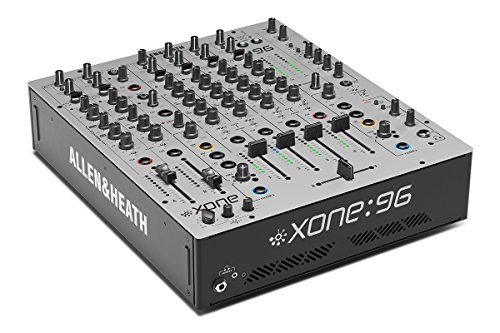
Allen & Heath XONE:96 — Best Overall
For linear-fader DJs, the XONE:96 is where the analog argument peaks. The four-band EQ gives you two midrange controls — the frequency territory where two tracks fight — and the dual VCF filters, assignable and beautifully resonant, let you carve transitions that are equal parts engineering and composition. Played loud through a good system, its summing has a density and calm that digital desks admire from a respectful distance.
Six channels with returns make it a hybrid-era instrument rather than a purist’s shrine: turntables, CDJs, a drum machine, effects returns and a guest’s controller all live here, with dual USB interfaces for the laptop side of modern sets. It is the analog mixer least likely to be outgrown, because its brief keeps expanding with its owner.
Rotary devotees will call it busy, effects-driven DJs will call it bare, and both are describing the same focused design. If your mixing is linear, long and sound-obsessed, this is the benchmark against which the rest of this guide is measured.
Strengths
- Reference analog summing and filter sound
- Four-band EQ for sculptural blends
- Six channels and dual USB for hybrid rigs
Trade-offs
- Premium tier, large footprint
- No onboard beat effects
- Rotary purists will prefer knobs to faders
Key specs: 6 channels, fully analog, 4-band EQ, dual VCF filters, dual USB, 2 independent headphone cues
Best for: house and techno DJs mixing long on any source / Not suited for: rotary-only or scratch DJs
Check the current price on Amazon

Allen & Heath XONE:92 Mk2 — Best Classic Sound
The XONE:92’s contribution to DJ sound is historical fact: its filters taught a generation of techno and house DJs to mix with resonance, and the Mk2 keeps that voice intact while renewing the hardware. The filter LFO — sweeping automatically in time — remains a signature move no rival has truly copied, turning transitions into rhythmic events.
Sonically it is the 96’s rawer sibling: the same analog confidence and four-band EQ in a four-channel frame with a slightly more immediate, less polished edge that long-time users cherish. In a booth, its layout is pure inherited muscle memory for a whole generation of DJs, which is itself a sound quality — mixes attempted confidently sound better.
Choose it when four channels and the classic voice are the whole brief and the 96’s extra channels, returns and dual-USB would sit idle. It is not the cheaper option so much as the purer one, and for the DJs it suits, nothing else sounds quite like home.
Strengths
- The definitive filter sound, with LFO
- Four-band EQ and analog glue
- Mk2 hardware refresh of a classic
Trade-offs
- Four channels only
- No dual-USB changeover convenience
- No onboard effects beyond filters
Key specs: 4 channels, analog path, 4-band EQ, dual VCF filters with LFO, MIDI sync output
Best for: techno and house DJs raised on the original / Not suited for: hybrid rigs needing six channels
Check the current price on Amazon

Ecler WARM4 — Best Rotary Sound
The WARM4 is what the rotary philosophy looks like with no channel-count excuses. Four fully analog rotary channels, hand-built in Barcelona, with three-band full-cut EQ per channel and Ecler’s warm, wide summing — plus a subharmonic synthesizer that generates low-end weight beneath thin recordings and small systems, a genuinely useful piece of sound design rather than a gimmick.
Mixing on it is the rotary sacrament at its best: big, smooth knobs that invite two-minute blends, EQ that can erase a band completely for dramatic reveals, and VU meters that keep you honest. Vinyl through its phono stages sounds unhurried and expensive; digital sources gain a forgiving analog frame. An FX send with pre/post selection welcomes a favourite pedal or delay without surrendering the analog core.
It remains a rotary: no crossfader, no cuts, no screen-driven tricks, and a premium tier. DJs whose sound is built on patience — disco, deep house, Balearic, soul — will find it the most beautiful-sounding tool in this guide. Everyone else should admire it accurately and buy their own format.
Strengths
- Superb four-channel rotary sound
- Subharmonic synthesizer fattens any rig
- Full-cut EQ and an FX send for pedals
Trade-offs
- No crossfader — rotary technique required
- Premium tier, boutique support footprint
- No USB or digital conveniences
Key specs: 4 channels, rotary, fully analog, 3-band full-cut EQ, subharmonic synthesizer, FX send, classic VU metering
Best for: disco, deep house and vinyl connoisseurs / Not suited for: scratch or effects-driven DJs
Check the current price on Amazon

Ecler WARM2 — Best Two-Channel Rotary
Most rotary mixing is, in truth, two-deck mixing — and the WARM2 is built precisely for it. Two channels of Ecler’s analog warmth, full-cut three-band EQ, and a microphone/line channel for the listening-bar host or the home DJ who occasionally speaks, in a compact hand-built chassis that has become a modern classic of the format.
Its sound-per-size ratio is the story. Fed with two good turntables, it produces the wide, calm, expensive sound that sells the entire analog idea to sceptics in one record. Home booths, wine bars, hi-fi listening spaces and vinyl-only club corners are its natural rooms, and in those rooms four channels would be furniture, not features.
The WARM4 above adds channels, the subharmonic synth and an FX send; the WARM2 counters with focus, footprint and tier. Two-deck DJs who know their format will not feel short-changed — they will feel understood.
Strengths
- Flagship rotary sound in a compact body
- Full-cut EQ and a useful mic/line channel
- Hand-built quality, enduring value
Trade-offs
- Two main channels, hard ceiling
- No FX send or subharmonic features
- Rotary-only technique
Key specs: 2 channels, rotary, fully analog, 3-band full-cut EQ, microphone/line channel, VU metering
Best for: two-deck vinyl DJs and listening bars / Not suited for: multi-source or hybrid digital rigs
Check the current price on Amazon

Headliner R4 — Best Rotary Value
The Headliner R4 democratises the rotary room. Four analog rotary channels, a built-in filter for transitions, isolator-style EQ and proper VU metering deliver the essential rotary experience — smooth gain riding, dramatic isolation, analog summing — at a tier that working DJs and smaller venues can reach without treating the mixer as an heirloom purchase.
Sound-wise it plays the format’s strengths honestly: warm, forgiving summing that flatters digital files and vinyl alike, and blends that encourage patience. For a bar, a small club corner or a home DJ converting from linear faders, it teaches the rotary discipline on a complete instrument rather than a toy, and four channels mean a guest deck or a sampler can join the rig.
Against the Ecler flagships it concedes refinement — knob feel, ultimate phono polish and hand-built aura. Against everything else at its tier it offers something rarer: a format-defining experience without the format’s usual entry fee. Many rotary journeys will start here, and some will happily end here too.
Strengths
- Four rotary channels at a reachable tier
- Built-in filter for rotary transitions
- Proper metering and cueing for the format
Trade-offs
- Refinement trails the boutique flagships
- No USB or digital features
- Rotary learning curve still applies
Key specs: 4 channels, analog rotary, built-in filter, isolator-style EQ, VU metering, headphone cueing for rotary workflow
Best for: rotary newcomers and working bar/club rigs / Not suited for: audiophile flagship seekers
Check the current price on Amazon
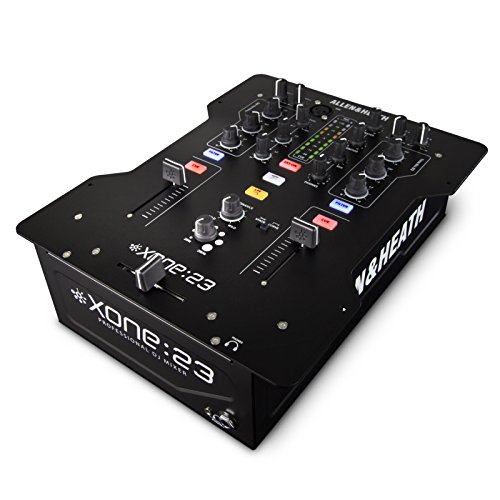
Allen & Heath XONE:23 — Best Budget Analog
The XONE:23 is the gateway through which a generation met analog DJ sound. It carries the family’s essential DNA — a genuine XONE voltage-controlled filter with resonance, total-kill three-band EQ and an analog path with the composure the badge promises — in a 2+2 channel format sized and priced for first serious rigs, bedrooms and bars.
In use it punches far beyond its tier. The filter alone justifies it: smooth, musical sweeps that teach filter mixing properly, on a mixer whose crossfader and layout welcome both blending and cutting. Paired with two decks it covers the complete classic DJ workflow, and its sound through a decent system embarrasses larger, lesser mixers.
Its ceilings are format ceilings: limited channels, no four-band EQ, no dual anything. DJs who outgrow it keep it — as a backup, a second-room mixer, the bar rig — because its sound never stops being useful. As the budget door into analog DJ mixing, it has no serious rival in this guide.
Strengths
- A real XONE VCF filter at an entry tier
- Total-kill EQ and honest analog sound
- Compact, durable and endlessly re-deployable
Trade-offs
- 2+2 channels cap growing rigs
- 3-band EQ only
- No USB recording path
Key specs: 2+2 channels, analog, XONE VCF filter, 3-band total-kill EQ, crossfader with curve options
Best for: first analog rigs, bedrooms and bars / Not suited for: four-deck or hybrid performance setups
Check the current price on Amazon
Comparison Table
| Pick | Badge | Key spec | Best for |
|---|---|---|---|
| Allen & Heath XONE:96 | Best Overall | 6ch analog, dual VCF filters | house and techno DJs mixing long on any source |
| Allen & Heath XONE:92 Mk2 | Best Classic Sound | 4ch analog, filters with LFO | techno and house DJs raised on the original |
| Ecler WARM4 | Best Rotary Sound | 4ch analog rotary, subharmonic synth | disco, deep house and vinyl connoisseurs |
| Ecler WARM2 | Best Two-Channel Rotary | 2ch analog rotary | two-deck vinyl DJs and listening bars |
| Headliner R4 | Best Rotary Value | 4ch rotary, built-in filter | rotary newcomers and working bar/club rigs |
| Allen & Heath XONE:23 | Best Budget Analog | 2+2ch analog, VCF filter | first analog rigs, bedrooms and bars |
Rotary Versus Linear: Choosing Your Analog Religion
The formats differ in what a transition is. Linear mixing rides channel faders and a crossfader; it permits cuts, quick swaps and four-band sculpting, and its masters — the XONE:96 above all — treat EQ and filters as composition tools. Rotary mixing rides rotary gains with no crossfader; transitions are journeys, EQ or isolators do the carving, and the music’s continuity is never broken by a fader’s travel.
Neither is more ‘analog’ than the other; they are different instruments sharing a signal philosophy. The honest test is your record bag and your hands: if your sets are built on tension curves over minutes, rotary will feel like coming home. If you mix quickly across tempos and use the crossfader as an accent, linear is your instrument and no amount of rotary romance should talk you out of it.
Many serious DJs eventually own both — a rotary for listening-led rooms and home, a linear for the club. If you are buying one, buy for the room you play most, and let the second format be a future pleasure rather than a present compromise.
Phono Stages, Filters and Isolators: Where DJ Analog Sound Lives
The phono stage is half the product. Vinyl’s signal is tiny and equalised by the RIAA curve; a great phono stage reproduces it quietly, accurately and with headroom for loud pressings, while a poor one adds hiss, hardness and fatigue that no later stage can remove. When comparing analog DJ mixers, phono quality — praised consistently by owners, not just specified — is the first sound criterion.
Filters divide into per-channel designs (the XONE approach: sweep any channel, any time) and master or isolator approaches (the rotary tradition: carve the whole mix or a channel’s bands completely). Per-channel filters are more flexible; isolators are more dramatic. Both are legitimate instruments, and the one you will actually play mid-set is the right one.
Judge all of it loud, on a real system, with your own records. Analog DJ sound reveals itself at club volume in the third hour — summing composure, filter grace under pressure, phono stages staying sweet. Showroom whispers flatter every mixer equally.
Buying Boutique Analog Without Regrets
Rotary and flagship analog mixers are often boutique purchases: smaller production runs, specialist dealers, longer waits. Protect yourself with basics — buy from authorised sources, confirm warranty and service arrangements in your country, and check power supply and voltage for imported units. These mixers hold value unusually well, but only when provenance and condition are clean.
Budget for the ecosystem honestly. A rotary setup may want an external effects unit on the send; a vinyl rig wants cartridges and styli maintained; any analog flagship wants a system — speakers and room — capable of revealing it. The mixer is the heart, but the audience hears the whole chain.
Finally, respect the learning curve in the budget. A rotary mixer bought in January is a new instrument by March only if you play it weekly. Factor your own practice time as part of the purchase; the sound you are buying includes the technique it demands.
How to Set Up an Analog DJ Mixer for Vinyl and Digital Sources
Connect turntables to the phono inputs with ground wires firmly fastened — on an analog rig, grounding is sound quality, eliminating the hum that ruins quiet passages and recordings alike. Set phono/line switches correctly per source, route digital players to line inputs, and keep power supplies and audio cables sensibly separated to keep the noise floor where the mixer’s design put it.
Gain-stage for analog headroom. Play your loudest record and set channel gains so peaks live comfortably below the red; analog summing rewards headroom with openness and punishes greed with congestion. Match your digital sources to the vinyl’s level at the gains, so transitions are about music, not volume jumps.
Learn your mixer’s signature control deliberately. On a XONE, practise filter sweeps against the four-band EQ until the two work as one gesture; on a rotary, practise riding gains through full phrases without touching EQ, then add isolator moves. Ten focused minutes per session builds the muscle memory that makes analog mixing feel like playing an instrument — because it is one.
Finish with a recording. Capture a short set through a record output or interface and listen on headphones: hum, imbalance and phono harshness announce themselves on recordings that a loud room forgives. Fix them at the setup stage, label your inputs, and your analog rig will sound like the brochures promised.
Common Buying Mistakes
Feeding a line-level player into a phono input — distorted, harsh and entirely avoidable with one switch check.
Skipping the ground wire, then chasing the resulting hum through every other part of the system.
Buying rotary for a cutting style, or a battle layout for disco blending — format must match technique.
Judging analog sound quietly in a showroom; these mixers reveal themselves at working volume.
Starving the rest of the chain — a flagship analog mixer into tired speakers is money spent where nobody hears it.
Final Recommendation
For linear-fader DJs the XONE:96 is the sounding analog summit, with the XONE:92 Mk2 its classic-voiced alternative. Rotary devotees should hear the Ecler WARM4 and WARM2 — the format’s modern flagships — while the Headliner R4 opens rotary sound at a working tier and the XONE:23 remains the unbeatable budget door into analog DJ mixing.
Related reading: Best Sound Mixers For Dj, Best Sounding Analog Mixers, Best Analog Mixers, Best Sound Mixers and Best 12 Channel Mixers. Choose the format your hands believe in, feed it good sources, and play it loud — analog DJ sound is a practice, not just a purchase.
Isolators, Crossovers and the Rotary Sound System Tradition
To understand why rotary DJs speak about sound the way they do, you have to meet the isolator. Rather than per-channel EQ alone, the classic rotary tradition — descending from the disco-era sound systems of New York and refined by generations of club engineers — places a powerful three-band isolator across the whole mix: the DJ can lift or erase the entire low, mid or high spectrum of the programme as one gesture. It is a system-level instrument, closer to conducting the room’s energy than to mixing two records, and mixers in that tradition are judged by how their summing feeds it.
The tradition extends beyond the mixer to the whole chain, which is why rotary DJs obsess over system matching. A warm, wide mixer into a well-tuned system with proper crossover alignment produces the physical, enveloping low end the culture prizes; the same mixer into a neglected system is merely a nice mixer. Buyers entering the rotary world should budget attention — and sometimes money — for the system around the desk, because the format’s sound is a chain sound more than any other in DJ culture.
The modern rotary mixers in this guide translate that tradition into purchasable instruments at several tiers, from the Headliner R4’s working accessibility to Ecler’s hand-built flagships. What they share is the philosophy: fewer, larger, more musical controls; summing that rewards patience; and an assumption that the DJ is building a night’s energy over hours. If that philosophy describes your ambitions, the isolator tradition is your home, and the mixer is simply its most personal component.
Vinyl, Cartridges and the Analog Source Chain
An analog DJ mixer’s sound can never exceed its sources, and in vinyl rigs the source chain has more links than newcomers expect: record condition, stylus health, cartridge quality and alignment, tonearm setup, and only then the phono stage. Each link is audible through the revealing mixers in this guide — which cuts both ways. A flagship analog desk will present a well-kept record and a good cartridge gloriously, and will present a worn stylus with equal honesty. DJs upgrading to this class of mixer should audit the chain in order before blaming or crediting the desk.
Cartridge choice is a voicing decision in its own right. DJ cartridges trade some refinement for tracking security and durability; audiophile-leaning cartridges repay careful handling with detail the best phono stages can use. Many serious vinyl DJs keep two setups — a robust pair for energetic club work and a finer pair for listening-led rooms — and the mixers above, particularly the Ecler and XONE flagships, have the phono stages to make that distinction meaningful rather than theoretical.
Digital sources belong in the same audit. A quality player or interface feeding the line inputs keeps the analog desk’s virtues relevant in hybrid sets; a poor source converted badly upstream gives the mixer nothing to flatter. The analog revival is sometimes misread as a rejection of digital sources, when its real position is simpler: whatever the source, the mixing itself should sound like music. Feed these desks well and they will prove the point nightly.
Analog DJ Sound at Home Versus in the Club
The same mixer lives two lives, and wise buyers choose for the life that dominates. At home, analog DJ sound is about intimacy: lower volumes, nearfield listening, the phono stage’s quiet detail and the tactile pleasure of the controls across a long evening. Compact flagships — the WARM2 above all — are designed for exactly this life, and home DJs should weight phono refinement and control feel over channel counts they will never use outside a booth.
In the club, the virtues reorder. Summing composure at genuine volume, headphone drive that can cue over a roaring room, metering readable at a glance in the dark, and the durability to survive other people’s drinks and enthusiasm become the sound qualities that matter — a mixer that distorts its cue feed at club level has failed sonically in the only way the DJ can hear. The XONE flagships’ booth credentials were earned in precisely these conditions.
Many DJs solve the duality by cascading: the flagship lives where it plays most, and a XONE:23-class mixer covers the other life honourably. What does not work is buying a delicate boutique instrument for a hostile booth, or a booth-bred flagship for a listening room, and resenting it for excelling at the wrong life. This guide’s per-pick briefs name each mixer’s natural habitat — trust them over the badge.
Setting Up a Rotary Rig: System Matching for the Format
A rotary mixer is the centre of a system with unusually strong opinions, and matching the chain around it decides how much of its sound survives to the audience. Start with gain structure across the whole rig: rotary mixers are mixed gently by design, so the amplifiers and speakers downstream should be sized to reach working volume with the mixer in its composed middle range, not with its masters straining. A system that needs the mixer pushed hard will sound hard, whatever the badge on the desk.
Speaker and crossover choices carry the tradition discussed earlier in this guide. The rotary culture grew up with horn-loaded, carefully crossed-over club systems whose physical low end suits long, blended music; modern equivalents — well-aligned point-source systems with honest subwoofers — serve the same philosophy. Time spent aligning and levelling the system returns more audible quality than any further mixer upgrade, a sentence this guide has now aimed at every format because it is true of all of them.
Cabling and placement finish the rig. Short, balanced runs; the mixer at a height where big knobs can be ridden with relaxed arms for hours; lighting that lets you read VU meters without washing the room. Rotary mixing is a physical practice sustained across a night, and ergonomics are sound quality by the third hour — a truth every format shares and the rotary format, with its long gestures, teaches fastest.
Learning Rotary: A Practice Path for Fader DJs
Fader DJs converting to rotary usually pass through the same three stages, and knowing them shortens the journey. The first stage is reaching for a crossfader that does not exist — typically during the first rushed transition — and discovering that rotary mixing must be planned a phrase earlier than fader mixing. The cure is repertoire: practise with records you know completely, where no transition can surprise you, until the earlier planning becomes instinct.
The second stage is gain-riding itself. A rotary channel is faded by turning, and the skill is smoothness under time pressure: bringing a record in across thirty seconds without a single audible step, while the outgoing record is carved away with EQ. Record every practice session and listen for the steps; they vanish faster than pride expects, usually within a few weeks of regular sessions, and their vanishing is the moment the format starts to feel like an instrument rather than a constraint.
The third stage is taste. With technique settled, rotary DJs discover the format’s real curriculum — patience as an aesthetic, the courage to let a blend breathe, the isolator or full-cut EQ used once a night to devastating effect instead of constantly. DJs who reach this stage rarely return to faders for listening-led music, which is why this guide treats the formats as instruments rather than rivals. Buy the rotary, practise honestly, and judge it at three months rather than three days.
Analog DJ Mixers Abroad: Voltage, Service and Touring Realities
Boutique analog mixers travel through a specialist economy, and buyers outside a maker’s home market should purchase with their eyes open. Confirm the power supply’s voltage and type for your country before ordering — a flagship delivered with the wrong supply is a paperweight with excellent filters — and confirm who services the brand within a sane shipping distance. These mixers are built to be repaired, but only by hands that know them, and the time to learn your technician’s name is before the first fault, not during a residency weekend.
Touring DJs face a different calculus: a personal flagship sounds wonderful in rooms that can reveal it and becomes a liability in rooms that cannot guarantee its rider. Many touring analog devotees therefore specify the widely-available XONE flagships for the road — a sound they know, on a desk any major venue can source — and keep the boutique rotary for home and trusted rooms. That is not compromise; it is the professional allocation of instruments to contexts, and this guide’s picks support both halves of it.
Resale and provenance complete the picture. Analog DJ flagships hold value unusually well when condition and provenance are clean, which makes authorised purchase and kept documentation part of the sound investment. Buy the mixer as the decade-long instrument it is, from sources who treat it the same way.
The Listening Bar and Hi-Fi DJ Movement
A growing venue format explains much of the rotary revival: the listening bar, where a DJ’s role is curation at conversational volume and the sound system is the room’s reason to exist. In these rooms the analog virtues reorder completely — phono refinement, summing calm at low level, control feel across a five-hour set, and a mixer that looks like furniture-grade equipment rather than stage gear. The Ecler WARM2 reads as if designed from this brief, because in spirit it was.
Listening-bar economics reward the analog investment unusually directly: the audience is paying, in part, for sound quality they can hear at the volume of conversation, where hiss, harshness and fatigue have nowhere to hide. A venue of this kind should audition mixers at the exact volume and distance of its own room, with its own records, and should weight the phono stage above every other component in the building after the speakers themselves.
Home listeners building in this image — the hi-fi DJ corner, the record room — can follow the same order with a clear conscience: sources and speakers first, the analog mixer as the chain’s musical centre, and channel counts kept honest. The movement’s lesson for all DJ buyers is portable: when the room gets quieter, sound quality gets louder, and the mixers in this guide were chosen to survive that scrutiny.
Analog Sound for Digital DJs: Hybrid Rigs Done Right
Most analog DJ mixers sold today will spend their lives in hybrid rigs — turntables beside controllers, vinyl beside files — and the format’s sound virtues survive the mixture when the rig is built honestly. The rules are the chain rules of this whole guide: digital sources at healthy levels into line inputs, gains matched so no transition is also a volume event, and the analog summing given material worth summing. A flagship analog desk fed by a starved, clipping controller output will sound exactly as bad as the feed, with better filters.
Software integration deserves a decision rather than a default. The XONE:96’s dual USB interfaces make it a citizen of the laptop world — DVS, hybrid sets, changeovers — while the rotary flagships ask the laptop to visit on their terms, through an external interface where needed. Neither posture is purer; they serve different relationships with the computer. DJs whose sets are built in software should buy the citizen; DJs whose laptop is a library and a recorder should buy the instrument and let the computer queue politely outside.
Record the hybrid rig as a matter of routine. The analog sum of a digital-era set is precisely the artefact worth keeping — it is your sound, distinguishable from every other DJ’s identical software chain — and the recording paths discussed earlier in this guide turn that artefact into your archive, your promo and your evidence. Analog’s revival was never about rejecting the digital world; it was about insisting the mix itself still be played by a person, on an instrument, in real time.
Keeping Analog DJ Sound Honest in Loud Rooms
Loud rooms lie to DJs in a specific way: as volume rises, ears compress, fatigue accumulates and every mix starts to sound harsher and less separated than it is — tempting the DJ to push gains, brighten EQs and ride the master into the very congestion analog summing is loved for avoiding. The discipline that protects analog sound at club volume is set before doors: gains staged with headroom, the booth at a sane and defended level, and a reference record — one you know completely — played at sound check and remembered as the night’s north star.
Revisit that reference hourly, briefly, at the same level. If it sounds brighter and harder than it did at doors, your ears have drifted, not the system, and the correct response is rest and restraint rather than EQ. The great analog mixers in this guide reward that restraint disproportionately, because their headroom and summing composure are reserves you spend only when the music genuinely peaks. DJs who protect those reserves sound, by the night’s end, like the only sober engineer in the building — because in the only sense that matters, they are.
Caring for Rotary Knobs, Faders and Phono Stages
Analog DJ mixers age at their touch points, and a light maintenance culture preserves both their sound and their considerable resale value. Rotary pots and faders should be exercised through their full travel regularly — controls left parked for months develop noisy resting spots — and the booth environment matters: dust covers when idle, drinks disciplined away from the surface, and a soft brush as the only cleaning tool that touches the panel weekly. Anything involving solvents or opened chassis belongs to a technician who knows the model, and flagship owners should learn that technician’s name before the first fault rather than during a residency weekend.
Phono stages ask for a different vigilance: connections clean and tight, ground wires sound, and cartridges maintained as the consumables they are. A worn stylus through a flagship phono stage sounds like a failing mixer to an undiagnosed ear, which is why this guide keeps returning to chain order — verify the source before indicting the desk. Keep a log, even a notebook page in the case: dates of stylus changes, services, fader replacements. Analog instruments reward owners who keep their biographies, in sound and in value alike.
Treat this as the format’s closing word: the analog DJ sound you are buying is not a property locked inside a chassis but a relationship between a desk, a system, a room and a pair of hands, renewed every time the three meet. Choose the instrument your hands believe in, feed it sources worthy of it, defend its headroom against the loud room’s slow temptations, and practise until the controls disappear. What remains, on the nights it all aligns, is the reason this corner of DJ culture has outlived every prediction of its death — music, mixed by a person, sounding like it matters.
Related guides
Frequently Asked Questions
Why do DJs say analog mixers sound warmer?
The warmth is identifiable engineering: analog summing that stays composed at high levels, gently forgiving overload behaviour, and EQ and filter designs voiced musically rather than clinically. Two bass-heavy records overlapping through a good analog desk tend to merge rather than clash, which listeners describe as warmth.
Is a rotary mixer better sounding than a linear one?
Not inherently — they share analog signal quality and differ in control philosophy. Rotary mixers encourage smoother, longer blends, which listeners experience as better-sounding sets. The best choice is the format whose technique matches your music and hands.
Do analog DJ mixers work with controllers and laptops?
Yes. Line inputs accept controllers and players, and hybrid flagships like the XONE:96 add dual USB interfaces for software rigs and changeovers. Pure rotary desks are more traditional — pair them with an external interface if you need recording or software integration.
What makes a phono stage good for DJ use?
Low noise at high gain, accurate RIAA equalisation, headroom for loud pressings and durability under booth conditions. It matters because the phono signal is the smallest and most fragile in the chain — quality lost there cannot be recovered downstream.
Are boutique rotary mixers worth it over the Headliner R4?
For refinement, phono polish, knob feel and hand-built character, yes — the Ecler flagships are genuinely finer instruments. For learning rotary, playing bars and most real-world gigs, the R4 delivers the format’s essential sound honestly. Buy refinement when your ears and rooms can reveal it.
Can I scratch on these analog mixers?
The linear XONE models handle cutting well, with the 23 a popular battle-adjacent budget choice. True scratch technique belongs on dedicated battle mixers with specialised crossfaders; rotary mixers have no crossfader at all and are the wrong tool for scratching by design.


