Disclosure: airfryerkitchensupply.com is reader-supported. When you buy through links on our site, we may earn an affiliate commission at no extra cost to you.
Where to buy
Every mixer below was confirmed before it earned a link, and DJ mixers are a category where buying the right unit the first time matters: crossfaders, channel filters and phono preamps wear, drift and date quickly, and a mixer that fights your workflow will be replaced within a year. Buy from a listing that shows the exact model and revision, keep the box and power supply together, and treat any deal that looks far outside the normal range for that model as a warning sign rather than a bargain.
Pioneer DJ DJM-A9 — check price on Amazon
Allen & Heath XONE:96 — check price on Amazon
Allen & Heath XONE:92 Mk2 — check price on Amazon
Ecler WARM2 — check price on Amazon
Behringer PRO MIXER DJX900USB — check price on Amazon
Numark M6 USB — check price on Amazon
Finding the best sound mixers for DJ work starts with a truth the spec sheets hide: a DJ mixer is a performance instrument, not a small PA desk. Your hands live on the crossfader, the channel EQs and the filter knobs, often in the dark, often mid-transition, and the mixer either disappears under your fingers or it interrupts every mix you attempt. That is why this guide weighs feel, layout and sound character as heavily as channel counts and feature lists.
The six mixers here split into three honest families. Club-standard digital-flagship mixers give you effects, USB audio and the layout guest DJs already know. Analog mixers — rotary and linear-fader alike — trade effects for signal path purity and a sound many DJs describe as warmer and more forgiving at high volume. Budget battle and mobile mixers cut channels and polish but keep the essentials: a replaceable crossfader, usable EQ and mic input for announcements. Every family has a legitimate winner below, matched to how you actually play.
One warning before the picks: DJ mixer prices and revisions move, and older listings sometimes describe superseded models. Every pick below was cross-checked against Amazon listing for its exact model name, and where a mixer is discussed without a link it is because that exact configuration could not be confirmed — never guess a model revision when a crossfader curve or connector type is the thing you are paying for.
In this guide
Quick Picks
Pioneer DJ DJM-A9 — Best Overall. The current club standard: four channels, a layout every guest DJ already knows, dual USB for changeovers, and effects that define modern headline sets. Check the current price on Amazon
Allen & Heath XONE:96 — Best Analog Sound. The analog flagship for DJs who mix long and listen hard: four-band EQ, twin resonant filters and a signal path that flatters everything fed into it. Check the current price on Amazon
Allen & Heath XONE:92 Mk2 — Best Classic Club Analog. The modernised legend: the original 92 defined a generation of techno and house mixing, and the Mk2 keeps its filters and EQ while refreshing the details. Check the current price on Amazon
Ecler WARM2 — Best Rotary. A hand-built rotary for DJs who mix with their ears over minutes, not seconds: buttery knobs, full-cut EQ and an unhurried, hi-fi soul. Check the current price on Amazon
Behringer PRO MIXER DJX900USB — Best Full-Feature Value. The feature-per-dollar champion: five channels, effects, USB and a contact-free crossfader at a working-DJ price tier. Check the current price on Amazon
Numark M6 USB — Best Budget Workhorse. Four honest channels, a replaceable crossfader and USB recording — the budget mixer that working beginners and hire rigs keep coming back to. Check the current price on Amazon
How These Picks Were Chosen
Picks were chosen the way working DJs actually shortlist mixers. First, the signal path: phono preamp quality for vinyl, line-level headroom for controllers and CDJs, and a master section that stays clean when the room gets loud. Second, the performance surface: crossfader feel and replaceability, EQ range and curve, filter design, and whether the layout matches the dominant club standard or deliberately departs from it. Third, connectivity: USB audio for recording and software, booth and record outputs, and mic handling for mobile work.
Sound character was judged on published design, not marketing language. Fully analog mixers sum in the analog domain and tend to flatter harsh digital sources; digital club mixers convert early and repay you with precise effects, per-channel processing and consistent behaviour from unit to unit — which is why touring DJs who play a different rented mixer every weekend often prefer the digital standard they can predict. Neither is automatically better; the reviews below say plainly which rooms and styles each design serves.
Finally, ownership cost was weighed honestly. Replaceable crossfaders, widely stocked power supplies, and models with a long production run are cheaper to live with than exotic units, however lovely they sound. Where a mixer demands expensive ecosystems, proprietary cables or a laptop to reach its best features, that cost is named in its trade-offs rather than buried.
The 6 Best Sound Mixers for DJ Use, Reviewed

Pioneer DJ DJM-A9 — Best Overall
The DJM-A9 is the mixer you will find bolted into serious club booths, and that ubiquity is itself the strongest feature. A guest DJ can walk up cold and play a full set without a manual, because the channel layout, colour FX section and beat-effects workflow follow the pattern Pioneer has refined across several generations. For a venue, a promoter or a DJ who hosts others, that predictability is worth more than any single specification.
Sonically it is a clean, confident digital mixer. The conversion and summing stay composed when all four channels run hot, the channel EQs are voiced for fast, musical correction rather than surgical repair, and the effects engine — delays, reverbs, sweeps and the signature colour FX — is deep enough that many DJs treat it as part of their instrument. Dual USB audio interfaces make back-to-back changeovers painless, and the microphone section handles hosting duties without a separate mixer.
The honest costs are size, price tier and commitment to the digital workflow. This is a large, heavy flagship that overwhelms a bedroom setup, and DJs who love the feel of an analog rotary will find its precision clinical rather than characterful. Buy it when the booth is the point — a venue, a serious home studio modelled on club conditions, or a working DJ whose riders and guest sets demand the standard.
Strengths
- Club-standard layout any guest DJ can play immediately
- Dual USB interfaces for seamless back-to-back changeovers
- Deep, musical effects and colour FX section
Trade-offs
- Premium price tier and a large, heavy footprint
- Digital character will not satisfy analog purists
- Overkill for solo bedroom or streaming-only use
Key specs: 4 channels, digital club-standard layout, dual USB audio interfaces, per-channel effects and colour FX, microphone section with talkover
Best for: clubs, venues and DJs who host guest sets / Not suited for: rotary lovers or minimal two-deck home rigs
Check the current price on Amazon
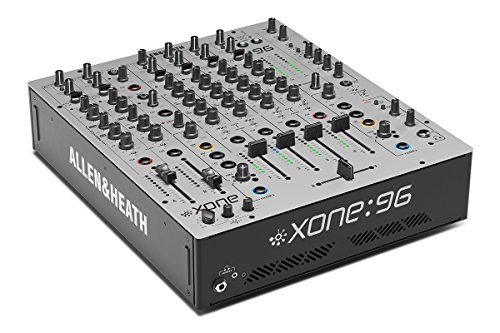
Allen & Heath XONE:96 — Best Analog Sound
The XONE:96 is what happens when a company famous for live-sound consoles builds a DJ mixer without compromise. The signal path is fully analog, the main channels carry four-band EQ — an extra mid band that lets you carve two tracks apart instead of merely balancing them — and the twin voltage-controlled filters, inherited from the beloved XONE:92, sweep with a resonance and smoothness digital filters still imitate rather than match.
In long, blending-heavy sets — house, techno, disco, downtempo — this mixer changes how you mix. The four-band EQ encourages slower, more deliberate transitions; the filters become a musical voice rather than an effect; and the analog summing glues overlapping tracks together forgivingly when levels creep. Two USB audio interfaces keep modern hybrid setups and changeovers practical, so the analog heart does not force an analog-only rig.
It asks things of you in return. There are no built-in beat effects, so DJs raised on one-knob club FX must bring their own pedals or software. The four-band EQ has a learning curve, the mixer is deep and heavy, and it sits firmly in the premium tier. For DJs whose reputation is built on how their sets sound rather than how many tricks they contain, it remains the reference point.
Strengths
- Fully analog path with famously musical filters
- Four-band EQ enables precise, long blends
- Dual USB interfaces for hybrid and B2B setups
Trade-offs
- No onboard beat effects section
- Premium tier; large and heavy for mobile work
- Four-band EQ rewards practice, punishes guesswork
Key specs: 6 channels (4 phono/line + 2 return), fully analog signal path, 4-band EQ on main channels, dual VCF filters, dual USB audio interfaces
Best for: house, techno and disco DJs who mix long blends / Not suited for: effects-driven open-format or scratch DJs
Check the current price on Amazon

Allen & Heath XONE:92 Mk2 — Best Classic Club Analog
Few mixers have shaped a genre the way the original XONE:92 shaped techno and minimal house. Its twin filters became a performance technique in themselves, and the Mk2 revision keeps everything players loved — the analog path, the four-band EQ, the filter LFO — while updating components, faders and the details that two decades of booth abuse exposed. It is a heritage instrument that is still a rational purchase.
Compared with the 96, the 92 Mk2 is the more focused tool: four channels rather than six, no dual-USB convenience, and a slightly rawer, more immediate feel that many long-time users prefer. In a dark booth its layout is pure muscle memory, and its filters encourage the slow, hypnotic mixing the model is famous for. Paired with two decks and an external effects unit, it covers the complete classic club workflow.
Choose it over the 96 when four channels are genuinely enough and you value the original character over hybrid flexibility. Choose the 96 when returns, extra channels or dual USB matter. Either way, budget for the ecosystem honestly: no onboard effects means a pedal or send-return unit belongs in the same purchase conversation for most modern sets.
Strengths
- The definitive filter-led mixing experience
- Four-band EQ and analog summing with real character
- Mk2 updates refresh a proven, repairable design
Trade-offs
- No onboard effects or dual-USB changeover support
- Four channels limit hybrid and multi-deck rigs
- Premium tier despite the narrower brief
Key specs: 4 channels, analog signal path, 4-band EQ, dual VCF filters with LFO, MIDI output for syncing external gear
Best for: techno and house purists mixing on two to four decks / Not suited for: DJs needing onboard FX or six channels
Check the current price on Amazon

Ecler WARM2 — Best Rotary
Rotary mixers are a philosophy as much as a format: no crossfader, no quick cuts, just smooth rotary gain riding and blends that evolve over whole phrases. The WARM2, hand-built by Ecler in Barcelona, is the most accessible serious expression of that philosophy — a two-channel, fully analog mixer whose large knobs, full-cut three-band EQ and warm summing suit disco, house, funk and Balearic sets beautifully.
The experience is tactile in a way linear mixers cannot copy. Riding a rotary through a two-minute blend feels like steering rather than switching, the EQ kills completely for dramatic isolations, and the classic VU meters keep levels honest without screen fatigue. Sound quality is the headline: quiet, wide and forgiving, especially with vinyl sources that benefit from a gentle, musical phono stage.
The limits are the philosophy’s limits. Two channels, no crossfader, no effects and no USB make it wrong for scratch, open-format or hybrid digital rigs, and rotary mixing itself is a skill that takes weeks to feel natural if you learned on faders. As a second mixer for listening-led sets, or the heart of a vinyl-focused home booth, it is close to perfect.
Strengths
- Superb rotary feel and analog sound quality
- Full-cut EQ for dramatic isolations
- Hand-built construction with classic metering
Trade-offs
- Two channels only; no crossfader or USB
- Rotary technique takes real adjustment
- No onboard effects of any kind
Key specs: 2 channels, rotary faders, fully analog path, 3-band full-cut EQ per main channel, classic VU metering, hand-built in Barcelona
Best for: vinyl and disco/house DJs who blend slowly / Not suited for: scratch, open-format or controller-based DJs
Check the current price on Amazon
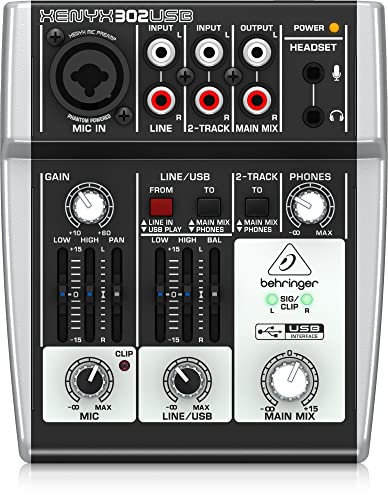
Behringer PRO MIXER DJX900USB — Best Full-Feature Value
The DJX900USB exists for DJs who need club-style features — multiple channels, beat effects, USB recording — without club-flagship money. Its contact-free VCA crossfader avoids the crackle and wear of conventional faders, the effects section syncs to a BPM counter for usable delays and echoes, and five channels swallow decks, a controller and a microphone with room to spare for mobile and party work.
Judged as a tool rather than a jewel, it performs its job well. The EQ offers full-kill behaviour for creative transitions, the mic channel handles announcements cleanly, and USB makes recording a set or streaming straightforward. For a first full-size mixer, a mobile rig, or a backup unit that can genuinely cover a night, the capability list is hard to argue with at its tier.
The compromises live in refinement. Fader feel, knob quality and long-term fit and finish do not match the premium mixers above, and critical listeners will hear the difference in the master section next to an analog flagship. Treat it as what it is — the most complete inexpensive route to a real multi-channel DJ setup — and it earns its place without pretending to be more.
Strengths
- Five channels, effects and USB at a value tier
- Contact-free crossfader resists wear and crackle
- Full-kill EQ and a usable mic channel
Trade-offs
- Fit, finish and fader feel trail premium mixers
- Master-section sound is functional, not luxurious
- Brand support network thinner than the flagships
Key specs: 5 channels, contact-free VCA crossfader, digital effects with BPM counter, USB audio interface, 3-band kill EQ
Best for: mobile, party and first-serious-rig DJs / Not suited for: audiophile home booths or heavy scratch use
Check the current price on Amazon

Numark M6 USB — Best Budget Workhorse
The M6 USB has survived in catalogues for years because it gets the budget equation right. Four channels cover two decks plus a controller and a spare, the crossfader is replaceable and slope-adjustable — the single most important ownership feature on an inexpensive mixer — and the USB interface records sets to a laptop without extra hardware. Nothing is exotic; everything is present.
On the job it behaves like a shrunken club mixer: three-band EQ per channel, gain trims where you expect them, a mic input for hosting, and a layout a beginner can learn on and a guest can play on. Hire companies and bars like it for the same reason home DJs do — when a fader eventually wears, it unbolts and swaps instead of writing off the mixer.
Spend more and you gain sound quality, effects and feel; the M6 does not hide that. Its phono stages and master section are workmanlike rather than inspiring, and there are no onboard effects. But as a first mixer, a practice rig, a bar install or a backup, it delivers the complete DJ workflow at the lowest sensible tier — which is exactly what a budget pick should do.
Strengths
- Replaceable, slope-adjustable crossfader
- Four channels plus USB set recording
- Familiar layout, easy to learn and to guest on
Trade-offs
- No onboard effects section
- Sound quality is workmanlike, not refined
- Basic metering and mic features
Key specs: 4 channels, USB audio interface, 3-band EQ per channel, replaceable slope-adjustable crossfader, mic input
Best for: beginners, bars, hire rigs and backup duty / Not suited for: DJs wanting effects or flagship sound
Check the current price on Amazon
Comparison Table
| Pick | Badge | Key spec | Best for |
|---|---|---|---|
| Pioneer DJ DJM-A9 | Best Overall | 4ch digital, dual USB, colour FX | clubs, venues and DJs who host guest sets |
| Allen & Heath XONE:96 | Best Analog Sound | 6ch analog, dual filters, dual USB | house, techno and disco DJs who mix long blends |
| Allen & Heath XONE:92 Mk2 | Best Classic Club Analog | 4ch analog, 4-band EQ, dual VCF | techno and house purists mixing on two to four decks |
| Ecler WARM2 | Best Rotary | 2ch analog rotary, full-cut EQ | vinyl and disco/house DJs who blend slowly |
| Behringer PRO MIXER DJX900USB | Best Full-Feature Value | 5ch, VCA crossfader, FX + USB | mobile, party and first-serious-rig DJs |
| Numark M6 USB | Best Budget Workhorse | 4ch, USB, replaceable crossfader | beginners, bars, hire rigs and backup duty |
How to Choose a DJ Mixer That Fits How You Play
Start from your transitions, not your wishlist. If your sets are built on long blends, prioritise EQ depth and filters — four-band EQ and smooth filters change what you can do. If you cut and scratch, crossfader quality, adjustability and replaceability outrank everything. If you perform tricks with effects, a digital flagship’s FX engine is the instrument. The mixer should amplify the technique you already have rather than demand a new one.
Count real inputs, honestly. Two turntables need two good phono stages; a controller plus decks needs line inputs that do not share awkwardly; a microphone for hosting needs its own channel with EQ, not a shared afterthought. Then check outputs: master, booth and record are the working trio, and missing booth control is the quiet deal-breaker in home and small-venue setups alike.
Budget in tiers. The budget tier buys workflow completeness — channels, replaceable faders, USB. The mid tier buys feel and sound. The flagship tier buys standards compliance, effects depth and resale strength. Money spent jumping a tier on the mixer usually outlasts the same money spent on a second controller, because the mixer is the one component every source passes through.
Analog, Digital and Rotary: What Actually Changes
Analog mixers sum signals electrically. The practical results are gentle overload behaviour, forgiving blends and a sound many listeners call warm — plus total independence from software, sample rates and firmware. Digital mixers convert early, then offer precision: repeatable effects, per-channel processing, USB multitrack and identical behaviour between units. In a blind, level-matched comparison the differences are smaller than forum arguments suggest, but the workflow differences are large and real.
Rotary is a control philosophy layered on analog design: rotary channel gains instead of faders and usually no crossfader. It suits mixing that unfolds over phrases and punishes nothing except impatience. Many DJs keep a rotary at home for listening-led sessions and a linear mixer for performance; neither choice invalidates the other.
Hybrid rigs blur all three categories. The XONE:96 above is analog at heart with dual USB interfaces; flagship digital mixers accept turntables happily. Choose by the centre of your workflow — the sources you play most and the transitions you make most — and let the category labels follow.
Crossfaders, EQ and Filters: The Controls Your Hands Live On
The crossfader is the highest-wear, highest-feel component on the mixer. Scratch DJs need a sharp curve, minimal lag and ideally a contact-free or premium replaceable unit; blend DJs need a smooth, gradual curve and enough physical travel to ride. Check three things before buying: curve adjustment, replaceability, and whether replacement faders are actually stocked — a replaceable fader nobody sells is a theoretical feature.
EQ design shapes your mixing grammar. Three-band full-kill EQ supports dramatic swaps and isolations; four-band EQ supports surgical blends where two basslines or two vocals must coexist. Neither is superior — they encourage different music. Filters deserve the same attention: a resonant low/high-pass per channel (or a master filter section) is the most expressive single knob on many mixers, and filter quality is where analog flagships still make their case most persuasively.
Finally, play the layout mentally in the dark. Are gains, EQs and filters in the order your hands expect? Can you read the metering at booth distance? Small ergonomic frictions repeat hundreds of times a night; on paper-identical mixers, layout is often the real difference.
How to Set Up and Sound-Check a DJ Mixer
Connect sources with the mixer off and gains down: turntables to phono inputs with ground wires firmly attached — a loose ground is the classic source of hum that ruins recordings — line sources to line inputs, and never feed a line signal into a phono input, which overloads and distorts badly. Connect master out to the PA or speakers, booth out to your monitors, and USB to your laptop if you record or stream.
Set gain structure channel by channel. Play your loudest typical track, raise the channel gain until the channel meter peaks just below the red, then repeat for every source so decks and controller arrive at the mixer at matched levels. Set the master so the PA runs comfortably with headroom to spare; a mixer driven into its red zone sounds harsh on every system downstream, and no EQ trick repairs clipped summing.
Dial in the booth. Position monitors at ear height aimed at your head position, set booth level independently of the master, and check that you can hear transitions clearly without the room volume. Test the microphone at performance distance, roll off low frequencies if the channel allows, and set talkover or manual ducking before the room fills — never during a set.
Before doors, record a five-minute test mix through USB and listen back on headphones. Recordings expose hum, imbalance and clipping that a loud room hides, and they verify your record output level in one step. Label your cables, photograph your settings, and keep the mixer’s power supply and a spare crossfader — if your model allows swaps — in the same case.
Common Buying Mistakes
Buying channels you will never use while skimping on the crossfader you touch constantly — count real sources, then spend on feel.
Feeding line-level sources into phono inputs, or forgetting turntable ground wires, then blaming the mixer for distortion and hum.
Running gains into the red for perceived loudness; headroom is sound quality, and the PA provides the volume.
Choosing a rotary mixer for a scratch workflow, or a battle mixer for long-blend house sets — format must match technique.
Ignoring outputs: discovering there is no booth or record output after the mixer arrives is a common and avoidable regret.
Final Recommendation
For most working DJs the Pioneer DJ DJM-A9 is the safest flagship: standard layout, deep effects and changeover-friendly dual USB. DJs who mix long and listen hard should hear the Allen & Heath XONE:96 and XONE:92 Mk2 before deciding — their filters and EQ define analog mixing — while rotary devotees will find the Ecler WARM2 a joy. On real budgets, the Behringer DJX900USB maximises features and the Numark M6 USB maximises honest durability.
Round out your research with the wider mixer guides on this site: Best Sound Mixers, Best Analog Mixers, Best Sounding Analog Mixers Dj, Best Sound Mixers For Streaming and Best 12 Channel Mixers. Match the mixer to your technique first and your ambitions second, and it will stay in your booth for years.
DJ Mixer Specifications That Actually Matter
Specifications mislead DJ buyers more than most because the numbers that print well — channel counts, effect counts, sample rates — are not the numbers your hands and ears live with. Start instead with fader specification: travel length, whether the crossfader is replaceable, and what curve adjustments exist. A mixer can carry a famous badge and still frustrate a scratch DJ with a crossfader curve that cannot be sharpened, or frustrate a blend DJ with a curve that cannot be softened. The specification sheet will tell you, but only if you read the fader section before the effects section.
Phono preamp specification deserves the same forensic reading. Look for signal-to-noise figures quoted honestly and gain ranges that suit real cartridges, and then weight owner experience heavily, because phono quality is the least specifiable virtue in the category. Two mixers with identical printed figures can present vinyl very differently at club volume, which is why the analog flagships in this guide built their reputations in booths rather than in brochures.
USB audio specification matters in a specific way: the number of stereo streams in each direction decides whether you can record your set while playing from software, run a hybrid rig, or host a second laptop for changeovers. Dual-interface flagships exist precisely because back-to-back sets exposed single-interface limits. Count the streams your actual workflow needs — most DJs need fewer than they fear, but the one they lack will be lacked at the worst possible moment.
Finally, read the output specification like a venue engineer. Master, booth and record outputs with independent level control, balanced connections for long runs to a PA, and a headphone amplifier strong enough to cue over a loud room are the specifications that decide whether a mixer works in the real world. A mixer that sounds superb but cannot drive your booth monitors or your headphones has failed at its actual job, whatever its converter figures claim.
Building a Complete DJ Rig Around Your Mixer
The mixer sits at the centre of a rig, and the rig should be budgeted as one purchase even when it is assembled over a year. Sources come first in the signal chain: turntables with maintained styli and honest cartridges, or players and controllers in good health, because the finest mixer in this guide can only present what it is fed. DJs upgrading in stages should usually upgrade sources and mixer in that order — unless the current mixer is actively limiting technique, in which case its replacement unlocks practice itself.
Monitoring is the second half of the rig and the half most often under-bought. Booth monitors at ear height, positioned for your standing position, let you mix at sane master levels and hear transitions the way the floor will. Headphones deserve equal seriousness: they are your cueing instrument for hours at a time, and comfort plus isolation decide whether you can still judge a mix in hour three. Many DJs find a headphone upgrade transforms their mixing more than a mixer upgrade at the same money.
Cabling and cases look unglamorous and decide reliability. Balanced interconnects of sane length, a power arrangement that keeps audio and lighting power apart, and a case that travels with the mixer as a unit turn a collection of gear into an instrument. Label both ends of every cable the day you install it; the DJ who can re-patch a dark booth by touch is the DJ whose set survives the venue’s surprises.
Leave the rig room to grow in the direction of your ambitions. A streamer needs the USB path tested, not assumed. A vinyl DJ planning a rotary second mixer should keep the phono sources accessible rather than buried. A mobile DJ should weigh every component twice — once for sound, once for the load-in. The mixer you chose from this guide will serve any of these rigs; the rig around it decides how much of its quality the audience ever hears.
A Short History of the DJ Mixer, and Why It Explains Today’s Choices
The DJ mixer’s design arguments make more sense with their history attached. The crossfader arrived from hip-hop’s turntablism, where it is a rhythmic instrument, while the rotary format descends from disco’s New York pioneers, who mixed records into continuous journeys and needed controls that moved as smoothly as the music. Club mixers in the European tradition added the four-band EQ and the resonant filter as techno and house demanded longer, more sculptural blends. Every pick in this guide is an heir to one of those lineages, and choosing between them is partly choosing which tradition your own mixing descends from.
The digital flagship era added a fourth lineage: the software-era club standard, where the mixer’s effects, screens and USB plumbing treat the booth as a production studio. Its dominance in headline booths is not merely marketing — a touring DJ can specify one model worldwide and know every control blindfolded, and that certainty is a genuine performance feature. The analog revival running alongside it is equally rational: DJs whose sets are long and listening-led found the digital standard’s precision less valuable than analog summing and filter character.
Understanding the lineages protects you from the category’s loudest mistake, which is buying a mixer as a fashion statement. A battle-bred DJ on a rotary is as misplaced as a disco purist on a scratch mixer, and both will blame the equipment for a mismatch of traditions. Read the picks above as instruments from specific schools, choose the school you actually play in, and the equipment arguments mostly settle themselves.
Recording, Streaming and Sharing Your Sets
A modern DJ mixer earns part of its keep after the set ends. USB-equipped picks in this guide — the DJM-A9 with its dual interfaces, the XONE:96 likewise, and the budget pair’s single USB paths — exist because recording and streaming a set is no longer a bonus activity but the way most DJs are discovered. The practical standard is simple: your mixer should hand your computer a clean stereo mix at a level that needs no rescue, while you monitor exactly what the audience hears. Set that record level once, during a loud practice session, and verify it with a test recording played back on headphones, because a clipped or whisper-quiet recording is usually a level set by hope rather than by measurement.
Streaming adds a second audience with different ears. A club mix rides a PA’s physical weight; a stream is heard on earbuds and laptop speakers, where low end vanishes and harshness doubles. DJs who stream seriously keep a slightly tamed master for the broadcast — the same mix, judged on small speakers before going live — and the mixers with flexible output routing make that a setting rather than a rebuild. Whichever platform carries your stream, treat the first ten minutes of any new setup as a private test with a friend listening on a phone, because that phone is the most honest monitor in your entire rig.
Archiving is the quiet professional habit underneath both. Label recordings by date, venue and mixer settings, keep the ones that taught you something, and review your own transitions monthly with the ruthlessness you would apply to a rival. The mixers in this guide will not make you a better DJ, but their recording paths make improvement measurable — and DJs who measure improve.
Maintenance, Spares and Keeping a DJ Mixer Alive
DJ mixers live harder lives than almost any audio equipment: faders cycled thousands of times a night, drinks in the vicinity, cases dropped, booths shared with strangers. The ownership virtues are therefore unglamorous and decisive. Keep the mixer covered when idle — dust is a fader’s slow poison — and work every control through its full travel monthly, because pots and faders that sit in one position for months develop noisy spots exactly where they rest. A contact cleaner formulated for faders, used sparingly and correctly, restores most scratchy controls; anything beyond that belongs to a technician.
Spares strategy separates working DJs from hopeful ones. If your crossfader is replaceable — a headline virtue of the Numark M6 and the pro desks alike — own the spare before you need it, and know the swap procedure cold enough to do it between sets. Keep the correct power supply, and only the correct one, in the case; universal supplies with the wrong polarity or current are how mixers die in foreign booths. Photograph your cable loom assembled, so a borrowed pair of hands can rebuild your rig from the picture.
Finally, respect the service interval on premium desks. The analog flagships in this guide are built to be serviced — faders replaced, pots cleaned, calibrations checked — and a professional service every few years of hard use returns them to factory feel. Budgeted honestly, that maintenance is why a flagship bought today is still the right mixer in a decade, while a neglected one becomes an expensive lesson in entropy.
Headphones, Cueing and Hearing Your Mix Honestly
Cueing is the DJ’s private mix, and it deserves the same engineering respect as the master output. Your headphone system must deliver the incoming track at a level and clarity that survives a loud room, which is why headphone amplifier strength — a specification buried on most sheets — matters more to working DJs than another effect. Test any candidate mixer with your own headphones at realistic booth volume: if the cue cannot win against the room, you will mix defensively all night, and defensive mixing is audible on the floor.
Split-cue and cue-mix controls shape how you learn. Hearing the master in one ear and the cue in the other, or blending them in both, are different disciplines with different adherents, and the mixers in this guide support both philosophies to different degrees. Beginners should choose the blend they can judge pitch and timing through most reliably; experienced DJs should refuse to compromise on the cue workflow their muscle memory is built on, because relearning cueing on a new desk costs a season of confidence.
Protect the ears the whole system depends on. Booth levels creep upward across a night as fatigue dulls perception, and the DJ who sets a sane booth level at doors and defends it mixes better at closing than the DJ who chased volume hourly. Your mixer cannot enforce that discipline, but its booth control — independent, reachable, clearly marked — is the tool the discipline uses.
DJ Mixers for Special Situations: Battles, Weddings and Radio
Special formats stress different corners of a mixer, and honest guidance means naming them. Battle and scratch DJs live on the crossfader’s cut: they should weight fader quality, curve adjustability and replaceability above every other line in this guide, and will find the workhorse picks’ replaceable faders more relevant than any flagship’s filter. A dedicated battle mixer remains the specialist answer; within this guide, choose by fader first and forgive everything else.
Wedding and mobile DJs live on the microphone channel and reliability. Their mixer must make announcements sound warm and authoritative, survive transport weekly, and connect to any venue’s system without drama — the brief that makes the value picks in this guide, with their honest mic channels and USB convenience, the professional choice rather than the cheap one. A mobile DJ’s flagship is the mixer that has never once been the story of the night.
Radio and broadcast DJs — community stations, internet radio, syndicated mix shows — should weight clean outputs, recording paths and talkover behaviour, because their audience hears the mixer with studio intimacy. The hybrid flagships serve them superbly, but so does a mid-tier desk with disciplined levels; broadcast exposes sloppiness, not price tags. Match the mixer to the format you actually play most, and let the other formats rent, borrow or make do.
Second-Hand DJ Mixers: Smart Buys and Traps
The used market is unusually kind to DJ mixer buyers, because the category’s flagships are durable, repairable and produced for years, which means a clean used XONE or club-standard desk can be the smartest purchase in a whole rig. The inspection ritual matters more than the haggling: every channel with a real source, every fader and pot through its full travel while listening, the crossfader worked hard for a full minute, and the headphone output tested at booth level. Faults on DJ mixers announce themselves honestly under that treatment, and a seller who welcomes it is telling you something valuable about the mixer’s life.
Price the wear you can see and the service you cannot. A cosmetically tired desk with a fresh, documented fader replacement can be a better buy than a gleaming one whose crossfader is original and exhausted, because faders are the consumable heart of the instrument. Ask what has been replaced, keep the receipts with your own records, and budget a professional clean and check for any used flagship — it converts an unknown history into a known starting point for roughly the cost of a good night out.
Avoid the traps with equal clarity: mixers with intermittent channels described as ‘probably a cable’, imported units with unclear voltage, and any flagship priced far beneath its market without a story that survives questions. The DJ mixer market is liquid enough that patience is a strategy — the right desk, in the right condition, from a seller who can describe its life, appears regularly. Wait for it, and your second-hand flagship will feel like the bargain the category keeps promising.
Frequently Asked Questions
Do DJ mixers improve sound quality over a controller’s built-in mixer?
Usually, yes. A standalone mixer brings better phono stages, more headroom, fuller EQ and a stronger master section than the mixer built into most controllers. The improvement is largest with turntables and at high volume in real rooms; at bedroom levels with digital sources the difference is smaller but the workflow gain remains.
How many channels do I actually need?
Two channels cover two-deck mixing completely. Four channels suit hybrid rigs — decks plus controller, or two DJs back-to-back. Six channels serve complex live-hybrid setups and venues. Buy for the rig you own plus one realistic addition, not for an imagined future studio.
Is a rotary mixer hard to learn?
It is different rather than hard. Without a crossfader you mix with rotary gains and EQ, planning transitions over phrases instead of cutting. Most fader DJs feel comfortable within a few weeks of regular practice, and many find their blends become smoother and more deliberate.
Can I record my sets with these mixers?
Most picks here include USB audio for direct recording to a laptop, and all provide line outputs that can feed a recorder or interface. Check the comparison table for USB on each model, and always make a short test recording first to set levels and catch hum.
What is the difference between DJ mixers and PA mixers?
DJ mixers are performance instruments: crossfaders, per-channel filters, cue systems and phono inputs for turntables. PA mixers prioritise microphone channels, monitor sends and room control. A DJ can play through a PA mixer, but the performance controls DJs rely on will be missing.
Should beginners buy a flagship mixer first?
Not usually. A workhorse like the Numark M6 USB teaches the complete workflow and survives being outgrown as a backup or bar rig. Move to a flagship when your technique is limited by your current mixer — you will know exactly which limitation you are paying to remove.


