Disclosure: airfryerkitchensupply.com is reader-supported. When you buy through links on our site, we may earn an affiliate commission at no extra cost to you.
Where to buy
This is a specialist corner of the mixer market, so the buying advice starts with candour: true 8-bus Soundcraft consoles form one family, the GB8, in several frame sizes. The GB8 listings below were confirmed for their exact models and frame sizes before earning links — check the channel count in the listing title carefully, because the same console name covers frames from compact to very large, and freight, footprint and price tier scale with the frame.
Soundcraft GB8 32-Channel — check price on Amazon
Soundcraft GB8 48-Channel — check price on Amazon
Soundcraft GB8 24-Channel — check price on Amazon
Soundcraft GB4 24-Channel — check price on Amazon
Soundcraft Signature 22 MTK — check price on Amazon
Soundcraft Ui24R — check price on Amazon
Searching for the best soundcraft 8 bus mixers leads somewhere refreshingly specific. Eight-bus (eight-group) architecture — eight subgroups between the channels and the stereo master — belongs to serious live and installation mixing, where drums, backing vocals, band sections and effects each need group-level control, group inserts and flexible routing to recorders and distributed outputs. In Soundcraft’s catalogue, one family was built precisely for that job: the GB8, offered in multiple frame sizes.
This guide therefore does two honest things. It reviews the GB8 in its key frame sizes as the genuine 8-bus answer, and then — clearly labelled — reviews the closest Soundcraft alternatives for buyers whose real need is smaller: a four-bus GB-family console and modern Soundcraft desks that trade bus count for recording integration or digital control. Many buyers searching ‘8 bus’ actually need eight channels or eight inputs; the buying guide below untangles that confusion before it becomes an expensive purchase.
Every linked model was cross-checked against its Amazon listing. Large consoles are freight purchases with long service lives, so each review covers not just sound and features but footprint, weight, serviceability and the venues each frame genuinely suits.
In this guide
Quick Picks
Soundcraft GB8 32-Channel — Best Overall 8-Bus. The heart of the GB8 range: a true eight-group analogue console sized for full bands and large worship or venue rigs. Check the current price on Amazon
Soundcraft GB8 48-Channel — Best for Large Venues. The flagship frame: forty-eight channels of 8-bus analogue mixing for orchestras, festivals, large productions and big worship platforms. Check the current price on Amazon
Soundcraft GB8 24-Channel — Best Entry into 8-Bus. The smallest true GB8: the full eight-group architecture in a 24-channel frame for mid-size venues that mix with subgroups, not just channels. Check the current price on Amazon
Soundcraft GB4 24-Channel — Best 4-Bus Alternative. Labelled honestly as a four-bus console: the GB family’s sound and build for venues whose group needs stop at drums, vocals, band and playback. Check the current price on Amazon
Soundcraft Signature 22 MTK — Best Recording Alternative. Not an 8-bus desk — the modern Soundcraft answer when the real need is recording every channel while mixing live, with Ghost preamps and Lexicon effects. Check the current price on Amazon
Soundcraft Ui24R — Best Digital Alternative. The digital rethink: 24 inputs in a rack, controlled from any tablet, with recall and processing no analogue desk at its tier can match. Check the current price on Amazon
How These Picks Were Chosen
Selection started with the literal brief: eight subgroups, Soundcraft badge, analogue GB-series architecture. The GB8’s design — GB30 preamps and EQ heritage, eight groups, extensive aux sends and a proper master section — was assessed as a system for installed venues, touring regional rigs and houses of worship mixing full bands with multiple vocal groups.
Frame sizes were then treated as distinct products, because they are: a 24-channel GB8 and a 48-channel GB8 share a badge and a philosophy but serve different rooms, budgets and crew realities. Each frame review states its venue scale and the point at which the next frame up becomes the rational buy.
The alternatives were chosen to answer the searches behind the search. Buyers who need group mixing on a smaller budget meet the GB4; buyers who need multitrack recording meet the Signature MTK line; buyers who need remote control and recall meet the Ui digital series. Each is labelled with its true bus count — this guide does not round a four-bus desk up to eight for convenience.
The Best Soundcraft 8 Bus Mixers and Closest Alternatives, Reviewed

Soundcraft GB8 32-Channel — Best Overall 8-Bus
The 32-channel GB8 is the frame most 8-bus buyers actually need. Thirty-two channels cover a full band, a row of vocalists, playback and effects returns, while the eight subgroups let the operator run the show the way 8-bus mixing intends: drums on a pair of groups with their own compression, backing vocals grouped, band sections balanced as units, and the master fader reserved for the whole picture.
Soundcraft’s GB-series design brings the company’s live heritage — the GB30 preamp and EQ lineage — to an installed-console format: four-band EQ with swept mids for surgical channel work, generous aux sends for monitors and effects, and a master section built for real venues, including matrix-style routing flexibility for fills and recording feeds. It sounds composed at scale, which is the analogue virtue that matters most: thirty channels summing without strain.
Ownership realities are physical. This is a large, heavy console that wants a permanent home or a proper flight case and crew; it is not a carry-to-the-gig desk. Venues, churches and regional companies with the room and the role for it gain a decade-scale instrument whose group architecture cheaper desks simply do not offer.
Strengths
- True 8-group architecture for real subgroup mixing
- GB30 preamp and EQ heritage, composed at scale
- Master section suited to installed venues
Trade-offs
- Large and heavy — an installation, not a portable
- Analogue workflow: no recall or onboard recording
- Demands an operator who uses groups properly
Key specs: 32 channels, 8 subgroups, GB30 mic preamps, 4-band EQ with swept mids, extensive aux sends, group and master inserts
Best for: venues, large churches and regional touring rigs / Not suited for: portable or small-format mixing
Check the current price on Amazon

Soundcraft GB8 48-Channel — Best for Large Venues
At forty-eight channels the GB8 becomes infrastructure. Large worship platforms with full bands and choir microphones, festival stages with changeover-heavy line-ups, theatres running big pit-and-stage counts and venues whose channel list never shrinks — these are the GB8 48’s natural habitats, and its eight subgroups keep even those inputs organised into mixable sections.
The working method scales gracefully: each section of the production lives on its groups, monitor sends stay plentiful for large stage counts, and the master section distributes the mix to mains, fills, delay speakers and a recording feed without external patching gymnastics. Analogue summing at this scale has a headroom and composure that operators of big desks consistently describe as calm — the mix holds together when everything plays at once.
Be honest about the commitment: footprint, weight, freight, a console position that fits it, and an operator culture that maintains an analogue flagship. Organisations at that scale already think this way, and for them the GB8 48 is among the last of a breed — a purpose-built, large-format analogue group console from a heritage maker.
Strengths
- 48 channels with full 8-bus group control
- Scales to orchestras, festivals and big platforms
- Venue-grade master and distribution section
Trade-offs
- Freight-scale purchase in every sense
- Needs a permanent, sized console position
- Analogue maintenance is an organisational duty
Key specs: 48 channels, 8 subgroups, GB30 preamps, full venue master section, extensive aux and group routing
Best for: large venues, festivals and flagship worship rigs / Not suited for: anyone who must move their console regularly
Check the current price on Amazon
Soundcraft GB8 24-Channel — Best Entry into 8-Bus
The GB8 24 is the connoisseur’s entry point — the full 8-bus architecture, unshrunk in concept, in the range’s most manageable frame. Twenty-four channels suit a working band, a worship team with several vocalists, or a venue’s house rig, while the eight groups deliver the actual reason to buy a GB8: drums grouped and compressed together, vocals grouped, the show mixed in sections.
Nothing about the smaller frame feels like a cut-down model. The preamps, EQ and master section follow the family design, so the sound and the workflow match its bigger siblings; what changes is scale and physical presence. For a venue upgrading from a basic mixer, it is the step that changes how the team mixes, not merely how much they can plug in.
The discipline check is utilisation: eight groups earn their keep only if the operator actually mixes in groups. A venue whose shows are three channels and playback gains nothing here over the alternatives below. A venue whose band keeps growing into its subgroups will wonder how it mixed without them.
Strengths
- Full 8-bus architecture in the smallest frame
- Family-identical sound and workflow
- Ideal scale for mid-size venue bands
Trade-offs
- Still a substantial installed console
- Groups unused are money unspent wisely elsewhere
- No digital conveniences or recall
Key specs: 24 channels, 8 subgroups, GB30 preamps, 4-band EQ, full GB8 group and master architecture in the smallest frame
Best for: mid-size venues and worship bands using subgroups / Not suited for: simple playback-and-announcements mixing
Check the current price on Amazon

Soundcraft GB4 24-Channel — Best 4-Bus Alternative
The GB4 24 earns its place in this guide by being the right answer for many buyers who arrive asking for eight buses. Four subgroups — typically drums, band, vocals and playback/effects — cover the group-mixing most mid-size venues actually practise, in the same GB-series design language as the GB8: GB30 preamps, musical four-band EQ and a master section built for installed sound.
The saving over a GB8 is real money that a venue can spend on loudspeakers, microphones or installation — the parts of the chain the audience hears most. And the workflow is identical in kind: channels feed groups, groups feed the master, monitors and effects ride generous aux sends. An operator trained on a GB4 steps up to a GB8 without relearning anything.
Choose the GB8 instead when your productions genuinely separate more sections — split drum groups, multiple vocal groups, orchestra sections — or when eight group insert points for outboard processing are the plan. Otherwise the GB4 is the GB family’s value sweet spot, and this guide recommends it without the asterisk of pretending it is something it is not.
Strengths
- GB-series sound with the groups most venues use
- Meaningfully lower tier than the GB8
- Identical workflow philosophy to its sibling
Trade-offs
- Four buses — not the eight of the headline brief
- Same installed-console physical commitment
- Analogue-only, like the whole GB family
Key specs: 24 channels, 4 subgroups, GB30 preamps, 4-band EQ, venue master section — the GB8’s smaller-group sibling
Best for: mid-size venues mixing in four main sections / Not suited for: productions needing eight separate subgroups
Check the current price on Amazon
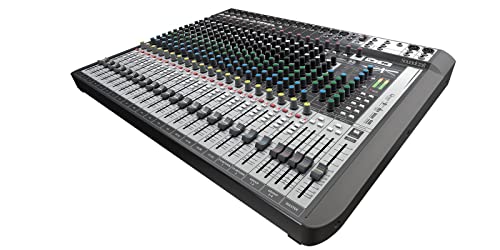
Soundcraft Signature 22 MTK — Best Recording Alternative
Many ‘8-bus’ searches are really recording searches: the buyer wants every channel captured separately, the way old 8-bus desks fed tape machines. The Signature 22 MTK is Soundcraft’s modern answer — an analogue mixer whose USB interface records every channel multitrack to a computer while the show mixes live, no group-routing gymnastics required.
As a mixer it is thoroughly Soundcraft: Ghost preamplifiers with a musical, low-noise character, Sapphyre EQ voiced in the British console tradition, Lexicon effects onboard and dbx limiting protecting inputs. Small venues, rehearsal studios and churches recording their services find the combination — real analogue desk, complete recording — more useful than bus architecture they would rarely exploit.
The labelling matters: its group structure is modest and it is not a GB-series console. Buy it when recording and everyday mixing are the job. Buy a GB8 when subgroup architecture for large live productions is the job. The two briefs overlap less than search results suggest, and choosing by the real brief is the whole point of this guide.
Strengths
- Records every channel multitrack over USB
- Ghost preamps and Lexicon effects onboard
- Analogue Soundcraft character, modern workflow
Trade-offs
- Not an 8-bus console — different brief
- 22 channels cap larger productions
- Recording needs a computer in the chain
Key specs: 22 channels, multitrack USB recording, Ghost mic preamps, Sapphyre EQ, Lexicon effects, dbx limiting on inputs
Best for: venues and studios that record every service or show / Not suited for: large-scale subgroup live mixing
Check the current price on Amazon

Soundcraft Ui24R — Best Digital Alternative
The Ui24R asks what an 8-bus searcher might want instead in 2026: not subgroups at all, but total recall, per-channel processing everywhere, and a console that lives in a rack while the operator mixes from a tablet in the seats. For installed venues run by rotating volunteers, scene recall alone — the whole desk restored identically for each service or event — can outweigh analogue group architecture.
Technically it is complete: twenty-four remote-controlled inputs, full EQ and dynamics on every channel, effects, feedback management tools and recording options, all driven from a browser interface that needs no app installation and works across devices. A stage-side rack shortens every cable run, and there is no console position to build, light or protect.
The trade is tangibility and dependency. There are no faders to grab, and the system is only as reliable as your network discipline — a dedicated router is effectively mandatory. Analogue devotees mixing full bands nightly will prefer the GB8’s physical groups; venues valuing recall, footprint and tier will find the Ui24R the smarter modern answer.
Strengths
- Total recall — identical setup every event
- No console position needed; rackmount footprint
- Full processing on every channel
Trade-offs
- No physical surface; network discipline required
- Not an analogue or 8-bus design
- Browser control feels indirect to desk operators
Key specs: 24 inputs, rackmount digital mixer, tablet/laptop control from any browser, onboard processing and multitrack recording options, remote-controlled preamps
Best for: installed venues with rotating operators / Not suited for: analogue purists wanting physical subgroups
Check the current price on Amazon
Comparison Table
| Pick | Badge | Key spec | Best for |
|---|---|---|---|
| Soundcraft GB8 32-Channel | Best Overall 8-Bus | 32ch, true 8-bus analogue | venues, large churches and regional touring rigs |
| Soundcraft GB8 48-Channel | Best for Large Venues | 48ch, true 8-bus analogue | large venues, festivals and flagship worship rigs |
| Soundcraft GB8 24-Channel | Best Entry into 8-Bus | 24ch, true 8-bus, smallest frame | mid-size venues and worship bands using subgroups |
| Soundcraft GB4 24-Channel | Best 4-Bus Alternative | 24ch, 4-bus GB-series | mid-size venues mixing in four main sections |
| Soundcraft Signature 22 MTK | Best Recording Alternative | 22ch analogue, multitrack USB | venues and studios that record every service or show |
| Soundcraft Ui24R | Best Digital Alternative | 24-in rackmount digital, browser control | installed venues with rotating operators |
Eight Buses, Four Buses, Eight Channels: Untangling the Search
A bus is a mixing destination — a subtotal. Channels assigned to a group bus can be processed, compressed and faded together before joining the stereo master. Eight group buses let a big mix be run as eight big decisions instead of forty small ones, and historically fed eight-track recorders, which is why ‘8-bus’ also appears in recording conversations. It has nothing to do with having eight channels, the confusion behind many searches.
Ask what you will actually do with groups. A typical venue uses groups for drums, band, vocals and playback — four. Productions that split further — drum subgroups, multiple vocal groups, orchestra sections, separate effects groups — genuinely use eight. If your honest answer is four, the GB4 in this guide is not a compromise; it is the correct console, and the saving belongs in your loudspeaker budget.
Recording reframes the question entirely. Multitrack USB desks like the Signature MTK capture every channel directly, making bus-to-recorder routing obsolete for most users. If your ‘8-bus’ need is really ‘record everything separately’, shop the recording specification, not the bus count.
How to Choose a Frame Size Without Regretting It
Count channels at your largest recurring production, including the unglamorous ones: playback devices in stereo, effects returns, a spare vocal channel, the talkback and announcement microphones, the extra keyboard that arrives at Christmas. Then add growth headroom — installed consoles serve for a decade or more, and productions expand into available channels with gravitational reliability.
Measure the room, literally. Console width, depth, the operator’s working space, cable access and sightlines to the stage all constrain the frame you can install. A 48-channel desk in a position where the operator cannot see the stage is a worse console than a 32 in a position with a clear view. Freight, door widths and turning space for delivery belong in the same calculation.
Finally, staff the desk honestly. Large analogue group consoles reward trained operators and punish occasional ones; if your venue runs on rotating volunteers, recall-based digital (the Ui24R pattern) may serve the mission better than architecture nobody on the team will fully use. The best console is the one your people mix well on, every week.
Living With a Large Analogue Console
Analogue flagships are maintained, not merely owned. Budget and schedule for fader and pot cleaning, connector inspection and the occasional channel repair across a long life; the GB family’s professional design assumes competent servicing and rewards it with decades of work. Keep the console covered, the room’s dust managed and a service relationship in place before you need one.
Document your installation: input lists, group assignments, insert patching, output distribution to mains, fills and recorders. Large consoles accumulate tribal knowledge; written patch documentation is what lets a guest operator or a new staff member run your room safely. Photograph the master section settings your venue treats as home.
Protect the investment electrically. Clean power, sensible surge protection and correct grounding prevent the hums, buzzes and failures most often blamed on consoles. At this scale, the installation around the desk is part of the instrument.
How to Set Up Group Mixing on an 8-Bus Console
Patch and label before mixing: channels labelled at the scribble strip, groups labelled by section (drums, band, vocals, playback), outputs to mains, fills and recording documented. Assign each channel to its group rather than directly to the master, and confirm group-to-master routing with a single channel before opening the whole rig.
Build the mix in the order groups imply. Set channel gains for healthy preamp levels, balance within each section at the channel faders, then bring sections together at the group faders. Insert a compressor across the drum group and feel the kit become one instrument; keep group processing gentle — the group’s job is cohesion, not repair.
Set monitor and effects sends from channels, not groups, so individual needs stay individual, and check the master section’s distribution: main speakers at show level, fills and delays balanced from their own outputs, recording feed independent of the house faders so the archive does not ride your show moves.
Sound-check by section, then together, then save the knowledge: photograph group assignments and master settings, note them in the venue’s patch book, and walk the room while the full band plays. Group mixing reveals its value in the seats — sections holding their places in the whole — and that is where you verify it.
Common Buying Mistakes
Buying an 8-bus flagship for a four-group reality, and starving the loudspeaker budget to do it.
Confusing ‘8 bus’ with ‘8 channels’ and ordering a freight-scale console for a podcast-sized brief.
Ignoring the physical install — door widths, console position, sightlines and freight — until delivery day.
Assigning channels straight to the master out of habit, leaving the group architecture you paid for unused.
No maintenance or documentation culture; large analogue desks repay care and punish neglect over years.
Final Recommendation
If your brief is genuinely eight subgroups under a Soundcraft badge, the GB8 is the answer and the only remaining question is frame: 24 channels for mid-size venues, 32 for the full-band mainstream, 48 for flagship scale. If your honest group count is four, the GB4 24 delivers the same family sound for less; if your real need is recording or recall, the Signature 22 MTK and Ui24R answer those briefs directly.
Related research: Best Sound Mixers, Best Sound Mixers For Churches, Best 16 Channel Mixers, Best Analog Mixers and Best Sound Mixers For Musical Theatre. Buy for the mixing you actually do — at this scale, the honest brief is the whole purchase.
Group Mixing Technique: What Eight Buses Let You Do
Owning eight groups is not the same as mixing with them, and the technique is worth describing because it is the entire return on a GB8’s price. Begin with the drum kit, the classic group: channels balanced individually, then assigned to a stereo pair of groups where one compressor glues them and two faders ride the whole kit against the band. Backing vocals become another stereo group, balanced internally, then floated beneath the lead as a single decision. Keys and guitars take their own groups; playback and effects returns take theirs; and the operator’s hands spend the show on eight group faders and the lead vocal, which is a humanly performable job even at forty channels.
Group inserts are where the architecture turns into sound design. A compressor across the drum group, an equaliser sweetening the vocal group as a unit, a favourite outboard unit patched across the band group — these are moves impossible at channel level without eight of everything. Venues that invest in a small rack of quality outboard alongside a GB8 are practising the classic large-console method, and it remains sonically legitimate in a way that has nothing to do with nostalgia: parallel group compression on drums is a sound engineers still chase in studios with every digital tool available.
The discipline that makes it work is restraint at the channel. Channels are gained and tonally tidied, then left alone; the show is mixed at the groups. Operators who keep reaching past the groups to individual channels mid-show are running two mixing philosophies at once and getting the benefits of neither. Train the team on the group method during rehearsals, mark the group assignments in the venue’s patch book, and the GB8 stops being a big mixer and becomes what it was designed to be — eight big, musical decisions under two hands.
Installation, Power and Signal Flow in GB-Series Venues
A large analogue console is an installation before it is an instrument, and the venues that get decades from GB-series desks treat the install as part of the purchase. Power comes first: a clean, correctly grounded supply, lighting and dimmer circuits kept away from audio power, and surge protection sized for the room. Most hum and buzz blamed on consoles is born in the building’s wiring, and a freight-scale console deserves an electrician’s hour before its first power-up rather than a season of fault-finding afterwards.
Signal flow rewards the same foresight. Decide where the console’s outputs must travel — mains, fills, delay rings, recording, hearing assistance, foyer — and install that distribution properly, with the matrix and group outputs documented in a patch book that lives at the desk. Wireless receivers belong at stage side with short antenna runs; a digital or analogue snake path between stage and desk should be installed once, labelled at both ends, and tested before the first production depends on it.
Physical installation closes the job: a console position with sightlines to the stage, working light that does not spill into the audience, ventilation the desk’s power supplies will thank you for, and access behind the console for the servicing it will eventually need. None of this is glamorous, and all of it is audible — in reliability, in noise floor, and in how calmly your operators work. The GB8’s sound begins at the building, and this guide’s insistence on the point is deliberate.
The GB Series in Context: Analogue Groups in a Digital Decade
A fair question hangs over this entire guide: why buy analogue group architecture when digital consoles offer groups, recall and processing in software? The honest answer has three parts. First, immediacy and legibility: on a GB8, the entire signal path is visible and touchable, every control is what it appears to be, and a competent engineer from any tradition can walk up and mix — no file, no firmware, no philosophy. For venues hosting visiting engineers and varied productions, that universality is a working asset, not a sentiment.
Second, the sound and feel of the method itself. Analogue summing at scale, group compression through chosen outboard, and faders that respond with mechanical certainty produce mixes many engineers simply prefer to make — and an engineer who enjoys the desk mixes better on it. Third, longevity arithmetic: an analogue flagship has no software support horizon. It will not be orphaned by an operating system, and its repairs are electronic rather than computational. Venues thinking in decades weigh that heavily.
None of this makes digital wrong — the Ui24R in this guide exists because recall-driven venues are right too. It makes the GB8 a deliberate choice rather than a default, bought by organisations that know which virtues they are purchasing. That deliberateness is the healthiest way to read this whole category: the architecture is the argument, and the venues that still argue for it, with full knowledge of the alternatives, are the ones who should buy it.
Used GB Consoles: Inspection, Service and Value
The GB family’s longevity means a real used market exists, and it rewards methodical buyers. Inspect in person where possible: run every channel with a microphone and a line source, ride every fader and group listening for noise, exercise every pot through its travel, and check inserts and aux sends individually — faults on large consoles cluster in the controls nobody used. A channel or two with issues is negotiable on a desk this serviceable; a pattern of noise across groups suggests power-supply age, which is a service budget line to price into the offer rather than a reason to walk away.
Serviceability is the used GB’s hidden value. Professional analogue consoles were designed for technicians: modular thinking, documented schematics in the pro ecosystem and components a competent engineer can source and replace. Before buying, identify who in your region services large-format desks and confirm they will take the work; that single phone call converts a used purchase from a gamble into a plan. Keep the service relationship warm with a post-purchase inspection and cleaning, and the desk’s second life can be as long as its first.
Value the whole picture when comparing used GB frames against new alternatives. A used GB8 plus a service visit often lands near a new mid-tier digital desk — and the comparison is then honestly about architecture and workflow, not about new versus old. Venues that want groups, immediacy and decades of legibility will find the used GB a rational flagship; venues that want recall and warranty should buy the new digital with equal confidence.
Crew, Training and Running a GB Room Night After Night
A large group console shapes a venue’s crew culture, for better or worse, and the better outcome is planned. Train operators on the group method explicitly — channel discipline, group mixing, insert patching, master-section distribution — using the venue’s own productions as the curriculum, because the GB rewards a house method and punishes improvisation at scale. A short written house standard, kept at the desk, turns individual expertise into institutional reliability: input lists, group assignments, monitor conventions and the settings that define the room’s home sound.
Rotas and handovers deserve the same seriousness as the mix itself. A GB room run by three operators with a shared method sounds consistent; the same room run by three personal styles sounds like three venues. Log each event’s notable settings and problems in the patch book, and review it when something sounded unusually good as faithfully as when something failed — the book becomes the room’s memory, and rooms with memories improve.
Finally, programme the maintenance into the calendar rather than into emergencies: fader and pot exercise during quiet weeks, connector inspection each season, a service visit on a planned cycle. Crews sometimes resist this unglamorous rhythm until the first fault-free festival weekend converts them. The GB8 was built for organisations that think this way; meet it halfway and it will anchor your room’s sound for a very long time.
Specifying a GB Installation: A Buyer’s Checklist
Committees and venue managers buying at this scale benefit from a written specification, and the GB decision reduces to a short list of verifiable items. Frame size against the largest production’s input list, with headroom stated as a number rather than a hope. Group count against the sections the team actually mixes, with the four-versus-eight question answered in writing — that single answer decides between the GB4 and GB8 more honestly than any audition. Aux and output counts against monitors, effects, fills, recording and access feeds, listed one by one.
The physical specification follows: console position dimensions and sightlines, freight and access routes measured rather than assumed, power and grounding confirmed by an electrician, and the snake or stagebox path planned before the desk is ordered. None of these items appears in a product listing, and every one of them has embarrassed a real installation somewhere; the checklist exists so yours is not next.
Close the specification with people: who operates, who is trained as relief, who services, and where the documentation lives. A GB console bought with those four names attached is a decade of sound; the same console bought as a line item is a gamble with excellent preamps. This guide’s enthusiasm for the architecture is conditional on the organisation around it, and the condition is achievable by any venue willing to write the checklist down.
Soundcraft Heritage: Why the GB Design Endures
Soundcraft’s place in live sound was built across decades of touring and installed consoles, and the GB series distils that inheritance into a deliberate form: preamps and EQ drawn from the company’s large-console practice, group architecture from the era when subgroups were the live engineer’s main organisational tool, and construction intended for service rather than replacement. Understanding that lineage explains the GB8’s otherwise puzzling purity — no recording interface, no recall, no screen — as a set of choices rather than omissions.
That purity is also the product’s market position in a digital decade. Buyers who choose a GB8 today are choosing a known, stable technology whose behaviour will not change with a firmware generation, whose sound is a documented quantity among engineers, and whose operating method any trained guest can perform. In procurement language, it is the low-risk option for organisations whose risk is measured in decades of Saturday nights rather than in feature comparisons.
Heritage should never be bought as nostalgia, and this guide has not recommended it as such — the alternatives above exist for buyers whose briefs point elsewhere. But where the brief is genuinely large-scale group mixing in an installed room, the GB design endures because the brief endures. Consoles are answers to questions; the GB8 remains the answer to a question that big rooms still ask.
Comparing the GB8 With Modern Digital Rivals at the Same Budget
A venue choosing between a GB8-class analogue flagship and a modern digital console at a similar total budget deserves the comparison stated cleanly, because both answers are defensible and neither is a consolation prize. The digital desk offers recall, per-channel processing everywhere, remote control and a smaller physical and training footprint; across a year of varied events with rotating operators, it will usually produce the more consistent result, and its total cost of ownership is easier to predict.
The GB8 offers a different bundle: an interface every trained engineer already knows, group architecture as a physical reality rather than a screen page, analogue summing at scale, outboard integration at group level, and a service horizon measured in decades with no software dependency. For a venue with a stable team, a house engineer culture and productions built around group mixing, those are not nostalgic virtues — they are operational ones, and they compound across the same year of events in the opposite direction.
The deciding questions are therefore organisational. Who mixes here, and how often does that change? Does the programme repeat identically (favouring recall) or vary nightly under expert hands (favouring the analogue surface)? Is there a service relationship for analogue, or an IT comfort with digital? A venue that answers honestly will find its console named by its own answers — and a venue that cannot answer yet should probably buy the digital desk’s forgiveness first and revisit the GB romance with a trained team in place.
A Note on Delivery, Freight and Acceptance Testing
Consoles at GB scale arrive as freight, and the purchase is not complete when the truck leaves — it is complete when the desk has passed an acceptance test in your room. Schedule it before the first production depends on the console: every channel with a microphone and a line source, every group and aux exercised, inserts patched and confirmed, outputs verified at each destination from mains to recording feed. Faults discovered at acceptance are the seller’s conversation; the same faults discovered in tech week are yours, and the difference is purely a matter of calendar discipline.
Keep the acceptance record with the patch book, alongside delivery documentation, serial numbers and warranty papers, in the venue’s permanent file rather than in an individual’s inbox. Large consoles outlive the staff who bought them, and the organisation that can produce its desk’s complete paper history — purchase, acceptance, services, repairs — owns a measurably more valuable asset than one whose flagship arrived, as far as anyone can prove, by magic. The GB8 rewards institutions; paperwork is how institutions remember.
Frequently Asked Questions
What does 8-bus actually mean on a mixer?
It means eight subgroup buses between the channels and the stereo master. Channels are assigned to groups — drums, vocals, band sections — which can be processed and faded together. It is an architecture for mixing large productions in sections, unrelated to having eight channels.
Is the GB8 the only Soundcraft 8-bus family?
In Soundcraft’s modern catalogue, the GB8 is the dedicated 8-bus analogue line, offered in several frame sizes. Other Soundcraft desks in this guide are included as clearly-labelled alternatives with fewer buses or digital architecture, because many buyers searching this term need those instead.
Can I record from an 8-bus console?
Traditionally, yes — group outputs fed multitrack recorders, and the GB8’s master section supports recording feeds. For channel-by-channel multitrack recording today, a desk like the Signature 22 MTK records every input over USB directly, which most users find simpler.
Which GB8 frame size should a church choose?
Count the full platform: band, vocalists, choir, playback and spares. Most large churches land on the 32; growing platforms with big teams should weigh the 48; compact venues whose group mixing is real but whose channel count is modest fit the 24. Add headroom — consoles serve for a decade.
Are large analogue consoles hard to maintain?
They need a maintenance culture rather than constant repair: cleaning, connector care, sensible power and an occasional service visit. Professional designs like the GB family are built to be serviced, and venues that keep records and a service relationship get very long lives from them.
When is a digital rack mixer the better buy?
When recall, footprint and rotating operators dominate: the Ui24R restores the entire desk setup per event, lives in a rack at stage side and needs no console position. If your team mixes by scenes and tablets happily, digital serves better than group architecture nobody uses.


