Disclosure: airfryerkitchensupply.com is reader-supported. When you buy through links on our site, we may earn an affiliate commission at no extra cost to you.
Where to buy
The fastest way to buy any of the best 16 channel mixers in this guide is through Amazon, where each model below is sold by the brand’s own storefront or an authorised dealer. Start with the Mackie ProFX16v3 if you want one board that handles a full band, records over USB and still fits in a small venue budget, or the Yamaha MG16XU if proven live reliability matters more than anything else. Every pick in this guide was verified against Amazon’s current catalogue before we wrote a word about it, and each review links to the exact model — not a bundle, not a smaller sibling, not a lookalike listing. Prices on mixers move with stock and seasonal promotions, so instead of printing a number that could be wrong tomorrow, each pick simply invites you to check the current price on Amazon. If a listing shows a different channel count or a “v2” name, back out and search the exact model name from this page.
One honest note before the list: “16 channel” on a spec sheet almost never means sixteen microphone inputs. Most boards in this class offer somewhere between eight and thirteen mic preamps, with the remaining channels arriving as stereo line inputs for keyboards, playback devices and effects returns. That is not a scam — it is how the whole category works — but it does mean you should count your microphones first and buy for the mic preamp number, not the big number on the box. We call out the real input layout for every pick below.
Introduction: what a 16-channel mixer actually gives you
Finding the best 16 channel mixers starts with a simple reality check: this is the size class where a mixer stops being a utility box and becomes the nerve centre of a real show. Sixteen channels is enough for a four- or five-piece band with every drum mic’d, a worship team with a choir pair overhead, a school theatre production with a dozen wireless receivers, or a podcast-and-livestream studio that also records live music. It is also the size where the differences between brands stop being cosmetic. Preamps get quieter or noisier, EQ sections get more surgical or stay blunt, USB recording goes from a stereo afterthought to genuine multitrack, and build quality decides whether the board survives its fiftieth load-in or dies at its fifth.
We built this guide around the six boards we would actually hand to a working band, a church tech team or a small-venue engineer in 2026. All six are analogue or hybrid analogue boards — if you want a fully digital console with scene recall and tablet mixing, that is a different guide and a different budget tier. Here, the appeal is physical faders, knobs you can grab mid-song, and a signal path you can trace with your eyes. Within that brief, the field splits into three camps: the do-everything USB boards (Mackie ProFX16v3, PreSonus StudioLive AR16c), the live-first workhorses (Yamaha MG16XU, Mackie 1604VLZ4), and the tone-first British-style boards (Soundcraft Signature 16, Allen & Heath ZED-16FX). Each camp wins for a different buyer, and the reviews below are blunt about who should skip what.
Budget framing matters too. The 16-channel class spans a wide band: entry boards in the lower tier give you basic EQ and a stereo USB port, mid-tier boards add better preamps, subgroups and real effects engines, and the upper tier buys you more mic inputs, sturdier chassis and cleaner gain staging. Nothing in this guide is a toy, and nothing requires a second mortgage either — this is the sweet spot of the mixer market, and it is crowded for a reason.
In this guide
Quick Picks
- Best Overall — Mackie ProFX16v3: Eleven Onyx mic preamps, a genuinely fun GigFX effects engine, USB recording and a layout a volunteer can learn in one rehearsal. The default answer for most bands and churches.
- Best for Live Reliability — Yamaha MG16XU: D-PRE preamps, one-knob compressors on the first eight channels, a metal chassis and Yamaha’s SPX effects. The board engineers trust when the show cannot fail.
- Best Sound Character — Soundcraft Signature 16: Ghost preamps and British-style EQ that flatters vocals and acoustic instruments, plus Lexicon effects. For buyers who mix with their ears first.
- Best for Home Recording — Allen & Heath ZED-16FX: A USB interface built into a proper live board, DuoPre preamps and Allen & Heath’s famously musical EQ. The studio-leaning pick.
- Best Hybrid Live/Studio Board — PreSonus StudioLive AR16c: Multitrack USB-C recording, an SD recorder for board mixes without a laptop, and Bluetooth playback. Built for creators who also play live.
- Best for Full Bands — Mackie 1604VLZ4: Sixteen genuine Onyx mic preamps — no stereo-channel padding — in a rack-mountable frame. The pick when every input really is a microphone.
How These Picks Were Chosen
We started with the full field of 16-channel analogue and hybrid mixers currently sold on Amazon and cut it down with four filters. First, availability: the board had to be a current model with a live, verifiable listing from the brand or an authorised seller — discontinued legends and grey-market imports were cut. Second, input honesty: we documented the real mic preamp count for every board and favoured models that do not lean too hard on stereo line channels to reach sixteen. Third, recording path: in 2026 a 16-channel board with no USB audio is a hard sell, so every pick here can get audio into a computer, though the depth of that recording — stereo versus multitrack — varies and is flagged in each review. Fourth, owner evidence: we weighed long-term reports from working engineers, church volunteers and studio owners, looking for patterns — noisy preamps, failing faders, fragile power supplies — rather than one-off complaints.
Each surviving board was then matched to the job it does best rather than ranked on a single ladder. A worship team running eight vocal mics and a keyboard rig needs something different from a metal band mic’ing a full kit, and pretending one board wins both jobs would be dishonest. The badges in this guide are the verdict: pick the badge that matches your stage plot and you will land on the right board. Where a spec appears in a mini spec box, it comes from the manufacturer’s own published data for that exact model; where we could not verify a number, we left it out rather than guessing.
The 6 Best 16 Channel Mixers
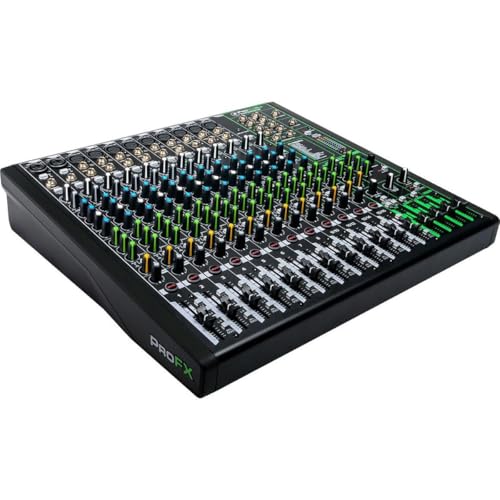
Mackie ProFX16v3 — Best Overall
The ProFX16v3 is the board we recommend first because it answers the most briefs at once. Eleven of its channels carry Mackie’s Onyx mic preamps — a genuinely high count for this class — and the remaining inputs cover keyboards, media players and a stereo return without stealing a mic channel. The GigFX effects engine is more than a spec-sheet ornament: its reverbs and delays are usable out of the box, and the single-knob compression on the first channels tames a loud singer or a sloppy bassist before they clip anything downstream. USB connectivity turns the board into a recording interface for rehearsals and demos, and the whole surface is laid out so clearly that a new volunteer can run sound after one walkthrough.
Strengths
- Eleven Onyx mic preamps — more real mic inputs than most rivals at this tier.
- GigFX effects engine with presets that genuinely suit vocals and acoustic guitars.
- Clear, colour-coded layout that beginners and volunteers learn fast.
Trade-offs
- USB recording is a stereo mix rather than full multitrack — demo-grade, not album-grade.
- No channel inserts on every channel, which limits outboard processing options.
- The built-in effects are one shared engine, so you cannot run an independent reverb and delay chain per channel.
| Spec | Detail |
|---|---|
| Channels | 16 |
| Mic preamps | Onyx |
| USB | Yes — recording and playback |
| Effects | GigFX engine |
In practice, the ProFX16v3 shines in the exact situations most 16-channel buyers face: a band that rehearses in a garage on Tuesday and plays a bar on Friday, a church whose sound team is whoever shows up, a school that needs one board for assemblies and musicals. The 3-band EQ with a sweepable mid on the mic channels is the quiet hero — it lets you notch out the one boxy frequency in a vocal without touching anything else. Gain staging is forgiving, the headphone monitoring is honest, and the board’s subgroups make it easy to park all the drums or all the backing vocals on a single fader for the chorus. It is not the quietest board here at extreme gain, and engineers recording quiet acoustic acts may hear the difference the Soundcraft makes, but as an all-round tool it has no serious weakness.
Best for: bands, churches and schools that need one board to do everything well. / Not suited for: engineers who need multitrack recording of every channel.
Check the current price on Amazon

Yamaha MG16XU — Best for Live Reliability
Yamaha’s MG series is the board you will find already installed in half the small venues on earth, and the MG16XU shows why. Its D-PRE preamps are clean and consistent, the chassis is metal where rivals use plastic, and the one-knob compressors on the first eight mic channels are a gift for anyone mixing inexperienced singers — turn the knob until the peaks behave, done. The onboard SPX effects are a step above the generic reverbs in this class, and the USB audio path makes it a perfectly serviceable interface for recording a stereo board mix or playing backing tracks from a laptop.
Strengths
- D-PRE mic preamps with a clean, neutral character that suits any source.
- One-knob compressors on eight channels — fast, musical peak control for live vocals.
- Metal chassis and a long track record of surviving hire-company abuse.
Trade-offs
- Ten mic preamps, so a fully mic’d drum kit plus a big front line can run you out of XLR inputs.
- USB is stereo only; there is no multitrack recording path.
- The effects are good but the parameter control is shallow compared with the Mackie GigFX engine.
| Spec | Detail |
|---|---|
| Channels | 16 inputs, 6-bus design |
| Mic preamps | D-PRE |
| USB | Yes — stereo interface |
| Effects | SPX digital effects |
The MG16XU’s real strength is boring in the best way: it behaves identically on night one and night one hundred. Faders track evenly, knobs stay tight, and the board forgives rough power and rough handling. For a venue engineer, the subgroup structure and the flexible monitoring make it easy to run wedges and a house mix without drama. For a band that self-mixes from the stage, the footswitchable effects mute is a small feature that feels huge at 11 p.m. when the singer wants to talk between songs without the reverb tail swallowing every word. If your priority is a board that simply never becomes the story of the night, this is the one.
Best for: venues, hire companies and bands that value dependability above features. / Not suited for: buyers who need more than ten microphone inputs or multitrack USB.
Check the current price on Amazon

Soundcraft Signature 16 — Best Sound Character
Soundcraft built the Signature series around two things its bigger consoles are famous for: the Ghost mic preamp and a British-style EQ that adds warmth instead of harshness when you push it. The Signature 16 puts ten Ghost preamps up front, adds Lexicon effects — the name that defined studio reverb — and wraps it in a clean, uncluttered surface. Vocals sit forward without getting brittle, acoustic guitars keep their body, and the whole board has a slightly forgiving, musical quality that flatters live sources recorded straight to its USB stereo output.
Strengths
- Ghost preamps deliver low noise and a flattering, analogue character.
- Lexicon effects are a genuine step up from generic onboard reverbs.
- British-style EQ stays musical even with aggressive boosts.
Trade-offs
- Ten mic preamps — the same ceiling as the Yamaha, so count your drum mics carefully.
- No per-channel compression, so vocal dynamics need an outboard unit or a careful hand.
- USB recording is stereo only, despite the studio-leaning sound.
| Spec | Detail |
|---|---|
| Channels | 16 |
| Mic preamps | Ghost |
| USB | Yes — stereo interface |
| Effects | Lexicon |
Choose the Signature 16 when the mix itself is the product: singer-songwriter bills, jazz and folk ensembles, acoustic worship sets, theatre work where dialogue clarity is everything. The EQ deserves its reputation — the high shelf sweetens without fizz, and the midrange finds the intelligibility band in a voice without the honk cheaper boards produce. It is less forgiving of sloppy gain staging than the Yamaha, rewarding engineers who set levels properly, and its feature set is deliberately lean: no compressors, no subgroups-for-everything routing gymnastics, just a great-sounding straight line from microphone to speakers. Engineers who mix with their ears will feel at home within minutes.
Best for: acoustic acts, vocal-led groups and engineers who prioritise tone. / Not suited for: buyers who need onboard compression or more than ten mic inputs.
Check the current price on Amazon

Allen & Heath ZED-16FX — Best for Home Recording
Allen & Heath’s ZED boards occupy a sweet spot: they are proper live mixers that also behave like studio tools. The ZED-16FX carries ten mic/line channels with DuoPre preamps, three stereo channels, a built-in effects section derived from the company’s bigger desks, and a USB connection that was designed for recording from the start rather than bolted on. The EQ is the famous Allen & Heath recipe — a responsive, musical three-band with a swept mid that engineers consistently describe as hard to make sound bad.
Strengths
- DuoPre preamps with generous gain range for quiet and loud sources alike.
- USB audio designed for recording workflows, with flexible routing of what gets sent to the computer.
- Superb EQ that flatters everything from spoken word to full drum kits.
Trade-offs
- USB recording is still a stereo feed, not per-channel multitrack.
- The effects section is preset-led, with limited deep editing.
- Ten mic inputs means the same drum-kit arithmetic as the Yamaha and Soundcraft.
| Spec | Detail |
|---|---|
| Channels | 16 (10 mic/line + 3 stereo) |
| Mic preamps | DuoPre |
| USB | Yes — I/O for recording and playback |
| Effects | Onboard FX |
The ZED-16FX makes the most sense for the hybrid user: the project studio that occasionally mixes a live gig, the content creator who records a house band, the church that livestreams every service and wants the stream mix to sound like a record. Its preamps handle condensers and low-output dynamics gracefully, the build quality is a clear step above the budget tier, and the layout rewards good engineering habits. It will not replace a dedicated multitrack interface for album work, but as the centre of a small recording-and-live rig it is the most studio-literate board in this guide.
Best for: home studios, livestream rigs and engineer-led small venues. / Not suited for: buyers expecting multitrack-per-channel USB recording.
Check the current price on Amazon

PreSonus StudioLive AR16c — Best Hybrid Live/Studio Board
The StudioLive AR16c is what happens when a recording company builds a live board. Under the analogue surface — twelve mic inputs with PreSonus XMAX preamps, a stereo Bluetooth channel, a proper effects section — sits a recording system: multitrack USB-C capture to a computer, an onboard SD recorder that captures the stereo mix (or a rehearsal) without any computer at all, and a copy of Studio One software in the box. For bands who record every rehearsal and creators who gig, nothing else in this class removes as much friction.
Strengths
- True multitrack USB-C recording — every channel captured separately for later mixing.
- Onboard SD recorder grabs board mixes and rehearsals with zero laptop involvement.
- Bluetooth input channel for walk-in music and backing tracks without burning a mic input.
Trade-offs
- The recording-first design means a slightly denser surface for pure live work.
- No per-channel compression, so live vocal control is manual.
- Buyers who never record are paying for capability they will not use — the Yamaha is simpler for them.
| Spec | Detail |
|---|---|
| Channels | 16 |
| Mic preamps | XMAX |
| USB | USB-C multitrack interface |
| Recording | Multitrack USB + SD stereo recorder |
The workflow win is real: set up for the gig, press record on the SD card as a safety, capture the multitrack over USB, and on Monday you are remixing Friday’s show in Studio One with the same channel layout. Podcasters who host live panels, schools recording concerts for parents, and bands building a live album all get more from this board than from any rival here. Live-only engineers should note the surface is still fully hands-on — this is an analogue board with recording superpowers, not a digital console in disguise — but the extra menus live in the recorder section, not in your signal path.
Best for: recording bands, creators, schools and churches that archive every event. / Not suited for: pure live users who will never press record.
Check the current price on Amazon

Mackie 1604VLZ4 — Best for Full Bands
Every other board in this guide reaches sixteen channels with help from stereo line inputs. The 1604VLZ4 does it the expensive way: sixteen full Onyx mic preamps, sixteen line inputs, four buses, and a chassis that rack-mounts for install work. It is the fourth generation of a design that has been a small-venue and studio staple for decades, and its appeal is honesty — what you see on the channel strip is what every single channel actually has.
Strengths
- Sixteen genuine mic preamps — mic a full kit, the whole front line, and still have spares.
- Four-bus routing and rich aux sends suit complex monitor setups.
- Rack-mountable, road-proven design with a very long service history.
Trade-offs
- No USB audio at all — recording requires a separate interface.
- No built-in effects; reverbs and delays must come from outboard or a DAW.
- The dense, professional surface is less friendly to first-time volunteers.
| Spec | Detail |
|---|---|
| Channels | 16, all with mic preamps |
| Mic preamps | 16 × Onyx |
| USB | None |
| Format | 4-bus, rack-mountable |
Buy the 1604VLZ4 when your input list is genuinely sixteen microphones: a rock band with a big kit and four singers, a theatre pit, a rehearsal complex selling rooms by the hour, an install where the board lives in a rack and outboard handles the effects. The Onyx preamps are clean at sensible gains, the EQ is the classic Mackie recipe, and the routing depth — subgroups, multiple auxes, control-room outputs — supports monitor worlds that simpler boards cannot. It asks more of its operator and gives more back; paired with even a modest interface it also doubles as a front end for a project studio that records live-off-the-floor.
Best for: full bands, rehearsal studios and installs where every input is a microphone. / Not suited for: buyers who need USB recording or built-in effects in the same box.
Check the current price on Amazon
Comparison Table
| Pick | Badge | Key spec | Best for |
|---|---|---|---|
| Mackie ProFX16v3 | Best Overall | 11 Onyx preamps, GigFX, stereo USB | Most bands, churches, schools |
| Yamaha MG16XU | Best for Live Reliability | D-PRE preamps, 1-knob compressors, SPX FX | Venues and hire use |
| Soundcraft Signature 16 | Best Sound Character | Ghost preamps, Lexicon FX | Acoustic and vocal-led acts |
| Allen & Heath ZED-16FX | Best for Home Recording | DuoPre preamps, recording-focused USB | Studios and livestream rigs |
| PreSonus StudioLive AR16c | Best Hybrid Live/Studio | Multitrack USB-C, SD recorder | Recording bands and creators |
| Mackie 1604VLZ4 | Best for Full Bands | 16 real mic preamps, 4-bus | Big input lists, installs |
How to Choose the Right 16 Channel Mixer
Count microphones, not channels. Write down every mic in your stage plot — vocals, drum kit piece by piece, guitar amps, a DI for bass still needs a channel. If your list is ten mics or fewer, every board here works. If it is twelve to sixteen, only the ProFX16v3 (eleven preamps, plus line inputs for DIs) and the 1604VLZ4 (sixteen preamps) stay comfortable. Drum kits are the usual trap: kick, snare, two toms, floor tom and two overheads is seven mics before a single singer opens their mouth.
Decide how you will record — honestly. If “recording” means a stereo board mix for the band’s socials, any USB board here does it. If it means remixing the show later, only the AR16c’s multitrack capture does the job in this class. And if it means a proper studio front end, the ZED-16FX’s recording-minded USB and preamps are the best analogue compromise. Buying multitrack you never use wastes money; buying stereo when you needed multitrack wastes the show.
Think about who is mixing. Volunteer teams and self-mixing bands should weight layout clarity and helper features — one-knob compression, colour coding, effects that sound right at default settings. That points to the ProFX16v3 and MG16XU. Experienced engineers can trade that simplicity for routing depth (1604VLZ4) or tonal character (Signature 16).
Check phantom power and DI provision. Condenser microphones — overheads, choir mics, many vocal condensers — need +48V phantom power, and every board in this guide provides it, though some switch it globally rather than per channel, which matters if you mix condensers with ribbon mics or unbalanced sources on the same show. Guitar and bass players who go direct need either DI boxes or channels with a high-impedance instrument input; several boards here offer instrument-ready inputs on selected channels, which can save you a DI box or two. Neither feature makes headlines, but both decide whether your existing microphones and instruments plug straight in on day one or need adapters and workarounds.
Budget in tiers, not fantasies.
The lower tier of this class buys competent preamps and stereo USB. The middle tier — where most of this guide sits — adds better effects, more preamps and sturdier builds. The upper tier buys input count and routing. Accessories eat budget too: a case, a snake and spare cables are not optional for a gigging board, so leave room for them rather than maxing out on the mixer itself.
Analogue, Hybrid or Digital at 16 Channels?
Every board in this guide is analogue at its core, and that is a deliberate choice for this size. Analogue boards respond instantly, teach sound reinforcement better than any screen, and keep working when a laptop crashes. Hybrid boards like the AR16c add digital recording without changing how you mix. Fully digital 16-channel consoles — rack units mixed from a tablet, or compact digital desks — add scene recall, per-channel everything and remote mixing, but they change the workflow completely and punish beginners mid-show. If your team rotates volunteers, analogue wins. If one engineer runs every show and needs recall between a wedding band on Saturday and a choir on Sunday, look at digital as a separate purchase decision. For most readers of this guide, an analogue or hybrid board is the right tool at the right tier.
How to Set Up a 16 Channel Mixer for a Live Band
1. Plot the inputs on paper first. Assign channels in stage order — drums on 1–7, bass DI on 8, guitars on 9–10, keys stereo on 11–12, vocals on 13–16 — and tape labels under each fader. Consistency between shows is worth more than cleverness.
2. Connect in the right order. With the board powered off and master fader down, run the snake or cables from stage to inputs, then connect main outputs to your amplifiers or powered speakers last. Power on the mixer first, speakers last; reverse the order at shutdown to avoid pops.
3. Gain stage one channel at a time. Have each musician play at show volume. Set the channel gain so the signal peaks healthily without clipping, then bring the fader up. Repeat for every channel before touching EQ — most “bad EQ” problems are actually bad gain.
4. Ring out the monitors. Raise each monitor send slowly with the vocal mics live and cut the frequencies that feed back using the channel or graphic EQ. Do this in soundcheck, never during the first song.
5. Dial effects last. Add reverb to vocals and snare until you can just hear the space, then back off slightly. Effects should be felt more than heard.
6. Save the scene. Photograph the surface, note your gain settings, and — on the AR16c — start the SD recording before the house music fades. The best mix is the one you can reproduce next weekend.
A final setup habit separates smooth shows from chaotic ones: soundcheck in the order the audience will hear things. Start with the rhythm section, build the mix around kick and bass, add guitars and keys at lower priority, and place vocals on top last, because the vocal is what the audience actually judges. If you run out of time — and one day you will — a mix with great vocals and a solid kick will carry a show that a perfectly balanced drum kit under buried vocals never will.
Who Should Skip the 16-Channel Size Entirely
Honesty cuts both ways: some buyers reading this guide should not buy any of these boards. If your act is a duo or trio with two vocals, an acoustic guitar and a keyboard, a 16-channel mixer is money and table space spent on inputs that will sit dark for years — an 8- or 10-channel board will sound identical on your sources and set up in half the time. Conversely, if your plot already needs sixteen mics and a stereo keyboard rig, you have outgrown this class before you have bought into it: a 20–22 channel board buys the headroom to add a guest vocalist or a second guitar without re-planning the whole show, and the price step is smaller than the cost of replacing a board in eighteen months. Podcasters and streamers with two to four microphones should also look elsewhere — a dedicated interface or a podcast production console will give cleaner recordings and simpler routing than a live board pressed into studio service. The 16-channel sweet spot is real but specific: full bands, worship teams, schools, theatres and small venues whose input lists live between nine and sixteen sources and whose shows are mixed by human hands on physical faders.
Keeping a 16 Channel Mixer Alive: Cleaning and Care
Analogue boards fail slowly and then all at once, and the failures are almost always mechanical: scratchy faders, intermittent knobs, connectors that crackle when a cable moves. Prevention is cheap. Keep the board covered or cased when it is not in use — dust is the enemy, and faders are dust magnets. Once a month in a working venue, exercise every fader and knob through its full travel a few times; pots that sit in one position for months develop noisy spots exactly where you left them. Use compressed air, never household cleaners, around the surface, and keep drinks on a different surface entirely — a single spilled coffee can write off a channel strip. Every six months, unplug and re-seat every connector in a fixed install; the tiny amount of corrosion this wipes away is the source of most mystery crackles. If a fader does go scratchy, a purpose-made contact cleaner designed for audio faders is the fix — general-purpose sprays can damage the resistive track. Treat the board this way and any of the six picks here will outlast the band’s current lineup, probably several times over.
Common Buying Mistakes
Buying the channel count on the box. Sixteen channels with eight mic preamps is an eight-mic board for most bands. Count preamps, always.
Forgetting the monitor mixes. A board with two aux sends cannot feed four separate wedge mixes and an effects send. Count your auxes against your stage plot, not your hopes.
Skipping the case. A 16-channel board is exactly big enough to be awkward and expensive enough to hurt when a fader snaps in transit. Budget for a padded case or rack from day one.
Assuming USB means multitrack. Most USB mixers send only the stereo mix to a computer. If multitrack matters, verify it in writing — in this class, that means the AR16c.
Ignoring the room. No mixer fixes a gymnasium’s acoustics. If your space is very live, spend on the board with the best EQ control (and one-knob compression for unruly singers) rather than the longest feature list.
Preamps, EQ and Effects: Where the Real Differences Live
Strip away the marketing and three circuits decide how a 16-channel board sounds: the mic preamp, the EQ and the effects engine. The preamp’s job is brute force with manners — it may need to raise a quiet ribbon-style dynamic or a whispered vocal by 50 dB or more without adding hiss of its own. Each brand here takes a different route. Mackie’s Onyx preamps (ProFX16v3, 1604VLZ4) are known for headroom: they stay clean when a drummer or a belting singer hits them hard. Yamaha’s D-PRE design aims for transparency, adding as little colour as possible, which engineers love for sources that already sound the way they should. Soundcraft’s Ghost preamps, drawn from the company’s studio consoles, are the quietest-feeling of the group on delicate sources and pair with an EQ voicing that sweetens rather than slices. Allen & Heath’s DuoPre offers an unusually wide gain range, so one channel can handle a kick drum on Saturday and a quiet acoustic guitar on Sunday without pad gymnastics. PreSonus XMAX preamps in the AR16c are built to recording standards, because in that board the preamp feeds an A/D converter as often as a speaker.
EQ philosophy divides the field just as clearly. All six boards give you at least a three-band EQ on mic channels, but the midrange is where money shows. A sweepable (or semi-parametric) mid — found on the Mackie, Soundcraft and Allen & Heath boards — lets you find the exact frequency where a vocal turns boxy or a snare turns harsh and cut only that. Fixed-frequency EQ, by contrast, forces broad strokes. In a live room with one problem frequency, the sweepable mid is worth more than two extra channels. High-pass filters matter too: engaging an 80–100 Hz cut on every vocal and instrument channel except kick and bass cleans up stage rumble more than any other single move, and you should confirm your chosen board offers it per channel.
Effects are the third divider. A shared stereo effects engine — the arrangement on every board here except the effect-free 1604VLZ4 — means one reverb flavour serves the whole mix, fed per channel by an FX send knob. That is the right design for live work: vocals and snare get the space, kick and bass stay dry and tight. The differences are in flavour and control. Mackie’s GigFX offers the broadest preset palette with simple depth control; Yamaha’s SPX is the polished, conservative choice; Lexicon processing in the Soundcraft has the smoothest tails for ballads and worship; Allen & Heath’s effects lean subtle and studio-like. None replaces a quality outboard unit, but all six boards’ engines — where fitted — are good enough that effects should be the last tiebreaker, not the first.
Size, Power and Installation: The Practical Checks
A 16-channel board is a physical object that has to live somewhere, and the practical details sink more purchases than the audio specs do. Measure your space: these boards run roughly from compact tabletop footprints to rack-width units like the 1604VLZ4, which is designed to drop into a standard equipment rack or a mixer case with rack rails. If the board will travel, add the case dimensions and weight to your plan, not just the mixer itself, and check whether the power supply is internal (one less wall-wart to lose — most of these boards use internal supplies or locking external ones) and whether it auto-senses voltage for international touring.
Think about cabling as part of the purchase. Sixteen inputs at the back of a board in a fixed install cry out for a stage box and snake, which keeps the stage tidy and the board’s connectors from wearing out; a rehearsal-room board can live with direct cables. Check connector placement too: top-panel inputs suit tabletop use and constant re-plugging, rear-panel inputs suit installs. Finally, plan your monitoring path before the board arrives — how many wedge mixes, whether the drummer needs a headphone feed, whether the livestream needs its own mix from a spare aux or subgroup. Every one of those decisions maps to a feature on the spec sheet, and discovering a missing aux after the return window closes is the most common regret in this category.
Final Recommendation
For most readers, the answer is the Mackie ProFX16v3: the most mic preamps in a friendly layout, good effects, easy USB, done. If the board will live in a venue or a hire fleet, take the Yamaha MG16XU and its proven toughness. If tone is the priority, the Soundcraft Signature 16 makes voices sound expensive. Creators and recording bands should go straight to the PreSonus StudioLive AR16c, home-studio users to the Allen & Heath ZED-16FX, and anyone whose input list is truly sixteen microphones to the Mackie 1604VLZ4. Exploring the rest of the mixer range? See our guides to Best 12 Channel Mixers, Best 10 Channel Mixers, Best 20 To 22 Channel Mixers and Best 16 Channel Digital Mixers List for neighbouring sizes and formats.
Frequently Asked Questions
How many microphones can a 16 channel mixer actually take?
It depends on the model, and the honest range in this class is ten to sixteen. The Mackie 1604VLZ4 takes sixteen mics; the ProFX16v3 takes eleven; the Yamaha, Soundcraft and Allen & Heath boards here take ten each, with their remaining channels designed for keyboards, playback and other line-level sources. Always check the mic preamp count, not the headline channel count.
Can a 16 channel mixer record to a computer?
Five of the six boards here can, over USB. Most send a stereo mix of the whole board, which is fine for demos and archives. Only the PreSonus StudioLive AR16c records every channel separately (multitrack) over USB-C, and it can also record a stereo mix to an SD card with no computer attached. The Mackie 1604VLZ4 has no USB and needs a separate interface.
Is 16 channels enough for a five-piece band?
Usually, yes — with planning. A typical plot is seven drum mics, one bass DI, two guitar mics or DIs, a stereo keyboard feed and three vocals, which lands right at the limit of a ten-preamp board if the kit is fully mic’d. Smaller kits (kick, snare, two overheads) free up room quickly. If your plot regularly exceeds the preamps, step up to the 1604VLZ4 or a 20–22 channel board.
What is the difference between subgroups and aux sends?
Aux sends tap a copy of each channel to send elsewhere — usually stage monitors or an effects unit — and each aux mix is independent. Subgroups route whole sets of channels (all drums, all vocals) to a shared fader within the main mix, so you can ride the entire drum kit with one hand. Live boards need both: auxes for monitors, subgroups for control.
Do I need built-in effects on a mixer?
For live vocals, a decent onboard reverb is close to essential and every board here except the 1604VLZ4 includes one. Built-in effects are convenient and recall-free; outboard or plug-in effects sound better and cost more in money and setup time. Most small-venue and band users are well served by the onboard engines in this guide.
Should a church buy an analogue or digital 16 channel mixer?
If volunteers run sound, analogue — the boards here can be taught in one session and cannot be “in the wrong menu” mid-service. If one trained engineer runs every service and needs different saved setups for services, rehearsals and events, digital recall earns its keep. Many churches split the difference with a hybrid like the AR16c: analogue surface, digital recording.


