Disclosure: airfryerkitchensupply.com is reader-supported. When you buy through links on our site, we may earn an affiliate commission at no extra cost to you.
Where to buy
The best 20 to 22 channel mixers are serious tools bought by serious users — bands with full stage plots, houses of worship with choirs and media teams, theatres, schools and venues — and every model in this guide is a current product verified against its manufacturer’s Amazon listing before inclusion. Start with the Yamaha MG20XU if you want the proven all-rounder, or the Soundcraft Signature 22 MTK if multitrack recording matters as much as the live mix itself. Either way, buy once and buy deliberately: a console in this class will be the centre of your productions for the better part of a decade, outlasting the band’s current lineup, the venue’s current programme and probably the vehicle you transport it in. We print no fixed prices in this guide — consoles at this level move with stock and configuration — so each pick links to Amazon for you to check the current price on Amazon. One warning that governs this entire class: the channel number on the box counts every input including stereo line channels, while your microphones only care about preamps. This class offers between twelve and sixteen mic preamps depending on the model, and every review below states the real number in plain language. Count your stage plot against preamps, never against the badge on the box.
Introduction: the working heart of mid-size live sound
Twenty to twenty-two channels is where live sound gets real. The best 20 to 22 channel mixers serve the exact moment a production outgrows the compact board: the worship team adds a choir and a second keyboard, the band mics the whole drum kit and puts everyone on vocals, the theatre runs fourteen wireless channels and an orchestra pit feed, the venue needs one console that survives a wedding on Saturday and a rock bill on Sunday. At this size, mixers stop being accessories and become infrastructure — and the differences between models stop being about features and start being about philosophy.
The six boards in this guide divide into clear camps. Yamaha’s MG20XU and Mackie’s ProFX22v3 are the live-first workhorses: maximum reliability, helper features like one-knob compression, and USB that treats recording as a bonus. Soundcraft’s Signature 22 MTK and Tascam’s Model 24 are the recording-first hybrids: multitrack USB and, in the Tascam’s case, a full multitrack recorder built into the console, for venues and bands whose shows are also content. Allen & Heath’s ZED-22FX is the touring-grade analogue purist, built like the desks its maker supplies to professionals. Behringer’s Xenyx X2442USB is the budget door into the class — the most channels and routing per dollar, with the compromises that implies. All six were verified as current Amazon listings; all six earn their badge honestly; and the right one for you is decided by your stage plot and your recording habits, not by any ranking we could impose.
It is worth pausing on who this class is not for, because the honest answer saves real money. A duo or a four-piece with a modest kit does not need twenty channels; they need the discipline of a smaller board and the budget back for microphones. A podcast or streaming studio does not need a live console at all; it needs an interface and a quiet room. And a production that has already decided on in-ear monitors for eight musicians, three playback rigs and a broadcast split has outgrown analogue at this size and should be reading about digital consoles and stage boxes instead. The 20–22 channel analogue class is a specific, glorious middle: big enough for real productions, direct enough for human hands, and — in the six models below — refined by decades of competition into tools with no bad choices among them, only different right answers for different stages.
In this guide
Quick Picks
- Best Overall — Yamaha MG20XU: Twelve D-PRE mic preamps, one-knob compressors, SPX effects and Yamaha’s bulletproof build. The default console for mid-size live work.
- Best for Bands — Mackie ProFX22v3: Fourteen Onyx preamps — the most in this guide — plus GigFX effects and an easy layout for self-mixing bands and volunteer teams.
- Best for Multitrack Recording — Soundcraft Signature 22 MTK: Ghost preamps, British EQ, Lexicon effects and a multitrack USB interface that captures every channel for the studio.
- Best Build Quality — Allen & Heath ZED-22FX: Touring-quality construction, DuoPre preamps and superb EQ in a console built to be serviced, not replaced.
- Best Budget — Behringer Xenyx X2442USB: Twenty-four inputs of routing, subgroups and inserts at the class’s entry tier. The most console per dollar here.
- Best Hybrid Recorder — Tascam Model 24: An analogue mixer, a multitrack SD recorder and a USB interface in one console — record the whole show with no computer at all.
How These Picks Were Chosen
We filtered the 20–22 channel market on Amazon with five tests. First, currency and verifiability: each console had to be a current model with a live listing from the brand or an authorised seller, confirmed through manufacturer catalogue data. Second, preamp honesty: we documented the true mic preamp count of every candidate and weighted it heavily, because in this class the gap between the badge number and the preamp number decides real-world usefulness. Third, routing depth: subgroups, aux sends for monitors, and inserts were scored against typical stage plots — a 22-channel board that cannot feed four monitor mixes fails the class’s basic job. Fourth, the recording path: stereo USB, multitrack USB and onboard recording were distinguished precisely, because buyers routinely discover the difference after purchase. Fifth, longevity evidence: consoles at this level are five-to-ten-year purchases, so brand service networks and long model histories counted for more than launch-day features.
The badges map to buyers rather than a single ladder: the venue that needs reliability, the band that needs preamps, the creator-venue that needs multitrack, the installer that needs build, the school that needs budget, and the production that needs a recorder in the console. Spec boxes contain only facts confirmed from each manufacturer’s listing for the exact model; anything unverifiable was described in prose or omitted.
The 6 Best 20 to 22 Channel Mixers

Yamaha MG20XU — Best Overall
The MG20XU is the console the industry reaches for when the brief is “twenty channels, no drama.” Twelve D-PRE mic preamps cover a full band or a worship team’s front line, one-knob compressors on the mic channels tame inexperienced singers exactly the way a busy volunteer needs, and Yamaha’s SPX effects provide the reverb polish live vocals expect. The 6-bus architecture gives subgroups for drums and vocals, the USB interface handles stereo recording and playback, and the metal chassis carries the MG series’ decades-long reputation for surviving hire fleets and school cupboards alike.
Strengths
- D-PRE preamps: clean, consistent and honest with any source.
- One-knob compressors on mic channels — the single most useful helper feature in live sound.
- Proven MG reliability with a metal chassis and a global service network behind it.
Trade-offs
- Twelve mic preamps: a fully mic’d big kit plus choir can still run you short.
- USB is stereo only — no multitrack capture for studio remixing.
- Effects control is preset-level; engineers who sculpt reverbs will want outboard or the Soundcraft.
| Spec | Detail |
|---|---|
| Channels | 20 inputs, 6-bus |
| Mic preamps | D-PRE |
| USB | Yes — stereo interface |
| Effects | SPX digital effects (24 programs) |
The MG20XU’s excellence is cumulative rather than flashy: every control is where a working engineer expects it, every feature works the way the manual says, and the console behaves identically in year three as in week one. Houses of worship with rotating volunteers, schools with one board for everything, and venues that cannot afford a failure mid-show form its natural constituency. It is not the best recorder here and not the cheapest, but as the single console to anchor a mid-size production for a decade, it has no peer in this guide.
Best for: venues, churches, schools and hire use that prize reliability. / Not suited for: multitrack recording workflows or plots needing more than twelve mics.
Check the current price on Amazon

Mackie ProFX22v3 — Best for Bands
Mackie’s ProFX22v3 leads this class where bands feel it most: fourteen Onyx mic preamps, the highest count in this guide, wrapped in the friendliest layout. The GigFX effects engine covers vocals and instruments with presets that work at default settings, single-knob compression smooths the loudest singer, and USB recording captures the stereo mix for rehearsals and demos. Subgroups let a self-mixing band park the drums and the backing vocals on single faders, and the whole surface is colour-coded and legible under stage lighting at midnight — a specification no sheet lists and every gigging musician appreciates.
Strengths
- Fourteen Onyx mic preamps — mic the full kit and the whole front line.
- GigFX effects and intuitive layout built for self-mixing bands and volunteers.
- Subgroups and flexible monitoring suit real stage plots, not just spec sheets.
Trade-offs
- USB recording is stereo; multitrack hopefuls should look at the Soundcraft or Tascam.
- At this size the board plus case is a two-person carry for load-ins.
- No per-channel compression beyond the single-knob channels; finesse users add outboard.
| Spec | Detail |
|---|---|
| Channels | 22 |
| Mic preamps | Onyx |
| USB | Yes — recording and playback |
| Effects | GigFX engine |
The ProFX22v3 is the console a working band buys when the 16-channel board starts forcing compromises — a tom mic sacrificed, a backing vocal shared. Fourteen preamps end those arguments, and Mackie’s gain structure forgives the enthusiastic drummer and the whispering balladeer in the same set. Churches whose teams are musical rather than technical will also feel at home: the board teaches itself in one rehearsal. It asks only that you accept stereo recording as the trade for its preamps and price, and for live-first buyers that trade is correctly priced.
Best for: full bands, growing worship teams, self-mixing acts. / Not suited for: buyers whose priority is multitrack capture of every channel.
Check the current price on Amazon
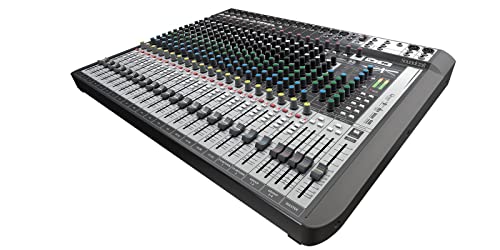
Soundcraft Signature 22 MTK — Best for Multitrack Recording
The Signature 22 MTK is the recording engineer’s live console: fourteen Ghost mic preamps, Soundcraft’s British-style EQ, Lexicon effects — and the feature that defines it, a multitrack USB interface that sends every channel to your DAW separately. The live show becomes a studio session automatically: mix the room on Saturday, remix the recording on Tuesday, release the live album in June. The non-MTK Signature 22 (stereo USB) exists for live-only users; the MTK is the one this guide recommends, because at this class the multitrack path is the difference between a console and a content factory.
Strengths
- Multitrack USB recording of every channel — unique value in this class.
- Ghost preamps and British EQ deliver genuine studio character live.
- Lexicon effects bring studio-grade reverb tails to the live mix.
Trade-offs
- No onboard SD recording — multitrack needs a computer present and healthy.
- No per-channel compression; dynamics are the engineer’s hand or outboard.
- The recording depth rewards a technically confident operator; pure beginners may underuse it.
| Spec | Detail |
|---|---|
| Channels | 22 |
| Mic preamps | Ghost |
| USB | Multitrack interface |
| Effects | Lexicon |
Venues that stream and archive, bands building a live catalogue, churches whose services become podcasts and videos — the MTK serves all of them with one workflow: perform once, produce forever. Its preamps and EQ flatter the acoustic and vocal sources that dominate recorded live content, and its surface remains a proper analogue console, so the live audience never waits for a menu. If your organisation’s future includes recorded output as a first-class product, this is the console in the guide designed around that future.
Best for: recording venues, content-producing churches and bands, engineer-led teams. / Not suited for: computer-free recording (see Tascam) or compression-dependent live workflows.
Check the current price on Amazon

Allen & Heath ZED-22FX — Best Build Quality
Allen & Heath builds the ZED series the way it builds its touring desks: individual vertical channel boards, metal chassis, and components chosen to be repaired rather than replaced. The ZED-22FX applies that philosophy to this class with DuoPre mic preamps across its mono channels, the company’s famously musical EQ, an onboard effects section, and USB for stereo recording and playback. It is the console you buy when the purchase is expected to outlast the committee that approved it.
Strengths
- Touring-grade construction with serviceable, modular channel design.
- DuoPre preamps with wide gain range handle quiet and loud sources gracefully.
- Superb EQ that engineers consistently rate the best-feeling in this class.
Trade-offs
- USB is stereo only, and the design is deliberately analogue-first.
- No onboard compression or recording — it is a mixer, purely and proudly.
- The premium for build quality is real; budget buyers should look at the Behringer honestly.
| Spec | Detail |
|---|---|
| Channels | 22 |
| Mic preamps | DuoPre |
| USB | Yes — stereo I/O |
| Effects | Onboard FX |
Installers, theatres and serious venues choose the ZED-22FX for the decade view: faders that stay smooth, knobs that stay tight, and a manufacturer whose professional desks create a service culture that trickles down. Its sound is the other argument — the EQ genuinely flatters voices and acoustic instruments, and the preamps stay composed at the extremes of gain where budget boards get grainy. It will not record your multitrack or compress your vocalist; it will mix beautifully every night for years, which for many buyers is the entire job description.
Best for: installs, theatres and venues buying for the long term. / Not suited for: multitrack recordists or the tightest budgets.
Check the current price on Amazon

Behringer Xenyx X2442USB — Best Budget
The X2442USB is the most console this class offers at its entry tier: a 24-input, 4/2-bus mixer with ten XENYX mic preamps, per-channel compressors on the mic channels, a 7-band graphic EQ on the main mix, channel inserts, four subgroups and a USB audio interface. Schools, community theatres and starter venues that need genuine routing depth — multiple monitor mixes, subgroups for sections, inserts for outboard — reach this feature set here or not at all.
Strengths
- Routing depth (subgroups, inserts, auxes) unmatched at its tier.
- Per-channel compressors on mic channels — rare and useful for speech-heavy shows.
- Graphic EQ on the mains helps tame difficult rooms without extra outboard.
Trade-offs
- Ten mic preamps despite the 24-input headline — the class’s widest badge-to-preamp gap.
- Build quality is serviceable rather than premium; it rewards careful handling.
- USB is stereo, and the effects are functional rather than beautiful.
| Spec | Detail |
|---|---|
| Channels | 24 inputs, 4/2-bus |
| Mic preamps | XENYX |
| USB | Yes — stereo interface |
| Extras | Subgroups, inserts, 7-band graphic EQ |
Judge the X2442USB by its constituency: the school drama department running twelve wireless mics (via receivers at line level, where its input count shines), the community venue that needs subgroups more than it needs preamp snobbery, the starter PA company assembling a rig that can do a real show tonight. Its compromises are the honest kind — you can see them on the spec sheet — and its capabilities are equally real. Buyers whose plots are microphone-heavy should step up to the Mackie or Yamaha; buyers whose plots are source-heavy and budget-bound have found their console.
Best for: schools, community theatres, budget rigs needing routing depth. / Not suited for: mic-heavy plots or buyers prioritising premium build.
Check the current price on Amazon

Tascam Model 24 — Best Hybrid Recorder
The Model 24 collapses three products into one console: an analogue mixer with sixteen mic preamps, a multitrack recorder that captures every channel to SD card with no computer involved, and a USB audio interface for studio work. Its retro-styled surface hides a thoroughly modern idea — the live console as the recording studio — with per-channel compression, a straightforward transport section, and punch-in recording that lets a band track overdubs at rehearsal. Note the honest framing: Tascam badges it a 24-track machine (22 inputs plus the stereo mix), which is why it belongs in a 20–22 channel conversation.
Strengths
- Multitrack SD recording with zero computer — the show archives itself.
- Sixteen mic preamps, the joint-highest real count in this guide’s class.
- Doubles as a studio desk: overdubbing and USB interface modes built in.
Trade-offs
- The recorder’s workflow is its own learning curve on top of mixing.
- Fewer live-helper features (no one-knob army of compressors across a live surface philosophy).
- Size and retro layout suit fixed positions better than cramped portable rigs.
| Spec | Detail |
|---|---|
| Channels | 22 inputs / 24-track recording |
| Mic preamps | 16 |
| Recording | Multitrack SD + USB interface |
| Effects | Onboard digital effects |
The Model 24’s buyer is the production that records everything: the venue building an archive, the band writing and gigging with the same desk, the church whose services become albums and streams. Removing the computer from the recording chain removes the most failure-prone link — no driver updates, no crashed DAW, no forgotten laptop — and the SD multitrack drops into any editor afterwards. As a pure live board it is very good; as a live-plus-studio system it is, in this class, unique. If your console budget must also cover your recorder budget, the arithmetic points here and nowhere else.
Best for: recording productions, band studios, archive-everything venues. / Not suited for: pure live users who will never record multitrack.
Check the current price on Amazon
Comparison Table
| Pick | Badge | Key spec | Best for |
|---|---|---|---|
| Yamaha MG20XU | Best Overall | D-PRE preamps, 1-knob compression, SPX FX | Venues, churches, schools |
| Mackie ProFX22v3 | Best for Bands | 14 Onyx preamps, GigFX | Full bands, worship teams |
| Soundcraft Signature 22 MTK | Best for Multitrack Recording | Ghost preamps, multitrack USB | Recording venues, creators |
| Allen & Heath ZED-22FX | Best Build Quality | DuoPre preamps, touring build | Installs, theatres |
| Behringer Xenyx X2442USB | Best Budget | 24 inputs, subgroups, inserts | Schools, community venues |
| Tascam Model 24 | Best Hybrid Recorder | 16 preamps, multitrack SD | Recording productions |
How to Choose a 20 to 22 Channel Mixer
Start from the stage plot, in writing. List every source with its type: microphone, DI, stereo playback, wireless receiver. The microphone total chooses your preamp floor — twelve (Yamaha), fourteen (Mackie, Soundcraft) or sixteen (Tascam) — and the source total chooses your channel floor. Plots written on paper end arguments that opinions cannot.
Count monitor mixes next. Each wedge or in-ear mix consumes an aux send. A five-piece band with individual mixes plus an effects send needs at least five auxes; verify your shortlist delivers them pre-fader for monitors, not just on paper.
Decide the recording truth. Stereo archive: any board here. Multitrack with a computer: Signature 22 MTK. Multitrack without a computer: Model 24. This single decision eliminates half the field correctly, and it is the one buyers most often postpone until after purchase.
Plan for the operators, not just the specs. A console this size is a workplace. If your team is one professional, depth wins and the Soundcraft or Tascam’s recording power will be used weekly. If your team is a rota of volunteers with mixed experience, teachability wins: the Yamaha’s one-knob compression and the Mackie’s legible surface produce better shows in untrained hands than deeper boards produce in frightened ones. Interview your own team before you interview spec sheets — ask who will run the Christmas production, the midweek rehearsal and the funeral, and buy the console that the least experienced of those operators can still run well. That question, answered honestly, has picked more correct consoles than any feature comparison ever published.
Budget in tiers, including the ecosystem.
A console at this size implies a case, a snake, and often a power conditioner and spare cables. The Behringer tier buys the board alone; the Yamaha and Mackie tier buys the board as a decade-long anchor; the Allen & Heath tier buys build as a feature. Reserve a real share of the budget for the ecosystem or the best console here will still fail you at load-in.
Subgroups, Auxes and Inserts: Routing That Earns Its Keep
Three routing features separate this class from the compact boards below it, and each maps to a live problem. Subgroups let you route sets of channels — all drums, all backing vocals, the whole choir — to a single fader inside the main mix, so one hand can rebalance the show’s architecture mid-song; every pick here offers them, and the Behringer and Mackie make them a centrepiece. Aux sends create independent mixes for stage monitors and effects; the count and the pre/post-fader flexibility of auxes decide how many musicians hear themselves properly, which decides how well they play. Channel inserts let you patch outboard compressors, gates or de-essers into individual channels — the professional’s toolkit — and their presence on the budget Behringer is genuinely unusual generosity. When comparing spec sheets in this class, read these three lines first; they predict your show-night experience more accurately than any effects list.
Monitor engineering is where these routing features stop being specifications and become musicianship. A singer who hears themselves clearly sings in tune and in time; a drummer whose kick is missing from the wedge plays the room instead of the song. The craft is subtraction: build each monitor mix from silence, add the musician’s own voice or instrument first, then only what they ask for, and resist the urge to give everyone everything — a crowded monitor mix is a loud stage, and a loud stage is a feedback negotiation. Engineers moving up to this class should also learn the talkback habit: a microphone at the console, routed only to the monitors, that lets you speak to the stage without shouting across the room or walking up mid-rehearsal. Most consoles here support it through a spare channel and aux routing, and once a band has rehearsed with talkback they will never willingly give it up. Routing, in other words, is not the plumbing behind the music. At twenty channels, routing is a large part of the music’s working conditions, and it is the strongest argument for buying this class deliberately rather than drifting into it.
How to Set Up a 20+ Channel Console for a Worship Team or Full Band
1. Build the input list from the stage outward. Drums first (kick, snare, hats, toms, overheads), then bass DI, guitars, keys in stereo, then vocals in stage order, then media/playback. Label every channel at the board and at the stage box; a labelled plot is a reusable plot.
2. Gain stage in sections. Set gains section by section at performance volume, drums through vocals, before any fader mixing. With twenty-plus channels, undisciplined gain staging is the difference between a clean mix and a noisy one — preamps summed carelessly add hiss arithmetically.
3. Assign subgroups deliberately. Drums to one group, band instruments to another, vocals to a third. Your right hand now mixes the show’s balance in three moves, and a guest engineer can read your intent at a glance.
4. Build monitor mixes from zero. Start every aux silent, add each musician’s own instrument and voice first, then the essentials they request. Ring out each mix with the house muted, at show volume, before doors.
5. Start the recording before the house opens. On the Model 24, arm the SD multitrack; on the MTK, confirm the DAW sees every channel; on stereo boards, check levels on the quietest and loudest planned moments. Archives are made by habits, not intentions.
6. Document the show. Photograph the surface, save the input list with the date and lineup, and note what you would change. Twenty-channel shows are productions; productions run on paperwork.
Common Buying Mistakes
Buying the badge number. A “24-input” board with ten preamps is a ten-microphone board. In this class the gap between marketing and microphones is at its widest — read the preamp count in this guide’s reviews, not the box.
Under-buying auxes. Consoles are returned over monitor mixes more than any other spec. Count your wedges and in-ears, add one for effects, and treat the result as a hard floor.
Forgetting the case and snake. A 22-channel console without a case is a repair bill in transit, and without a snake it is a cable spaghetti incident at every setup. Both belong in the first purchase order.
Assuming all USB is multitrack. In this guide, multitrack means the Signature 22 MTK and the Model 24. Everything else records the stereo mix. If a listing does not say multitrack explicitly, it is not.
Skipping the operator. The best console here is the one your actual team can run confidently. A volunteer crew will produce better shows on the friendly Mackie than on a deeper board they fear — buy for your operators, not your aspirations.
What These Consoles Do Not Do: Amplification, Speakers and the Rest of the System
Every console in this guide is an unpowered mixer: it shapes and routes signals at line level and produces no wattage of its own. New buyers stepping up from a powered box — the kind of all-in-one mixer-amplifier common in schools and small halls — are sometimes surprised that a far more expensive console cannot drive a speaker directly. The signal chain at this level is deliberate: console, then power amplifiers or powered speakers, then the room. That separation is a feature — each part can be upgraded, serviced and positioned independently — but it belongs in your budget from the start. A 20-channel console implies, at minimum, a main speaker system it can feed, monitor speakers for the stage, and the amplification to run both.
The monitor system deserves its own line in the plan, because at this scale it stops being an accessory. Four wedge mixes need four aux sends (all six consoles here can supply them in some configuration) and either four amplifier channels or powered wedges. In-ear systems change the arithmetic again — one aux per musician, wireless transmitters for the movers, wired packs for the drummer and keyboardist who stay put. None of this is the console’s fault or the console’s cost, but the console you choose sets the ceiling on all of it through its aux count, which is why this guide keeps returning to that unglamorous number. Buy the console whose aux and bus architecture matches the system you are actually building, and the rest of the system will assemble itself around it without a single forced compromise.
Snakes, Stage Boxes and Cable Discipline at 20+ Channels
Twenty channels of cable run individually from stage to console is not a setup; it is an incident report waiting for a date. The professional answer is a snake or stage box: a multicore cable that carries every stage source to the console in one loom, with a fan-out or box at the stage end where microphones and DIs plug in short, manageable runs. At this class of console, a snake is not an upgrade — it is part of the product, and it should be in the same purchase order. Size it with spare channels (a 24-channel snake for a 20-channel console leaves room for the guest vocalist and the broken channel you will meet someday), and label both ends identically, in the same order as your input list, in characters readable under stage lighting.
Cable discipline scales with channel count in ways small rigs never teach. Colour-code or number every microphone cable so a fault can be traced in seconds during a show. Keep power cables and signal cables in separate runs where they must cross, cross them at right angles. Coil spares at the stage box, not at the console, because failures happen at the musician’s end. And build the habit of the post-show walk: every cable inspected as it is coiled, every suspect one tagged and binned to the repair pile before the next load-in. The consoles in this guide will faithfully amplify a bad cable’s crackle to the whole room; the discipline above is what stands between a twenty-channel production and twenty channels of troubleshooting. Experienced teams know the console gets the credit and the cables do the work — budget and behave accordingly.
Keeping a Big Analogue Console Alive
A 20-plus-channel analogue console has over a hundred knobs and faders, and its long-term health is a maintenance habit, not a warranty clause. Dust is the primary enemy: faders ingest it from above, and the defence is a cover or case whenever the console is idle, plus a monthly exercise routine — every fader and knob swept through its full travel a few times — that keeps contact surfaces clean in exactly the positions where they would otherwise oxidise. In fixed installs, an annual re-seating of every connector in the chain wipes away the micro-corrosion behind most mystery crackles. In portable use, the case is non-negotiable and the load-in order matters: console travels flat or on its designed edge, never with weight stacked on the faders.
When a control does go noisy, treat it correctly: purpose-made fader cleaner-lubricant, sparingly, is the professional fix; flooding with general contact spray dissolves the lubricant that faders need and converts a scratchy channel into a dead one. Keep a channel map on file — which channels are healthy, which are suspect, which are retired to line-duty — because on a big console a managed flaw is a planning detail, while a discovered flaw is a show problem. The brands in this guide support their consoles with parts and service for years, the Allen & Heath and Yamaha especially, which is a final, practical argument for buying a name at this size: a console is a decade-long relationship, and the service network is part of what the badge buys.
When to Skip This Class and Go Digital Instead
Honesty about this guide’s own category: some 20-channel buyers should not buy any of these consoles. Digital mixers at this size — rack units mixed from a tablet, or compact digital desks — offer total recall of every setting, per-channel compression and gating everywhere, wireless control from anywhere in the room, and a footprint a fraction of these boards’. If one experienced engineer runs every show, if your venue hosts three different productions a week that each need their own saved setup, or if the mix position must be wherever the engineer is standing rather than at the end of a snake, digital is the correct answer and no analogue console in this guide will change that.
The analogue case, made honestly in return, is about people and failure modes. Analogue consoles can be taught to a new volunteer in an evening and cannot be in the wrong menu, the wrong layer or a crashed app at the moment the service starts. They fail one channel at a time, audibly and fixably, rather than all at once and silently. They also age gracefully: a fifteen-year-old analogue board is a slightly worn tool, while a fifteen-year-old digital platform is an orphan. The productions that thrive on this guide’s consoles — churches with rotating teams, schools, theatres with house engineers who mix by ear, bands who self-mix — share a trait: the human at the console changes more often than the show does. If that is your production, analogue is not the conservative choice; it is the correct one, and the six boards above are its best current expressions.
Size and installation deserve a final practical word. These are large objects: a 22-channel console in its case is a two-person lift and a vehicle decision, and in a fixed install it claims a permanent, ventilated position with cable access behind it. Measure the mix position, the doorways and the storage before ordering — consoles have been returned over centimetres — and if the board will live in a rack or a custom desk, confirm the exact width and depth against the manufacturer’s drawing rather than a marketplace listing. The unglamorous logistics are the difference between a console that anchors a venue for a decade and a very capable machine that never quite fits anywhere.
Final Recommendation
For most mid-size productions, the Yamaha MG20XU is the anchor buy: reliable, musical and teachable to anyone willing to learn, in a single rehearsal, without a manual in sight. It is the console we would install in a venue we personally had to answer for, and that is the strongest recommendation this guide knows how to give. Bands that need every preamp should take the Mackie ProFX22v3; recording-led venues, the Soundcraft Signature 22 MTK with a computer or the Tascam Model 24 without one; long-term installs, the Allen & Heath ZED-22FX; and budget-bound schools and community venues, the Behringer Xenyx X2442USB. Neighbouring sizes live in our guides to Best 16 Channel Mixers and Best 24 Channel Mixers Comparison, with Best 12 Channel Mixers covering the step down for smaller acts. Whichever console you choose, write the stage plot first, count preamps and auxes twice, and let the show — not the spec sheet, the salesperson or the forum thread — make the final decision, every single time, without exception or regret whatsoever.
Related guides
Frequently Asked Questions
How many microphones can a 22 channel mixer really take?
In this guide: twelve on the Yamaha MG20XU, fourteen on the Mackie ProFX22v3 and Soundcraft Signature 22 MTK, sixteen on the Tascam Model 24, and ten on the Behringer X2442USB despite its 24-input badge. The remaining inputs are line-level channels for keyboards, playback and wireless receivers. The mic preamp count is the only number your stage plot cares about.
Is a 20 channel mixer enough for a church worship team?
For most teams, yes. A typical plot — five drum mics, bass DI, two guitars, stereo keys, four to six vocals, a choir pair and playback — lands between fourteen and eighteen sources with ten to twelve microphones, which the Yamaha, Mackie, Soundcraft and Tascam all cover. Teams with large choirs or orchestras should count carefully and consider stepping to a 24-channel or digital console.
Which of these mixers records multitrack?
Two: the Soundcraft Signature 22 MTK, which sends every channel to a computer over USB, and the Tascam Model 24, which records multitrack to SD card internally and also works as a USB interface. The Yamaha, Mackie, Allen & Heath and Behringer record the stereo mix only — fine for archives and demos, not for remixing.
What is the difference between the Signature 22 and the Signature 22 MTK?
Recording depth. The standard Signature 22 offers a stereo USB interface; the MTK version’s USB interface is multitrack, capturing each channel separately. The preamps, EQ and Lexicon effects are shared. Live-only buyers can save with the standard model; anyone who records should buy the MTK — the price of discovering you needed multitrack is a second console.
Do I need subgroups on a 20 channel mixer?
If more than one person performs, effectively yes. Subgroups turn twenty faders into a manageable show: drums as one gesture, vocals as another. They also feed secondary zones (a lobby, an overflow room or a stream) cleanly. Every pick in this guide includes them; the discipline of assigning them well is covered in the setup section above.
Analogue or digital at this size?
Analogue — this guide’s field — wins on immediacy, teachability and independence from software. Digital consoles at this size add scene recall, per-channel everything and tablet mixing, at the cost of menus and a learning curve. Rotating volunteer teams and traditional venues thrive on analogue; a single professional engineer running varied productions may prefer digital. Both are legitimate; the wrong choice is the one your operators cannot run confidently at showtime. There is also a middle path many venues take deliberately: an analogue console from this guide as the house board, owned and understood by everyone, with digital brought in by visiting productions when their engineer demands it. The house board stays simple, the guests bring their complexity with them, and nobody’s Saturday depends on a firmware update.


