Disclosure: airfryerkitchensupply.com is reader-supported. When you buy through links on our site, we may earn an affiliate commission at no extra cost to you.
Where to buy
Every verified pick in this guide to the best small power mixers is sold through Amazon, which keeps ordering, delivery and returns in one place. Use the Check on Amazon link under any pick to check price on Amazon and confirm the exact configuration before you order. If a listing has drifted to a different model variant, back out and search the exact model name from our review instead of accepting a near-match substitute.
Yamaha EMX5 — Check on Amazon
Yamaha EMX7 — Check on Amazon
Behringer Europower PMP500 — Check on Amazon
Behringer Europower PMP550M — Check on Amazon
Peavey PVi 6500 — Check on Amazon
Rockville RPM870 — Check on Amazon
Introduction
The best small power mixers solve a specific problem elegantly: they combine the mixer and the power amplifier in one box, so a pair of passive speakers plugs straight in and a small venue, rehearsal room, school or worship space gets sound without a separate amp rack. If your speakers are already powered, stop here — a powered mixer is the wrong tool for you, and our small PA mixers guide covers the unpowered boards you actually need. If your speakers are passive, this category remains the simplest honest way to run them.
Judge a powered mixer first by its amplifier, not its channel count. Amplifier figures in this category are advertised aggressively, often as peak numbers into minimum impedances that no real speaker load matches. What matters for a small venue is clean, sustained output into the speakers you actually own, with headroom for peaks — a shouted announcement, a drum hit, a film soundtrack swell — without the gritty strain of an amp at its limit.
The six picks below are the small powered mixers we can stand behind: established models from Yamaha, Behringer and Peavey, plus value options from Rockville, each confirmed against Amazon’s catalogue. They span compact five-channel boxes for a classroom up to twelve-channel units that can run a small band, and the reviews are blunt about where each one’s amplifier and feature set genuinely end.
In this guide
Quick Picks
Yamaha EMX5 — Best Overall: the complete small-venue powered mixer, pairing a real amplifier section with Yamaha DSP effects and a feedback suppressor that earns its keep in live rooms. — Check on Amazon
Yamaha EMX7 — Best for Larger Small Venues: the EMX5’s bigger sibling, with a higher-output amplifier section for larger rooms and fuller bands through passive speakers. — Check on Amazon
Behringer Europower PMP500 — Best Value 12-Channel: a feature-rich value powered mixer with Klark Teknik effects, per-channel compression and FBQ feedback detection across twelve channels. — Check on Amazon
Behringer Europower PMP550M — Best Compact Powered: the compact powered option: five channels, effects and feedback detection in the smallest serious box in this guide. — Check on Amazon
Peavey PVi 6500 — Best All-in-One for Bands: Peavey’s all-in-one powered workhorse, built for bands and event spaces that want one rugged box to run the show. — Check on Amazon
Rockville RPM870 — Best Budget Power: the budget reach pick for churches and schools, with eight channels, Bluetooth, USB and effects at an entry tier. — Check on Amazon
How These Picks Were Chosen
We selected for the jobs powered mixers actually do: rehearsal rooms, school halls, small churches, café stages and mobile presenters who own passive speakers. For each candidate we weighed amplifier honesty — sustained output and sensible load ratings over headline peaks — then channel and effects provision for vocals, then the practicalities of a box that gets carried by its handle and set on a chair: weight, ventilation and control layout.
Every ASIN here was confirmed before linking, and listings that had drifted to bundles or different models were excluded. Following this site’s standing rules, no article in this programme prints a static price or a fixed rating: check price on Amazon on the pick’s own link, and judge value against the passive speakers you already own, which are the sunk cost this category exists to protect.
We deliberately excluded unpowered boards and DJ mixers masquerading as powered units. A powered mixer must drive speakers from its own speaker outputs; if a listing’s ‘power’ refers only to phantom power for microphones, it does not belong in this guide, and several popular listings were cut on exactly that ground.
The 6 Best Small Power Mixers

Yamaha EMX5 — Best Overall
The EMX5 is the powered mixer for a venue that hosts varied events — services, school performances, community concerts — through passive speakers. Its feedback suppressor, flexible EQ and one-knob compressors address the problems that actually occur in those rooms, and Yamaha’s build suits a box that lives a working life rather than a shelf life.
Strengths
- Feedback suppressor tackles the small-hall problem directly
- DSP effects and master EQ shape the whole system for the room
- One-knob compressors tame unpredictable speakers and singers
Trade-offs
- Premium tier within the small powered class
- More capability than a speech-only venue will ever open up
- Box format is substantial beside the smallest rivals
Powered mixers live in difficult rooms, and the EMX5 is designed by people who understand that. The feedback suppressor is not a gimmick: in a reflective hall with roaming handheld microphones, it buys the operator margin that would otherwise require a dedicated outboard unit and the skill to run it. Combined with sensible master EQ, it turns marginal acoustics into workable events.
The amplifier section is honestly matched to small passive speakers, delivering clean output for speech and music at venue volumes without the strained edge of underpowered rivals. Channels cover a small band or a full presentation roster, effects polish vocals, and the whole unit sets up in minutes — mixer, amp and effects in a single carry, which is the entire promise of this category fulfilled properly.
Ownership reinforces the choice: Yamaha’s powered mixers have a long service record in schools and churches precisely because they tolerate indifferent handling and infrequent maintenance. If your venue’s sound system is operated by whoever is available, that institutional toughness — and documentation a successor can follow — is worth more than a longer feature list on a more fragile box.
Best for: small venues with passive speakers and varied programmes / Not suited for: owners of powered speakers, who need an unpowered board
Check on Amazon — check price on Amazon before you decide, because bundles and included accessories change over time.

Yamaha EMX7 — Best for Larger Small Venues
Choose the EMX7 when the room or the band outgrows the EMX5: a bigger hall, a louder programme, or passive speakers that need more drive to reach the back row cleanly. It keeps the same operator-friendly philosophy — feedback suppression, musical effects, compressors — and spends its premium on amplifier headroom, which is the correct place to spend it.
Strengths
- Higher-output amplifier covers larger rooms without strain
- Same feedback-fighting toolkit as the EMX5
- Headroom keeps peaks clean for bands and film playback
Trade-offs
- The largest and heaviest direction in this guide
- Overkill for classrooms and small meeting spaces
- Premium pricing reflects power you must actually need
Headroom is the least glamorous and most audible specification in a powered mixer. An amplifier working at half its capacity sounds relaxed at volumes where a smaller amp is already hardening and compressing peaks, and audiences feel that difference as clarity rather than volume. The EMX7 exists for rooms where that difference is the whole event — the back row hearing the speech as clearly as the front.
Everything else follows the EMX5’s proven pattern, which is a compliment: the same thoughtful channel facilities, effects that serve vocals rather than showing off, and setup speed that suits a single operator. Buy the EMX7 by room size and speaker demand, not by aspiration; in a small room its extra power buys nothing, and the EMX5 is the smarter spend.
A practical note on pairing: the EMX7 rewards passive speakers of decent sensitivity. Efficient speakers convert its headroom into effortless coverage, while inefficient speakers waste it as heat. If you are buying speakers and mixer together, audition the pairing at real event volume in a real room before committing the venue’s money to either half.
Best for: larger halls and small bands with passive speakers / Not suited for: small rooms where the EMX5 already has ample headroom
Check on Amazon — check price on Amazon before you decide, because bundles and included accessories change over time.

Behringer Europower PMP500 — Best Value 12-Channel
The PMP500 suits bands, schools and venues that need twelve channels and real facilities on a value budget. Its FBQ feedback detection shows the operator which frequency is ringing — a teaching tool as much as a fix — and the Klark Teknik effects give vocals a professional finish that budget powered mixers usually fake badly.
Strengths
- Twelve channels cover small bands and full event rosters
- FBQ system identifies feedback frequencies visually
- Klark Teknik effects and compressors at a value tier
Trade-offs
- Amplifier output is modest for its channel count in big rooms
- Panel density demands a labelled, rehearsed setup
- Wireless option requires a separate proprietary microphone system
Behringer’s Europower formula mirrors its Xenyx one: breadth first. Twelve channels with compression, a respected effects engine and feedback detection at this tier is a genuinely useful combination for a working small venue, and the PMP500 has been a default recommendation for budget-conscious bands for years because it covers the whole job in one box.
The honest caveat is amplifier scale. Twelve channels invite a full band, but the amp section is sized for small rooms; push a loud band through it in a big hall and it will run out of clean output before the mixer runs out of inputs. Match it to intimate venues and efficient speakers, and it delivers far beyond its price class. Ask it to be a concert rig, and it will tell you so.
The FBQ detection deserves emphasis for volunteer-run venues: instead of guessing which slider tames a ring, the operator sees the offending frequency light up and cuts it. That single feature prevents the panic-driven broad EQ cuts that make speech unintelligible at exactly the moment — mid-event — when clarity matters most.
Best for: small bands and schools on a value budget, in small rooms / Not suited for: loud bands in large halls, where its amplifier runs out first
Check on Amazon — check price on Amazon before you decide, because bundles and included accessories change over time.

Behringer Europower PMP550M — Best Compact Powered
The PMP550M is the powered mixer for a single presenter, a solo performer or a classroom whose passive speakers need a proper front end. Five channels sound limiting until you map a real small job — presenter mic, spare mic, laptop, phone — and find one still free. Its compact format travels in one hand and sets up on a desk corner.
Strengths
- Smallest serious powered format here, genuinely portable
- Klark Teknik effects polish a solo voice properly
- FBQ feedback detection helps novice operators in live rooms
Trade-offs
- Five channels cap any group ambitions immediately
- Amplifier suits small rooms and efficient speakers only
- No room to grow if the programme expands
Compact powered mixers are often toys; the PMP550M is not. Its effects come from the same Klark Teknik stable as its larger siblings, its feedback detection is the real FBQ system, and its preamps handle a presenter’s dynamic range without embarrassment. For the defined job — one or two voices plus media through passive speakers — it is complete rather than compromised.
Buy it with clear eyes about growth. A programme that adds a second regular presenter, a musician or a panel discussion outgrows five channels in a single step, and there is no expansion path. If your format is fixed and small, that ceiling never matters, and you gain the easiest setup and transport in this guide.
Mobile presenters and fitness instructors are this box’s natural owners: one carry from car to room, speakers on stands, mic on, and the system is working. In that workflow, setup minutes are a real cost paid weekly, and the PMP550M’s compact honesty — everything reachable, nothing buried — repays its price in time alone.
Best for: solo presenters, classrooms and mobile instructors with passive speakers / Not suited for: any programme likely to grow beyond two microphones
Check on Amazon — check price on Amazon before you decide, because bundles and included accessories change over time.
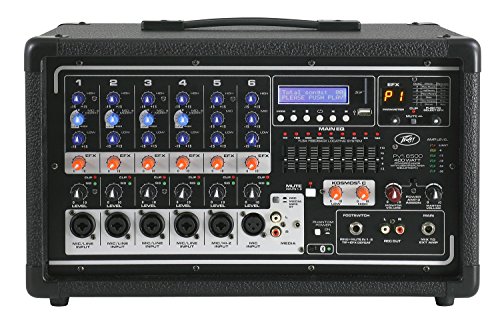
Peavey PVi 6500 — Best All-in-One for Bands
The PVi 6500 speaks to working bands, rehearsal spaces and event venues in Peavey’s traditional heartland: users who value durability and a straightforward, powerful all-in-one over studio-style refinement. It is a gigging tool, designed to be loaded in, run hard and loaded out without ceremony.
Strengths
- Rugged all-in-one design aimed at working bands
- Straightforward layout suits fast gig setup
- Peavey’s live-sound heritage and service network
Trade-offs
- Refinement and effects subtlety trail the Yamaha picks
- Heavier, utilitarian presentation than venue-install rivals
- Feature set targets bands more than speech venues
Peavey built its name on equipment that survives the working-musician economy, and the PVi 6500 carries that DNA: an all-in-one powered mixer whose priorities are output, durability and a layout a band can run from the stage. For a rehearsal room that doubles as a small gig space, or a covers band running its own sound in pubs and halls, that is exactly the right priority order.
Speech-first venues will find the Yamaha picks more polished, and the effects here serve a band’s vocals adequately rather than beautifully. Judge the PVi on its own terms — as the box that turns up, works, and drives passive speakers night after night — and it remains a defensible, characterful choice in a guide otherwise led by Japanese refinement and German value.
Rehearsal spaces are an underrated use case: a band that rehearses through its gig rig learns its behaviour intimately, and the PVi 6500’s stage-friendly layout supports that. If your band owns passive PA speakers and needs one box for practice room and performance alike, this is the pick shaped by that exact life.
Best for: working bands and rehearsal spaces with passive speakers / Not suited for: speech venues wanting the subtlest effects and EQ
Check on Amazon — check price on Amazon before you decide, because bundles and included accessories change over time.

Rockville RPM870 — Best Budget Power
The RPM870 targets the buyer the premium brands underserve: a small church, school or community group with passive speakers, several microphones and a hard budget ceiling. Bluetooth playback, USB facilities and sixteen effects cover the modern small-venue checklist, and eight channels fit a small worship team or school production.
Strengths
- Eight channels plus Bluetooth and USB at an entry tier
- Effects provision covers singers without extra gear
- Aimed squarely at churches and schools, and specced for them
Trade-offs
- Headline power figures are peak-oriented; judge it in small rooms
- Build and finish trail Yamaha and Peavey noticeably
- Long-term durability record is thinner than the heritage brands
Rockville’s proposition is access: facilities that used to require a mid-tier budget, offered at an entry one. For a congregation or school whose alternative is no system at all, that access is real value, and in a small room with efficient passive speakers the RPM870 runs services, assemblies and concerts creditably. Its effects and Bluetooth handle the two things modern small events demand most: polished vocals and phone-based playback.
The discipline is to keep expectations inside its tier. Treat the amplifier as a small-room unit regardless of headline numbers, handle the box with more care than a Peavey would demand, and it will serve. Ask it to anchor a large hall or a loud band and the gap to the Yamaha picks becomes audible — which is a statement about tiers, not a dismissal of a useful budget tool.
For a first powered system, the RPM870 also functions as an education: its owner learns gain staging, effects balance and feedback control on a complete-featured box, and every one of those skills transfers when the venue eventually upgrades. Few budget purchases teach their replacement’s requirements as thoroughly as a full-featured first mixer does.
Best for: churches and schools on hard budgets, in small rooms / Not suited for: large halls or buyers prioritising decade-long durability
Check on Amazon — check price on Amazon before you decide, because bundles and included accessories change over time.
Comparison Table
| Pick | Badge | Key spec | Best for |
|---|---|---|---|
| Yamaha EMX5 | Best Overall | 12 inputs, built-in amplifier, DSP effects, feedback suppressor | small venues with passive speakers and varied programmes |
| Yamaha EMX7 | Best for Larger Small Venues | 12 inputs, higher-output amplifier, DSP effects | larger halls and small bands with passive speakers |
| Behringer Europower PMP500 | Best Value 12-Channel | 12 channels, Klark Teknik FX, compressors, FBQ feedback detection | small bands and schools on a value budget, in small rooms |
| Behringer Europower PMP550M | Best Compact Powered | 5 channels, compact powered format, Klark Teknik FX, FBQ | solo presenters, classrooms and mobile instructors with passive speakers |
| Peavey PVi 6500 | Best All-in-One for Bands | All-in-one powered mixer, band-oriented channel count | working bands and rehearsal spaces with passive speakers |
| Rockville RPM870 | Best Budget Power | 8 channels, USB, Bluetooth, 16 digital effects | churches and schools on hard budgets, in small rooms |
How to Choose the Best Small Power Mixers
Begin with your speakers, because they define everything. Note their impedance and sensitivity, and how many you run: a powered mixer’s amplifier must be comfortable driving that load at your room’s volume. Efficient speakers in a small room need surprisingly little clean power; inefficient speakers in a hall expose an undersized amp immediately. If you cannot state your speakers’ impedance, find it on the rear label before shopping — guessing here is how amplifiers get damaged.
Then count microphones honestly, as in any mixer purchase, and decide whether effects and feedback tools matter to your programme. Singing programmes need effects; speech programmes need feedback control and EQ; bands need both plus monitor capability. The picks above map cleanly onto those three profiles, and choosing by profile rather than by headline wattage is the whole method.
Finally, weigh the box itself. A powered mixer concentrates mixer, amplifier and effects into one carry, which is its glory for mobile and single-operator use — and its risk, because one failure silences everything. Heritage brands earn their premium partly in reliability and service; budget picks earn theirs in access. Decide which risk your venue tolerates before deciding which box it buys.
Understanding Powered Mixer Wattage Without Being Fooled
Wattage advertising in this category mixes RMS and peak figures, single-channel and combined totals, and loads of four and eight ohms into numbers that cannot be compared across brands. A peak figure can be several times the sustained RMS output, and output into four ohms is not available to an eight-ohm speaker pair in the way brochures imply. Compare like with like: sustained figures, into your speakers’ impedance, with both channels driven.
In practice, small-room listeners need far less sustained power than they fear, because perceived loudness grows slowly with wattage while clarity collapses quickly when an amp runs out. A modest honest amplifier working comfortably beats a heroic headline figure working at its edge, every event, which is why this guide’s Yamaha picks lead despite conservative-looking numbers beside some rivals.
How to Set Up a Powered Mixer Safely
Connect speakers before power, with proper speaker cables — never instrument cables, which are not built for amplifier output and can overheat or fail. Match total load to the amplifier’s stated minimum impedance: wiring extra speakers in parallel drops impedance fast, and an amp driving too low a load will protect itself or damage itself mid-event. When in doubt, run fewer speakers.
Power up in order — mixer section sources first, amplifier last where the design allows — and set gains as you would any PA: sources at real volume, channel gains clean and strong, master to the room. Check ventilation before the event, not during it: powered mixers shed real heat, and a box buried under coats in a cupboard corner will shut down to protect itself at the worst possible moment.
At the first event, run the system for the programme’s full duration at full volume during setup if you can. Thermal and load problems announce themselves in rehearsal or not at all until the audience is seated; a powered mixer’s single-box nature makes that rehearsal check worth more than any specification.
Powered Mixer or Separate Amp: The Honest Trade-Off
A powered mixer wins on setup speed, transport and simplicity: one box, one power cable, speaker cables out. For mobile presenters, schools and small venues with one operator, that simplicity is a feature money cannot add later to a component system. It also fixes the pairing — the amplifier and mixer were designed together, removing a whole class of matching errors.
Separates win on flexibility and failure isolation: a failed amp or mixer can be swapped alone, power can grow with the room, and a monitor amplifier can be added. If your venue’s programme is growing or your speakers are demanding, price both routes honestly. Many venues start powered, exactly as this guide assumes, and graduate to separates only when a specific limitation — usually monitor mixes or room size — forces the move.
Keeping a Powered Mixer Alive
Heat and dust are the enemies. Keep vents clear, blow dust out gently on a schedule, and never store the unit in a damp space where condensation reaches the amplifier section. Transport it in a padded case or at least upright and restrained; the heaviest components in the system live in this box, and a dropped powered mixer damages itself with its own weight.
Test under load periodically — a powered mixer that idles perfectly can still shut down at event volume if its fan or thermal path has degraded. A termly full-volume rehearsal check, logged like any other venue maintenance, prevents the mid-service silence that single-box systems are uniquely vulnerable to.
Matching Passive Speakers to a Powered Mixer
The pairing begins with two numbers on the speaker’s rear label: impedance in ohms and sensitivity. Impedance tells the amplifier what load it faces — and two speakers wired in parallel halve it — while sensitivity tells you how loud a given amount of power becomes. An efficient speaker makes a modest powered mixer sound generous; an inefficient one makes a strong mixer sound tired, in the same room, at the same settings.
Programme material completes the picture. Speech and acoustic music ask little of an amplifier’s reserves; a DJ set or a full band asks for sustained low-frequency energy that consumes headroom invisibly. Size the pairing for your loudest regular programme, not your average one, and the system will sound relaxed on the nights that define its reputation.
Running Monitors From a Small Powered Mixer
Bands buying powered mixers often discover the monitor question late: the performers need to hear themselves, and the main amplifier is already busy with the room. Some powered mixers assign a second amplifier channel or a monitor output to a wedge; others expect monitors to be small powered speakers fed from an aux send. Either route works, but it must be planned before purchase, because retrofitting stage monitoring onto a box with no monitor path means replacing the box.
Keep monitor expectations honest at this scale. One shared wedge mix for the singers is the realistic standard; individual mixes for every player belong to larger systems. A band that rehearses with the monitor arrangement it gigs with stops being surprised by it, which is most of what stagecraft means.
Portable PA Versus Installed Venue Systems
A powered mixer serves two different lives: the portable system that travels to events, and the installed system that lives in one venue. Portable buyers should weight handles, case options and setup speed — the Yamaha and compact Behringer picks travel best — while installed buyers should weight ventilation, security of settings and the discipline of a fixed wiring loom that nobody re-patches weekly.
Installed systems gain one more virtue from this category: a single power switch brings the whole sound system to life, which is how a venue’s system actually gets used by staff. Complexity that requires a technician’s presence is, in a community venue, a system that stays off — and an unused excellent system loses to a used adequate one every week of the year.
Thermal Reality: Heat, Dust and Duty Cycles
Amplifiers convert a meaningful share of their intake into heat, and powered mixers concentrate that heat in the same box as the mixing electronics. A unit that runs a quiet speech event barely warms; the same unit driving a band for four hours in a summer marquee works thermally hard. Respect the duty: vents unobstructed, no direct sun where avoidable, and a cool-down before the case lid closes and traps the heat inside.
Dust compounds heat by insulating exactly the surfaces that shed it. A termly cleaning ritual — power off, soft brush, gentle air — is the cheapest reliability programme in this entire guide, and the venues that adopt it stop experiencing the mid-event thermal shutdowns that give single-box systems an undeserved reputation.
When to Graduate to a Separate Amplifier
The graduation triggers are specific: the room grows beyond the amplifier’s clean reach, the band needs independent monitor amplification, or the venue wants speakers in two zones at different levels. Each is a capability boundary, not a quality complaint, and each is solved by separates without discarding the skills the powered mixer taught its operator.
Until a trigger fires, resist the graduation. A powered mixer that covers the programme is simpler, cheaper and more reliable than the separates that replace it, and the money not spent remains available for the microphones and speakers audiences actually hear.
A Worked Example: Sizing a School Hall System
Consider the guide’s most typical buyer concretely: a school hall, two passive speakers of ordinary sensitivity, a programme of assemblies, a choir, two school productions a year and a disco at term’s end. Speech dominates the calendar, music dominates the difficulty. A mid-output powered mixer — the EMX5 class — covers speech effortlessly and the choir comfortably, and meets its honest test at the disco, where programme energy is sustained and low. The correct response to that test is not a bigger mixer bought for one night a term; it is hiring reinforcement for the disco and owning the right system for the other two hundred days.
The same arithmetic, run honestly, protects every buyer in this category. List the programme by frequency, size for the demanding end of the regular programme, and treat the exceptional event as a rental problem. Powered mixers bought for exceptions spend their lives oversized, overweight and over budget for the ordinary work that defines their value.
Safety Around Amplifier Outputs
Speaker outputs are the one place in small audio where real energy leaves the box, and they deserve a paragraph of respect. Never connect or disconnect speaker cables while the amplifier is powered and passing signal; never let bare speaker wire strands bridge the terminals; and never use a damaged speaker cable because it ‘still works’ — intermittent shorts at amplifier outputs are how output stages die. These are thirty-second disciplines, printed here because powered mixers concentrate them in a single unit that a non-technical operator may be handling.
Equally, respect the mains side: one sound power distribution point, no daisy-chained domestic strips buried under staging, and cables routed where feet and chair legs cannot work on them for four hours. Small-venue electrical accidents are rare precisely where these habits are boring and routine, and a powered mixer’s single-box simplicity makes the habits easier to keep than in any component system.
The Resale and Hand-Down Life of Powered Mixers
Powered mixers enjoy a second life that pure mixers rarely match: the venue that upgrades hands its box to the youth group, the rehearsal room or the village hall, where it serves another decade. Heritage-brand units — Yamaha and Peavey in this guide — dominate that hand-down economy because parts, manuals and institutional memory persist around them. A buyer choosing between a premium pick and a value pick for a community institution is partly choosing how many owners the box will serve.
That longevity reframes the price comparison honestly. A powered mixer is infrastructure, closer to the hall’s chairs than to its consumables, and infrastructure bought well is bought once. The value picks here remain the right answer for private and short-horizon buyers; institutions with decades in view should weight the ownership sections of each review accordingly.
Two Rooms, One Box: Zoning With a Powered Mixer
Small venues increasingly ask one system to serve two spaces — the hall and the foyer, the sanctuary and the overflow room — at different moments or different levels. A powered mixer can serve sequential zoning easily, since the system simply moves or re-patches between events, but simultaneous two-room coverage at independent levels is a separates problem, and recognising that boundary before purchase prevents the one genuinely disappointing outcome in this category: a good box asked to be in two places at once.
The practical compromise many venues adopt is to let the powered mixer own the main room permanently and serve the second space with a small powered speaker fed from a line output when overflow demands it. That hybrid keeps the single-box simplicity where it matters daily and buys flexibility only where the calendar occasionally requires it — a pattern this guide recommends over replacing a working system for a twice-a-year configuration.
A Pre-Event Checklist for Powered Systems
Powered systems reward a five-line checklist used every event: speaker cables fully seated and strain-relieved; vents visibly clear; load confirmed — the same speakers as last time, no additions; gains at their marked starting points; and a full-volume test with programme material before doors. The list takes four minutes and intercepts every common powered-mixer failure this guide has described, each of which is a setup failure rather than an equipment failure.
Print the checklist and keep it in the mixer case, because the person setting up is not always the person who wrote it. Institutions run on artefacts, not memories, and a powered mixer surrounded by good artefacts — checklist, marked settings, labelled cables — behaves like a far more expensive system than it is.
Ownership Costs Nobody Mentions at Purchase
A powered mixer’s lifetime cost includes items no product page lists: a padded case if it travels, replacement speaker cables as the originals age, the occasional fuse or service visit, and — for institutions — the staff time of the termly test this guide recommends. None of these is large, and together they favour the same conclusion as the reliability sections: a well-supported unit from a maker with persistent parts and documentation costs less across a decade than a cheaper unit replaced once. Buyers comparing two picks separated by a modest price gap should run that decade arithmetic, not the afternoon’s.
The countervailing truth is that value picks exist precisely for horizons where the decade arithmetic does not apply — the two-year community project, the starter band, the classroom refresh with a fixed grant. This guide’s structure, premium anchors and honest value options, is designed so that each horizon finds its correct answer without pretending the other horizon’s answer is wrong.
Common Buying Mistakes
Using instrument cables for speakers. Speaker outputs need real speaker cable. Instrument cable on an amplifier output is a fire-and-failure risk, not a saving.
Chasing headline wattage. Peak and four-ohm figures flatter weak amplifiers. Judge sustained output into your speakers’ actual impedance.
Overloading the amplifier with extra speakers. Parallel speakers drop impedance quickly. Exceeding the amp’s minimum load causes shutdowns or damage.
Buying powered for powered speakers. If your speakers already contain amplifiers, a powered mixer is unusable overkill — buy an unpowered board instead.
Blocking the vents. A powered mixer is an amplifier and sheds heat. Buried under gear, it will protect itself by going silent mid-event.
Final Recommendation
For most small venues with passive speakers, the Yamaha EMX5 is the best small power mixer to buy: honest amplification, feedback suppression and effects that serve real rooms, in a box built for institutional life. Larger rooms and fuller bands step up to the EMX7’s headroom. Value buyers should look hard at the Behringer PMP500 for channels and facilities, or the compact PMP550M for solo and classroom work.
Peavey’s PVi 6500 remains the band-and-rehearsal choice, and Rockville’s RPM870 opens the category to the hardest budgets for small churches and schools. Whichever you choose, match it to your speakers’ impedance, cable it with proper speaker cable, and rehearse it at full volume before its first audience.
Check on Amazon — check price on Amazon before you decide, because bundles and included accessories change over time.
Check on Amazon — check price on Amazon before you decide, because bundles and included accessories change over time.
Check on Amazon — check price on Amazon before you decide, because bundles and included accessories change over time.
Check on Amazon — check price on Amazon before you decide, because bundles and included accessories change over time.
Check on Amazon — check price on Amazon before you decide, because bundles and included accessories change over time.
Check on Amazon — check price on Amazon before you decide, because bundles and included accessories change over time.
Best Small Pa Mixers Best Small Stage Mixers Best Small Usb Mixers Best Analog Powered Mixers Best Analog Powered Mixers For Small Church Best Small Studio Mixers
Frequently Asked Questions
What does a powered mixer do that a normal mixer cannot?
It amplifies. A powered mixer contains a power amplifier, so passive speakers connect directly to its speaker outputs. A normal mixer outputs line-level signal and needs powered speakers or a separate amplifier. The two categories look similar and are completely incompatible if mismatched with the wrong speakers.
How much power do I need for a small venue?
Less than advertising suggests, if your speakers are efficient and the room is small. Judge sustained output into your speakers’ impedance rather than peak headline figures, and favour headroom: an amplifier working comfortably sounds cleaner than a bigger-claimed unit at its limit. For halls and loud bands, step up within a range — here, from the EMX5 to the EMX7.
Can I add more speakers to a powered mixer later?
Only within the amplifier’s minimum impedance. Speakers wired in parallel reduce the load impedance, and dropping below the rated minimum causes shutdowns or damage. Check the manual’s wiring examples before adding any speaker, and use proper speaker cable for every run.
Can a powered mixer feed a monitor speaker?
Most small powered mixers provide a monitor send or a second amplifier assignment for a stage monitor, but provision varies. If performers need to hear themselves, confirm the specific model’s monitor path before buying — it is the facility bands outgrow first.
Is a powered mixer good for recording?
It is a live tool first. Some models add USB playback or simple recording, but multitrack recording belongs to interface-style mixers. If recording matters equally with live sound, look at the hybrid boards in our small USB mixers guide instead.
Why does my powered mixer shut down during events?
Usually heat or load: blocked vents, a speaker load below the rated impedance, or sustained volume beyond the amplifier’s comfort. Clear ventilation, verify speaker wiring and impedance, and reduce level. If shutdowns persist at modest volume, the unit needs service before its next event.


