Disclosure: airfryerkitchensupply.com is reader-supported. When you buy through links on our site, we may earn an affiliate commission at no extra cost to you.
Where to buy
Every powered mixer below is a current Amazon listing from its manufacturer or an authorized dealer: the Yamaha EMX7 as our overall pick, the Yamaha EMX5 for compact rigs, the Behringer Europower PMP500 for bands, the Behringer Europower PMP500MP3 for playback-focused setups, the Peavey PVi 6500 as an all-in-one box mixer, and the Rockville RPM870 for maximum power on a budget. Check the current price on Amazon, and confirm the amplifier’s power rating into your speakers’ impedance on the exact listing — powered mixers are the one category where the fine print changes what you can actually drive.
Introduction
The best analog powered mixers fold the two heaviest boxes in a PA system — the mixer and the power amplifier — into one. For schools, churches, rehearsal rooms, small venues, mobile DJs, and bands that run their own sound, that consolidation is transformative: one unit to carry, one power cable, speaker cables out, and the system is running. The trade is equally clear: a powered mixer is a commitment to passive speakers and to the amplifier inside the box, so its power rating, its speaker outputs, and its real-world headroom deserve more scrutiny than any other specification in this guide.
This guide covers six analog powered mixers across the realistic range — compact boxes for presentations and acoustic acts, mid-size units for bands and sanctuaries, and a high-output budget option — each verified against its current Amazon listing. We weighted honest amplifier capability first, because headline wattage figures in this category are marketing’s favorite playground: what matters is continuous power into the impedance of your speakers, with headroom for peaks, not a peak number measured under laboratory conditions. Mixer quality came second — preamps, EQ for feedback control, effects, monitor capability — because a powered mixer is still the board you mix on all night.
A scope note: powered mixers pair with passive speakers. If you already own powered speakers, you want an unpowered mixer instead, and our companion guides cover those. If you own passive speakers — or are buying a complete simple system from scratch — read on: this is your category, and the six picks below are its strongest current representatives.
It is also worth naming who should skip this category. If your speakers are powered, if your venue is large enough to need distributed or delayed speakers, or if your system must grow channel by channel over several years, separates will serve you better and our unpowered mixer guides are the right reading. The powered mixer’s kingdom is the small-to-medium room with a stable cast of users — and in that kingdom, which contains most of the sound systems on Earth, it rules because it removes every decision except the ones that make music.
In this guide
Quick Picks
- Best Overall: Yamaha EMX7 — twelve inputs, a capable stereo amplifier, feedback suppression, and Yamaha reliability for bands and venues.
- Best Compact: Yamaha EMX5 — the EMX formula in a smaller box: twelve-input format scaled for acoustic acts, schools, and small rooms.
- Best for Bands: Behringer Europower PMP500 — twelve channels, dual graphic EQ, compressors, and FBQ feedback detection at a working band’s tier.
- Best for Playback: Behringer Europower PMP500MP3 — a built-in MP3 player and wireless-ready option for venues that live on recorded music.
- Best All-in-One Box: Peavey PVi 6500 — a self-contained powered mixer with effects, Bluetooth, and Peavey’s gig-ready simplicity.
- Best Power per Dollar: Rockville RPM870 — eight channels with a high-output amplifier, Bluetooth, and USB recording for budget systems.
How These Picks Were Chosen
We selected analog powered mixers that working users actually deploy — in schools, sanctuaries, rehearsal spaces, and small venues — and verified each against its live Amazon listing. Digital powered consoles were excluded; this guide’s promise is an analog surface with a built-in amplifier. Scoring began with the amplifier: continuous output capability, the impedances it can drive, fan cooling and protection, and speaker connector quality. Mixer essentials followed — preamp count and quality, EQ including graphic EQ on the mains (the feedback-fighting tool of powered-mixer life), monitor sends, effects, and playback options. Finally we judged the package as a system: weight, handles and form factor, and how honestly the manufacturer presents the power figures. Value is discussed by tier, never as a printed price.
One category-specific note on evidence: amplifier claims are the least standardized numbers in audio, so where this guide compares output capability it does so in relative, practical terms — which units suit which rooms with which speakers — rather than by repeating headline wattage as if it were comparable across brands. That restraint is deliberate, and it is the same restraint we recommend to buyers: the manual’s continuous rating, your speakers’ sensitivity, and your room’s size form a triangle of facts that predicts your experience; a peak wattage figure predicts nothing except the size of the type it is printed in.
The 6 Best Analog Powered Mixers

Yamaha EMX7 — Best Overall
The EMX7 is what a powered mixer looks like when a serious audio company designs it as a system rather than a bundle. Twelve inputs with Yamaha’s D-PRE-grade front end feed a stereo power amplifier with the headroom to run a pair of efficient passive mains — and a monitor send — at honest small-venue levels. The SPX effects cover vocal and instrument ambience, a one-knob feedback suppressor addresses the powered-mixer user’s most common emergency, and the graphic EQ on the outputs lets you tune the system to the room in seconds.
Strengths
- Balanced system design: mixer, amplifier, effects, and feedback tools that work together.
- Yamaha build and support — the safe long-term purchase in this category.
- Flexible output configuration for mains-plus-monitor setups.
Trade-offs
- Premium tier for the category.
- Amplifier output suits small-to-medium rooms, not large halls with hungry speakers.
- Box format is less elegant on a tabletop than a console-style mixer.
In service, the EMX7’s virtue is predictability: it sounds like a Yamaha mixer because it is one, and its amplifier behaves conservatively, protecting itself and your speakers rather than chasing headline numbers. Bands that play restaurants and small clubs, churches with a volunteer team, and schools that need one system for everything from assemblies to dances all fit its brief. If you buy one powered mixer to serve a decade of mixed duty, this is the one the evidence supports.
Best for: bands, churches, schools, and small venues wanting one dependable system / Not suited for: large rooms or low-efficiency speakers needing serious wattage. Check the current price on Amazon.

Yamaha EMX5 — Best Compact
The EMX5 scales the same philosophy down: twelve-input format in a lighter, more compact powered box, with the same approach to effects, feedback management, and honest amplification. It is aimed at the enormous class of users whose “venue” is a classroom, a café corner, a small sanctuary, or a rehearsal room — places where the system is carried by one person, set up in ten minutes, and expected to make speech and acoustic music clear rather than loud.
Strengths
- One-person portability with a complete mixer-amplifier feature set.
- Feedback suppression and graphic EQ tame difficult small rooms.
- Yamaha clarity for speech and acoustic sources.
Trade-offs
- Amplifier headroom is for small rooms; full bands in big spaces will outrun it.
- Fewer routing options than the EMX7.
- Premium relative to budget boxes of similar channel count.
The EMX5 earns its recommendation in the details of small-room life: a teacher’s voice that stays intelligible at the back of a hall, an acoustic duo that sets up without a soundcheck marathon, a fitness or dance instructor whose music and microphone both need to work every morning. Its amplifier is honestly matched to efficient speakers in modest spaces, which is where powered mixers are happiest. Choose it when the rooms are small and the operator is you.
Best for: schools, small churches, acoustic acts, instructors, and presenters / Not suited for: loud full bands or large spaces. Check the current price on Amazon.

Behringer Europower PMP500 — Best for Bands
The PMP500 is the working band’s powered mixer in this guide: twelve channels with XENYX preamps and per-channel compressors, a Klark Teknik effects engine, dual seven-band graphic EQs for mains and monitors, and Behringer’s FBQ feedback detection, which lights up the offending frequency so a non-engineer can cut it. The amplifier section is sized for the rehearsal-room-to-small-club circuit, and the whole package lands at a tier that lets a band own its sound instead of renting it.
Strengths
- FBQ feedback detection makes monitor ring-out accessible to non-engineers.
- Dual graphic EQs serve both mains and monitors — rare and valuable here.
- Channel compressors keep a self-mixed band’s levels civilized.
Trade-offs
- Headline wattage is a peak figure; judge it by the continuous rating and your speakers.
- Build quality is a step below the Yamaha units.
- Box format and fan noise suit stages better than quiet rooms.
Self-mixed bands are this mixer’s home crowd, because its features answer their actual problems: the singer runs the board from the stage, the feedback system finds the ring before the audience hears it, and the monitor EQ is independent from the mains. Set up with efficient passive speakers, it covers the small-venue circuit that most working bands actually play. It is the pragmatic center of the category — maximum working capability at a band-friendly tier.
Best for: self-mixed bands, rehearsal rooms, small clubs and bars / Not suited for: quiet speech-focused rooms or very large venues. Check the current price on Amazon.

Behringer Europower PMP500MP3 — Best for Playback
The PMP500MP3 variant builds the same powered-mixer idea around recorded music: an onboard MP3 player reads USB media directly, a wireless microphone option simplifies presentations, and the eight-channel mixer with reverb covers the live sources — a host’s microphone, a singer, an instrument — that share the bill with playback. Restaurants, event spaces, karaoke and community venues, and mobile entertainers are its natural habitat.
Strengths
- Built-in MP3 playback removes the laptop from simple events.
- Wireless-ready design suits presenters and mobile hosts.
- Compact eight-channel format covers speech-plus-music duty.
Trade-offs
- Eight channels and modest power limit full-band use.
- Effects are a simple reverb set rather than a full engine.
- Peak-rated amplifier figures require the usual careful reading.
Events run on reliability and simplicity, and this box is engineered for both: plug in speakers, insert the USB stick with the evening’s music, hand the host a microphone. The mixer section is honest rather than elaborate, which matches work where the music is recorded and the live element is a voice or two. For venues whose calendar is parties, presentations, and community nights rather than concerts, it is the most fit-for-purpose pick in this guide.
Best for: event venues, mobile entertainers, restaurants, karaoke and community spaces / Not suited for: full live bands. Check the current price on Amazon.
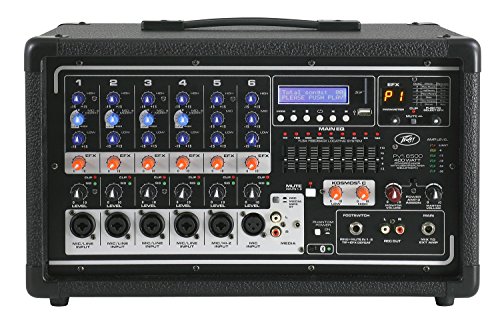
Peavey PVi 6500 — Best All-in-One Box
Peavey’s PVi 6500 is the classic American powered box mixer, refined: ten channels, a stereo amplifier, built-in digital effects, Bluetooth connectivity for playback, and a layout a first-time operator can run after one explanation. Peavey’s decades in working musicians’ hands show in the priorities — feedback control, a mid-morph EQ that makes quick tonal fixes intuitive, and construction meant to live in a van and a rehearsal space rather than a showroom.
Strengths
- Genuinely simple operation for volunteers and first-time users.
- Bluetooth playback plus effects covers modern event needs.
- Peavey durability and service network.
Trade-offs
- Amplifier output is for small-to-medium rooms.
- Fewer channels and sends than the twelve-channel picks.
- Box aesthetics are purely functional.
The PVi 6500’s constituency is the user who says “we just need sound” — a church fellowship hall, a school gym, a duo or trio playing patios, a community theater. For them, its combination of enough power, enough channels, modern playback, and near-zero learning curve is exactly the product. It also makes an excellent first powered mixer because its limitations are all about scale, and scale is the easiest requirement to predict. There is a further, underrated virtue in its simplicity: a system that any authorized adult in the building can operate is a system that never sits silent because the one trained volunteer is away. Institutions consistently underestimate that property when they buy, and consistently value it most once they own it.
Best for: small venues, churches, schools, and small acts wanting maximum simplicity / Not suited for: larger bands or demanding rooms. Check the current price on Amazon.

Rockville RPM870 — Best Power per Dollar
The RPM870 competes on output: an eight-channel powered mixer whose amplifier is rated for serious levels into typical passive speakers, with Bluetooth, USB recording and playback, sixteen digital effects, dual seven-band graphic EQs, and 48V phantom power across its mic inputs. For buyers building a budget system around passive speakers they already own — a common situation in schools, churches, and rehearsal complexes — it delivers the most system capability per dollar in this guide.
Strengths
- High-output amplifier section for the tier, with fan cooling.
- Dual graphic EQs, effects, Bluetooth, and USB in one box.
- Eight full mic channels with phantom power.
Trade-offs
- Power figures are peak-oriented; match carefully to your speakers’ real needs.
- Brand support and longevity trail Yamaha and Peavey.
- Eight channels is the ceiling — plan the input list.
The RPM870 makes sense as a system decision: if the speakers are already hanging in the hall and the budget must cover the mixer-amplifier alone, its output and feature set stretch that budget furthest. Set it up with realistic expectations — efficient speakers, sensible levels, the graphic EQs doing the room work — and it runs events and rehearsals without complaint. Buyers who need a decade of institutional service should weigh the Yamaha and Peavey support networks; buyers who need capability now, at this tier, have their answer.
Best for: budget systems with existing passive speakers, schools and rehearsal spaces / Not suited for: buyers prioritizing long-term brand support. Check the current price on Amazon.
Comparison Table
| Pick | Badge | Key spec | Best for |
|---|---|---|---|
| Yamaha EMX7 | Best Overall | 12 inputs, stereo amp, feedback suppressor | Bands, churches, venues |
| Yamaha EMX5 | Best Compact | Compact powered box, graphic EQ | Small rooms and solo operators |
| Behringer Europower PMP500 | Best for Bands | 12 channels, FBQ feedback detection, dual GEQ | Self-mixed bands |
| Behringer Europower PMP500MP3 | Best for Playback | Built-in MP3 player, wireless-ready | Events and venues |
| Peavey PVi 6500 | Best All-in-One Box | 10 channels, Bluetooth, effects | Maximum simplicity |
| Rockville RPM870 | Best Power per Dollar | High-output amp, dual GEQ, USB | Budget systems |
How to Choose an Analog Powered Mixer
Start with your speakers, because they decide the amplifier you need. Note their impedance (most passive PA speakers are 8 ohms; running two per side in parallel makes 4) and their sensitivity, which determines how loud a given wattage becomes. Efficient speakers in a small room need surprisingly little continuous power; inefficient speakers in a big room need more than any box in this category honestly provides, which is the moment to consider a separate amplifier system instead. Read powered-mixer power ratings the way engineers do: look for the continuous (RMS) figure at your speakers’ impedance, and treat peak figures as marketing context, not capability.
Second, decide the output configuration. Most powered mixers can run two mains, or one main and one monitor, or mains plus monitors in a mono/stereo arrangement — but not every combination at full power. If your act needs a monitor mix (most do), confirm the unit supports mains-plus-monitor operation and has a monitor send with its own EQ or level control; the dual graphic EQs on the Behringer and Rockville picks exist precisely for this. Third, count channels with the same discipline as any mixer purchase: every microphone and instrument, plus playback, plus a spare.
Finally, judge the package as the portable system it is. Weight, handle placement, whether the mixer can sit on a table or wants a stand, fan noise for quiet rooms, and the speaker connectors (Speakon-style locking connectors are the professional standard; spring clips and jacks are the budget one) all shape daily life with the unit. A powered mixer is bought to make sound simpler — choose the one whose compromises all fall on the side of your actual rooms, speakers, and operators.
How to Set Up a Powered Mixer System Safely and Well
Place the powered mixer where the operator works, with ventilation unobstructed — the amplifier’s fan and heatsinks are part of the instrument, and a box mixer shoved into a foam-lined case while running will protect itself by shutting down mid-show. Connect speakers with proper speaker cables, never instrument cables: speaker cable is unshielded, heavy-gauge wire, and substituting a guitar cable risks both sound quality and the amplifier. Confirm the total impedance per side stays within the mixer’s rating before powering up; two 8-ohm speakers in parallel present 4 ohms, and adding a third drops the load below most powered mixers’ minimum.
Power up in order — mixer first, and since the amplifier is inside, keep the master level down until the system is fully connected, then raise it slowly. Set channel gains with the loudest sources, engage high-pass filters on vocal and instrument channels to keep low-frequency energy from eating amplifier headroom (bass content consumes most of a small amplifier’s power, and removing what the speakers cannot reproduce buys real loudness), and ring out the monitors with the graphic EQ before the audience arrives. During the show, watch the clip indicators the way you watch a fuel gauge: occasional peaks are normal, constant clipping is the amplifier asking for either more efficient speakers, a smaller room, or a bigger system.
At teardown, let the fan run a moment after the music stops if the unit has been working hard, coil speaker cables separately from signal cables, and note anything that ran hot or clipped early — that note is how a powered system gets matched better to its rooms over time. Treated this way, a powered mixer is among the most dependable devices in live sound: one box, no interconnections to fail, and a decade of service is a normal expectation for the better-built picks here.
Common Buying Mistakes
The category’s defining mistake is buying by peak wattage. A “5000-watt” peak figure and a 250-watt continuous figure can describe the same amplifier; only the continuous rating into your speakers’ impedance predicts your show. The second mistake is the impedance trap: connecting too many speakers, or the wrong combination, and presenting the amplifier with a load below its minimum — the cause of most powered-mixer shutdowns and failures. Read the manual’s speaker section before the first gig, not after the first silence.
Third, buyers pair a powered mixer with powered speakers, which cannot work as intended — the amplifier output must never feed a powered speaker’s input. Fourth, they forget the monitor: buying a unit whose outputs cannot serve mains and a monitor simultaneously, then discovering the band cannot hear itself. Fifth, they use instrument cables for speakers. Sixth, they underbuy channels because the amplifier figure distracted them — a powered mixer is still a mixer, and the input list obeys the same arithmetic as every guide in this series. Avoid those six and a powered mixer is the simplest sound system money can buy.
Final Recommendation
Buy the Yamaha EMX7 for the best all-round powered system, the Yamaha EMX5 for compact rooms, the Behringer Europower PMP500 for a self-mixed band, the Behringer Europower PMP500MP3 for playback-led venues, the Peavey PVi 6500 for maximum simplicity, and the Rockville RPM870 when the budget must stretch to cover existing passive speakers.
It is worth one more emphasis, because it decides more purchases than any other in this category: the operator. A powered mixer is run by whoever the room provides — a band member mixing from the stage, a teacher, a volunteer, a DJ between announcements. Choose the unit whose surface that operator can run confidently after one demonstration, even if a more elaborate box tempts you on paper. Capability that the operator cannot reach under pressure is not capability; it is decoration, and decoration has never once run a successful event, assembly, rehearsal, wedding, or club night anywhere. The six picks here were each chosen, in part, because a real operator can be taught them in an afternoon and trusted with them by the weekend.
Before you order, do the two calculations this category demands, on paper: the impedance your exact speaker set presents on each side in every configuration you will use, and the channel count of your largest real event. Then read the chosen model’s manual pages for those two numbers and confirm them. That ten-minute exercise is the difference between a powered mixer that serves silently for a decade and one that teaches you amplifier protection the hard way — and it is the same exercise the engineers behind this guide performed on every candidate before a single one was recommended.
Related guides: Best Analog Powered Mixers For Small Church, Best Analog Mixers For Live Sound, Best Analog Mixers With Usb, Best Analog Mixers For Live Sound And Studio, Best Analog Mixers For Studios.
Speaker Matching in Practice
The amplifier inside a powered mixer and the speakers in front of it are one system, and matching them is a skill worth learning once. The first variable is sensitivity: a speaker rated a few decibels more sensitive will play noticeably louder on the same wattage, which is why experienced buyers shop for efficient speakers before they shop for powerful amplifiers. The second is impedance discipline, covered in the setup section: know what each side of the amplifier sees, in every configuration you use, including the monitor. The third is power handling in the honest direction — speakers should be able to handle the amplifier’s continuous output comfortably, and the amplifier should not be run into constant clipping, because a clipping amplifier is harder on speakers than a clean, larger one played sensibly.
Practically, the pairings that make owners happy share a pattern: efficient two-way passive speakers with horns for speech clarity, sized to the room rather than to ambition; a monitor wedge of the same family so EQ intuition transfers; and cable runs kept reasonably short with proper speaker cable, since long thin runs waste power as heat. If your existing speakers are old, heavy, and inefficient, the most cost-effective “amplifier upgrade” is often a speaker upgrade — a truth that reorders many powered-mixer purchases once it is understood. Judge the six picks here as the centers of systems, and choose the system, not the box.
Powered Mixer or Separate Components?
The alternative to a powered mixer is an unpowered mixer plus a separate power amplifier (or powered speakers), and the choice is worth making consciously. The powered mixer wins on simplicity, portability, setup speed, and the impossibility of mismatching mixer to amplifier — decisive advantages for single operators, volunteers, schools, and anyone whose system moves weekly. Separate components win on scalability and service: a failed amplifier does not sideline the mixer, power can grow with the venue, and each half can be upgraded on its own schedule. Large or growing venues eventually migrate to separates for exactly those reasons.
The honest middle observation is that most small systems never outgrow a good powered mixer, because most rooms do not grow. A sanctuary that seats the same congregation, a school hall, a band’s club circuit — these are stable requirements, and stability is what integrated systems reward. Buy the powered mixer for the system you will run for the next five years, and let a hypothetical larger future buy its own equipment when it actually arrives. Every pick in this guide was chosen to make that five-year bet a safe one at its tier.
Feedback: The Powered-Mixer User’s Core Skill
Powered mixers live in the rooms where feedback happens — small stages, close microphones, reflective walls, volunteer operators — so their feedback tools deserve a working explanation. Feedback begins when a microphone hears its own amplified output loudly enough to sustain a tone at one frequency. The cures, in order of preference, are physical first: move the microphone or speaker, aim speakers at the audience and away from microphones, keep vocalists close to their mics so less gain is needed. Electronic cures come second: a graphic EQ cut at the ringing frequency, a high-pass filter removing the low energy that excites room modes, and the automatic suppressors and detection systems built into several picks here.
The Behringer FBQ approach — lighting the fader of the offending frequency — deserves special mention for volunteer-run systems, because it converts an expert skill into a visible instruction. Yamaha’s one-knob suppressor takes the opposite approach, automating the notch entirely. Both philosophies work; the choice between them is whether your operators want to learn the craft or have the box handle it. Either way, the discipline that matters most is gain before feedback: a system rung out patiently at soundcheck, with two or three careful cuts, will run several decibels louder all evening than a system pushed until it squeals and then merely turned down.
Three Systems Built Around These Mixers
Consider a school that needs sound for assemblies, a small choir, and the annual musical. One operator — a teacher — runs everything, the speakers live on stands in the hall, and the system is stored in a closet. The EMX5 or the PVi 6500 fits that life exactly: complete, simple, light enough to move weekly, with feedback tools that protect a speech-heavy program. Now a working cover band playing bars and private parties with its own passive PA: the PMP500’s monitor EQ, feedback detection, and channel count match a self-mixed five-piece, and its tier leaves budget for the second monitor wedge that improves their shows more than any mixer feature would.
Finally, a community venue — weddings, reunions, karaoke nights, a Sunday rental group — where the music is mostly recorded and the live element is a host, a toast, a singer or two. The PMP500MP3’s built-in playback and wireless readiness are the product that venue actually needs, with the RPM870 as the answer if the hall is large and the speakers are already installed. Three different systems from six boxes, each chosen by the room’s real calendar rather than by the largest number on a specification sheet — that is the method this whole guide teaches, applied.
Troubleshooting a Powered System
Powered systems fail in characteristic ways, and a fixed diagnostic order resolves most of them in minutes. If the system is silent, check in order: power at the mixer (and its fuse or breaker if the venue’s circuit is suspect), the master level, the speaker cables at both ends, and one known-good channel with a known-good microphone — substituting certainties for guesses until the fault isolates itself. If the system plays but shuts down under load, suspect the amplifier’s protection: too low an impedance load, blocked ventilation, or sustained clipping, in that order of likelihood. Reduce the load, clear the vents, lower the level, and the honest system will tell you by recovering.
If the sound is distorted at modest levels, walk the gain chain: a channel clipping at its input sounds identical to an amplifier clipping at its output, and only checking stage by stage separates them. If one side is quieter, swap the speaker cables left-to-right at the mixer — if the quiet side follows the cable, the cable or speaker is at fault; if it stays, the mixer side is. Keep a spare speaker cable and a spare microphone cable in the case permanently; in powered-system work, the fault is a cable often enough that the spares pay for themselves the first season. Document what you find in the system’s notebook, because powered systems serve rotating operators and the note you leave is the training the next operator gets.
Transport, Storage, and the Life of a Portable System
Powered mixers are bought to move, and their longevity is decided by how they travel and rest. A padded case or a rack that fits the unit is not an accessory but part of the system; box mixers carried loose in a van die by bent knobs and cracked corners, not by electronics. Store the system with its speaker cables coiled separately, its power cable in the case, and a card in the lid noting the room’s standard settings — graphic EQ positions, the usual master level, the monitor configuration — so any operator can rebuild the house sound in minutes. In damp or dusty storage, a cover over the unit and a monthly power-up to warm the electronics keep a seasonal system (the school hall, the summer camp) ready for its first event.
Keep the system’s documentation together: the manual’s speaker-configuration pages, the impedance math for your exact speaker set written out in plain numbers, and the service contact for the brand. When a powered mixer does eventually need repair, those papers turn a crisis into a phone call. The better-built picks in this guide — Yamaha and Peavey especially — carry service networks measured in decades, which is part of what their tier buys, and a system notebook is how an institution collects on that value across changes of staff and volunteers.
Amplifier Design in Plain Terms: Class, Cooling, and Protection
Three amplifier details explain most of the real-world differences between powered mixers. The first is amplifier class: modern powered mixers increasingly use efficient Class D designs that run cooler and lighter than older Class AB designs, which is why today’s powered boxes weigh what they do. Neither class is a quality verdict — execution matters more than topology — but efficiency shows up as less heat, less fan demand, and more of the unit’s weight budget available for the mixer section. The second is cooling: fan-cooled units (most here) must have their vents respected, while the fan’s noise sets a floor under how quiet a room can be — a real consideration for speech recording or a small chapel, and a reason the Yamaha boxes’ conservative thermal design suits quiet rooms.
The third is protection circuitry, the unsung hero of institutional audio. Thermal protection, short-circuit protection, and clip limiting are what stand between a volunteer’s mistake and a repair bill; every pick in this guide includes them, and they are a genuine part of what separates deployable equipment from optimistic equipment. When you compare two otherwise similar powered mixers, ask how each behaves on its worst day — a blocked vent, a shorted cable, a load too low — because the answer predicts the ownership experience better than any best-day specification.
Frequently Asked Questions
What speakers work with a powered mixer?
Passive speakers only — speakers without their own built-in amplifier. Match the total impedance per side to the mixer’s rating (commonly 4 to 8 ohms) and choose reasonably efficient models, since a powered mixer’s amplifier is sized for small-to-medium rooms. Never connect a powered mixer’s speaker outputs to powered speakers or to line inputs; those outputs carry full amplifier power. If you are buying speakers to match, bring the mixer’s continuous power figure and minimum impedance to the speaker purchase, choose models whose sensitivity makes the most of that power, and buy the pair as a matched set — two different speaker models on the same system complicate EQ and coverage in ways no mixer feature can undo. A matched pair, properly placed, is the cheapest sound-quality upgrade in the entire powered-mixer world.
How much power do I actually need?
Less than marketing suggests, if your speakers are efficient and the room is modest. Speech and acoustic music in a small hall need modest continuous power; a full band in a club needs more, plus headroom for peaks. Judge by the continuous (RMS) rating into your speakers’ impedance, leave headroom rather than running at the limit, and remember that doubling perceived loudness takes roughly ten times the power — which is why efficient speakers matter more than wattage figures. A useful field test: if your current system reaches the loudness your room needs with its master well below maximum and no clip lights, its continuous power is sufficient, whatever the brochure said. If the clip lights live on the edge all night, no EQ trick will save the situation — the honest fixes are more efficient speakers, a smaller coverage job per speaker, or a larger system, in that order of cost.
Can a powered mixer run monitors as well as mains?
Most can, in a mains-plus-monitor configuration, though the exact arrangement varies: some split the stereo amplifier between mains and monitor, others run both from one side. Confirm the configuration in the manual, and prefer models with an independent monitor send and graphic EQ — like the dual-EQ picks in this guide — if the monitor mix matters to your act. Be aware of the power consequence: splitting the amplifier between mains and monitors divides the available output, so a configuration that works in rehearsal may run out of headroom in a larger room. Bands that depend on strong monitors in bigger spaces are the classic case for stepping up to a separate monitor amplifier or powered wedges fed from the mixer’s line outputs while the internal amplifier serves the mains alone.
What is the difference between peak and RMS power ratings?
RMS (continuous) power is what the amplifier can deliver steadily, and it is the figure that predicts real performance. Peak power is a momentary maximum under favorable conditions, often many times higher, and it is the figure marketing prints largest. Compare powered mixers by their continuous ratings at the same impedance, or not at all. When a product page offers only a peak figure, treat the honest continuous capability as unknown and look for the manual’s specifications table before buying — reputable manuals state the continuous rating, the impedance it was measured at, and the distortion level, and a manufacturer willing to print those three numbers together is telling you something good about the product and the company.
Can I add a subwoofer to a powered mixer system?
Usually, yes — with a powered subwoofer fed from a line-level output (a monitor send, sub out, or the main line output) rather than from the speaker outputs, or with a passive sub designed for the system and an appropriate crossover arrangement. A powered sub with its own crossover is the simplest path and also relieves the main amplifier of bass duty, buying headroom for everything else. For dance and event work the improvement is dramatic, because low frequencies consume the majority of a small amplifier’s power; moving them to a dedicated subwoofer often makes the whole system sound larger and cleaner at once. Set the crossover where the subwoofer’s documentation suggests, place the sub near a wall or corner for natural reinforcement, and resist running it hotter than the mains — the goal is a foundation the audience feels, not a separate bass performance.
Are powered mixers good for recording?
Some models add USB playback and basic recording of the stereo mix, which suits archiving a service or a rehearsal. As a category, though, powered mixers are live-sound tools; studios and multitrack work are better served by the unpowered USB mixers in our companion guide to Best Analog Mixers With Usb referenced above. That said, the archive recording a powered mixer makes — a service, a school concert, a rehearsal — is often exactly the recording its owners need: not a production, but a faithful document, captured with zero additional setup by the same box that ran the event. Judge recording features in this category by that standard and several of these picks serve it well.


