Disclosure: airfryerkitchensupply.com is reader-supported. When you buy through links on our site, we may earn an affiliate commission at no extra cost to you.
Where to buy
All six picks below were verified against live Amazon listings — four in fresh searches on 2026-11-22 and two reused from this site’s verified API cache (2026-11-20). Use these links to check the current price on Amazon and confirm the current filter type and coverage figures before ordering.
- BLUEAIR Blue 211i Max Air Purifier — Check the current price on Amazon
- BLUEAIR Blue Pure 311i Max Air Purifier — Check the current price on Amazon
- LEVOIT Vital 200S-P Smart Air Purifier — Check the current price on Amazon
- WINIX 5510 Air Purifier — Check the current price on Amazon
- COWAY Airmega 400 Air Purifier (AP-2015F) — Check the current price on Amazon
- Medify MA-50 Air Purifier V3.0 — Check the current price on Amazon
Introduction: the trade every large-room purifier has to make
The search for the best quiet air purifiers for large rooms runs into physics immediately. Cleaning a large room means moving a large volume of air, and moving air makes noise — so every purifier in this category is a negotiation between coverage, cleaning speed, and decibels. The honest way to shop is not to ask “which is quietest?” but “which is quiet at the speed that actually cleans my room?” A purifier whispering on its lowest setting while barely turning the room’s air over is not quiet purification; it is a quiet ornament. This guide compares six verified large-room purifiers on exactly that basis: the coverage and noise figures their own listings state, the modes that let you run them quietly at night and harder during the day, and the filter economics that decide what they cost you over three years.
Two framing notes. First, an air purifier is a comfort and home-air appliance, not a medical device, and this guide makes no health claims — it compares filtration specifications, coverage, and noise as the listings state them. Second, decibel figures in listings are measured on the quietest settings, while headline coverage figures are measured at the highest speeds. Both numbers are real; they simply never happen at the same time. Where a listing states a dB figure, we quote it and say which mode it belongs to. Where a listing does not state a dB figure at all — one pick below — we say “not stated” and judge that model on its sleep and auto modes instead of inventing a number.
The six picks span the realistic strategies. BLUEAIR’s HEPASilent approach (211i Max and 311i Max) uses ion-assisted filtration to clean with less fan pressure, which is why both state a strikingly low 23dB. LEVOIT’s Vital 200S-P states 27dB with a dedicated sleep profile and the strongest smart features per size. WINIX’s 5510 brings a large-room tower with app support and a high-deodorisation carbon filter, with noise handled by its modes rather than a headline dB claim. COWAY’s Airmega 400 covers the largest stated area here — up to 3,120 square feet — with a washable pre-filter and a long warranty. And Medify’s MA-50 pairs 2,640 square feet of stated coverage with a “quiet” positioning aimed at smoke and pet households. Read the badges by room size and night-time use, not by brand loyalty.
In this guide
Quick Picks
| Pick | Badge | Why it is here | Link |
|---|---|---|---|
| BLUEAIR Blue 211i Max | Best Overall | Up to 3,235 ft² stated coverage with Quiet 23dB and AHAM Verified rating | Check price on Amazon |
| BLUEAIR Blue Pure 311i Max | Best for Bedrooms in Open Plans | Same 23dB HEPASilent approach at 2,107 ft², washable pre-filter | Check price on Amazon |
| LEVOIT Vital 200S-P | Best Smart Features | 1,875 ft², 27dB quiet-bedroom positioning, air quality monitor, AHAM VERIFIDE | Check price on Amazon |
| WINIX 5510 | Best for Odours | 1,881 ft² in 1 hr, True HEPA plus high-deodorisation carbon filter, app support | Check price on Amazon |
| COWAY Airmega 400 | Best for Very Large Spaces | Up to 3,120 ft², washable pre-filter, auto & sleep modes, 5-year warranty per listing | Check price on Amazon |
| Medify MA-50 V3.0 | Best for Smoke & Pet Homes | 2,640 ft² coverage in 1 hr, HEPA filtration positioned for smoke, odours, pollen, pets | Check price on Amazon |
How These Picks Were Chosen
The search sets two filters that eliminate most of the catalogue: the room must be large, and the machine must be quiet. We operationalised “large” as a stated coverage of roughly 1,700 square feet or more in the listing’s own figures — the six picks range from 1,875 to 3,235 square feet — because below that, a purifier is working too hard at full speed to stay quiet in a genuinely big space. “Quiet” was operationalised as either a stated low decibel figure (23dB on both BLUEAIR models, 27dB on the LEVOIT) or a credible quiet/sleep positioning in the listing (WINIX, COWAY, Medify), with the distinction made explicit in each review rather than smoothed over.
Every pick was verified. Four listings were confirmed in fresh searches on 2026-11-22 (both BLUEAIR models, the LEVOIT, and the WINIX). The COWAY Airmega 400 and Medify MA-50 were reused from this site’s own verified API cache dated 2026-11-20, with their full cached titles used for specifications. Replacement filters and filter bundles appeared in the same searches; they were excluded as picks, because this guide recommends complete purifiers only. Prices the listed were used only as an internal sanity check and are never printed, per this site’s price-free rule.
We also weighted ownership factors that listings reveal honestly: whether the pre-filter is washable (both BLUEAIR 311i and the COWAY state one, which cuts consumable cost), whether an air quality monitor and auto mode are present (LEVOIT, WINIX 5520-class features, COWAY’s AQI), and warranty length where stated (COWAY’s listing states 5 years). A purifier is a five-year appliance with an annual filter bill; the purchase decision that ignores filters is only half a decision.
The 6 Best Quiet Air Purifiers for Large Rooms

BLUEAIR Blue 211i Max — Best Overall
The 211i Max makes the strongest combined claim in this category, and it makes it in its own listing title: large-room coverage up to 3,235 square feet, Quiet 23dB, HEPASilent filtration, AHAM Verified, with WiFi and auto mode. HEPASilent is BLUEAIR’s hybrid approach — an ioniser charges particles so the mechanical filter can catch them at lower air pressure — and lower pressure is precisely how a big purifier stays quiet: the fan does less work per unit of cleaning. AHAM verification matters because it means the coverage claim sits inside a tested rating framework rather than a marketing estimate.
Strengths
- Stated 23dB quiet operation with up to 3,235 ft² coverage — the best noise-to-coverage pairing in this roundup
- AHAM Verified rating anchors the coverage claim in independent testing
- WiFi and auto mode let it run quietly by default and step up only when the air demands it
Trade-offs
- The 23dB figure belongs to the lowest setting; maximum cleaning speed is louder, as with every purifier here
- Premium tier positioning — check the current price on Amazon, and budget for BLUEAIR’s own replacement filters
- Hybrid ion-assisted filtration is a different technology from pure mechanical HEPA, which some buyers prefer on principle
Spec snapshot (from the verified listing)
- Stated coverage: up to 3,235 ft²
- Stated noise: Quiet 23dB (lowest setting)
- Filtration: HEPASilent
- Rating: AHAM Verified
- Features: WiFi, auto mode
The ownership experience this design produces is “set and forget in a big room.” In an open-plan living area, auto mode spends most of its life at the quiet end of its range, because a machine sized for 3,235 square feet is loafing in a 600-square-foot room — and an oversized purifier loafing is the real secret of quiet purification. That is the strategic lesson of this whole guide in one product: buy coverage headroom, and quiet comes free. The 211i Max simply offers the most headroom with the lowest stated noise floor, which is why it leads the list.
Best for: open-plan homes and large living rooms where the purifier runs within earshot all day. / Not suited for: buyers who insist on purely mechanical HEPA filtration or the lowest purchase tier.

BLUEAIR Blue Pure 311i Max — Best for Bedrooms in Open Plans
The 311i Max applies the same HEPASilent formula at a slightly smaller scale: up to 2,107 square feet of stated coverage, the same Quiet 23dB, AHAM Verified, WiFi and auto mode, plus a washable pre-filter. That pre-filter is a small detail with real money attached — it catches the coarse dust and pet hair before the main filter, extends the main filter’s life, and washes clean instead of being replaced. For a large bedroom or a studio where the purifier sleeps in the same room as you do, 23dB at the bedside is the headline that matters.
Strengths
- Same stated 23dB quiet floor as the flagship, sized for large bedrooms and studios
- Washable pre-filter reduces consumable cost and main-filter load
- AHAM Verified, WiFi, and auto mode — the full modern feature set at a mid tier
Trade-offs
- Less coverage headroom than the 211i Max — in a very large open plan it will run a speed higher, and louder, to keep up
- As with its sibling, the quiet figure is a low-setting figure
- Replacement main filters remain a BLUEAIR-specific ongoing cost
Spec snapshot (from the verified listing)
- Stated coverage: up to 2,107 ft²
- Stated noise: Quiet 23dB (lowest setting)
- Filtration: HEPASilent
- Rating: AHAM Verified
- Features: WiFi, auto mode, washable pre-filter
Choose between the two BLUEAIRs by room, not by budget anxiety. If the purifier’s home is a bedroom, a nursery-adjacent room, or a studio flat, the 311i Max is the right-sized machine and its washable pre-filter makes it the cheaper one to own. If it must serve a double-height living space or an open-plan floor, the 211i’s headroom will keep it quieter in practice even though both state the same 23dB — because the bigger machine achieves the same cleaning at a lower fan speed. That paradox — the larger purifier is the quieter purifier in a large room — is the most useful idea in this entire category.
Best for: large bedrooms and studios where the purifier runs all night nearby. / Not suited for: very large open-plan floors, where the 211i Max’s headroom wins.

LEVOIT Vital 200S-P — Best Smart Features
LEVOIT’s Vital 200S-P states its brief right in the listing: smart purifier for large rooms up to 1,875 square feet, positioned “for quiet bedroom at 27dB,” with an air quality monitor, HEPA sleep mode, and AHAM verification. The 27dB figure is 4dB above the BLUEAIRs’ claim, but LEVOIT pairs it with the strongest sensor-and-app package in this set — a displayed air quality reading that tells you what the machine is doing and why. For buyers who like evidence, that monitor is worth real money: it turns purification from an act of faith into something you can watch working after cooking, vacuuming, or a smoky evening outside.
Strengths
- Stated 27dB quiet positioning with a dedicated HEPA sleep mode for night running
- Air quality monitor plus smart/app control — the most informative ownership experience here
- AHAM VERIFIDE rating and 1,875 ft² stated coverage cover most large single rooms
Trade-offs
- Coverage is the smallest in this roundup — true great-rooms may need the bigger machines
- 27dB is a low-setting figure, and it is above the BLUEAIR pair’s stated 23dB
- Smart features depend on the app ecosystem; buyers who avoid apps lose part of the value
Spec snapshot (from the verified listing)
- Stated coverage: up to 1,875 ft²
- Stated noise: 27dB (quiet/sleep positioning)
- Filtration: HEPA, with sleep mode
- Rating: AHAM VERIFIDE (as printed in the listing)
- Features: air quality monitor, smart WiFi control
The Vital 200S-P is the purifier for the buyer who will actually engage with it: checking the air quality readout after frying fish, scheduling quiet hours, and letting the sensor drive the fan. Its coverage figure is honest mid-pack — this is a large-room machine, not a whole-floor machine — and inside a large bedroom or a mid-size living room it has enough headroom to live at its quiet speeds. If your room is bigger than its comfort zone, no app can save it; step up to the BLUEAIR 211i or the COWAY. If your room fits, this is arguably the most satisfying purifier here to own day to day.
Best for: large bedrooms and living rooms up to its stated coverage, and buyers who want sensor feedback. / Not suited for: very large open plans or buyers who never use apps.

WINIX 5510 — Best for Odours
The WINIX 5510 is the current generation of the long-running 5500-series tower, now with app support, and its listing leads with the numbers that matter here: large room up to 1,881 square feet in one hour, True HEPA filtration, and a high-deodorisation carbon filter. That carbon stage is this pick’s identity. Standard carbon catches some odour; a high-deodorisation carbon bed is built for kitchens, pet households, and homes where cooking smells linger into the next morning. On noise, honesty is required: the listing does not state a decibel figure, so we do not invent one. WINIX handles quiet through its speed range and sleep behaviour rather than a headline dB claim, and buyers for whom a verified dB number is the whole point should choose between the BLUEAIRs or the LEVOIT instead.
Strengths
- High-deodorisation carbon filter — the strongest odour brief in this roundup
- True HEPA mechanical filtration for buyers who prefer it over hybrid approaches
- 1,881 ft² in 1 hr stated coverage with app support, succeeding a well-known tower line
Trade-offs
- No decibel figure stated in the listing — quiet performance must be judged by mode, not by a number
- Tower format has a larger footprint presence than the compact BLUEAIR designs
- Carbon beds saturate; in heavy odour homes the carbon stage is a recurring cost to plan for
Spec snapshot (from the verified listing)
- Stated coverage: up to 1,881 ft² in 1 hr
- Filtration: True HEPA + high-deodorisation carbon filter
- Noise figure: not stated in the Amazon title
- Features: app support (new generation of the 5500-2)
The WINIX buyer is usually fighting a smell, not a sound: litter boxes, a keen home-cooking habit, a wood stove, a teenager’s bedroom door that should stay closed. For that buyer, carbon capacity outranks a 4dB difference at the lowest fan setting, because the machine will spend its working life at moderate speeds where all of these purifiers are audible anyway. Run it on auto, let the carbon do its slow work continuously, and the house simply stops holding onto yesterday’s cooking. That is a different victory from the BLUEAIRs’ silence, and for the right household it is the one that matters.
Best for: pet and cooking households whose main complaint is lingering odour. / Not suited for: buyers who need a stated, verified decibel figure before purchasing.
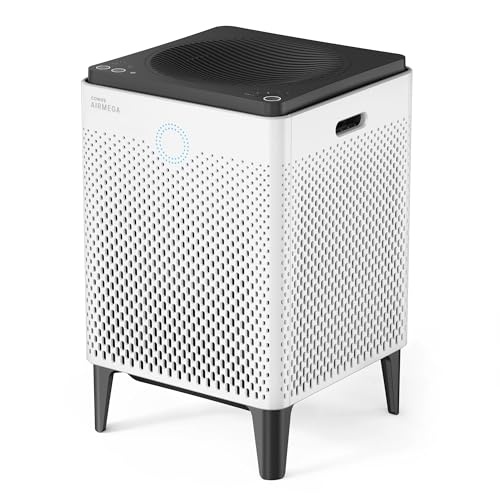
COWAY Airmega 400 (AP-2015F) — Best for Very Large Spaces
The Airmega 400 is the coverage heavyweight: its listing states up to 3,120 square feet, a washable pre-filter and HEPA filtration, an air quality indicator, auto and sleep modes, a timer, and a 5-year warranty. COWAY’s Airmega line is built like furniture-grade appliance hardware, and the warranty length in the listing signals how the maker expects it to be owned — for years, in the biggest room of the house. The sleep mode is its quiet answer: rather than advertising a decibel figure (the listing states none), it dims and drops to its gentlest speed for night hours in a large bedroom or loft.
Strengths
- Up to 3,120 ft² stated coverage — whole-floor territory for open plans and lofts
- Washable pre-filter plus HEPA keeps consumables to the main filter
- 5-year warranty stated in the listing — the longest ownership promise in this roundup
Trade-offs
- No decibel figure stated in the listing; quiet is delivered via sleep mode, not a published number
- Large, premium appliance — footprint and tier both exceed the compact picks
- At modest room sizes it is more machine than the job requires
Spec snapshot (from the verified listing, cached 2026-11-20)
- Stated coverage: up to 3,120 ft²
- Filtration: washable pre-filter + HEPA
- Modes: auto, sleep, timer; AQI display
- Warranty: 5 years (per listing)
- Noise figure: not stated in the Amazon title
The Airmega 400 suits the house whose “large room” is really a floor: the open-plan kitchen-living-dining expanse, the converted loft, the great room with a vaulted ceiling where air volume — not floor area — is the true load. Ceiling height is the variable coverage figures quietly assume away; a 3,120-square-foot rating buys the headroom to handle volume, and headroom, again, is what lets a machine spend its life at quiet speeds. If your space is that space, the COWAY is not overspending; it is correct sizing. If your space is a normal large bedroom, it is a wonderful machine solving a problem you do not have, and the 311i Max will serve you quieter and cheaper.
Best for: open-plan floors, lofts, and great rooms with high ceilings. / Not suited for: ordinary bedrooms or buyers who want a published dB figure.

Medify MA-50 V3.0 — Best for Smoke & Pet Homes
Medify builds its line around problem air — smoke, wildfire drift, odours, pollen, pets — and the MA-50’s listing states that brief directly, with 2,640 square feet of coverage in one hour and HEPA filtration, positioned as “quiet” in the listing’s own wording. Medify’s appeal is specification density for the tier: big coverage, a substantial filter path, and a design aimed at homes where the purifier works hard because the air genuinely needs it — a smoker-adjacent household, a multi-pet home, a house in a wildfire-prone region that sees weeks of drift each year.
Strengths
- 2,640 ft² stated coverage in 1 hr — second-largest figure in this roundup
- Positioned by its maker for smoke, wildfires, odours, pollen, and pets — the hard-air brief
- HEPA filtration with “quiet removal” positioning in the listing
Trade-offs
- The listing says “quiet” without a decibel figure — we do not convert that word into a number
- Filter replacements for a hard-working machine are a real annual budget line
- Less of a smart-home product than the LEVOIT or BLUEAIR picks
Spec snapshot (from the verified listing, cached 2026-11-20)
- Stated coverage: 2,640 ft² in 1 hr
- Filtration: HEPA filter
- Colour/format: White, 1-pack
- Noise figure: not stated numerically in the Amazon title (“quiet” per listing wording)
The MA-50’s buyer should think in seasons. During the weeks when outside air is the enemy — wildfire drift, heavy pollen, a houseful of guests and pets — this machine’s coverage and filter appetite earn their keep at working speeds. During mild weeks it idles down like the rest. What it does not offer is a certified whisper number for the bedroom, so light sleepers should treat it as the living-space machine and, if needed, pair it eventually with one of the 23dB BLUEAIRs where they sleep. As a single purchase for a hard-air household, though, it is the most purpose-built tool in this list.
Best for: smoke-affected, multi-pet, and high-pollen households with large rooms. / Not suited for: light sleepers who need a stated decibel figure for the bedroom.
Comparison Table
| Pick | Badge | Key spec (verified) | Best for | Link |
|---|---|---|---|---|
| BLUEAIR 211i Max | Best Overall | 3,235 ft², Quiet 23dB, HEPASilent, AHAM Verified | Open-plan living | Check price |
| BLUEAIR 311i Max | Best Bedroom | 2,107 ft², Quiet 23dB, washable pre-filter | Large bedrooms, studios | Check price |
| LEVOIT Vital 200S-P | Best Smart Features | 1,875 ft², 27dB, AQM, AHAM VERIFIDE | Sensor-driven running | Check price |
| WINIX 5510 | Best for Odours | 1,881 ft²/hr, True HEPA, high-deodorisation carbon | Pet & cooking odours | Check price |
| COWAY Airmega 400 | Best Very Large Spaces | 3,120 ft², washable pre-filter, 5-yr warranty | Lofts & great rooms | Check price |
| Medify MA-50 | Best Smoke & Pets | 2,640 ft²/hr, HEPA, quiet positioning | Hard-air households | Check price |
How to Choose a Quiet Air Purifier for a Large Room
Start with the room’s real size, and be honest in both directions. Measure floor area, then adjust for ceiling height: a 500-square-foot room with a 14-foot vaulted ceiling holds the air of a much larger standard room, and purifiers clean volume, not floor plans. Compare your adjusted figure against listings’ stated coverage with one rule — your room should sit comfortably below the machine’s maximum, ideally at half to two-thirds of it. That headroom is what allows the fan to live at its quiet speeds. A purifier whose maximum barely covers your room will spend its life at full speed, and no “quiet” badge survives that.
Understand the two numbers game. Coverage figures are measured at maximum speed; decibel figures at minimum. Neither is dishonest, but quoting them side by side — as listings do — describes a machine that does not exist. The useful question is what happens in between, and that is governed by auto mode and sensors. A purifier with a good air quality sensor (the LEVOIT’s monitor, the COWAY’s AQI, BLUEAIR’s auto mode) spends most hours near its quiet floor and sprints only when cooking, cleaning, or open windows load the air. Prefer that intelligence over a marginally lower laboratory dB figure on a dumb machine.
Filtration approach is the third decision. Mechanical True HEPA (WINIX, LEVOIT, COWAY, Medify) traps particles in a dense mat and nothing else — simple, proven, and dependent on fan pressure, which is where noise comes from. HEPASilent (BLUEAIR) charges particles first so a more open filter can catch them at lower pressure — the engineering shortcut that produces those 23dB figures. Neither is “fake”; they are different trades between fan work and filter work. What you should reject is any purifier whose main stage is an ioniser alone with no real filter for a large room — none of the six here makes that mistake.
Odour changes the calculation. Particles are easy; gases are not, and only carbon mass handles them. If your problem is smell — pets, cooking, smoke — the depth of the carbon stage (WINIX’s high-deodorisation bed, Medify’s smoke brief) matters more than another 200 square feet of coverage. If your problem is dust and pollen, carbon is a minor line item and coverage-plus-quiet should lead. Name your actual enemy before you rank the specs.
Finally, price the filters, not the box. Every purifier here will consume replacement filters for as long as you own it, and over three years the consumables can rival the purchase. Washable pre-filters (311i Max, Airmega 400) trim that bill and protect the main filter. Long warranties (COWAY’s stated 5 years) protect the machine itself. The cheapest purifier to buy is often the most expensive to own; the listings give you enough information to do the three-year arithmetic, and this category rewards the buyers who do it.
There is one more ownership variable the listings reveal if you look: how the machine tells you the truth. A displayed air quality reading — the LEVOIT’s monitor, the COWAY’s AQI — changes behaviour in a household. People stop running the machine pointlessly at full speed “just in case,” because the readout shows the room is already clean; they also catch real events, like a forgotten pan smoking on the hob, by the number climbing. Sensor feedback is thus a quiet feature as much as a convenience feature: it keeps the fan at the lowest speed that the actual air requires, hour by hour, instead of the speed a worried owner guesses at. If two machines otherwise tie on coverage and stated noise, the one with the better feedback wins the tie in real homes.
How to Set Up and Run a Large-Room Purifier Quietly
Placement decides half of real-world performance. Put the purifier in the room where you spend the hours — usually the living room by day or the bedroom by night — with clearance around its intakes: a hand’s width from walls and furniture at minimum, more if the manual asks for it. Never tuck it behind a sofa or inside a cabinet niche; a starved purifier runs faster and louder to move the same air, which defeats the entire purchase. In an open plan, place it near the dominant pollution source (kitchen edge, pet corner, fireplace side) rather than at the geometric centre, because cleaning air near its source beats chasing it across the room.
Run it continuously, not in bursts. New owners often switch a purifier on when they notice dust or smell and off when the room “seems fine,” which guarantees the machine always works at its loudest, catching up. Left on auto around the clock, a correctly sized purifier idles at its quiet floor and the room never gets dirty enough to need a sprint. For sleep, use the sleep mode rather than switching off: the BLUEAIRs’ 23dB low end and the LEVOIT’s sleep profile exist precisely so the machine can guard the room all night at conversation-destroying-nothing levels. Keep doors to the room closed where practical — a purifier sized for one room cannot quietly serve a whole floor through open doorways.
Maintain the quiet. A clogged pre-filter makes the fan work harder and louder for the same cleaning, so wash or vacuum pre-filters on the rhythm the manual states — monthly attention is typical for washable ones. Replace main filters on schedule rather than on vibes; a loaded HEPA is both less effective and louder. And if the machine grows noisier over months, check placement first (something leaning against an intake is the classic cause) before assuming the motor is failing.
Energy use follows the same logic as noise. A purifier idling on auto for twenty-four hours typically draws less over a day than a purifier sprinting for four, and both draw modest power next to the heating and cooling systems that move the same air far less efficiently. If energy matters to you, the efficient purchase is the correctly oversized machine on auto — not the small machine switched on and off in guilty bursts, which spends its life at maximum draw doing maximum-speed work.
Common Buying Mistakes
The classic mistake is buying to the room’s exact size — choosing a purifier whose maximum coverage equals the room and then discovering that “quiet” only exists at speeds that barely clean. Buy headroom. The second mistake is comparing decibel figures without asking which speed produced them; a 23dB low-speed figure and a 27dB sleep-mode figure describe different machines’ different moments, and both are quieter than normal conversation anyway — placement and auto behaviour will matter more to your ears. The third is ignoring ceiling height and open-plan volume. The fourth is buying for particles when your problem is odour, or for odour when your problem is dust. The fifth is forgetting the filter budget until the indicator lights up. And the sixth is expecting any purifier to be a medical device: these machines clean room air as an appliance, and this guide recommends them strictly on filtration, coverage, and noise specifications.
One placement mistake deserves a paragraph of its own: the corner behind the curtain. New owners hide a purifier because it looks like an appliance, and a hidden purifier is a loud purifier — starved of intake air, it climbs a speed to compensate, and the household concludes the machine is noisy. Every machine in this guide was designed to sit visibly in a room with air moving freely around it. Give it that, and the quiet figures in the listings become the quiet figures in your home. Hide it, and no specification can save you.
Buy the headroom, run it on auto, keep the pre-filter clean, and let the machine be boring — in this category, boring is the sound of everything working.
Final Recommendation
For most large rooms, the BLUEAIR 211i Max (check price on Amazon) is the complete answer — the largest quiet headroom, a stated 23dB, and AHAM-verified coverage. Large bedrooms should take its sibling, the 311i Max (check price on Amazon), and pocket the washable pre-filter savings. Sensor lovers in mid-large rooms get the most satisfying ownership from the LEVOIT Vital 200S-P (check price on Amazon). Odour-led households should choose the WINIX 5510 (check price on Amazon), genuine great-rooms and lofts the COWAY Airmega 400 (check price on Amazon), and smoke-and-pet households the Medify MA-50 (check price on Amazon).
Related guides on this site: Best Quiet Air Purifiers For Asthma · Best Air Purifiers For Large Spaces · Best Air Purifiers Blueair · Best Air Purifiers Below 300 · Best Air Purifiers For Living Rooms
Seasonality is the last sizing factor. The same room is a different job in pollen season, in wildfire weeks, and with a house full of holiday guests than it is on a quiet week in February. Size for the season you actually dread, not the average week, and let auto mode enjoy the easy months at a whisper.
Reading Coverage Ratings Without Being Fooled
Coverage is the most gamed number in this category, so it deserves a buyer’s field guide. The first thing to notice is the time basis. Some listings in this very roundup state coverage “in 1 hr” — the WINIX 5510’s 1,881 square feet and the Medify MA-50’s 2,640 square feet are hourly figures, meaning the machine can cycle that room’s air volume within an hour at full speed. Other listings state a maximum area without a time basis. These are not directly comparable numbers, and a smaller hourly figure can describe a stronger machine than a larger timeless one. When a listing is AHAM Verified — both BLUEAIRs and the LEVOIT in this guide — the coverage sits inside a standardised rating that assumes a sensible number of air changes per hour for the stated room, which is why we weight verified ratings above raw marketing area claims.
The second thing is air changes. Purification is not a one-pass event: a room’s air must cycle through the filter repeatedly to bring particle levels down and keep them down against constant re-introduction from clothing, pets, and doorways. A machine that cycles your room once an hour at full speed is, at its quiet speed, cycling it far less than once an hour — which may still be fine for maintenance in a clean house, but it is not the same product the headline promised. This is the mathematical root of the headroom rule used throughout this guide. Buy the machine whose quiet-to-medium speeds still cycle your room at a respectable rate, and the headline numbers can be whatever they like.
The third is volume. Ratings assume standard ceiling heights, roughly eight feet. Every extra foot of ceiling adds an eighth more air per foot of height to the same floor. Vaulted living rooms, loft conversions, and double-height entrances are where correctly-sized-on-paper purifiers disappoint in practice — and where the two 3,100-plus-square-foot machines in this roundup justify themselves. Measure your room in cubic feet if your ceilings are anything but standard, and compare like with like.
Noise, Measured Honestly: What the Decibel Figures Mean at Home
Decibels are logarithmic, which makes small numerical differences bigger than they look and big marketing differences smaller. A 10dB increase is perceived as roughly a doubling of loudness; the 4dB gap between the BLUEAIRs’ stated 23dB and the LEVOIT’s stated 27dB is audible in a silent room if you listen for it, but both sit in the band of a whisper-quiet library, far below normal conversation or a refrigerator’s hum cycling on. What dominates real-world annoyance is rarely the steady-state figure anyway. It is fan tone — a whine or whistle at a particular speed — and it is speed changes at 3 a.m. when an auto mode reacts to a disturbance. Steady, low, and boring beats nominally quieter but variable, every night of the week.
Distance is the other free variable. Noise falls with distance, so a purifier across a large bedroom can be effectively silent at the pillow even at a medium speed, while the same machine on the nightstand is intrusive at its lowest. This is a genuine advantage of large rooms: you can place the machine properly — clear of walls, near the pollution source — and far from ears at the same time. Small-room buyers do not get that luxury, which is one more reason the large-room brief in this guide is, paradoxically, the easiest brief in purification to satisfy quietly.
Finally, treat any purifier with no stated decibel figure — three of our six picks — as an unknown, not as a failure. WINIX, COWAY, and Medify sell large numbers of these machines into bedrooms; their sleep modes exist because the demand is real. But if a published, comparable dB number is how you need to decide, the honest shortlist is the three machines that publish one, and this guide’s badges already point light sleepers exactly there.
Frequently Asked Questions
How quiet is quiet enough for a bedroom purifier?
The stated low-speed figures in this guide — 23dB for both BLUEAIR models and 27dB for the LEVOIT — sit at or below the ambient noise of a typical quiet bedroom, which is why those machines can run all night. What matters more than the exact figure is that the purifier is sized with headroom, so it never needs its loud speeds while you sleep.
Why do listings quote huge coverage and tiny decibels at the same time?
Because both are measured at opposite ends of the fan range: coverage at maximum speed, noise at minimum. The numbers are individually real but never simultaneous. Auto mode with a good sensor is what bridges them in daily life, spending most hours near the quiet end.
Is a bigger purifier actually quieter in a large room?
Yes, in practice. Cleaning demand is fixed by the room; a bigger machine meets it at a lower fan speed, and lower fan speed is where quiet lives. Correct oversizing — a machine rated at roughly one-and-a-half to two times your room’s size — is the most reliable quiet strategy in this category.
HEPA or HEPASilent — which should I choose?
Mechanical True HEPA (WINIX, LEVOIT, COWAY, Medify here) is the traditional, purely mechanical route. BLUEAIR’s HEPASilent charges particles so its filter works at lower air pressure, which is how it reaches its low stated noise figures. Choose by priority: absolute mechanical simplicity, or the quietest stated operation for a large room.
How often will I replace filters?
It varies by model and by how hard the machine works, and the listing or manual for your model is the authority. Budget for main-filter replacement as a recurring annual-scale cost, keep washable pre-filters clean to protect the main filter, and treat the three-year filter bill as part of the purchase decision.
Should I run the purifier all day, or only when I am in the room?
Continuously, on auto, is the quieter strategy. A machine left running holds the room at a clean baseline while idling at its lowest speeds. A machine switched on only when you enter must sprint to catch up, and sprints are the loud part. Continuous auto running is also how the stated quiet figures become your lived experience rather than a laboratory number.
Can one purifier serve a whole open-plan floor?
Only the largest machines here — the 211i Max at up to 3,235 ft² stated and the Airmega 400 at up to 3,120 ft² — are even aimed at that job, and high ceilings eat into those figures. For most open plans, one large purifier in the main living zone, run continuously on auto, is the practical and quiet answer.


