Disclosure: airfryerkitchensupply.com is reader-supported. When you buy through links on our site, we may earn an affiliate commission at no extra cost to you.
Where to buy
Start with the picks that carry a verified Amazon listing below — each one was matched against the Amazon catalogue before it earned a link in this guide to the best air purifiers for living rooms. Use the links in the Quick Picks, the individual reviews, the comparison table and the final recommendation to check price on Amazon for the exact size, colour or configuration you want, because options inside one listing can differ a lot. Picks marked as unlinked are described honestly without a link: in this session there was no confident API match for that exact item, so we would rather explain it in words than send you to the wrong product.
- WINIX 5510 Air Purifier — Best Overall: Check on Amazon
- BLUEAIR Blue 211i Max Air Purifier — Best for Large Open-Plan Rooms: Check on Amazon
- COWAY Airmega 400 Air Purifier AP-2015F — Best Premium Power: Check on Amazon
- LEVOIT Core 600S-P Smart Air Purifier — Best Smart Value for Large Rooms: Check on Amazon
- Medify MA-50 Air Purifier V3.0 — Best for Smoke and Wildfire Seasons: Check on Amazon
- Austin Air HealthMate Plus Air Purifier, White, B450 — Best for Odours and Chemicals: Check on Amazon
Introduction
The best air purifiers for living rooms are sized for the room where life actually happens — the largest, most occupied, most door-opened space in the home, shared by people, pets, cooking smells drifting from the kitchen and dust that never seems to settle. That scale defeats the small bedroom purifiers many households promote to living-room duty: an undersized unit on its highest, loudest setting, cleaning a fraction of the room’s air per hour, is money spent on a noise machine. The six purifiers in this guide are living-room-class machines, verified, with the coverage figures from their own listings stated in each review.
Living rooms ask for three things a bedroom never does. Coverage for a large, often open-plan volume, at a speed that keeps up with doors opening and people moving. Quietness at the low speeds the machine will actually live on, because a purifier that annoys the room gets switched off — and an off purifier cleans nothing. And filtration that matches the household’s real load: pet dander and hair, pollen through open windows, wood-smoke or cooking odours, or the chemical smells of a newly renovated room. Different picks below lead on different loads, and the guide is explicit about which is which.
A note on honesty: an air purifier reduces airborne particles and, with the right carbon filtration, many odours and gases in the air that passes through it. It is a comfort and cleanliness appliance. This guide makes no medical claims for any model, and anyone managing a health condition should follow their clinician’s advice about their environment rather than a shopping guide’s enthusiasm.
In this guide
Quick Picks
1. WINIX 5510 Air Purifier — Best Overall. The current generation of a beloved large-room design: true HEPA, a serious deodorisation carbon filter, auto mode and app support, sized for rooms up to a stated 1,881 square feet per hour of cleaning.
Check on Amazon — check price on Amazon.
2. BLUEAIR Blue 211i Max Air Purifier — Best for Large Open-Plan Rooms. The big-room specialist: a stated 3,235 square feet of coverage, HEPASilent filtration, WiFi and auto mode, and a stated quiet level that suits a room people talk in.
Check on Amazon — check price on Amazon.
3. COWAY Airmega 400 Air Purifier AP-2015F — Best Premium Power. A flagship large-room machine with stated coverage to 3,120 square feet, air-quality indication, auto and sleep modes and a five-year warranty per its listing.
Check on Amazon — check price on Amazon.
4. LEVOIT Core 600S-P Smart Air Purifier — Best Smart Value for Large Rooms. A smart large-room Levoit with stated coverage to 2,933 square feet, AHAM verification per its listing, app and voice control, and an energy-efficient positioning.
Check on Amazon — check price on Amazon.
5. Medify MA-50 Air Purifier V3.0 — Best for Smoke and Wildfire Seasons. A large-coverage HEPA machine whose listing speaks directly to smoke, wildfires and odours — the seasonal-smoke and heavy-load pick.
Check on Amazon — check price on Amazon.
6. Austin Air HealthMate Plus Air Purifier, White, B450 — Best for Odours and Chemicals. A four-stage machine built around a heavy activated-carbon and zeolite bed, covering a stated 1,500 square feet, with a filter life stated in years rather than months.
Check on Amazon — check price on Amazon.
How These Picks Were Chosen
Every candidate was matched through the site’s verified Amazon listing data cache, and a purifier entered this guide only if its returned listing title confirmed living-room-relevant credentials: a stated large-room coverage figure, true HEPA or equivalent high-grade filtration, and the filtration stages its review describes. Small desktop and car purifiers were excluded regardless of brand, as were models whose titles offered no coverage figure to judge them by.
Ranking weighed effective coverage first — the room sizes in each title are the manufacturers’ own claims, and the guide treats them as comparative rather than absolute, advising buyers to size for their real room with headroom. Filtration fit came second: carbon weight for odour and smoke households, allergen capture for pet and pollen homes. Noise and running practicality came third, because a living-room machine runs for hours in company. Filter life and replacement simplicity closed the ranking, since a purifier’s second purchase — its filters — is where ownership cost actually lives.
The 6 Best Air Purifiers for Living Rooms

1. WINIX 5510 Air Purifier — Best Overall
The WINIX 5510 takes the overall slot the way its predecessor earned its reputation: by being good at everything a living room asks. True HEPA handles the particle load — dust, dander, pollen — while the high-deodorisation carbon filter is the detail that separates it from particle-only rivals, because living rooms smell of cooking, pets and people, and carbon is what a purifier can actually do about odour. Auto mode is the feature that makes it livable: quiet at rest, responsive when the kitchen door opens or the dog comes in wet.
Size it honestly. The listing’s figure is coverage in one hour, and air-cleaning guidance generally wants a room’s air cycled multiple times per hour for real effect — so treat the 5510 as the right machine for small-to-large living rooms rather than stretching it across a vast open plan, where the bigger picks below exist. As the one purifier a mixed-load household buys for its main room, it is the easiest recommendation in this guide.
Strengths
- True HEPA plus a heavy carbon stage covers particles and odours in one machine
- Auto mode lets it live quietly and surge when cooking or guests raise the load
- App support suits a machine that runs in the home’s main room all day
Trade-offs
- Its stated coverage is a one-hour figure — real rooms need the headroom advice in the guide
- Replacement filters are an ongoing cost to budget, as with every pick here
- Design is functional rather than furniture-like
Key specs: Coverage to 1,881 sq ft in 1 hr per listing; True HEPA; high deodorisation carbon filter; auto mode; app support
Best for: most living rooms — the balanced all-rounder for mixed dust, pet and odour loads / Not suited for: very large open-plan spaces at the top of its range, where the Blueair or Airmega 400 should take over
Check on Amazon — check price on Amazon.

2. BLUEAIR Blue 211i Max Air Purifier — Best for Large Open-Plan Rooms
Open-plan living defeats ordinary purifiers arithmetically: the volume is two or three rooms’ worth, and a machine cycling a bedroom’s worth of air per hour is decoration. The Blue 211i Max is built for that arithmetic, with the largest stated coverage in this guide and Blueair’s HEPASilent approach, which aims to move large air volumes at living-room-friendly noise. Its washable pre-filter is a quietly important feature in pet homes, intercepting hair before it loads the main filter and shortening the interval between expensive filter changes.
Place it with the respect its size deserves: a corner with clearance around its intakes, not buried behind a sofa where it will diligently clean the air behind the furniture. Run it on auto and let it manage itself around the household’s rhythm. For the genuinely large living space — the open-plan kitchen-living room that defines modern homes — this is the pick that ends the undersizing problem rather than managing it.
Strengths
- Largest stated coverage in this guide by a wide margin
- Quiet operation is a headline specification, not an afterthought
- Washable pre-filter catches the pet hair that chokes finer filters early
Trade-offs
- Physical size matches its capacity — plan its corner before ordering
- Premium tier, with filters to match
- Overkill is a real cost in a small room: buy the capacity your room needs
Key specs: Coverage to 3,235 sq ft per listing; HEPASilent filtration; WiFi; auto mode; washable pre-filter per listing
Best for: large and open-plan living spaces where smaller purifiers cannot cycle the volume / Not suited for: small living rooms, where its capacity is wasted and its footprint is felt
Check on Amazon — check price on Amazon.
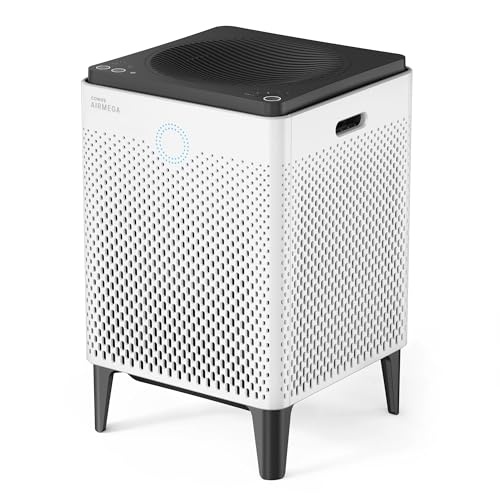
3. COWAY Airmega 400 Air Purifier AP-2015F — Best Premium Power
The Airmega 400 is the flagship argument: near-maximum coverage, an air-quality indicator that makes the invisible visible — genuinely useful when you are learning what raises your home’s particle load, from cooking to candles to the dog shaking off a walk — and auto and sleep modes that let one machine serve an open-plan space around the clock. The five-year warranty stated in its listing matters at this tier: it is the manufacturer pricing its own confidence, and it changes the ownership arithmetic against cheaper machines replaced sooner.
Buy it as the main-room machine for a large home and engage with it for the first month: watch the indicator, learn the household’s patterns, position the unit where it responds fastest. After that education, auto mode carries the routine. Households in smaller rooms should take the same money to the WINIX and a year of filters instead — capacity you cannot use is not value, however fine the machine.
Strengths
- Flagship coverage close to the Blueair’s, with an air-quality indicator to show it working
- Auto and sleep modes cover the living room’s day and the open-plan night
- The stated five-year warranty is the longest commitment in this guide
Trade-offs
- Premium purchase and premium filter costs
- Substantial footprint and presence in the room
- Its display and features reward owners who engage with them; set-and-ignore buyers pay for unused depth
Key specs: Coverage to 3,120 sq ft per listing; HEPA; washable pre-filter; AQI display; auto & sleep; 5yr warranty per listing
Best for: large living rooms wanting flagship capacity with a visible air-quality readout / Not suited for: budget buyers — this is the premium end of the guide in every sense
Check on Amazon — check price on Amazon.

4. LEVOIT Core 600S-P Smart Air Purifier — Best Smart Value for Large Rooms
Levoit’s Core 600S-P is the value disruptor in this company: coverage figures in the flagship conversation, AHAM verification named in its listing, and the full smart package — app scheduling, remote control, Alexa voice control — at the tier below the flagships. For a living room, smart control is not a gimmick: a purifier you can surge from the sofa when cooking smoke drifts in, or schedule around the household’s day, is a purifier that actually gets used at the right speeds.
Its honest boundary is filtration specialisation. A combined generalist filter handles the normal living-room mix of dust, pollen, pet dander and everyday smells well; a home whose defining problem is heavy odour — a smoker’s room, a renovation’s chemical load — should weight carbon above convenience and look at the WINIX or the Austin. For the mainstream smart household in a large room, this is the most capability per purchase in the guide.
Strengths
- Large stated coverage with the convenience of app and voice control
- AHAM verification in the listing gives its claims an independent frame
- Energy-efficient positioning suits a machine that runs all day, every day
Trade-offs
- Its combined filter design is a generalist — heavy odour loads want more carbon
- Smart features need WiFi setup and an app account to shine
- At full speed, as with all large machines, it will be heard
Key specs: Coverage to 2,933 sq ft per listing; HEPA; app + Alexa; AHAM VERIFIDE per listing; sleep mode
Best for: smart-home households wanting flagship-scale coverage with app control at a keener tier / Not suited for: odour-heavy homes, where a dedicated heavy-carbon machine like the WINIX or Austin serves better
Check on Amazon — check price on Amazon.

5. Medify MA-50 Air Purifier V3.0 — Best for Smoke and Wildfire Seasons
Some living rooms have a season when the air turns hostile: wildfire smoke that closes windows for weeks, a wood-stove neighbourhood in winter, a nearby road’s worst months. The MA-50 is the pick for those homes — a HEPA machine whose own listing names smoke and wildfires first, with one-hour coverage sized to cycle a large room’s air when the household is sealed indoors and the purifier becomes the lungs of the house. In those weeks, capacity and filter quality are not specifications; they are the difference between a liveable room and a headache.
The discipline for episodic buyers is maintenance in the off-season: filters age on the shelf of a running machine, seals and pre-filters want checking before the season arrives, and the time to discover a spent filter is in spring, not on the first smoke day. Bought and kept ready, the Medify turns the worst air weeks of the year from an endurance test into a managed inconvenience — which, for the regions that need it, is worth more than any quiet-spec bragging rights.
Strengths
- Positioned and specced for smoke, the hardest common living-room load
- Large one-hour coverage suits episodic surges when windows must stay shut
- Covers the everyday pollen and pet mix as its baseline duty
Trade-offs
- Episodic buyers must still maintain filters through the clean season
- White, clinical styling is functional rather than decorative
- Like all picks, its figures are the maker’s — size with headroom
Key specs: Coverage 2,640 sq ft in 1 hr per listing; HEPA; smoke/wildfire positioning
Best for: homes in wildfire-smoke regions and households whose air problem arrives in heavy episodes / Not suited for: quiet-first buyers in small rooms — this is a capacity machine for bad-air days
Check on Amazon — check price on Amazon.

6. Austin Air HealthMate Plus Air Purifier, White, B450 — Best for Odours and Chemicals
Every other pick in this guide leads on particles. The HealthMate Plus leads on gases: a substantial bed of activated carbon and zeolite, the materials that adsorb odours, chemical vapours and the volatile compounds of new paint, flooring and furniture that a HEPA filter — a particle sieve — simply cannot touch. For the household whose living-room problem is a smell with a chemical edge, or a newly renovated space that needs living in before it has finished airing, this is not one option among six; it is the category answer.
Its economics are equally distinctive: a filter life stated at five years turns the purifier from a subscription into an appliance, and its coverage figure — a stated 1,500 square feet — is the guide’s most conservative, which in a defined living room is capacity honestly matched rather than stretched. Heavy, plain and purposeful, it is the purifier for households who know exactly what is in their air and want the machine built for that specific enemy.
Strengths
- The carbon and zeolite bed is the serious odour-and-gas tool in this guide
- Five-year filter life transforms the running-cost calculation
- Steel, built-to-last construction is the opposite of disposable appliance design
Trade-offs
- Smallest stated coverage here — size it to a defined living room, not an open plan
- Heavy unit; choose its position once and leave it there
- Particle performance is good, but this machine’s premium buys gas filtration — buy it for that
Key specs: Coverage to 1,500 sq ft per listing; 4-stage filtration; activated carbon + zeolite; 5-year filter life per listing
Best for: homes whose problem is gaseous — renovation smells, chemical sensitivities in the household, persistent odours / Not suited for: particle-only households in huge rooms, where its coverage is the smallest here and carbon weight is wasted
Check on Amazon — check price on Amazon.
Comparison Table
| Pick | Badge | Key spec | Best for |
|---|---|---|---|
| WINIX 5510 Air Purifier | Best Overall | 1,881 sq ft/hr, True HEPA + carbon | most living rooms — the balanced all-rounder for mixed dust, pet and odour loads |
| BLUEAIR Blue 211i Max Air Purifier | Best for Large Open-Plan Rooms | 3,235 sq ft, HEPASilent, WiFi | large and open-plan living spaces where smaller purifiers cannot cycle the volume |
| COWAY Airmega 400 Air Purifier AP-2015F | Best Premium Power | 3,120 sq ft, AQI, 5yr warranty | large living rooms wanting flagship capacity with a visible air-quality readout |
| LEVOIT Core 600S-P Smart Air Purifier | Best Smart Value for Large Rooms | 2,933 sq ft, smart, AHAM listed | smart-home households wanting flagship-scale coverage with app control at a keener tier |
| Medify MA-50 Air Purifier V3.0 | Best for Smoke and Wildfire Seasons | 2,640 sq ft/hr, smoke focus | homes in wildfire-smoke regions and households whose air problem arrives in heavy episodes |
| Austin Air HealthMate Plus Air Purifier, White, B450 | Best for Odours and Chemicals | 1,500 sq ft, carbon+zeolite, 5yr filter | homes whose problem is gaseous — renovation smells, chemical sensitivities in the household, persistent odours |
Compare coverage with the guide’s headroom rule in mind: choose a machine whose stated figure comfortably exceeds your room, because those figures are best-case rates and real rooms have doors, furniture and life in them. Then compare filtration against your load — carbon weight for odours and smoke (WINIX, Austin, Medify), capacity for volume (Blueair, Airmega, Levoit), and filter life for running cost (Austin’s years against the others’ months). The right row is the one whose strength matches your air’s actual problem.
How to Choose an Air Purifier for a Living Room
Sizing a purifier: coverage figures, decoded
Manufacturers state coverage as the room size a machine can clean in a set time — often one hour — at its top speed. Useful air cleaning for a lived-in room generally means cycling the room’s air several times per hour, which is why this guide advises headroom: pick a machine whose stated one-hour coverage is at least double your room’s actual size, and it will deliver meaningful cycling at a middle speed you can tolerate all day. A machine matched exactly to its room on paper will live on its loudest setting and still fall behind whenever a door opens.
Measure your living room properly, including the kitchen volume if the plan is open — air does not respect the line where the flooring changes. Then be honest about ceiling height: the published figures assume a standard ceiling, and a vaulted living room holds half again the air its floor plan suggests. When between sizes, buy up. An oversized purifier idling quietly is a pleasure; an undersized one straining audibly is a regret with a filter subscription.
Filtration, stage by stage: what each layer actually does
A washable pre-filter catches hair and large dust, protecting the expensive filters behind it — in pet homes it is the difference between a main filter lasting its rated life and choking early. The HEPA stage captures the fine particles: pollen, dander, dust fragments and smoke particles down to the sizes that stay airborne longest. True HEPA, named on the WINIX, is a defined standard; treat unqualified HEPA-type language elsewhere in the market with polite suspicion.
Carbon is the gas stage, and its capacity is measured in weight, not in the word activated on a box. A thin carbon sheet freshens lightly; a deep carbon bed, like the Austin’s carbon-and-zeolite fill, adsorbs serious odour and chemical load for years. Match the stage to your enemy: particles want HEPA and airflow, odours want carbon mass, and most living rooms want both in the proportion their household actually produces — which is why the all-rounders in this guide pair a real HEPA with a real carbon stage rather than token versions of each.
Noise: the specification that decides whether you own a purifier or an ornament
Every purifier in this guide can be loud at full speed; that is physics, not failure. What matters is the noise at the speed the machine will live on — the low or auto setting that runs through conversation, television and reading. A stated quiet figure, like the Blueair’s in its listing, is worth more than a top-speed airflow number, because a purifier switched off for the evening cleans nothing at all. Auto mode is the practical solution: the machine idles near-silently and surges only when its sensor detects a load — cooking, a crowd, a shaken rug — then settles again.
Placement feeds noise too. A purifier in a corner reflects sound into the room less than one boxed between furniture, and a machine on a hard floor transmits more vibration than one on a rug or mat. Before concluding a purifier is too loud, move it a metre and change its surface; the difference is frequently the whole complaint. And run new machines through their first evening on auto during a film: if nobody reaches for the remote to compensate, the noise question is settled for the life of the machine.
Running costs: filters, electricity and the honest total
A purifier’s purchase is the down payment; filters are the mortgage. Before buying, price the replacement filter for each candidate, note its rated life under normal use, and do the five-year arithmetic — the Austin’s multi-year filter and the others’ shorter cycles produce very different totals than their shelf prices suggest. Pre-filter discipline protects that arithmetic: vacuum or wash the pre-filter monthly in pet homes, and the main filter behind it will actually reach its rated life instead of expiring early under a blanket of hair.
Electricity is the smaller cost and still worth a thought for a machine that runs around the clock: efficient models on auto draw modest power at their living speeds, surging only when needed, while a machine run permanently on turbo out of habit can cost noticeably more and wear its filter faster. The economical pattern is also the effective one — auto mode, doors to unused rooms closed, pre-filter kept clean — which is a pleasant alignment of thrift and performance that this category does not always offer.
Purifiers and Pets, Cooking and Open Windows: Running the Room as a System
A living-room purifier works best as part of a small system rather than as a lone appliance. Source control comes first: lids on pans, the extractor on while cooking, pets brushed weekly — ideally in one place, away from the purifier’s intake, so the hair leaves in the brush rather than the filter. Ventilation comes second: on clean-air days, open windows do what no filter can, and the purifier rests; on bad-air days — pollen peaks, smoke episodes, a houseful of guests — windows close and the purifier takes over, which is exactly the division of labour auto mode automates.
Finally, give the machine the room’s geography. It cleans the air that reaches it, so place it in the living zone rather than a hallway, away from walls on its intake sides, and not behind the sofa that blocks its circulation. Households that run these three habits — sources managed, windows used intelligently, machine placed in the room’s life — find a mid-tier purifier outperforming a flagship ignored in a corner. The picks above are the hardware; this system is the software, and it is free.
Reading Your Home’s Air: A Month of Observation Before You Upgrade
The most underused feature of modern purifiers is the air-quality indicator, because most owners glance at it for a day and ignore it for a year. Used deliberately for one month, it becomes a diagnostic instrument for the whole house. Note what makes it climb: frying without the extractor, a shaken rug, the dog arriving wet, candles, a vacuum cleaner raising what it was meant to remove, the hour the street outside peaks. Each observation is a free intervention — a habit, a door closed at the right hour, a pre-filter cleaned — that costs nothing and compounds the machine’s work.
That month also settles placement empirically. If the indicator barely stirs when cooking smoke visibly crosses the room, the machine is too far from the room’s life or boxed by furniture; move it and watch the response sharpen. If it surges at the same hour daily, a schedule or a closed door at that hour is the fix. Households that run this observation month end up with a purifier system tuned to their actual air, and they consistently report the machine mattering more in month two than in week one — the opposite of most appliances, whose novelty only fades.
Keep the notes, even informally. When filter-replacement time comes, you will know whether your load is heavy or light and can judge the maker’s schedule against your evidence. When a second room is considered for a machine, you will know which loads follow you around the house and which stay in the living room. And if anyone in the household questions whether the purifier does anything, the month’s record — causes, responses, the evenings the indicator stayed calm through a houseful of guests — is a better answer than any specification sheet.
Allergens, Guests and the Social Life of a Living Room
A living room’s air load is social. The room that hosts Sunday lunch, the children’s friends, the dog’s admirers and the holiday crowd breathes for all of them, and its purifier’s hardest hours are its happiest ones. Hosts learn to run the machine up an hour before guests arrive — a pre-clean that drops the baseline so the room absorbs the crowd’s added load gracefully — and to let auto mode surge through cooking and conversation without apology. Guests with pet sensitivities, given honest warning and a room whose air has been running through a HEPA stage all day, fare noticeably better than in an unfiltered pet home; it is one of the kinder, quieter things a host can do.
Allergen seasons write the other half of the calendar. Pollen households run the living-room machine hardest exactly when windows beg to open, and the discipline is to ventilate briefly at the day’s low-pollen hours and purify the rest, rather than choosing one strategy for the whole season. The purifier also earns its keep overnight in open-plan homes, where the living room’s air is the bedroom’s air by morning; a machine on its quiet night setting, cleaning the shared volume while the house sleeps, serves rooms it never enters.
None of this requires the flagship. It requires a correctly sized machine, honestly filtered, placed in the room’s life and run with intention — the recurring argument of this guide. The household that treats its purifier as part of hosting, of allergy season, of the home’s daily hospitality, gets a return on the purchase that a specification table cannot capture: a room that always feels easy to breathe in, for the people who live there and the people they love having over.
Second Rooms and Hand-Me-Downs: The Purifier’s Longer Life
A living-room purifier rarely dies in the living room. When a household upgrades — a bigger space, a new allergy in the family, a flagship arriving — the old machine steps down to a bedroom, a study or a child’s room, where its now-modest coverage is suddenly generous for the volume. Planning for that cascade argues for buying recognised, filter-supported models in the first place: a purifier whose filters remain available for years can serve three rooms across a decade, while an obscure model whose filters vanish from sale is landfill with a fan. Every pick in this guide comes from a line with an established filter ecosystem, which is part of what their prices buy.
The cascade also disciplines the first purchase. Buy the living room’s machine for the living room’s volume, honestly, and let the future bedroom inherit it in due course; do not buy a mid-size machine now intending it to serve both rooms inadequately in sequence. One right-sized machine, cascading down through the house as better ones arrive, will clean more air across its life than two compromised purchases — and when it finally retires, its last room will have been served by a machine that was once the best in the house.
One Last Check Before You Order
Run the three-question check that prevents nearly every purifier regret. Have you measured the room — including its open-plan volume and ceiling height — and chosen a machine whose stated coverage gives you at least double that figure in headroom? Have you matched the filtration to your air’s actual enemy, particles toward HEPA capacity and odours toward carbon mass, rather than buying the badge? And have you priced the replacement filter and accepted its schedule as part of the purchase? Three yeses and the machine will still be earning its place in five years; any no is a sizing, filtration or budget fix that is free today and expensive after the first filter change comes due.
How to Place and Run a Living Room Air Purifier
Placement and routine decide a living-room purifier’s real performance more than its badge does. Set it up once with clearances respected, then run a light monthly rhythm, and the machine will deliver its rated life instead of a fraction of it.
- Choose the position before unboxing fully: in the living zone, with clear space around the intakes and outlet, away from walls and soft furnishings that block airflow.
- Remove all filter packaging inside the machine — new purifiers ship with their filters bagged, and a machine run with the bag on cleans nothing and strains its motor.
- Run the purifier on its highest setting for the first hour in a closed room to pull the initial load down, then switch to auto for daily life.
- Keep doors to the living room closed during heavy-load episodes — cooking smoke, smoke days, a roomful of guests — so the machine cycles a defined volume.
- Vacuum or wash the pre-filter monthly, more often with shedding pets, and note the date on a sticker on the machine.
- Replace main filters on the maker’s schedule or the machine’s indicator, not on guesswork — and order the replacement when the indicator first warns, not when it expires.
- Wipe the sensor lens and exterior vents when you service the pre-filter; a blinded sensor makes auto mode guess, and it guesses conservatively.
After the first month, review the machine’s behaviour once: what makes its indicator climb, when it surges, whether its position serves the room’s real life. One repositioning based on that month of evidence is worth more than any amount of specification comparison — the best purifier setup is the one tuned to your household’s actual air.
Common Buying Mistakes
Promoting a bedroom purifier to the living room. A small machine in a large room cleans a corner and audibly fails at the rest. Living rooms need living-room coverage, bought with headroom — the arithmetic is in the guide above.
Running the machine with its filter still bagged. New purifiers ship with filters sealed in plastic inside the unit. It is the most common setup error in the category and completely silent — open the machine and remove every bag before first use.
Placing the purifier behind furniture or in a hallway. It cleans the air that reaches it. Boxed behind a sofa it purifies the sofa’s shadow; in a hallway it serves a room nobody sits in. Place it in the living zone with clearance.
Buying for particles when your problem is odour. HEPA cannot adsorb gas. Chemical and persistent odour loads need carbon mass — the Austin’s bed, the WINIX’s deodorisation stage — not a bigger particle filter.
Neglecting the pre-filter in a pet home. Hair blankets the pre-filter, starves the main filter and shortens its life. Five minutes monthly with a vacuum is the cheapest filter-life extension in the category.
Switching it off whenever anyone is in the room. That is a noise problem solved by auto mode and placement, not by surrender. A purifier that is off during the room’s occupied hours is cleaning for an empty house.
Final Recommendation
For most living rooms, start with the WINIX 5510: true HEPA, serious carbon, auto mode and honest all-round coverage. Large and open-plan homes should step up to the Blueair 211i Max for volume or the COWAY Airmega 400 for flagship features and warranty, while smart-home households will get the most daily use from the Levoit Core 600S-P’s app control at scale. Smoke-prone regions belong to the Medify MA-50, and odour-and-chemical households to the Austin HealthMate Plus, whose carbon bed and multi-year filter answer a problem the others only visit.
Whichever machine you choose, size it with headroom, unbag its filters, place it in the room’s life and run it on auto. Use the links to check price on Amazon — and price the replacement filter at the same time, because the honest cost of a purifier is the machine plus the filters it will eat while you own it.
Quick links to every pick, to check price on Amazon one last time before you decide: WINIX 5510 Air Purifier. BLUEAIR Blue 211i Max Air Purifier. COWAY Airmega 400 Air Purifier AP-2015F. LEVOIT Core 600S-P Smart Air Purifier. Medify MA-50 Air Purifier V3.0. Austin Air HealthMate Plus Air Purifier, White, B450.
Best Air Purifiers For Living Rooms Best Air Purifiers Best Air Purifiers For Pets Best Air Purifiers For Allergies Best Hepa Air Purifiers
Frequently Asked Questions
What size air purifier does a living room need?
One whose stated one-hour coverage is at least double your room’s size, so it can cycle the air meaningfully at a tolerable speed. Include connected open-plan volume and allow for high ceilings. When between sizes, buy the larger machine and run it quieter.
Does an air purifier help with pet hair?
It helps with airborne dander and the fine hair that floats; the hair on the sofa is a vacuum’s job. A washable pre-filter, as on the Blueair and COWAY picks, catches hair before it loads the main filter — valuable in shedding households.
HEPA or carbon — which matters more?
They do different jobs. HEPA captures particles — pollen, dander, dust, smoke particles. Carbon adsorbs gases and odours. Most living rooms need both, weighted toward their real problem: particle households toward HEPA capacity, odour and chemical households toward carbon mass.
How loud is a living-room purifier, really?
At living speeds on auto, the good machines in this guide are background-level — present if you listen, ignorable in conversation. At turbo they are all plainly audible, which is why auto mode and correct sizing matter more than any single noise figure.
How often do filters need replacing?
It varies by model from months to the Austin’s stated five years — check the specific machine’s schedule and indicator, keep the pre-filter clean to protect the main filter’s life, and budget replacements as part of the purchase decision, not as a surprise.
Can a purifier replace opening windows?
No — on clean-air days, ventilation is free and complete, and the purifier should rest. The purifier earns its keep when windows cannot help: pollen peaks, smoke episodes, winter, and the daily background load of an occupied, pet-sharing home.


