Disclosure: airfryerkitchensupply.com is reader-supported. When you buy through links on our site, we may earn an affiliate commission at no extra cost to you.
Where to Buy
Electric cooktops are built-in, hardwired appliances, so the listing’s voltage, cutout dimensions and element configuration matter as much as the brand. Every model below was verified against Amazon’s catalogue data for this site, with brand and model matched exactly — including the radiant, induction and coil technologies, which this guide keeps clearly separated.
- Frigidaire Professional 30 Inch Electric Cooktop (FPEC3077RF) — check price on Amazon
- Frigidaire 36 Inch Electric Cooktop with Stainless Trim — check price on Amazon
- Empava 30 Inch Electric Cooktop (Radiant, Dual Zone) — check price on Amazon
- Karinear 30 Inch Electric Cooktop (Knob Control, 6700W) — check price on Amazon
- VEVOR 36 Inch Induction Cooktop (9200W) — check price on Amazon
- Summit 30 Inch Electric Cooktop (WEL05) — check price on Amazon
No fixed prices are printed here, because appliance pricing moves with promotions and configuration. Use the links to check the current price on Amazon, and confirm your electrical supply — most 30 and 36-inch models need a 240V circuit of adequate amperage — before ordering. If your project involves a circuit upgrade, get the electrician’s quote before choosing between the radiant and induction finalists — occasionally the wiring cost, not the cooktop, casts the deciding vote.
The best quality electric cooktops divide into three technologies that cook genuinely differently, and an honest guide has to keep them separate. Radiant smoothtops heat elements beneath ceramic glass — the mainstream choice, compatible with every pan, quick to clean. Induction heats the pan itself magnetically — fastest, most precise, most efficient, but it only works with magnetic cookware. Coil cooktops are the old, repairable technology that refuses to die, because it works with everything and can be fixed with a screwdriver. Quality means something specific in each: glass and element engineering in radiant, electronics and pan detection in induction, and sheer indestructibility in coil.
This guide ranks six verified models across those technologies by build quality and cooking substance. Frigidaire’s Professional and 36-inch radiant models anchor the mainstream; Empava and Karinear carry the value-radiant flag with dual-zone elements and honest knob controls; VEVOR’s 36-inch induction represents the magnetic future at a challenger price; and Summit’s American-made coil cooktop closes the list as the durability pick. One famous name is addressed in its own section rather than the picks: JennAir, whose full cooktops are not sold on Amazon at all — only a replacement cartridge is, and this guide will not pretend otherwise.
A note for replacement shoppers, who are most of this category’s readers: an electric cooktop swap is decided by three measurements and one circuit. Cutout width and depth, counter thickness, and the amperage of the dedicated circuit filter this list before taste does — the installation section below turns that into a checklist. Buyers who start there find that the ‘best’ cooktop is usually the best one that fits, and this guide’s picks were chosen to give every common cutout a quality option.
In this guide
Quick Picks
Six verified electric cooktops across radiant, induction and coil — plus an honest note on a famous brand you cannot buy here. Shortlist first, reviews below. Technologies are badged on every pick so a radiant and an induction model are never compared as if they were the same appliance wearing different glass.
Frigidaire Professional 30 Inch Electric Cooktop (FPEC3077RF) — Best Overall Quality. A five-element ceramic-glass radiant cooktop with stainless trim, expandable elements and an established maker’s support — the quality benchmark for mainstream electric cooking. Check the current price on Amazon.
Frigidaire 36 Inch Electric Cooktop with Stainless Trim — Best 36-Inch Radiant. The 36-inch radiant format from a mainstream maker: five elements with room to use them, stainless edge protection and family-sized spacing. Check the current price on Amazon.
Empava 30 Inch Electric Cooktop (Radiant, Dual Zone) — Best Value Radiant. A four-burner radiant smoothtop with a dual-zone element, ETL certification and ceramic glass — the value pick that keeps the safety paperwork in order. Check the current price on Amazon.
Karinear 30 Inch Electric Cooktop (Knob Control, 6700W) — Best Knob Control. A 6700W four-burner ceramic cooktop that keeps physical knobs — no touch-panel hunting with wet hands — with a hot-surface indicator and hardwired installation. Check the current price on Amazon.
VEVOR 36 Inch Induction Cooktop (9200W) — Best Induction Value. Five induction zones and 9200W with touch controls, child lock and overheat protection — magnetic cooking’s speed and precision at a challenger price. Check the current price on Amazon.
Summit 30 Inch Electric Cooktop (WEL05) — Best Coil / Made in USA. A four-burner coil cooktop made in the USA: the repairable, pan-agnostic, landlord-proof technology, from a specialist in compact and replacement appliances. Check the current price on Amazon.
How These Picks Were Chosen
Every pick was verified against Amazon’s catalogue data — brand, model, size and technology matched exactly — before earning a link. We then ranked within technologies rather than pretending they are one: radiant models on element control, glass and trim quality; the induction model on output, zoning and safety electronics; the coil model on repairability and construction. Certification (ETL) and brand support were weighted as quality markers throughout.
One deliberate exclusion became a section of its own below. JennAir is a famous premium cooktop name, and buyers search for it here — but no full JennAir cooktop is sold on Amazon; the brand’s downdraft cooktops used a modular cartridge system, and what the catalogue actually offers is a replacement radiant cartridge for those legacy units. Rather than pad the picks with a part pretending to be a cooktop, this guide documents the situation honestly and tells existing JennAir owners exactly what is available.
We also excluded, quietly, a long tail of lookalike glass cooktops whose listings could not be matched to a stable maker or model through the catalogue channel. In a category where the appliance is hardwired into a home for fifteen years, an untraceable listing is a quality failure before the first meal is cooked — however elegant its photographs.
- Every linked ASIN verified against Amazon catalogue data for this site
- Radiant, induction and coil technologies ranked within their own logic, never blurred
- JennAir handled honestly: no full cooktop exists on Amazon; only a legacy replacement part does
- No fixed prices or star ratings printed anywhere in this guide
The 6 Best Quality Electric Cooktops

Frigidaire Professional 30 Inch Electric Cooktop (FPEC3077RF) — Best Overall Quality
The Professional is what a quality radiant cooktop looks like when an appliance major builds it: five elements on ceramic glass, including expandable zones that match element size to pan size, front controls with positive feel, hot-surface indicators, and stainless trim that protects the glass edge — the detail that decides whether a smoothtop survives a decade of sliding pans. It suits households replacing a 30-inch electric cooktop with something properly made. It is radiant, not induction: response is good rather than instant, and the glass asks for reasonable care.
Strengths
- Five elements with expandable zones match heat to pan size efficiently
- Stainless trim protects the vulnerable glass edge
- Established brand support, parts and documentation
Trade-offs
- Radiant response is slower than induction, especially cooling down
- Ceramic glass needs non-abrasive care to stay unmarked
- Premium pricing over value-brand radiant models
| Size | 30 inch, built-in |
| Technology | Radiant, ceramic glass |
| Elements | 5 elements, expandable zones |
| Trim | Stainless steel edge trim |
| Controls | Front control knobs |
Radiant quality shows in evenness and control. Cheap elements cycle crudely — full power, off, full power — and sauces feel it as surging; the Professional’s elements and controls meter heat smoothly enough to hold a simmer without babysitting, while the largest zones bring a stockpot to the boil at a pace older smoothtops never managed. The glass itself is the other quality marker: flat, well-sealed to the trim, and free of the flex that makes budget glass feel like a liability under a full canner.
Ownership is the familiar radiant rhythm: cook, let the surface cool, wipe with the proper cleaner, and lift rather than drag rough cast iron. Do that and this class of cooktop routinely serves fifteen years with nothing but an element or a switch across its life — the sort of boring reliability that ‘quality’ means in an appliance you use three times a day.
Best for: households wanting the best-supported, best-finished mainstream radiant cooktop / Not suited for: cooks wanting induction speed or the lowest possible price
Check on Amazon — verify the current price on Amazon first; sellers refresh these listings regularly.

Frigidaire 36 Inch Electric Cooktop with Stainless Trim — Best 36-Inch Radiant
If your kitchen has a 36-inch cutout and your pans are not induction-ready, this Frigidaire is the straightforward quality answer: five radiant elements spread across a wide ceramic-glass surface, with the stainless trim that guards the glass and the brand support that guards the owner. It suits larger households and keen cooks who use several pans at once. As with all big radiant tops, the glass is a large, expensive component — treat it as such — and element response remains radiant-paced.
Strengths
- Full 36-inch spacing lets large pans coexist
- Five elements cover simmer-to-stockpot duties
- Stainless trim and mainstream brand support
Trade-offs
- Large glass surface is costly if ever damaged
- Radiant heat-up and cool-down lag behind induction
- 36-inch cutouts vary — measure before ordering
| Size | 36 inch, built-in |
| Technology | Radiant, ceramic glass |
| Elements | 5 elements |
| Trim | Stainless steel trim |
| Supply | 240V hardwired (typical for class) |
Width is the feature, and it is a real one: on a 36-inch top, a 12-inch skillet, a saucepan and a kettle stop negotiating for space, and the cook stops shuffling pans to the back to stir the front. Frigidaire’s element layout uses the width sensibly, with the largest zone positioned for the stockpot-and-canning work this size attracts. For households whose cookware predates induction — aluminium, copper, much beloved non-magnetic stainless — a quality radiant top like this remains the correct, no-new-pans answer.
The ownership notes mirror its 30-inch sibling, scaled up: protect the glass, clean with the right products, and confirm the cutout twice, because 36-inch electric cutouts are less standardised than their gas counterparts. Within those disciplines this is the wide radiant cooktop we would specify for a family kitchen that cooks daily.
Best for: 36-inch kitchens with non-induction cookware and multi-pan cooking habits / Not suited for: induction-ready households wanting magnetic speed
Check on Amazon — verify the current price on Amazon first; sellers refresh these listings regularly.

Empava 30 Inch Electric Cooktop (Radiant, Dual Zone) — Best Value Radiant
Empava’s 30-inch radiant model is the value formula applied honestly: four elements on black ceramic glass, one of them a dual-zone that shrinks or expands to the pan, ETL certification for the North American market, and compatibility with every kind of cookware. It suits renovators and rental kitchens that need a certified, good-looking smoothtop without flagship pricing. The brand’s support is seller-based rather than dealer-based, and four elements — not five — is the format’s honest limit at this price.
Strengths
- Dual-zone element matches heat to pan size and saves energy
- ETL certified for North American installation
- Smooth ceramic glass wipes clean and suits all cookware
Trade-offs
- Four elements where flagships offer five
- Seller-based support rather than a dealer network
- Touch-style controls divide opinion versus knobs
| Size | 30 inch, built-in |
| Technology | Radiant, ceramic glass |
| Elements | 4 burners, dual-zone element |
| Certification | ETL certified |
| Compatibility | All cookware types |
The dual-zone element is the feature that lifts this cooktop above generic value models: a small saucepan on the inner ring stops wasting heat around its base, and the same position expands for the family skillet. In daily use that flexibility, plus the sheer wipe-clean convenience of glass, is what owners actually praise. Element cycling is a touch less refined than the Frigidaire’s, visible if you hold delicate sauces at the edge of simmering — acceptable at the price, and worth naming.
Empava has built a real presence in the value-appliance space, which matters for parts confidence, and the ETL mark matters for inspectors. As the certified, dual-zone value radiant in this guide, it is the pick for budget renovations that still intend to cook seriously.
Best for: budget renovations wanting a certified radiant smoothtop with a dual-zone element / Not suited for: five-element households or buyers wanting dealer support
Check on Amazon — verify the current price on Amazon first; sellers refresh these listings regularly.
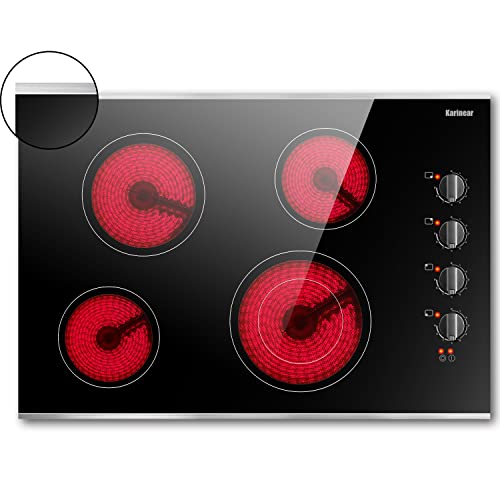
Karinear 30 Inch Electric Cooktop (Knob Control, 6700W) — Best Knob Control
The Karinear exists for cooks who have used touch-control cooktops and hated them. Its knobs are instantly adjustable, work with wet or floury hands, and give the cook’s peripheral vision a setting it can read at a glance. The 6700W total output is honest for the class, the ceramic glass is the standard wipe-clean surface, and the hot-surface indicator covers the radiant safety basic. It suits traditional cooks and households replacing a knob-controlled coil top. It is a value brand with value-brand support, and radiant physics still apply.
Strengths
- Physical knobs: fast, tactile, usable with wet hands
- 6700W across four burners is honest class output
- Hot-surface indicator and hardwired, no-plug installation
Trade-offs
- Value-brand support network is thin
- Radiant response, as ever, trails induction
- Knob panel takes a strip of the cooking surface’s front edge
| Size | 30 inch, built-in |
| Technology | Radiant, ceramic glass |
| Output | 6700W total |
| Controls | Knob control |
| Installation | 220–240V hardwired, no plug |
Control interfaces are a quality issue in disguise. A knob’s position is its setting — visible across the kitchen, adjustable without looking, immune to a splash of pasta water. Touch panels offer a cleaner look and a flatter surface, and they fail in small daily ways that knobs never do. Karinear’s implementation is simple and robust, and in a category drifting entirely to touch, a well-made knob radiant is a genuinely differentiated product rather than a dated one.
The rest of the appliance is competent value radiant: even elements, standard glass, sensible burner sizes. Buy it for the knobs and the price, maintain the glass kindly, and it will cook three meals a day without ever asking you to dry your hands before turning down a sauce — which is, for its intended owner, the entire point.
Best for: cooks who prefer physical knobs and households replacing knob-controlled cooktops / Not suited for: buyers wanting touch controls or five elements
Check on Amazon — verify the current price on Amazon first; sellers refresh these listings regularly.

VEVOR 36 Inch Induction Cooktop (9200W) — Best Induction Value
This is the guide’s induction representative, and it earns the role on output and format: five zones across 36 inches, 9200W total, nine heat levels per zone, a timer, child lock and overheat protection. Induction’s physics are the review: water boils startlingly fast, low settings hold a bare simmer without cycling surges, and the glass stays comparatively cool because the pan is the heater. It suits households whose cookware is magnetic — cast iron, enamelled steel, induction-ready stainless — or who are ready to make it so. Non-magnetic pans simply will not work, and VEVOR is a generalist brand whose appliance support is marketplace-grade.
Strengths
- Induction speed and precision: fastest boils, steadiest simmers
- 9200W across five zones in the full 36-inch format
- Surface stays cooler and wipes clean; child lock and overheat protection fitted
Trade-offs
- Requires magnetic cookware — aluminium and copper need replacing or discs
- Generalist brand; support is seller-based
- Touch controls and fan noise are induction’s usual companions
| Size | 36 inch, built-in |
| Technology | Induction |
| Output | 9200W, 5 burners |
| Controls | LED touch, 9 heating levels |
| Safety | Child lock, overheat protection, pan detection (class standard) |
First-time induction owners consistently report the same conversion experience: the boil that arrives before the pasta water was supposed to, the chocolate that melts without a bain-marie, the sauce that holds at a shiver for an hour. Those are not marketing effects; they are what happens when heat is generated in the pan and controlled electronically. VEVOR’s implementation delivers that experience across a full-size, five-zone surface at a price the European induction brands do not approach.
The cautions are the category’s, plus one brand note. Test your pans with a fridge magnet before ordering — if it sticks firmly to the base, the pan works. Expect a faint fan hum under heavy load. And weigh the support question honestly: induction electronics are the least owner-serviceable in this guide, so the value calculation should include the small risk premium of a challenger brand. For magnetic-ready households, the performance-per-dollar here is the strongest in the list.
Best for: households with magnetic cookware wanting induction performance at a value price / Not suited for: aluminium and copper pan collections or buyers wanting dealer support
Check on Amazon — verify the current price on Amazon first; sellers refresh these listings regularly.
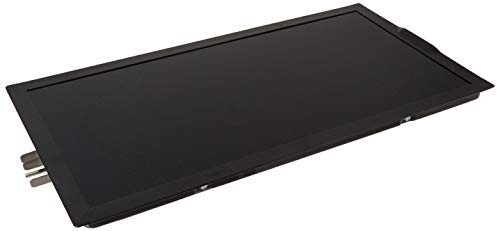

Summit 30 Inch Electric Cooktop (WEL05) — Best Coil / Made in USA
The WEL05 is the anti-smoothtop: four exposed coil elements on a white porcelain surface, in a 30-inch built-in format, made in the USA by Summit, a specialist in exactly this kind of durable, replacement-friendly appliance. Coils heat any pan ever made, tolerate abuse that would crack glass, and when an element eventually fails it unplugs and a new one plugs in — a five-minute repair with no technician. It suits rentals, cabins, workshops and traditionalists. It is slower to clean, less precise at a simmer, and unapologetically plain to look at.
Strengths
- Elements are user-replaceable in minutes — the most repairable technology here
- Works with every pan, including warped, oversized and canning loads
- Made in the USA by an appliance specialist
Trade-offs
- Coils are slower to respond and harder to wipe clean than glass
- Simmer control is cruder than radiant or induction
- Styling is utilitarian, deliberately
| Size | 30 inch, built-in |
| Technology | Coil elements |
| Elements | 4 burners |
| Supply | 230V class |
| Origin | Made in the USA |
There is a quality argument that only coil can make: total lifecycle cost and repairability. A smoothtop’s cracked glass can exceed the appliance’s remaining value; a coil cooktop’s wear parts cost little and fit by hand. For landlords, camps, hunting cabins and anyone whose cooktop must survive tenants, teenagers and canning season, that arithmetic beats elegance every year it runs. Summit’s version is the properly made one — solid elements, real porcelain, a maker that stocks parts.
Cooking on coils is its own familiar craft: preheat by eye, shift pans between burners to moderate heat, accept that the surface wants a proper clean rather than a wipe. Generations of cooks produced excellent food exactly this way. The WEL05 is in this guide because ‘quality’ that cannot be repaired is a loan, and this cooktop is owned outright.
Best for: rentals, cabins and traditionalists wanting maximum repairability and pan freedom / Not suited for: design-led kitchens or cooks wanting precise low-heat control
Check on Amazon — verify the current price on Amazon first; sellers refresh these listings regularly.
Comparison Table
| Pick | Badge | Key Spec | Best For |
|---|---|---|---|
| Frigidaire Professional 30 Inch Electric Cooktop (FPEC3077RF) | Best Overall Quality | 5 radiant elements, expandable zones, stainless trim | households wanting the best-supported, best-finished mainstream radiant cooktop |
| Frigidaire 36 Inch Electric Cooktop with Stainless Trim | Best 36-Inch Radiant | 36-inch radiant, 5 elements, stainless trim | 36-inch kitchens with non-induction cookware and multi-pan cooking habits |
| Empava 30 Inch Electric Cooktop (Radiant, Dual Zone) | Best Value Radiant | 4 radiant burners, dual-zone element, ETL certified | budget renovations wanting a certified radiant smoothtop with a dual-zone element |
| Karinear 30 Inch Electric Cooktop (Knob Control, 6700W) | Best Knob Control | 6700W radiant, knob control, hot-surface indicator | cooks who prefer physical knobs and households replacing knob-controlled cooktops |
| VEVOR 36 Inch Induction Cooktop (9200W) | Best Induction Value | 36-inch induction, 9200W, 5 zones | households with magnetic cookware wanting induction performance at a value price |
| Summit 30 Inch Electric Cooktop (WEL05) | Best Coil / Made in USA | 4 coil burners, user-replaceable elements, made in USA | rentals, cabins and traditionalists wanting maximum repairability and pan freedom |
Technology is the first sort, size the second. If your pans are magnetic and speed matters, the induction row wins its argument outright; if your cookware is mixed and your habits are traditional, radiant is the mainstream answer and the Frigidaire rows lead it; if repairability outranks everything, the coil row is the whole argument. The badges name each pick’s home ground rather than a universal hierarchy. One more sort is worth doing in your head before ordering: installation reality. Every row assumes a correctly rated circuit and a matching cutout, and the cheapest quality cooktop is the one that fits both without modification — a point the installation section prices honestly. Keep the technology badge in view as you compare prices across rows: a radiant and an induction model at the same price are not the same purchase. Keep the technology badge in view as you compare prices across rows: a radiant and an induction model at the same price are not the same purchase at all.
Radiant vs Induction vs Coil: Choosing Your Technology
Radiant is the safe mainstream: every pan works, the glass wipes clean, response is adequate, and prices span from value to premium. Its weaknesses are physics — the glass holds heat after switch-off, and low-end control cycles rather than glides. Induction is the performance choice: heat generated in the pan means fastest boils, the steadiest simmers, a cooler surface and the best energy efficiency, at the price of magnetic-only cookware and electronics that specialists must repair. Coil is the durability choice: slowest and plainest, but pan-agnostic and repairable by its owner forever.
Choose by cookware and temperament. Audit your pans with a magnet: if most pass, induction deserves serious consideration and will likely convert you. If your collection is aluminium, copper and glass, radiant is your technology and no induction review should shame you out of it. If the cooktop will be rented, abused or kept for thirty years, coil’s argument is actuarial and correct.
- Check your circuit: 30/36-inch electric cooktops typically need a dedicated 240V circuit — confirm amperage before choosing a high-output model
- Measure the cutout: electric cutouts vary more by brand than gas ones do
- Glass care: radiant and induction share ceramic glass — lift heavy pans, avoid sliding rough cast iron, clean with glass-specific products
- Residual heat: radiant surfaces stay hot after cooking; indicators matter in households with children
- Controls: knobs forgive wet hands; touch panels give timers, locks and a flush surface — choose for your cooking style
The JennAir Question, Answered Honestly
Search this category and you will find JennAir’s name attached to listings — so here is the verified situation. JennAir’s famous downdraft cooktops were built around interchangeable cartridges, and the brand’s full cooktops are sold through appliance dealers, not Amazon. What Amazon’s catalogue actually contains, verified through this site’s API channel, is a replacement part: the Jenn-Air Radiant Cartridge A122B — a plug-in radiant cartridge (similar to part JEA8120ADB) that restores a radiant cooking position on a compatible legacy JennAir downdraft cooktop.
To be completely clear: that cartridge is a PART, not a cooktop. It does not cook anything by itself; it refurbishes an existing JennAir unit whose cartridge has failed. If you own one of those cooktops, it is a genuinely useful purchase — it can return a dead position to service for a fraction of a replacement cooktop. If you do not own one, it is not a shortcut to a JennAir kitchen, and any guide that lists it among ‘the best electric cooktops’ without that explanation is misleading you. Buyers who want a new premium electric cooktop today should choose from the verified full cooktops in this guide.
Buying for a Rental, a Flip or a Forever Kitchen
The right quality target depends on who will own the consequences. Rentals reward the Summit’s coil logic and mid-tier radiant: repairable, pan-agnostic, unsurprising to tenants. A flip rewards recognisable mainstream names and flawless glass, because buyers read brands as quality at a glance. A forever kitchen rewards the deepest support and the technology the household actually cooks on, chosen without reference to resale at all.
Naming which purchase you are making — before the listings start arguing — is the simplest quality decision in this whole guide, and the one most buyers skip. The picks above serve all three purposes, but not interchangeably, and the badges were written with those purposes in mind.
Cookware for Electric Cooktops: Getting the Best From Glass and Coils
Electric surfaces reward flat bottoms more than gas ever did. On radiant and induction glass, a warped pan rocks, spins and heats in rings; a heavy, flat-based pan makes full contact and cooks evenly. Test your pans with a straightedge before blaming a new cooktop for hot spots. On induction the magnet test decides compatibility, but flatness still decides quality — a magnetic pan with a domed base is a compatible pan that cooks badly.
Size matching matters electrically in a way it never did on gas: a small pan on a large radiant element wastes energy and overheats the exposed glass ring, while an oversized pan on a small element cooks slowly and unevenly. The dual-zone and expandable elements in this guide’s picks exist to solve exactly that matching problem — use them, and the same cooktop feels a class better.
Electrical Installation: What Quality Requires Behind the Counter
An electric cooktop is only as good as its supply. Most models in this guide hardwire into a dedicated 240V circuit; the amperage must match the appliance’s rating with headroom, and older kitchens wired for a smaller cooktop may need a circuit upgrade before a 9200W induction top can join the household. That upgrade is not an upsell — an undersized circuit means nuisance tripping at best and hot wiring at worst — and it belongs in the purchase budget from the start.
Have a licensed electrician make the final connection and verify the junction box, cable gauge and breaker against the data plate. Keep the installation paperwork with the appliance documents: when the cooktop is serviced or the home is sold, a documented, correctly rated installation is part of what ‘quality’ means for a hardwired appliance.
Element Layouts and the Way You Actually Cook
Electric cooktop layouts reward the same paper exercise as gas ones: place your three most-used pans on the diagram before you buy. Radiant and induction tops concentrate their largest, strongest element in one or two positions, and a layout that puts the big zone at the back suits stockpot households while a front power zone suits cooks who sear and sauté at the front of the action. Dual-zone and bridge-capable elements add a third pattern — the long griddle or fish kettle across two zones — which matters if your cooking includes them and is dead money if it does not.
Also count the small positions honestly. A cooktop with four large elements and no genuinely small one wastes energy under every saucepan and overheats the glass ring around it. The balanced tops in this guide pair their power with at least one modest element, and that balance, more than the element count itself, is what a household feels across a week of breakfasts, sauces and side dishes.
Residual Heat, Children and the Case for Indicators
Electric cooking’s one inherent hazard is invisible heat: a radiant element switched off stays capable of burning for many minutes, and the glass gives no visual warning once the element’s glow fades. Quality cooktops answer with residual-heat indicators that stay lit while any zone is unsafe to touch — a feature this guide treated as mandatory in its picks, and one households with children or forgetful adults should refuse to compromise on. Induction largely designs the hazard away, since the glass is heated only by the pan sitting on it, though the pan itself remains hot.
Teach the household the indicator’s meaning the day the cooktop is installed, the way you would teach a stove’s flame. It is a small ritual that converts an invisible risk into a managed one — and it is part of what separates a quality installation from a merely expensive one.
Downdraft, Island and Other Awkward Installations
Electric cooktops are the natural choice where gas cannot go or should not: islands and peninsulas without a gas run, apartments in buildings that prohibit new gas work, and kitchens designed around downdraft ventilation. Radiant and induction glass sits flush and tolerates the downdraft’s pull without the flame disturbance that plagues gas in the same layout, and induction in particular pairs well with island designs because its surface adds little heat to the room the cook is standing in.
If your project is one of these, let the architecture lead the technology choice rather than fighting it: induction for the island that hosts and cooks at once, radiant for the mixed-pan household, and in both cases a ventilation plan drawn with the cooktop rather than after it. The picks in this guide cover those patterns at 30 and 36 inches, which is why they were chosen across technologies instead of within one.
How to Care for a Ceramic Glass Cooktop (and Keep It Looking New)
Radiant and induction tops share the same glass and the same enemies. This routine, followed from day one, keeps the surface unmarked for years.
- Let the surface cool to warm — never cold-water a hot top — before cleaning, unless the maker directs otherwise
- Remove ordinary soil with a soft cloth or sponge and a cleaner made for ceramic glass; buff dry to prevent water marks
- Lift sugary spills (jam, syrup, melted plastic) off as soon as it is safe: sugar pits hot glass permanently if it cools in place
- For burnt-on rings, use a single-edge razor scraper held nearly flat, as glass-cooktop makers direct, then clean and buff
- Lift heavy pans on and off; never slide cast iron or stoneware across the surface
- Avoid abrasive pads and powders, which micro-scratch the glass and make future soil stick harder
- Check pan bottoms for burrs and grit before they meet the glass — most scratches arrive stuck to a pan, not from the cooktop
Ten unglamorous minutes a week is the whole secret. Glass cooktops rarely wear out from cooking; they wear out from cleaning deferred and pans dragged — both of which are habits, and habits are free to change. The same discipline, applied to the coil pick in this guide, is simpler still: lift the elements, clear the drip bowls, and let everything dry before reseating — coil’s whole maintenance philosophy in one sentence, and the reason it outlives fancier surfaces in hard service.
Common Buying Mistakes
Buying induction without testing your pans. A magnet that does not stick firmly to a pan’s base means that pan will not work. Test the whole collection before the cooktop arrives, and budget replacements into the decision.
Assuming your circuit can feed any cooktop. High-output models need correctly rated dedicated circuits. An undersized supply is a safety and performance problem, not a detail for later.
Cleaning glass with abrasives. Scouring pads and powders permanently dull ceramic glass. Use glass-specific cleaner and a scraper as directed — the surface’s enemies are haste and grit.
Dragging cast iron across the top. Sliding heavy, rough cookware is the leading cause of scratched and chipped glass. Lift pans; the habit takes a week to form and saves the appliance.
Buying a replacement part as if it were a cooktop. Legacy brand cartridges and elements refurbish existing appliances; they are not cooktops. Read what a listing actually is — this guide’s JennAir section shows how easily the confusion happens.
Final Recommendation
For most households, the Frigidaire Professional is the best quality electric cooktop in this guide: finished, supported and even-cooking radiant heat in the standard 30-inch format, with its 36-inch sibling for wider kitchens. The Empava is the certified value radiant, the Karinear the knob-lover’s choice, the VEVOR the induction performance bargain for magnetic-ready kitchens, and the Summit the repairable coil classic. Each wins a real argument; none pretends to win them all.
And if you arrived here hunting a JennAir, you now know the verified position: the full cooktops live at appliance dealers, and what exists on Amazon is a legacy replacement cartridge — useful if you own the matching downdraft unit, irrelevant if you do not. Buy the verified cooktop that fits your pans, your circuit and your cutout, and it will repay you three times a day.
Whichever technology you choose, install it like a quality appliance: verified circuit, documented connection, a household taught the residual-heat indicator. Electric cooktops ask less daily attention than gas and repay it for longer — the quietest quality bargain in the kitchen, when the buying is done with open eyes.
Measure the cutout, test the pans, price the circuit — then buy once, properly, and let the cooktop disappear into fifteen years of breakfasts.
The shortlist in one line: Frigidaire Professional 30 Inch Electric Cooktop (FPEC3077RF), Frigidaire 36 Inch Electric Cooktop with Stainless Trim, Empava 30 Inch Electric Cooktop (Radiant, Dual Zone), Karinear 30 Inch Electric Cooktop (Knob Control, 6700W), VEVOR 36 Inch Induction Cooktop (9200W), Summit 30 Inch Electric Cooktop (WEL05). Check the current price on Amazon for the one that matches your kitchen, then commit to learning it properly for a month before judging it.
Keep researching inside this cluster: Best Quality Gas Cooktops Best 36 Electric Cooktops Best 30 Electric Cooktops Best Coil Cooktops Best Cooktops Electric Jenn Air Best 5 Burner Electric Smoothtop Cooktops
Frequently Asked Questions
Which is better quality, radiant or induction?
They are different technologies rather than ranks. Induction is faster, more precise and more efficient; radiant is compatible with every pan and simpler to service. Quality within each is what this guide ranked — a good radiant top beats a poor induction top for most kitchens, and vice versa.
Can I replace a coil cooktop with a smoothtop in the same cutout?
Often, but measure: cutout dimensions and circuit ratings differ between models and eras. Confirm both against the new model’s specification sheet, and have an electrician verify the supply matches the new appliance’s rating.
Why is JennAir not among the picks?
Because no full JennAir cooktop is sold on Amazon. The only verified JennAir cooking product in the catalogue is a replacement radiant cartridge for legacy downdraft units — a part, not a cooktop — and this guide documents it in its own section rather than disguising it as a pick.
Do electric cooktops need special pans?
Radiant and coil work with any flat-bottomed pan. Induction requires magnetic pans — cast iron, enamelled steel and induction-rated stainless. A fridge magnet is the whole test: firm stick, works; no stick, does not.
How long should a quality electric cooktop last?
Fifteen years is a reasonable expectation for a well-kept radiant or coil cooktop, with an element or switch along the way; coil elements are user-replaceable in minutes. Induction electronics are durable but specialist-repaired, which is factored into this guide’s brand-support weighting.
Are knob controls better than touch controls?
Neither is universally better. Knobs are faster, tactile and wet-hand friendly; touch panels add timers, child locks and a flush, wipe-clean surface. This guide includes a knob-controlled pick precisely because the preference is legitimate and underserved.
Can I put a griddle or grill pan on a glass electric cooktop?
Yes, with care: use a flat-bottomed griddle sized to bridge two elements where the layout allows, preheat it gradually rather than at full power, and lift rather than slide it. Cast-iron griddles are heavy enough to crack glass if dropped — the risk is handling, not heat — so treat the combination with the respect you would give a glass tabletop and a brick.


