The best espresso maker for induction cooktops is a narrower search than it first appears, because most classic stovetop espresso makers were never designed for induction at all. The iconic aluminum moka pot, which has sat on gas and electric hobs for generations, simply will not work on an induction cooktop: aluminum is not magnetic, so the induction field has nothing to grip, and the pot stays cold while the cooktop waits for a pan that never heats. The answer is a stainless steel moka pot with a magnetic base, built specifically for induction, and the models in this guide are exactly that: stainless steel stovetop espresso makers that work on induction as well as on gas, electric, and ceramic hobs.
A stovetop espresso maker, often called a moka pot, brews by forcing hot water up through finely ground coffee under gentle pressure, producing a strong, rich cup that sits between drip coffee and true espresso. On an induction cooktop the process is faster and more controllable than on gas, because the heat is precise and the pot heats evenly from the base. The picks below come from two makers who understand this well: Bialetti, the inventor of the moka pot, whose Venus Induction and Moka Induction lines are stainless steel throughout, and Easyworkz, whose Diego line offers the same induction-ready stainless construction in a wider range of sizes. Every pick is verified by brand and model, and every one is induction-compatible by design, not by accident.
In this guide
Quick picks: best espresso maker for induction cooktops
| # | Product | Where to buy |
|---|---|---|
| 1 | Bialetti Venus Induction 4 Cups | Check on Amazon |
| 2 | Bialetti Venus Induction 6 Cups | Check on Amazon |
| 3 | Bialetti Moka Induction 2 Cups | Check on Amazon |
| 4 | Easyworkz Diego 4 Cups | Check on Amazon |
| 5 | Easyworkz Diego 6 Cups | Check on Amazon |
| 6 | Easyworkz Diego 12 Cups | Check on Amazon |
How the picks were chosen
Induction compatibility was the first and absolute requirement. Every model in this guide is stainless steel with a magnetic base, and every one states induction compatibility in its listing. Aluminum moka pots were excluded entirely, including the classic Bialetti Moka Express, because aluminum does not work on induction no matter how good the coffee is. That exclusion matters: a shopper who buys the wrong moka pot for an induction cooktop ends up with a handsome object that cannot brew a single cup.
Size range was the second test. A two-cup pot suits a single drinker, a four-cup pot suits a couple, a six-cup pot suits a small household, and a twelve-cup pot suits a gathering, and the guide covers all four so the right size is here for every household. Build quality was the third test: stainless steel throughout, a secure seal between the chambers, a handle that stays cool, and a base that sits flat on the cooktop for even heating. Finally, every model had to be a real, currently listed stovetop espresso maker with a verifiable brand and model, so the maker you read about is the maker you can buy.
Best Espresso Maker for Induction Cooktops at a Glance
The six picks below split evenly between two makers: three Bialetti models, including two Venus Induction sizes and one Moka Induction, and three Easyworkz Diego models in four, six, and twelve cups. All six are stainless steel, all six work on induction, and all six brew the same rich moka coffee, so the choice comes down to size, maker, and the details of the design.
1. Bialetti Venus Induction Stovetop Espresso Maker, 4 Cups

The Bialetti Venus Induction in the four-cup size is the most balanced pick in this guide: a stainless steel stovetop coffee maker that works on all types of hobs, including induction, in a size that brews about 5.7 ounces, enough for two small cups or one generous mug. Venus is Bialetti’s induction-ready line, built entirely from stainless steel with a magnetic base that couples cleanly to an induction cooktop. The shape is the classic moka silhouette, an octagonal body that is easy to grip and pour from, with a handle that stays cool while the coffee brews.
On an induction cooktop, the Venus heats quickly and evenly, and the four-cup size is the sweet spot for daily use: large enough for a couple, small enough to heat fast and to store easily. The stainless construction means it will not stain or corrode the way aluminum can, and it can go on any hob in the house, so it is not locked to the induction cooktop alone. The seal between the chambers is secure, the pressure valve is the standard Bialetti design, and the whole pot disassembles for washing. For a first induction moka pot, this is the safest and most satisfying choice.
Strengths:
- Stainless steel throughout with a magnetic base, so it works on induction and every other hob.
- Four-cup size suits a couple and heats quickly on induction.
- Classic Bialetti octagonal shape is easy to grip, pour, and store.
Trade-offs:
- Four cups is too small for a household that brews for four or more at once.
- Stainless steel costs more than the classic aluminum Moka Express.
- The pot needs a fine grind and a gentle heat, which takes a little practice for a first-time user.
Who it fits: couples, single drinkers who like a second cup, and anyone buying their first induction-compatible moka pot.
Best for: daily brewing for one or two on an induction cooktop. / Not suited for: large households that need six or more cups at once.
2. Bialetti Venus Induction Stovetop Espresso Maker, 6 Cups
Check price on Amazon: Bialetti Venus Induction 4 Cups

The Bialetti Venus Induction in the six-cup size is the same stainless steel design scaled up to about 7.9 ounces, enough for three small cups or two generous ones, and it suits a small household that brews together in the morning. The larger base couples well to an induction element, and the extra volume means the pot can serve a small group without a second brew. The octagonal shape, cool handle, and secure seal are the same as the four-cup model, and the stainless construction carries the same durability and the same freedom to use any hob.
A six-cup pot on induction needs a little more attention to heat than a four-cup one, because the larger volume takes longer to come up to pressure and the temptation is to turn the heat too high. A medium induction setting, patience, and a listen for the first gurgle are the whole technique. The reward is a pot that serves the household in one brew, with the same rich moka coffee that the smaller model produces. For a household of three or four coffee drinkers, this is the right size.
Strengths:
- Six-cup capacity serves a small household in a single brew.
- Stainless steel with a magnetic base works on induction and every other hob.
- Same classic Bialetti design as the four-cup model, with a cool handle and secure seal.
Trade-offs:
- Larger volume takes a little longer to brew and needs a gentler heat.
- Too large for a single drinker who wants a quick single cup.
- Stainless steel costs more than aluminum alternatives that cannot work on induction.
Who it fits: small households that brew together, and cooks who want one pot for the morning round.
Best for: households of three or four coffee drinkers. / Not suited for: single drinkers or kitchens with a very small induction element.
3. Bialetti Moka Induction Stovetop Espresso Maker, 2 Cups, Red
Check price on Amazon: Bialetti Venus Induction 6 Cups

The Bialetti Moka Induction in the two-cup size is the smallest pick in this guide, brewing about 3.4 ounces, and it is the right choice for a single drinker who wants a proper moka coffee without brewing more than will be drunk. The red finish is the other half of its appeal: it is the most colorful pot in this guide, and it brings a small bright note to a kitchen that is otherwise stainless and black. The boiler is stainless steel with a magnetic base, while the upper chamber keeps the classic aluminum of the Moka Express, and the combination is suitable for all types of hobs including induction, and the two-cup size heats fast on even a small induction element.
A small pot on induction is a good match, because the small base couples tightly to the element and the coffee comes up to pressure quickly. The technique is the same as for the larger models, with a fine grind, a medium heat, and a listen for the gurgle that signals the brew is done. The two-cup size also stores easily and travels well, which makes it a good companion for a small kitchen, a dormitory, or a holiday home with an induction hob. For one person and one cup, nothing in this guide is more direct.
Strengths:
- Two-cup size brews a single serving fast, with no waste.
- Stainless steel boiler with a magnetic base works on induction and all other hobs.
- Red finish adds color and is easy to spot in a crowded cupboard.
Trade-offs:
- Two cups cannot serve a couple or a household in one brew.
- The small base needs an induction element that is not much larger than the pot.
- The red finish may not suit a kitchen that favors plain stainless.
Who it fits: single coffee drinkers, small kitchens, and anyone who wants a quick solo brew on an induction cooktop.
Best for: solo brewing and small kitchens. / Not suited for: couples, households, or entertaining.
4. Easyworkz Diego Stovetop Espresso Maker, 4 Cups
Check price on Amazon: Bialetti Moka Induction 2 Cups
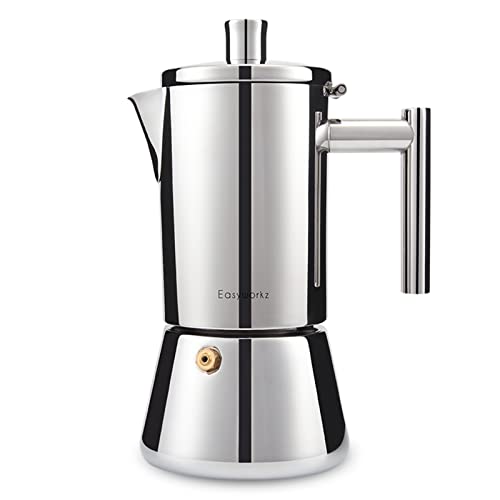
The Easyworkz Diego in the four-cup size is a stainless steel Italian coffee maker that brews about 6.8 ounces and states induction compatibility directly in its listing. Diego is Easyworkz’s moka line, built from stainless steel with a magnetic base, and the four-cup model is the direct counterpart to the Bialetti Venus four-cup, at a similar size and capacity. The design is a clean, modern take on the moka shape, with a polished steel body, a handle that stays cool, and a straightforward two-chamber construction that disassembles for washing.
On an induction cooktop, the Diego heats evenly and comes up to pressure at a medium setting, with the same listen-for-the-gurgle technique as any moka pot. The four-cup size suits a couple, and the stainless body means the pot can be used on any hob in the house, not only induction. For a shopper choosing between the Bialetti and the Easyworkz four-cup models, the difference is mostly maker and styling: the coffee is the same rich moka brew, and the induction compatibility is the same stainless magnetic base. The Diego is the right pick when its styling or its listing suits the kitchen better.
Strengths:
- Stainless steel with a magnetic base, induction-compatible by design.
- Four-cup size suits a couple and heats quickly on induction.
- Clean modern styling with a polished steel body and a cool handle.
Trade-offs:
- Four cups cannot serve a larger household in one brew.
- A newer maker with a shorter track record than Bialetti.
- Needs the same fine grind and gentle heat as any moka pot, which takes practice.
Who it fits: couples who want a modern-looking induction moka pot, and shoppers choosing on styling as much as on maker.
Best for: daily brewing for two with a modern look. / Not suited for: large households or cooks who want the longest-established maker.
5. Easyworkz Diego Stovetop Espresso Maker, 6 Cups
Check price on Amazon: Easyworkz Diego 4 Cups

The Easyworkz Diego in the six-cup size brews about 10 ounces of moka coffee, enough for three small cups or two generous ones, and it carries the same stainless steel induction-ready construction as the four-cup model. The larger base couples well to an induction element, and the extra capacity means a small household can brew once instead of twice. The polished steel body, cool handle, and two-chamber design are the same, scaled up, and the pot disassembles for washing in the same way.
A six-cup pot needs a gentler hand on the heat than a four-cup one, because the larger volume takes longer to reach pressure and the temptation to turn the heat up is stronger. A medium induction setting and a little patience produce a better cup than a high setting and a rushed brew, because overheated coffee turns bitter and the pot can sputter. For a household of three or four coffee drinkers, the six-cup Diego is the right size, and its induction compatibility means it works on the cooktop the household already owns.
Strengths:
- Six-cup capacity serves a small household in a single brew.
- Stainless steel with a magnetic base, induction-compatible by design.
- Polished modern styling that suits a contemporary kitchen.
Trade-offs:
- Larger volume takes longer to brew and needs a gentler heat.
- Too large for a single drinker who wants a quick solo cup.
- A newer maker with a shorter track record than Bialetti.
Who it fits: small households that brew together, and cooks who want a modern six-cup pot for induction.
Best for: households of three or four coffee drinkers. / Not suited for: single drinkers or very small induction elements.
6. Easyworkz Diego Stovetop Espresso Maker, 12 Cups
Check price on Amazon: Easyworkz Diego 6 Cups
The Easyworkz Diego in the twelve-cup size brews about 17.5 ounces, the largest capacity in this guide, and it is the pot for a gathering rather than a daily brew. A twelve-cup moka pot serves a group in one go, which matters when the kitchen is full and the coffee needs to keep up with the conversation. The construction is the same stainless steel with a magnetic base as the smaller Diego models, and the listing states induction compatibility directly, so the large base couples to a full-size induction element and heats the whole volume evenly.
A pot this large needs the right element: a full-size induction zone that is close to the diameter of the base, so the heat spreads evenly rather than concentrating in the center. A small element under a large pot heats the middle first and can scorch the coffee before the edges catch up, so the match between pot and element matters more here than for any other pick in this guide. Used on the right element at a medium setting, the twelve-cup Diego produces a large round of rich moka coffee without a second brew, which is exactly what a gathering needs.
Strengths:
- Twelve-cup capacity serves a group in a single brew.
- Stainless steel with a magnetic base, induction-compatible by design.
- Same clean modern styling as the smaller Diego models.
Trade-offs:
- Needs a full-size induction element close to the base diameter for even heating.
- Too large for daily use by one or two people, and heavy when full.
- A newer maker with a shorter track record than Bialetti.
Who it fits: hosts, large households, and kitchens with a full-size induction element that can carry a large pot.
Best for: gatherings and large households. / Not suited for: daily solo brewing or small induction elements.
Best Espresso Maker for Induction Cooktops Comparison
| Espresso maker | Cups | Capacity | Material | Induction | Best for |
|---|---|---|---|---|---|
| Bialetti Venus Induction | 4 | 5.7 oz | Stainless steel | Yes | Daily brewing for two |
| Bialetti Venus Induction | 6 | 7.9 oz | Stainless steel | Yes | Small households |
| Bialetti Moka Induction | 2 | 3.4 oz | Stainless steel | Yes | Solo brewing |
| Easyworkz Diego | 4 | 6.8 oz | Stainless steel | Yes | Daily brewing for two |
| Easyworkz Diego | 6 | 10 oz | Stainless steel | Yes | Small households |
| Easyworkz Diego | 12 | 17.5 oz | Stainless steel | Yes | Gatherings |
Check price on Amazon: Easyworkz Diego 12 Cups
How to choose an espresso maker for induction cooktops
Start with size, because a moka pot brews a fixed amount and does not scale down well. Makers size their pots in small espresso cups, so a four-cup pot brews about two small mugs of moka coffee and a six-cup pot serves two or three drinkers. A pot that is too large for the household wastes coffee, while a pot that is too small means brewing twice every morning. The two-cup Bialetti suits a solo drinker, the four- and six-cup models cover most households, and the twelve-cup Diego exists for gatherings rather than daily use.
Next, check the material of the base, not just the body. Induction needs a magnetic base, so the boiler must be stainless steel with a magnetic bottom, and the listing should say so directly. A pot that only says stainless steel without mentioning induction may still have a base that does not couple to the element, so look for the words induction-compatible or suitable for all hobs before buying. The Bialetti Venus and Moka Induction lines and the Easyworkz Diego line all state induction compatibility in their listings, which is why they lead this guide.
Match the base to an induction element of a similar diameter. A pot much smaller than the element heats unevenly and can confuse the cooktop pan detection, while a pot much larger than the element heats slowly at the edges. Most induction cooktops have at least one element in the 6 to 8 inch range, which fits the four- and six-cup pots in this guide well, and a portable single-burner induction cooktop works just as well for a small pot. If the pot wobbles or the cooktop does not detect it, the base and the element are mismatched.
Look at the small details that decide daily use. A heat-resistant handle stays cool enough to hold, a safety valve is essential on any moka pot, and a reducer lets a larger pot brew a smaller amount when only one cup is wanted. Cleaning matters too: Bialetti advises rinsing the Venus and Moka Induction by hand with water only, while the Easyworkz Diego tolerates the dishwasher, so a household that hates hand-washing should weigh that difference. None of these details changes the coffee, but all of them change the routine around it.
Why aluminum moka pots do not work on induction
Induction cooking works by creating a magnetic field that heats the cookware itself, and that field only grips magnetic materials. Stainless steel with a magnetic base couples to the field and heats quickly and evenly. Aluminum does not, because it is not magnetic, so an aluminum pot on an induction cooktop stays cold while the cooktop waits for a pan it can heat. The classic Bialetti Moka Express is aluminum, which is why it has brewed on gas and electric hobs for generations but cannot brew on induction at all. That is not a flaw in the Moka Express; it was designed before induction existed, and it remains a fine pot for gas and electric hobs. It is simply the wrong tool for an induction cooktop.
The test is simple and takes seconds. Hold a magnet to the base of any moka pot: if it sticks firmly, the pot will work on induction. If it slides off, the pot will not. Every model in this guide passes that test, because each is stainless steel with a magnetic base. When shopping, check the listing for the words induction-compatible and stainless steel, and be wary of any listing that says suitable for all hobs without naming induction specifically, because that phrase sometimes means gas, electric, and ceramic only. A pot that is truly induction-ready will say so plainly, and its base will be flat, so it sits evenly on the glass and couples cleanly to the element.
Base size matters as much as material. An induction element heats the area directly above it, so a pot whose base is much smaller than the element can heat unevenly, and a pot whose base is much larger than the element can heat in the center while the edges lag. The best match is a base close to the diameter of the element, which is why the two-cup and four-cup pots suit small and medium elements while the twelve-cup pot needs a full-size zone. If your cooktop has elements of different sizes, match the pot to the element that fits it best, and the coffee will be better for it.
Induction also explains why the adapter plate workaround disappoints. A plate of magnetic steel placed under an aluminum pot will heat, and the pot will eventually brew, but the plate adds a layer of metal between the element and the coffee, so the heat arrives slowly and unevenly. The cooktop cannot sense the pot through the plate the way it senses a proper magnetic base, so temperature control turns vague and the fast response that makes induction attractive is lost. A stainless steel pot with a magnetic base is the direct answer, and it costs about the same as a good adapter plate.
The same physics explains the magnet test that buyers use in stores. A magnet sticks firmly to the base of a Venus or a Diego because the steel in the boiler is ferromagnetic, and that grip is what the induction element needs to transfer energy. Hold a magnet to the base of a classic aluminum Moka Express and it slides straight off, because aluminum is not magnetic at all, and no setting on the cooktop will change that. The test takes seconds and it never lies, so it is worth doing on any pot whose listing does not mention induction directly. A pot that passes the magnet test and states induction compatibility in its listing is a safe buy for any induction kitchen.
How to brew moka coffee on an induction cooktop
Start with fresh water in the lower chamber, filled to just below the pressure valve, and a fine grind in the filter basket, leveled off without pressing it down. Pressing the grounds, a habit carried over from espresso machines, chokes a moka pot and can make it sputter or stall, so a loose, level fill is the right technique. Screw the chambers together firmly, so the seal is tight, and place the pot on an induction element close to the base diameter. A medium setting is the right heat: high heat scorches the coffee and makes it bitter, while low heat takes too long and can stall before the brew finishes.
Listen for the brew. The coffee will rise quietly at first, then gurgle as the lower chamber empties, and that gurgle is the signal to remove the pot from the heat. Leaving it on the element after the gurgle overheats the coffee and turns it bitter, so a quick removal matters more than any other step. Pour immediately, because moka coffee left in the pot continues to cook in the residual heat. Rinse the pot with hot water after it cools, without soap if the maker advises it, and let it dry fully before storing, so the seal stays fresh and the steel stays clean. The whole routine takes minutes, and after a few brews it becomes second nature.
Water quality matters more than most brewers expect. Hard tap water leaves scale in the valve and the chambers over time, so filtered water keeps the pot cleaner and the coffee clearer. The grind should be fine and even, slightly coarser than espresso and finer than drip, and a consistent grind from a burr grinder beats a random grind from a blade grinder every time. If the coffee sputters violently or the pot takes more than five minutes to brew, the grind is usually too fine or the heat is too low, and a small adjustment to either fixes it.
Common mistakes with induction moka pots
The most common mistake is buying an aluminum moka pot for an induction cooktop, which simply will not heat. The second is pressing the coffee grounds down, which chokes the brew and can make the pot sputter or stall. The third is using too high a heat, which scorches the coffee and turns it bitter; induction is powerful, and a medium setting is usually enough. The fourth is leaving the pot on the heat after the gurgle, which overheats the finished coffee. The fifth is mismatching the pot to the element, so a large pot on a small element heats unevenly and a small pot on a large element wastes energy. Match the pot to the element, use a medium heat, listen for the gurgle, and remove the pot promptly, and the coffee will be rich and smooth every time.
Two more mistakes deserve attention. The first is buying an induction adapter plate to force an aluminum moka pot onto an induction cooktop. An adapter plate works after a fashion, but it heats slowly, wastes energy, and removes the precise control that makes induction attractive in the first place, so a proper induction-ready pot is the better buy. The second is filling the lower chamber past the safety valve, which blocks the valve and can make the brew stall or spray. Keep the water below the valve, keep the filter basket level, and the pot will do the rest.
Final recommendation
For most induction kitchens, the Bialetti Venus Induction in four cups is the right first pot: stainless steel, induction-ready, and sized for one or two drinkers. A small household should take the six-cup Venus or the six-cup Diego, a solo drinker should take the two-cup Moka Induction in red, and a host should take the twelve-cup Diego for gatherings. Whichever size you choose, confirm the stainless steel and the magnetic base, match the pot to an element of a similar diameter, and brew at a medium heat. The coffee will be rich, the pot will last for years, and the induction cooktop will finally have a moka pot that belongs on it.
Frequently asked questions
Will a classic aluminum moka pot work on induction?
No. Aluminum is not magnetic, so an induction cooktop cannot heat it. The classic Bialetti Moka Express is aluminum and works on gas and electric hobs, but not on induction. For induction you need a stainless steel moka pot with a magnetic base.
How do I test whether a moka pot works on induction?
Hold a magnet to the base. If it sticks firmly, the pot will work on induction. If it slides off, it will not. Check the listing for the words induction-compatible and stainless steel as well.
What grind should I use in a moka pot?
A fine grind, slightly coarser than espresso and finer than drip coffee, leveled off in the basket without pressing it down. Pressing the grounds chokes the brew and can make the pot sputter.
Why does my moka coffee taste bitter?
Bitterness usually comes from too much heat or leaving the pot on the element after the gurgle. Use a medium induction setting, remove the pot as soon as it gurgles, and pour immediately.
Can I use a moka pot on a gas or electric hob as well?
Yes. Every stainless steel induction-compatible moka pot in this guide also works on gas, electric, and ceramic hobs, so the same pot serves any kitchen.
How do I clean a stainless steel moka pot?
Rinse with hot water after it cools, without soap if the maker advises it, and let it dry fully before storing. A periodic descale with a vinegar solution keeps the valve and the chambers clean.
What size moka pot should I buy?
Match the pot to the household. A two-cup pot serves one drinker, a four-cup pot serves one or two, a six-cup pot serves two or three, and a twelve-cup pot is for gatherings. A pot brews its full amount every time, so a pot that is too large wastes coffee and a pot that is too small means brewing twice.
Can I use an induction adapter plate with an aluminum moka pot?
It works, but poorly. An adapter plate sits between the element and the pot, heats slowly, and wastes much of the energy that makes induction efficient. A stainless steel induction-ready moka pot costs little more than a plate and brews faster, cleaner, and more evenly, so it is the better choice.
Does a moka pot make real espresso?
Not quite. A moka pot brews strong, rich coffee under gentle pressure, but it does not reach the pressure of a pump espresso machine, so it makes no true crema. The result sits between drip coffee and espresso, and it suits milk drinks and strong black coffee alike.
How long does a stainless steel moka pot last?
Years, with little care beyond rinsing. Stainless steel does not rust the way aluminum pits and dulls, and the only part that wears is the rubber seal, which is cheap and easy to replace. Rinse the pot after it cools, dry it fully before storing, descale it now and then, and a good moka pot will outlast several cooktops.
Can I brew decaf or tea in a moka pot?
Yes, with the same technique. Decaf ground coffee brews exactly like regular coffee in a moka pot, and the strong brew suits milk drinks well. Tea is a poor fit, because the fine grind and the pressure are made for coffee, and tea leaves can clog the filter basket, so a kettle or a teapot is the better tool for tea.
Related reading
For more on induction cooking, see our guides to the best 30 inch induction cooktops and the best pots and pans for induction cooktops, and our guide on how to choose a portable induction cooktop.


