The best designed cooktops prove that a cooking surface can be both a workhorse and the visual anchor of the kitchen. A well designed cooktop sits nearly flush with the counter, keeps its controls where hands naturally fall, wipes clean without a fight, and still delivers the even, responsive heat that everyday cooking depends on. The models in this guide were chosen for that balance of form and function: clean glass or stainless profiles, thoughtful control placement, sealed or smooth surfaces that resist spills, and burner layouts that fit real pots and pans rather than looking good only in a showroom photograph.
Design is not decoration here. A cooktop with a poorly placed control panel forces you to reach across hot burners. A glossy surface that shows every fingerprint will look tired within a week. A burner layout with one oversized element and three cramped ones limits what you can cook at once. This guide looks at the details that matter after the first month of use: how the surface cleans, how the controls feel, how the burners are spaced, and how the whole unit sits in the counter. Every pick below is a genuine built-in cooktop from a known brand, verified by brand and model, with a link to check the current listing.
In this guide
Quick picks: best desinged cooktops
| # | Product | Where to buy |
|---|---|---|
| 1 | Frigidaire FFEC3025UB | Check on Amazon |
| 2 | Frigidaire FFEC3625UB | Check on Amazon |
| 3 | Frigidaire Professional FPEC3077RF | Check on Amazon |
| 4 | Bosch Benchmark NITP660UC | Check on Amazon |
| 5 | Bosch 500 Series Radiant Electric Cooktop | Check on Amazon |
| 6 | Karinear 30 Inch Electric Cooktop | Check on Amazon |
How the picks were chosen
Each cooktop in this guide earned its place on design grounds first and cooking performance second, because a badly designed cooktop fails daily even when its burners are strong. We looked for a low, flush profile that meets the counter without a raised lip that traps crumbs, a control layout that stays clear of the hottest zones, and a surface material that cleans with a wipe rather than a scraper. Glass ceramic and smooth radiant surfaces scored well for their seamless look and easy wipe-down, while stainless trim earned points for hiding wear and matching other appliances.
Burner layout mattered as much as looks. A good design staggers element sizes so a large stockpot and a small saucepan can sit side by side without handles colliding, and it places the most powerful element where a cook naturally works. We favored models with at least four elements, a mix of sizes, and controls that are readable at a glance. Induction models earned a place because their flat glass surface is the cleanest visual statement a cooktop can make, and because the surface itself stays cooler and safer. Finally, every model had to be a real, currently listed built-in cooktop with a verifiable brand and model number, so the design you read about is the design you can actually buy.
Best Designed Cooktops at a Glance
The six picks below cover the main design directions for a modern kitchen: two clean Frigidaire smoothtops in different widths, a Frigidaire Professional model with stainless trim, a Bosch induction showpiece, a Bosch radiant model from the 500 Series, and a knob-controlled Karinear ceramic model for cooks who prefer tactile controls. Widths run from 30 to 36 inches, and every model sits as a built-in unit designed to blend into the counter rather than dominate it.
1. Frigidaire FFEC3025UB 30 Inch Electric Smoothtop Cooktop

The Frigidaire FFEC3025UB is the quiet classic of this guide: a 30 inch electric smoothtop cooktop with four elements in black, a flat ceramic glass surface, and controls that sit at the front where they are easy to reach without leaning over a hot pan. Its design strength is restraint. There is no raised edge, no busy trim, and no control clutter, so the unit reads as a single dark plane set into the counter. That simplicity is what makes it disappear into almost any kitchen, from a white shaker remodel to a darker modern scheme.
Four elements cover the usual spread of cooking tasks, with a dual element that expands to fit a larger pot when needed. The smoothtop surface heats evenly and, because it is flat, a spill stays where it lands instead of running into a burner bowl. Wiping it down takes a damp cloth and a minute, and the black glass hides light marks between deeper cleans. Front controls keep hands away from steam and heat, and the hot surface indicator is a small but important design touch that tells you at a glance when an element is still too hot to touch.
Strengths:
- Flat black glass surface gives a clean, unbroken look that suits nearly any counter and cabinet combination.
- Front-mounted controls stay clear of hot cookware and are easy to read and reach while cooking.
- Dual expandable element adapts to both small saucepans and larger stockpots without wasting space.
Trade-offs:
- Four elements can feel tight when several large pots are on at once, especially at holiday scale.
- Black glass shows dust and water spots, so it needs a quick wipe to keep its showroom look.
- Radiant elements take longer to cool than induction, so the surface stays hot after cooking.
Who it fits: cooks who want a tidy, affordable 30 inch built-in that looks intentional without demanding attention, and who cook for a household rather than a crowd.
Best for: clean, understated kitchens and everyday family cooking. / Not suited for: cooks who regularly run five or six pots at once or who want the fastest possible cool-down.
2. Frigidaire FFEC3625UB 36 Inch Electric Smoothtop Cooktop
Check price on Amazon: Frigidaire FFEC3025UB

The Frigidaire FFEC3625UB takes the same calm design language as its 30 inch sibling and stretches it across 36 inches, which changes the cooking experience more than the extra six inches suggest. The wider surface gives each element breathing room, so a large skillet, a stockpot, and two saucepans can share the cooktop without handles fighting for space. The black smoothtop finish keeps the whole unit looking like one continuous plane, and the added width makes the cooktop a deliberate design feature of the kitchen rather than an appliance squeezed between cabinets.
Five elements in the 36 inch layout mean a genuine multi-pot workflow: a big element for searing or boiling, mid-size elements for everyday pans, and smaller ones for sauces that need gentle heat. The control panel stays at the front, and the layout is symmetrical enough to look balanced from across the room. For a remodel where the cooktop is the centerpiece of an island or a long run of counter, the proportions of this model are hard to beat at its level.
Strengths:
- 36 inch width gives real elbow room between pots, which is the single biggest daily benefit of a wider cooktop.
- Five elements support a full multi-pot meal without crowding or handle collisions.
- Flat black glass reads as a single clean plane and pairs with almost any countertop material.
Trade-offs:
- Needs a 36 inch cutout, so it is not a drop-in replacement for a standard 30 inch opening.
- The larger glass surface takes a little longer to wipe down and shows smudges more readily.
- Radiant heat is slower to respond than induction when you need an instant drop in temperature.
Who it fits: households that cook big meals often, remodels with a wide counter run or island, and anyone who has ever wished for one more burner and a little more space.
Best for: large kitchens, frequent multi-pot cooking, and island installations. / Not suited for: standard 30 inch cutouts or small kitchens where the extra width crowds the counter.
3. Frigidaire Professional FPEC3077RF 30 Inch Electric Cooktop
Check price on Amazon: Frigidaire FFEC3625UB


The Frigidaire Professional FPEC3077RF is the dressed-up member of the family: a 30 inch ceramic glass cooktop with five burners and stainless steel trim that frames the black glass like a picture frame. The trim is not just decorative. It protects the glass edge from chips, gives the unit a finished boundary against the counter, and ties the cooktop visually to a stainless range hood or refrigerator. The result is a cooktop that looks deliberate and complete rather than simply installed.
Five burners on a 30 inch surface is a tight but workable arrangement, and the Professional line arranges them so the largest element sits where it is most useful. The ceramic glass surface wipes clean like the other Frigidaire smoothtops, and the stainless trim resists the wear that a bare glass edge can show over time. Controls are straightforward and front-facing, keeping the cooking surface itself uncluttered. This is the pick for a kitchen where the cooktop needs to look as considered as the cabinets around it.
Strengths:
- Stainless steel trim frames the glass, protects its edge, and matches other stainless appliances.
- Five burners in a 30 inch width cover more cooking tasks than a standard four-burner layout.
- Ceramic glass surface is flat, seamless, and quick to wipe clean after cooking.
Trade-offs:
- Five burners on 30 inches means tighter spacing, so very large pots can crowd their neighbors.
- Stainless trim needs occasional polishing to keep fingerprints from dulling its look.
- The professional styling carries a more formal feel that may not suit a casual or rustic kitchen.
Who it fits: remodels with stainless appliances throughout, cooks who want five burners without widening the cutout, and anyone who values a finished, framed look.
Best for: stainless kitchens and 30 inch spaces that need five burners. / Not suited for: cooks who need wide spacing between large pots or who prefer a trim-free glass look.
4. Bosch Benchmark NITP660UC 36 Inch Induction Cooktop
Check price on Amazon: Frigidaire Professional FPEC3077RF


The Bosch Benchmark NITP660UC is the most modern-looking cooktop in this guide, and its design case starts with what is not there: no knobs, no grates, no raised elements. The 36 inch black induction surface is a single sheet of glass with touch controls printed on its face, so when it is off it looks like a dark glass panel set flush into the counter. That minimalism is the whole point. Induction also brings a practical design benefit that radiant cooktops cannot match: the surface itself stays relatively cool, so a spill does not bake on and the glass wipes clean while you are still cooking.
Five induction elements give fast, precise heat, and the touch controls allow fine adjustments that a knob can only approximate. The Benchmark line is Bosch’s top tier, and the details show it: clear markings, responsive touch zones, and a layout that keeps the controls out of the way of the cooking zones. Induction needs magnetic cookware, which is the one real condition on this pick, but for a household already using stainless or cast iron, that is no obstacle at all.
Strengths:
- Knob-free glass surface is the cleanest visual statement in this guide and the easiest to wipe down.
- Induction heat is fast and precise, with instant response when you lower the setting.
- Cooler surface means spills do not bake on, so cleaning is a quick wipe rather than a scrub.
Trade-offs:
- Requires induction-compatible cookware, so aluminum or copper pans without a magnetic base will not work.
- Touch controls take a short learning curve for cooks used to the feel of a knob.
- The 36 inch width needs a matching cutout and a suitable electrical supply for induction.
Who it fits: modern kitchens, cooks who value a minimalist look and fast precise heat, and households with induction-ready cookware.
Best for: sleek modern kitchens and cooks who want the fastest, cleanest cooking surface. / Not suited for: kitchens stocked with non-magnetic cookware or cooks who strongly prefer physical knobs.
5. Bosch 500 Series 30 Inch Radiant Electric Cooktop
Check price on Amazon: Bosch Benchmark NITP660UC

The Bosch 500 Series 30 inch radiant electric cooktop is the quiet achiever of this guide: a black glass cooktop with four burner elements, including a 2,500-watt element that brings water to a boil noticeably faster than a standard radiant burner. Its design appeal is understatement. The surface is flat and unbroken, the markings are subtle, and the unit sits neatly in a standard 30 inch cutout without demanding a remodel around it. Bosch’s build quality shows in the details, from the even heating across the elements to the fit of the glass in its frame.
Four elements keep the layout simple and spacious for a 30 inch width, and the powerful element earns its place for the daily task of boiling pasta water or searing. The radiant surface is compatible with any flat-bottomed cookware, which makes it an easy replacement for an older coil or smoothtop unit without changing a single pan. For a cook who wants German engineering without the learning curve of induction or the cost of a Benchmark model, this is the sensible middle of the range.
Strengths:
- High-power 2,500-watt element boils water faster than most radiant cooktops at this size.
- Flat black glass surface is simple, tidy, and easy to wipe clean.
- Works with any flat-bottomed cookware, so no pan changes are needed.
Trade-offs:
- Four elements limit multi-pot cooking compared with five-burner models.
- Radiant elements cool slowly, so the surface stays hot for a while after use.
- The understated look may feel plain next to a statement range hood or bold backsplash.
Who it fits: cooks replacing a standard 30 inch cooktop who want a quality upgrade without changing cookware or cutout, and kitchens where quiet competence matters more than showpiece style.
Best for: straightforward 30 inch replacements and everyday cooking with any cookware. / Not suited for: large multi-pot meals or cooks who want induction speed.
6. Karinear 30 Inch Electric Cooktop With Knob Control
Check price on Amazon: Bosch 500 Series Radiant Electric Cooktop
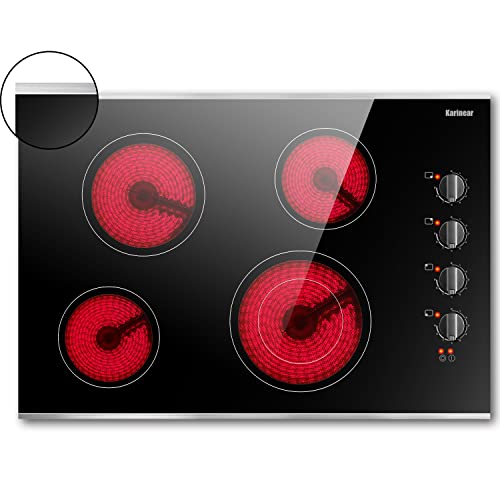
The Karinear 30 inch electric cooktop earns its place on a design point that touch-control models have abandoned: physical knobs. Four burners sit on a ceramic glass surface, and the knobs give immediate, tactile feedback that many cooks prefer, especially when hands are wet or when a quick glance is not enough to confirm a setting. The knob-controlled layout also keeps the glass surface itself free of printed touch zones, which gives the cooktop a cleaner face than many of its rivals.
As a built-in radiant ceramic cooktop, it covers the everyday range well: four burners, a flat surface that wipes clean, and a 30 inch footprint that fits the standard cutout. The design trade is clear and honest. Knobs add a small amount of visual clutter and a few more parts to clean around, but they repay that cost every time a cook adjusts the heat without looking down. For a household where several people cook, including older cooks or anyone who dislikes touch panels, that tactile certainty is a genuine design feature.
Strengths:
- Physical knobs give instant tactile feedback and work well with wet hands.
- Clean ceramic glass surface without printed touch zones looks uncluttered when off.
- Standard 30 inch built-in size fits the most common cutout without modification.
Trade-offs:
- Knobs add small crevices that need wiping and can collect grease over time.
- Four burners and radiant heat mean slower response than induction models.
- Brand support and parts availability are thinner than for the major appliance brands.
Who it fits: cooks who prefer knobs over touch controls, shared kitchens where several people need an obvious control, and budget-conscious remodels that still want a built-in glass look.
Best for: knob lovers, shared family kitchens, and budget built-in remodels. / Not suited for: cooks who want induction speed or a completely knob-free glass surface.
Best Designed Cooktops Comparison
| Cooktop | Width | Elements | Surface | Controls | Design highlight |
|---|---|---|---|---|---|
| Frigidaire FFEC3025UB | 30 inch | 4 | Black smoothtop glass | Front | Clean, unbroken plane |
| Frigidaire FFEC3625UB | 36 inch | 5 | Black smoothtop glass | Front | Wide, balanced proportions |
| Frigidaire Professional FPEC3077RF | 30 inch | 5 | Ceramic glass, stainless trim | Front | Framed, finished edge |
| Bosch Benchmark NITP660UC | 36 inch | 5 | Black induction glass | Touch | Knob-free minimalism |
| Bosch 500 Series radiant | 30 inch | 4 | Black radiant glass | Front | Understated, powerful element |
| Karinear 30 inch ceramic | 30 inch | 4 | Ceramic glass | Knobs | Tactile knob control |
Check price on Amazon: Karinear 30 Inch Electric Cooktop
How to choose a well designed cooktop
Start with the cutout. A cooktop is one of the few appliances where the existing opening decides most of the shortlist, so measure the width, depth, and the clearance to the nearest cabinet before falling for any model. A 30 inch unit fits the standard opening in most kitchens, while a 36 inch model needs both the width and the counter space to make its extra burners useful. Check the depth as well, because a unit that is slightly too deep will sit proud of the counter and spoil the flush look that good design promises.
Next, decide how you feel about controls. Touch controls give the cleanest face and the easiest wipe-down, but they ask you to look at the panel to confirm a setting. Knobs give feedback you can feel without looking, at the cost of a few more parts to clean. Front controls keep hands away from hot pans in either case, and that placement matters more than most shoppers expect. If you often reach across the cooktop to adjust a rear knob, you will notice the difference within a week.
Surface material is the third decision. Smooth glass ceramic and radiant glass wipe clean in a minute and give the seamless look most remodels want, but they show smudges and need the right cleaner to stay streak-free. Stainless trim frames the glass and protects its edge, which is worth having in a busy kitchen. Induction glass stays cooler and cleans fastest of all, but it commits you to magnetic cookware. Finally, look at the burner layout with your own pans in mind. A large element is only useful if it sits where your biggest pot naturally goes, and two large elements side by side are only useful if their handles do not collide.
Using and caring for a designed cooktop
Daily care is simple and it is what keeps a designed cooktop looking designed. Wipe the surface after it cools, using a soft cloth and a cleaner made for glass cooktops. Avoid abrasive pads, which leave fine scratches that catch the light and dull the glass over time. Lift pans rather than sliding them, especially cast iron, because dragging a heavy pan across glass is the most common cause of scratches. For induction models, the same habit matters less for heat but just as much for the glass.
Spills are easier to manage on a flat surface than on a coil or grate cooktop, but sugary spills deserve quick attention. Sugar can pit glass if it is left to cool and harden, so wipe it while the surface is still warm, using a scraper made for glass cooktops if needed. Keep the control area dry when wiping, and never spray cleaner directly onto touch controls, where liquid can seep under the panel. A few minutes of care after cooking is the whole maintenance routine, and it is what keeps the cooktop looking new for years.
Matching the cooktop to the rest of the kitchen is part of the design decision, and the range hood is the closest relationship. A cooktop with a wide, flush profile pairs best with a hood that covers the full width, because steam rises straight up and a narrow hood leaves the outer burners unvented. The backsplash matters too: a glossy tile behind a black glass cooktop reflects light and makes the whole wall feel intentional, while a matte stone or wood panel gives a softer contrast. The counter material sets the final tone. Dark counters make a black glass cooktop nearly disappear, which suits a minimalist scheme, while a light counter makes the same cooktop a visible dark band, which suits a kitchen that wants a clear focal point. None of these pairings is a rule, but thinking about them before ordering avoids the common surprise of a cooktop that is beautiful on its own and awkward in its setting.
Common mistakes when choosing a cooktop for design
The most common mistake is choosing by photograph alone. A cooktop that looks stunning in a showroom can be awkward in daily use if its controls sit behind the hottest burner or its burner spacing crowds your pans. The second mistake is ignoring the cutout: ordering a 36 inch model for a 30 inch opening, or a unit whose depth does not match the counter, turns a design upgrade into a carpentry project. Measure twice, and confirm the cutout dimensions against the model’s installation guide rather than the marketing page.
A third mistake is forgetting cookware. Induction buyers who discover their favorite pans do not work on the new surface face an unplanned second purchase, and radiant buyers who switch to a glass surface sometimes keep sliding heavy cast iron across it out of habit. The fourth mistake is underestimating cleaning. A black glass surface looks flawless on day one and shows every splash by day seven, so if you dislike wiping down, a stainless-trimmed model or a lighter finish may suit you better. Design is a daily relationship, not a first impression.
Design details worth paying attention to
Flush mounting is the first detail to check, because it decides whether the cooktop looks built in or simply placed on the counter. A truly flush installation meets the counter with almost no step, so crumbs wipe straight across the joint instead of collecting against a raised lip. Most glass cooktops can sit nearly flush when the cutout is accurate, but a cutout that is slightly too large leaves a gap that needs trim, and one that is too small leaves the unit sitting proud. The installation guide for each model gives the exact cutout dimensions, and a careful installer treats those numbers as law rather than guidance.
Trim is the second detail, and it divides opinion more than any other. Stainless trim frames the glass and protects its edge from chips, which is a real benefit in a kitchen where heavy pots are lifted on and off daily. It also gives the eye a boundary, so the black glass does not bleed visually into a dark countertop. The cost is a thin line of metal that needs wiping and can show fingerprints. Trim-free glass gives the cleanest look of all, a single dark plane with nothing to interrupt it, but it leaves the glass edge exposed and asks for more care when setting down heavy cookware. Neither choice is wrong; the right one depends on how the kitchen is used and how much polishing its owner is willing to do.
Control placement is the third detail, and it is the one most often overlooked until the first week of cooking. Front controls keep hands away from steam and hot pans, and they are readable while standing in a natural position. Side controls can work well on a wide unit, but they put the panel close to the largest burner on that side. Rear controls are the worst of the three for daily use, because reaching across a hot surface to adjust the heat is awkward and, with a large pot in the way, sometimes impossible. When comparing models, stand in front of each layout in your mind and picture adjusting the heat with a full pot on the front burner. The models that pass that test are the ones that stay pleasant to use.
Indicator lights and markings are the fourth detail. A hot surface indicator is a small light that stays on while an element is still too hot to touch, and it is worth having on any radiant or smoothtop model. Clear burner markings matter just as much: a ring that shows the true size of each element helps you center a pan, and markings that are printed rather than etched can wear over years of cleaning. Induction models solve this differently, with the control panel itself showing which zones are active, but the principle is the same. Good design communicates clearly, without making you guess.
The final detail is proportion. A 30 inch cooktop in a large kitchen can look lost between wide stretches of counter, while a 36 inch model in a compact kitchen can crowd the workspace and leave too little landing space beside it. The cooktop should relate to the counter around it, leaving enough room on at least one side to set down a hot pan or a cutting board. That landing space is part of the design too, and it is easy to forget when the focus is on the appliance itself. A cooktop that fits its space, with room to work beside it, will look better and cook better than a larger model squeezed into a space that cannot hold it.
What the best designed cooktops share
Across all six picks, a few traits repeat. The surfaces are flat and easy to wipe, the controls sit where hands naturally fall, the burner layouts respect real pots rather than theoretical ones, and the finishes are restrained enough to age well. None of these cooktops relies on a gimmick, and none of them would look dated in five years, because their design comes from restraint rather than fashion. That restraint is the real test of a designed cooktop: it should look as good after a thousand meals as it did on installation day, and it should make cooking slightly easier rather than slightly harder. The models in this guide pass that test in different ways, at different widths and different levels of technology, but they share the same idea that a cooktop is part of the kitchen, not an appliance sitting on top of it.
The shared trait is restraint. None of these cooktops shouts for attention, and none of them hides its purpose behind decoration. Each one puts the cooking surface first, keeps the controls where they belong, and lets the materials speak quietly: black glass, a stainless edge, a knob that turns with a firm click. That restraint is also what makes them age well. A cooktop designed around a passing trend looks dated when the trend moves on, while a clean plane of glass and a sensible layout still look right a decade later. Buyers who choose on those grounds rarely regret the decision, because the design keeps working long after the novelty of a new kitchen fades.
Final recommendation
For most kitchens, the Frigidaire FFEC3025UB is the right balance of clean design, sensible size, and easy care at a 30 inch width, while the 36 inch FFEC3625UB is the better choice when the counter and the cooking both run large. If the kitchen leans modern and the cookware is already induction-ready, the Bosch Benchmark NITP660UC is the most striking and the fastest of the group. The Frigidaire Professional FPEC3077RF suits stainless kitchens that need five burners in a 30 inch space, the Bosch 500 Series is the quality-first replacement for a standard opening, and the Karinear is the honest pick for cooks who simply want knobs. Whichever you choose, measure the cutout, check your cookware, and pick the design you will still enjoy wiping down a year from now.
Frequently asked questions
What makes a cooktop well designed?
A well designed cooktop combines a flush fit with the counter, controls placed where hands do not cross hot burners, a surface that wipes clean quickly, and a burner layout that fits real pots without crowding. Looks matter, but the design has to work every day.
Is a 36 inch cooktop better than a 30 inch model?
It is better when you cook with several large pots at once and have the counter width to support it. For a standard kitchen and everyday meals, a 30 inch model with a good layout is usually enough, and it fits the most common cutout.
Does black glass show every mark?
Black glass shows dust and water spots more than a lighter finish, but a quick wipe with a glass cooktop cleaner keeps it looking clean. The trade-off is the sleek, seamless look that black glass gives to the whole kitchen.
Are touch controls or knobs better?
Touch controls give a cleaner surface and are easier to wipe, while knobs give tactile feedback that works well with wet hands and without looking. The better choice depends on who cooks and how they like to work.
Do I need new cookware for an induction cooktop?
Induction needs magnetic cookware, so stainless steel and cast iron usually work while aluminum and copper without a magnetic base do not. A magnet test on the base of each pan tells you in seconds whether it will work.
Can I replace a coil cooktop with a glass smoothtop?
Yes, in most cases a glass smoothtop fits the same 30 inch cutout as an older coil model, but check the cutout dimensions and the electrical supply first. Some older installations need a small adjustment to the opening or the wiring, and the installation guide for the new model gives the exact requirements.
How do I keep a black glass cooktop looking new?
Wipe it after every use once it has cooled, use a cleaner made for glass cooktops, and lift pans instead of sliding them. A scraper made for glass cooktops handles the occasional burnt spill, and avoiding abrasive pads prevents the fine scratches that dull the surface over time.
Do well designed cooktops cost more than plain ones?
Not always. Design shows up at every level in this guide, from the Karinear ceramic model to the Bosch Benchmark induction cooktop, and the difference usually follows size, fuel type, and features rather than looks alone. A clean glass surface and front controls cost little to make, so a modest model can look better than a costly one with a cluttered layout. Compare the layout and the finish first, and let the feature list decide the rest.
Should the cooktop match the other appliances?
Matching finishes help a kitchen look planned rather than assembled, so a black glass cooktop pairs naturally with black ovens and dishwashers, while stainless trim ties in with a steel range hood or refrigerator. An exact match matters less than a consistent finish family, and a cooktop with a clean face fits in even when the brands differ. Choose the finish you can live with for years, not the one that matches a single appliance.
Related reading
For more on cooktop sizes and layouts, see our guides to the best 30 inch electric cooktops and the best 30 inch electric cooktops by size, and our overview of cooktops and wall ovens for remodels that split the range into two pieces.


