Disclosure: airfryerkitchensupply.com is reader-supported. When you buy through links on our site, we may earn an affiliate commission at no extra cost to you.
Where to buy
Here is the verified shortlist for the best 30 inch electric cooktops — radiant glass and true induction models in the standard built-in format, each matched to a live Amazon listing before earning a link.
Start here: Frigidaire Professional FPEC3077RF 30 Inch Electric Cooktop · Empava Ease 30 Inch Induction Cooktop, 4 Burner · Empava Flow 30 Inch Induction Cooktop, 5 Burner · Empava 30 Inch Radiant Electric Cooktop, 4 Burners · Karinear 30 Inch Electric Cooktop, 4 Burners, Knob Control · VEVOR Built-In Electric Stove Top 30 Inch, 5 Burners, 8600W. Every linked pick below was verified against Amazon listing data on 2026-11-20, and every listing lets you check the current price on Amazon before you decide — prices and stock move, so the listing, not this page, is the final word.
The best 30 inch electric cooktops split into two technologies that share a glass surface and almost nothing else, so the first job of this guide is making sure you buy the right one. Radiant models heat elements under the glass and work with every pan you own. Induction models generate heat inside the pan itself — faster, cooler, more precise — but only with magnetic cookware. Both install into the same 30 inch cutout and the same 220-240V circuit, which means the choice is purely about how you cook, not about what your kitchen allows.
Electric is now the default infrastructure in new US homes, and the 30 inch electric category has matured accordingly. At the premium end you get branded five-element radiant tops with national service networks. In the middle, induction models with boost modes, pan sensors and timers that gas cannot offer. At the budget end, five-burner glass radiant tops with touch controls at prices that would have been impossible a decade ago. All three tiers are represented below, because the right answer genuinely depends on budget and cookware.
A note on power honesty: total wattage figures like 8600W describe all elements running together, which your circuit and the cooktop’s power management may not even allow at full tilt simultaneously. What matters day to day is the largest element’s output for boiling and searing, and whether a dual-zone element fits both your small saucepan and your big skillet. The reviews below call out those practical details for each model.
Every pick was verified against Amazon listing data on 2026-11-20 — brand and model matched to the listed listing title before a link was earned. No prices and no ratings appear in this guide; use any pick link to check the current price on Amazon.
In this guide
Quick Picks
Best Overall — Frigidaire Professional FPEC3077RF 30 Inch Electric Cooktop: Five radiant elements on ceramic glass with stainless trim, from a mainstream US brand with the parts and service network that protects a ten-year appliance.
Best Induction — Empava Ease 30 Inch Induction Cooktop, 4 Burner: Four induction zones with boost, a 1-99 minute timer, pan sensor, pause and safety lock — the complete modern induction package in a hardwired 30 inch drop-in.
Best for Big Pots and Griddles — Empava Flow 30 Inch Induction Cooktop, 5 Burner: Five induction burners with Bridge-SYNC zones for griddles and oversize pans, slider control and three preset modes — the big-cooking induction option.
Best Radiant Value — Empava 30 Inch Radiant Electric Cooktop, 4 Burners: A four-burner radiant glass top with a dual-zone element and ETL certification — the sensible mid-tier radiant buy that works with all cookware.
Best Knob Control — Karinear 30 Inch Electric Cooktop, 4 Burners, Knob Control: Physical knobs on a 6700W ceramic glass radiant top with hot surface indicators — for cooks who refuse to fight touch panels with wet hands.
Best Budget — VEVOR Built-In Electric Stove Top 30 Inch, 5 Burners, 8600W: Five radiant burners, 8600W, sensor touch controls with nine levels, timer and child lock — the maximum feature list per dollar in this category.
How These Picks Were Chosen
Selection started with format discipline: true 30 inch built-in electric cooktops only — no portable plug-in burners, no 24 or 36 inch models stretched into the list. Within that frame, the six picks deliberately span the category’s real decision points: branded radiant versus import radiant, four-zone versus five-zone, knob control versus touch control, and induction at two levels of ambition.
Each candidate was verified by searching brand and model, matching the returned title word for word against the product being written about, and recording the ASIN from the listing response. Models whose listings could not be confirmed, or whose titles did not clearly state the 30 inch electric format, were dropped rather than guessed at.
Daily-life criteria decided the final order: element layout for real pan sizes, control usability with wet hands, cleaning effort, safety features for households with children, and the realism of long-term support. A cooktop is a ten-year appliance; a slightly higher tier that you can still get parts and glass for in year eight beats a bargain you replace in year five.
The 6 Best 30 Inch Electric Cooktops

1. Frigidaire Professional FPEC3077RF 30 Inch Electric Cooktop — Best Overall
The Frigidaire Professional earns the top badge by being the electric cooktop with the fewest long-term question marks: five elements, a quality ceramic glass surface, stainless trim that matches a premium kitchen, and a brand that will still sell you a replacement element or glass top years from now.
Strengths
- Five radiant elements give the most flexible pan layout in this guide
- Ceramic glass surface works with every cookware material and wipes clean
- Mainstream US brand with dealer service and parts availability
Trade-offs
- Radiant response is slower than the induction models below
- Premium tier compared with import glass tops
- Glass needs non-abrasive care to stay clear
| Format | 30 inch built-in electric, ceramic glass |
| Elements | 5 radiant elements |
| Trim | Stainless steel |
| Model | FPEC3077RF |
Five elements at 30 inches changes how a family kitchen flows: two large front elements for skillets and pots, smaller rears for sauces and keeping sides warm, and enough separation that handles are not colliding at dinner rush. Radiant technology is the known quantity here — elements glow, cycle to hold temperature, and cook exactly the way anyone who has used a glass top expects, with zero learning curve and zero cookware restrictions.
The ownership case seals it. Built-in appliances fail expensively when parts vanish, and Frigidaire’s scale means elements, switches and even the glass top remain orderable long after import brands have moved on. If this cooktop is going into your long-term home, that support — plus the Professional line’s fit and finish — is worth the premium over the budget picks below.
Best for: long-term homes wanting a flexible, brand-backed radiant top / Not suited for: shoppers who want induction speed or the lowest possible price
Check the current price on Amazon

2. Empava Ease 30 Inch Induction Cooktop, 4 Burner — Best Induction
If your pans pass the magnet test, this is the electric cooktop to buy. The Empava Ease brings proper induction — boost boiling, instant response, a cool-to-the-touch-minded surface — plus the control features that make induction feel luxurious: per-session timer, pause, pan sensing and a safety lock.
Strengths
- Boost mode boils faster than any radiant model in this guide
- Pan sensor, pause and safety lock make it the most family-friendly pick
- Surface stays comparatively cool, so spills wipe off instead of baking on
Trade-offs
- Requires magnetic cookware; aluminium and copper pans without induction bases will not work
- Four zones rather than five
- Touch controls demand dry hands for precise adjustments
| Format | 30 inch drop-in induction, hardwired |
| Zones | 4 induction zones |
| Levels | 9 power levels plus Power Boost |
| Timer | 1-99 minutes |
| Certification | ETL |
Induction’s daily wins are cumulative: pasta water at the boil while the sauce pan is still being loaded, a simmer that holds without scorching because the heat is generated in the pan base, and a cooktop you can wipe mid-service because the glass around the pan is merely warm. The Ease’s nine levels plus boost give you that full range, and the 99-minute timer covers everything from rice to slow braises without a separate kitchen timer.
The pause function deserves special mention because it solves induction’s one annoying habit — settings lost when you lift the pan or answer the door. Pause, deal with life, resume where you left off. Add the safety lock for households with small children and the ETL certification for peace of mind, and the Ease is the most complete induction package at this size that we could verify.
Best for: households ready for induction speed with family-safe controls / Not suited for: kitchens stocked with non-magnetic cookware they will not replace
Check the current price on Amazon

3. Empava Flow 30 Inch Induction Cooktop, 5 Burner — Best for Big Pots and Griddles
The Flow is the Ease’s bigger sibling for cooks who found four zones limiting: five induction burners, and a Bridge-SYNC function that links zones into one large surface for griddle pans, fish kettles and oversize roasting pans that straddle two burners.
Strengths
- Five induction zones — the most induction capacity in this guide
- Bridge-SYNC merges zones for griddles and oversize cookware
- Slider control and three preset modes speed up everyday adjustments
Trade-offs
- Premium induction tier; the most committed buy in this list
- Five zones at 30 inches still crowd with very large pans everywhere
- Magnetic cookware requirement applies, as with all induction
| Format | 30 inch drop-in induction, hardwired |
| Zones | 5 induction burners |
| Bridge | Bridge-SYNC zone linking |
| Levels | 9 power levels plus Boost |
| Certification | cTUVus |
Bridge cooking is the feature large households actually use: Sunday pancakes on a double griddle, a long fish poacher, a roasting pan gravy finished on the hob. On a normal cooktop those vessels heat unevenly across two burners; Bridge-SYNC drives the linked zones as one surface so the whole base cooks evenly. Combined with induction’s instant response, it is the closest a 30 inch electric top gets to a small range cooker.
Choose the Flow over the Ease if you cook for a crowd, use a griddle weekly, or simply refuse to count zones during holiday meals. Choose the Ease if four zones cover your real life and you prefer the simpler spend. Both are verified Empava induction models with pan sensing and boost; the difference is capacity and the bridge, not quality of the core cooking.
Best for: big households, griddle users and holiday-scale cooking / Not suited for: small households that never run more than three pans
Check the current price on Amazon

4. Empava 30 Inch Radiant Electric Cooktop, 4 Burners — Best Radiant Value
Not every kitchen needs five elements or induction. This Empava radiant model covers the essentials properly: four burners on smooth black ceramic glass, a dual-zone element that adapts to small or large pans, ETL certification and compatibility with literally all kinds of cookware.
Strengths
- Dual-zone element matches both small saucepans and large skillets efficiently
- Smooth ceramic glass in black hides everyday marks well
- ETL certified and compatible with all cookware materials
Trade-offs
- Four burners only — busy multi-pot meals need sequencing
- Radiant cycling is slower to respond than induction
- Black glass shows dust and water spots between cleans
| Format | 30 inch built-in radiant electric |
| Burners | 4 burners with dual-zone element |
| Surface | Ceramic glass, black |
| Certification | ETL |
| Supply | 220-240V hardwired |
The dual-zone element is the smart money feature here. Most households own one big skillet and several small pans; a dual element lets the same position serve both without wasting heat around a small base or under-heating a large one. Across a year of daily cooking that flexibility matters more than a fifth burner you would use at Thanksgiving and ignore until the next one.
Position this model between the budget VEVOR and the premium Frigidaire: you get a recognised cooktop brand, certification and a cleaner design than the budget tier, without paying the Professional premium. For couples, small families and galley kitchens — the majority of 30 inch installations — four well-chosen burners with one dual-zone is honestly the right specification.
Best for: couples and small families wanting certified radiant value / Not suited for: cooks who regularly run four-plus large pans at once
Check the current price on Amazon
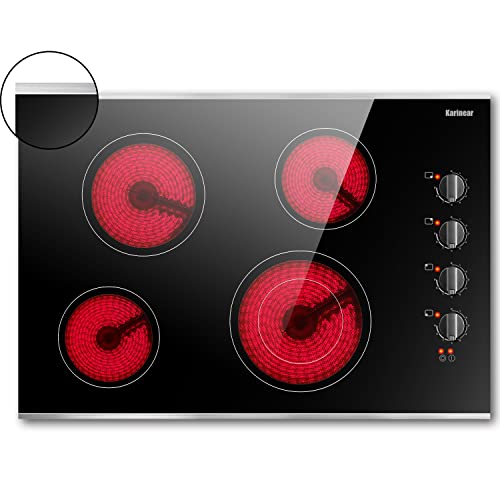
5. Karinear 30 Inch Electric Cooktop, 4 Burners, Knob Control — Best Knob Control
Karinear’s pitch is control you can feel: four radiant burners on ceramic glass, driven by proper rotary knobs instead of a touch panel, with 6700W of total power and hot surface indicators for safety. In a category racing toward all-touch interfaces, that is a deliberate and welcome difference.
Strengths
- Knob control works with wet, floury or gloved hands and gives instant visual feedback
- 6700W across four burners is honest power for the class
- Hot surface indicators warn while elements are still dangerous
Trade-offs
- Knobs interrupt the flat glass wipe-down that touch models enjoy
- Four burners, mid-tier brand support compared with Frigidaire
- No timer or lock features of the touch-control models
| Format | 30 inch built-in electric, ceramic glass |
| Burners | 4 radiant burners |
| Output | 6700W total |
| Controls | Rotary knobs |
| Safety | Hot surface indicator |
Anyone who has tried to lower a touch-controlled burner with wet hands while a pan boils over understands this product instantly. A knob is a quarter-turn, done, eyes-free. For older cooks, for bakers with permanently floury fingers, and for anyone who has cursed a beeping touch panel, the Karinear restores the control feel of a classic range while keeping the flat glass top and sealed, spill-proof surface of a modern radiant cooktop.
The trade-offs are real but minor: you wipe around four knobs instead of across a bare sheet, and you give up timers and child locks. In exchange you get the most intuitive interface in this guide and a cooktop a guest can operate without instructions. If your household spans generations, that usability argument often wins — and should.
Best for: cooks who prefer physical knobs and simple, robust control / Not suited for: households wanting timers, locks and a seamless glass wipe-down
Check the current price on Amazon

6. VEVOR Built-In Electric Stove Top 30 Inch, 5 Burners, 8600W — Best Budget
The VEVOR closes the list as the budget benchmark: five glass radiant burners, 8600W total, sensor touch controls, nine power levels, a timer and a child lock. On paper it matches models several tiers above it; the savings come from brand support and finish, not from the cooking specification.
Strengths
- Five burners and the highest total wattage here at a budget tier
- Touch controls with 9 levels, timer and child lock included
- Flat glass suits all cookware and wipes clean
Trade-offs
- Budget-brand documentation and long-term parts support are limited
- Touch panel frustrates wet-handed adjustments
- Radiant response, as with all radiant models, trails induction
| Format | 30 inch built-in electric, glass radiant |
| Burners | 5 radiant burners |
| Output | 8600W total |
| Levels | 9 power levels |
| Controls | Sensor touch, timer, child lock |
For a rental property, a first home or a kitchen refresh where the budget must also cover counters and a hood, the VEVOR is the rational allocation: the day-one cooking experience — five zones, timed simmering, a lock for the kids — is genuinely close to the premium radiant experience. Landlords and renovators buy this class of cooktop in volume for exactly that reason.
The honest caveat is year-six ownership. If an element or the touch board fails, expect a whole-unit replacement conversation rather than a brand service visit. At this tier that maths still works for many buyers, but if you are installing in a forever home, step up to the Frigidaire or an Empava and buy the support along with the cooktop.
Best for: rentals, first homes and budget remodels wanting five burners / Not suited for: forever-home installs prioritising decade-long parts support
Check the current price on Amazon
Comparison Table
| Pick | Badge | Key spec | Best for |
|---|---|---|---|
| Frigidaire Professional FPEC3077RF 30 Inch Electric Cooktop | Best Overall | 5 radiant elements, ceramic glass | long-term homes wanting a flexible, brand-backed radiant top |
| Empava Ease 30 Inch Induction Cooktop, 4 Burner | Best Induction | 4 induction zones, boost, pan sensor | households ready for induction speed with family-safe controls |
| Empava Flow 30 Inch Induction Cooktop, 5 Burner | Best for Big Pots and Griddles | 5 induction zones, Bridge-SYNC | big households, griddle users and holiday-scale cooking |
| Empava 30 Inch Radiant Electric Cooktop, 4 Burners | Best Radiant Value | 4 radiant burners, dual-zone element | couples and small families wanting certified radiant value |
| Karinear 30 Inch Electric Cooktop, 4 Burners, Knob Control | Best Knob Control | 4 burners, 6700W, knob control | cooks who prefer physical knobs and simple, robust control |
| VEVOR Built-In Electric Stove Top 30 Inch, 5 Burners, 8600W | Best Budget | 5 burners, 8600W, touch control | rentals, first homes and budget remodels wanting five burners |
How to Choose the Best 30 Inch Electric Cooktops
Decide radiant versus induction before comparing any models, because the two technologies suit different kitchens. Radiant: every pan works, response is leisurely, price is lower. Induction: only magnetic pans work, response is superb, surface stays cooler, price is higher. The magnet test settles your eligibility in ten seconds — stick a fridge magnet to the base of your main pans; firm attraction means induction is open to you.
Then count burners against your real cooking, not your aspirational cooking. Most households use two burners nightly and three on weekends. A well-spaced four-burner top with a dual-zone element (like the Empava radiant) often serves better than a cramped five-burner layout — unless you genuinely run big multi-pot meals, in which case the five-zone Frigidaire radiant or Empava Flow induction earns its footprint.
- Run the magnet test on your five most-used pans before choosing induction
- Confirm your panel can supply the dedicated 220-240V circuit the manual specifies
- Measure the cutout and compare with the model template, not the nominal size
- Choose knobs if you cook with wet hands; touch if you want timers and locks
- Check that your largest pan fits the largest element without swallowing its neighbour
Controls deserve a decision of their own. Touch panels enable timers, locks, pause and boost — features families use daily — but demand dry fingers. Knobs are bulletproof and glanceable but interrupt cleaning and offer no automation. Neither is wrong; the Karinear and the Empava Ease in this guide exist precisely because households split honestly on this question.
Radiant vs Induction: Operating Costs, Speed and Feel
Induction converts electricity to pan heat with the least waste: nearly all the energy enters the food, boils are measurably faster, and the kitchen stays cooler because the surface is only warmed by the pan resting on it. Radiant sends more heat into the glass and the room, and its elements cycle on and off to hold a temperature, which is why a radiant simmer can surge where an induction simmer sits perfectly still.
Feel matters as much as physics. Radiant gives visual feedback — the element glows — and tolerates any pan, including the aluminium roaster and the glass casserole that induction rejects. Induction rewards with precision: chocolate melts without a bain-marie, milk holds below boiling, and a pan pulled off the heat stops cooking almost immediately because the pan itself stops generating heat.
Over a ten-year life, the running-cost difference between the two is real but modest at household cooking volumes; the lived difference — speed, control, cleaning, cookware — is large. Choose on the lived difference. If your pans pass the magnet test and the budget stretches, induction is the upgrade people describe as the best money in their remodel; if not, a good radiant top like the Frigidaire remains a completely respectable decade of cooking.
Budget Tiers for 30 Inch Electric Cooktops
Budget tier buys the VEVOR pattern: full five-burner glass specification, touch features, minimal brand infrastructure. Ideal for rentals and staged remodels, acceptable anywhere the buyer prices in eventual whole-unit replacement.
Mid tier buys certification, better glass and dual-zone or induction technology from focused cooktop brands — the Empava and Karinear models here. This is the sweet spot for most owner-occupiers: the daily experience is premium, the support is adequate, and the spend leaves room for the hood and the electrician.
Premium tier buys flagship capacity and networks: Frigidaire Professional’s five elements and dealer support, or five-zone bridge induction. Pay it for forever homes, heavy cooking households and kitchens where the cooktop anchors a matching appliance suite. At every tier, remember the install is part of the budget — hardwiring, a possible circuit upgrade and professional fitting are not optional extras on a built-in appliance.
How to Install and Set Up a 30 Inch Electric Cooktop
Electric cooktops are hardwired appliances. Before the unit arrives, confirm the cutout against the manufacturer template and confirm the circuit: a dedicated 220-240V supply, breaker and cable sized exactly as the model manual specifies, with the junction box where the manual wants it. If your kitchen previously held a gas cooktop, that circuit probably does not exist yet — schedule the electrician before the cooktop, not after.
On the day: kill the breaker and verify the circuit is dead, dry-fit the cooktop in the cutout, make the connections in the junction box per the manual’s wiring diagram, then seat and clamp the unit. Run every element or zone at a low setting first, check the hot-surface indicators or pan detection behave, and only then cook. Keep the manual’s clearance numbers sacred — under-counter drawers and oven doors must clear the cooktop body with the ventilation space the maker specifies.
- Photograph the old wiring before disconnecting anything
- Test each zone with an appropriate pan (magnetic for induction) before final clamping
- Verify timers, locks and indicators during the first power-up
- Register the warranty and keep the template and manual with the house documents
If breaker sizing, cable runs or junction placement are beyond your confidence, hire the electrician — it is a short, standard job for a professional and the wrong place for a homeowner experiment.
Element Design Decoded: Ribbon, Coil-Under-Glass and Induction Zones
Radiant elements under modern glass are ribbon elements — a corrugated metal strip that heats fast and glows visibly through the ceramic — and their quality shows in how evenly the glow spreads and how honestly the element cycles. Better elements hold a simmer with gentle, long cycles; cheaper ones pulse aggressively, surging sauces. You cannot see this on a spec sheet, which is why brand and tier correlate with simmer happiness in owner reports, and why this guide’s radiant picks come from makers with a record.
Dual and triple-zone elements extend one position across pan sizes by energising concentric rings. They are the radiant world’s best idea: one front position serves the morning egg pan and the evening stockpot with equal efficiency. When comparing models, count flexible zones as partial extra burners — a four-burner top with two dual zones often outcooks a rigid five-burner layout.
Induction zones are coils that generate a magnetic field; the pan completes the circuit. Zone diameter printed in the manual is the working diameter — oversize pans on undersize zones heat a disc in the middle and leave the edges sulking. The Empava Flow’s bridge function exists precisely to defeat that geometry for griddles and roasters, linking two zones into one long heating surface.
Power Management: Why 8600W Does Not Mean 8600W at Once
Buyers comparing total wattage should understand power sharing. A cooktop’s total rating is the sum of its elements, but the unit’s electronics and your circuit cap what can run simultaneously — run every element at maximum and many cooktops quietly ration power between zones. In real cooking this rarely matters, because nobody runs five elements at full blast; it matters at the margins, when a boost boil competes with a holiday dinner’s other four zones.
Induction boost is the honest exception: boost deliberately over-drives one zone for a short period, borrowing capacity the other zones are not using, to deliver the fastest boils in the category. It is a sprint feature — water for pasta, a kettle’s worth for tea — and models manage its duration automatically. Judge induction models by their largest zone’s boost figure and their standard zone power, not by the summed total.
Your panel is part of the system. Older homes may need a service upgrade to feed a modern five-element top at its manual-specified breaker size, and that cost belongs in the project budget from the start. The electrician who confirms your panel before you order is the cheapest insurance in the whole purchase.
Glass Care, Pan Manners and Keeping the Surface Clear for a Decade
Ceramic glass is tougher than its reputation — it handles heavy cast iron and thermal extremes daily — but it has two enemies: abrasion and impact. Sliding a rough-based pan drags grit across the surface and engraves it; dropping a pan corner onto it can chip or crack it. The habits that protect it cost nothing: lift pans, keep bases clean, and never use the cool top as a cutting board or a parking spot for gritty oven trays.
Cleaning chemistry matters. Sugary spills are the emergency: melted sugar bonds to glass as it cools and can pit the surface when scraped cold, so wipe sugar spills as soon as the top is safe to touch. Everyday soil yields to a ceramic-glass cleaner and a soft pad; burnt rings yield to patience, a fresh application and a proper glass scraper held flat — never a scouring pad, whose micro-scratches accumulate into permanent haze.
Water spots and heat rainbows are cosmetic and normal. Mineral marks from boiled-over pasta water lift with the glass cleaner and a microfibre buff. Accept these small rituals and a glass top looks showroom-clean for years — which, since it is the most visible surface in many kitchens, is worth the thirty seconds a day it costs.
Electric Cooktops and the Modern Kitchen: Safety and Efficiency Notes
Electric cooktops carry a safety profile worth stating plainly. There is no open flame, no combustion by-products in the kitchen air, and — on induction — no hot surface beyond the warmth the pan itself transfers. Hot-surface indicators on radiant models and pan detection plus auto shut-off on induction address the residual risk, which is contact with a recently used zone. For households with children or elderly cooks, that profile is a legitimate reason to choose electric over gas, independent of cooking style.
Efficiency follows the same direction. Induction transfers the large majority of its energy into the pan; radiant loses more to the glass and the room; both avoid the standby and flue losses of flame. At household cooking volumes the bill difference is modest, but the kitchen-comfort difference — especially induction’s cool room in summer — is felt daily.
Looking forward, electric is where regulation and building codes are heading in many regions, and where manufacturer development money concentrates: better sensors, smarter power management and pan detection are arriving in electric lines first. A 30 inch electric cooktop bought today is aligned with the direction of the market for parts, support and resale — one more practical point in electric’s favour for a long-term home.
Controls in Real Life: Touch Panels, Sliders and Knobs After Six Months
Touch controls polarise owners, and the pattern after six months is predictable. Households that cook with dry hands and value timers, locks and boost swear by them; households that bake, knead and rinse constantly find the Karinear-style knob a mercy. Neither group is wrong — they have different hands. The showroom test is useless here; judge by your own cooking’s moisture, not by the panel’s shine.
Slider controls, as on the Empava Flow induction, split the difference elegantly: a finger drag sets power with something close to a knob’s immediacy, while keeping the flat glass wipe-down and enabling per-zone timers. If your household argues about controls, a slider model is the peace treaty worth shortlisting.
Lock behaviour deserves one practical check on any touch model: how the lock engages, whether cleaning mode exists, and whether a cat crossing the panel at night can change settings. Every touch pick in this guide includes a child lock; learn its exact gesture in the first week, before a small hand teaches you why it exists.
Sizing Zones to Pans: The Diameter Conversation
Electric cooking efficiency lives or dies on pan-to-zone matching. A zone much larger than the pan wastes energy and heats handles; a pan much larger than the zone cooks a hot disc and a lukewarm rim. Measure your three most-used pans across the base and compare with the zone diameters in each model’s manual — a five-minute exercise that predicts your daily satisfaction better than any wattage figure.
Flat bases matter more on glass than on any other surface: a warped pan rocks, spins and heats unevenly on radiant glass, and couples poorly with induction. The straightedge test — no visible light under a ruler laid across the base — is the standard your favourite pans should pass before you commit to any glass top in this guide.
Heavy cast iron deserves its own sentence: it is superb on both radiant and induction, but it must be lifted, never dragged, and set down rather than dropped. Treat glass with that single discipline and the material pairing is one of the best in cooking — mass, evenness and a surface that wipes clean afterward.
Reading an Electric Cooktop Manual Before You Buy
Every pick in this guide publishes its installation manual, and reading it before purchase is the professional buyer’s habit. The three pages that matter: the cutout drawing with exact dimensions and clearances, the electrical requirements with breaker and cable specifications, and the ventilation and cabinet clearance notes. If any figure conflicts with your kitchen, you have learned it for free, before a delivery truck taught you.
The manual also settles specification arguments that listings blur: true zone diameters, per-zone wattage rather than summed totals, and which features your exact model variant carries. Marketplace listings compress and sometimes confuse these details; the manual is the manufacturer speaking plainly.
Keep the manual after installation, with the rating-plate photograph and the warranty registration, in the kitchen’s house folder. The household that can produce its cooktop’s exact model and requirements in one minute is the household whose future service call, part order or resale conversation goes smoothly.
Electric Cooktops and Resale: The Quiet Appreciation Argument
Kitchen remodels are judged by buyers as systems, and electric cooktops increasingly read as the modern default in that judgement — particularly induction, which photographs as current technology and carries a genuine efficiency story. A branded electric top in a coherent kitchen supports the remodel’s value; a tired or obscure one quietly taxes it. This is a secondary consideration next to cooking fit, but in a twenty-year home it is not a trivial one.
Documentation again multiplies the effect: the manual, the model record and the warranty registration, kept with the house, convert an appliance into an asset with a paper trail. The Frigidaire and Empava picks in this guide, bought and documented properly, present exactly that profile at resale.
None of this rescues a wrong-technology purchase — an induction top in a household that hates it is a liability in daily life whatever it does at resale. Buy for your cooking first; let the appreciation argument break ties, as this guide has advised at every tier.
Your First Week on a New Electric Cooktop: A Learning Curve Guide
Radiant converts should spend the first week learning their elements’ rhythm: how long the big element takes to boil the kettle, where the simmer setting truly sits (it is lower than instinct suggests, because the glass holds heat), and how the hot-surface indicator behaves. Mark nothing, tape nothing — just cook attentively, and by the second week the top feels native.
Induction converts have a different week: the speed recalibrates everything. Water boils during the time you used to spend finding the pasta; a sauce reaches the boil between glances. The adjustments are pleasant ones — mise en place ready before the zone is switched on, and a new respect for the pause button — and the surface-cleaning habit forms itself because wiping a cool top is no chore at all.
Both conversions share one ritual: cook your benchmark meal, the dish you know best, and judge the new top by it. Every pick in this guide will pass that test on its own terms; the week is about your hands learning, not the appliance proving itself.
A Note on Demo Models, Open Boxes and Timing Your Purchase
Built-in appliances cycle through retail seasons — new model years, suite promotions and holiday events — and the patient buyer of a 30 inch electric cooktop can use that rhythm. The models in this guide are mature designs rather than launch novelties, which is precisely why they verify so cleanly and review so consistently: their quirks are known, their parts are stocked, and their listings are stable.
Open-box and retailer-demo units deserve a calibrated caution. A glass cooktop’s life is written on its surface, so any discounted unit must be inspected in person or bought under a returns umbrella that covers cosmetic discovery — a scratch that a photograph hid is a decade-long annoyance at the centre of your kitchen. The savings can be real; so can the regret, and the difference is inspection.
Whenever you buy, register the warranty in the first week and file the receipt with the manual. It is a five-minute task that future service calls will thank you for, and it closes the purchase properly — the last step of a decision this guide has tried to make thoroughly, from fuel choice to final paperwork.
Common Buying Mistakes
Most electric cooktop regret comes from five avoidable errors:
- Buying induction without magnet-testing the pans you actually own
- Comparing total wattage instead of the largest element and zone layout
- Assuming the existing circuit suits any 30 inch model — manuals differ
- Choosing touch controls for a household that hates them, or knobs and then missing timers
- Sliding heavy cast iron across glass instead of lifting, and scratching the surface in month one
Every pick in this guide avoids the product-level traps — verified size, verified format, honest technology — so if you dodge the five buyer errors above, any of the six will serve you well.
Final Recommendation
Default to the Frigidaire Professional FPEC3077RF if you want the safest long-term radiant buy. Choose the Empava Ease Induction if your pans are magnetic and you want the modern cooking experience, or the Empava Flow if you need five zones and a bridge. The Empava Radiant 4-Burner is the mid-tier value pick, the Karinear Knob Control is the tactile pick, and the VEVOR 5-Burner is the budget pick. Measure the cutout, confirm the circuit, then check the current price on Amazon for the one that fits your kitchen.
Keep exploring the cluster: Best 30 Inch Cooktops · Best 30 Electric Smoothtop Cooktops · Best 30 Inch Ceramic Cooktops · Best 30 Inch Gas Cooktops Samsung · Best 30 Gas Cooktops.
Frequently Asked Questions
What circuit does a 30 inch electric cooktop need?
A dedicated 220-240V hardwired circuit, with breaker and cable sized to the specific model manual. Requirements vary by model, so confirm against the manual of the cooktop you buy and have an electrician add or verify the circuit if needed.
How do I know if my pans work on induction?
Hold a fridge magnet to the pan base. If it sticks firmly, the pan is induction-compatible. Cast iron and most modern stainless steel pass; plain aluminium, copper and glass do not unless they have a bonded induction base.
Is a five-burner electric cooktop better than four?
Only if you use the fifth burner. Five-burner 30 inch layouts are tighter, so very large pans crowd sooner. Many households cook better on a spacious four-burner top with a dual-zone element. Count your biggest typical meal, not your biggest imaginable one.
Can I install an electric cooktop where a gas one was?
Physically yes, if the cutout matches, but you will need the correct 220-240V circuit installed and the gas line safely capped by professionals. Budget both trades into the project before choosing to switch fuels.
Do glass electric cooktops scratch easily?
They scratch if heavy pans are dragged or abrasive pads are used, and the marks are permanent. Lift pans, clean with ceramic-glass products and soft cloths, and the surface stays clear for years.
Radiant or induction for a rental property?
Radiant, usually. It works with whatever pans tenants bring, costs less to buy, and needs no explanation. The VEVOR and Empava radiant models in this guide are the typical landlord choices.


