Disclosure: airfryerkitchensupply.com is reader-supported. When you buy through links on our site, we may earn an affiliate commission at no extra cost to you.
Where to buy
Every model in this roundup is sold on Amazon and was verified against Amazon’s product data feed for this site before earning its link. Built-in cooktop prices move with promotions and freight, so no static prices are printed here — use the links to check the current price on Amazon, and confirm your cutout dimensions and circuit capacity before ordering.
- Frigidaire Professional FPEC3077RF 30 Inch Electric Cooktop — check the current price on Amazon
- VEVOR Built-In Electric Stove Top 30 Inch 5 Burners 8600W — check the current price on Amazon
- Karinear 30 Inch Electric Cooktop 4 Burners Knob Control — check the current price on Amazon
- Empava 30 Inch Radiant Electric Cooktop 4 Burners — check the current price on Amazon
- VEVOR Built-In Electric Stove Top 30 Inch 4-Burner Touch — check the current price on Amazon
- 30 Inch Built-In Electric Cooktop 4 Burner 6700W Knob Control — check the current price on Amazon
Shopping for the best 30 electric smoothtop cooktops means shopping for the default American electric cooktop — and that is a compliment. The best 30 electric smoothtop cooktops pair a flat ceramic glass deck with radiant elements: any pan works, the surface wipes clean in seconds, and the 30-inch format drops into the standard cutout most kitchens already have. Every pick below was verified through this site’s Amazon product data feed.
The real decisions inside this category are narrower than the marketing suggests. Burner count: four is standard, five is available if your cooking genuinely runs five vessels. Controls: knobs that answer wet hands, or touch glass that wipes perfectly flat and adds timers and child locks. Power: total wattage from a gentle 6700W to an 8600W five-burner deck — a figure your circuit must be able to feed. This guide ranks the strongest verified option at each of those decision points.
A smoothtop is not induction, and this guide does not pretend otherwise. Radiant glass responds more slowly and stays hot after cooking — the hot-surface indicator is a safety feature to respect, not decoration. What you get in return is total cookware freedom and the easiest-cleaning surface in cooking. If that trade suits your kitchen, one of the six decks below is your replacement.
In this guide
Quick Picks
- Frigidaire Professional FPEC3077RF 30 Inch Electric Cooktop — Best Overall: Five ceramic-glass burners and a stainless-trimmed Professional platform — the complete smoothtop package. Check the current price on Amazon.
- VEVOR Built-In Electric Stove Top 30 Inch 5 Burners 8600W — Best Five-Burner Value: Five burners, 8600W and touch controls at a value tier — the specification bargain. Check the current price on Amazon.
- Karinear 30 Inch Electric Cooktop 4 Burners Knob Control — Best with Knob Controls: Physical knobs on a 6700W ceramic deck — the control style half of buyers actually prefer. Check the current price on Amazon.
- Empava 30 Inch Radiant Electric Cooktop 4 Burners — Best Flexible Element: A dual-zone element that sizes itself to the pan — four burners that behave like five. Check the current price on Amazon.
- VEVOR Built-In Electric Stove Top 30 Inch 4-Burner Touch — Best Sleek Touch Deck: Full-glass touch style with a timer and a gentler electrical appetite. Check the current price on Amazon.
- 30 Inch Built-In Electric Cooktop 4 Burner 6700W Knob Control — Best Budget Replacement: ETL-certified knob deck at replacement-day prices. Check the current price on Amazon.
How These Picks Were Chosen
Every candidate was verified against the site’s Amazon product data feed: brand, model, 30-inch built-in format and burner count had to match the listing before the cooktop earned a link. Nothing is described from memory, and no wattage appears in this guide that a verified listing does not state.
The shortlist balances what smoothtop buyers actually weigh: burner count (four versus the rarer five), control style (knobs that work with wet hands versus seamless touch glass), total power and its circuit implications, and the support behind the badge. All picks are radiant ceramic glass — the smoothtop technology itself — so every pan you own is compatible, a point the guide returns to because it decides real purchases.
Price is discussed in tiers only. Built-in cooktop pricing shifts with promotions and freight, and a printed figure would be stale before it was useful; the links exist so you can check the current price on Amazon at the moment you buy.
The 6 Best 30-Inch Electric Smoothtop Cooktops

Frigidaire Professional FPEC3077RF 30 Inch Electric Cooktop — Best Overall
The FPEC3077RF is the reference smoothtop on the smoothtop shortlist: a ceramic glass, five-burner flat deck with stainless steel trim from Frigidaire’s Professional line. Five burners in a 30-inch electric deck is the exception rather than the rule, and it changes the cooking geometry — a centre element for the griddle or stockpot while four corners handle the supporting cast.
Radiant smoothtop cooking is the known quantity here: any flat-bottomed pan works, heat is even and forgiving, and the flat glass wipes clean in seconds — the daily-life advantage that keeps smoothtops the default electric choice. You give up induction’s instant response, and in exchange you get the legacy brand’s service network and a deck that asks nothing new of your cookware collection.
Strengths
- Ceramic glass 5-burner flat deck with stainless trim — the classic smoothtop
- Frigidaire Professional platform: parts and service nationwide
- Five burners give a centre option most 30-inch electrics lack
Trade-offs
- Radiant elements cycle on/off — less precise than induction at the low end
- Ceramic glass needs non-abrasive care to stay unmarked
- Premium tier versus value-brand radiant decks
| Specification | Detail |
|---|---|
| Burners | 5-burner ceramic glass flat deck |
| Trim | Stainless steel |
| Line | Frigidaire Professional FPEC3077RF |
Best for: Five-vessel cooks wanting a legacy-brand smoothtop / Not suited for: Induction converts wanting instant response

Check on Amazon — check the current price on Amazon before you buy; listings, bundles and included accessories change over time.

VEVOR Built-In Electric Stove Top 30 Inch 5 Burners 8600W — Best Five-Burner Value
VEVOR’s five-burner deck is the specification leader on the smoothtop shortlist: 8600W total, five radiant burners under glass, sensor touch controls, nine power levels, a timer and a child lock. If your household genuinely cooks with five vessels — a real Sunday gravy operation — this is the value route to that layout in electric.
Confirm the electrical side before ordering: 8600W is a serious load and your circuit must be sized for it. The touch controls reward dry hands and punish splashed ones, as all touch decks do. Within those truths, the capability per dollar is the strongest in this guide.
Strengths
- Five burners and 8600W — the most powerful deck in this guide
- Sensor touch controls with timer and child lock
- Nine power levels per zone for finer radiant control
Trade-offs
- Touch controls divide opinion; wet or gloved hands can struggle
- 8600W demands confirming your circuit capacity
- Glass touch surface shows every fingerprint
| Specification | Detail |
|---|---|
| Burners | 5 burners |
| Power | 8600W |
| Controls | Sensor touch, 9 power levels, timer, child lock |
Best for: Five-vessel cooks on a value budget with adequate circuits / Not suited for: Homes with limited electrical capacity
Check on Amazon — check the current price on Amazon before you buy; listings, bundles and included accessories change over time.
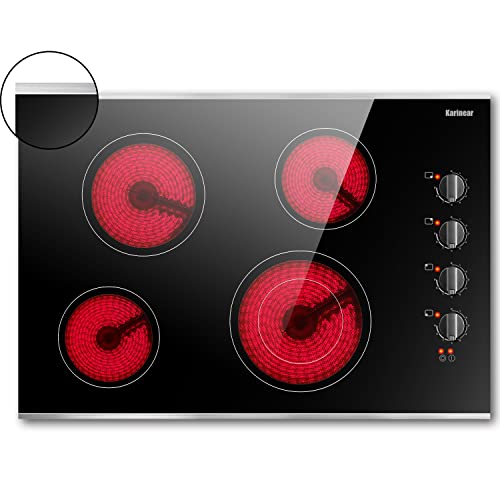
Karinear 30 Inch Electric Cooktop 4 Burners Knob Control — Best with Knob Controls
The Karinear is the knob-lover’s answer on the smoothtop shortlist: a 30-inch ceramic cooktop, 6700W across four burners, controlled by physical knobs you can turn with a wet hand, a gloved hand or without looking. In an era of touch panels that ignore damp fingers mid-sauce, that is not nostalgia — it is ergonomics.
The deck itself is standard radiant ceramic glass: even heat, all-pan compatibility, a surface that wipes flat. What you give up is the seamless full-glass aesthetic and digital timers. What you gain is a cooktop your whole household, including its least technical member, operates perfectly on day one.
Strengths
- Physical knobs — no touch-panel learning curve or wet-finger failures
- 6700W across four burners in ceramic glass
- Straightforward built-in replacement for older knob cooktops
Trade-offs
- Knobs interrupt the flat smoothtop look some buyers want
- Four burners, conventional radiant response
- Value-brand support is marketplace-based
| Specification | Detail |
|---|---|
| Burners | 4 burners |
| Power | 6700W |
| Controls | Knob control |
| Surface | Ceramic glass |
Best for: Knob-control loyalists and mixed-ability households / Not suited for: Design-first buyers wanting a seamless touch deck
Check on Amazon — check the current price on Amazon before you buy; listings, bundles and included accessories change over time.

Empava 30 Inch Radiant Electric Cooktop 4 Burners — Best Flexible Element
Empava’s radiant deck earns its slot on the smoothtop shortlist with one thoughtful feature: a dual-zone element that runs as a small ring for a saucepan or expands for a stockpot, so a four-burner deck behaves larger than its count. The ceramic glass surface is ETL certified, the deck is hardwired at 220-240V, and — the radiant birthright — every pan you own already works on it.
Four burners is the honest limit: households that truly run five vessels at once should take the Frigidaire or VEVOR five-burner decks instead. For the majority, whose fifth burner would be a trivet with ambitions, the Empava’s flexibility per burner is the smarter trade.
Strengths
- Dual-zone element adapts to small or large pans
- Ceramic glass smooth surface, ETL certified
- Works with all cookware — no induction compatibility test
Trade-offs
- Four burners only — no centre burner
- 220-240V hardwired, no plug — an electrician installs it
- Radiant heat lingers after switch-off; use the indicators
| Specification | Detail |
|---|---|
| Burners | 4 burners, dual-zone element |
| Surface | Ceramic glass smooth surface, black |
| Power | 220-240V, no plug (hardwired) |
| Certification | ETL certified |
Best for: Four-burner households wanting one flexible large element / Not suited for: Five-burner households
Check on Amazon — check the current price on Amazon before you buy; listings, bundles and included accessories change over time.

VEVOR Built-In Electric Stove Top 30 Inch 4-Burner Touch — Best Sleek Touch Deck
VEVOR’s four-burner touch deck rounds out the smoothtop shortlist for cooks who want the full-glass look without the five-burner power bill: a ceramic radiant surface with touch control and timer, explicitly tuned across simmering, steaming, slow cooking and frying — the low-and-slow repertoire where radiant’s steady cycling actually shines.
It shares the family caveats — touch controls want dry hands, and support is marketplace-based — but as a sleek, standard-cutout replacement with a gentler electrical appetite than its 8600W sibling, it is the balanced VEVOR choice.
Strengths
- Ceramic radiant surface with touch control and timer
- Tuned for simmering, steaming and slow cooking as well as frying
- 240V built-in format replaces standard electric cutouts
Trade-offs
- Four burners — keen five-burner cooks should look above
- Touch controls need dry hands for reliable response
- Value-tier documentation and support
| Specification | Detail |
|---|---|
| Burners | 4 burners |
| Surface | Ceramic, 240V built-in |
| Controls | Touch control with timer |
Best for: Sleek-deck buyers with standard power / Not suited for: Five-burner households
Check on Amazon — check the current price on Amazon before you buy; listings, bundles and included accessories change over time.

30 Inch Built-In Electric Cooktop 4 Burner 6700W Knob Control — Best Budget Replacement
This unbranded 6700W deck covers the smoothtop essentials on the smoothtop shortlist: four burners in ceramic glass, intuitive knob control, ETL certification and a hot-surface indicator, hardwired at 220V in the standard cutout. It is the rental-and-replacement special — the cooktop you buy when the old one dies on a Tuesday.
Unbranded means diligence: buy from a seller with explicit warranty terms and keep your documentation. The cooking itself is conventional radiant — even, pan-agnostic and predictable — which is precisely what a replacement buyer wants.
Strengths
- Knob control with ETL certification and hot-surface indicator
- Ceramic glass surface in the standard 30-inch cutout
- 6700W hardwired deck at a value tier
Trade-offs
- Unbranded — check seller warranty terms carefully
- Knob deck is less sleek than full-touch rivals
- Four burners only
| Specification | Detail |
|---|---|
| Burners | 4 burners |
| Power | 6700W, 220V hardwired |
| Certification | ETL certified |
| Controls | Knob control, hot surface indicator |
Best for: Rentals and urgent replacements / Not suited for: Buyers wanting branded warranty infrastructure
Check on Amazon — check the current price on Amazon before you buy; listings, bundles and included accessories change over time.
Comparison Table
| Pick | Badge | Key spec | Best for |
|---|---|---|---|
| Frigidaire Professional FPEC3077RF 30 Inch Electric Cooktop | Best Overall | 5-burner ceramic glass flat deck | Five-vessel cooks wanting a legacy-brand smoothtop |
| VEVOR Built-In Electric Stove Top 30 Inch 5 Burners 8600W | Best Five-Burner Value | 5 burners | Five-vessel cooks on a value budget with adequate circuits |
| Karinear 30 Inch Electric Cooktop 4 Burners Knob Control | Best with Knob Controls | 4 burners | Knob-control loyalists and mixed-ability households |
| Empava 30 Inch Radiant Electric Cooktop 4 Burners | Best Flexible Element | 4 burners, dual-zone element | Four-burner households wanting one flexible large element |
| VEVOR Built-In Electric Stove Top 30 Inch 4-Burner Touch | Best Sleek Touch Deck | 4 burners | Sleek-deck buyers with standard power |
| 30 Inch Built-In Electric Cooktop 4 Burner 6700W Knob Control | Best Budget Replacement | 4 burners | Rentals and urgent replacements |
How to Choose the Best 30 Electric Smoothtop Cooktops
Start at the cutout and the circuit, not the catalogue. Measure your existing cutout (30-inch cooktops vary by fractions that matter), then confirm your circuit’s capacity against the deck’s total wattage — the 8600W five-burner in this guide is a different electrical commitment from a 6700W four-burner. Both checks take ten minutes and eliminate the two commonest return reasons.
Next decide burners by behaviour, not aspiration. Reconstruct your last ten real dinners: how often did a fifth vessel genuinely need a home? If the answer is ‘most Sundays,’ take a five-burner deck and accept the crowding. If it is ‘twice a year,’ a four-burner deck gives every pan more room on the 360 days that matter more.
Finally choose controls for your household’s hands. Kitchens with enthusiastic child helpers benefit from touch decks with child locks; cooks who work wet and fast, and households with users who distrust touch panels, are happier with knobs for a decade. The glass, the elements and the cooking are comparable — the interface is what you touch ten thousand times.
Radiant Smoothtop vs Induction: The Honest Trade
Radiant smoothtops heat the glass, which heats the pan. The consequences: universal pan compatibility, even and forgiving heat, slower response, and a surface that stays hot after the element darkens — hence the indicators. Induction heats the pan itself: instant response, a cool-to-the-touch deck, and a magnetic-pan requirement that can mean replacing cookware.
Neither is ‘better’ outside a household’s facts. If your pans are a beloved mixed collection and your cooking is steady rather than frantic, radiant is the rational, economical choice — which is why smoothtops remain the default. If you boil water constantly, cook with split-second timing, or have small children grabbing at counters, price an induction deck before deciding.
How to Install and Commission a 30-Inch Electric Smoothtop Cooktop
A radiant smoothtop rewards gentle habits: the glass is tough in service and unforgiving of specific abuses. Set these habits from day one.
- Confirm the circuit and hardwired connection with a qualified electrician — most decks in this guide are 220-240V, no-plug appliances.
- Use flat-bottomed pans that match the element size; a small pan on a large ring wastes heat and overheats the glass edge.
- Lift pans, never slide them — grit trapped under a sliding pan is what scratches ceramic glass.
- Clean with a ceramic-glass cleaner and a non-abrasive pad once the deck is cool; sugary spills should be moved off a hot element promptly, as melted sugar can pit glass.
- Respect the hot-surface indicator: radiant glass stays burn-hot long after the element looks dark.
- Keep the touch controls (on touch models) dry and clean — a greasy film is the usual cause of ‘unresponsive’ panels.
After the first week, check the deck in raking light. Early micro-scratches tell you which pan or habit is the culprit while the lesson is still cheap.
Living with Radiant Heat: Response, Residual Heat and Technique
Radiant smoothtop cooking has a rhythm that gas and induction cooks must learn, and once learned it becomes second nature. Elements cycle: they glow, rest, and glow again, holding an average temperature rather than a constant one. The practical consequence is that a smoothtop rewards preheating the pan properly and then trusting the setting — the pan’s own mass smooths the cycles into even cooking. Cooks who chase the knob, turning it up and down in response to each glow, fight the system; cooks who set and let the pan stabilise get the even, forgiving heat that made this format the default.
Residual heat is the other half of the technique, and it cuts both ways. A radiant element stays cooking-hot for minutes after switch-off — free energy for holding a sauce or finishing rice by the method every smoothtop household discovers: pull the pan to a cool zone, or simply switch off early and let the deck’s stored heat finish the job. The same fact is the safety fact: the hot-surface indicator is lit because the glass can burn, long after it looks dark. Households that internalise ‘the indicator is the truth’ never have the accident; the glass itself gives no visual warning once the glow fades.
Element Layouts and the Dual-Zone Idea
Four-burner smoothtops arrange two large and two small elements in a pattern refined over decades: large at the front for attended cooking, small at the rear for sauces and holding. The interesting variation in this guide is the flexible element — Empava’s dual zone runs an inner ring alone for a small pan or adds the outer ring for a stockpot. One flexible element quietly answers the commonest four-burner complaint, which is not the count of burners but the mismatch between a big pan and a small ring.
Five-burner decks add the centre position, best used for the long griddle and the canning pot rather than as a fifth everyday burner. Whichever layout you choose, map it against your pans before ordering: the element diameters are in the listings, your pan bases are in your cupboard, and the match between them — pan covering element, not dwarfed by it — is what even heating is made of.
What a Smoothtop Does to a Kitchen’s Value and Routine
Real-estate practice treats a clean ceramic-glass cooktop as the expected modern baseline, and a stained, scratched or dated coil top as a deduction a buyer prices instantly. That is a shallow reason to buy, but it compounds the deep ones: the smoothtop is also the easiest cooking surface ever sold to keep presentable, needing a wipe where coil and gas decks need a project. For households that cook daily and clean honestly but briefly, the smoothtop’s lifetime labour saving is measured in weekends.
The routine change is subtler. A flat deck becomes counter space when cool — a landing zone for groceries and prep that a grate-topped gas deck never offers. Kitchens reorganise themselves around that flatness within a month, which is why smoothtop owners rarely go back: the appliance improved the room, not just the cooking. Buy the deck for the cooking; keep it for the kitchen it gives you.
Measuring Your Cutout and Planning the Swap
Every built-in cooktop project in this programme stands or falls on one measurement session, and it deserves to be done like a surveyor rather than a shopper. Remove the old unit’s control access or open the cabinet below and measure the cutout itself — length, width and, on older kitchens, squareness — rather than trusting the nominal size of the appliance being replaced. Thirty-inch cooktops have been made to at least three subtly different cutout patterns over the decades, and the fraction of an inch you discover now is the difference between a drop-in swap and a counter modification quoted in days.
While you are under there, record the services: the gas line’s position and shutoff, or the electrical junction and its circuit rating, photographed for the installer and for your own ordering checks. Confirm the counter material’s heat tolerance at the edges, and plan the landing zone for the old unit’s removal — cooktops are awkward, sharp-edged objects that leave through a kitchen full of obstacles. None of this is skilled work; all of it is the difference between an installation that takes an hour and one that takes a week of phone calls.
The First Month: Learning Your New Deck
Every cooktop in this programme’s guides has a personality that the specification sheet cannot convey, and the first month is when you learn it. Cook your five most familiar dishes first, in rotation, and keep the notes mental but deliberate: which burner boils your pasta water fastest, where the true simmer lives on the dial, which corner of the deck runs a degree hotter. Familiar food is the control group that makes the new variable — the appliance — legible.
By the second month the deck should disappear into your cooking, which is the actual definition of a successful appliance purchase. If it has not — if you are still fighting a control layout, a burner that will not simmer, a surface that punishes your habits — that information is worth acting on while returns and installers’ goodwill are still warm. Appliances are long commitments made from short trials; use the trial on purpose.
Warranty, Registration and the Paper Trail
The least exciting section of this guide may be the most valuable in year four. Register the appliance in the first week, while the model and serial numbers are already photographed from installation. File the manual, the receipt and the installer’s invoice together — digitally is fine — with one note recording the fuel configuration and circuit or line details. Warranty claims, parts orders and eventual resale all begin from that folder, and every one of them is miserable without it.
Read the warranty’s actual terms once, specifically for the exclusions that surprise people: commercial use of a residential appliance, installation by unlicensed hands where the maker requires otherwise, and damage from the cleaning products the care section warns against. A built-in cooktop is infrastructure, and infrastructure rewards the households that keep its paperwork like infrastructure — briefly, completely, and before they need it.
Ownership Notes: Elements, Indicators and the Small Repairs
Radiant ceramic decks ask little maintenance beyond the cleaning discipline covered earlier, but two ownership skills separate a calm decade from a frustrating one. The first is spill triage: sugary and starchy boil-overs are cleaned the same day, while ordinary splashes join the evening wipe — the deck forgives the second category indefinitely and the first almost never. The second is indicator literacy: the hot-surface light is wired to temperature, not to the control, so a lit indicator on an ‘off’ deck means residual heat, and a dark indicator on a deck that should be hot is your earliest warning of an element fault worth a service call.
Element failure, when it eventually comes, announces itself honestly — a zone that heats partially, unevenly or not at all — and on mainstream platforms it is a standard, repairable event rather than a replacement verdict. This is where the platform choices in this guide pay their second dividend: parts for the Frigidaire line are a phone call, while value decks depend on the seller’s horizon. Neither fact should scare a buyer off a tier; both belong in the decade arithmetic every built-in purchase deserves.
Seasoning the Kitchen Around the Cooktop
A new cooktop reorganises the kitchen around itself whether you plan it or not, so plan it. The landing zones on both sides — where hot pans go without thought — should be heatproof, clear and within a step, remembering that a radiant deck itself becomes a landing zone only once fully cool, which is later than it looks. The tools of the deck deserve a drawer within arm’s reach, because a cook holding a hot pan does not walk. Even the pan collection migrates: flat-based vessels get used, warped ones drift to the back of the cupboard, and within a season the kitchen has quietly standardised itself around the deck you chose. Choosing the deck with your pans audited, as this guide keeps insisting, is what makes that standardisation a pleasure rather than a purge.
Deep Dive: How Radiant Elements Actually Behave
A radiant element under ceramic glass is a ribbon or coil that heats in cycles governed by its control: full power to reach temperature, then a rhythm of on-and-off that holds the average. Two consequences follow that every owner should understand. First, the low settings are not weaker heat but shorter duty cycles — the element still glows at full intensity in bursts — which is why a delicate sauce can scorch on ‘low’ if the pan is thin and the bursts are long; a heavy-based pan is the smoothing capacitor that turns those bursts into gentle, continuous warmth. Second, the glass itself is a participant: it stores heat, spreads it laterally a little, and returns it to the pan during the element’s off moments, which is why radiant cooking feels steadier than its cycling mechanism sounds.
Assess your own deck in the first week with a pan of water and patience. Note how each zone behaves at its lowest setting with your heaviest pan — that pairing, not the brochure, is your true simmer. Note which zone recovers fastest after a cold pan lands on it; that is your searing station. This small commissioning ritual converts a specification sheet into knowledge about your specific unit, and it is repeated across this programme’s guides because it earns its place every time.
Deep Dive: The Kitchen Around the Glass — Counters and Clearances
A ceramic deck asks its surroundings for different respect than flame does. The counter cutout’s edges bear the deck’s weight and its thermal expansion, and they should be sound, sealed and true — a crumbling particleboard edge under a glass deck is a slow failure scheduled in advance. Above the deck, the common microwave-over-cooktop arrangement deserves its standard caution: steam and grease rise into that appliance regardless of what cooks below, and its clearances are set by its own manual, not by optimism.
The glass also changes the counter’s working life in one welcome way: cool, it is counter. Prep bowls, shopping and cooling racks all land on it in real kitchens, and the deck tolerates that double duty gracefully provided nothing hot meets it suddenly and nothing heavy drops from height. Treat the glass as the hardest-working surface in the room — because it is — and it will look and cook like new for the decade these purchases are meant to span.
How This Guide’s Picks Hold Up Against Each Other
Readers who have followed the whole guide deserve the comparative summary in one place, stated as plainly as the reviews allow. The picks divide by intent rather than by rank. The top-badged model is the one to buy when you want the category’s balanced best and your circumstances match its assumptions — the standard cutout, the standard supply, the standard household. The value picks are not lesser versions of it; they are the same engineering decisions made at a different budget, with their compromises named in their reviews so you can judge whether those specific compromises touch your cooking at all.
The specialist picks answer narrower questions — a control style, a layout, a support network, a name — and for the households asking those questions they are not alternatives to the top pick but corrections of it. This is why the guide assigns badges by job rather than numbering a league table: a cooktop is bought for a kitchen, not for a ranking, and the right answer changes when the kitchen does. If you finish this guide knowing which job is yours, the model has effectively chosen itself, and the remaining work — measuring, verifying, installing well — is the work this guide’s how-to sections exist to support.
A Last Check Before You Order
Run this final checklist against your chosen model, in order, and stop at any failure. One: the cutout measurement, taken from the actual opening, matches the listing’s requirement in fractions. Two: the supply — gas type and line, or circuit and voltage — matches the appliance as shipped, with any conversion planned and priced. Three: your two largest pans have been placed, mentally or physically, on the deck’s layout without collision. Four: the ventilation plan exists on paper, not as an intention. Five: the listing you are ordering from is the verified model in this guide, checked once more on the product page, where you will also check the current price on Amazon.
Five checks, perhaps twenty minutes, and they are the entire difference between the households that describe their new cooktop as ‘should have done it years ago’ and the ones describing a return. The appliance itself — whichever of these verified decks you chose — will do its part for a decade. The checklist is how you do yours.
Delivery Day: Receiving and Commissioning Like a Professional
A built-in cooktop’s most dangerous journey is its last fifty feet, and receiving it properly protects everything after. Inspect the carton before signing anything; glass decks and stainless corners announce freight damage honestly if you look, and a photograph taken with the driver present is worth a month of claim correspondence. Unbox in the kitchen if space allows, check the deck surface in raking light for the hairline crack that hides under flat light, and confirm the conversion kit, grates or accessories the listing promised are physically in the box — a missing LPG jet kit discovered on installation day costs a second installer’s visit.
Keep every piece of packaging until the installed deck has cooked a full meal. Commissioning is the installer’s final task and your first: every burner lit or every zone heated, the simmer test run, the indicators and protection systems observed working, and the rating plate photographed for the warranty folder. A cooktop that passes its first evening has effectively passed its probation; the ones that fail, fail early and loudly, while every remedy is still warm. Sign nothing final until the meal is cooked — that sentence, kept, is the cheapest insurance in this entire guide.
The Ten-Minute Conversation Before Any Model Is Chosen
Before the shortlist, have the conversation this guide’s structure assumes: write down, physically, the ten meals your household cooks most on the cooktop, with the pans each one uses. The list is always more specific than the shopper expected — it names the stockpot’s diameter, the skillet that lives on the front burner, the sauce that must hold a true simmer for an hour. Hold that written list against the picks’ badges and layouts and the field shortens itself: the five-burner lists point one way, the simmer-serious lists another, the two-pan households discover they have been shopping for capacity they will use at Thanksgiving and pay for, in crowding, all year.
This is not a ritual for its own sake. Appliances bought against a written account of real cooking fit their households for a decade; appliances bought against an imagined cooking life — the dinner parties not given, the wok mastery not pursued — are the ones exchanged, regretted and worked around. Your list takes ten minutes and a pencil. It is the highest-return step in this entire guide, and it costs less than the tape measure the cutout check requires.
Common Buying Mistakes
Dragging cast iron across the glass
Cast iron is welcome on a smoothtop — slid across it, it engraves it. Lift heavy pans, or use a smooth enamelled base, and the glass stays clear for years.
Ignoring a sugar spill on a hot element
Melted sugar bonds to ceramic glass and can pit it as it cools. Move the pan, let the spot cool to warm, and clean it the same day — this is the one spill that cannot wait until morning.
Oversizing the circuit load
An 8600W deck on an undersized circuit is a breaker-trip machine at best. Confirm capacity before ordering the high-power five-burner models; your electrician’s five-minute check beats a return freight bill.
Scrubbing with abrasive pads
Steel wool and scouring powders cloud ceramic glass permanently. Ceramic-specific cleaner and a soft pad remove the same marks without the damage.
Final Recommendation
For most households the Frigidaire Professional FPEC3077RF is the recommendation: five burners, a trusted platform and a stainless-trimmed deck that suits nearly any kitchen. Five-burner cooks on a budget should take the VEVOR 8600W deck after confirming their circuit; knob loyalists get the Karinear; four-burner households that want one clever element get the Empava’s dual zone; and urgent replacements are served by the touch VEVOR or the unbranded knob deck at the value end.
Decide in the order this guide used — cutout, circuit, burners, controls — and the shortlist resolves itself. Widen the comparison with the neighbouring formats:
Best 30 Inch Ceramic Cooktops Best 30 Gas Cooktops Best 30 Inch 5 Burner Gas Cooktops Best Commercial Countertop Convection Ovens
Frequently Asked Questions
Do all my pans work on a ceramic smoothtop?
Yes, if they sit flat. Radiant ceramic glass heats any flat-bottomed cookware — stainless, enamel, cast iron, aluminium. Warped or heavily ridged bases rock and heat unevenly on any flat deck, so check bases with a straight edge.
Is a smoothtop the same as induction?
No. A smoothtop (radiant) heats the glass, which heats the pan — it works with all cookware but responds and cools slowly. Induction heats the pan directly, responds instantly and needs magnetic cookware. This guide covers radiant smoothtops.
Four or five burners in 30 inches?
Five adds a centre element for griddles and stockpots but crowds large pans; four gives each burner breathing room. Count your simultaneous large pans honestly — most households run two large and two small, which both layouts serve.
Knobs or touch controls?
Knobs work with wet or gloved hands and suit every user instantly. Touch panels give the seamless glass look, timers and child locks, but want dry, clean fingers. Neither cooks better; choose for your household’s hands.
How hard is installation?
These are hardwired 220-240V built-ins for a standard 30-inch cutout. If you are replacing a similar unit the swap is straightforward for an electrician; gas-to-electric conversions need new circuit work priced into the project.
How do I keep ceramic glass looking new?
Lift rather than slide pans, clean spills the same day with ceramic-glass cleaner, treat sugar spills as urgent, and never use abrasive pads. Five minutes of habit preserves the deck for its whole service life.
Can I use a griddle on a smoothtop cooktop?
Yes, with the right griddle: a flat-bottomed, smoothtop-rated griddle that spans two elements on the same side, used on matched settings so both zones heat evenly. Five-burner decks with a centre element suit long griddles best. Avoid warping-prone thin griddles, keep the glass clean beneath the griddle so grit cannot grind into it, and lift rather than slide it when the cooking is done — the same rule as every pan on glass, with a larger pan.
Does a smoothtop need special electrical work?
Most decks in this guide are hardwired 220-240V appliances with no plug, sized to the standard electric-cooktop circuit most kitchens already have. Replacing a similar unit is usually a like-for-like electrician’s job; converting from gas, or choosing the 8600W five-burner deck on a marginal circuit, is where new work enters the budget. The circuit check in this guide’s checklist exists to surface that cost before the deck arrives, not after.


