Disclosure: airfryerkitchensupply.com is reader-supported. When you buy through links on our site, we may earn an affiliate commission at no extra cost to you.
Where to buy
Every linked model in this roundup was verified against Amazon’s product data feed for this site before earning its link. Commercial ovens move on dealer pricing and freight terms, so no static prices are printed here — use the links to check the current price on Amazon, and confirm voltage and plug type on the listing before ordering, because a 240-volt oven delivered to a 120-volt kitchen is an expensive paperweight.
- Waring WCO500X Countertop Convection Oven — check the current price on Amazon
- Cadco OV-003 Quarter-Size Commercial Convection Oven — check the current price on Amazon
- VEVOR Commercial Convection Oven 47L Half-Size — check the current price on Amazon
- KoolMore KM-CTCO-15 23-Inch Commercial Countertop Convection Oven — check the current price on Amazon
- Avantco CO-14 Quarter-Size Convection Oven — check the current price on Amazon
- Cadco XAF-133 Heavy-Duty Countertop Convection Oven — check the current price on Amazon
The search for the best commercial countertop convection ovens starts with a distinction home buyers never have to make: in a commercial kitchen, the oven is not an appliance, it is a workstation. It has to hold standard sheet pans, run for ten or twelve hours without drifting, survive staff who will never read its manual, and — in most jurisdictions — carry a commercial listing such as NSF or ETL sanitation so the health inspector nods instead of writing. The six ovens below were chosen for exactly that working life, and every linked model was verified through this site’s Amazon product data feed.
Capacity in this category is measured in pans, not cubic feet, and the pan language matters. Quarter-size pans (roughly 9.5 by 13 inches) suit cafés, food trucks and concession stands reheating and finishing small batches. Half-size pans (13 by 18 inches) are the true commercial workhorse — the size bakeries, delis and prep kitchens already own in stacks. Full-size countertop units exist but demand 240-volt power and serious counter depth. This guide covers the quarter and half-size heart of the market, plus one humidity-equipped heavy-duty line for kitchens that proof and bake in the same box.
Power is the second dividing line. A 120-volt oven plugs into a standard outlet and suits cafés and trucks, but it recovers temperature more slowly after the door opens. A 208/240-volt oven reheats fast and holds temperature under load, at the cost of an electrician’s visit. Neither is better in the abstract — the right answer is the one your service panel and your ticket volume agree on. Read the picks with your busiest hour in mind, not your average one: commercial ovens fail businesses at the rush, not at rest.
In this guide
Quick Picks
- Waring WCO500X Countertop Convection Oven — Best Overall: The half-size benchmark: four half-size sheet pans, convection bake, roast and broil functions, NSF listing, and ordinary 120-volt plug-in power, so it delivers commercial throughput without an electrician. Check the current price on Amazon.
- Cadco OV-003 Quarter-Size Commercial Convection Oven — Best for Cafés and Food Trucks: A true commercial quarter-size oven — three pans, 120-volt power, compact footprint — built for cafés, coffee bars and trucks where counter inches are the scarcest resource. Check the current price on Amazon.
- VEVOR Commercial Convection Oven 47L Half-Size — Best Value for Startups: Half-size, four-tier capacity with trays, racks and gloves in the box at a startup-friendly tier — the lowest-friction way to get commercial-format baking onto a new counter. Check the current price on Amazon.
- KoolMore KM-CTCO-15 23-Inch Commercial Countertop Convection Oven — Best ETL-Listed Mid-Size: A 23-inch stainless half-size oven with four racks and an ETL safety-and-sanitation listing — the inspection-friendly middle path between value units and legacy brands. Check the current price on Amazon.
- Avantco CO-14 Quarter-Size Convection Oven — Best Budget Commercial: The restaurant-supply house brand’s quarter-size workhorse: 0.8 cubic feet, 1440 watts, standard plug — commercial-format cooking at the lowest tier in this guide. Check the current price on Amazon.
- Cadco XAF-133 Heavy-Duty Countertop Convection Oven — Best Heavy-Duty with Humidity: The step-up for serious bakers: heavy-duty construction, manual controls, a humidity function for proofing and crust work, NSF listing and 208/240-volt power for fast recovery. Check the current price on Amazon.
How These Picks Were Chosen
Each candidate was checked against the site’s Amazon product data feed: the listing title had to match the manufacturer model, the pan capacity and the electrical specification before the model earned a link. Models whose listings could not be confirmed to that standard were excluded rather than guessed at, and no specifications are printed in this guide that do not come from a verified listing.
The shortlist was then balanced across the real buying axes of this category: pan size (quarter versus half), power (120-volt plug-in versus 208/240-volt hard service), control style (manual dials that any staff member can run versus digital programs), and duty rating — true commercial construction with a sanitation listing versus light-duty units that borrow commercial styling. Price was treated qualitatively, in tiers, because dealer and marketplace pricing for commercial equipment shifts too often for a printed number to stay honest.
Finally, each pick was assigned the job it is genuinely best at. A quarter-size oven is not a failed half-size oven; it is the right tool for a smaller ticket flow. The badges below reflect the workstation each oven should anchor, so a café, a bakery and a food truck can each find their answer without reading the guide as a single ladder from worst to best.
The 6 Best Commercial Countertop Convection Ovens

Waring WCO500X Countertop Convection Oven — Best Overall
The WCO500X is the oven most small commercial kitchens should start from. Its 1.5-cubic-foot cavity takes four half-size sheet pans — the pan format prep kitchens already own — and its function set (convection bake, convection roast, bake and broil) covers the finishing, reheating and baking work that dominates café and deli tickets. Because it runs on 120 volts, it installs anywhere a commercial outlet exists, which removes the single biggest friction in countertop oven buying.
Waring’s commercial line is built for staff-proof operation: heavy construction, straightforward controls and a cavity that tolerates constant door cycles. The NSF listing matters beyond the badge — many health departments and commissary kitchens require listed equipment, and an unlisted bargain oven can fail an inspection that this oven passes. For a bakery-café, sandwich shop or catering prep station doing steady half-pan work, this is the balanced answer.
Strengths
- Four half-size pans in a genuine 1.5 cu ft commercial cavity
- 120V plug-in power — no electrician, no new circuit
- NSF listed for commercial inspection environments
Trade-offs
- 120V recovery is slower than 240V rivals after repeated door openings
- Too large for the smallest food-truck counters
- Broil and bake share one cavity — no simultaneous two-temperature work
| Specification | Detail |
|---|---|
| Pan capacity | Half-size — fits 4 half-size sheet pans |
| Interior volume | 1.5 cubic feet |
| Power | 120V |
| Functions | Convection bake, roast, bake, broil |
| Listing | NSF |
Best for: Cafés, delis and prep kitchens doing steady half-pan volume on standard power / Not suited for: High-volume bakeries that need 240V recovery speed
Check on Amazon — check the current price on Amazon before you buy; listings, bundles and included accessories change over time.

Cadco OV-003 Quarter-Size Commercial Convection Oven — Best for Cafés and Food Trucks
Cadco built its reputation on exactly this format: small commercial ovens that behave like their full-size relatives. The OV-003 takes three quarter-size pans on 120-volt power, which makes it the natural finishing oven for a coffee bar warming pastries, a food truck crisping and reheating, or a concession stand keeping pace with a fryer. Quarter pans are also the right batch size for low-waste operations — you cook closer to demand instead of holding large trays.
The trade for the footprint is throughput: three small pans will not carry a bakery’s morning. But judged as what it is — a listed commercial oven that fits where commercial ovens usually cannot — the OV-003 has few peers. Staff controls are simple, the build is stainless commercial grade, and it plugs into the power small spaces actually have.
Strengths
- Genuine commercial build in a quarter-size footprint
- 120V plug-in suits trucks, kiosks and coffee bars
- Three-pan capacity matches small-batch, low-waste service
Trade-offs
- Quarter pans limit batch size for growing operations
- No humidity or steam function for proofing work
- Premium positioning within the quarter-size class
| Specification | Detail |
|---|---|
| Pan capacity | Quarter-size — 3 pans |
| Power | 120V |
| Format | Compact countertop, commercial construction |
Best for: Coffee bars, food trucks and concessions finishing small batches / Not suited for: Bakeries needing half-size or full-size pan throughput
Check on Amazon — check the current price on Amazon before you buy; listings, bundles and included accessories change over time.
VEVOR Commercial Convection Oven 47L Half-Size — Best Value for Startups
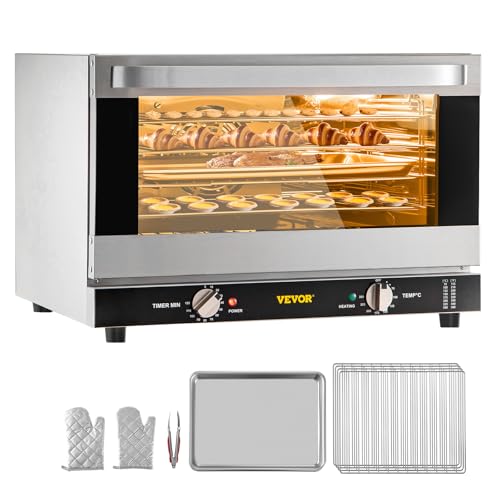
VEVOR’s 47-litre half-size oven is the entry point many new bakeries and cafés actually buy: four tiers, a front glass door for monitoring without heat loss, and the working accessories — trays, wire racks, even clip gloves — included rather than sold separately. At 1600 watts on 120-volt power it installs like the Waring, and its half-size format keeps it compatible with standard prep pans.
The honest framing is duty cycle. This is a value-tier unit for a business proving its menu and volume; a kitchen running an oven twelve hours a day, seven days a week, should budget for the heavier commercial lines in this guide. For a startup, a church kitchen, a market stall or a second oven for overflow and reheating, the capability per dollar is difficult to argue with.
Strengths
- Four-tier half-size capacity with accessories included
- Glass door allows monitoring without opening and losing heat
- 120V / 1600W installs on standard commercial power
Trade-offs
- Value-tier build — not the choice for maximum daily duty cycles
- Controls and fit-and-finish are plainer than legacy commercial brands
- Confirm local listing requirements before inspection day
| Specification | Detail |
|---|---|
| Capacity | 47L / 43 qt, 4 tiers, half-size format |
| Power | 1600W, 120V |
| Included | Trays, wire racks, clip gloves |
| Door | Front glass door |
Best for: Startups, market stalls and overflow/reheat duty on a budget / Not suited for: Twelve-hour daily production baking
Check on Amazon — check the current price on Amazon before you buy; listings, bundles and included accessories change over time.

KoolMore KM-CTCO-15 23-Inch Commercial Countertop Convection Oven — Best ETL-Listed Mid-Size
KoolMore positions the KM-CTCO-15 exactly where many small restaurants live: half-size pans, four racks, 1600 watts, stainless construction, and — the detail that decides purchases in permitted kitchens — an ETL listing for safety and sanitation. Where a health or fire inspector will review the equipment list, that listing is not a luxury; it is the difference between opening on schedule and scrambling for a replacement.
At 23 inches wide it keeps a modest counter footprint while still swallowing the half-size pans your prep already uses. Controls are straightforward commercial fare, the cavity handles baking, roasting and reheating duty, and the stainless exterior wipes down to inspection standard. It is the deliberate, no-drama choice for a first permitted kitchen.
Strengths
- ETL listed for safety and sanitation — inspection-ready
- Four racks in a half-size cavity at a 23-inch width
- Stainless construction wipes down to commercial standard
Trade-offs
- 1600W class recovery, not a high-output production oven
- Fewer advanced functions than humidity-equipped Cadco lines
- Brand service network is thinner than legacy makers
| Specification | Detail |
|---|---|
| Pan capacity | Half-size, 4 racks |
| Power | 1600W |
| Width | 23 inches |
| Listing | ETL (safety and sanitation) |
Best for: First permitted restaurants and cafés that need a listed half-size oven / Not suited for: High-throughput production bakeries
Check on Amazon — check the current price on Amazon before you buy; listings, bundles and included accessories change over time.
Avantco CO-14 Quarter-Size Convection Oven — Best Budget Commercial
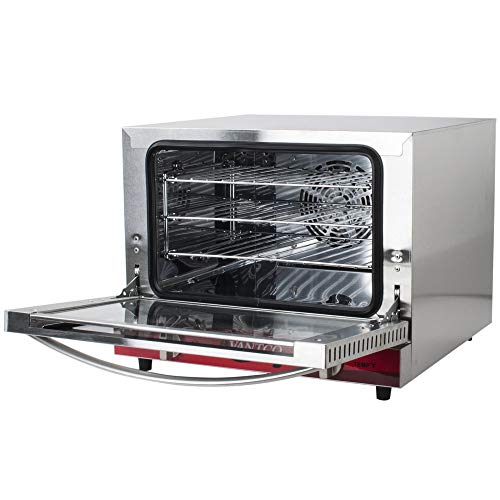
Avantco is the house brand of a major restaurant-supply channel, and the CO-14 is built to that channel’s logic: a simple, serviceable quarter-size convection oven (0.8 cubic feet, 1440 watts, 120-volt plug) that a café or snack bar can buy, install and run without ceremony. It bakes, reheats and finishes the small batches its format suits, with controls any new hire can learn in a minute.
Expectations should match the tier. The CO-14 is the right oven for warming, finishing and light baking — a satellite oven, a starter oven, a truck oven. It is not a production bakery’s anchor, and its quarter-size pans cap batch ambition. Within its honest job description, it is one of the most cost-effective ways to put a commercial-format convection oven on a counter.
Strengths
- Lowest-cost route to a commercial-format quarter-size oven
- 1440W on a standard 120V plug — installs anywhere
- Simple controls suit high-turnover staffing
Trade-offs
- 0.8 cu ft cavity is strictly small-batch
- Light-duty positioning versus Cadco/Waring quarter-size rivals
- Minimal feature set — no humidity, no programming
| Specification | Detail |
|---|---|
| Pan capacity | Quarter-size |
| Interior volume | 0.8 cubic feet |
| Power | 1440W, 120V |
Best for: Snack bars, satellite stations and starter kitchens on tight budgets / Not suited for: Production baking or half-size pan workflows
Check on Amazon — check the current price on Amazon before you buy; listings, bundles and included accessories change over time.

Cadco XAF-133 Heavy-Duty Countertop Convection Oven — Best Heavy-Duty with Humidity
The XAF-133 is what a kitchen graduates to. Cadco’s heavy-duty line adds the feature bakers actually ask for — humidity — which supports proofing and gives lean doughs the moist early bake that produces proper crust. Manual controls keep operation direct, the stainless build is rated for commercial use, and the NSF listing keeps inspectors satisfied. At 125 pounds, this is a committed countertop appliance, not a portable.
The cost of admission is electrical: 208/240-volt service, which means an electrician and a dedicated circuit. In return you get the recovery speed and temperature stability that high ticket volume demands — doors open all morning and the cavity holds its line. For an artisan bakery, a hotel breakfast station or a production café, this is the professional answer in this guide.
Strengths
- Humidity function supports proofing and superior crust formation
- 208/240V power delivers fast recovery under constant door cycles
- Heavy-duty stainless build, NSF listed, manual staff-proof controls
Trade-offs
- Requires 208/240V service — electrician and dedicated circuit
- 125 lb — a fixed station, not a movable oven
- Highest tier in this guide; overkill for warming-only duty
| Specification | Detail |
|---|---|
| Controls | Manual, with humidity function |
| Power | 208-240V |
| Construction | Stainless steel, heavy-duty commercial |
| Listing | NSF |
| Weight | 125 lbs |
Best for: Artisan bakeries and production cafés needing humidity and recovery speed / Not suited for: Plug-and-play cafés without 240V service
Check on Amazon — check the current price on Amazon before you buy; listings, bundles and included accessories change over time.
Comparison Table
| Pick | Badge | Key spec | Best for |
|---|---|---|---|
| Waring WCO500X Countertop Convection Oven | Best Overall | Half-size, 4 pans, 1.5 cu ft, 120V, NSF | Cafés, delis and prep kitchens doing steady half-pan volume on standard power |
| Cadco OV-003 Quarter-Size Commercial Convection Oven | Best for Cafés and Food Trucks | Quarter-size, 3 pans, 120V | Coffee bars, food trucks and concessions finishing small batches |
| VEVOR Commercial Convection Oven 47L Half-Size | Best Value for Startups | 47L / 43 qt, 4 tiers, 1600W, 120V | Startups, market stalls and overflow/reheat duty on a budget |
| KoolMore KM-CTCO-15 23-Inch Commercial Countertop Convection Oven | Best ETL-Listed Mid-Size | Half-size, 4 racks, 1600W, ETL listed | First permitted restaurants and cafés that need a listed half-size oven |
| Avantco CO-14 Quarter-Size Convection Oven | Best Budget Commercial | Quarter-size, 0.8 cu ft, 1440W, 120V | Snack bars, satellite stations and starter kitchens on tight budgets |
| Cadco XAF-133 Heavy-Duty Countertop Convection Oven | Best Heavy-Duty with Humidity | Heavy-duty, humidity, NSF, 208-240V | Artisan bakeries and production cafés needing humidity and recovery speed |
How to Choose the Best Commercial Countertop Convection Ovens
Start with the pan, because the pan decides everything else. Audit the pans your kitchen already owns and the batch sizes your menu needs at peak. Quarter-size suits finishing and small batches; half-size is the commercial standard and the safer long-term bet for any kitchen that bakes in volume. Buying an oven that orphans your existing pan inventory is a hidden cost that dwarfs small price differences between models.
Next, audit your power honestly. Count your available circuits and their voltage before falling in love with a specification sheet. A 120-volt oven is limited in recovery speed by physics, not by brand quality; a 240-volt oven is useless until the circuit exists. Get the electrician’s quote early — for some kitchens it is trivial, for others it rivals the oven’s cost, and it should be part of the purchase decision rather than a surprise after delivery.
Then match duty rating to duty reality. Estimate your oven’s daily hours at peak season, not on a quiet Tuesday. Light-duty and value-tier ovens serve satellite and startup roles well; a primary production oven should come from a heavy commercial line with a sanitation listing, serviceable parts and a manufacturer that supports commercial accounts. Finally, confirm the listing your jurisdiction requires — NSF or ETL sanitation marks are the common commercial standards — before the inspector visit is scheduled, not after.
Countertop Footprint, Clearance and Ventilation
Commercial countertop ovens are deeper than home buyers expect, because the cavity must swallow a half-size pan with air space around it and the fan housing sits behind the cavity. Measure your counter depth, then add the manufacturer’s required rear and side clearances for heat dissipation — an oven pushed flush against a splashback will run hot, age fast and may violate its listing conditions.
Heat output into the room is the second spatial fact. A convection oven cycling all morning turns a small kitchen hotter; plan its station away from refrigeration and chocolate or pastry work that suffers in warmth, and confirm your hood and ventilation arrangement satisfies local code for the equipment class. None of this is difficult — it is simply cheaper to plan before the oven arrives on a pallet than after.
Manual vs Digital Controls in a Working Kitchen
Digital controls offer programs, timers and repeatability — valuable when the same product bakes forty times a day and consistency is the brand. Manual dials offer something different: zero training, instant adjustment, and nothing to reprogram when a new hire starts mid-rush. Many experienced operators deliberately choose manual ovens for staff-proofing, accepting small batch-to-batch variation as the price of simplicity.
Humidity is the feature that separates baking ovens from reheating ovens. If your menu includes lean breads, laminated pastry or any product that proofs, a humidity-capable oven like the Cadco heavy-duty line changes what your kitchen can produce. If your oven’s real job is reheating, finishing and frozen-to-finished work, humidity is money spent on a function you will rarely open — put the budget into pan capacity or a second smaller oven instead.
How to Set Up a Commercial Countertop Convection Oven Station
A commercial oven earns its money at a well-planned station. Set the station up once, properly, and every shift afterwards runs faster and safer.
- Confirm the circuit: verify voltage and amperage at the outlet match the oven’s plate before the unit is unboxed, and give a 240V oven its dedicated circuit.
- Level and space the oven on a heat-rated, stable counter, observing the manufacturer’s side and rear clearances for airflow.
- Season and test: run the empty oven through a full heat cycle to burn off manufacturing residues, then verify cavity temperature with an oven thermometer at two set points.
- Stage the station: pans, racks, mitts and a landing surface within one step of the door, so hot pans never travel across the kitchen.
- Post the working sheet: your top products with their time and temperature settings, taped where the operator stands — this card, not memory, is what keeps batches consistent across staff.
- Log cleaning into closing duties: crumb and grease removal daily, a deeper cavity clean on a fixed weekly slot, before buildup becomes a smoke and flavour problem.
Recheck temperature accuracy monthly with the same thermometer test. Commercial ovens drift as elements and sensors age, and a ten-degree drift quietly rewrites every recipe card in the kitchen. Catching it in a monthly check is maintenance; discovering it in a week of underbaked product is a loss.
Quarter-Size vs Half-Size: Reading a Production Sheet
The pan decision deserves a worked example, because it is where commercial buyers most often undersize. Take a café whose morning peak sells forty warmed pastries an hour. A quarter-size oven holding three small pans might finish twelve to fifteen pastries per batch cycle; the oven becomes the bottleneck by the second hour, and staff begin holding product — which degrades it — to stay ahead. The same café on a half-size four-pan oven finishes the hour’s demand in two calm batches. The ovens differ by a modest step in price and counter inches; they differ enormously in whether the rush feels controlled.
Now invert the example. A food truck selling grilled sandwiches with a small baked side runs perhaps fifteen oven items an hour, in ones and twos. A half-size oven there is dead counter and wasted heat; the quarter-size Cadco or Avantco cycles small batches continuously, which keeps product fresh rather than held. The lesson generalises: size the oven to the peak batch your menu truly produces, in the pans that batch travels in, and let the average day look after itself.
Energy, Heat Load and the Working Environment
A commercial convection oven is also a room heater that occasionally bakes. Every watt in this guide eventually becomes kitchen heat, and in a small café or truck that heat load decides whether staff can work a full shift comfortably in summer. Higher-wattage 240-volt ovens finish batches faster and then rest; lower-wattage 120-volt ovens run longer per batch. Total daily energy for the same menu is closer than the nameplates suggest — what differs is the peak load on your circuit and the pace of heat dumped into the room.
Placement is the practical lever. Keep the oven out of the refrigeration corner, give its vents the clearances the manual specifies, and if the kitchen has a hood, the oven station belongs at its edge rather than across the room. Staff comfort is not a soft consideration in a commercial kitchen: a station nobody wants to work at peak is a bottleneck with a power cord.
Cleaning and Maintenance in Commercial Service
Commercial ovens fail from neglect more often than from defects. The maintenance rhythm that protects them is unglamorous: crumbs and grease wiped from the cavity daily before they carbonise, door gaskets checked weekly for the tears that leak heat and lengthen every bake, and a monthly temperature verification with an inexpensive oven thermometer against the dial’s promise. Carbonised grease is not merely dirty — it smokes at working temperatures, flavours delicate product, and in inspection terms it reads as a kitchen that has stopped paying attention.
Parts thinking belongs in the purchase, too. Fans, elements, gaskets and thermostats are the wear items of this category. Legacy commercial makers (Waring, Cadco) support their lines with parts channels built for operators; value brands support through the seller. Neither model is wrong, but a kitchen that cannot tolerate a week of downtime should weigh the parts channel as seriously as the specification sheet — downtime during your season costs more than the oven did.
When One Oven Is Not Enough: The Two-Oven Strategy
Many mature small kitchens end up with two countertop ovens rather than one large one, and the logic is worth understanding before you buy the first. Two ovens give two temperatures at once — pastry proofing low while a second oven roasts high — and they give redundancy: one oven down is a bad day, not a closed kitchen. A common pairing from this guide is a half-size anchor (the Waring) with a quarter-size satellite (the Cadco OV-003 or Avantco) for reheating and overflow.
The two-oven strategy also stages your investment. Start with the anchor your menu needs today; add the satellite when a specific bottleneck — not a vague sense of growth — proves itself at peak. Kitchens that buy both on day one often discover the second oven’s true job only after a season of service, and it is rarely the job they predicted.
Staff-Proofing: Controls, Training and Consistency
Commercial kitchens run on whoever is working today, and the oven’s interface decides how much of your product quality survives staff turnover. Manual dials — the pattern on most picks in this guide — have a training cost of about ninety seconds: set temperature, set time, listen for the bell. Their weakness is drift: one operator’s ‘medium’ mark is another’s guess, and dials get bumped. The countermeasure is the posted working sheet from the setup section: product, pan, temperature, minutes, written by the person who perfected the recipe and taped where the operator stands.
Digital and programmable ovens invert the trade. Once a program is dialled in, any operator reproduces the bake exactly — valuable for a signature product baked forty times a day across three shifts. The costs are setup time, a manual somebody must actually read, and a control board that is a more expensive failure than a dial. Choose by your reality: a two-person bakery where the baker is the owner should buy dials and keep the difference; a café chain standardising across locations should buy programs and keep the consistency.
Buying for Inspection Day and Every Day After
Permitted kitchens live two lives: the inspection, and the ten thousand services after it. The listing question (NSF, ETL) decides the first; everything else in this guide decides the second. But the two lives interact in ways buyers miss. An oven whose cavity wipes down in two minutes will be clean on inspection day because it is clean every day; an oven with inaccessible grease traps will be dirty on the day because it is dirty by design. When you compare the picks, imagine the closing shift, tired, at 11 p.m. — the oven that gets cleaned then is the oven that passes in March.
Documentation is the other inspection habit worth buying into. Keep the manual, the listing certificate and the purchase record in the kitchen’s compliance folder from day one, and record the monthly temperature checks beside them. Inspectors respond to systems, not apologies, and the folder costs nothing but the decision to start it when the oven arrives rather than the week before a renewal.
The Upgrade Path: Knowing When to Step Up
Every oven in this guide has a successor, and knowing yours in advance turns an eventual crisis into a planned purchase. The signals are consistent across kitchens: the oven runs at capacity through the whole peak rather than in batches; a second product line wants a different temperature at the same hour; or recovery time — the minutes lost after each door opening — starts dictating the service rhythm. Any one signal says the satellite-oven addition is due. Two signals together say the anchor itself has been outgrown.
Stepping up usually means one of three moves: from quarter-size to half-size pans, from 120-volt to 240-volt recovery, or from a single multi-purpose oven to the two-oven strategy described earlier. The Cadco XAF-133 exists in this guide precisely as the step-up destination — humidity, heavy construction, real power — for kitchens whose first oven proved the concept and the volume. Buy the first oven for the kitchen you have; buy the second for the kitchen the first one created.
What Commercial Buyers Ask at the Counter: A Reality Checklist
Experienced food-service buyers interrogate a countertop oven with a short list of unglamorous questions, and home-programme readers benefit from stealing it. What pans, exactly, does the cavity take — measured, not described? What is the recovery expectation after a full minute with the door open at peak? Which parts wear, what do they cost, and who stocks them within a day’s shipping? What does the warranty cover in commercial use — a clause that quietly voids many residential-grade appliances the moment they enter a business, and one more reason this guide restricted itself to commercial-rated units.
Run that checklist against the six picks and the badges explain themselves. The Waring and KoolMore answer with listings and pan standards; the Cadco heavy-duty line answers with parts depth and duty rating; the VEVOR and Avantco answer with acquisition cost and simplicity, accepting thinner answers elsewhere as their tier’s honest trade. There is no pick in this guide that fails the checklist outright — there are only picks whose answers fit different kitchens, which is what a shortlist is for.
Seasonal Menus and the Oven’s Second Job
Commercial countertop ovens quietly acquire second jobs as menus turn with the seasons, and planning for that flexibility is part of buying well. The café oven that finishes breakfast pastries in spring becomes the soup-and-melt station of autumn; the bakery’s reheating oven becomes the holiday overflow that carries November. Ovens with honest temperature range and standard pan formats absorb these reassignments without complaint, which is one more argument for buying the format standards — quarter and half pans, conventional controls — rather than a specialised unit optimised for a single menu that will change by next year anyway.
Cost of Ownership Across a Commercial Life
The purchase price of a commercial oven is the smallest number in its life. Energy across a decade of daily service, the labour of cleaning it nightly, the parts it will consume and the revenue of the shifts it anchors all dwarf the invoice — which is why this guide has consistently steered buyers toward duty-matched equipment rather than the cheapest box that fits the counter. A value oven in light duty is genuinely economical; the same oven in production duty becomes expensive through downtime, inconsistency and early replacement. Run your own arithmetic with your real hours and your real menu, and the correct tier usually identifies itself before the brand discussion even starts.
Final Word on Specification Sheets
Read commercial oven listings the way operators do: pan format first, electrical second, listing third, and everything else as commentary. A specification that leads with styling while burying the pan size is telling you who it is for. The six ovens in this guide lead with their working facts, which is why they are in this guide — and why, matched to the right kitchen, any of them will still be earning its counter long after the menu that justified it has been rewritten twice over.
Delivery Day: Receiving a Commercial Oven Like an Operator
Commercial ovens arrive on pallets, and the receiving ritual protects you. Inspect the carton before signing, photograph any crush damage with the driver present, and unbox before the freight leaves if the carrier allows it — concealed damage claims are won with photographs and timestamps, not recollections. Check the cavity against the order: pan format, rack count, and the accessories the listing promised (the VEVOR’s included trays and racks are part of its value; verify they are in the box). Keep the packaging until the oven has run its first full heat cycle and held temperature, because a unit that fails its first week goes back in its own carton or not at all. Only then does the oven graduate from delivery to equipment — seasoned, tested, documented and ready for the station setup this guide described.
The Menu-First Buying Conversation
Before any model is chosen, the most useful ten minutes in a commercial oven purchase is a conversation with the menu, conducted in writing. List the oven’s ten most frequent jobs with their batch sizes and their hours. The list always surprises: kitchens discover the oven is really a reheating station with occasional baking, or a baking station mis-sold to itself as a warmer. Match that written list against the picks’ badges and the shortlist shortens itself — the café list points at quarter-size and plug-in convenience, the bakery list at half-size pans and humidity, the truck list at footprint above all. Equipment bought against a written menu fits; equipment bought against a feeling gets exchanged, and commercial exchanges are measured in freight and downtime rather than in a drive to the store.
Common Buying Mistakes
Buying pan size by price instead of by menu
A cheap quarter-size oven that forces double batches at the morning rush costs more in labour and lost sales than the half-size oven would have. Size the oven to peak tickets, then shop within that size.
Ignoring the listing until inspection day
An unlisted oven in a jurisdiction that requires NSF or ETL sanitation can be ordered out of service. Confirm your local requirement first and buy a listed model — several picks in this guide carry NSF or ETL listings for exactly this reason.
Skipping the electrical audit
Ordering a 208/240V oven for a kitchen with only standard outlets — or overloading a shared 120V circuit — turns delivery day into a crisis. Audit power before ordering, and price any electrical work into the decision.
Treating a value oven as a production oven
Value-tier units are excellent in satellite and startup roles, but running one as a twelve-hour production anchor invites downtime at the worst moment. Match the duty rating to the duty, and let heavy lines do heavy work.
Final Recommendation
For most small commercial kitchens, the Waring WCO500X is the recommendation: half-size capacity, NSF listing and plug-in 120-volt convenience in one balanced package. Kitchens that bake seriously — proofing, crust work, constant door cycles — should step up to the Cadco XAF-133 and its humidity function on 240-volt power. Small counters and trucks belong with the Cadco OV-003 or the Avantco CO-14, while new permitted kitchens that need an ETL listing at a mid tier should take the KoolMore KM-CTCO-15, and startups watching cash should start with the VEVOR 47L and upgrade when volume proves itself.
Whichever you choose, decide in this order — pan size, power, listing, duty — and the model largely chooses itself. Explore the wider countertop range alongside this guide:
Best Consumer Small Convection Ovens Best 30 Electric Smoothtop Cooktops Best 30 Gas Cooktops Best 30 Inch Ceramic Cooktops
Frequently Asked Questions
What size commercial countertop convection oven do I need?
Match the pan to your peak batch. Quarter-size (three small pans) suits cafés, trucks and finishing stations. Half-size — four pans, as on the Waring WCO500X and KoolMore KM-CTCO-15 — is the commercial standard for bakeries, delis and prep kitchens. Buy for your busiest hour, not your average one.
Do I need 240 volts for a commercial countertop oven?
Only for heavy-duty models such as the Cadco XAF-133, which trade an electrician’s visit for faster temperature recovery under constant use. Most countertop commercial ovens in this guide, including the Waring and Cadco OV-003, run on standard 120-volt power.
Why do commercial ovens carry NSF or ETL listings?
Many health and fire jurisdictions require listed equipment in commercial kitchens. An NSF or ETL sanitation listing confirms the oven meets commercial safety and cleanability standards. If your kitchen is inspected or permitted, treat the listing as a requirement, not a feature.
Can a countertop convection oven replace a full-size range oven?
For baking, roasting, reheating and finishing at café and deli volumes, yes — that is exactly the job these ovens are built for. High-volume production, very large roasts and simultaneous multi-temperature work still belong to full-size equipment.
Is a humidity function worth paying for?
If you proof dough or bake lean breads and pastry, yes — humidity supports proofing and proper crust formation, as on the Cadco XAF-133. If the oven mainly reheats and finishes, spend the money on pan capacity instead.
How long should a commercial countertop oven last?
Heavy-duty commercial lines are built for years of daily service with basic maintenance — daily crumb and grease removal, weekly deep cleans and periodic temperature checks. Value-tier units suit lighter duty; matching the oven’s rating to your real hours is what protects the investment.