Disclosure: airfryerkitchensupply.com is reader-supported. When you buy through links on our site, we may earn an affiliate commission at no extra cost to you.
Where to Buy
This guide covers the best convection wall ovens for new home — what actually exists, what we verified, and which picks fit which rooms and budgets. Every oven in this guide is a 30-inch-class built-in (or a combination unit on the same cabinet footprint), verified against Amazon’s product data before earning its link. A wall oven is the most installation-bound purchase in the kitchen — it must fit a cutout that may already exist in a new home’s cabinetry — so use the links to check the current price on Amazon and, with equal care, to confirm the cutout dimensions in the listing’s specification section against your cabinet before ordering.
- GE 30 in. Single Smart Convection Wall Oven with No-Preheat Air Fry (Best Overall) — Check on Amazon
- Empava 30 Inch Electric Single Wall Oven with Convection and Air Fryer (Best Value) — Check on Amazon
- ZLINE 30 in. Professional True Convection Single Wall Oven with Air Fry (WAS-30) (Best Professional Style) — Check on Amazon
- Cosmo COS-30ESWC 30 in. 5 cu. ft. Electric Wall Oven with True Convection (Best True Convection Value) — Check on Amazon
- Bosch 800 Series 30 in. Built-in Combination Wall Oven with Microwave (Best Premium Combination) — Check on Amazon
- Samsung 30 in. Smart Wall Oven with Steam Cook (NV51K6650SG) (Best for Bakers and Steam Cooking) — Check on Amazon
Choosing the best convection wall ovens for new home kitchens is a different exercise from replacing an old oven. In a new home — whether newly built or newly yours — the wall oven is often the anchor appliance decision: it sets the kitchen’s cooking capacity for a decade, it must marry a cabinet cutout that already exists or will be built once, and it is usually bought alongside a separate cooktop, which frees it from the compromises of a range. Convection is the right default for that anchor. A fan that circulates heated air cooks more evenly across racks, roasts with better browning, and handles the multi-rack baking — holiday cookies, sheet-pan dinners, a turkey with sides — that defines how a family kitchen actually gets used.
The six picks below are all 30-inch class, because that is the cutout the overwhelming majority of new homes are built with, and they span the real decision space: a mainstream smart oven with air fry, a value model with a full mode list, a professional-style unit, a true-convection specialist, a premium combination oven with a microwave above, and a steam-cook model for serious bakers. Prices in this category span a wide range, so the guide is organized by what each tier actually buys rather than by superlatives.
One discipline runs through every review: specifications come only from verified listing data, and dimensions are treated as a listing-check item rather than a printed promise. Wall ovens are heavy, expensive to ship back, and unforgiving of a half-inch error. Measure the cutout, compare it with the listing’s stated requirements, and only then let features decide. That order of operations — fit, then fuel, then features — is the spine of the buying guide that follows the reviews.
In this guide
Quick Picks
Six verified 30-inch convection wall ovens for new-home kitchens, from value to premium combination. Badges repeat in the full reviews.
- Best Overall: GE 30 in. Single Smart Convection Wall Oven with No-Preheat Air Fry — GE’s mainstream flagship formula: true smart controls, convection cooking, and no-preheat air fry in the standard 30-inch single cavity — the balanced default for a new home. — Check on Amazon
- Best Value: Empava 30 Inch Electric Single Wall Oven with Convection and Air Fryer — a 5 cu. ft. cavity with convection, air fry, and 10 cooking modes at 4800W, behind a screen-touch control panel — the mode list of a premium oven at a value tier. — Check on Amazon
- Best Professional Style: ZLINE 30 in. Professional True Convection Single Wall Oven with Air Fry (WAS-30) — ZLINE’s professional-styled 30-inch oven with true convection, air fry, and self-clean — for new homes designed around a chef-kitchen look and feel. — Check on Amazon
- Best True Convection Value: Cosmo COS-30ESWC 30 in. 5 cu. ft. Electric Wall Oven with True Convection — true convection, a 5 cu. ft. cavity, seven oven functions, self-clean, and a blue porcelain interior — convection substance without the professional-style premium. — Check on Amazon
- Best Premium Combination: Bosch 800 Series 30 in. Built-in Combination Wall Oven with Microwave — Bosch’s 800 Series stack: a smart convection wall oven with self-clean below and a microwave above, in one built-in 30-inch installation — two appliances, one cutout. — Check on Amazon
- Best for Bakers and Steam Cooking: Samsung 30 in. Smart Wall Oven with Steam Cook (NV51K6650SG) — Samsung’s steam-cook wall oven: steam-assisted baking and roasting, Wi-Fi smart control, and a large cavity in fingerprint-resistant stainless. — Check on Amazon
How These Picks Were Chosen
Verification came first: each oven was cross-checked against its live Amazon listing, and the spec boxes quote only what those listings state — size class, capacity where given, cooking modes, and headline features. Where a listing does not publish a figure we would like, the review proceeds without inventing one; in particular, we do not print cutout dimensions from memory, because the listing in front of you at purchase time is the only dimension sheet that matters.
Selection aimed at the new-home brief specifically. All six are built-in 30-inch class units, the cutout standard for new construction. All six offer convection cooking, the search’s core requirement — with one pick distinguished by true convection, where a dedicated element around the fan heats the circulated air, and the reviews explain where that distinction shows up in food. We included one combination unit — oven plus microwave in a single built-in stack — because new homes increasingly plan that configuration, and one steam model because bread and pastry bakers ask for it by name.
Within that frame, ranking weighed cooking versatility, control quality, self-cleaning provisions, smart features where they genuinely help, and the depth of the brand’s service network — a consideration with real weight on an appliance expected to serve for fifteen years.
The 6 Best Convection Wall Ovens for New Home Kitchens, Verified
All six fit the 30-inch built-in class. Read for cooking style first — the differences that matter are in modes, cavity design, and whether a second appliance rides along.
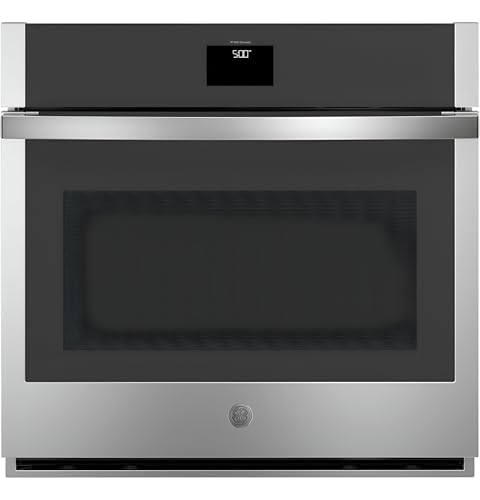
GE 30 in. Single Smart Convection Wall Oven with No-Preheat Air Fry — Best Overall
GE’s 30-inch smart convection oven takes the overall badge because it covers the new-home brief with the fewest weaknesses: a full-size single cavity, convection for even multi-rack cooking, air fry without the preheat wait, and smart controls from one of the deepest appliance service networks in the country. In a new home — where the oven will be expected to simply work, daily, for years, with parts and technicians available in any zip code — that combination of capability and support is what ‘best overall’ means.
The no-preheat air fry deserves its headline. Air frying in a full oven cavity is the feature that has quietly killed the countertop air fryer in many kitchens: same crisping logic, family-sized capacity, no extra appliance eating counter space. Skipping the preheat removes the friction that made oven air fry feel slow, and for weeknight cooking — wings, vegetables, frozen anything — that friction was the whole battle.
Strengths
- Complete mainstream package: convection, air fry, smart control, big service network
- No-preheat air fry brings countertop convenience to full-cavity capacity
- 30-inch single format matches the standard new-home cutout
Trade-offs
- Single cavity — holiday loads share one oven, unlike double-oven configurations
- Smart features assume your kitchen Wi-Fi is part of the plan
- Mid-premium tier pricing — check price on Amazon
| Size | 30 in. single wall oven (listing title) |
| Cooking | Smart convection with no-preheat air fry (listing title) |
| Finish | Stainless steel (listing title) |
The ownership case is about the decade, not the demo. GE’s appliance ecosystem means the app will be maintained, the control board will be orderable in year nine, and the local technician will have seen your oven before. New-home buyers, who are simultaneously making a hundred appliance-adjacent decisions, systematically undervalue that boring infrastructure — until the first holiday breakdown teaches them otherwise.
Choose it as the default when the kitchen plan is a single wall oven plus a separate cooktop, the cooking is family-scale and varied, and nobody in the house has a specialist obsession — steam, professional styling — that one of the picks below serves better. Defaults earn their name by being right most often, and this one is.
Best for: most new-home kitchens wanting one capable, well-supported convection oven / Not suited for: buyers who need two cavities, steam baking, or a microwave in the same stack
Check the current price on Amazon
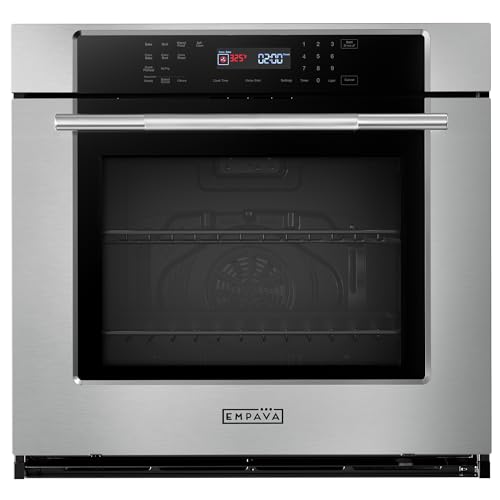
Empava 30 Inch Electric Single Wall Oven with Convection and Air Fryer — Best Value
Empava has built its name on a simple proposition: the specification sheet of a premium appliance at a fraction of the premium price. This 30-inch model states its case in the verified listing — a 5 cubic foot cavity, convection plus air fry among 10 cooking modes, 4800 watts of power, and screen-touch controls. On paper, that is the feature set new-home buyers cross-shop against ovens costing far more, which is precisely why it holds the value badge.
The honest trade-offs live off the spec sheet. Value brands carry thinner service networks, and a wall oven is the appliance where service access matters most, because it is hardwired, heavy, and built in. The mitigation is planning: confirm who services the brand in your area before purchase, register the warranty on day one, and keep the documentation. Buyers who do that homework routinely get years of strong service from this tier; buyers who assume a national network that is not there are the ones who write the angry reviews.
Strengths
- Full mode list — convection, air fry, 10 modes — at a value-tier position
- 5 cu. ft. cavity is full family size
- 4800W power rating promises brisk preheats
Trade-offs
- Service network is thinner than the legacy brands — verify local coverage first
- Touch-screen controls are a love-or-hate interface with no tactile fallback
- Long-term parts depth is less proven than the premium picks
| Size | 30 inch single wall oven (listing title) |
| Capacity | 5 cu. ft. (listing title) |
| Modes | 10 cooking modes with convection and air fryer (listing title) |
| Power | 4800W (listing title) |
| Controls | Screen touch control (listing title) |
Who should buy the value pick in a new home? The buyer furnishing a whole kitchen at once, where the appliance budget is a zero-sum fight among oven, cooktop, refrigerator, and dishwasher — and who would rather have a full-featured oven plus a better cooktop than a badge-premium oven plus a compromised one. Also the confident self-installer, for whom service-network depth is a lesser concern.
Who should not? The buyer for whom a two-week parts wait in year six is unacceptable, and anyone whose local market genuinely lacks coverage. The oven itself, on specification and early-life performance, is the strongest value argument in this guide; the badge is earned on the sheet and hedged on the infrastructure, in the open.
Best for: whole-kitchen furnishing on a budget, and confident buyers who verify local service first / Not suited for: buyers who prioritize decade-deep service networks over specification value

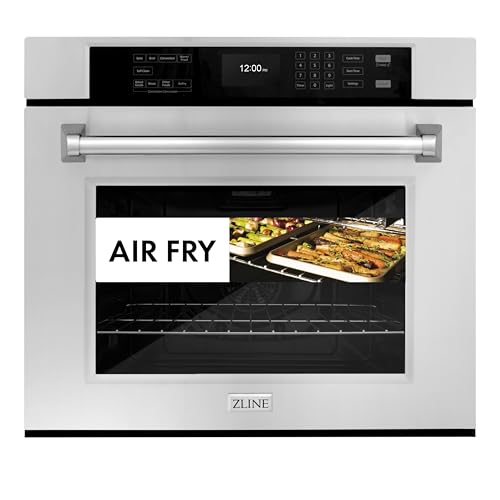
ZLINE 30 in. Professional True Convection Single Wall Oven with Air Fry (WAS-30) — Best Professional Style
ZLINE sells the professional kitchen as an attainable aesthetic, and the WAS-30 is its wall-oven expression: professional styling, true convection — a dedicated element at the fan, so circulated air arrives already heated — air fry, and self-cleaning, in the standard 30-inch footprint. In new homes, where the kitchen is designed as a visual statement as much as a workplace, the styling is not superficial: the oven is the largest uninterrupted surface in the room’s appliance wall, and it sets the tone the range and hood are asked to match.
True convection is the substantive claim beneath the style. Standard convection circulates air heated by the main elements; true (or European) convection adds an element around the fan itself, which tightens temperature uniformity across racks — the difference shows in three-tray baking, where edge-to-center consistency is the whole game, and in roasting, where the moving heated air browns more evenly.
Strengths
- True convection for multi-rack uniformity
- Professional styling that anchors a designed kitchen
- Air fry and self-clean round out a complete mode set
Trade-offs
- Style-led brands command a premium over equivalent mainstream specification
- Service network sits between the value tier and the legacy giants
- Professional look commits the kitchen’s design direction
| Size | 30 in. single wall oven (listing title) |
| Cooking | Professional true convection with air fry (listing title) |
| Cleaning | Self clean (listing title) |
| Model | WAS-30 (listing title) |
The right buyer is designing the kitchen, not just equipping it: the new home where the appliance wall is a feature, guests gather in the kitchen, and the oven’s face is part of the architecture. For that buyer the ZLINE’s premium buys daily visual satisfaction plus a genuinely strong convection system, which is a defensible allocation.
The wrong buyer is the specification accountant, who will find the GE or the Cosmo delivering comparable cooking for less, and the steam baker, who should be looking at the Samsung below. Know which buyer you are and the pick makes itself.
Best for: design-led new kitchens wanting professional styling with true convection substance / Not suited for: budget-driven furnishing, or bakers who need steam
Check the current price on Amazon

Cosmo COS-30ESWC 30 in. 5 cu. ft. Electric Wall Oven with True Convection — Best True Convection Value
The Cosmo is the convection purist’s value pick: true convection with the fan element, seven oven functions, a full 5 cubic foot cavity, self-cleaning, and the blue porcelain interior that signals a cooking-first design — all without the professional-styling premium of the ZLINE or the smart-ecosystem pricing of the mainstream flagships. Its verified listing reads like a checklist written by someone who bakes on multiple racks and cleans up afterward.
Seven functions is the honest number for most households: the modes real cooking uses weekly, without a scroll-wheel of novelties. Combined with true convection’s uniformity, the package targets the cook who measures an oven by what comes out of it — even trays, properly browned roasts, a self-clean cycle for the aftermath — rather than by its app.
Strengths
- True convection at a mid-tier position
- Blue porcelain interior and self-clean: built for heavy use and easy recovery
- 5 cu. ft. capacity matches the guide’s largest single cavities
Trade-offs
- No air fry headline and no smart ecosystem story
- Brand network smaller than GE or Samsung
- Seven focused functions may feel plain beside 10-mode rivals
| Size | 30 in. wall oven (listing title) |
| Capacity | 5 cu. ft. (listing title) |
| Cooking | True convection, 7 oven functions (listing title) |
| Interior | Blue porcelain (listing title) |
| Cleaning | Self clean function (listing title) |
Compare the Cosmo directly with the Empava below it in price logic and the ZLINE above it in style logic, and its position clarifies: it is the middle path for the cooking-focused buyer. More convection substance than the value pick, less design premium than the professional pick, and an interior specification — porcelain, self-clean — that speaks to people who roast often and hate scrubbing.
In a new home that will host real cooking rather than reheating, that middle path is frequently the wisest money in the kitchen. The badge says value, but the honest word is balance.
Best for: cooking-focused households wanting true convection and easy cleaning without style premiums / Not suited for: smart-home integrators, or buyers who want a microwave in the same unit
Check the current price on Amazon

Bosch 800 Series 30 in. Built-in Combination Wall Oven with Microwave — Best Premium Combination
The combination oven answers a floor-plan question that new homes increasingly ask: where does the microwave live? The Bosch 800 Series answer — stacked above the convection oven in a single built-in unit — frees the counter, avoids the over-range microwave’s compromises, and puts both appliances at a civilized height in one cabinet column. The verified listing confirms the formula: smart convection, self-cleaning, stainless, in the 800 Series, Bosch’s flagship mainstream line.
Bosch’s engineering reputation in this class rests on fit and finish as much as features: flush installation, tight door action, quiet operation, and controls that feel machined rather than molded. In a new home, where the kitchen’s perceived quality is substantially the sum of such details, the premium is legible every day in a way a spec sheet cannot capture.
Strengths
- Two appliances in one cutout — a genuine floor-plan solution
- Bosch fit, finish, and flush-installation discipline
- Smart convection oven with self-clean below, microwave above
Trade-offs
- Premium tier pricing, the highest commitment in this guide — check price on Amazon
- If one half fails, the stack complicates service and replacement
- Microwave capacity in combination units trails large countertop models
| Format | 30 in. built-in combination wall oven (listing title) |
| Cooking | Smart convection with self-clean (listing title) |
| Upper | Microwave (listing title) |
| Series | 800 Series (listing title) |
The combination decision should be made at the plan stage, not the product stage: it affects cabinet design, electrical provisioning, and the cooktop-versus-range choice. New-home buyers have the luxury of making it deliberately. If the plan says the microwave must disappear into the cabinetry, this Bosch is the guide’s answer, and its convection oven half is a full peer of the single-oven picks rather than a compromise cavity.
If the plan is flexible, compare honestly against a single oven plus a drawer or countertop microwave: the separate route costs less and replaces easier. The combination premium buys integration and architecture, and it is worth it exactly when the kitchen’s design says so.
Best for: new-home plans that want the microwave built into the appliance wall / Not suited for: flexible layouts, tight budgets, or households wanting a large microwave cavity
Check the current price on Amazon

Samsung 30 in. Smart Wall Oven with Steam Cook (NV51K6650SG) — Best for Bakers and Steam Cooking
Steam is the one cooking medium the other picks cannot imitate, and the Samsung is here for the households who know why they want it. Steam-assisted baking produces the crackling crust and open crumb that define serious bread; steam roasting keeps poultry moist while the skin renders; vegetables emerge vivid rather than tired. The verified listing pairs that steam system with Wi-Fi control and a large cavity, in fingerprint-resistant stainless — a finish whose value every parent of a toddler understands instantly.
Samsung’s smart ecosystem is the other half of the proposition: remote preheat, monitoring, and notifications through the same app family as its other appliances. In a new home being fitted with a connected appliance suite, that coherence has real convenience value, and Samsung’s ovens have consistently been the technology-forward entries in this class.
Strengths
- Steam Cook: a capability no other pick here can replicate
- Large cavity with Wi-Fi smart control
- Fingerprint-resistant finish suits family kitchens
Trade-offs
- Steam reservoir adds a maintenance habit — filling, and periodic descaling discipline
- Technology-forward appliances ask you to live in the brand’s app ecosystem
- Buyers who never bake bread will not use the headline feature
| Size | 30 in. wall oven (listing title) |
| Cooking | Steam Cook (listing title) |
| Smart | Wi-Fi (listing title) |
| Model | NV51K6650SG/AA (listing title) |
| Finish | Fingerprint resistant stainless steel (listing title) |
The steam decision is binary in a way most appliance features are not: either bread, pastry, and steam-roasting are part of your cooking life, in which case no non-steam oven at any price substitutes, or they are not, in which case the reservoir is furniture. Be honest about the baker in the house — including the aspirational one, since a new home’s kitchen has a way of creating the cook it was designed for.
Aged gracefully, Samsung’s proposition is the enthusiast’s pick: the oven for the household that reads recipes for pleasure. Everyone else is better served by the GE’s all-round competence or the Cosmo’s convection purity — which is not a criticism of this oven, but a definition of its audience.
Best for: bakers, steam-roasting enthusiasts, and connected-suite new homes / Not suited for: households that will never use steam, or buyers wary of app-dependent appliances
Check the current price on Amazon
Comparison Table
| Pick | Badge | Key Spec | Best For |
|---|---|---|---|
| GE 30 in. Single Smart Convection Wall Oven with No-Preheat Air Fry Check on Amazon | Best Overall | 30 in. single, smart convection, no-preheat air fry | most new-home kitchens wanting one capable, well-supported convection oven |
| Empava 30 Inch Electric Single Wall Oven with Convection and Air Fryer Check on Amazon | Best Value | 30 in., 5 cu. ft., convection + air fryer, 10 modes, 4800W | whole-kitchen furnishing on a budget, and confident buyers who verify local service first |
| ZLINE 30 in. Professional True Convection Single Wall Oven with Air Fry (WAS-30) Check on Amazon | Best Professional Style | 30 in. professional, true convection, air fry, self clean | design-led new kitchens wanting professional styling with true convection substance |
| Cosmo COS-30ESWC 30 in. 5 cu. ft. Electric Wall Oven with True Convection Check on Amazon | Best True Convection Value | 30 in., 5 cu. ft., true convection, 7 functions, self clean | cooking-focused households wanting true convection and easy cleaning without style premiums |
| Bosch 800 Series 30 in. Built-in Combination Wall Oven with Microwave Check on Amazon | Best Premium Combination | 30 in. combination, convection oven + microwave, smart, self-clean | new-home plans that want the microwave built into the appliance wall |
| Samsung 30 in. Smart Wall Oven with Steam Cook (NV51K6650SG) Check on Amazon | Best for Bakers and Steam Cooking | 30 in., steam cook, Wi-Fi, large capacity | bakers, steam-roasting enthusiasts, and connected-suite new homes |
How to Choose a Convection Wall Oven for a New Home
Fit first: the cutout is the contract
A wall oven is bought against a hole. In new construction the hole is usually built to the 30-inch standard, but ‘usually’ has ended more installations than any product defect: measure the cutout’s width, height, and depth, confirm the cabinet’s support structure, and compare all of it with the listing’s stated requirements before ordering. If the home is still at the plan stage, the sequence reverses — choose the oven class first and have the cabinet built to its sheet, which is one of new construction’s genuine luxuries.
Electrical provisioning belongs in the same conversation. Wall ovens are hardwired appliances on dedicated circuits; the junction box location and the circuit capacity are plan-stage decisions that become expensive surprises at trim-out. Confirm both against the chosen oven’s requirements while the walls are still open, or before the cabinet is set in a finished home.
True convection, standard convection, and air fry, translated
Standard convection circulates air heated by the bake and broil elements; true convection adds a dedicated element at the fan, tightening uniformity across racks. The difference is real but graded, not binary: true convection shows its value in full-load, multi-rack baking and in faster, more even roasting, while standard convection already delivers most of the benefit over a still-air oven. Air fry, meanwhile, is a convection mode tuned hot and fast with a perforated tray — excellent at crisping, and best understood as a recipe setting rather than a separate technology.
Match the system to the cooking. Multi-tray bakers should weight true convection heavily — it is why two picks in this guide carry it. Roasting households are well served by any pick here. And every buyer should treat ‘convection’ itself as the non-negotiable: in a new home’s anchor oven, a still-air-only cavity would be a decade-long compromise bought to save very little.
One cavity, two cavities, or a combination
This guide’s picks are single-cavity units plus one combination, because that is where the verified value concentrates — but the configuration question deserves a direct answer. Double wall ovens suit households that routinely cook two temperatures at once: holiday hosts, large families, serious entertainers. Combination units suit plans that need the microwave in the wall. Single ovens suit everyone else, cost the least, and leave cabinet room for storage that most kitchens need more than a second cavity used twice a year.
Be honest about the calendar. The double oven earns its premium on perhaps ten days a year for most households; the single oven’s lower cost and simpler service earn theirs on the other 355. New-home buyers, flush with plan-stage optimism, overbuy configuration more reliably than any other appliance attribute — the tape measure and the calendar are the antidotes.
Planning the Appliance Wall as a System
A wall oven in a new home is never bought alone: it shares a wall, a style, and an electrical plan with the cooktop, the microwave decision, and often a warming drawer or a second oven. Decide the system’s architecture before its members. Handles and finishes should be chosen as a family — mixing brands is perfectly workable if the stainless tones and handle styles are compared in person, and a quiet trap if ordered from separate product photos.
Service planning is the system’s invisible layer. A new home in a developing area may have thinner appliance-service coverage than an established neighborhood; the legacy brands’ networks are the hedge. Whatever the brands, keep every manual, register every warranty in the first week, and photograph the model plates before the units are built in — the fifteen minutes that future-you will bless at the first service call.
Convection Modes, Demystified: Bake, Roast, and Proof
Modern convection ovens present their fan under several names, and new owners often treat the modes as marketing. They are not — each mode is a considered combination of which elements fire and how the fan behaves, and choosing correctly is worth real cooking quality. Convection bake runs the fan gently with the lower element dominant: it is the mode for cakes, cookies, and anything that rises, where violent air would lean a soufflé and dry a crumb. Convection roast runs the fan harder with more top heat: it is the mode for proteins and vegetables, where moving hot air is a browning engine. Still-air bake remains the right answer for the most delicate work — custards, meringues, and the recipes written by grandmothers who distrust fans on principle and occasionally with reason.
Two supporting features deserve a new-home buyer’s attention. A temperature probe, where fitted, converts roasting from time-guessing to measurement — the single largest quality upgrade available to a home roaster, and worth seeking in the listing details of any pick here. And a proof mode, increasingly common in this class, holds the low, steady warmth bread dough wants, turning the wall oven into the bakery tool that pairs naturally with the steam pick’s ambitions. Neither feature headlines a listing the way air fry does; both out-earn it across a decade of Sundays.
Finally, a word on capacity honesty. Cavity figures are measured by standards that include spaces your roasting pan cannot use, so treat cubic feet as a class indicator rather than a promise. The practical test is the pan audit: your largest roaster, your two sheet pans, the holiday bird’s footprint. A 30-inch cavity in this guide’s class swallows all of them — that, and not the decimal, is what the number is trying to tell you.
How to Plan Installation and First Use of a Built-in Wall Oven
Most of a wall oven’s installation quality is decided before the installer arrives. Work through the plan in this order.
- Confirm the cutout against the listing’s dimension sheet — width, height, depth, and the required clearances — and confirm the cabinet floor is rated and built for the oven’s weight.
- Verify the electrical provision: dedicated circuit, correct capacity, and a junction box positioned where the oven’s conduit can reach it. Any doubt here goes to a licensed electrician, not to optimism.
- Decide the microwave and cooktop configuration as part of the same plan, so cabinet and electrical work happen once.
- On delivery, inspect the unit before signing, photograph the model and serial plate, and keep the manual and warranty documents in a kitchen drawer, not a moving box.
- Before the first real cooking, run the manufacturer’s burn-in: an empty high-heat cycle to clear manufacturing residues, ideally with the kitchen ventilated and the household elsewhere.
- Calibrate your expectations with a thermometer test across racks on convection mode — every oven has a personality, and learning yours in week one, with an inexpensive oven thermometer, pays off for years.
- Register the warranty, note the service number in the manual, and set a calendar reminder for the first self-clean cycle after the holiday season rather than before it.
That last point deserves emphasis: never run a first-ever self-clean the week of a major cooking holiday. Self-clean cycles stress an oven at its thermal limits, and if a weakness exists, that is when it announces itself. Break the oven in gently, learn it, and let the heavy cycles come after it has earned your trust.
A closing piece of new-home advice that outranks every feature in this guide: photograph everything at installation. The model plate, the serial number, the electrical connection before the unit slides home, the cutout dimensions with a tape in frame. Appliance service over a fifteen-year life runs on those photographs — the technician’s first questions are all answered by them — and the installation day is the only day they can be taken. Store them with the home’s documents, register the warranty the same week, and the oven’s second decade will be as uneventful as its first. Features impress for a month; documentation serves for the life of the appliance.
Common Buying Mistakes
Ordering before measuring the cutout. Thirty-inch class is a neighborhood, not a dimension. Cutouts vary by maker and era; the listing’s sheet and your tape measure must agree before money moves.
Overbuying configuration. Double ovens and combinations are wonderful for the households that need them and expensive furniture for those that do not. Count the days per year honestly.
Ignoring the service network at a new address. A new home may sit at the edge of a brand’s coverage map. Verify local service for your chosen brand before purchase, not at the first fault.
Running the first self-clean before a holiday. Thermal stress finds weaknesses. Schedule the inaugural self-clean for a quiet week, not the eve of the year’s biggest roast.
Treating the oven as a standalone purchase. It is one member of an appliance wall — style, power, and cabinet decisions interact. Plan the system, then buy the members.
Final Recommendation
For the majority of new homes, the GE is the recommendation: complete convection capability, air fry without preheat, and the service depth that a fifteen-year appliance deserves. The Empava is the value play for whole-kitchen budgets, the Cosmo the convection purist’s balance, and the ZLINE the design-led choice with true-convection substance. The Bosch combination solves the microwave’s floor-plan problem in a single cutout, and the Samsung is the baker’s oven, with a steam capability nothing else here can imitate.
Whichever pick earns the wall, honor the sequence this guide opened with: measure the cutout, confirm the power, then let the cooking decide. A wall oven chosen in that order becomes invisible infrastructure — the best compliment a kitchen appliance can earn.
- GE 30 in. Single Smart Convection Wall Oven with No-Preheat Air Fry — Check on Amazon
- Cosmo COS-30ESWC 30 in. 5 cu. ft. Electric Wall Oven with True Convection — Check on Amazon
- Bosch 800 Series 30 in. Built-in Combination Wall Oven with Microwave — Check on Amazon
Best Cookware For Convection Ovens Best Cooktops Induction 30 Inch With Bridge Best Cookware Sets For Induction Cooktop Best Large Capacity Toaster Convection Ovens Best Cooktops Stainless
Frequently Asked Questions
Is convection worth it in a wall oven?
Yes — in a new home’s anchor oven it is close to non-negotiable. Moving air evens out hot spots, improves browning, and makes multi-rack cooking practical, which is how family kitchens actually cook. The premium over a still-air oven is small at purchase and the benefit is daily for the life of the appliance.
What is the difference between convection and true convection?
True convection adds a heating element around the fan, so the circulated air is itself heated; standard convection circulates air heated by the main elements. True convection’s advantage shows in full-load, multi-rack baking and faster, more even roasting. For most cooking the two are close; for three-tray baking they are not.
What size wall oven do new homes usually need?
The 30-inch class is the standard cutout in the great majority of new construction, and every pick in this guide belongs to it. A 27-inch class exists in older and smaller kitchens, and 24-inch units serve compact and European-style plans — measure your cutout rather than assuming, because the class name is not the dimension.
Should I choose a double oven or a combination unit instead?
Choose by calendar and floor plan. Double ovens pay off for households that regularly cook at two temperatures at once; combinations pay off when the microwave must live in the appliance wall. Most households are best served by a single excellent oven and the cabinet space the alternatives would consume.
Can a wall oven replace a countertop air fryer?
For most households, yes. Oven air fry modes — especially no-preheat versions like the GE pick’s — crisp the same foods at family scale, and the countertop appliance becomes redundant. Dedicated air fryers still heat faster for single servings, but the wall oven wins on capacity and on counter space reclaimed.
How long should a wall oven last, and what protects that lifespan?
Fifteen years is a reasonable expectation from the brands in this guide. The lifespan levers are boring: correct installation with proper clearances, sensible self-clean use, prompt attention to door seals and error codes, and keeping the model documentation and service contacts from day one — the habits the installation section of this guide sets up.
Do I need a temperature probe in a wall oven?
If you roast whole birds or large cuts with any regularity, it is the highest-value feature in the category: the probe ends the guesswork of doneness and the quality difference is immediate. Check the listing details of your chosen pick for probe inclusion, and treat its presence as a genuine tiebreaker between otherwise equal ovens.
Should a new home’s wall oven be electric or gas?
In the wall-oven format, electric is the mainstream answer and the one this guide’s picks represent: electric cavities hold steadier temperatures, convection systems are more consistent, and self-cleaning is more effective. Gas wall ovens exist in a narrow niche, but the category’s depth — models, service, parts — is electric. New construction also increasingly plans all-electric kitchens, which makes the electric wall oven the future-proof default.
How do I verify a wall oven will fit before it arrives?
Work from paper, not hope: measure the existing cutout’s width, height, and depth with a tape, then compare each figure against the dimension sheet in the chosen model’s listing — not a showroom summary and not a sibling model’s numbers, since revisions change dimensions quietly. Confirm also the electrical rating and junction position. If any figure disagrees, resolve it while the oven is still a web page; cabinet modification is a plan-stage task, and a delivery-day discovery converts it into a crisis with a very heavy appliance standing in the kitchen.
When should I run the self-clean cycle?
On a quiet week, with the kitchen ventilated, the racks prepared per the manual, and nothing scheduled that needs the oven for several hours. Self-cleaning is the most thermally violent thing a home oven does; run it when a problem, however unlikely, would be an inconvenience rather than a catastrophe — which is to say, never in the days immediately before a major cooking event.


