Disclosure: airfryerkitchensupply.com is reader-supported. When you buy through links on our site, we may earn an affiliate commission at no extra cost to you.
Where to buy
Every linked pick in this guide to the best large capacity toaster convection ovens was verified against Amazon’s catalogue on 2026-11-22: the product name and ASIN below come from that check, not from memory. Prices move constantly, so this guide never prints them — use a link to see today’s figure.
- Cuisinart TOB-260N1 Convection Toaster Oven — check price on Amazon
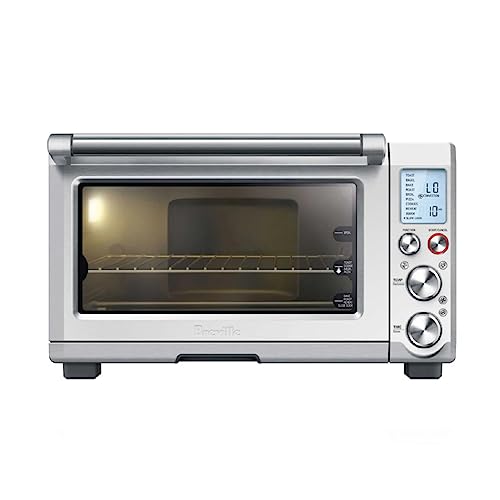
- Breville BOV800XL Smart Oven — check price on Amazon
- Ninja Prestige Smart XL DT501 — check price on Amazon
- KitchenAid Dual Convection Countertop Oven KCO255 — check price on Amazon
- Oster Extra-Large French Door Air Fryer Countertop Oven — check price on Amazon
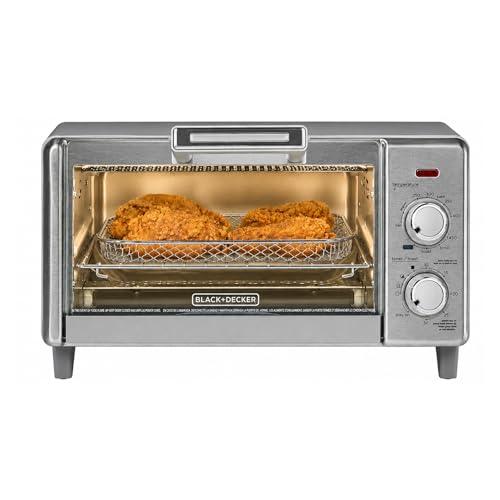
- BLACK+DECKER TO3250XSBD 8-Slice Extra Wide Convection Toaster Oven — check price on Amazon
The best large capacity toaster convection ovens are for households that bake, roast and reheat in real quantities but do not need — or do not want to pay for — air fry branding on the door. A convection toaster oven is a fan-assisted oven in countertop form, and in large sizes it becomes a true second oven: two racks of cookies, a 9×13 casserole, a roast chicken with room for the air to do its work.
Convection changes large-oven cooking in ways size alone cannot. The fan erases the hot corner and the cold door zone that plague big still-air cavities, so a full load cooks like a small one. That is why this guide judges capacity and convection as one system: interior dimensions, fan design, rack spacing and temperature accuracy together decide whether a large oven earns its counter.
Every pick was verified, and the list deliberately spans the category’s real shapes — a precision benchmark, a smart-oven classic, a high-power XL, a dual-convection specialist, a French-door giant and an extra-wide value model — because large convection ovens are bought for decades-shaped reasons, not impulse.
In this guide
Quick Picks
Best Overall — Cuisinart TOB-260N1 Convection Toaster Oven. The TOB-260N1 is the large convection oven for people who cook by temperature rather than by preset. Check the current price on Amazon.
Best for Bakers — Breville BOV800XL Smart Oven. The BOV800XL is the oven that taught the category what smart convection meant: power routed between elements according to the job, so toast browns without drying and a tray of scones bakes edge-to-edge. Check the current price on Amazon.
Best for Big Family Meals — Ninja Prestige Smart XL DT501. Ninja sized the DT501 around the meals that break lesser ovens: a 12 lb turkey, twenty cookies at once, a family pizza night without relays. Check the current price on Amazon.
Best Dual Convection — KitchenAid Dual Convection Countertop Oven KCO255. Dual convection is KitchenAid’s answer to the large-cavity problem: more air movement, from more directions, so a chicken roasts evenly without religious turning and a full sheet of vegetables caramelises instead of steaming in patches. Check the current price on Amazon.
Best for Extra-Wide Pans — Oster Extra-Large French Door Air Fryer Countertop Oven. Oster’s extra-large French door oven is built around a pan dimension — 15 by 12 inches — which tells you exactly who it serves: the household whose cooking happens on wide trays, from sheet-pan dinners to party batches of roasted vegetables. Check the current price on Amazon.
Best Value Large Oven — BLACK+DECKER TO3250XSBD 8-Slice Extra Wide Convection Toaster Oven. The TO3250XSBD has been the value answer in large convection for years: an extra-wide cavity that takes eight slices or a family casserole, a convection fan to keep that width cooking evenly, and controls a babysitter can operate without a manual. Check the current price on Amazon.
How These Picks Were Chosen
We screened first for verified listings: each ASIN matched its Amazon title, and every capacity, function count and wattage in the spec boxes comes from that verified data. Large ovens with inflated interior claims and no rack information were excluded.
Performance weighting put convection evenness first, because in a large cavity the fan is the difference between an oven and a hot cupboard. Temperature accuracy and recovery after the door opens came second — big doors dump big heat — followed by rack quality, interior cleanability and control clarity for gloved, floury hands.
Finally we checked the second-oven test: could this appliance take over a Sunday roast, a double batch of cookies and a week of reheating without the household routing around its weaknesses? The six below pass that test in different ways and at different tiers.
The 6 Best Large Capacity Toaster Convection Ovens

Cuisinart TOB-260N1 Convection Toaster Oven — Best Overall
The TOB-260N1 is the large convection oven for people who cook by temperature rather than by preset. Its Exact Heat sensor system monitors and corrects the cavity the way a good full-size oven does, the 1800W platform recovers quickly after the door opens, and the interior swallows a 13-inch pizza or a full-size chicken without the squeeze-and-pray of smaller ovens. Fifteen functions sound like excess until a baking household discovers the slow-cook and dual-cook combinations it actually uses weekly.
Strengths
- Exact Heat sensors hold temperature like a full-size oven
- Fits a 13-inch pizza and a whole chicken — real second-oven range
- Nonstick interior wipes clean after roasts
Trade-offs
- 15 functions include a learning curve for new users
- Large footprint in every dimension
- Premium tier within the convection category
| Functions: 15 functions, 1800W |
| Capacity: fits 13-inch pizza and a full-size chicken |
| Interior: nonstick, Exact Heat sensor technology |
The nonstick interior matters more than any single function: large ovens cook large, fatty, splattering food, and an interior that wipes clean is the difference between a second oven and a second chore. It is a premium appliance in size and tier, and it behaves like one — the benchmark against which this category’s value picks must argue their case.
The Cuisinart becomes the oven recipes are tested against in its household: set 180°C and it is 180°C, which quietly upgrades every bake. The nonstick interior survives roasts with a wipe, and the dual-cook combinations — a roast finished with a broil — move from novelty to routine. Owners should budget the first week to learn the interface properly; the oven repays structured learning more than any other pick here.
Best for: households wanting one large convection oven that does everything / Not suited for: air fry maximalists — see the air fryer oven guide instead.
Check on Amazon — check price on Amazon for the current figure.

Breville BOV800XL Smart Oven — Best for Bakers
The BOV800XL is the oven that taught the category what smart convection meant: power routed between elements according to the job, so toast browns without drying and a tray of scones bakes edge-to-edge. For bakers, that evenness is the whole argument — convection in a large cavity exists to make a full load behave like a tested recipe says it should, and few ovens have done it longer or better.
Strengths
- Breville’s element management gives superb baking evenness
- Controls bakers love: precise, memorable, repeatable
- Build quality that supports decade-scale ownership
Trade-offs
- No dedicated air fry function — it is a convection purist
- Large countertop presence
- Older platform beside newer smart rivals
| Class: large smart convection oven |
| Brand platform: Breville Smart Oven with Element IQ tradition |
| Use: baking, roasting, toasting at family scale |
It predates the air fry era and does not pretend otherwise; its convection will crisp respectably, but it is a baker’s and roaster’s oven first. Judge it on those terms and it remains, years into its production life, one of the most satisfying large countertop ovens to cook from daily — the kind of appliance owners replace with the same model when it finally retires.
The BOV800XL’s ownership pleasure is repeatability: the same scone recipe emerges the same way in month thirty as in month one. Its controls become muscle memory, its results become the household standard, and its lack of air fry fades into irrelevance for the baking household that chose it. It is the oven most often described by owners in the past tense of satisfaction — ‘we have had ours for years’ — which is the review that matters.
Best for: bakers who want convection purity and proven controls / Not suited for: buyers who need air fry on the badge.
Check on Amazon — check price on Amazon for the current figure.

Ninja Prestige Smart XL DT501 — Best for Big Family Meals
Ninja sized the DT501 around the meals that break lesser ovens: a 12 lb turkey, twenty cookies at once, a family pizza night without relays. The 1800W platform keeps preheats short despite the cavity, and the 10-in-1 set — air fry included — covers the week from Monday reheats to Sunday roasts. Its reheat function deserves specific mention: in a large household, yesterday’s dinner is a daily menu item, and this oven treats it like one.
Strengths
- Turkey-class capacity with family-batch baking to match
- 1800W preheats the big cavity quickly
- Reheat mode is tuned for leftovers, not just warming
Trade-offs
- XL dimensions demand a permanent counter home
- Feature depth exceeds toast-and-go households’ needs
- Two-level loads still benefit from a mid-cook swap
| Capacity: fits a 12 lb turkey; bakes 20 cookies |
| Functions: 10-in-1, 1800W |
| Modes: air fry, bake, toast, pizza, reheat and more |
It is unapologetically XL, in footprint as in capacity, and households cooking for two will heat a lot of empty air. For the households it is built for, though, the math reverses: one big efficient cycle replaces two small ones, and the counter space buys back range space, time and sanity during every holiday season.
The DT501 reorganises a big family’s cooking week: batch day fills it, weeknights reheat from it, and holidays stop being a scheduling crisis. Its reheat quality changes leftover culture — food comes back as food, not as a compromise. The oven’s size means it owns its counter zone permanently; households should grant that zone gladly or choose smaller, because a resentful fit helps nobody.
Best for: large families and holiday hosts who batch-cook / Not suited for: small households cooking for one or two.
Check on Amazon — check price on Amazon for the current figure.
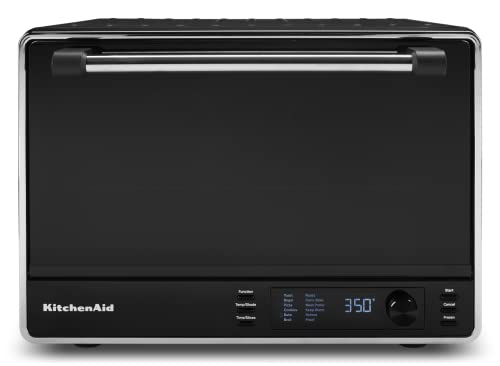
KitchenAid Dual Convection Countertop Oven KCO255 — Best Dual Convection
Dual convection is KitchenAid’s answer to the large-cavity problem: more air movement, from more directions, so a chicken roasts evenly without religious turning and a full sheet of vegetables caramelises instead of steaming in patches. In practice the KCO255 feels calm under load — temperatures hold, recovery is quick, and results stay consistent from the front of the rack to the back.
Strengths
- Dual convection attacks large-cavity hot spots directly
- KitchenAid ergonomics and finish suit daily heavy use
- Strong roasting performance for its class
Trade-offs
- Function set is focused rather than exhaustive
- Premium positioning within the category
- Check cabinet clearance — it is a tall oven
| Heating: dual convection design |
| Brand: KitchenAid countertop oven platform |
| Class: large-capacity family oven |
The function list is deliberately focused next to 15-mode rivals, which some buyers will read as restraint and others as absence. What is not absent is build intent: this is an oven designed for households that cook seriously every day and expect the appliance to keep up for years. If evenness is your religion, this is your large oven.
The KitchenAid’s calm is its signature: full loads cook without drama, temperatures hold through door openings, and the oven feels unhurried even when dinner is not. Its finish and heft suit kitchens built around serious daily cooking. Owners who roast often report the turning habit dying away — the dual convection genuinely does the work the single-fan ovens ask of the cook.
Best for: roasters and bakers frustrated by hot spots in big ovens / Not suited for: preset collectors who want twenty modes.
Check on Amazon — check price on Amazon for the current figure.

Oster Extra-Large French Door Air Fryer Countertop Oven — Best for Extra-Wide Pans
Oster’s extra-large French door oven is built around a pan dimension — 15 by 12 inches — which tells you exactly who it serves: the household whose cooking happens on wide trays, from sheet-pan dinners to party batches of roasted vegetables. The French doors open with one pull while your other hand holds the tray, a small mercy that becomes a big one across a cooking session.
Strengths
- 15 x 12 pan fit takes half-sheet-style loads
- French doors open one-handed and clear the food
- Extra-large cavity suits batch and party cooking
Trade-offs
- The widest footprint in this guide
- French door seals need regular crumb attention
- Air fry is a supporting function, convection is the star
| Capacity: fits 15 x 12 inch pans |
| Doors: French door design |
| Class: extra-large countertop oven with air fry |
Convection does the heavy lifting here, circulating heat across that wide cavity so the edges of a big tray do not lag the centre. Air fry capability rides along for smaller crisping jobs. The oven’s width is its warning label: measure the counter honestly, keep the door seals brushed out, and it will feed a crowd from a footprint the range cannot match for speed.
The Oster’s width shapes its household: sheet-pan dinners become the default format, party batches finish in one pass, and the French doors make loading wide trays a one-handed job. Keep the door seals brushed and the wide cavity stays efficient. It is the entertainer’s oven in this guide, and households that host monthly will feel under-equipped if they choose anything narrower.
Best for: batch cooks and entertainers with wide pans / Not suited for: galley kitchens with narrow counters.
Check on Amazon — check price on Amazon for the current figure.

BLACK+DECKER TO3250XSBD 8-Slice Extra Wide Convection Toaster Oven — Best Value Large Oven
The TO3250XSBD has been the value answer in large convection for years: an extra-wide cavity that takes eight slices or a family casserole, a convection fan to keep that width cooking evenly, and controls a babysitter can operate without a manual. It does not sensor-monitor or self-program; it heats, fans, toasts and bakes, at a tier that leaves budget for the food.
Strengths
- Extra-wide cavity fits casseroles and 8 slices at once
- Convection evenness at a mainstream tier
- Simple controls the whole household can run
Trade-offs
- Basic finish and accessories beside premium rivals
- No smart features or thermometer systems
- Wide body needs width, if not depth, on the counter
| Capacity: 8 slices, extra-wide interior |
| Heating: convection |
| Class: large family toaster oven |
Finish and accessories are a step below the premium picks, and long-term owners should expect honest wear rather than heirloom polish. But the cooking core — size plus convection — is the category’s essence, and this oven delivers it for households that would rather spend on ingredients. As a first large oven or a hard-working second one, it remains stubbornly hard to beat.
The BLACK+DECKER wide oven is the set-and-forget member of this category: no interface to learn, no modes to update, just a big even box that takes the casserole. Families hand it to teenagers and babysitters without a briefing. Its finish will show honest wear over years of this service — wear its owners tend to read as a working appliance’s patina rather than a flaw.
Best for: families wanting large convection capacity without premium pricing / Not suited for: cooks who want guided smart cooking programs.
Check on Amazon — check price on Amazon for the current figure.
Comparison Table
| Pick | Badge | Key spec | Best for |
|---|---|---|---|
| Cuisinart TOB-260N1 Convection Toaster Oven | Best Overall | 15 functions, 1800W | households wanting one large convection oven that does everything |
| Breville BOV800XL Smart Oven | Best for Bakers | large smart convection oven | bakers who want convection purity and proven controls |
| Ninja Prestige Smart XL DT501 | Best for Big Family Meals | fits a 12 lb turkey; bakes 20 cookies | large families and holiday hosts who batch-cook |
| KitchenAid Dual Convection Countertop Oven KCO255 | Best Dual Convection | dual convection design | roasters and bakers frustrated by hot spots in big ovens |
| Oster Extra-Large French Door Air Fryer Countertop Oven | Best for Extra-Wide Pans | fits 15 x 12 inch pans | batch cooks and entertainers with wide pans |
| BLACK+DECKER TO3250XSBD 8-Slice Extra Wide Convection Toaster Oven | Best Value Large Oven | 8 slices, extra-wide interior | families wanting large convection capacity without premium pricing |
How to Choose a Large Capacity Toaster Convection Oven
Convection quality is the product
In a large cavity, the fan system is not a feature — it is the oven. Dual convection, rear fans and well-spaced racks produce even full loads; a token fan in a big box produces a big box with hot spots. Weight fan design and rack engineering above preset counts.
Buy by pan, not by litres
List the three dishes you cook most — the 9×13 casserole, the 13-inch pizza, the roasting pan — and verify each fits with air space around it. Pan fit predicts satisfaction better than any capacity figure on the box.
Temperature recovery matters at scale
Large doors dump large amounts of heat. Higher-wattage platforms and sensor-managed ovens recover faster, which is the difference between a roast that keeps its schedule and one that runs twenty minutes long.
Plan for main-oven duty
If this oven will cook daily, prioritise interior cleanability, rack quality and control clarity over novelty functions. You will wipe it five hundred times; you will use the dehydrate preset five times.
How to Roast a Whole Chicken in a Large Convection Oven
- Truss the bird and season under the skin; a compact shape roasts evenly in moving air, and loose wings scorch first.
- Preheat the convection oven fully — large cavities forgive nothing about a cold start — and set the bird on a rack over a tray to let air circulate underneath.
- Reduce your conventional recipe temperature by roughly 15°C (25°F) as a convection starting point, and expect a modestly shorter cook; verify with a thermometer in the thickest thigh, never by colour alone.
- Rest the bird, tented, for at least fifteen minutes. In a large household the oven is now free for the vegetables while the chicken’s juices settle — the second-oven rhythm this appliance exists for.
- Wipe the interior while it is still warm. Roast splatter removed today is a cloth’s work; roast splatter removed next month is a project.
Common Buying Mistakes
Using conventional temperatures unchanged
Convection’s moving air cooks faster and hotter at the surface. Failing to reduce temperature is the classic route to dark skin over underdone thighs.
Blocking the fan with an oversized pan
A pan that touches the cavity walls strangles circulation and recreates every hot spot convection exists to remove. Leave air gaps on all sides.
Skipping the thermometer for large roasts
Big cavities and big birds multiply variables. Colour and wobble tests are folklore; a thermometer reading is dinner, on time, safely cooked.
Letting the crumb tray become a carbon layer
In a large oven cooking fatty food, tray neglect is a smoke and flavour problem within weeks. Weekly emptying is the entire secret.
Buying XL for a household of one
Heating a huge cavity for a single portion wastes energy and time daily. Size the oven to the household, not to the one holiday you host.
Convection vs Air Fry: What Actually Differs
Mechanically, an air fryer is a small, intense convection oven; a large convection oven is the same physics at family scale with a gentler fan-to-volume ratio. That is why large convection ovens bake and roast superbly and crisp very well, while dedicated air fry ovens push fan intensity higher for maximum crunch on smaller loads.
Households that bake, roast and reheat more than they crisp should buy convection confidence first — which is this guide’s category. Households whose cooking is wings, fries and nuggets at volume should read the air fryer oven guide instead. Honest self-knowledge about your menu is worth more than any single specification.
The Second-Oven Effect on a Household
A capable large countertop oven changes how a kitchen flows: the range stops being a bottleneck, holiday cooking parallelises, summer baking stops heating the whole house, and teenagers can reheat real food without supervision anxiety. Owners consistently report the surprise is not any single meal — it is the disappearance of queueing from daily cooking.
That effect only arrives when the oven is genuinely large and genuinely even. A too-small or hot-spotted oven becomes a third appliance competing for counter space instead of a second oven earning it, which is why this guide’s bar was main-oven duty, not occasional assistance.
Convection for Baking vs Roasting: Two Different Jobs
Bakers ask convection for evenness at moderate temperatures over long, undisturbed cycles — the fan must be gentle enough not to set a cake’s crumb leaning, yet thorough enough to erase corner effects across two racks. Roasters ask for the opposite personality: aggressive circulation at high heat that renders fat, crisps skin and recovers instantly when the door opens for basting.
The best large convection ovens manage both personalities through fan speed control and element management — the engineering that separates this guide’s top picks from big boxes with a fan bolted in. When you read a specification, look for that duality; when you test a new oven, bake one tray of identical cookies and roast one chicken before you judge it at all.
Matching the Investment to the Role
A large convection oven can play two roles, and they justify different spending. As an auxiliary — holiday overflow, summer baking, reheating — the value picks here are entirely sufficient, and flagship money is wasted. As the primary oven, used daily for the household’s real cooking, build quality, temperature management and cleanability compound across thousands of cycles, and the premium picks repay their tier.
Decide the role before the model. Kitchens are full of auxiliary-priced ovens failing at primary jobs and flagship ovens reheating one slice a week; both are the same mistake in opposite directions.
Two Racks of Cookies: The Honest Test
Every large convection claim collapses into one test: two racks of identical cookies, baked simultaneously, emerging indistinguishable. Passing it requires the fan to move air evenly front-to-back and top-to-bottom, the elements to recover after loading, and the racks themselves to be spaced so the lower tray is not simply steaming in the upper tray’s weather.
Run this test in your first week with any oven in this guide. If a model swaps trays halfway as a matter of design honesty, its results will still shame a still-air oven; if it passes unswapped, you own a genuine second oven. Either way, you will know your appliance’s true character before the first important meal depends on it.
Insulation: The Specification Nobody Lists
Large ovens differ enormously in how much heat they keep inside. Good insulation means a cooler kitchen, safer nearby cabinets, faster recovery and lower running costs — and it is almost never printed on the box. The proxies are weight, cabinet temperature during a long roast, and the maker’s platform reputation, all of which this guide weighted.
At home, respect what insulation cannot do: clearance still matters, vents still need their space, and no countertop oven should run sealed into a corner. Give a well-insulated oven its breathing room and it will feel less like a heater with a door and more like installed equipment.
Baking Bread in a Large Convection Oven
Large convection ovens are surprisingly serious bread tools. The fan evens the crust colour that still-air ovens stripe, the smaller cavity preheats to baking temperature in a fraction of the range’s time, and a baking stone or steel sized to the cavity stores heat for the initial spring that decides a loaf’s shape.
Manage steam honestly: a small oven-safe dish of hot water, or a spritz on the loaf at loading, gives crust the humidity it needs before it sets. Convection dries surfaces faster than still air, so bread bakers often reduce fan reliance — using convection for preheat and the first phase, then finishing gentler where the oven allows.
Two-loaf households gain the most: a large convection cavity bakes a pair of boules or a full batch of rolls in one cycle, evenly, which is the moment a countertop oven stops being an accessory and becomes the bakery.
Holiday Cooking With a Second Oven
The large convection oven’s finest hour is the holiday meal, when it absorbs everything the range cannot hold: the casserole that needs its own temperature, the rolls that must bake while the bird rests, the pie that cannot share air with garlic. Plan the day as two ovens with two temperature personalities and the traditional scheduling panic largely evaporates.
Assign by temperament. The countertop oven, with its fast preheat and precise recovery, takes the items needing attention and timing — rolls, gratins, the vegetable tray. The range takes the bird and the long, undisturbed roasts. Desserts bake in whichever oven frees first, in a kitchen that suddenly feels twice its size.
After the holiday, notice what happened: the second oven was not a luxury but a scheduling technology. Households that host twice a year justify this guide’s entire category on those two days alone.
Convection Conversion Rules That Actually Work
Converting conventional recipes for a large convection oven follows three rules that cover nearly everything. Reduce temperature by roughly 15°C (25°F) as the starting point. Begin checking for doneness at three quarters of the stated time. And protect delicate surfaces — meringues, custards, soufflés — from direct fan blast with placement low in the cavity or a loose shield where the recipe allows.
Some foods should not be converted at all in spirit: anything whose rise depends on still, humid air needs the fan’s gentlest setting or a conventional mode. The dual-personality ovens in this guide exist for exactly this judgement, and learning when not to convect is the mark of a cook who has made the technology theirs.
Keep a conversion notebook for your ten most-cooked recipes. Two cycles of notes per recipe converts folklore into your oven’s personal data, after which conversion anxiety disappears permanently.
Rack Positions and Load Geometry
Large cavities offer rack positions that small ovens cannot, and using them deliberately is half of convection craft. The centre position is the default for even work. The lower position favours bottom heat for pizza and pies. The upper position concentrates finishing heat for gratins and broils. Two-rack loads should straddle the centre, leaving the fan’s airflow path as open as the load allows.
Geometry inside the tray matters equally: centre-heavy loads cook slower at the edges in any oven, and a ring arrangement with a small central gap often evens a full tray better than a solid block of food. Rotate once, halfway, for very full loads — convection reduces the need; it does not repeal physics.
Treat the first month with a new oven as mapping, not cooking alone. One tray of identical items, run at each rack position, teaches you your oven’s personal geography more reliably than any review — including this one.
Grains, Casseroles and the Slow Virtues
Large convection ovens excel at the casserole repertoire that defines home cooking across most cuisines: baked grains, gratins, braises in lidded dishes, and the layered dishes that need an hour of even, unattended heat. The fan’s gift here is not speed but uniformity — a gratin that browns as one surface, a rice bake with no raw corner, a braise whose top stays as gentle as its base.
Lidded dishes forgive almost everything, which makes them the ideal first cooks in a new oven while you learn its character. Note the times against your old oven for three casseroles and you will hold a personal conversion table no chart can give you.
The second-oven rhythm completes the picture: the casserole in the countertop oven, the roast in the range, both finishing together without negotiation. That simultaneity is the lived experience this category sells, and it delivers it every single week.
Pastry and Delicate Baking Under Moving Air
Pastry is convection’s examination subject, because moving air both helps and threatens it. It helps by erasing the cold spots that leave one end of a tray pale. It threatens by setting delicate surfaces early and by drying exposed fillings. The craft lies in placement and shielding: centre rack for most work, lower rack for pies wanting bottom heat, and a watchful first run for anything laminated.
Choux, meringue and soufflé each have their own negotiation with the fan, and the dual-mode ovens in this guide — which let you soften or suspend convection’s aggression — exist for cooks who bake across that whole repertoire. A purely fan-forced oven can still succeed with placement and timing, but it asks more of the baker.
Keep a pastry log for the first season: item, rack, temperature adjustment, result. Pastry punishes improvisation and rewards records, and a large convection oven in a recording household becomes a precision instrument within a dozen bakes.
The Economics of the Second Oven
A large countertop convection oven costs less than most repairs to a built-in wall oven, heats in a third of the time, and can substitute for the range across most of a household’s cooking year. The economic case strengthens with energy prices and with household patterns: small families heating a cavernous range for two portions are paying a daily tax that a right-sized oven abolishes.
There is also a resilience argument rarely priced: when the range fails — and ranges fail at holidays with suspicious reliability — a capable countertop oven keeps a household cooking properly through the repair queue. Owners who have lived through one such December describe the oven’s price differently ever after.
None of this requires the flagship tier. It requires genuine size and genuine convection, which is why this guide’s value pick exists: the economics work at every tier, provided the oven is honestly large and honestly fan-assisted.
Teaching Teenagers and Guests to Cook in It
A large countertop oven is the most teachable cooking appliance in the house: visible food, forgiving convection, no open flame, no giant cavity to fear. Households that want teenagers cooking real dinners route them here first — tray bakes, roast vegetables, baked proteins — where success is likely and supervision can be light.
Write the house conversions on a card inside the cupboard: your oven’s temperature offset, its two best rack positions, the three family dishes with their exact settings. A new cook with that card produces adult results on their first evening, which is how cooking confidence actually begins.
Guests, too, can be trusted with it in a way they cannot be trusted with a range’s quirks. The oven becomes the kitchen’s shared instrument — and shared instruments, unlike private ones, get used enough to justify every inch of their counter.
Vegetables: Convection’s Home Ground
If convection has a home ground, it is the roasting tray of vegetables. Moving air strips surface moisture, edges caramelise instead of steaming, and a full tray — convection’s whole point — emerges with the blistered, sweet result that still-air ovens achieve only in small, uncrowded batches. Cut for density, oil lightly, salt after for the crispiest edges, and resist stirring more than once.
Root vegetables reward the lower rack and patience; delicate greens and asparagus want the centre and a watchful eye. A large convection oven holds both trays at once, which is the difference between a side dish and a vegetable course.
Defrosting and Gentle Work
Large ovens earn quiet credit for gentle work: warming plates, holding a finished dish at serving temperature, softening butter, proofing dough in the oven’s mild residual warmth where the model supports low temperatures. These unglamorous jobs are daily, and an oven that does them without drama becomes the kitchen’s default tool for everything between cooking and serving.
Treat the hold function with food-safety respect — hot food held warm belongs above safe temperatures and within sensible times — and the large oven becomes a staging area that smooths the hardest ten minutes of any meal: the landing.
Convection and Cast Iron: A Happy Marriage
A lidded cast iron pot inside a large convection oven is one of home cooking’s great combinations: the pot provides thermal mass and a sealed microclimate, the fan guarantees the surrounding temperature is the one you set, everywhere, for hours. Braises emerge with a consistency that stovetop attention struggles to match, and bread baked in the lidded pot gains its famous crust from the same partnership.
Size the pot to the cavity with the same air-gap discipline as any pan. The combination asks nothing exotic — only the recognition that two mature technologies, each honest about its physics, multiply rather than add.
Reading the Door: Glass, Seals and Heat You Can See
A large oven’s door is its largest surface and its largest heat leak, and its quality is legible: glass that stays clear enough to judge browning, a seal that meets evenly all round, hinges that hold the door at any angle without sag. Judge these in the first week — they predict the oven’s fifth year more reliably than any function list.
Keep the glass clean with the warm-wipe habit and it stays a window rather than becoming a curtain. Cooks who can see their food open the door less, lose less heat, and cook better — a small, compounding advantage built into every pick in this guide.
The Sunday Reset: Ten Minutes That Organise the Week
Large-oven households benefit from a Sunday reset: crumb tray emptied, interior wiped, racks checked, and the week’s cooking mentally assigned between the two ovens. Ten minutes, done with coffee in hand, converts the appliance from a reactive tool into planned infrastructure.
Use the reset to glance at the freezer and the store cupboard with the oven in mind — what trays, what casseroles, what bakes does this week hold? The households that cook best from large ovens are not more talented; they are more scheduled, and the reset is where the scheduling lives.
Final Recommendation
The Cuisinart TOB-260N1 leads this category on temperature control and true second-oven range, with the Breville BOV800XL the baker’s classic and the Ninja DT501 the family-volume specialist. KitchenAid’s dual convection answers hot spots, Oster goes widest, and BLACK+DECKER brings the size to a value tier.
Choose by the pans you own and the meals you repeat — a large convection oven chosen that way becomes infrastructure, not an appliance.
Related guides on this site: Best Large Capacity Air Fryer Toaster Ovens Best Inexpensive Toaster Ovens Best Low Cost Toaster Ovens Best Made Toaster Ovens Best Convection Ovens
Revisit the top picks: Cuisinart TOB-260N1 Convection Toaster Oven.
Revisit the top picks: Breville BOV800XL Smart Oven.
Revisit the top picks: Ninja Prestige Smart XL DT501.
Frequently Asked Questions
What is the difference between a convection toaster oven and an air fryer oven?
Air fryer ovens are convection ovens with more intense fans and a mesh basket, optimised for crisping. Large convection ovens prioritise even baking and roasting across bigger loads. Many households need the second more than the first.
Can a large convection oven fit a 9×13 pan?
Several picks here can, including the Cuisinart and the extra-wide models. Always verify your specific pan — handles included — against the cavity width before ordering.
How much should I reduce temperature for convection?
Start about 15°C (25°F) below the conventional recipe temperature and check earlier than the recipe’s time. Adjust by results; every oven’s fan has its own personality.
Is a large countertop oven expensive to run?
It heats a smaller cavity than a full-size range and preheats far faster, so for countertop-sized meals it typically uses less energy than the big oven doing the same job.
Do I still need to rotate food in a convection oven?
Less than in a still-air oven, but a single halfway rotation remains cheap insurance for very full loads and delicate bakes.
What clearance does a large convection oven need?
Plan on several inches above and behind at minimum and follow your model’s manual. Large ovens move a lot of hot air and need somewhere for it to go.