Disclosure: airfryerkitchensupply.com is reader-supported. When you buy through links on our site, we may earn an affiliate commission at no extra cost to you.
Where to buy
Every linked pick in this guide to the best made toaster ovens was verified against Amazon’s catalogue on 2026-11-22: the product name and ASIN below come from that check, not from memory. Prices move constantly, so this guide never prints them — use a link to see today’s figure.
- Breville Smart Oven Air Fryer Pro BOV900BSS — check price on Amazon
- Cuisinart TOB-260N1 Convection Toaster Oven — check price on Amazon
- Panasonic FlashXpress NB-G110P — check price on Amazon
- KitchenAid Digital Air Fry Countertop Oven KCO124BM — check price on Amazon
- Breville Smart Oven Pro BOV845BSS — check price on Amazon
- Breville Mini Smart Oven BOV450XL — check price on Amazon
The best made toaster ovens are bought by people who have already owned the other kind — the oven whose door stopped sealing, whose dial went vague, whose elements gave up one side at a time. ‘Best made’ is a claim about materials, tolerances and time: stainless cavities that do not rust at the seams, doors that close with the same quiet precision in year five, controls that stay calibrated, and makers who still stock the rack you bent in year two.
Judging build quality from a listing requires knowing where quality hides. It is in hinge design and door seals, in whether the crumb tray is pressed tin or proper gauge metal, in element support, in the weight of the unit and the reputation of the platform it belongs to. Every pick below was verified, and each represents a distinct school of well-made: Breville’s smart-oven engineering, Cuisinart’s sensor-managed classic, Panasonic’s Japanese infrared precision, KitchenAid’s appliance-grade solidity.
These ovens cost more than the budget guides on this site, deliberately. The argument of this page is cost per decade: a well-made oven bought once, serviced by a real parts network, outperforms a sequence of cheap ovens on every measure except the first receipt.
In this guide
Quick Picks
Best Made Overall — Breville Smart Oven Air Fryer Pro BOV900BSS. Pick up the BOV900’s rack, open and close its door, turn its dials: the flagship Breville communicates its manufacturing budget through your hands before it cooks anything. Check the current price on Amazon.
Best Made for Temperature Control — Cuisinart TOB-260N1 Convection Toaster Oven. The TOB-260N1’s build quality expresses itself as control. Check the current price on Amazon.
Best Made Compact — Panasonic FlashXpress NB-G110P. The FlashXpress is the connoisseur’s compact: double infrared heating that reaches working temperature instantly, precise electronic temperature control, and the kind of fit and finish that has kept this basic design in production for years with a devoted following. Check the current price on Amazon.
Best Made Mid-Size — KitchenAid Digital Air Fry Countertop Oven KCO124BM. KitchenAid builds countertop ovens the way it builds stand mixers: as appliances expected to be handed down. Check the current price on Amazon.
Best Made Without Air Fry — Breville Smart Oven Pro BOV845BSS. The BOV845 Smart Oven Pro represents the mature end of well-made: a platform refined over years, ten cook functions including slow cook, an interior light — a small thing that signals a maker thinking about owners — and Breville’s element management routing power intelligently between top and bottom. Check the current price on Amazon.
Best Made Small Oven — Breville Mini Smart Oven BOV450XL. The Mini Smart Oven exists because Breville understood that small households still notice build quality. Check the current price on Amazon.
How These Picks Were Chosen
Build quality cannot be photographed, so we weighted proxies that listings and platforms can prove: years in production, maker service networks, materials named in verified Amazon titles (brushed stainless steel, nonstick interiors, dual infrared heating), and the engineering systems — Element IQ-style power management, Exact Heat sensors, dual convection — that only serious manufacturing sustains.
Each ASIN was matched against its Amazon title before any link was placed. Models trading on a premium badge with budget internals were excluded; the badge had to be backed by a platform with a track record.
The six picks span sizes from the Mini Smart Oven to the full Smart Oven Air Fryer Pro, because ‘best made’ is a standard, not a size — a small household deserves the same tolerances as a large one.
The 6 Best Best Made Toaster Ovens
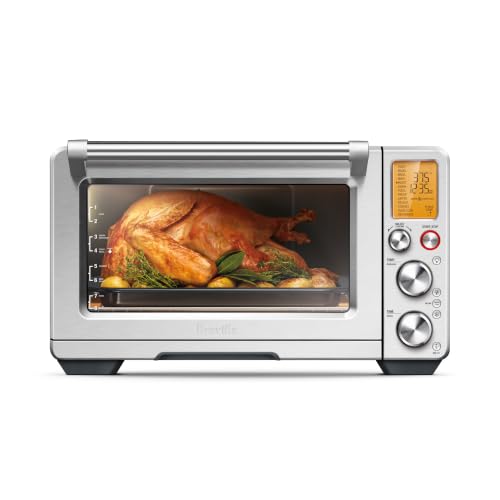
Breville Smart Oven Air Fryer Pro BOV900BSS — Best Made Overall
Pick up the BOV900’s rack, open and close its door, turn its dials: the flagship Breville communicates its manufacturing budget through your hands before it cooks anything. Brushed stainless panels align, the door seals with a damped certainty, and the controls have the weighted, indexed feel of instruments rather than switches. Thirteen functions and super convection give that hardware something worthy to do, from two-level air frying to low dehydrating.
Strengths
- Cabinet, door and controls feel machined, not assembled
- Super convection performance matches the build promise
- The platform’s parts and accessory ecosystem is deep
Trade-offs
- Flagship tier pricing
- Size demands a permanent, cleared counter zone
- More electronics than a purely mechanical oven
| Construction: brushed stainless steel |
| Functions: 13, with super convection |
| Platform: Breville Smart Oven flagship |
Longevity in an electronic oven is a fair question, and Breville answers it with the deepest accessory and parts ecosystem in the category — replacement racks, trays and pans remain orderable because the platform sells in volume year after year. It is the most expensive oven in this guide and the one whose cost-per-year math most easily justifies itself.
A year with the BOV900 changes a household’s reference point: other ovens start to feel approximate. The racks still glide, the door still seals with the same damped certainty, and the results of a recipe written in January repeat in December. Its accessories drawer — basket, trays, racks — becomes part of the kitchen’s organisation rather than clutter, because each piece is used weekly.
Best for: buyers purchasing a decade-scale appliance / Not suited for: minimalists who want three functions and no screen.
Check on Amazon — check price on Amazon for the current figure.

Cuisinart TOB-260N1 Convection Toaster Oven — Best Made for Temperature Control
The TOB-260N1’s build quality expresses itself as control. Exact Heat sensors watch the cavity and correct it continuously, so the temperature you set is the temperature the food experiences — the single hardest thing for a countertop oven to do and the first thing cheap ovens fake. Around that system Cuisinart built a stainless, nonstick-interior family oven that fits a 13-inch pizza and a whole chicken.
Strengths
- Sensor-managed heat holds set temperatures like a built-in oven
- Nonstick interior is thick, even and genuinely wipeable
- Stainless build with family capacity
Trade-offs
- Control interface takes a week to fully learn
- Large in every dimension
- Premium tier
| Power: 1800W, 15 functions |
| Technology: Exact Heat sensor system |
| Interior: nonstick, fits 13-inch pizza and full-size chicken |
Fifteen functions is a lot of interface, and new owners should expect a learning week. What they get for it is an oven that behaves like installed equipment: preheats honestly, recovers after door openings, and wipes clean after a roast. For cooks who measure doneness in degrees, this is the best-made argument in the category.
The Cuisinart’s owners develop a particular trust: they set temperatures for delicate work — custards, meringues, slow roasts — that they would not attempt in a lesser countertop oven. The nonstick interior keeps its promise through years of roasts, and the learning curve of week one becomes the fluency of year three. It is the pick for cooks whose recipes are written in degrees.
Best for: precision cooks who bake and roast by exact temperature / Not suited for: small kitchens.
Check on Amazon — check price on Amazon for the current figure.
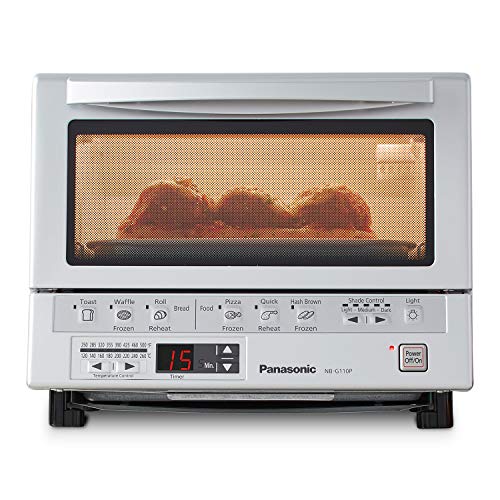
Panasonic FlashXpress NB-G110P — Best Made Compact
The FlashXpress is the connoisseur’s compact: double infrared heating that reaches working temperature instantly, precise electronic temperature control, and the kind of fit and finish that has kept this basic design in production for years with a devoted following. Infrared elements do not sag, spot and fade the way ageing calrod elements do, which is part of why these ovens develop decade-long ownership stories.
Strengths
- Infrared elements need no preheat and age gracefully
- Japanese manufacturing tolerances in a small footprint
- Precise temperature control unusual at this size
Trade-offs
- 4-slice capacity only
- No convection fan — infrared is its own philosophy
- Silver finish is sober, not showy
| Heating: double infrared, 1300W |
| Functions: 6 auto cook options, precise temperature control |
| Size: compact 4-slice |
It is a 4-slice oven with no convection fan, and it asks you to accept infrared’s philosophy — radiant, immediate, superb for toast, reheating and small bakes — instead of fan cooking. Households of one or two who buy quality in small footprints will find nothing better made at this size. It is the argument that ‘best made’ was never about dimensions.
The FlashXpress inspires the strongest owner loyalty in this guide relative to its size: people keep them for a decade, gift them, and replace them with the same model. Its instant infrared heat rewires breakfast expectations — there is no preheat pause in its household’s morning at all. The compact body also means it is the premium oven most likely to survive a kitchen remodel unchanged, because it never needed much space to begin with.
Best for: small households that refuse small quality / Not suited for: families needing capacity.
Check on Amazon — check price on Amazon for the current figure.

KitchenAid Digital Air Fry Countertop Oven KCO124BM — Best Made Mid-Size
KitchenAid builds countertop ovens the way it builds stand mixers: as appliances expected to be handed down. The KCO124’s Even-Heat convection system circulates air thoroughly enough for two 3.4 lb chickens or a 12-inch pizza to cook as one even load, and the black matte cabinet has the dense, finished feel of the brand’s better decades.
Strengths
- KitchenAid appliance-grade fit and finish
- Even-Heat convection lives up to its name on full loads
- Capacity hits the two-chicken family sweet spot
Trade-offs
- Black matte shows flour and dust
- Digital controls over dial simplicity
- Mid-premium tier
| Capacity: fits 12-inch pizza or two 3.4 lb chickens |
| Heating: Even-Heat convection system |
| Finish: black matte |
Digital controls divide households — some love the precision, some miss dials — and the matte finish keeps a visible diary of baking days. Neither undermines the core proposition: a mid-size, family-capable oven manufactured to appliance standards by a company whose service network will outlive us all. For buyers burned by disposable ovens, that institutional permanence is itself a feature.
The KitchenAid settles into a hard-working kitchen like a colleague: present daily, uncomplaining under full loads, finished in a matte that means business. Families report the two-chicken capacity changing Sunday habits permanently. Its digital interface, once learned, disappears — which is what good interfaces do — leaving only the cooking.
Best for: families wanting appliance-grade build without flagship size / Not suited for: buyers who prefer mechanical dials.
Check on Amazon — check price on Amazon for the current figure.
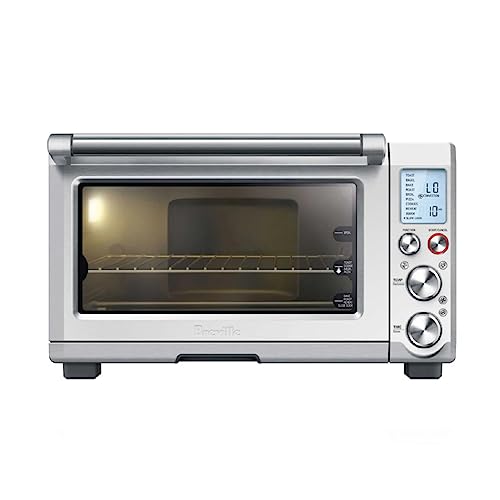
Breville Smart Oven Pro BOV845BSS — Best Made Without Air Fry
The BOV845 Smart Oven Pro represents the mature end of well-made: a platform refined over years, ten cook functions including slow cook, an interior light — a small thing that signals a maker thinking about owners — and Breville’s element management routing power intelligently between top and bottom. Its production history is itself evidence; badly made ovens do not survive a decade in a competitive range.
Strengths
- Proven Smart Oven platform with a long production history
- Interior light and slow-cook capability broaden real use
- Element management gives fine baking control
Trade-offs
- No air fry — convection crisping only
- Footprint is family-size
- Premium tier beside newer rivals
| Functions: 10 cook functions |
| Construction: brushed stainless steel |
| Platform: Breville Smart Oven Pro with interior light tradition |
It omits air fry, which in 2026 requires honesty to recommend — but convection crisping covers most real cooking, and what you receive in exchange is a thoroughly debugged appliance. Buyers who keep a mental list of products that simply work, year after year, will recognise the species immediately.
The Smart Oven Pro’s interior light becomes the feature owners mention first, improbably: browning judged through the door, heat kept inside, a small daily pleasure. Its slow-cook function earns a second life for the oven beyond baking days. A decade into the platform’s life, its ownership story is stability — nothing about it feels experimental, because nothing is.
Best for: bakers and slow cooks who value maturity over novelty / Not suited for: air fry devotees.
Check on Amazon — check price on Amazon for the current figure.
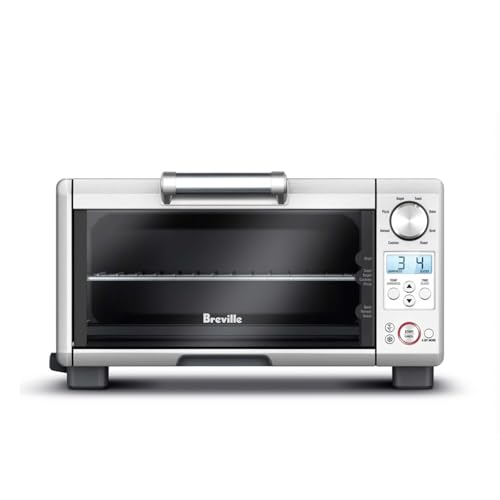
Breville Mini Smart Oven BOV450XL — Best Made Small Oven
The Mini Smart Oven exists because Breville understood that small households still notice build quality. It carries the brand’s element intelligence and eight functions into a space-saving body with the same brushed stainless seriousness as its flagship siblings — a small oven that toasts, bakes and broils with big-oven manners.
Strengths
- Flagship build standards in a mini body
- Eight functions with Breville’s element intelligence
- The small oven for people who hate small-oven quality
Trade-offs
- Mini capacity — four slices is the world here
- Premium cost for the size class
- No convection fan on this model
| Functions: 8 cooking functions |
| Construction: brushed stainless steel |
| Size: space-saving mini footprint |
There is no convection fan, and four slices define its universe. Within that universe it has few peers: the controls feel right, the results repeat, and the appliance reads as a miniature of a flagship rather than a toy. For a household of one or two furnishing a kitchen for the long term, it is the best-made small answer we know.
The Mini Smart Oven is the connoisseur’s small appliance: guests who know ovens notice it. It makes a small kitchen feel considered rather than compromised. Owners downsizing from houses to apartments frequently choose it as the one appliance that does not downsize in quality — a telling pattern for a ‘best made’ guide.
Best for: singles and couples who buy quality once / Not suited for: families — see the full-size picks above.
Check on Amazon — check price on Amazon for the current figure.
Comparison Table
| Pick | Badge | Key spec | Best for |
|---|---|---|---|
| Breville Smart Oven Air Fryer Pro BOV900BSS | Best Made Overall | brushed stainless steel | buyers purchasing a decade-scale appliance |
| Cuisinart TOB-260N1 Convection Toaster Oven | Best Made for Temperature Control | 1800W, 15 functions | precision cooks who bake and roast by exact temperature |
| Panasonic FlashXpress NB-G110P | Best Made Compact | double infrared, 1300W | small households that refuse small quality |
| KitchenAid Digital Air Fry Countertop Oven KCO124BM | Best Made Mid-Size | fits 12-inch pizza or two 3.4 lb chickens | families wanting appliance-grade build without flagship size |
| Breville Smart Oven Pro BOV845BSS | Best Made Without Air Fry | 10 cook functions | bakers and slow cooks who value maturity over novelty |
| Breville Mini Smart Oven BOV450XL | Best Made Small Oven | 8 cooking functions | singles and couples who buy quality once |
How to Judge How Well a Toaster Oven Is Made
Weight, doors and dials tell the truth
A well-made oven has heft from real materials, a door that closes evenly against its seal with no rattle, and dials with positive, indexed movement. Sloppy gaps, tinny trays and vague controls in the showroom become failures at home on a schedule.
Production history is evidence
Models that stay in a maker’s range for many years have survived warranty data, parts demand and owner word of mouth. A long production run is the closest thing to a published reliability record this category offers.
Parts availability is a build feature
Racks, trays, knobs and crumb trays are consumables over a decade. Makers who keep them orderable — Breville, Cuisinart, KitchenAid, Panasonic — are telling you they expect the oven to still be cooking when you need them.
Electronics vs mechanics is a values choice
Sensor systems and smart controls deliver precision that mechanical ovens cannot, at the cost of more that can age. Decide which you value; both philosophies appear in this guide because both, done well, are legitimate.
How to Care for a Premium Toaster Oven So It Lasts a Decade
- Wipe the interior while warm after fatty cooking; premium nonstick and enamel finishes are designed for a cloth, not for chisels after a month of carbon.
- Wash racks and trays in the sink rather than the dishwasher’s harshest cycles if the manual permits either — hand care keeps coatings and finishes years younger.
- Keep door seals and hinges crumb-free with a soft brush weekly; seals are the first place heat escapes and the cheapest place to prevent it.
- Run the oven empty at high heat for ten minutes monthly if you cook fatty food often, burning off vapour deposits before they become smoke.
- Register the product and keep the manual. Decade-scale ownership eventually needs a part number, and the households that get ten years are the ones who can order the exact rack in year seven.
Common Buying Mistakes
Equating price with build quality automatically
Some expensive ovens are feature collections in thin cabinets. Judge materials, production history and parts support — price is a hint, not a verdict.
Buying flagship size for a small household
The best-made oven in the wrong size still disappoints daily. Every size class in this guide has a well-made representative; choose the size first.
Neglecting a premium oven because it was expensive
Quality finishes still carbonise under neglect. The care routine above is what converts build quality into actual service years.
Ignoring the service network for your country
A superb oven from a maker with no local parts presence is a risk. Buy the best-made oven you can also get serviced.
Judging by the first week
Well-made ovens reveal themselves in year three: seals still tight, calibration still true, tray still flat. Weight long-owner evidence over unboxing impressions.
Where the Money Goes in a Well-Made Oven
Open a premium oven and a budget oven side by side and the budget difference is visible: thicker-gauge steel, real insulation between cavity and cabinet, supported elements that cannot sag, a door with an actual seal and hinges engineered for tens of thousands of cycles, and a thermostat or sensor system that treats temperature as a measurement rather than a suggestion. None of it photographs well. All of it cooks.
The second destination of the money is invisible: quality control and support. Calibration at the factory, a parts warehouse, a service network — these are manufacturing costs that never appear in a feature list and are the entire reason one oven serves a decade while its paper twin serves a year.
The Case for Buying Once
Countertop ovens sit at the centre of daily cooking, which makes their failure unusually disruptive and their quality unusually valuable. The buy-once argument is not snobbery; it is arithmetic plus breakfast. An oven used twice daily for ten years delivers over seven thousand services — at that count, even a large price difference between tiers shrinks to very little per use, while the daily experience difference remains at full size.
There is also a waste argument owners feel in their hands: a well-made oven is repairable, its parts are orderable, and its end is measured in decades. In a category full of disposable boxes, that is a genuine distinction worth paying for once.
Materials, Up Close: What You Are Actually Paying For
Brushed stainless on a flagship is not jewellery; it is thicker-gauge metal that resists denting, heat tint and the slow warping that makes cheap doors leak. Interior finishes divide into raw metal that seasons into stains, basic coatings that scratch, and the heavy nonstick or enamel surfaces of this guide’s picks, which release roast residue with a cloth for years. Element quality shows in support brackets and spacing — sagging elements are a budget signature and a hot-spot guarantee.
None of this is visible in a product photo, which is why ‘best made’ cannot be shopped by image. It is shopped by platform history, by weight, by parts catalogues and by makers whose other appliances your family already trusts. This guide’s six picks are simply where that evidence currently points.
Best Made at Three Sizes of Ambition
For a small household, best made means the Panasonic or the Breville Mini: flagship tolerances, tiny footprints, decade horizons. For a family, it means the KitchenAid or the Cuisinart — capacity with control, built to be used by everyone daily. For the household replacing its oven outright, it means the Breville flagship, bought as infrastructure.
Notice what does not change across the tiers: the standard. Size and function scale with the household; materials, calibration and support should not scale down with them. That consistency is the difference between a product line and a pile of price points.
Repair, Parts and the Right to Keep Cooking
A well-made oven is one you are allowed to keep. The makers in this guide publish parts diagrams and sell racks, trays, knobs and crumb trays years after purchase — a policy that converts accidents into orders instead of replacements. When a knob cracks in year six, the household that can order a knob keeps its oven; the household that cannot, landfills a working appliance over a small plastic part.
Before buying any premium oven, spend two minutes on the maker’s parts site for that model. The depth of that catalogue is the most honest longevity forecast in the entire category — more honest than warranties, which are written by lawyers, while parts catalogues are written by warehouses.
Calibration: The Invisible Quality
Two ovens with identical dials can differ by twenty degrees at the food. Premium platforms calibrate at the factory and hold that calibration because their sensors, elements and insulation are stable; budget platforms drift as components age. The home test is simple: an oven thermometer, three set temperatures, ten minutes each. A well-made oven lands close and stays close across the test.
Calibration is why recipes ‘work’ in one kitchen and fail in another, and why serious bakers defend their ovens like instruments. If you bake for people whose opinions you value, calibration is not a luxury feature — it is the product.
The Decade Test: Imagining Year Ten
Judge a premium oven by imagining its tenth year in your kitchen. The door seal should still close evenly — a property of hinge engineering and gasket material chosen today. The calibration should still be true — a property of sensors and elements that do not drift. The tray you need should still be orderable — a property of the maker’s parts policy. Every pick in this guide was chosen because its year ten is imaginable in detail.
Contrast the un-imaginable oven: proprietary parts already delisted, a door that closed perfectly only in the showroom, electronics from a platform abandoned in year two. Its year one may be delightful. Premium money spent on an un-imaginable decade is merely expensive, not well spent.
This is why the guide weights production history so heavily. A platform in its eighth year has already shown you its tenth.
Well-Made Ovens and the People Who Cook From Recipes
Recipe writers assume an oven that tells the truth: 180 degrees means 180 degrees, the centre of the rack behaves like the edges, and twenty minutes produces the photographed result. Most cooking disappointment blamed on recipes is actually oven variance — which is why serious home bakers migrate, eventually, to the ovens in this guide.
The migration usually follows a pattern: a cake that failed identically three times, a thermometer bought in suspicion, a reading that explained everything. From that moment, calibration stops being a specification and becomes the criterion, and the next oven is bought from this page’s shortlist rather than from a feature comparison.
If you cook from recipes you care about, you are already this guide’s reader. The only remaining question is size.
Heirlooms, Hand-Me-Downs and Resale
Well-made countertop ovens have a second life market that budget ovens never develop: they are handed to students, sold to neighbours and kept through kitchen remodels, because a ten-year-old flagship still outperforms a new budget box at the tasks both can do. That residual value is part of the purchase arithmetic, rarely counted and always real.
It also changes how owners treat them. Appliances expected to be handed down get wiped, descaled and maintained; appliances expected to be replaced get endured. The care habits in this guide’s how-to section are simply the maintenance schedule of an object with a future.
Buy the oven you would be pleased to give away in a decade, still working, to someone you like. That single test eliminates most of the category and all of its regrets.
What Best Made Does Not Mean
It does not mean most functions — several picks here are deliberately focused. It does not mean largest, or smartest, or newest; the FlashXpress design is years old and the Smart Oven Pro is a mature platform, and both outrank fresher novelties on the evidence of their service lives. It does not even mean most expensive within a brand’s own range, where flagships sometimes chase features past the point of sense.
Best made means the manufacturing budget went to the parts that decide a decade: materials, calibration, hinges, seals, elements and support. Everything in this guide was audited against that allocation, and the models that spent their budget on theatre were excluded however impressive their launches were.
Hold any future oven to the same audit and the category becomes easy to shop for the rest of your life.
The Makers and Their Philosophies
Each maker in this guide represents a distinct theory of quality. Breville’s theory is engineering intelligence: power managed electronically, functions integrated, performance measured. Cuisinart’s is control: sensors holding a cavity to a cook’s intention. Panasonic’s is precision through simplicity — infrared elements doing one physical thing perfectly for decades. KitchenAid’s is institutional durability: appliances as long-term household citizens.
None of these theories is the correct one; they are answers to different cooks’ values. The precision cook and the durability cook can both be right while choosing different ovens, which is why this guide presents schools rather than a single throne.
What unites the schools is what they refuse: none spends its budget on novelty at the expense of the cooking core. In a category full of theatre, that shared refusal is the actual definition of ‘best made’.
Buying Premium Without the Showroom
Most premium ovens are now bought unseen, which shifts the buyer’s craft from touching to reading. Read the parts catalogue before the feature list. Read the manual — makers publish them, and a clear manual signals an organised company. Read the warranty’s exclusions, which describe what the maker itself expects to fail. And read long-owner accounts for the specific failure vocabulary of the platform: every model has one, and knowing it in advance converts surprises into expectations.
Weight and dimensions, printed honestly, are your hands at a distance. A suspiciously light large oven is telling you about its materials; a maker that publishes exact interior dimensions is telling you about its confidence.
Finally, buy from a channel with a real returns policy and use the first week as the showroom you did not have: toast, bake, roast, and judge. Premium money deserves a probationary period, and good makers expect to survive one.
When Best Made Is the Wrong Answer
Honesty requires the counter-case. A household that cooks twice a week, moves every two years, or is furnishing a first kitchen for a cook still discovering whether they cook at all, will extract more value from this site’s inexpensive guides than from this one. Premium build amortises across use; without the use, it is sculpture.
Similarly, a buyer whose real constraint is space should let size rule: the best-made oven that does not fit is worth less than the adequate oven that does. This guide includes compact flagships precisely so that constraint rarely forces the trade — but where it does, fit wins.
Buy for the household you have, at the intensity it actually cooks, and revisit this page when either changes. The ovens here keep; they will still be the answer when the question becomes yours.
The Quiet Luxury of an Oven That Just Works
There is a form of luxury that never appears in advertisements: the appliance that disappears. Temperatures that are simply correct, a door that simply seals, toast that simply repeats — across years, these simplicities compound into a kitchen that feels calm. Cooks protect that calm fiercely once they have it, which is why owners of these ovens sound almost emotional describing objects that are, after all, heated boxes.
The calm is manufactured, not accidental. It is the downstream effect of every decision this guide has audited — materials, calibration, hinges, support — arriving in a kitchen as the absence of friction. You do not notice a well-made oven daily. You notice that cooking feels easier, and eventually you understand why.
That understanding is the real product. The stainless and the sensors are merely how it is delivered.
The First Month With a Premium Oven
Premium ovens reward a deliberate first month. Week one: the toast and bake calibrations, learning your unit’s honesty against an oven thermometer. Week two: a roast that tests recovery and capacity. Week three: the function you bought it for, used properly, with the manual open. Week four: teach the household, and write the house settings where everyone can find them.
This apprenticeship converts a purchase into an instrument. Owners who skip it often underrate excellent ovens for years, blaming the machine for the learning curve they declined to climb. The ovens in this guide are worth the month; few appliances repay attention so reliably.
Premium Ovens in Small Kitchens
Small kitchens are not excluded from this guide; they are its sharpest test. The Panasonic and the Breville Mini exist because their makers understood that a small footprint household may care most about quality — it owns few appliances, uses each constantly, and cannot hide a failure in a cupboard of alternatives.
Measure with the same rigour as for a large oven, and value the compact flagships’ shallower depths and calmer heat signatures. A small kitchen with one superb oven is a better kitchen than a large one with four mediocre appliances, and it is not close.
What Warranty Length Really Tells You
A warranty is a maker’s priced opinion of its own failure rate, and in this category it deserves reading as data. Longer coverage on the whole appliance signals confidence in the platform; short coverage padded with long coverage on a trivial part signals marketing. Compare warranties between finalists as you would compare any other specification — after the parts catalogue, it is the second-most honest document a maker publishes.
Register the product, keep the receipt with the manual, and note the support channel before you need it. Premium ownership is a relationship with a service network, and relationships work better when they are set up in peacetime.
The Aesthetics of Serious Appliances
Well-made ovens share a visual language worth naming: restraint. Brushed metal rather than chrome theatre, dials that look like instruments, displays that tell you the temperature and stop talking. This restraint is not a style choice laid over the engineering; it is the engineering, visible — the same discipline that calibrates a thermostat also refuses a decorative bezel.
Such appliances age gracefully in a kitchen because they were never chasing a season’s fashion. A decade-old Smart Oven looks like a serious object in a way a decade-old novelty design never will, which is another form of longevity: the kind measured in whether you still want it on the counter.
Handing Down: The Premium Oven’s Second Decade
Plan, even loosely, for the oven’s second decade and you will maintain its first one better. The likely paths — a child’s first kitchen, a second home, a sale to a neighbour who has eaten from it for years — all reward the same habits: parts kept, manual kept, finishes wiped rather than scoured, accessories stored together.
There is satisfaction available here that disposable appliances cannot offer: an object that served ten thousand breakfasts, passed on still serving. In a category defined by churn, the well-made oven’s biography is its final specification, and it is written by its owner one wiped crumb tray at a time.
A Buyer’s Walkthrough: Five Minutes in the Showroom
If you do meet one of these ovens in person, spend five structured minutes. Minute one: open and close the door ten times, feeling for even seal contact and hinge confidence. Minute two: turn every dial through its range, listening for indexed certainty rather than mush. Minute three: slide the racks and lift the tray — gauge and finish announce themselves to your hands. Minute four: read the interior’s corners and seams, where manufacturing honesty hides. Minute five: simply look at it, and ask whether its restraint suits your kitchen for a decade.
An oven that passes those five minutes has passed the only showroom test that correlates with year ten. Everything else — the functions, the screens, the promises — can be learned from documents. Build can only be learned this way, or from a platform’s history.
Why This Guide Contains No Scores
A single score for build quality would be a lie of precision: the Panasonic’s decade of infrared simplicity and the Breville flagship’s electronic sophistication are both ‘best made’, along axes no number can share. What can be shared is evidence — materials, platforms, parts, calibration — and this guide has tried to give you the evidence in a form your own priorities can weigh.
Distrust any ranking of durable goods that cannot show its working. Prefer, always, the review that tells you what a thing is made of, how long it has been made, and what happens when a small part breaks in year six. Those three answers, for any oven, are worth more than a decimal.
Final Recommendation
For a flagship that justifies itself daily, the Breville BOV900 leads; for temperature precision, the Cuisinart TOB-260N1; for compact excellence, the Panasonic FlashXpress; for appliance-grade family build, KitchenAid; and for proven maturity, the two smaller Brevilles.
Whichever you choose, you are buying the same thing in different sizes: an oven whose tenth year resembles its first. That is what ‘best made’ means, and it is worth paying for exactly once.
Related guides on this site: Best Toaster Ovens Best Inexpensive Toaster Ovens Best Large Capacity Air Fryer Toaster Ovens Best Large Capacity Toaster Convection Ovens Best Low Cost Toaster Ovens
Revisit the top picks: Breville Smart Oven Air Fryer Pro BOV900BSS.
Revisit the top picks: Cuisinart TOB-260N1 Convection Toaster Oven.
Revisit the top picks: Panasonic FlashXpress NB-G110P.
Frequently Asked Questions
Which toaster oven brand lasts the longest?
Longevity tracks platform maturity and parts support. Breville’s Smart Oven line, Cuisinart’s sensor models, Panasonic’s FlashXpress and KitchenAid’s countertop ovens all have long production histories and active parts ecosystems — the pattern behind every pick here.
Is stainless steel construction worth it?
For the cabinet and door, yes: it resists heat discolouration, cleans without degrading and signals the heavier-gauge build that usually continues inside. Interior finish — nonstick or enamel — matters as much for daily cleaning.
Do smart ovens fail sooner than dial ovens?
They have more components that can age, but established platforms manage that with mature electronics and available parts. A well-made smart oven from a major maker is a safer decade bet than a no-name mechanical oven.
What is the best made small toaster oven?
The Breville Mini Smart Oven for flagship standards in a small body, and the Panasonic FlashXpress for infrared precision and Japanese tolerances. Both appear in this guide.
How can I tell build quality when shopping online?
Look for named construction materials in the listing, the model’s years in production, parts availability on the maker’s site, and unit weight — heavier ovens in the same size class are usually built with more material.
Is an interior light a meaningful feature?
More than it sounds. It signals owner-focused design, helps you judge browning without opening the door and dumping heat, and tends to appear on platforms engineered for long service.