Disclosure: This article contains affiliate links, and airfryerkitchensupply.com may earn an affiliate commission when you buy through them, at no extra cost to you.
A double convection wall oven is the single biggest upgrade a serious home cook can make to a kitchen, and also the one most likely to go wrong on paper before it ever goes wrong in person. Two full-size cavities stacked in one cabinet cutout means a turkey can roast at one temperature while pies bake at another, a sheet of rolls can proof low and slow beneath a braising dutch oven, and a weeknight salmon fillet never has to heat a cavernous single oven again. But it also means a taller cutout, a heavier electrical draw, a bigger delivery, and a purchase you will live with for fifteen years or more. Getting the choice right matters more here than with almost any other appliance.
This guide walks through the six double convection wall ovens that stand out right now, from a value-leaning Samsung with a camera inside the cavity to a design-forward Café model you can customize with different hardware finishes. Every pick below is a real, currently sold 30-inch double wall oven (the standard size for most American kitchens), and every one offers convection cooking in at least the upper cavity. Where models differ — and they differ a lot — is in whether that convection is true European-style convection with its own heating element, or a simpler fan-assisted setup, how evenly the racks bake, how the controls behave when your hands are covered in flour, and how much cabinet surgery the installation will demand.
Before the individual reviews, there is a long section on what to look for: the difference between true convection and fan-only systems, how to measure your existing cutout so a new oven actually fits, what your electrical panel needs to feed two ovens at once, and why independent temperature control between the cavities is the whole point of the format. If you are replacing an older double oven, read that section twice. Most buying mistakes with wall ovens are measurement mistakes, not cooking mistakes.
In this guide
Quick picks: best double convection wall ovens
| # | Product | Where to buy |
|---|---|---|
| 1 | GE Profile double wall oven | Check on Amazon |
| 2 | KitchenAid double wall oven | Check on Amazon |
| 3 | Bosch 800 Series double wall oven | Check on Amazon |
| 4 | Samsung Bespoke double wall oven | Check on Amazon |
| 5 | LG InstaView double wall oven | Check on Amazon |
| 6 | Café double wall oven | Check on Amazon |
Quick comparison: the six picks at a glance
All six ovens below are 30-inch double wall ovens with convection capability, but they aim at different kitchens. The table summarizes positioning in words rather than numbers, because street pricing on built-in ovens swings with promotions, bundle rebates, and retailer installation deals.
| Model | Convection type | Positioning | Best for |
|---|---|---|---|
| GE Profile 30-Inch Double Wall Oven | True convection, both cavities | Mid-range to premium | Connected features and air fry without the luxury markup |
| KitchenAid 30-Inch Double Wall Oven | True convection (Even-Heat), upper cavity focus | Premium | Bakers who care about even browning across every rack |
| Bosch 800 Series Double Wall Oven | True convection, European styling | Premium | Flush installs and quiet, precise baking |
| Samsung Bespoke Double Wall Oven | Dual convection with divider flexibility on some configurations | Mid-range | Tech-forward cooks who want a camera and app control |
| LG InstaView Double Wall Oven | True convection with air fry and sous vide modes | Mid-range to premium | Mode collectors: air fry, steam, and knock-to-view glass |
| Café 30-Inch Double Wall Oven | True convection, both cavities | Premium / luxury-leaning | Design-led kitchens and heavy holiday entertaining |
Two patterns show up in that table. First, true convection — a third heating element wrapped around the circulation fan — has become the expectation rather than the exception at this level, and every pick here except in certain lower Samsung configurations delivers it. Second, the real dividing lines are controls and cleaning: touchscreens versus knobs, pyrolytic high-heat self-cleaning versus steam-only cycles, and whether the lower oven gets the same convection hardware as the upper or a lesser fan-only setup. Those details are where the individual reviews spend their time.
What to look for in a double convection wall oven
True convection vs. fan-assisted convection
This is the distinction that matters most, and the one marketing language works hardest to blur. In a fan-assisted (sometimes just called “convection”) oven, the standard bake and broil elements heat the cavity while a fan at the back wall stirs the air. It helps — food cooks faster and more evenly than in a still-air oven — but the air being circulated has already picked up temperature swings from the cycling elements, so hot spots soften rather than disappear.
True convection, also sold as European convection or third-element convection, adds a dedicated heating element around the fan itself. The fan blows air that is heated to a consistent temperature as it enters the cavity, which produces measurably more even results: three racks of cookies brown at the same rate, a sheet pan of vegetables roasts instead of steaming at the edges, and you can typically reduce the set temperature by about 25 degrees Fahrenheit compared with a conventional recipe. Many ovens automate that conversion; the good ones let you toggle it off when you are following a recipe written for convection already.
For a double oven, ask a second question: does the lower cavity get the same system? On several models the upper oven is the convection showcase while the lower oven is a simpler thermal or fan-only cavity. That is not automatically a dealbreaker — the lower oven is often the roasting and holiday-overflow cavity, where raw power matters more than finesse — but you should know which arrangement you are buying, because the spec sheets do not always volunteer it in the headline.
Cutout dimensions: measure the hole, not the oven
Wall ovens are sold by nominal width — 30 inches for everything in this guide — but they install into a cabinet cutout whose exact width, height, and depth are specified to the fraction of an inch, and those numbers vary between brands. A double oven cutout is roughly twice the height of a single, typically somewhere around 50 inches tall, and swapping brands can require trimming the opening taller, adding filler strips at the sides, or shimming the base platform the oven rests on. The oven is heavy, often well over 200 pounds, and it slides in on a support platform inside the cabinet rather than hanging from its trim.
Before ordering anything, pull your current oven’s model number, download the installation manual for both the old and new units, and compare cutout ranges line by line. Measure the actual opening with the old oven removed if you can, including the depth to any obstruction at the back and the location of the electrical junction box — many ovens require the box in a specific zone so the conduit does not foul the chassis. If your kitchen has a 27-inch double oven (an older standard), none of the picks here will fit without cabinet modification; that is a carpenter conversation, not an appliance-store conversation.
Electrical requirements
A double wall oven is one of the hungriest appliances in the house. Most 30-inch doubles ask for a dedicated 240-volt circuit in the 40-amp range, hardwired through flexible conduit to a junction box, and running both cavities at full broil during the holidays is exactly the load that rating anticipates. If you are replacing an existing double oven, the circuit is probably adequate, but “probably” deserves a check of the breaker size and wire gauge against the new oven’s installation sheet — some models specify 30 amps, others 40, and a mismatch in either direction is a problem an electrician should resolve, not a detail to wave through.
Homes with 100-amp service and several other large electric loads (an induction range, an EV charger, electric water heating) should have the panel load reviewed before adding or upsizing any oven circuit. This is also the moment to confirm the junction box location noted above, because moving a box after the oven is on the truck is how installations stall for a week.
Independent temperatures and simultaneous cooking
The entire reason to own a double oven is cooking two dishes at genuinely different temperatures at the same time, so verify that both cavities run fully independently — separate elements, separate controls, separate timers — rather than sharing any heating hardware. Every pick in this guide does. Then think about how you will actually split the work. A common holiday pattern: turkey or a standing rib roast in the lower cavity (larger, closer to the floor, easier to baste a heavy pan at that height for some cooks), sides and pies cycling through the upper. On ordinary weeks the upper oven becomes the default for everything small, because it preheats faster and wastes less energy than heating the big lower cavity for a single sheet pan.
Pay attention to how each oven divides its capacity. Total capacity figures around ten cubic feet combined are typical for 30-inch doubles, split unevenly or evenly depending on brand. If you regularly roast a very large turkey, check the lower cavity’s interior height and rack positions against your roasting pan with the lid and handles — published cubic feet will not tell you whether the pan fits, but interior dimensions will.
Racks, probes, and the small hardware that matters daily
Glide racks — heavy racks on ball-bearing or roller glides that extend fully and stay level — sound like a luxury until you have pulled a sloshing pan of braising liquid toward you with one hand. Most premium doubles include at least one; check how many, and in which cavity. Meat probes that plug into the cavity wall and shut the oven down or hold temperature at a target doneness remove the guesswork from roasts, and every pick here offers one, though probe storage (a little magnetic or clip holder) varies. Rack counts and positions matter for convection baking in particular: true multi-rack baking needs the rack spacing the manufacturer recommends, and the manual’s convection rack guide is worth reading before your first batch, not after a lopsided one.
Self-cleaning: pyrolytic vs. steam
Pyrolytic self-cleaning heats the cavity to very high temperatures and reduces spills to ash you wipe out. It is effective, it heats up the kitchen, it takes hours, and on a double oven you can only run it in one cavity at a time — plan accordingly around holidays. Steam cleaning is gentler and faster, good for light soil, useless for a season of polymerized grease. Many ovens offer both, with steam positioned as the maintenance cycle between rare pyrolytic deep cleans. Also check whether the racks can stay in during self-clean (some gliding racks must come out, and forgetting is an expensive mistake) and whether the oven locks you out of the other cavity during a cycle — most do not, which is another quiet advantage of the double format.
Controls you can use with messy hands
Full-glass touchscreens look clean and wipe clean, and they enable features like guided cooking and remote preheat. Knobs and physical buttons give tactile feedback and work with wet or floury fingers. There is no universal winner; there is only your cooking style. If you bake with your hands in dough, strongly consider models with at least some physical controls or highly responsive touch panels. Also look for a control lock (essential with children), a Sabbath mode if your household needs one, and a display you can read from across the room — timer legibility sounds trivial until you are timing three dishes against a turkey.
The six best double convection wall ovens, reviewed
The reviews below follow the same pattern: what the oven is, its strengths, its trade-offs, and who it suits. Positioning is described in words — budget, mid-range, premium — because built-in appliance pricing moves constantly with promotions and package deals.

1. GE Profile 30-Inch Double Wall Oven — the connected all-rounder
GE Profile’s 30-inch double wall oven is the pick that tries to give you the most modern feature set without stepping into luxury-brand pricing, and it largely succeeds. Both cavities offer true convection with a third element, which puts it ahead of rivals that reserve the good system for the upper oven only. It also builds in an air fry mode that needs no preheat and no basket beyond a dark sheet pan, a precision temperature probe, and Wi-Fi through GE’s SmartHQ app for remote preheat, timer checks, and downloadable feature updates that have genuinely added modes to earlier units after purchase.
Strengths. The convection performance is even and honest: multi-rack cookie bakes come out uniformly browned, and the automatic conversion adjusts temperatures for conventional recipes if you want it to. The full-color touch display is one of the more legible in this class, with big type and a sensible menu structure. Steam cleaning handles everyday soil, a pyrolytic cycle is there for the annual deep clean, and the heavy-duty roller rack in the upper oven glides smoothly enough to pull a full dutch oven toward you one-handed. GE’s service network is also among the widest in the country, which matters for a built-in you intend to keep for a decade and a half.
Trade-offs. The touchscreen-only control scheme will frustrate cooks who prefer a knob to grab with an oven mitt on; there is no physical dial to fall back on. The air fry results, while good, still do not match a dedicated countertop air fryer for small batches — it shines on family-size trays instead. Some owners find the touch panel’s responsiveness a beat slow when cycling through modes. And like most smart appliances, the app features depend on your willingness to keep the oven on your home network.
Who it suits. Households that entertain often and want true convection in both cavities, remote preheat on the drive home, and air fry capacity for a crowd, at a mid-range-to-premium position rather than a luxury one. If your holiday cooking routinely runs two temperatures at once and you like connected features that actually get used, this is the sensible default.
Check price on Amazon.
Check price on Amazon: GE Profile double wall oven

2. KitchenAid 30-Inch Double Wall Oven — the baker’s choice
KitchenAid built its wall oven reputation on one system: Even-Heat true convection, which pairs the third element and fan with a distinctive bow-tie-shaped baffle design intended to keep airflow consistent across every rack. In practice it delivers some of the most even baking in this guide — the kind of result that shows up when you bake three trays of scones and cannot tell which rack each came from. The upper cavity is the star and gets the full convection treatment, while the lower cavity serves as a capacious thermal oven for roasting and overflow work.
Strengths. Baking evenness is the headline, backed by a temperature probe, a gliding roll-out extension rack that makes heavy roasts safer to handle, and a fitting aesthetic — the handles and trim echo KitchenAid’s stand-mixer design language, so the oven looks intentional in a kitchen built around the brand. The control panel combines a digital display with a straightforward interface that does not bury the basics. Interior capacity is generous, and the lower oven swallows a large turkey with room to spare in most roasting pans.
Trade-offs. The asymmetry is the main caveat: if you specifically want true convection in both cavities for simultaneous multi-rack baking upstairs and downstairs, the GE Profile and Café in this guide are structured that way and this one leans its convection investment upward. KitchenAid’s connected features have historically been thinner than GE’s or Samsung’s, so app-driven cooks should compare carefully. Positioning is firmly premium, and the design-forward handle styling polarizes people — see it in person if your kitchen is minimalist.
Who it suits. Bakers first. If your double-oven dreams are built around layered cakes, laminated pastry, holiday cookie production, and evenly browned casseroles — with the lower oven as a roasting workhorse — KitchenAid’s convection tuning is aimed squarely at you.
Check price on Amazon.
Check price on Amazon: KitchenAid double wall oven
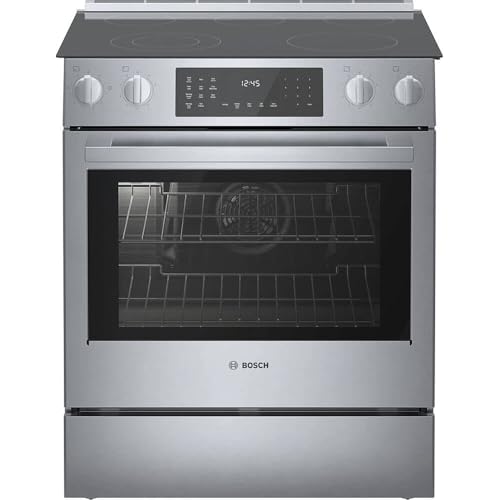
3. Bosch 800 Series Double Wall Oven — the quiet precision pick
Bosch approaches the double wall oven the European way: flush installation that sits nearly invisible in the cabinetry, dampened hinges that close the doors softly and quietly, and true convection engineered for precision rather than spectacle. The 800 Series double offers genuine third-element convection, a meat probe, and a fast preheat that is noticeably quicker than most — useful when the upper oven is your weeknight default. The design language is restrained stainless and glass, meant to disappear into a modern kitchen rather than anchor it.
Strengths. Evenness and temperature accuracy are excellent, and the oven holds set temperatures with the kind of stability that rewards custards, meringues, and other unforgiving work. The flush-fit capability is a real differentiator for high-end cabinetry where a protruding appliance face breaks the design line. Doors close with a soft, damped motion that feels engineered every single time. Bosch also specs a telescopic rack option and a control interface that favors clarity over flash — physical-feeling touch controls with a clean display.
Trade-offs. Capacity runs slightly smaller than the biggest American rivals, so measure your largest roasting pan against the interior dimensions if a giant holiday bird is non-negotiable. The feature list skips the novelty modes — no in-oven camera, no knock-on glass — and the smart features are present but comparatively modest. Premium positioning plus Bosch’s smaller (though capable) service footprint outside metro areas are worth factoring in for rural buyers. The aesthetic restraint that delights minimalists can read as plain to anyone wanting a statement appliance.
Who it suits. Design-conscious cooks doing a full kitchen remodel, especially with flush cabinetry, who value quiet operation, precise temperatures, and understated European styling over novelty features.
Check price on Amazon.
Check price on Amazon: Bosch 800 Series double wall oven


4. Samsung Bespoke Double Wall Oven — the tech-forward value
Samsung’s Bespoke double wall oven is the most feature-dense option here relative to its mid-range positioning: a large touchscreen, Wi-Fi with the SmartThings ecosystem, an in-oven camera on many configurations that lets you watch a roast brown from your phone, and air fry built in. The Bespoke line also offers panel color choices beyond standard stainless on some models, which makes it one of the few doubles that can be a deliberate design accent rather than a stainless inevitability.
Strengths. The camera sounds like a gimmick until you use it to check a cheesecake without opening the door and dumping heat — then it becomes a habit. SmartThings integration is genuinely broad if your home already runs on it, covering remote preheat, notifications, and energy monitoring. Convection performance is strong, preheat is quick, and the big display handles guided recipes gracefully. For the feature count, the positioning undercuts the premium brands in this guide, often decisively during promotional periods.
Trade-offs. Samsung’s long-term appliance service reputation is the recurring concern in owner communities — parts availability and local service quality vary by region, so check who actually services Samsung built-ins in your area before buying. The touchscreen-centric interface, while attractive, can be laggy, and the sheer number of modes means a learning curve before the oven feels simple. Configurations vary a great deal between model numbers (camera or not, divider features or not, steam options or not), so confirm the exact spec of the exact SKU you are ordering rather than assuming from the Bespoke name.
Who it suits. Connected-home households already invested in SmartThings, younger cooks who will actually use the camera and app, and anyone who wants the longest feature list their budget can reach — provided local service checks out.
Check price on Amazon.
Check price on Amazon: Samsung Bespoke double wall oven
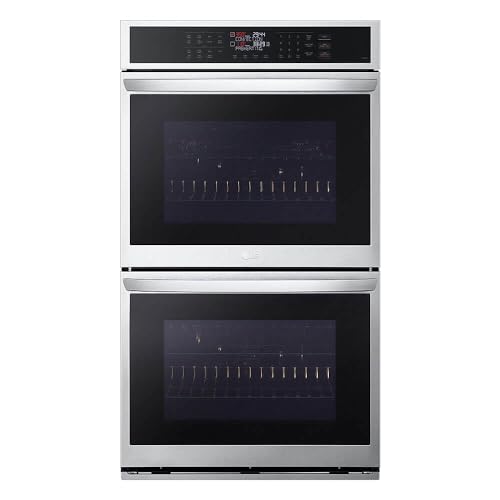
5. LG InstaView Double Wall Oven — the mode collector’s oven
LG’s InstaView double wall oven leads with its party trick — knock twice on the glass and the interior lights up so you can check progress without opening the door — but the substance underneath is a full-featured true convection double with air fry, a steam-assist function for bread and reheating, and on higher configurations a sous vide mode that holds low temperatures with unusual steadiness. It also tends to offer one of the larger total capacities in the class, which holiday cooks will notice.
Strengths. The knock-to-view window genuinely reduces door openings during bakes, and the interior light and glass are bright and clear enough to judge browning. Convection evenness is strong, the air fry mode handles big trays well, and steam assist gives bread a better crust and leftovers a second life without the microwave’s texture penalties. LG’s ThinQ app covers remote control and diagnostics, including proactive alerts that can flag a failing component before it ruins a dinner party. Cleaning includes both a quick steam-based easy-clean for light soil and full self-clean for heavy work.
Trade-offs. The light-touch steam clean is for maintenance, not miracles; baked-on grease still needs the pyrolytic cycle. The mode list is long enough that infrequent users may find the interface busy, and some advanced features differ between the upper and lower cavities, so read the cavity-by-cavity spec rather than the marketing summary. As with Samsung, verify local service coverage for built-in LG in your area, since a wall oven is not an appliance you can box up and ship back.
Who it suits. Cooks who will genuinely use the extras — air fry for weeknight trays, steam for bread, low-and-slow modes for experiments — and hosts who want maximum capacity and visibility into what is happening behind the glass.
Check price on Amazon.
Check price on Amazon: LG InstaView double wall oven

6. Café 30-Inch Double Wall Oven — the design-led entertainer
Café, GE’s design-forward line, builds the double wall oven for people who start with how the kitchen looks and refuse to compromise on how it cooks. The signature move is customizable hardware: handles and knobs in finishes like brushed bronze, brushed black, or brushed copper, swapped onto stainless, matte white, or matte black fronts. Underneath the styling sits serious hardware — true convection in both cavities, a roller rack, a temperature probe, and in-oven camera availability on some configurations — making this the rare appliance that is both the prettiest and among the most capable in its class.
Strengths. Both-cavity true convection means your holiday two-temperature cooking never has to negotiate which dish gets the good oven. The build feel is a step above mainstream built-ins: substantial handles, smooth racks, and doors with real heft. The touch display is large and clear, Wi-Fi features ride on GE’s mature SmartHQ platform, and the customization program means the oven can match cabinet hardware you already own instead of forcing a stainless decision on the whole room. For frequent entertainers, the combination of capacity, evenness, and presentation is hard to beat.
Trade-offs. Positioning is premium verging on luxury, and the custom hardware finishes are an additional cost on top of an already top-tier appliance. If your kitchen renovation budget is being counted carefully, the GE Profile earlier in this guide delivers much of the same cooking hardware for less, minus the design program. The matte finishes, while beautiful, ask for a bit more care in cleaning than standard stainless. And as with any style-led purchase, confirm the finish in your own lighting — showroom light flatters everything.
Who it suits. Renovators building a kitchen around a cohesive design vision, and serious entertainers who want both cavities to be first-class convection ovens rather than a star and a backup.
Check price on Amazon.
Check price on Amazon: Café double wall oven
True convection, explained without the marketing fog
Because the phrase does so much work in this category, it is worth slowing down on what is physically happening inside the oven. In a conventional oven, heat radiates from elements and rises naturally, so the top of the cavity runs hotter than the bottom and food cooks unevenly unless you rotate pans. A circulation fan fixes the stratification by moving the air, which is why even fan-assisted ovens outperform purely thermal ones. True convection goes one step further: the fan draws air across its own ring-shaped heating element, so the air entering the cavity is already at a uniform temperature rather than being a mixture of hot and cool pockets the elements happened to produce.
The practical consequences are three. First, multi-rack baking becomes reliable — the whole point of convection for bakers — because every rack receives air at roughly the same temperature. Second, cooking times shrink modestly, often by a fifth to a quarter, and recipes usually call for a temperature reduction of about 25 degrees Fahrenheit to compensate; ovens with automatic conversion do that math for you, while ovens without it expect you to. Third, roasting improves in a specific way: moving hot air strips the insulating layer of cooler air off the surface of food, so skin crisps and vegetables caramelize instead of steaming in their own moisture — provided you use a shallow pan and do not crowd it, because no fan can fix a pan that is physically overloaded.
There are dishes where convection is not the right tool. Delicate soufflés, custards, and some foam cakes prefer the still, humid air of a conventional bake, and every oven here lets you run a standard thermal mode for exactly that reason. The skill worth developing with a new convection oven is simply remembering which mode a given dish wants — after a month of cooking, it becomes instinct.
The holiday test: running both cavities like a system
A double oven earns its price on the four or five days a year when the whole menu lands at once, so it helps to think through the choreography before you buy. The classic Thanksgiving split puts the turkey in one cavity and everything else in the other, but the more useful mental model is temperature lanes. The turkey, a ham, or a rib roast occupies a low-to-moderate lane (325–375 degrees) for hours. Casseroles and gratins want a moderate lane and tolerate sharing. Pies start hot and finish moderate. Rolls want a short burst of real heat at the very end. Dinner rolls, in other words, are why the second cavity’s ability to hold a completely different temperature — not merely to be on — is the feature you are paying for.
Sequencing matters as much as temperature. Resting meat holds beautifully, tented, for the length of time your sides need to finish, which means the bird should be scheduled to come out before the rolls go in, not simultaneously with them. Casseroles can bake ahead and reheat gently in the cavity the turkey vacated. A probe in the roast removes the last source of timing anxiety, because the oven, not your guess, announces when the low lane is free. Every pick in this guide includes a probe; if your cooking includes big roasts even twice a year, learn to use it.
Two smaller holiday details separate good doubles from great ones. Independent timers per cavity sound basic, yet juggling three timers on one display has ruined more side dishes than any heating element; check how the interface handles two timers at once. And notice where the vents are: double ovens exhaust heat into the kitchen, and during a six-hour holiday cook that is a real contribution to room temperature — one more reason the upper oven’s faster preheat and smaller volume make it the right default for everyday cooking the other 360 days of the year.
Measuring and installation: the unglamorous section that decides everything
More wall oven purchases go sideways over a tape measure than over any cooking consideration, so treat this section as the actual buying decision. Start with the cutout: width, height, and depth of the cabinet opening, compared against the new oven’s installation sheet — not its marketing dimensions. Nominal 30-inch ovens differ in the cutout they demand, and a replacement from a different brand frequently needs the opening trimmed or furred. The support platform inside the cabinet must be level and rated for the oven’s full weight plus a holiday turkey; sagging platforms from a previous installation should be rebuilt, not inherited.
Depth is the quiet troublemaker. Wall oven cabinets are typically 24 inches deep, and the oven’s chassis, conduit, and junction box all compete for the space at the back. The installation manual specifies where the electrical box may live; a box in the wrong zone can physically prevent the oven from sliding home. If your current oven sits above a drawer or below a cooktop, check those clearances too, and if a gas cooktop is involved anywhere in the stack, confirm the combination is approved — some pairings are, some are explicitly not.
Delivery and path matter as well. A double wall oven is a large, heavy, awkward box; measure doorways, hallway turns, and any stairs between the curb and the kitchen, and arrange for the old unit’s removal in the same visit if the retailer offers it. Professional installation is worth its cost here: the unit must be leveled, secured, connected to the conduit, and tested in both cavities, and a good installer will also verify that doors align and that the trim kit (if your cabinet needs one to cover a slightly oversized opening) sits flush. Keep the old oven’s paperwork until the new one has cooked its first full meal — warranty registration, model and serial photos, and the installation receipt are the documents that make any later service call painless.
Care, cleaning, and living with it for fifteen years
Built-in ovens are among the longest-lived appliances in a home, and small habits protect that lifespan. Wipe spills once the cavity is cool rather than letting them bake on through a dozen cycles; run the steam clean monthly if your oven offers it and reserve pyrolytic cycles for genuine need, since repeated extreme heat is the hardest work the oven ever does. Keep racks out of pyrolytic cycles unless the manual explicitly allows them in — glide mechanisms and high heat are natural enemies. The temperature probe should be wiped and stored in its holder rather than left rattling in a drawer, and door gaskets deserve an occasional inspection, because a torn gasket leaks heat that shows up as uneven baking long before it shows up as a repair bill.
One inexpensive tool earns its keep during that first month: a simple oven thermometer, moved between racks and cavities across a few bakes, will show you exactly how your individual oven’s display compares with the air temperature your food experiences. Most ovens allow a calibration adjustment in their settings menu, so if yours consistently runs ten degrees hot on the center rack, you can correct it once and stop compensating forever. Note the result, along with your preferred rack positions for cookies, roasts, and casseroles, on a card kept inside a nearby cabinet door — future you, mid-holiday, will be grateful.
Finally, register the warranty, save the manual’s convection rack-position chart somewhere you will actually find it, and spend the first month deliberately testing the oven: bake a familiar cookie recipe on three racks, roast vegetables at a known setting, and learn your oven’s personality while the stakes are low. Every oven runs a few degrees proud or shy of its display; knowing yours turns the holiday test from a gamble into a routine.
Convection modes decoded: what you will actually press
Open any of these ovens’ mode lists and you will find more settings than any cook uses in a month. It helps to sort them into the handful that matter. Convection bake is the workhorse for multi-rack baking — cookies, scones, sheet cakes — where evenness across racks is the entire point. Convection roast runs the fan with a bias toward the broil element and suits poultry, roasts, and vegetables, where surface browning matters as much as even heat. Plain bake, with the fan off, remains the right call for custards, soufflés, delicate foam cakes, and anything that benefits from a humid, still cavity. Broil is its own world of direct high heat, and on a double oven it is worth checking which cavity broils better; the upper cavity’s smaller volume usually brings food closer to the element and makes it the natural choice for gratins and finishing.
Below those staples sit the modes that differentiate brands. Air fry is convection turned aggressive — high fan speed, high heat, and a cycle tuned for crisping on a sheet pan or in the mesh baskets some brands sell as accessories. It will not replicate a small countertop air fryer for a handful of wings, but for a full tray of fries or a family batch of nuggets it is faster than preheating a big oven conventionally and frees the counter. Proof mode holds the gentle warmth yeast dough wants, and in a double oven it can run in the lower cavity while dinner cooks above — one of the quietest luxuries of the format. Warm and hold modes keep finished dishes at serving temperature without continuing to cook them, which is the difference between a calm holiday service and a frantic one. Steam assist, where offered, injects moisture early in a bake for better bread crusts and gentler reheating. None of these modes is essential; all of them are used weekly by the cooks who have them. When comparing two finalists, count the modes you would press in your own kitchen, not the modes on the box.
Double wall oven vs. the alternatives
A double wall oven is not the only way to get two cavities, and the honest comparison sometimes points elsewhere. A single wall oven plus a good countertop oven costs less in total, installs into a smaller cutout, and lets you replace the small oven cheaply when it ages — but the countertop unit eats counter space permanently, holds less than a true second cavity, and cannot take a full sheet pan or a second casserole dish at Thanksgiving. A freestanding range with a double-oven configuration (two cavities stacked in a range body) delivers genuine two-temperature cooking at a mid-range total cost and a simpler installation, but both cavities are smaller than a wall double’s, the lower one sits near the floor, and you give up the ergonomic waist-height baking that makes wall ovens pleasant for anyone with a bad back.
The wall double wins when three conditions coincide: you cook two-temperature meals often enough that the choreography above sounds familiar rather than aspirational; your kitchen has, or your remodel can create, the tall cutout and the electrical capacity; and you value the built-in look and the working height enough to pay the premium tier’s entry fee. If only one or two of those hold, the alternatives are not compromises — they are the correct answer for your kitchen, and the money saved buys excellent knives, pans, or a year of very good ingredients.
Smart features, honestly assessed
Connected features on wall ovens split into three tiers of usefulness. At the top sit features that change how you cook: remote preheat that has the upper oven ready when you walk in with groceries, push notifications when a probe hits temperature, and scan-to-cook or guided modes that set time and temperature for known dishes. In the middle are conveniences you will use monthly — in-oven cameras for checking browning without opening the door, downloadable cycles that add a mode the oven did not ship with, and voice control for setting a timer with messy hands. At the bottom are the features that exist for the spec sheet: recipe libraries you will never open, social integrations, and screens large enough to watch video on while your sauce reduces.
Two cautions apply to all of it. First, a wall oven is a fifteen-year appliance and software support is not; buy the oven for its hardware — elements, racks, cavity, controls you can operate entirely from the panel — and treat the app as a bonus that may or may not age as gracefully. Second, every connected feature depends on the oven joining your home Wi-Fi, which is a decision some households reasonably decline. Every pick in this guide operates fully without a network connection; none of the cooking quality described above requires an account, an app, or a password.
A pre-purchase checklist
Before ordering, work through this list in order; each item has stopped a real installation somewhere. One: confirm your cutout’s width, height, and depth against the new oven’s installation manual, with the old oven’s opening actually measured. Two: confirm the circuit — breaker size, wire gauge, and junction box location — against the same manual. Three: confirm the delivery path from curb to kitchen, including door widths and turns. Four: measure your largest roasting pan, lid and handles included, against the lower cavity’s interior dimensions and lowest rack position. Five: decide which cavity will be your daily oven and check that its rack configuration, glide rack, and probe match that job. Six: confirm who services the brand locally and how built-in service calls work in your area. Seven: if you are choosing between two finalists, visit both in a showroom and operate the controls with your eyes half on the display — legibility and logic beat feature counts in daily life. An oven that passes all seven checks is very unlikely to disappoint you, whatever badge it wears.
Capacity in practice: what actually fits
Cubic-foot figures are the least useful numbers on a wall oven spec sheet, because they measure empty volume rather than usable cooking space. What decides your holiday is a set of physical clearances: the distance between the lowest rack position and the top of the cavity, the width between the rack supports, and the depth from the back wall to the inside of the closed door. A roasting pan with a lid and two loop handles needs width for the handles and height for the lid’s dome; a half sheet pan needs depth with the door shut; two casseroles side by side need width that the headline capacity figure says nothing about. Before buying, write down the three measurements of the pans you actually own and compare them, in the showroom or against the manual’s interior dimensions, with both cavities — remembering that on many doubles the upper cavity is slightly smaller, which is precisely why the turkey traditionally goes low and the pies go high.
Rack positions deserve the same practical eye. Five or six positions per cavity is typical, and convection baking wants specific spacing the manual spells out — usually leaving an inch or more between pans and walls so air can circulate. If your baking style is three racks of cookies at once, confirm the oven’s recommended convection rack set includes three usable positions with adequate clearance, and check whether extra racks are included or sold separately, because ordering a third rack after installation day is a small annoyance that nearly every multi-rack baker eventually meets.
Finishes, handles, and fitting into your kitchen
Stainless steel remains the default finish for double wall ovens, but the category has loosened up. Matte black and matte white fronts — Café’s signature options — change the appliance from a reflective focal point into a quieter architectural element, and panel-ready or flush designs like Bosch’s disappear into cabinetry almost entirely. Samsung’s Bespoke line treats color as a feature in its own right. Whichever direction you lean, remember that a wall oven’s face is at eye level and spans a large area: it will set the visual temperature of the whole kitchen more than any other single appliance, and it will do so for a long time. Choose the finish for the kitchen you are building, not the trend of the season.
Handles are the other daily touchpoint. Pro-style bar handles give a confident grip with a mitt or towel in hand and project far enough to hang a towel — which manufacturers quietly discourage, since towels insulate the door and can affect the oven’s cooling. Slim integrated handles look cleaner and snag less in tight galley kitchens. If two cooks of different heights share the kitchen, stand in front of showroom units and open both doors: the upper cavity’s door, fully open, should not force a shorter cook to lean over a hot door to reach the back rack, and glide racks, again, repay their cost exactly here.
Frequently asked questions
Is true convection worth it in both ovens, or is the upper cavity enough?
For most households, an excellent true convection system in the upper cavity plus a strong thermal lower oven covers nearly everything, because the upper oven does the daily baking and the lower one handles roasts and overflow. Both-cavity true convection — as on the GE Profile and Café picks here — earns its premium if you regularly bake on multiple racks in two places at once, such as holiday cookie production running in parallel with pies. Be honest about which cook you are; the answer decides whether the asymmetry of a model like the KitchenAid is a compromise or a non-issue.
Can I replace a 27-inch double oven with a 30-inch model?
Not without cabinet work. The nominal size refers to the cabinet width the oven is built for, and a 30-inch oven will not fit a 27-inch opening. A cabinetmaker can sometimes widen an opening if the surrounding cabinetry allows it, but that is a renovation decision with its own cost. If you are keeping your cabinets, shop the 27-inch class instead — it is smaller, but several manufacturers still serve it.
What electrical work does a double wall oven need?
Typically a dedicated 240-volt circuit, commonly 40 amps for 30-inch doubles, hardwired via conduit to a junction box positioned where the installation manual specifies. Replacing a like-for-like double oven usually reuses the existing circuit, but the breaker size and wire gauge must match the new oven’s requirements, and any change belongs to a licensed electrician. Homes with small electrical panels should have the overall load reviewed before installation day.
Does convection really cook faster, and do I have to convert every recipe?
Yes, modestly — expect times roughly a fifth to a quarter shorter, with better browning, when using true convection. The standard conversion is to reduce the recipe temperature by about 25 degrees Fahrenheit and start checking for doneness early. Many of the ovens in this guide offer automatic conversion that applies the adjustment for you in convection modes; if yours does not, a note on the recipe card after your first attempt is all the system you need.
How long should a double wall oven last, and what usually fails first?
A well-kept double wall oven commonly serves fifteen years or more. The parts that age first are the ones that work hardest: igniters and elements, door gaskets, glide rack mechanisms, and control boards exposed to years of heat cycles. Choosing a brand with a strong local service network — and keeping up with the gentle cleaning habits described above — does more for longevity than any extended warranty. When comparing two finalists, the availability of a good local technician is a legitimate deciding factor.
After all the measuring, comparing, and second-guessing, the right double convection wall oven is simply the one whose cutout fits your cabinet, whose convection matches the way you actually cook, and whose second cavity turns your busiest cooking day of the year into the calmest one.