Disclosure: airfryerkitchensupply.com is reader-supported. When you buy through links on our site, we may earn an affiliate commission at no extra cost to you.
Where to buy
Homeowners shopping for the best 36 electric cooktops will find the verified field on Amazon, and every linked pick in this guide was matched to the title Amazon holds for it — size, burner count, wattage, and control style included. A cooktop is a cut-out-in-the-counter commitment, so check the current price on Amazon and then do the unglamorous thing: confirm the listing’s cutout dimensions against your counter before ordering, and confirm the electrical specification suits the circuit your kitchen can actually provide.
- Frigidaire Gallery 36-Inch Induction Cooktop (Best Overall) — check price on Amazon
- Karinear 36-Inch Electric Cooktop, 5-Burner Radiant, 8900W (Best Radiant) — check price on Amazon
- VEVOR 36-Inch Induction Cooktop, 5 Burners, 9200W (Best Value Induction) — check price on Amazon
- Frigidaire 36-Inch Electric Cooktop with Stainless Trim (Best Traditional Radiant) — check price on Amazon
- GASLAND 36-Inch Induction Cooktop, 5-Burner with Bridge Element (Best for Griddles and Large Pans) — check price on Amazon
- CIARRA 36-Inch Induction Cooktop, 5 Burners, 9600W (Best Flex Zones) — check price on Amazon
A 36-inch electric cooktop is the family-size centre of a kitchen: five burners across a wide glass field, room for a stockpot and a skillet and a sauce pan to coexist, and enough presence that the choice shapes how the kitchen cooks for a decade. The best 36 electric cooktops divide along one great fault line — induction versus radiant — and this guide refuses to pretend the line does not matter. Induction heats the pan itself: faster, cooler to the touch around the pan, and demanding magnetic cookware. Radiant heats the glass and then the pan: slower, simpler, and compatible with every pot you own. Both camps are represented here by verified models, because the right answer depends on your cookware, your cooking, and your tolerance for relearning a stove’s manners.
The second divide is trust. This field contains global brands with service networks and a crowd of high-specification value brands whose listings promise enormous wattage and long feature lists. Both can be the right buy — the value brands have genuinely changed what a modest budget buys in this size — but they are different purchases, and the reviews below keep the distinction honest. Every specification quoted comes from the product’s own verified listing; nothing has been borrowed from a manufacturer’s brochure or a rival’s review.
In this guide
Quick Picks
Six verified 36-inch electric cooktops: three induction flagships of different characters, three radiant and value alternatives. Badges match the full reviews.
- Frigidaire Gallery 36-Inch Induction Cooktop — Best Overall: The brand-name induction benchmark in this size — the pick for buyers who want induction’s performance with a major maker’s support behind it. — check price on Amazon
- Karinear 36-Inch Electric Cooktop, 5-Burner Radiant, 8900W — Best Radiant: An 8900W radiant five-burner with both knob and touch control, 9 heat levels and a 99-minute timer — the most control-flexible radiant pick verified. — check price on Amazon
- VEVOR 36-Inch Induction Cooktop, 5 Burners, 9200W — Best Value Induction: A 9200W five-burner induction cooktop with 9 heating levels, LED touch screen, child lock and over-temperature protection at the value end of induction. — check price on Amazon
- Frigidaire 36-Inch Electric Cooktop with Stainless Trim — Best Traditional Radiant: Frigidaire’s classic 36-inch electric cooktop with stainless trim — the like-for-like replacement for the radiant cooktops a generation of kitchens already run. — check price on Amazon
- GASLAND 36-Inch Induction Cooktop, 5-Burner with Bridge Element — Best for Griddles and Large Pans: An ETL-certified 36-inch induction cooktop whose bridge element lets two zones act as one under a griddle — with a matte, scratch-resistant surface as listed. — check price on Amazon
- CIARRA 36-Inch Induction Cooktop, 5 Burners, 9600W — Best Flex Zones: The highest listed wattage here at 9600W, with dual flex zones and booster function — the specification maximalist’s induction pick. — check price on Amazon
How These Picks Were Chosen
Shortlisting ran with a strict size filter: a pick had to be a built-in 36-inch electric cooktop in its own listing — not a 30-inch model photographed widely, not a portable unit. ASINs come from API responses matched to titles confirming width, fuel, burner count, and headline power. That process surfaced the category’s real structure: Frigidaire’s brand-name induction and radiant models, a set of feature-dense value brands (Karinear, VEVOR, GASLAND, CIARRA) competing on wattage and flexibility, and a long tail we excluded where listings could not confirm their own size.
Judgement criteria followed the decisions a buyer actually faces. Heating technology first, for the reasons in the introduction. Layout second: five burners is the 36-inch promise, and bridge or flex zones — which let two burners act as one under a griddle — are the layout feature large-pan cooks actually use. Controls third: touch sliders, knobs, and knob-plus-touch hybrids suit different cooks, and wet-hand usability matters more than showroom shine. Finally, ownership: brand support, surface durability claims as listed, and the realism of the wattage story. The six below are the picks that survived with their listings intact and their roles distinct.
The 6 Best 36 Electric Cooktops, Reviewed

Frigidaire Gallery 36-Inch Induction Cooktop — Best Overall
When a category has a safe pair of hands, it is usually this shape: a 36-inch induction cooktop from Frigidaire’s Gallery line, sold under a title that says exactly what it is and nothing it is not. Induction is the performance choice in electric cooking — heat generated in the pan, response that rivals gas for speed of change, a surface that stays comparatively cool because it was never the heat source — and buying it from a major appliance brand buys the unglamorous things that matter in year six: parts, service, and a company that answers. For most renovators choosing a 36-inch electric cooktop once and living with it for a decade, this is the centre of the target.
Strengths
- Induction performance from a major brand with a real support network
- Gallery line positioning — the maker’s mainstream-premium tier
- The conservative choice for a cut-it-once countertop decision
Trade-offs
- Induction requires magnetic cookware — budget a magnet test for your existing pans
- Brand-name induction costs brand-name money; check the current price on Amazon against the value picks
- Touch-style induction controls are a learning curve for knob loyalists
| Specification | Detail (as listed) |
|---|---|
| Width | 36-inch (as listed) |
| Type | Induction cooktop (as listed) |
| Line | Frigidaire Gallery (as listed) |
The induction experience, for readers who have not lived with it, is defined by two moments. The first is a pot of pasta water arriving at the boil with a speed that rearranges your sense of what electric means. The second is wiping a sauce spill off a surface that is warm, not weaponised, while the pan beside it is still cooking. Add simmer control fine enough for sauces that punish radiant’s on-off cycling, and the case writes itself for serious cooks. The honest costs are the cookware audit — a magnet must stick firmly to a pan’s base or the pan is furniture — and a faint hum and fan noise that are normal induction manners, not faults.
Choose this cooktop if the renovation is a long-term one and the cookware cupboard is already induction-friendly or due for replacement anyway. It is the pick this guide would hand a careful friend, which is the working definition of Best Overall.
Best for: renovators wanting induction performance with major-brand support / Not suited for: kitchens committed to non-magnetic cookware or knob-only control
Check the current price on Amazon

Karinear 36-Inch Electric Cooktop, 5-Burner Radiant, 8900W — Best Radiant
Radiant’s champion in this guide is a value-brand overachiever. The Karinear’s listing stacks the specifications radiant buyers actually ask for: five burners across 36 inches, 8900 watts of total power, nine heat levels, a 99-minute timer, child lock — and, most unusually, both knob and touch control on the same cooktop. That dual control is not a gimmick. Knobs are what many cooks trust with wet hands and boiling-over pans; touch is what makes a glass top effortless to wipe clean. A cooktop that refuses to make you choose is solving a real argument that happens in real kitchens, usually between the two people who cook in it.
Strengths
- Knob plus touch control — the only pick here serving both control tribes
- 8900W radiant power with 9 levels and a 99-minute timer as listed
- Works with every pan you own — radiant asks nothing of cookware
Trade-offs
- Radiant physics: slower response and a hot glass surface compared with induction
- Value brand — support expectations should be set accordingly
- 220-240V hardwired installation, as listed — an electrician line item, not a plug
| Specification | Detail (as listed) |
|---|---|
| Width | 36-inch, 5 burner (as listed) |
| Type | Radiant electric, ceramic glass (as listed) |
| Power | 8900W (as listed) |
| Controls | Knob and touch control, 9 heat levels (as listed) |
| Electrical | 220-240V hardwired (as listed) |
The radiant case deserves its honest paragraph. Radiant cooktops heat the glass, then the pan, and they cycle to hold temperature — which sounds like a flaw list until you price the alternative, inventory your cookware, and admit that most family cooking is not a wok station. Radiant simmers, fries, boils, and braises perfectly well, forgives every pan material including the aluminium and glass pieces induction rejects, and its hot surface, while a discipline, is at least an honest, visible one with indicators to match. For a household replacing a radiant unit, or refusing the cookware audit, this Karinear is the strongest verified specification in its camp.
Its timer and child lock matter more in family service than spec-sheet readers expect: a timer that kills a forgotten burner is a safety device wearing a convenience costume. Judge it as the full-featured radiant it claims to be, verify the listing still matches at purchase, and it is the radiant pick of this guide without apology.
Best for: radiant loyalists and mixed-control households wanting full features / Not suited for: cooks chasing induction’s speed and cool surface
Check the current price on Amazon

VEVOR 36-Inch Induction Cooktop, 5 Burners, 9200W — Best Value Induction
VEVOR’s proposition is induction without the brand tax. The listing promises a 36-inch built-in induction cooktop with five burners, 9200 watts, nine heating levels, an LED touch screen, child lock, and over-temperature protection — the full modern induction checklist — at the value tier of this market. A few years ago that combination did not exist; induction at 36 inches was a premium-brand preserve. For a renovator whose budget is being eaten by cabinets and counters, or a landlord fitting a quality rental, this is the pick that keeps induction in the plan. Check the current price on Amazon, because the price is precisely the argument.
Strengths
- Full induction specification — 5 burners, 9200W, 9 levels — at a value tier
- Safety set as listed: child lock and over-temperature protection
- LED touch control keeps the wipe-clean glass advantage of induction
Trade-offs
- Value-brand ownership: verify seller and support terms at purchase
- Induction’s cookware audit applies in full — magnet-test your pans
- Total wattage is shared across burners in this class; five burners at maximum simultaneously is not the design brief
| Specification | Detail (as listed) |
|---|---|
| Width | 36-inch, 5 burners (as listed) |
| Type | Induction, built-in (as listed) |
| Power | 9200W (as listed) |
| Controls | LED touch screen, 9 heating levels (as listed) |
| Safety | Child lock, over-temperature protection (as listed) |
The realistic expectation-setting matters with value induction. Total power figures describe the cooktop’s ceiling, shared across zones, which is normal across the industry and only becomes a limit if your cooking style runs every burner at full blast at once — a style almost no home cook actually has. In ordinary service — a boil here, a simmer there, a hard sear on one zone — a 9200W induction field feels fast, responsive, and modern, because induction’s advantages live in the pan-heating physics, not in the badge.
Buy it with the verification habit this guide keeps repeating: confirm the listing’s dimensions and electrical requirements match your cutout and circuit before the counter is cut, because a value purchase is no place for an installation surprise. Do that, and the VEVOR is the rational induction buy for budget-led projects — the pick that proves the technology no longer belongs only to premium kitchens.
Best for: budget-led renovations and landlords wanting real induction / Not suited for: buyers who rank long-term brand support above purchase price
Check the current price on Amazon

Frigidaire 36-Inch Electric Cooktop with Stainless Trim — Best Traditional Radiant
Some renovations are not reinventions. The existing cutout is 36 inches, the existing cookware is everything-under-the-sun, the cook of the house likes the radiant stove they know, and the brief is a trustworthy replacement from a name the local service trade knows. That brief is this Frigidaire: a 36-inch electric cooktop with stainless trim, from the brand whose cooktops anchor more American kitchens than any rival in this guide. Its listing is refreshingly plain — the product, the size, the trim — and plainness from a major brand is its own specification: this is the mainstream of the category.
Strengths
- Major-brand mainstream model — parts and service are the easiest in this guide
- Radiant compatibility with every pan, no cookware audit required
- Stainless trim suits traditional kitchen styling and mixed-metal schemes
Trade-offs
- Radiant performance is the familiar kind — no induction speed or cool-surface gains
- A conservative specification beside the feature-stacked value brands
- Buyers wanting bridge zones or flex layouts should look at the GASLAND and CIARRA picks
| Specification | Detail (as listed) |
|---|---|
| Width | 36-inch (as listed) |
| Type | Electric cooktop (as listed) |
| Finish | Stainless trim (as listed) |
The replacement scenario is where this pick quietly wins. Like-for-like swaps live and die on dimensions and electrical familiarity, and a mainstream Frigidaire is the model an installer has most likely fitted before, in a cutout most likely to match the one already in your counter. That reduces the two risks that actually ruin cooktop projects — the counter recut and the circuit surprise — to their minimum. It is not the exciting purchase. It is the purchase that is cooking dinner the same week it arrives.
Choose it when the kitchen’s story is continuity: same layout, same cooking style, better condition. Renovators chasing a step-change in performance should take the Gallery induction; feature hunters on a budget should take the Karinear. For the large, sensible middle who just want the heart of the kitchen replaced with confidence, this is the pick.
Best for: like-for-like replacements and traditional kitchens / Not suited for: renovators seeking a performance step-change
Check the current price on Amazon

GASLAND 36-Inch Induction Cooktop, 5-Burner with Bridge Element — Best for Griddles and Large Pans
The bridge element is the layout feature that separates cooktops designed for how families actually cook from cooktops designed as five identical circles. GASLAND’s 36-inch induction model lists a bridge element among its headline features: two zones that link into one long heating area under a griddle or a roasting pan. Weekend pancakes for six, a double-burner griddle of burgers, a fish kettle that no round burner has ever fit — these are the jobs that justify 36 inches in the first place, and they are precisely the jobs a bridge exists for. The listing adds ETL certification and a matte, scratch-resistant surface, two ownership details that matter more with time than any preset.
Strengths
- Bridge element turns two zones into a true griddle station
- Matte scratch-resistant surface, as listed — a durability answer to glass-top anxiety
- ETL certified, with boost function and touch control as listed
Trade-offs
- The bridge’s value depends on owning or buying a suitable griddle
- Induction cookware rules apply — the griddle itself must be magnetic
- A newer brand name beside Frigidaire; weigh support accordingly
| Specification | Detail (as listed) |
|---|---|
| Width | 36-inch, 5 burner (as listed) |
| Type | Induction with bridge element (as listed) |
| Surface | Matte scratch-resistant (as listed) |
| Certification | ETL certified (as listed) |
| Electrical | 240V (as listed) |
Griddle cooking exposes weak cooktops mercilessly: two unlinked burners give a griddle a hot stripe at each end and a sulk in the middle, and breakfast becomes a rotation chore. A bridged zone heats the whole rectangle as one surface, and pancakes brown in rows instead of rings. The same trick serves oval Dutch ovens and roasting pans that straddle burners for gravy-making after the roast — a small feature on a spec sheet, a weekly one in a family kitchen.
The matte surface is the second, quieter argument. Glass cooktops live or die by how their surface ages under dragged pans, and a finish designed to resist scratching — as this listing claims — addresses the complaint that ages more cooktops out of kitchens than any electronic failure. If your cooking is griddle-heavy and your pans are induction-ready, this is the most thoughtfully aimed pick in the guide.
Best for: griddle cooks, big-breakfast households, and large-pan users / Not suited for: cooks who never use oversized pans — the bridge premium buys them nothing
Check the current price on Amazon
CIARRA 36-Inch Induction Cooktop, 5 Burners, 9600W — Best Flex Zones
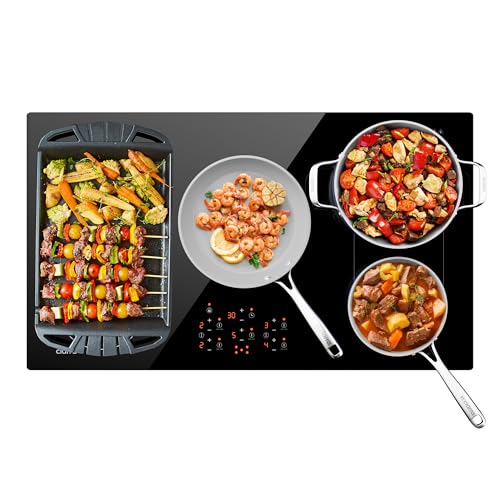
CIARRA’s entry competes on paper and knows it: 9600 watts — the highest total in this guide — five burners, dual flex zones, a booster function, digital timer, and child safety lock, all in a 36-inch built-in induction format described in its listing as a professional heavy-duty drop-in. Flex zones are the other answer to the large-pan problem: instead of fixed circles, areas of the surface adapt to the pan placed on them, so odd shapes and sizes heat as themselves. For cooks whose pan collection is eclectic and whose style is several things at once, flex is the layout philosophy that fits.
Strengths
- 9600W is the highest listed total power in this guide
- Dual flex zones adapt to pan shapes instead of dictating them
- Booster function for the fastest boils the format allows
Trade-offs
- Specification-led value brand — verify the listing and support at purchase
- Flex and boost features reward cooks who will actually learn the control system
- As with all induction here, cookware must be magnetic and flat-bottomed
| Specification | Detail (as listed) |
|---|---|
| Width | 36-inch, 5 burners (as listed) |
| Type | Induction, built-in (as listed) |
| Power | 9600W (as listed) |
| Layout | Dual flex zone (as listed) |
| Features | Booster function, digital timer, child safety lock (as listed) |
The honest reading of a wattage race is that ceilings are shared and real cooking happens below them — but headroom still matters at the moments home cooks actually notice: the big stockpot brought to the boil, the hard sear that should not sag when a cold steak lands. A 9600W platform with boost gives those moments their best chance in this guide, and the flex zones mean the pan delivering them can be the wide, heavy one the job wants rather than the round one the burner demands.
This is the pick for the specification-driven buyer who has done the cookware audit, wants the strongest listed numbers in a 36-inch induction field, and is comfortable trading a famous badge for capability per money spent. Paired with the verification habit — dimensions, circuit, listing, all confirmed before the counter is cut — it is a formidable amount of cooktop.
Best for: specification-driven cooks with eclectic, induction-ready pans / Not suited for: brand-first buyers or anyone who will not learn a touch control system
Check the current price on Amazon
Comparison Table
| Pick | Badge | Key spec | Best for |
|---|---|---|---|
| Frigidaire Gallery 36-Inch Induction Cooktop | Best Overall | 36-inch induction, Gallery line | renovators wanting induction performance with major-brand support |
| Karinear 36-Inch Electric Cooktop, 5-Burner Radiant, 8900W | Best Radiant | 8900W radiant, knob + touch | radiant loyalists and mixed-control households wanting full features |
| VEVOR 36-Inch Induction Cooktop, 5 Burners, 9200W | Best Value Induction | 9200W induction, 5 burners, value tier | budget-led renovations and landlords wanting real induction |
| Frigidaire 36-Inch Electric Cooktop with Stainless Trim | Best Traditional Radiant | 36-inch electric, stainless trim | like-for-like replacements and traditional kitchens |
| GASLAND 36-Inch Induction Cooktop, 5-Burner with Bridge Element | Best for Griddles and Large Pans | Induction + bridge element, matte top | griddle cooks, big-breakfast households, and large-pan users |
| CIARRA 36-Inch Induction Cooktop, 5 Burners, 9600W | Best Flex Zones | 9600W induction, dual flex zones | specification-driven cooks with eclectic, induction-ready pans |
Decide the technology first: induction picks occupy four of the six rows, radiant two, and no table can make that choice for you — your cookware and your cooking style make it. Within induction, the split is brand assurance (Frigidaire), value (VEVOR), layout for griddles (GASLAND), and maximum specification (CIARRA). Within radiant, it is features (Karinear) against familiarity (Frigidaire).
How to Choose the Best 36 Electric Cooktops for Your Kitchen
Begin under the counter, not on top of it. A 36-inch built-in cooktop needs a cutout that matches its listed dimensions and an electrical supply that matches its listed requirements — most of this field is hardwired at 220-240V, which in many kitchens means an electrician and possibly a circuit upgrade. Measure the existing cutout if you are replacing, and have the circuit’s capacity confirmed before falling in love with any model in this guide. The cheapest cooktop is the one that fits the hole and the wiring you already have.
Then settle the technology question with a magnet. Induction’s advantages — speed, response, a cooler surface, precision at low heat — are real, and so is its one demand: cookware with a magnetic base. Walk your cupboard with a fridge magnet. If the pans you love pass, induction is open to you and probably right for you. If the heart of your collection fails, radiant is not a defeat; it is the technology that cooks everything, and the Karinear and Frigidaire picks here serve it well.
Finally, choose the layout for your largest regular pan, not your largest imaginable one. Griddle households need a bridge or flex zones. Stockpot households need one genuinely large zone with room around it. Everyone should confirm the control style with wet hands in mind, because a cooktop is operated most critically at the exact moments your hands are least clean and dry.
Induction or radiant: which 36-inch electric cooktop is right for you?
Induction heats the pan directly through a magnetic field, which produces its signature trio of virtues: speed that shames radiant, response that mimics gas when you lift or lower the power, and a glass surface that only ever gets as hot as the pan makes it. Its costs are the cookware requirement, a higher purchase price at brand level, faint operational sounds, and a control experience that is entirely touch-based on most models. Cooks who value precision — sauces, chocolate, delicate simmers that radiant’s cycling coarsens — feel induction’s advantage daily.
Radiant heats the glass with elements beneath it and cooks by contact, the way electric stoves have worked for generations. It is slower to respond and its surface stays dangerously hot after cooking, but it accepts every pan ever made, it is mechanically simple, and at the value end it is dramatically cheaper to buy. The Karinear in this guide shows modern radiant at its best — real power, timers, locks, and dual controls. Neither technology is the future and the past; they are two tools, and this guide’s six picks are the strongest verified example of each philosophy at 36 inches.
What electrical and cutout checks matter before you order?
Three numbers decide whether a cooktop installation is an afternoon or an ordeal: the cutout width and depth in your counter, the cooktop’s listed cutout requirement, and the circuit behind the wall. Listings in this category state their requirements — several picks here specify 220-240V hardwired connections — and those statements are the contract. A replacement buyer should measure the old unit’s actual cutout rather than trusting the old unit’s nominal size, because nominal 36-inch units vary in the hole they need.
Granite, quartz, and solid-surface counters raise the stakes: recutting them is specialist work with specialist pricing, which is why the Frigidaire traditional pick’s like-for-like familiarity is a genuine feature. If your project involves a new counter, the order of operations is cooktop chosen first, cutout made to its listed specification second. Every year, kitchens are finished the other way around, and every year, someone pays for the lesson. Let the listings in this guide — verified, dimensioned, and quoted as the makers state them — be the measurements you build to.
How do bridge and flex zones change everyday cooking?
Layout features sound like brochure garnish until a household’s actual week is mapped against them. A bridge zone, like the GASLAND’s in this guide, serves the griddle breakfast, the oval roaster, and the long fish kettle — three recurring events in family life that round burners serve badly. Flex zones, like the CIARRA’s, serve the irregular pan collection: the rectangular grill pan, the small saucepan that wants a corner, the preserving pan that fits no circle ever drawn. In both cases the feature’s value is not exotic; it is the removal of a small weekly friction, repeated for a decade.
The honest counterweight is that households whose cooking lives on four round pans will never feel either feature’s absence. This is why the guide’s traditional picks exist without apology. The correct question is not which layout is best but which pans you own and reach for — inventory your three most-used vessels, and the cooktop whose zones welcome them is the cooktop you will love in year five.
What does living with a glass cooktop actually demand?
A decade of glass-top ownership teaches a short curriculum. Sugary spills are the enemy: left to bake, they can pit the surface, so sweet spills get lifted as soon as the zone is safe to touch. Cast iron is welcome on both technologies here but should be lifted, never dragged, and checked for rough bases. The surface tells you its state honestly — radiant through its residual-heat indicators, induction by simply being cooler — and a household that builds the wipe-after-cooking habit keeps a cooktop that photographs like new for years.
None of this is burdensome; it is lighter than the care a gas cooktop’s grates and burner caps demand, which is part of electric’s quiet case. The cooks who hate glass tops are usually the cooks who were never told the two rules — lift, and wipe — on day one. Consider yourself told, whichever pick in this guide you take home.
How long should a 36-inch electric cooktop last, and what kills them early?
A built-in cooktop is a decade-class appliance, and the two technologies here age differently. Radiant units are mechanically simple — elements, controls, glass — and their failures tend to be single-zone and repairable, which is part of the traditional Frigidaire pick’s appeal. Induction units add power electronics, which are reliable in modern form but make control-board health the long-term question, and make the brand’s parts pipeline — the Frigidaire Gallery’s home ground — a genuine ownership feature rather than a marketing one.
What kills cooktops early is rarely cooking. It is impact — a cast-iron pan dropped an inch too far — thermal abuse of the glass, liquid boiled over and left to cook into the surface repeatedly, and installations that left the unit stressed or unsupported in its cutout. Every one of those is addressed somewhere in this guide’s checks and habits, which is the real through-line: a 36-inch cooktop chosen carefully, installed level, and wiped after use will outlast several kitchen fashions. Choose the pick whose support story matches your appetite for risk, then give it the boring care that makes support unnecessary.
Knobs, touch, or both: choosing controls you will love in year five
Controls are the part of a cooktop you touch a thousand times a year, and the showroom is the worst place to judge them. Touch sliders are beautiful, wipe clean in a second, and divide cooks sharply: some find them precise and modern, others find them slippery with wet hands and maddening mid-boil-over. Knobs are unambiguous, glove-friendly, and operable by feel — and they interrupt the glass line, gather grease at their bases, and can be bumped by a passing pan. The Karinear’s dual-control answer exists precisely because this argument has no universal winner.
The honest test is autobiographical. If your cooking is saucy, hurried, and wet-handed, weight knobs or dual control. If your kitchen’s cleanliness is a point of pride and your cooking is composed, touch will delight you daily. Either way, choose for the cook you are at 7 p.m. on a Tuesday, not the one admiring a showroom at noon.
What about resale, warranties, and the paperwork of a built-in?
A built-in cooktop is part of the house in a way a countertop appliance never is, and its paperwork behaves accordingly. Keep the manual, the model and serial details, the installation record, and the purchase receipt together — ideally photographed into the same folder as the kitchen renovation documents. When the house is sold, a documented, warrantied, mainstream appliance is a line in the listing; when something fails in year seven, those details are the difference between a part ordered in one phone call and a detective story. This mundane advice favours no pick in this guide over another, but it multiplies the value of whichever one you choose, and it costs one envelope.
A final word on buying for the cook you actually are
Cooktop marketing sells the banquet: five burners blazing, a griddle smoking, a stockpot rolling. Kitchens live on Tuesday: two burners, one pan dirty in the sink, dinner in twenty minutes. The picks in this guide were judged against Tuesday first and the banquet second, which is why reliability, controls, and support recur in these reviews more often than spectacle. Whichever model you choose, choose the one whose daily manners suit your daily cooking — the banquet will take care of itself on the four nights a year it actually happens.
How to Install a 36-Inch Electric Cooktop: The Checks That Matter
Step 1: Verify the cutout against the listing, in person. Measure your counter’s opening in millimetres and compare it with the new cooktop’s stated cutout dimensions — not its overall width. A 36-inch cooktop does not mean a 36-inch hole.
Step 2: Confirm the electrical supply before the unit arrives. Most picks in this guide are hardwired 220-240V appliances. Have an electrician confirm the circuit, the breaker, and the junction arrangements suit the listed requirement. If they do not, that work happens before installation day, not during it.
Step 3: Dry-fit and check the overhangs. Lower the cooktop into the cutout without connecting it. The glass should sit flat and supported, the controls should clear the counter edge, and drawers or an oven below should open without meeting the cooktop’s underside.
Step 4: Connect, seal, and level as the manual directs. Follow the maker’s instructions for clamping, sealing, and electrical connection exactly — installation is the one place where this guide defers entirely to the manual and, where required, to a licensed electrician.
Step 5: Commission every burner. Boil a small pan of water on each zone in turn. On induction, confirm each of your pans is detected. Learn the control’s language now, with water, rather than during the first real dinner.
Step 6: Register, record, and keep the paperwork. Photograph the model plate, save the manual and the listing details, and note the installation date. The cooktop that serves a decade is the one whose details are findable in year nine.
Common Buying Mistakes
Ordering before measuring the cutout. The most expensive sentence in cooktop buying is ‘it is a standard 36-inch’. There is no standard hole. Measure yours; match the listing.
Discovering the circuit on installation day. A hardwired 240V appliance on an inadequate circuit is a stalled project and a second electrician visit. Confirm the supply first.
Buying induction without the magnet test. A beautiful induction cooktop and a cupboard of non-magnetic pans is a kitchen that cannot cook. Two minutes with a fridge magnet prevents it.
Chasing total wattage as the only spec. Wattage is shared across zones and says nothing about layout. A bridge or flex zone you use weekly beats a wattage figure you admire once.
Dragging pans across the glass. Glass tops age by abrasion. Lift pans, keep the surface clean of grit, and the cooktop that looks new in year five is yours.
Final Recommendation
The default answer is the Frigidaire Gallery induction: the best 36 electric cooktops decision for most renovators is performance plus a brand that will still answer the phone in a decade. Budget-led projects should take the VEVOR induction and bank the savings; griddle households the GASLAND with its bridge; specification hunters the CIARRA. Radiant loyalists split by temperament — the Karinear for features and dual control, the traditional Frigidaire for a familiar, serviceable replacement. Every one of them starts with the same two acts: measure the cutout, and test your pans with a magnet.
For the neighbouring decisions, see Best 36 Inch Induction Cooktops and Best 36 Induction Cooktops for the induction-only deep dives, Best 36 Inch Radiant Electric Cooktops for the radiant field, Best 36 Cooktops for the full 36-inch picture across fuels, and Best 36 Inch White Electric Cooktops if your kitchen’s scheme demands a white finish.
Shop the top picks: Frigidaire Gallery 36-Inch Induction Cooktop, Karinear 36-Inch Electric Cooktop, 5-Burner Radiant, 8900W, VEVOR 36-Inch Induction Cooktop, 5 Burners, 9200W — check the current price on Amazon for each before you decide.
Frequently Asked Questions
Is induction really faster than radiant at 36 inches?
Yes, meaningfully. Induction heats the pan directly, so a large pot of water reaches the boil noticeably sooner than on a comparable radiant zone, and power changes register in the pan almost immediately. Radiant must heat its glass first and cools slowly, which is why its response feels ponderous beside induction’s.
Will my existing pans work on an induction cooktop?
Only if a magnet sticks firmly to the base — that is the whole test. Cast iron and most stainless steel pass; aluminium, copper, and glass fail unless they have a magnetic base layer. Every induction pick in this guide carries the same rule, so run the magnet over your cupboard before choosing.
What does a bridge element actually do?
It links two zones into one long heating area sized for a griddle or roasting pan, so the whole vessel heats evenly instead of only where it crosses two separate burners. The GASLAND pick in this guide lists one. If you never cook on oversized pans, it will never earn its keep; if you do, it is transformative.
Can I install a 36-inch electric cooktop myself?
The physical fitting is straightforward for a competent DIYer, but most models here are hardwired 220-240V appliances, and electrical connection rules vary by jurisdiction — many require a licensed electrician. The checks in this guide’s installation section are safe for anyone; the wiring itself should follow your local code and the maker’s manual.
Are value-brand cooktops with huge wattage figures too good to be true?
The wattage is a shared ceiling, not a per-burner promise — that is industry-normal, not a trick. The real value-brand questions are listing accuracy and support, which is why this guide verifies titles through the API and tells you to re-confirm dimensions and terms at purchase. Judged that way, the value picks here are legitimately strong.
How do I keep a glass cooktop looking new?
Lift pans instead of sliding them, wipe spills once the surface is safe, keep grit off the glass before a pan goes down, and use the maker’s recommended cleaner for cooked-on marks. A matte or scratch-resistant finish, like the GASLAND’s listed surface, buys extra forgiveness, but habits matter more than finishes.


