Disclosure: airfryerkitchensupply.com is reader-supported. When you buy through links on our site, we may earn an affiliate commission at no extra cost to you.
Where to buy
The fastest way to shop this category is to start with the two cleaner families side by side: a self-contained robotic cleaner such as the Dolphin Automatic Robotic Pool Vacuum if you want a machine that works independently of your pump, or a pump-driven suction cleaner such as the Zodiac G3 Suction-Side Inground Pool Cleaner if you want simple mechanics and a lower running cost. Cordless shoppers should look at the WYBOT C1 Cordless Robotic Pool Vacuum and the AIPER Seagull Pro Cordless Robotic Pool Cleaner, while budget suction shoppers should compare the VINGLI Pool Cleaner against the Zodiac. Every product named in this guide was cross-checked against Amazon’s catalog data before it earned a link, and prices move with the season, so check the current price on Amazon for the exact model and hose or cord configuration you are considering.
Introduction: Two Ways to Let a Machine Clean Your Pool
Shoppers comparing the best pool vacuums automatic or suction cleaners are really choosing between two philosophies of pool care. An automatic robotic cleaner is a self-propelled machine with its own motor, its own filtration, and its own cleaning program: you drop it in, press a button, and it scrubs floors and walls without touching your pool’s plumbing. A suction cleaner is a far simpler device that plugs into your skimmer or a dedicated suction line and borrows power from the pump you already own, wandering the pool floor as long as the pump runs. Neither approach is automatically better. The right answer depends on your pool’s size and shape, the debris your yard drops into the water, how strong your pump is, and how much hands-on time you honestly want to spend each week.
This guide walks through six verified cleaners that cover both families honestly: three robotic or cordless machines and pump-driven suction models at different commitment levels. We explain what each one actually does well, where each one frustrates owners, and which pool types each suits. We also cover the buying criteria that matter more than marketing labels — navigation, filtration, wall climbing, hose and cord management, and the true weekly workload — plus a practical setup routine and the mistakes that make new owners blame a good cleaner for a plumbing problem. If your pool is small or above-ground, some of these machines are more than you need, and we say so plainly rather than pushing the biggest unit on every reader.
In this guide
Quick Picks
- Best Overall — Dolphin Automatic Robotic Pool Vacuum: a wall-climbing robotic cleaner with smart navigation built for in-ground pools up to 40 feet. Check the current price on Amazon
- Best Compact Robotic — Dolphin Nautilus CC Robotic Pool Vacuum: a smaller robotic unit with top-load filter access that suits modest in-ground and above-ground pools. Check the current price on Amazon
- Best Suction-Side — Zodiac G3 Suction-Side Inground Pool Cleaner: a diaphragm suction cleaner with one moving part that covers floors, walls, and steps. Check the current price on Amazon
- Best Budget Suction — VINGLI Pool Cleaner: an automatic wall-climbing suction vacuum supplied with 33 feet of hoses for straightforward in-ground pools. Check the current price on Amazon
- Best Cordless — WYBOT C1 Cordless Robotic Pool Vacuum: a cordless robotic cleaner for in-ground pools that removes cord management from the weekly routine. Check the current price on Amazon
- Best Cordless for Long Sessions — AIPER Seagull Pro Cordless Robotic Pool Cleaner: a quad-motor cordless robot with WavePath navigation and a stated 150-minute runtime for larger in-ground pools. Check the current price on Amazon
How These Picks Were Chosen
We started by dividing the category the way owners actually shop it: robotic cleaners with their own motors and filtration, cordless robotic cleaners that trade the power cord for a battery, and suction-side cleaners that run off the pool pump. A guide that only lists robots would fail the many owners whose pumps are strong, whose debris is mostly fine dust and sand, and who would rather maintain one simple diaphragm than a second motorized appliance. Within each family we favored machines with a clear, verifiable identity — a named manufacturer, a specific model, and catalog data we could confirm — over generic listings that change contents between shipments.
Every pick in this guide was cross-checked through Amazon data available to this site: we matched the product name to the catalog title returned for its ASIN and only kept products where that match was confident. That process matters in this category because pool cleaners are frequently sold under shifting bundle names, and a link that lands on a different hose length or a refurbished unit is a real-world problem, not a technicality. Where a cleaner family’s catalog presence was thin — pressure-side cleaners that need a booster pump, for example — we discuss the family in the buying guide but do not force a pick we could not verify.
Our evaluation criteria were practical. For robots: navigation method, whether the machine genuinely climbs walls, filter access and capacity, cord or battery management, and the pool sizes the manufacturer states. For suction cleaners: diaphragm or turbine mechanism, hose length supplied, whether the cleaner needs a minimum pump flow, and how it behaves around steps, ladders, and corners. Across both families we weighed the weekly workload honestly — a cleaner that saves twenty minutes of brushing but demands ten minutes of untangling has not saved you much — and we favored designs whose wear parts (diaphragms, tracks, brushes, hoses) are replaceable rather than disposable.
The 6 Best Pool Vacuums: Automatic and Suction Cleaners Reviewed

Dolphin Automatic Robotic Pool Vacuum — Best Overall
This Dolphin is the pick for in-ground pool owners who want the closest thing to a set-and-forget routine: a robotic cleaner with its own scrubbing brush, smart navigation, and wall-climbing ability, sized by the manufacturer for in-ground pools up to 40 feet. Because it carries its own filtration, it does not load your pool filter with the debris it collects, and because it is electrically independent, it cleans on its own schedule rather than whenever the pump happens to run. It suits owners of rectangular and gently shaped in-ground pools who get a mix of leaves, grit, and algae film and who would rather empty a filter basket than brush walls by hand.
Strengths
- Self-contained filtration means collected debris never reaches your main filter, extending the time between backwashes.
- Wall-climbing scrubbing action attacks the waterline film and wall algae that suction cleaners mostly ignore.
- Smart navigation aims for systematic coverage rather than the random wandering of basic suction heads.
Trade-offs
- The power cord needs management: it must be laid out without tight coils and stored loosely to avoid tangling over a season.
- It is a heavier lift out of the water than a suction head, which matters for owners with limited mobility.
- Steps, swim-outs, and tight corners still need an occasional manual brush pass; no robot fully scrubs a bench.
The ownership rhythm is simple: lower it in, run a cycle, lift it out by the handle, rinse the filter, and store it out of the sun. Owners who follow that rhythm generally find the machine replaces most weekly brushing. Owners who leave any robot sitting in chlorinated water all week shorten the life of its seals and cord, so the lift-out habit is part of the deal. For a mid-to-large in-ground pool with a working electrical outlet within cord planning distance of the water, this is the most complete cleaner in the guide.
Best for: in-ground pools up to 40 feet whose owners want independent, scheduled cleaning / Not suited for: small above-ground pools, or owners who cannot lift a wet appliance from the water
Check the current price on Amazon
Dolphin Nautilus CC Robotic Pool Vacuum — Best Compact Robotic
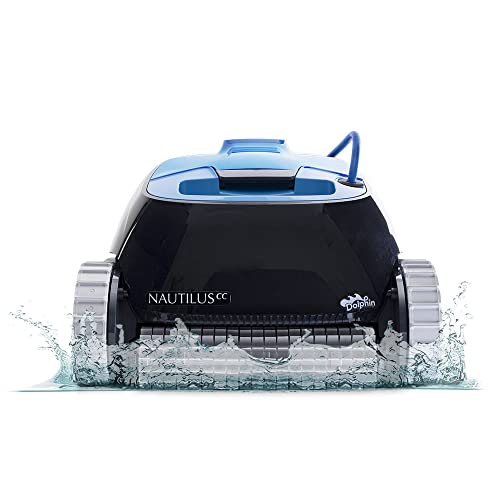
The Nautilus CC takes the same Dolphin robotic formula and trims it for smaller pools: wall-climbing scrubbing in a lighter body, with top-load filter access so you lift a basket out from above instead of flipping the machine over. That top-load detail sounds minor and is not — it is the difference between a thirty-second rinse and a wet wrestling match on the pool deck, and it is the main reason this model suits owners who will run shorter, more frequent cycles. It is the robotic pick for modest in-ground pools and larger above-ground pools where the full-size machine would be oversized.
Strengths
- Top-load filter access makes the empty-and-rinse step fast enough that owners actually do it every cycle.
- Lighter body is easier to lift from the water than full-size robotic cleaners.
- Wall-climbing brush keeps smaller pools’ walls scrubbed without a separate wall routine.
Trade-offs
- Smaller filter capacity fills faster in leaf-heavy yards, so autumn may mean mid-cycle emptying.
- Coverage is aimed at smaller pools; very large in-ground pools will want the bigger machine’s program.
- Like all corded robots, it needs sensible cord handling to avoid tangles over time.
In practice the Nautilus CC rewards owners who clean little and often: two shorter cycles a week keep a small pool visibly ahead of algae, and the quick filter rinse stops the chore from growing. If your pool is compact, your debris load is ordinary dust, pollen, and the odd leaf, and you want robotic independence without robotic bulk, this is the balanced choice. If your pool is at the large end of residential in-ground, step up to the full-size Dolphin instead of asking a compact machine to run marathon cycles.
Best for: smaller in-ground and larger above-ground pools, and owners who value quick filter access / Not suited for: very large pools or yards with heavy leaf fall
Check the current price on Amazon

Zodiac G3 Suction-Side Inground Pool Cleaner — Best Suction-Side
The G3 is the classic answer on the suction side of this category: a diaphragm cleaner with, as its catalog description emphasizes, one moving part, built to clean in-ground floors, walls, and steps using the suction your pump already produces. That single-moving-part design is the whole appeal. There are no wheels to jam, no gears to strip, and the wear item — the diaphragm — is inexpensive and replaceable. The cleaner pulses its way around the pool in a random pattern, and over a normal pump run it covers the floor thoroughly while nibbling at walls and step faces.
Strengths
- One moving part means very little to break, jam, or align; maintenance is mostly diaphragm and hose checks.
- The 36-fin disc keeps a good seal on varied in-ground surfaces and helps it climb and transition.
- Runs whenever the pump runs, so cleaning hours accumulate without a separate schedule or outlet.
Trade-offs
- It sends debris through your pump basket and filter, so your main filtration does the storage work.
- Random-pattern coverage can miss a corner for a day; it evens out over a week, not over one hour.
- Performance depends on pump strength and a clean filter — weak suction makes it sluggish.
The G3 suits owners who already run their pump for generous daily hours, whose debris is mostly fine material rather than acorns and large leaves, and who prefer mechanical simplicity they can service themselves. It is also a sensible choice for pools where an electrical outlet near the water is impractical. Keep the filter clean, balance the hose length to the pool, and the G3 will quietly do floor duty for seasons with little more than a diaphragm swap when its pulse weakens.
Best for: in-ground pools with healthy pumps and mostly fine debris / Not suited for: pools with weak pumps, short pump runs, or heavy large-leaf loads
Check the current price on Amazon

VINGLI Pool Cleaner — Best Budget Suction
The VINGLI is the value entry among suction cleaners: an automatic wall-climbing suction vacuum in the familiar creepy-crawler style, supplied with 33 feet of hoses so most residential in-ground pools can be reached without buying hose sections on day one. It works the same way the classic suction cleaners do — pump suction drives it across the floor and partway up walls, and debris travels to your pump basket and filter. For owners who want to retire the manual vacuum head without funding a robot, this is the honest budget route.
Strengths
- Supplied 33-foot hose set covers typical residential pool dimensions out of the box.
- Wall-climbing suction design gives some wall coverage rather than floor-only cleaning.
- Simple suction mechanism with no electronics, batteries, or power supply to manage.
Trade-offs
- Budget suction cleaners are more sensitive to hose balance and suction tuning than premium diaphragms.
- Debris capacity is your pump basket’s capacity; leaf-heavy pools will clog it quickly.
- Random movement means methodical coverage takes a full pump cycle, not a quick pass.
Set expectations correctly and the VINGLI earns its place: it will not scrub a waterline, it will not think its way around your pool, and it needs you to get the suction in its working range — too little and it stalls, too much and it pins itself to the floor or climbs out and sucks air. Get that balance right, keep the pump basket emptied, and it converts hours of manual vacuuming into a hose you coil up at the end of the week. For a straightforward rectangular in-ground pool on a budget, it is a rational buy; for complex shapes with benches and tanning ledges, save toward a robot.
Best for: budget-conscious in-ground owners with simple pool shapes / Not suited for: pools with heavy leaf loads or complex ledges and benches
Check the current price on Amazon

WYBOT C1 Cordless Robotic Pool Vacuum — Best Cordless
The WYBOT C1 removes the one chore corded robots impose — cord management — by running on an internal battery as a cordless robotic cleaner for in-ground pools, described in its catalog listing as a 4-in-1 robotic cleaner. You charge it on the deck, lower it in, and retrieve it when the cycle ends; there is no power supply to site, no cord to untwist, and no cable floating across the surface for swimmers or the cleaner itself to tangle in. For pools where the outlet is far from the water or the deck layout makes cords a trip hazard, that freedom is the entire point.
Strengths
- Fully cordless operation removes cord tangling, cord storage, and outlet placement from the routine.
- Robotic scrubbing and its own filtration keep debris out of the main filter, like a corded robot.
- Suited to in-ground pools whose owners want robotic cleaning without deck infrastructure.
Trade-offs
- Battery runtime sets a hard ceiling on session length; very large pools may need a second cycle.
- You must remember to charge it — a cordless cleaner with a flat battery cleans nothing.
- Retrieval from the deep end needs the supplied hook-and-pole habit rather than a cord to pull.
The C1 fits a particular owner perfectly: the pool is a normal residential in-ground size, the debris is weekly dust, pollen, and scattered leaves, and the household will genuinely charge the machine after each use. Build the charge into the lift-out routine and it behaves like any good robot. If your pool is oversized or your yard drops debris like a woodland, the runtime ceiling will frustrate you and a corded Dolphin is the safer spend.
Best for: in-ground pools where cords are impractical and owners will charge between cycles / Not suited for: very large pools or forgetful charging routines
Check the current price on Amazon

AIPER Seagull Pro Cordless Robotic Pool Cleaner — Best Cordless for Long Sessions
The Seagull Pro is the heavy-duty cordless option: a quad-motor robotic cleaner with WavePath navigation, wall-climbing ability, and a stated runtime of 150 minutes aimed at larger in-ground pools. The quad-motor layout is about traction and suction headroom — climbing walls and holding a line across a big floor takes more drive than a compact above-ground unit needs — and the navigation system is meant to turn that runtime into methodical coverage rather than random laps. If you like the cordless idea but your pool is at the bigger end of residential, this is the cordless machine specced for you.
Strengths
- Stated 150-minute runtime gives cordless cleaning a realistic shot at large in-ground floors in one session.
- Quad-motor drive supports genuine wall climbing and stronger debris pickup.
- WavePath navigation targets systematic coverage instead of purely random movement.
Trade-offs
- A bigger, more powerful machine is a heavier lift from the water than compact cordless models.
- Long runtime still ends; pools beyond its stated coverage will need split sessions.
- Like every cordless unit, its usefulness depends on a disciplined charging habit.
Choose the Seagull Pro when the pool is large, the walls genuinely need scrubbing rather than a token climb, and the household wants one long weekly session instead of several short ones. Pair it with a midweek skim and a filter rinse and it can carry the main cleaning load for a big pool without any cord on the deck. Owners of small pools will not use its headroom and should save the difference toward the WYBOT or a compact Dolphin.
Best for: larger in-ground pools wanting long cordless sessions and wall climbing / Not suited for: small pools, or owners who will not keep a charging routine
Check the current price on Amazon
Comparison Table
| Pick | Badge | Key spec | Best for |
|---|---|---|---|
| Dolphin Automatic Robotic Pool Vacuum | Best Overall | Robotic, wall-climbing scrubber, smart navigation, in-ground up to 40 ft | Independent scheduled cleaning |
| Dolphin Nautilus CC | Best Compact Robotic | Robotic, wall-climbing, top-load filter access | Smaller in-ground and larger above-ground pools |
| Zodiac G3 | Best Suction-Side | Diaphragm suction, one moving part, 36-fin disc, floors/walls/steps | Simple, owner-serviceable suction cleaning |
| VINGLI Pool Cleaner | Best Budget Suction | Suction wall-climber supplied with 33 ft of hoses | Budget in-ground floor cleaning |
| WYBOT C1 | Best Cordless | Cordless robotic, 4-in-1 cleaning, in-ground pools | Cord-free robotic cleaning |
| AIPER Seagull Pro | Best Cordless for Long Sessions | Quad-motor, WavePath navigation, stated 150-minute runtime | Larger in-ground pools |
How to Choose Between Automatic Robotic and Suction Pool Cleaners
Start with the honest question of where the cleaning power comes from. A robotic cleaner’s power is its own: a low-voltage motor, an onboard pump, and a filter that lives inside the machine. That independence is why robots scrub — the brush is driven, not dragged — and why they collect debris without burdening your main filter. A suction cleaner’s power is borrowed from your pump, which makes it cheap to buy and simple to maintain, but its cleaning quality rises and falls with your plumbing: pump size, filter cleanliness, valve settings, and hose condition all show up in how well it moves.
Next, match the cleaner to your debris. Fine dust, sand, pollen, and algae film are suction-cleaner home turf; a diaphragm cleaner running daily pump hours keeps floors ahead of silt indefinitely. Mixed debris with leaves and twigs favors a robot with a real filter basket. Heavy leaf fall — a pool under mature trees in autumn — overwhelms both families’ patience, but a robot’s basket is easier to empty mid-cycle than a pump basket, and neither replaces a leaf net during the worst weeks. Be honest about your yard: the cleaner that is perfect for a desert pool with wind-blown grit is wrong for a wooded lot.
Pool shape matters more than pool size. Rectangles flatter every cleaner. Freeform curves, benches, tanning ledges, swim-outs, and attached spas punish random-pattern suction cleaners, which stall on ledges and circle the deep end, and they still challenge robots, which cannot scrub a bench top the way they scrub a wall. If your pool has lots of furniture-shaped plaster, budget for a robot with navigation and accept a weekly hand-brush of the furniture, or keep expectations modest for any automatic option.
Finally, count the true weekly minutes. A robot asks for: drop in, retrieve, rinse filter, coil cord or charge battery — perhaps ten minutes of handling for hours of cleaning. A suction cleaner asks for: connect hose, check suction, empty pump basket more often, and store a long hose — less lifting, more plumbing attention. Owners who hate lifting choose suction; owners who hate fiddling with valves choose robots; owners who hate cords choose cordless robots and accept the charging discipline. There is no family without a chore — only the chore you mind least.
Understanding Filtration, Navigation, and Wall Climbing
Filtration decides how often you handle debris. Robots carry baskets or cartridges sized for a session or two; rinse them and the debris never touches your main filter, which stretches backwash intervals and keeps filter pressure honest. Suction cleaners use your pump basket as the first trap and your filter as the second, so a suction cleaner quietly converts floor dirt into filter maintenance. If your filter is undersized or your backwash routine is already a chore, that hidden cost matters more than the purchase gap.
Navigation decides how coverage happens. Programmed robots map or gyroscopically steer through a pool in overlapping paths, which is why a two-hour robot cycle can finish a pool that a random suction cleaner needs a full pump day to cover. Random-pattern cleaners are not broken — over a week of pump runs their coverage evens out — but they will leave a visibly untouched corner on any given afternoon, and owners who judge a cleaner by one session judge suction cleaners unfairly. Judge each family on its own clock.
Wall climbing deserves skepticism in both directions. A driven robot with a scrubbing brush genuinely cleans walls and the waterline band where sunscreen and algae film collect. A suction cleaner’s “wall climbing” usually means it pulses partway up and scrubs lightly as it slides; it helps, but it is not a waterline program. If your walls grow visible film, that difference alone can settle the robotic-versus-suction question.
How to Set Up and Run Your Pool Cleaner Each Week
For a robotic cleaner: first, check the filter basket or cartridge is clean before the cycle, not after — a clogged basket halves cleaning power. Uncoil the full cord on the deck in loose loops so it can pay out without twists, lower the machine slowly so air escapes, and let it sink to the floor before starting the program. Keep people out during the cycle, and when it finishes, lift by the handle — never by the cord — let it drain over the pool, rinse the filter with a garden hose, and store the unit shaded. For a cordless robot, add two habits: charge it the same day you run it, and use the retrieval hook on your pole rather than fishing by hand in the deep end.
For a suction cleaner: start with a clean filter and an emptied pump basket, because suction is the cleaner’s engine. Assemble hose sections to reach the farthest point of the pool plus one extra section, push the hose down to purge air section by section, and connect to the skimmer with the vacuum plate or to the dedicated suction line with the regulator valve in place. Watch the cleaner for the first minutes: it should pulse steadily and move; if it sits still, suction is low or the diaphragm is fouled; if it climbs and gulps air at the surface, suction is high or the hose is short. Adjust at the valve, not by hoping it settles. At week’s end, coil the hose in large straight loops out of the sun — hose memory from tight coils is the hidden cause of cleaners that circle one spot.
Whichever family you choose, keep a simple weekly rhythm: cleaner session(s) mid-week and weekend, a two-minute skim of surface debris before each session so the machine spends its capacity on the floor, and a monthly check of wear parts — brushes, tracks, diaphragms, hose cuffs. That rhythm, more than any feature list, is what separates pools that stay clear from pools that fight algae all summer.
Running Costs and Maintenance Over a Season
Purchase price is only the first line of the real budget. A suction cleaner’s ongoing costs are mostly invisible because they ride on equipment you already run: extra filter load means somewhat more frequent backwashing or cartridge rinsing, a pump basket that fills faster, and wear parts measured in small money — a diaphragm here, a hose section there, a replacement foot pad when the original wears smooth. Its electricity is your pump’s electricity, which is why owners with long pump schedules find suction cleaning nearly free at the margin, and owners who would have to extend pump hours purely for the cleaner should count those hours honestly.
A robotic cleaner’s costs are more visible and more contained. It draws modest power on its own circuit, asks for filter rinsing with water you were already using on the deck, and its wear parts are brushes, tracks or wheels, and eventually a cord. None of these are annual certainties; they are multi-season items whose life depends heavily on storage habits. A robot stored shaded, with its cord loosely coiled and its filter rinsed, ages slowly. The same robot left in the pool or baked on a sunny deck consumes its own lifespan. Cordless models add a battery to that ledger: batteries are consumables on a multi-year horizon, and owners should treat the stated runtime as the new-battery figure and expect gradual decline, exactly as with any rechargeable appliance.
Maintenance skill is the other hidden cost. Suction cleaners reward owners who are comfortable with valves, baskets, and hose logic; the entire diagnostic tree is mechanical and visible. Robots reward owners who will keep a simple routine and call support when electronics misbehave, because there is little user-serviceable depth beyond filters, brushes, and impeller checks. Neither is better — but buying against your own temperament is how good cleaners end up abandoned in garages while the manual vacuum comes back out.
Troubleshooting: Stalls, Circles, and Missed Spots
When a suction cleaner stalls, work the chain in order: filter pressure first, because a dirty filter starves suction before anything else fails; pump basket second; then hose sections for splits or a cuff sucking air; then the diaphragm for a tear or a pebble lodged in its throat. When it circles one area, suspect hose memory — lay the hose straight in the sun for an afternoon — or a hose that is one section too long for the pool. When it climbs and gulps air, suction is too strong or the hose is too short; adjust the regulator or add a section rather than weighting the cleaner down with improvised fixes.
When a robot misses areas, check the filter first, because a clogged basket changes buoyancy and traction, then the cord: a twisted cord literally steers the machine. Straighten it fully on the deck, let it rest, and start the next cycle from a different entry point. When a robot stops climbing, inspect brushes and tracks for wear and check that the water chemistry is not leaving the walls slimy beyond any cleaner’s grip — algae-slick walls defeat traction, and the honest fix is a brush and a chemistry correction, after which the robot maintains what you restored. When a cordless robot’s sessions shorten noticeably, run it fully down and recharge it completely a few times; if runtime does not recover, the battery is aging and replacement, not technique, is the answer.
One troubleshooting rule covers both families: change one variable at a time and watch a full session. Owners who adjust valves, hose length, and chemistry in the same afternoon learn nothing except that something worked. Pool cleaners are simple systems; patient, single-step diagnosis finds the fault almost every time, and most “broken cleaner” stories end at a dirty filter or a pebble in a diaphragm.
Suction Cleaners and Your Plumbing: What Must Match
If you lean toward the suction family, three plumbing facts decide success before the cleaner ever gets wet. The first is flow: diaphragm cleaners need a minimum suction level to pulse and travel, and that level depends on pump size, filter condition, and how many other suction lines — main drain, second skimmer — are sharing the pump’s attention. Closing or throttling competing suction lines during cleaning hours is normal practice, not a workaround. The second fact is the connection point: a skimmer connection with a vacuum plate is the common route, while a dedicated suction port gives cleaner flow and frees the skimmer to keep skimming; know which your pool has before you buy hose and fittings. The third is hose arithmetic: too few sections and the cleaner never reaches the shallow end; too many and it coils, kinks, and patrols a small territory. The rule of thumb — longest reach plus one section — exists because both errors are common.
Robotic buyers have a shorter checklist, but it is not empty. You need a ground-fault-protected outlet within the cord’s planned reach of the pool, a deck spot where the power supply can sit shaded and dry, and storage that keeps the cord untwisted. Cordless buyers trade all of that for one discipline: a charging spot you will actually use, because a robot stored far from its charger quietly becomes a robot that is never charged. None of these requirements is expensive; all of them are cheaper to check before ordering than after.
Common Buying Mistakes
The first mistake is buying a cleaner for the pool you wish you had: a compact robot for a 40-foot pool, or a suction cleaner for a pump that barely turns the water over. Match stated coverage and pump requirements to your real dimensions and equipment. The second mistake is ignoring debris type — no suction cleaner will happily eat acorns, and no robot basket enjoys a month of neglected leaves. The third is judging random-pattern cleaners by a single hour and returning a machine that would have covered the pool over its normal pump schedule. The fourth is leaving robots submerged all week, which ages cords and seals; these are session appliances, not residents. The fifth is forgetting the supporting costs and chores: replacement diaphragms, hoses, filters, and the electricity or pump hours each family quietly consumes. None of these are reasons to avoid a family — they are reasons to choose with your eyes open.
Which Cleaner for Which Pool: A Decision Walk-Through
Consider four common pools. The first is a 32-foot rectangular in-ground pool in a suburb with two shade trees: debris is moderate, the pump is modern, and the owners swim daily in season. A corded robot like the full-size Dolphin fits best, because wall scrubbing matters when swimmers are in the water every day, and the moderate leaf load will not outrun its basket between weekend cleanings. The second pool is a small kidney-shaped in-ground in a hot climate with mostly wind-blown dust: here the Zodiac G3 quietly wins, because the debris is exactly what suction handles, the pump already runs long hours against the heat, and the owners value a cleaner with almost nothing to break.
The third pool is a large freeform in-ground under mature oaks. Honesty matters here: no cleaner in this guide will make autumn effortless. The Seagull Pro’s long runtime and climbing drive give it the best chance among cordless options, but the owners should still plan on a leaf net for the worst weeks and on emptying baskets mid-cycle; a cleaner is a maintainer, not a substitute for removing a canopy’s worth of leaves. The fourth pool is a modest above-ground setup taken down or winterized each year: the Nautilus CC class of compact robot, or even diligent manual vacuuming, makes more sense than a premium machine, and overspending here buys capacity the pool cannot use.
Notice what decided each case: debris type first, pool shape second, pump and power logistics third, and only then features. Buyers who reverse that order — features first — end up with impressive machines fighting the wrong problem. Work through your own pool in that order and the shortlist usually narrows to one or two obvious candidates, which is exactly what a good buying decision should feel like.
A Note on Safety and Pool Chemistry
Two closing practicalities apply to every pick in this guide. Electrically, robotic cleaners run on low-voltage power supplies that belong on the deck, dry and shaded, plugged into a ground-fault-protected outlet — never run a cleaner while people are in the water, and never swim with a cord crossing the pool. Chemically, a cleaner is not a substitute for balanced water: no robot or suction head corrects a chlorine or pH problem, and algae-slick surfaces defeat brushes and traction alike. Keep the chemistry right and the cleaner maintains a clean pool; let the chemistry drift and you are asking a floor appliance to do a sanitizer’s job, which ends with a green pool and an unfairly blamed machine.
Final Recommendation
For most in-ground owners, the Dolphin Automatic Robotic Pool Vacuum is the cleanest answer: independent, scrubbing, and sized for real residential pools. Smaller pools get the same idea in friendlier form from the Dolphin Nautilus CC. If your pump is strong, your debris is fine, and you value a machine you can service with one inexpensive wear part, the Zodiac G3 remains the suction benchmark, and the VINGLI covers the same ground on a tighter budget. Cordless shoppers should choose between the WYBOT C1 for ordinary pools and the AIPER Seagull Pro when size and runtime demands grow. Whichever you pick, run it on a rhythm and maintain its wear parts, and the best pool vacuums automatic or suction cleaners stop being gadgets and become the reason your pool is simply always ready. For related cleaning jobs around the water, see our guides to Best Pool Vacuums For Vinyl Liner, Best Vacuum For Hot Tubs, and Best Outdoor Vacuums.
Frequently Asked Questions
Is a robotic or a suction pool cleaner better?
Robotic cleaners scrub better, filter independently, and cover pools on a programmed schedule, but cost more and need lifting and cord or battery care. Suction cleaners cost less, have almost nothing to break, and run whenever the pump runs, but they depend on pump strength and send debris to your filter. The better choice is the one matched to your pool, pump, and debris.
Can a suction cleaner work with a variable-speed pump?
Yes, provided the pump speed during cleaning hours produces enough flow for the cleaner to pulse and move. Many owners schedule a higher-speed window for cleaning and run lower speeds the rest of the day. If the cleaner stalls at your economy speed, the fix is scheduling, not a different cleaner.
How often should I run an automatic pool cleaner?
Most pools stay ahead of debris with two to three robotic cycles a week in swim season, or daily pump-run hours for a suction cleaner. Leaf-heavy periods call for more frequent, shorter sessions and more frequent basket emptying rather than one heroic weekly clean.
Do pool robots really clean the waterline?
Wall-climbing robots with driven brushes clean walls and much of the waterline band, which is a genuine advantage over suction cleaners. Steps, benches, and tight corners still benefit from a quick manual brush, because no cleaner geometry reaches every surface.
Can I leave my robotic cleaner in the pool all the time?
Manufacturers generally advise against it. Constant immersion in chlorinated water ages cords, seals, and plastics, and a resident robot is in the way of swimmers. Run the cycle, retrieve the machine, rinse its filter, and store it shaded.
What size cleaner do I need for an above-ground pool?
Choose a model whose stated coverage includes above-ground pools and whose climbing claims match your walls — many above-ground pools only need floor cleaning. A compact robotic like the Nautilus CC class suits larger above-ground pools; very small pools may be better served by a simple handheld or a basic suction unit matched to the pool’s pump.


